Comprehensive Hazards and Climate Change: Earthquakes, Volcanoes, Tsunamis, and Mitigation
 Call Kai
 Learn
Learn Practice Test
 Spaced Repetition
 Match
Match Flashcards
 Knowt Play
1/311

There's no tags or description
Looks like no tags are added yet.
Name | Mastery | Learn | Test | Matching | Spaced | Call with Kai |
|---|
No analytics yet
Send a link to your students to track their progress
312 Terms
Earthquakes
Result from the rupture of rocks along a fault, energy released in form of seismic waves; epicenter is on surface, focus is directly below it
Richter Scale
Developed in 1935, measure of strength of wave 100km from epicenter
Moment Magnitude Scale
Determined by area ruptured/amount of movement along fault, elasticity of crust at the focus
Strike-Slip Fault
Displacements are horizontal (San Andreas Fault)
Dip-Slip Faults
Displacements are vertical
Normal Fault
Hanging wall moved down relative to footwall
Reverse Fault
Hanging wall moved up relative to footwall inclined steeper than 45 degrees
Thrust Fault
Similar to reverse faults but angle is less than 45 degrees; strongest earthquakes
Tectonic Creep
Slow movement of rock/sediment along fracture caused by stress
P Waves
Primary/compressional waves, move fast w/ push-pull motion through solids/liquids
S Waves
Secondary/shear waves, move slowly in up down motion through solids
Surface Waves
Seismic waves forming when P & S waves reach Earth's surface; slower than body waves, responsible for damage near epicenter
Earthquake Shaking
Factors include magnitude, distance away, focal depth, direction of rupture; decreases with distance away from epicenter
Attenuation
Reduction of energy due to focal depth; seismic waves become less intense
Amplification
Increase in ground motion during an earthquake; P&S waves slow as they travel through alluvial sand/gravel etc.
Earthquake Cycle
Hypothesis explaining successive earthquakes on a fault; idea that strain drops abruptly after an earthquake and slowly accumulates until next one.
Stages of Earthquake Cycle
Inactive period, strain produces minor earthquakes, period of foreshocks (not always), mainshock occurs, aftershocks occur.
Intraplate Earthquakes
On fault in the interior, far from a plate boundary; considerable damage due to lack of preparedness, felt over large areas.
Primary Effects of Earthquakes
Ground shaking, surface rupture.
Secondary Effects of Earthquakes
Liquefaction, land-level change, landslides, fire, tsunamis.
Natural Service Functions of Earthquakes
Pathways for downward flow of surface water, new mineral resources, scenic landscapes.
Human Causes of Earthquakes
Weight from water reservoirs produced by dams creating faults, injecting liquid waste deep in the earth causes pressure, nuclear explosions may increase strain.
Precursors to Earthquakes
Pattern/frequency of earthquakes (foreshocks), land-level change over time, seismic gaps along faults, groundwater levels & rocks expanding.
Community Adjustments for Earthquakes
Critical facilities (hospitals) located safely away from faults, buildings must withstand vibrations, education, earthquake insurance.
Volcanoes
Located near plate boundaries, 2/3 found on 'Ring of Fire' in Pacific; subduction zones & mid-ocean ridges allow molten rock to reach surface.
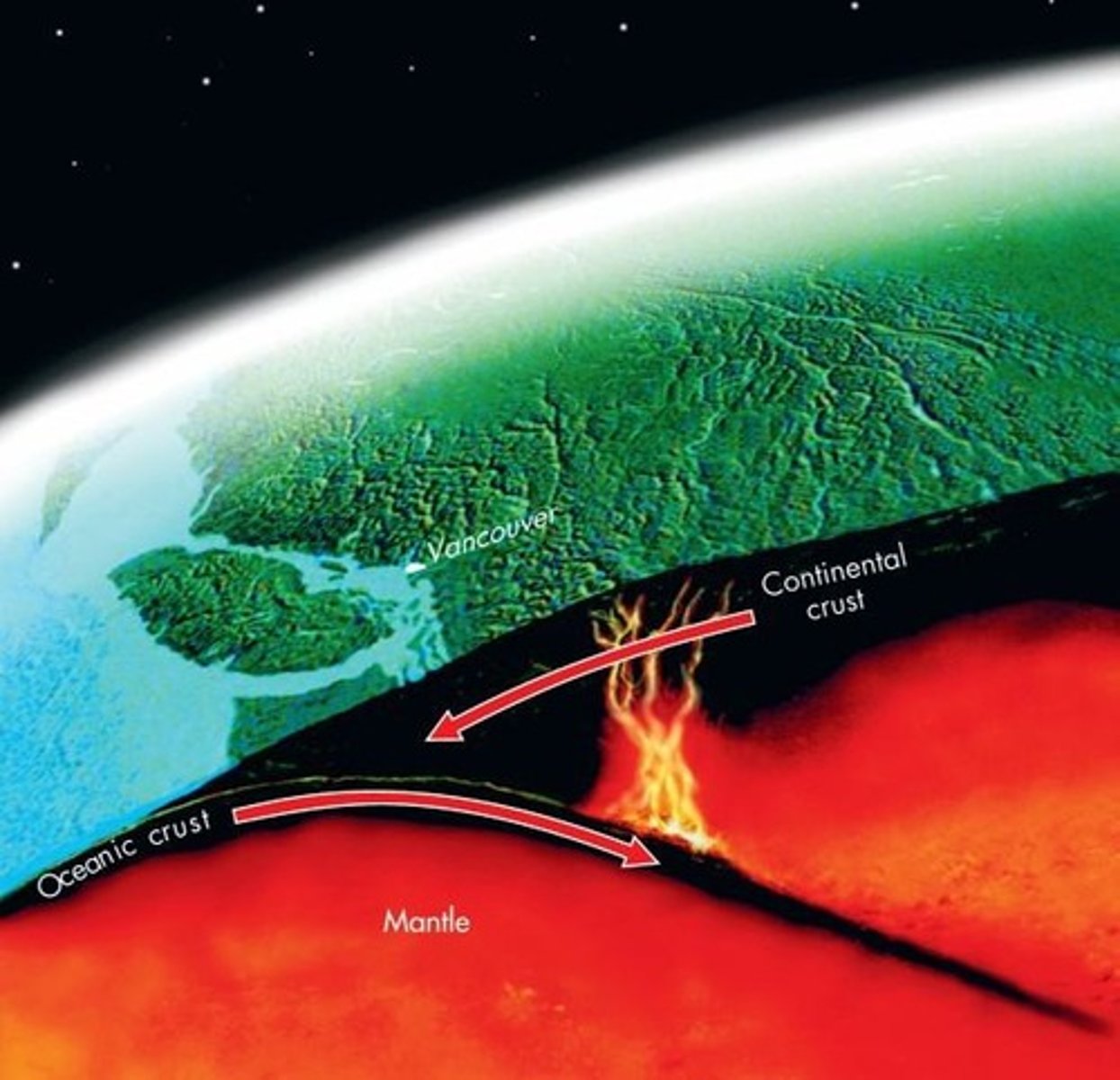
Magma
Formed with silicon and oxygen, combined make silica; volcanic rocks named based on amount of silica (basalt, dacite, rhyolite).
Viscosity
Resistance to flow, volcano shapes based on chemistry and viscosity of magma.
Shield Volcanoes
Largest, shaped as broad arcs built from lava, basaltic magma, non-explosive gentle flows.
Composite Volcanoes
Cone shaped, built from lava and pyroclastic deposits, more dangerous/explosive but less frequent.
Volcanic Domes
Contain highly viscous rhyolite magma, step-sided mounts form around vents.
Cinder Cone Volcanoes
Small, made of tephra, round and contain crater at top.
Maars
Circular volcanic crater produced by explosive eruption and filled with water.
Ice-Contact Volcanoes
Erupt beneath/against glaciers, melt ice producing floods known as Jokulhlaups.
Crater
Depression formed by explosion of volcano at the top; 2km diameter.
Volcanic Vent
Opening on the surface where lava and pyroclastic debris erupt.
Caldera
Circular depression formed during collapse of volcano; can be 25km diameter.
Super Eruptions
Products of rare supervolcanoes, large volume of magma rises to shallow depths in continental crust.
Pahoehoe Lava
Low viscosity (few km per hour), high temp, when hardened it's smooth.
Aa Lava
High viscosity (few m per day), lower temp, when hardened texture is blocky.
Pyroclastic Flows
Avalanches of ash/gas/rock fragments that travel down slopes of volcano, speeds reach 150km/h.
Lahar
Large amounts of material saturated with water moving downslope (mudflows).
Radon
From natural decay of uranium in rock and soil; when inhaled it lodges in lungs damaging tissues.
Nuclear Meltdown
Results in damage when heat generated by reactor exceeds heat removed by cooling systems.
Groundwater
Found within cracks/spaces in soil, sand & rock; materials are permeable allowing water to flow through.
Formation of Solar System
Cloud of gas and dust in space was disturbed by a supernova 4.6b years ago.
K-T Boundary Mass Extinction
Occurred 65m years ago from abrupt cooling caused by asteroid impact; caused extinction of dinosaurs.
Avalanche
Mass of snow many m3 in volume separating from a snowpack flowing downslope.
Point-Release Avalanches
Begin as initial failure after heavy snowfall; sliding snow causes more failures in adjacent snowpack.
Slab Avalanches
Snowpack fractures along weak layer parallel to surface; moves as cohesive block, most dangerous.
Run-out Zone
Area of deceleration and snow deposition
Terrain Factors
Slope is most important; most occur between 25-60° (30-45° most dangerous)
Minimizing Risk
Buildings/roads located outside danger areas; buildings in danger areas require special engineering (reinforced walls/deflection structures)
Compression Test
Vertical force placed on top of snowpack to detect weak layers
Shovel Test
Assesses strength by isolating a column of snow & applying force on the uphill side
Rutschblock Test
Skier pushes & jumps on column of snow to detect cohesion of snowpack
Avalanche Cord
10m rope dragging behind person while skiing/snowboarding
Avalanche Transceiver
Portable device emits radio signal to assist in finding location of victim
Avalanche Dogs
Detect human scent rising through the snow & can cover large areas
Adaptation to Wildfires
Oak&Redwood bark resists fire damage; some pine seeds only open after fire
Elements of Wildfires
Requires fuel, oxygen & heat; plants that burn release CO2
Pre-Ignition
Vegetation reaches temperature at which it can ignite, while losing water
Combustion
Begins with ignition, occurs repeatedly as fire moves; not all ignitions result in fire
Flaming combustion
Rapid, high temp conversion of fuel into heat (flames)
Conduction
Transfer of heat by molecule to molecule contact
Radiation
Transfer of heat in form of invisible waves
Convection
Transfer of heat by movement of liquid or gas
Fuel
Includes leaves, wood debris, decaying material, etc. density of forest plays a role
Weather
Wildfires common after droughts, wind helps preheat materials & carry embers that ignite spot fires ahead of fire front
Surface Fires
Travel close to ground burning shrubs, leaves, etc. vary in intensity & very slow
Crown Fires
Move rapidly through forest canopy by flaming combustion; can be fed by surface fires, driven by strong winds & common in boreal forests
Effects of Wildfires
Leave behind layer that increases surface runoff and erosion for years; increase of airborne particles
Mountain Pine Beetle
Destroys forests throughout western Canada, consequences felt for decades; survives through winter in BC
Natural Service Functions
Reduces competition for sunlight/moisture in a forest, remove parasites in the soil, remove surface litter (leaves) allowing more moisture into soil
Fire Management
Control wildfires to benefit ecosystem but prevent harm to people/property; fire season is April-October, must research fire regime (potential of fire)
Fire Suppression
Steer fire toward area with no fuel (fire break) such as river, lake, road
Prescribed Burns
Controlled fires purposely ignited to reduce amount of fuel
Hazard
A process that poses a potential threat to people or the environment.
Risk
The probability of an event occurring multiplied by the impact on people or the environment.
Disaster
A brief event that causes great property damage or loss of life.
Catastrophe
A massive disaster.
Magnitude-Frequency Concept
There is an inverse relationship between magnitude and frequency.
Tsunami
Thailand, December 2004.
Hurricane (Katrina)
New Orleans, August 2005.
Earthquake
Haiti, January 2010.
Oil Spill
Gulf of Mexico, April 2010.
Tectonic Cycle
This cycle involves the creation, movement, and destruction of tectonic plates.
Rock Cycle
Refers to a group of interrelated processes that produce the three different rock types: igneous, sedimentary, metamorphic.
Hydrologic Cycle
The movement and exchange of water among the land, atmosphere, and oceans by changes in state.
Hot Spots
Areas found away from plate boundaries where magma rises up from the mantle.
Divergent Plate Boundaries
At these boundaries, plates move away from each other, creating new land.
Convergent Plate Boundaries
At these boundaries, plates move toward each other, resulting in subduction zones.
Transform Boundaries
At these boundaries, plates slide horizontally past each other.
Acceptable Risk
The amount of risk that an individual or society is willing to take.
Population Growth
Human population reached 7 billion in late 2011.
Human Footprint
The risks associated with hazards change as human development expands.
Infrastructure Failure
A hazard that poses a risk to both humans and the environment.
Ozone Depletion
A hazard that poses a risk to both humans and the environment.
Acid Rain
A hazard that poses a risk to both humans and the environment.
Nuclear Meltdowns
A hazard that poses a risk to both humans and the environment.
Toxic Gas Release
A hazard that poses a risk to both humans and the environment.