BIOL2021: Chapter 18 - Cell Death
 Call Kai
 Learn
Learn Practice Test
 Spaced Repetition
 Match
Match Flashcards
 Knowt Play
1/35

There's no tags or description
Looks like no tags are added yet.
Name | Mastery | Learn | Test | Matching | Spaced | Call with Kai |
|---|
No analytics yet
Send a link to your students to track their progress
36 Terms
What is Necrosis a response to?
Cell damage
What are the 2 types of cell death?
Apoptosis; Programed cell death
a)necrosis; unregulated cell death
b)necropoptosis; Programmed cell death(more complicated)
What is apoptosis important for?
Creation and maintenance of limbs and organs
Quality control in immunity
To eliminate damaged/abnormal cells in adults (irreparable damage, infection, cancer)
What are the biochemical markers of apoptosis?
DNA cleavage
PtdSer exposed on cell surface (“eat me” signal)
Inactivation of “don’t eat me” signals
Loss of mitochondrial membrane potential; release of cytochrome C and other proteins into cytoplasm
What is apoptosis triggered by?
Intracellular proteases called caspases
What 2 characteristic amino acid residues do caspases have
Cysteine; In the active site
Aspartate; Cleaves proteins
What are the 2 major classes of caspases?
Initiator Caspases; Begin apoptosis by activating
Executioner Caspases; Act on target molecules (>1000)
Both exist initially as inactive Procaspases
What is a procaspase?
Inactive form of caspase
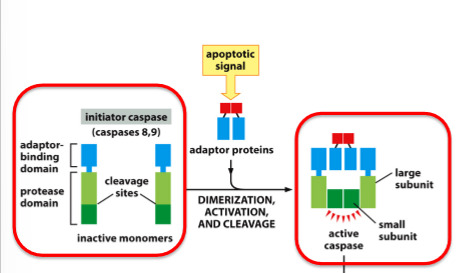
What do Initiator caspases do in the Intracellular Proteolytic Cascade?
Start off as inactive soluble monomers in the cytosol
An apoptic signal triggers assembly of adaptors which complex with initiator caspases
Caspase dimers form, cleave, and activate protease activity
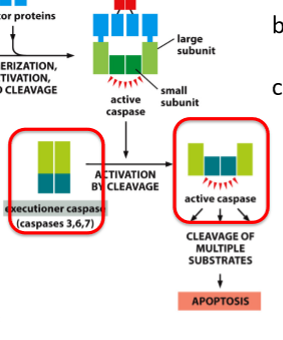
What do executioner caspases do in the Intracellular Proteolytic Cascade?
Start off as inactive dimers
Gets cleaved by initiator caspase
Activated by conformational rearrangement
True/False; one molecule of active initiator caspase can only act on one molecule of executioner caspases.
False; One initiator caspase can act on multiple executioner caspases
What 2 pathways can apoptosis be activated by?
Extrinsic pathway; Outside signals
Intrinsic/mitochondrial pathway; Injury, stress, DNA damage, loss of survival signals
How is the extrinsic pathway activated?
By signal proteins binding to the cell surface death receptors
What are TNFs and TNF receptors?
TNF: Tumor necrosis factor (ex FAS)
TNF receptors; Death receptors
What are the 3 main components of death receptors?
Single transmembrane domains; form homotrimers
Extracellular ligand binding domain
Intracellular death domain
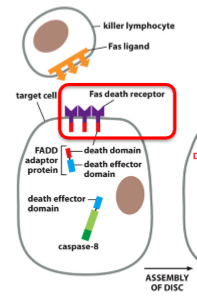
What family are TNF receptors and Fas receptors apart of?
Tumor necrosis factor (TNF) receptor family
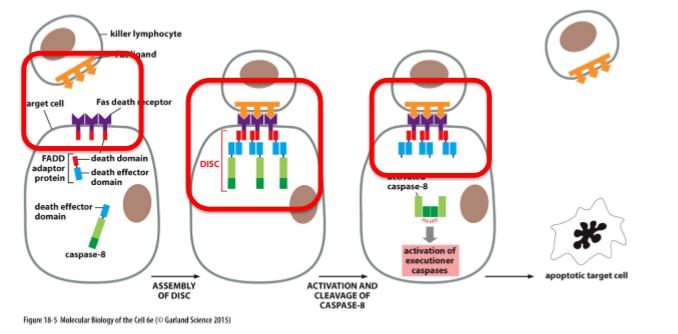
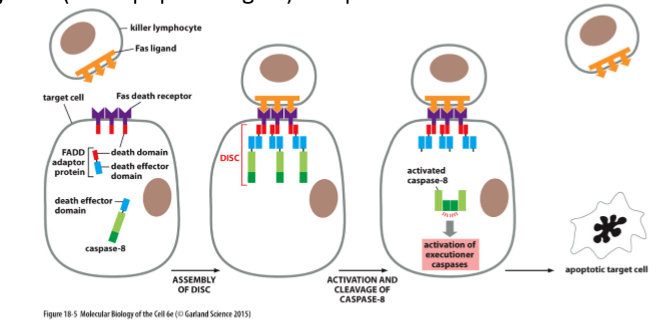
How does The Fas death receptor extrinsic pathway apoptosis activation work?
Fas ligan on cytotoxic killer lymphocytes binds to Fas death receptor on target cell, activating Fas death receptors
Activated Fas death receptors lead to activation of intracellular death domains
Fas death receptor death domain binds to death domain on adaptor protein, FADD (Fas-associated death domain)
FADD death effector domain binds to the death effector domain on initiator caspase (primarily caspase-8)
FADD-caspase complex is called the death-inducing signaling complex (DISC)
Adjacent initiator caspases in the DISC interact and form an activated dimer that cleaves itself from death effector domain
Activated initiator caspase dimer cleaves executioner caspases by proteolytic cleavage
What is the key protein for the intrinsic apoptosis pathway?
Cytochrome c
Which organelle does the Intrinsic pathway primarily involve?
Mitochondria
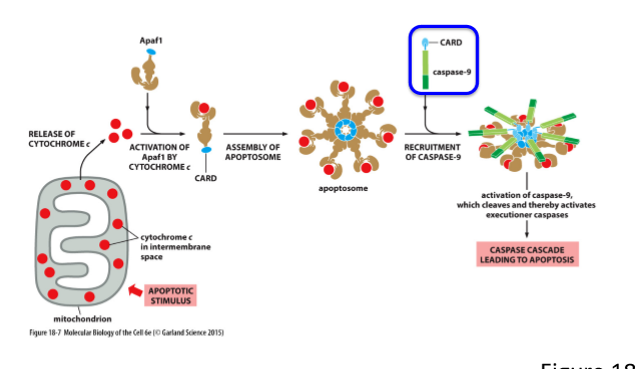
How does the apoptosis Intrinsic/Mitochondrial pathway work?
Cytochrome c is released into the cytosol binds to the adaptor protein, Apaf1 (apoptotic protease activating factor 1)
Apaf1 oligomerizes into a wheel-like heptamer - apoptosome
Apaf1 has a caspase recruitment domain (CARD) cluster in a central hub of the apoptosome
Apad1 CARD bind to similar CARD of caspase-9
Apaf1 CARD binding to CARD of caspase-9 activates caspase
Activated caspase-9 activates downstream executioner caspases
What does Bcl2 (B-cell lymphoma 2) do?
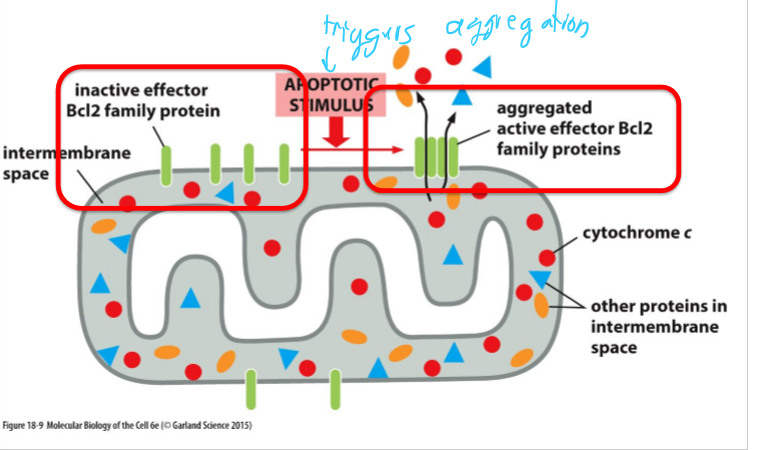
Controls the release of cytochrome c and other mitochondrial proteins into the cytosol
What are the 3 main types of Bcl2 proteins?
Anti-apoptotic Bcl2 family protein
Pro-apoptotic effector Bcl2 family protein
Pro-apoptotic BH3-only protein
Where are Pro-apoptotic Bcl2 proteins found?
In the outer mitochondrial membrane
What triggers oligomerization and activation of pro-apoptotic Bcl2 proteins?
Apoptotic stimulus
What do anti-apoptotic Bcl2s do?
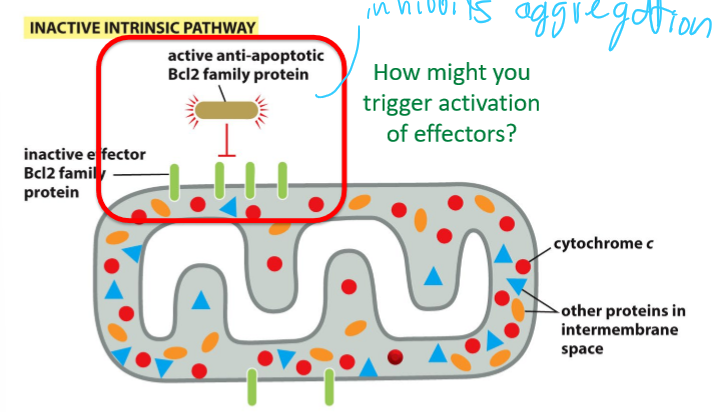
Bind Pro-apoptotic effector proteins and inhibit aggregation
What do BH3 only proteins do?
Inactivate anti-apoptotic proteins
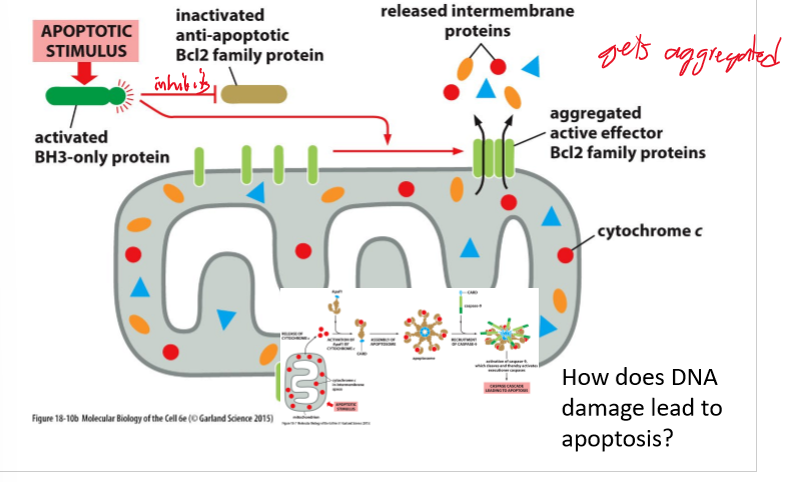
How does DNA damage lead to apoptosis?
DNA damage leads to phosphorylation and activation of p53, which stimulates BH3-only genes
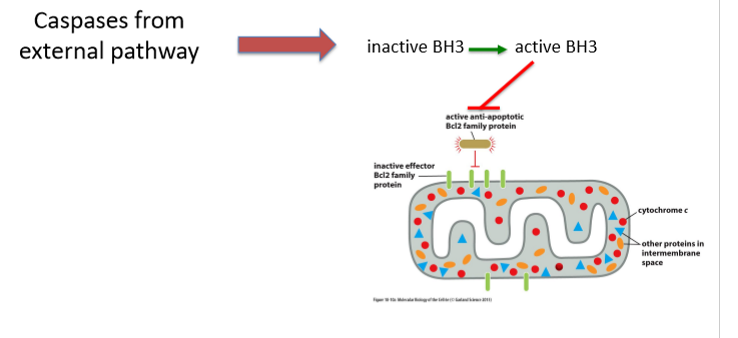
How can the extrinsic apoptosis pathway stimulate the intrinsic apoptosis pathway?
Activation of caspases in the extrinsic pathway cleaves BH3-only proteins to activate them
Activated BH3-only translocases to the outer mitochondrial membrane to inhibit anti-apoptotic Bcl2 family proteins
What extracellular survival factors can inhibit apoptosis
Increased production of anti-apoptotic Bcl2 family proteins
Inactivation of pro-apoptotic BH3-only protein
Inactivation of anti-IAPs (inhibitors of apoptosis)
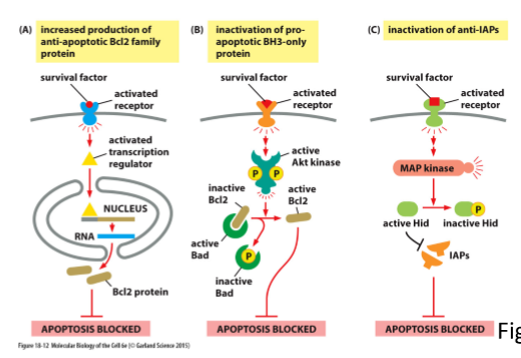
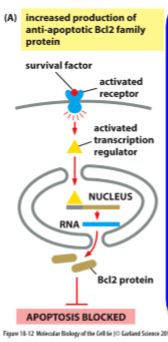
How does increased production of anti-apoptotic Bcl2 family proteins inhibit apoptosis?
Survival factor binds to cell surface receptor, leading ti activation of a transcription regulator to increase synthesis of an anti-apoptotic Bcl2 family protein
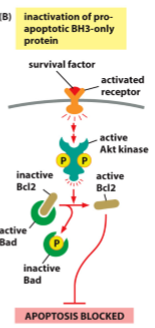
How does inactivation of pro-apoptotic BH3-only protein inhibit apoptosis?
Survival factor binds to cell surface receptor leading to activation of a cell signaling cascade which phosphorylates and inhibits pro-apoptotic BH3-only family protein
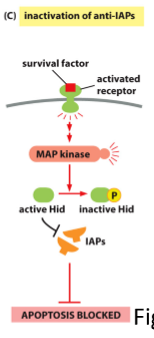
How does inactivation of anti-IAPs inhibit apoptosis?
IAPs (inhibitors of apoptosis) bind to and inhibit activated caspases. Some IAPs can polyubiquitylate caspases for destruction by proteosomes
Anti-IAPs are released from the mitochondria intermembrane space into the cytosol when the intrinsic pathway is activated, blocking IAPs
Survival factors can bind to cell surface receptors and activate cell signaling cascade leading to phosphorylation and inhibition of anti-IAP(ex Hid)
How is the target amount of nerve cells regulated?
By using apoptosis to adjust the number of cells
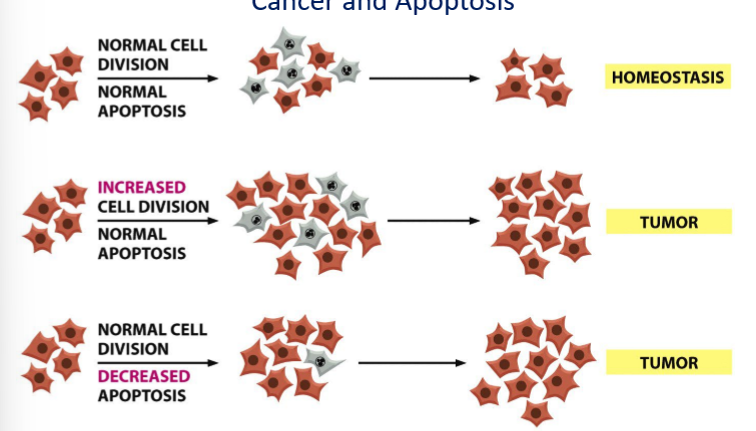
What impact does increased cell division or decreased apoptosis lead to?
Tumor formation
What diseases can result from too much apoptosis?
Heart attacks, strokes
What diseases can result from too little apoptosis?
Lymphocytes, autoimmune disorders