neurobiology exam 6 (final)
 Call Kai
 Learn
Learn Practice Test
 Spaced Repetition
 Match
Match Flashcards
 Knowt Play
1/66

Earn XP
Description and Tags
15 16 17
Name | Mastery | Learn | Test | Matching | Spaced | Call with Kai |
|---|
No analytics yet
Send a link to your students to track their progress
67 Terms
inner ear anatomy: equilibrium
vestibular complex
inner ear anatomy: vestibular complex
3 semicircular canals
vestibule
utricle
saccule
inner ear anatomy: hearing
cochlea
inner ear consists of ____ ____ surrounding a _____ ____
bony labyrinth; membranous labyrinth
between the bony labyrinth and membranous labyrinth is fluid called
Perilymph
Within the membranous labyrinth is fluid called
Endolymph
fluids are very high in what??
K+
If you open K+ channels in cells here (inner ear), where will the K+ go?
potassium goes into the cell (depolarize)
the equilibrium: vestibule provides information about _____ ____ and _____ _______
head tilt; linear acceleration
two chambers of vestibule
utricle
saccule
utricle is what movement
horizontal
saccule is what movement
vertical
Macula
specialized membrane that houses sensory hair cells (mechanoreceptors)
Top of hair cells are embedded in a gelatinous _____ ________ with calcium carbonate stones
Otolithic membrane (otoliths)
oto = ear
lithic = stone
sensory hair cells
Modified epithelial cells with 20-50 extensions called Stereocilia and one Kinocilium
(excite) When stereocilia bend ______ the kinocilium, K+ channels are opened and K+ rushes into cell (extracellular environment is K+ rich).
towards
depolarization of sensory hair cells =
more action potentials
Hair cells release excitatory neurotransmitter, depolarizing sensory dendrites of the ______ ______
vestibulocochlear nerve
(inhibit) Bending ____ from kinocilium hyperpolarizes sensory dendrites (K+ channels close)
away
Helps code for detection of movement direction
______ add weight to help bend stereocilia
Otoliths
Equilibrium: Semicircular Canals
Project along 3 planes to detect rotation
Each canal contains a _____ ______ filled with endolymph
semicircular duct
At the base of each duct is an enlarged area called the _______
Ampulla
Hair cells are embedded in the _____ _____ with stereocilia stuck into a gelatinous ______
Crista ampullaris; Cupula
semicircular canal rotation steps
Rotation causes endolymph to push on cupula bending stereocilia → K+ channels open → depolarization
Branches of the __________ ______ synapse in the vestibular nuclei of medulla oblongata, the cerebellum & the thalamus
vestibulocochlear nerve
The vestibular nuclei send neurons to the _________ _____ of the brain stem to control eye movements & down the spinal cord to adjust body movements for balance
oculomotor area
balance pathway
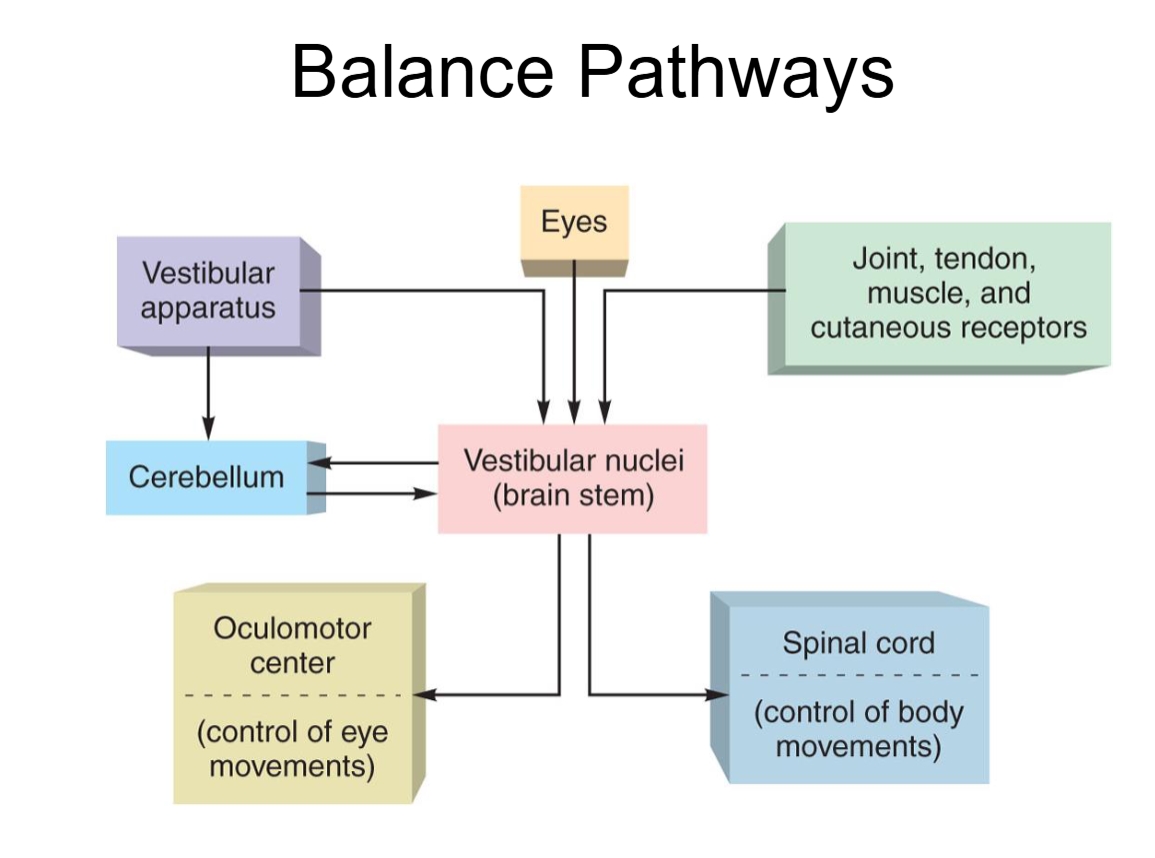
nystagmus
jerky eye movement produced
can also be a symptom of neurological problems
If someone is spinning, eyes move towards the _______ direction of the spin to maintain a fixation point
opposite
vertigo
Nystagmus, anything that alters vestibular function, or a conflict between the eyes & vestibular system can cause a loss of equilibrium
Can be accompanied by dizziness, pallor, sweating, nausea and vomiting
sound waves are characterized by
frequency
intensity
what is frequency
Measured in hertz (Hz). Higher frequencies = higher pitches
Human range is 20-20,000Hz
intensity
loudness.
measured in decibels
3 regions of ear
outer ear
middle ear
inner ear
outer ear sound waves are funneled by the _____ into the external auditory canal which channels them to the _______ _____ (ear drum) which vibrates
Pinna (or Auricle); Tympanic membrane
tympanic cavity
Cavity between the tympanic membrane and inner ear
middle ear contains three bones called
ossicles
middle ear ossicles
malleus
incus
stapes
malleus
transmits and amplifies soundwaves by hitting the incus
incus
transmits and amplifies soundwaves by hitting the stapes
stapes is attached to the _____ ______ which transfers the vibrations into the inner ear
oval window
Very loud sounds makes the _____ and _____ _____ muscles contract dampening movement of the ossicles
Stapedius; Tensor tympani
Stapedius and Tensor tympani
Protects from nerve damage in cochlea
Not quick enough to protect from sudden noise (shot)
inner ear cochlea
hearing part with 3 spiraling chambers
upper chamber is a portion of the bony labyrinth
scala vestibuli
lower chamber is a portion of the bony labyrinth called the
Scala Tympani
both the scala vestibuli and tympani are filled with
perilymph
The middle chamber is a portion of the membranous labyrinth called the
Scala media
Scala media is filled with
endolymph
three parts of the Scala media
Vestibular Membrane: Celling
Tectorial Membrane: Gel core
Basilar Membrane: Floor
sound transmission through the inner ear step 1
Vibrations from the oval window of the middle ear travel through the perilymph of the Scala Vestibuli
sound transmission through the inner ear step 2
Vibrations are passed into the endolymph of the Scala media, shaking the tectorial membrane
sound transmission through the inner ear step 3
Vibrations pass into the perilymph of the Scala tympani
sound transmission through the inner ear step 4
Vibrations leave the inner ear via the Round window
_____ ______ sounds travel further into the spiral of the cochlea
Low frequency
sound intensity
A louder sound will vibrate a larger portion of the tectorial membrane.
organ of corti
area of basilar membrane with hair cells
When sound waves enter the scala media the tectorial membrane vibrates bending the stereocilia on hair cells. This:
Opens mechanically gated K+ channels
K+ rushes in depolarizing the hair cell
Releases glutamate onto sensory neurons
Information about frequency & intensity sent to brain
two types of hair cells
inner and outer
inner hair cells
Form one row that runs the length of the basilar membrane. Each is innervated by 10-20 sensory neurons
outer hair cells
arranged in 3-5 rows. Innervated by motor neurons that make them shorten when depolarized and elongate when hyperpolarized
auditory acuity and sensitivity
• Outer hair cells located closest to where vibrations occur in the scala media are depolarized more often & are shortened, enhancing depolarization of inner hair cells.
• Those farther away are hyperpolarized and elongate, dampening depolarization of more distant inner hair cells.
• This allows us to differentiate between very similar pitches and hear far softer sounds than would otherwise be possible
auditory cortex is said to be
tonotopic
what is tonotopic
specific areas represent different sound frequencies (sound map)
conduction deafness
Sound waves are not conducted from the outer to inner ear.
Problem may be a foreign object, buildup of earwax, too much fluid in the middle ear, damage to the eardrum or overgrowth of bone in middle ear
Impairs hearing of all sound frequencies
Can be helped by hearing aids
sensorineural/perceptive deafness
Nerve impulses are not conducted from the cochlea to the auditory cortex
May be due to damaged hair cells (from loud noises or aging), damage to cochlear nerve, brain tumors
May only impair hearing of some sound frequencies and not others
May be helped by cochlear implants