BIOLOGY LAB PRACTICUM II
 Call Kai
 Learn
Learn Practice Test
 Spaced Repetition
 Match
Match Flashcards
 Knowt Play
1/96

There's no tags or description
Looks like no tags are added yet.
Name | Mastery | Learn | Test | Matching | Spaced | Call with Kai |
|---|
No analytics yet
Send a link to your students to track their progress
97 Terms
Embryology
The branch of biology that focuses on the study of development following fertilization
Fertilization
Union of gametes, the sperm and the egg
Are gametes haploid or diploid?
Haploid
Haploid
Cells that carry half the normal complement of chromosomes
Diploid
Cells with a complete set of genetic information
Mitosis produces first __ cells, then __
2, 4
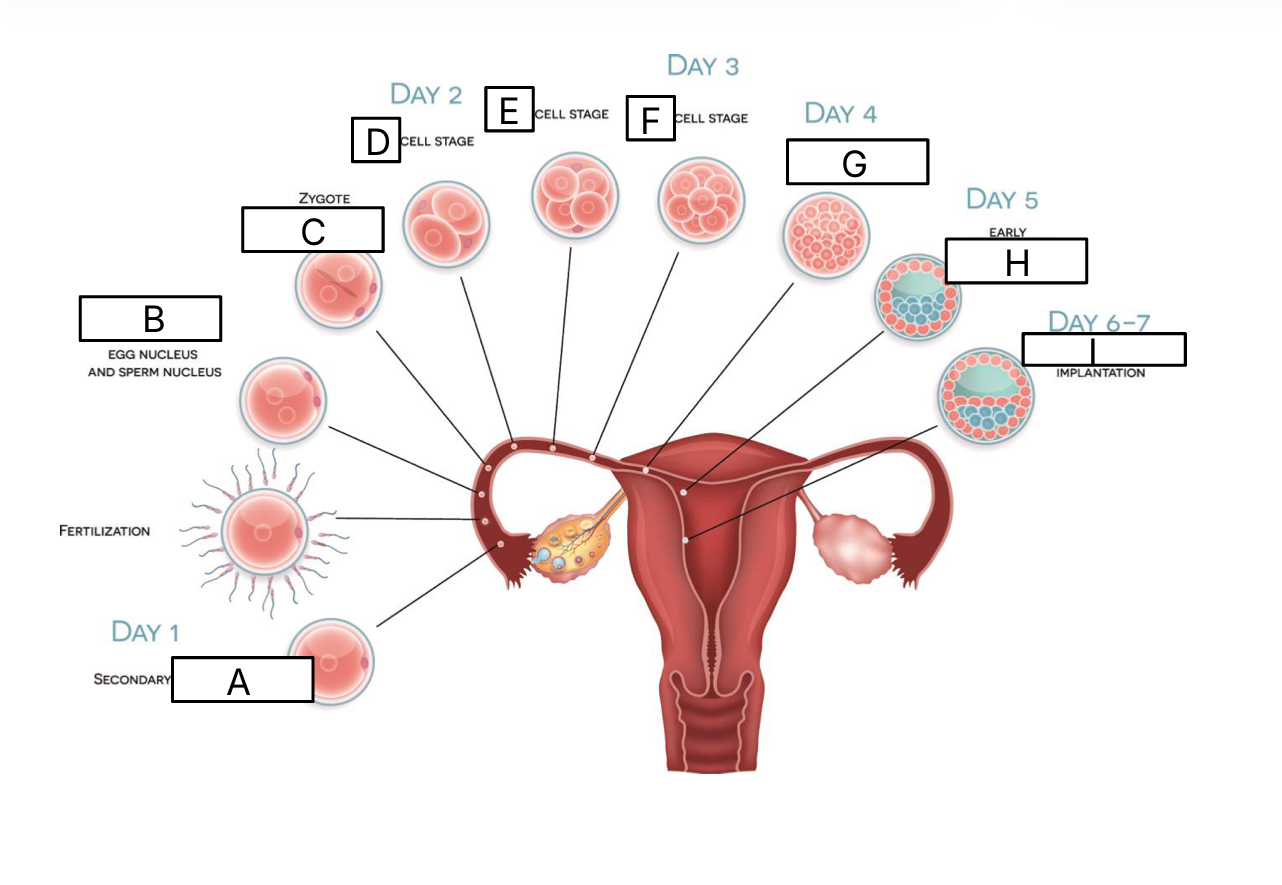
Name A through I.
A. Oocyte, B. zygote C. metaphase, D. two, E. four, F. eight, G. morula. H. blastocyst, I. blastocyst
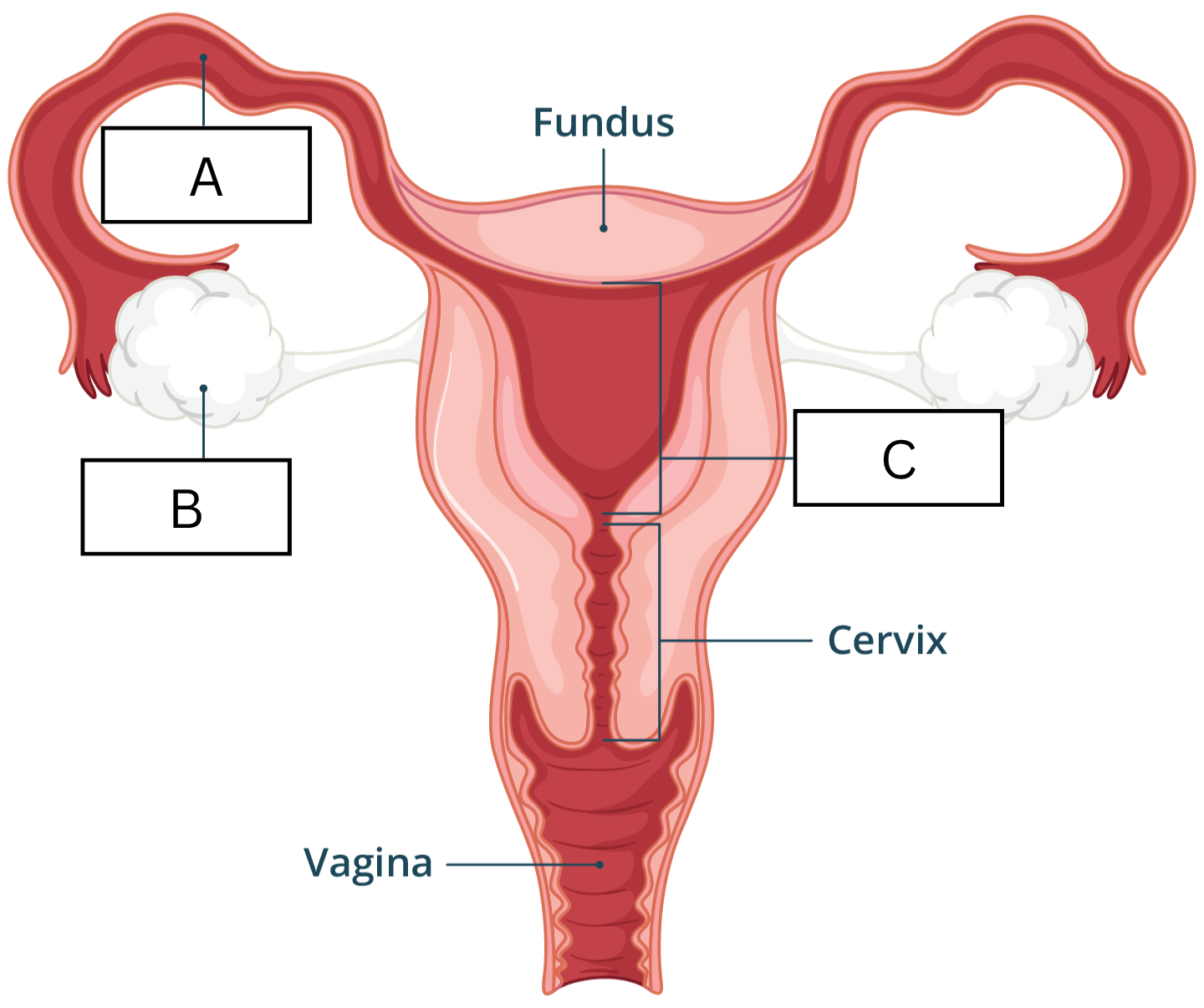
Name A, B, and C.
A. fallopian tube, B. Ovary, C. uterus
How many days does it take for the early embryo to travel from the time it leaves the ovary to the uterus?
5 days
Radial symmetry
Body parts radiate outward from a central point or pivot axis; commonly found in organisms such as jellyfish and starfish.
bilateral symmetry
organisms that could be sliced in half, and each part would be a mirror image of the other.
By the time the embryo reaches the gastrula stage, cells have differentiated and formed 3 germ layers: ___, ___, and ___.
the ectoderm, the mesoderm, and the endoderm
What structures develop from the ectoderm?
skin and nervous system
What structures develop from the mesoderm?
Muscles, bones, blood, heart, kidneys, connective tissues
What structures develop from the endoderm?
Liver, pancreas, lungs, thyroid
What comes after gastrulation and what is the process called?
Neurulation: formation of the neural tube, which becomes the brain and spinal cord.
What happens during neurulation?
During neurulation, the ectoderm forms the neural plate, which folds into the neural groove and then closes to form the neural tube, which develops into the brain and spinal cord.
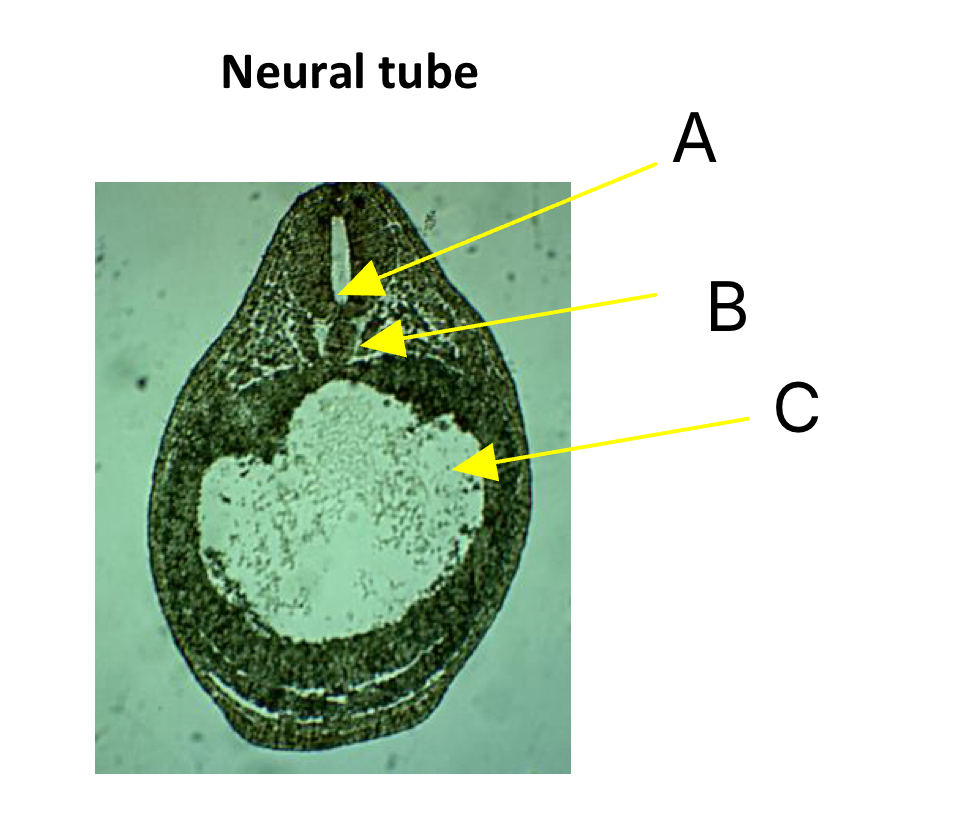
Name A, B, and C
neural groove, notochord, gut
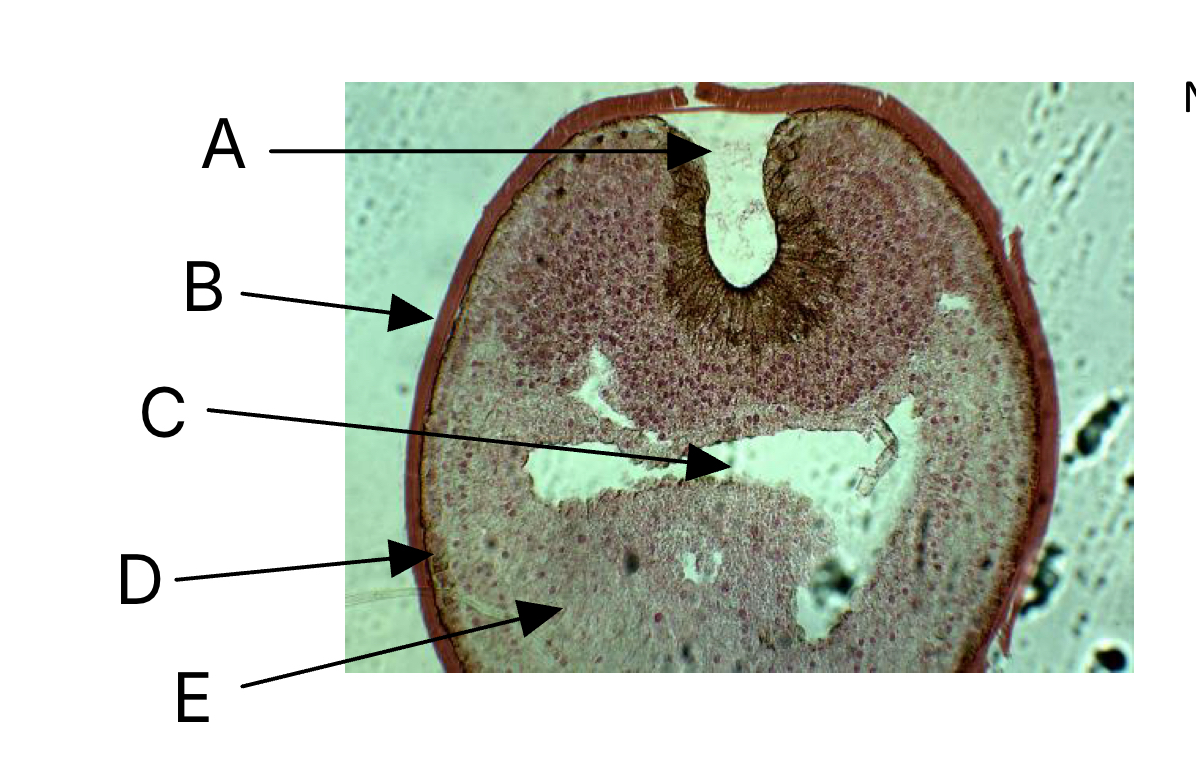
Which letter indicates the gut?
C
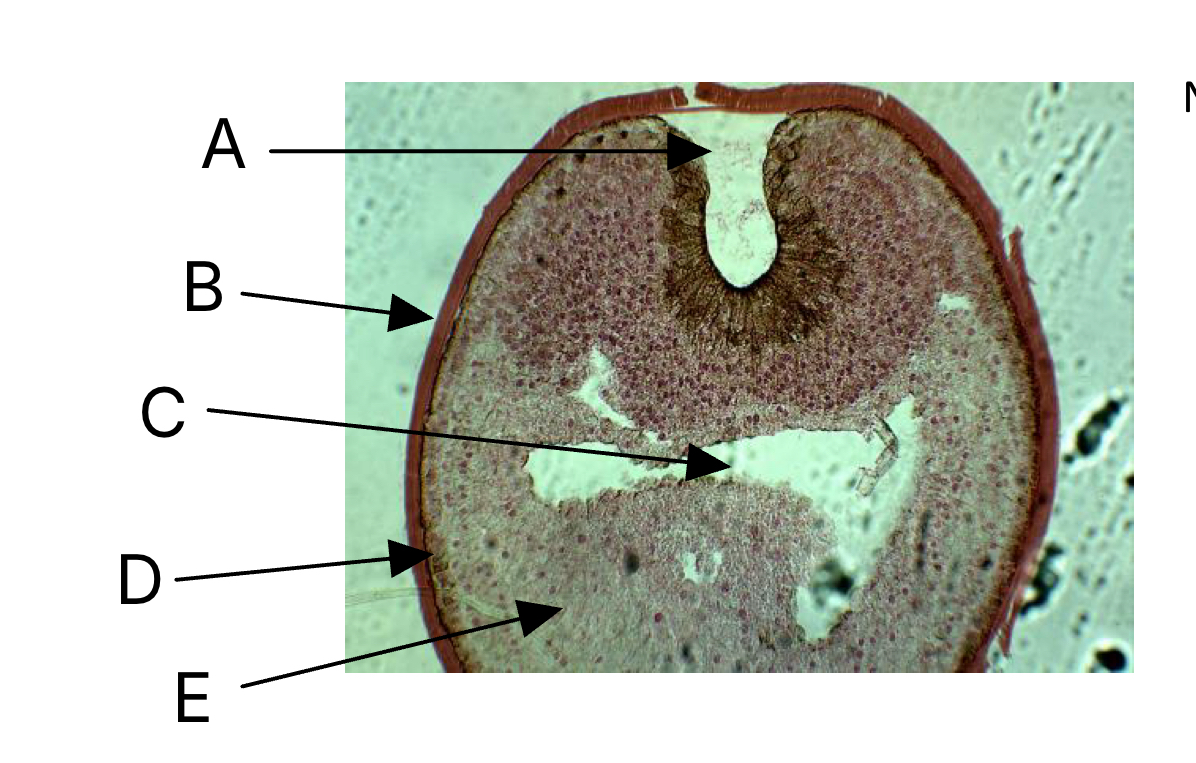
Which letters indicates the ectoderm, mesoderm, and endoderm?
B. ectoderm, D. mesoderm, E. endoderm
Why is the yolk sack in a bird embryo larger than in a human embryo?
Because they primarily draw their nutrients from the yolk sack while human embryos draw from the placenta.
Where does fertilization usually occur?
fallopian tube
Describe the layers of the gastrula
innermost = endoderm, middle = mesoderm, exterior = ectoderm
What structure in the developing embryo becomes the brain?
Anterior end of the neural tube
What structure in the developing embryo becomes the spinal chord?
Posterior neural tube
How long after fertilization is the developing baby considered a fetus?
After 8 weeks
What is the developing baby called priori to becoming a fetus?
Embryo
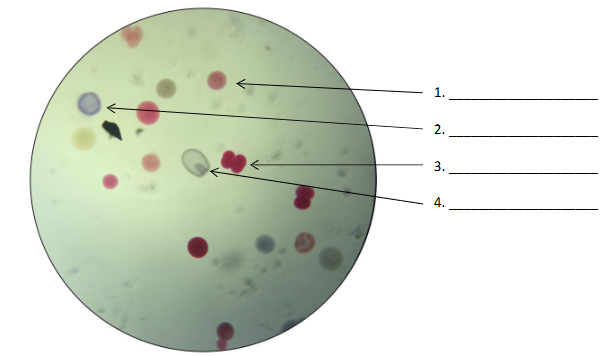
Name the cell stages
zygote
blastula
2-cell stage
gastrula
A solid ball of cells in the early stages of development describes the ___.
morula
a zygote is ___.
a fertilized egg.
a blastula is___.
a hollow mass of cells
The gastrointestinal tract, intestines and esophagus develop from the___.
endoderm
The skin, hair, and nervous system are derived from the ___.
ectoderm
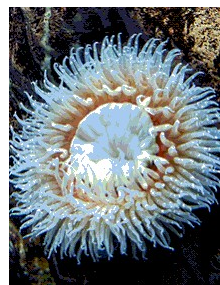
What type of symmetry is this?
Radial
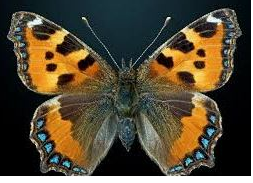
What type of symmetry is this?
bilateral
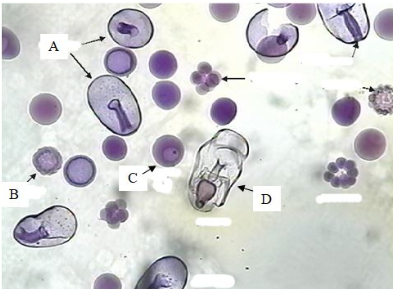
Which letter is pointing to a starfish larva?
D
In humans, fertilization usually occurs in the ___.
fallopian tube
Approximately how long does it take for the egg to travel from the ovary to the uterus?
5-6 days
Populations
groups of individuals of the same species living in the same area.
Population size ___ over time.
changes
Exponential population growth
the number of individuals increases at a constant percentage rate over time, causing the population to grow larger and larger more rapidly (J-curve)
Population growth rate formula
r = birth rate - death rate
Carrying capacity
the number of individuals the environment can support
The simplest model that includes the carrying capacity
logistic growth (S-curve)
Maximum sustainable yield
the maximum amount of resources that can be extracted sustainably over the long term
Calculating variance
Variance = (sum of squared differences from the mean) / (n − 1)
Calculate standard deviation
Standard deviation = sqrt(variance) = sqrt[(sum of squared differences from the mean) ÷ (n − 1)]
The time it takes for the population to double in size
Doubling time
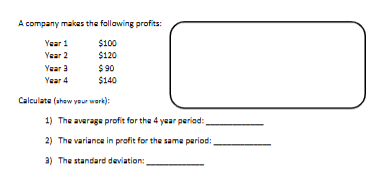
Average profit = $112.50
Variance ≈ 491.67
Standard deviation ≈ 22.17
Define evolution
the change in organisms across generations
Evolution is natural selection. True or false?
False
Observations that backed natural selection:
variation
heritability
struggle for existence
characteristics = ability to survive and reproduce
Conclusions of Wallace and Darwin’s observations
Populations will change and adapt over time as individuals with well-suited traits survive and reproduce, passing down the well-suited traits for future survival
Natural selection is random. True or false?
False
What happened to the peppered moth population before and after the Industrial Revolution?
Before: Light-colored moths were more common.
After: Dark-colored moths became more common because pollution darkened the trees.
Endemic species
native species that do not exist anywhere else
Allopatric speciation
formation of new species in geographic isolation
What is morphology?
The study of physical characteristics (body structure) used to compare species and infer evolutionary relationships.
What does a shared derived trait suggest?
Species with the same derived trait likely share a more recent common ancestor.
What is an ancestral trait?
A trait inherited from an older ancestor and shared by many species.
What is a derived trait?
A newer trait that evolved after a species diverged from its ancestors.
What does the cranial index measure?
Braincase width relative to face width.
High cranial index = larger braincase relative to face.
What does the facial extension index measure?
How far the face/jaw projects forward.
Higher value = more protruding face.
What is the dental formula?
The number and types of teeth on one side of the mouth.
What do brow ridges indicate?
The size of the ridge above the eyes.
Larger ridge = more pronounced brow.
What is a sagittal crest?
A ridge on top of the skull for jaw muscle attachment.
Large crest = powerful chewing muscles.
What does the frontal bone describe?
The slope of the forehead.
Vertical = flatter forehead
Sloping = forehead angles backward
What does the canine-incisor index measure?
Canine size relative to incisor size.
Higher value = larger canines.
What does the foramen magnum indicate?
Where the spinal cord enters the skull.
More forward position = more upright posture/bipedalism.
What does relative brain size measure?
Brain size compared to body size.
what do the parts of the phylogenetic tree describe?
Branch tip s= species, nodes where branches separate = speciation events (formation of a new species), notes between branches = evolutionary changes
fossils
the remains of organisms that existed long ago
How do fossils form?
An organism dies, is buried by sediment, and over time the remains or impressions are preserved as rock.
What is a trace fossil?
Fossil showing activity: footprints, tracks, nests, etc.
What are the three eras of the Phanerozoic Eon?
Paleozoic, Mesozoic, Cenozoic
When did the Paleozoic Era begin and end?
Started: 541 million years ago
Ended: 252 million years ago
When did the Mesozoic Era begin and end?
Started: 252 million years ago
Ended: 66 million years ago
When did the Cenozoic Era begin and end?
Started: 66 million years ago
Ended: Present
Which era is known as the "Age of Reptiles"?
Mesozoic Era
Eras are divided into…
Periods
What are the three periods of the Mesozoic Era?
Triassic, Jurassic, Cretaceous
What marks the transition from one period or era to another?
Mass extinctions and the appearance of new species.
What is a mass extinction?
An event in which more than 50% of species disappear.
What was the largest mass extinction in Earth's history?
Permian–Triassic extinction
When did the Permian–Triassic extinction occur?
252 million years ago
Front: What is the K–T (now K–Pg) extinction?
The mass extinction that wiped out the non-avian dinosaurs.
When did the K–T (K–Pg) extinction occur?
66 million years ago
What is a “missing link”?
transitional fossils in the fossil record that have not been found or don’t exist
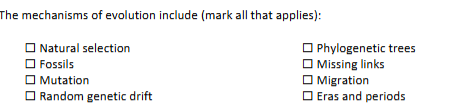
Natural selection, mutation, genetic drift, migration
The two biologists that independently developed the theory of natural selection:
Alfred Wallace and Charles Darwin
The evolution of several species of pupfish in the Death Valley region is an example of what type of speciation?
Allopatric speciation
What factors are required for allopatric speciation? List the 2 most important.
i. Geographic isolation (physical separation)
ii. Genetic divergence (different mutations/natural selection over time)
---
10) Name the 3 eras from oldest to most recent.
i. Paleozoic
ii. Mesozoic
iii. Cenozoic
---
11) A graph that shows the evolutionary relationships between species is called a(n)
✅ Phylogenetic tree
Geographic isolation and genetic divergence
Name the 3 eras from oldest to most recent.
paleo, meso, ceno
A graph that shows the evolutionary relationships between species is called a(n)
phylogenetic tree
Most plants are…
angiosperns
Key characteristics of Kingdom Plantae; plants…
have cells with cell walls made of cellulose
store energy as starch
use chlorophyll b, the pigment for photosynthesis
provide support for the developing embryo in early development
plant evolution main challenges
dehydration and reproduction without water