BIOL 220 Applications Immunology
 Call Kai
 Learn
Learn Practice Test
 Spaced Repetition
 Match
Match Flashcards
 Knowt Play
1/37

There's no tags or description
Looks like no tags are added yet.
Name | Mastery | Learn | Test | Matching | Spaced | Call with Kai |
|---|
No analytics yet
Send a link to your students to track their progress
38 Terms
What are some common practical applications (uses) of immunology? What do these applications typically involve?
Common Practical Uses
1. Vaccination
2. Serological testing
Applications typically involve:
• The use of substances that trigger an immune response (Antigens)
• Testing or analysis of a patient's blood (serum samples
What is a vaccine? What happens in the body after a vaccination?
Vaccine: Injection of substances (Antigens) in the body to induce an immune response
Vaccination (Vacca” = cow):
1. Provokes a primary immune response à Leads to the formation of memory
B cells and their antibodies
2. Produce a rapid and intense secondary immune response
What is Natural Immunity vs Artificial immunity, Immunogen, and Herd Immunity?
• Natural Immunity vs Artificial immunity
• Immunogen: A substance (antigen) that stimulates the immune system
• Herd immunity: Offers protection for most of the population
• Enough people get vaccinated, so the community is protected against a particular disease
What are the 5 desirable criteria for an ideal vaccine
Vaccine Safety
• “Should never cause a danger to your health”
• Vaccine must never be pathogenic (doesn’t cause disease) or toxigenic to host
Vaccine Effectiveness
• Vaccine must be a strong immunogen and stimulate the immune system → allowing the host to create specific antibodies against the disease
• Long term effect, don’t have to administer vaccine again
Painless or Oral administration
• Vaccine is taken orally is preferred over an injectable vaccine
Vaccine only requires one injection/administration
• Vaccine that requires 1 injection or a combination vaccine is preferred
• MMR, DTaP, TDaP, etc. (1 vaccine can prevent 3 different diseases)
Vaccine is affordable and the population has easy access
• Vaccine is available to most of the people at a reasonable cost
What is Live, attenuated vaccine and Inactivated, Killed vaccines
Live, attenuated vaccine
• Involves weakened pathogens
• Closely mimic an actual infection
• Ex: MMR Vaccine
Inactivated, Killed vaccines
• Involve a killed pathogen
• Safer than live vaccines
• Ex: Polio and Influenza vaccines
What is Toxoid vaccine and Conjugated Vaccine
Toxoid vaccine
• Inactivated toxins
• Immune response will target the toxin
• Makes antibodies against the toxins called antitoxins
• Ex: Td vaccine(Tetanus & diphtheria)
Conjugated Vaccine
• Main Vaccine component is combined with a strong immunogen (protein based)
• Ex: Pneumococcal vaccine
What is Subunit vaccines and mRNA (nucleic acid) vaccines
Subunit vaccines
• Use antigenic fragments (Pieces of the pathogen) to stimulate an immune response
• Ex: Hepatitis B and Pertussis Vaccines
mRNA (nucleic acid) vaccines
• You don’t inject the live pathogen, Inject only pathogenic nucleic acid
• Inject mRNA into host cells → Make proteins Antigens; these antigens will stimulate a host immune response
• Proteins always stimulate a strong immune response
• Ex: Covid 19 vaccine (Pfizer-BioNTech & Moderna Vaccines)
What is serology? What part of the blood sample is being tested? What are we looking for in the serum? What is the purpose of a serological test?
Serology
• The study or diagnostic examination of a patient’s blood serum from a blood sample
• “To see how the immune system responds to pathogens or substances introduced into the body”
What part of the blood sample is being tested?
• Serum (no clotting factors) and Plasma (contains clotting factors)
What are we looking for in the serum?
• The antigen itself (Ag)
• Antibodies (Ig M): Antibodies are made in a response to an active infection
What is the purpose of a serological test?
• To help identify and verify the disease/diagnosis
What is a positive and negative Serological Test
Positive Test:
• Positive for the Antigen (Pathogen) or the Antibody (usually IgM)
• Person has the disease
Negative Test:
• Negative for the Antigen (Pathogen) or Antibody
• Person does not have the disease!
What are the Desirable Criteria for an Ideal Serological Test
High specificity & accuracy
High sensitivity
Easy to set up and interpret
High Throughput:
Affordable cost and easy access
High specificity & accuracy and High sensitivity in desirable criteria for an Ideal Serological Test
High specificity & accuracy
• Detect only the antigen or antibody you are looking for and nothing else
• No cross reactivity; These tests should not react with other antigens or antibodies = false positives
• Test must be unambiguous, only have 1 interpretation (yes/no)
• Test must be reliable (No false positives/negatives)
• Ex: Pregnancy Test, HIV test, Athlete drug doping tests
High sensitivity
• Test uses a small sample size → sample size small enough to detect minute/trace quantities of Antigens or Antibodies)
Easy to set up and interpret, High Throughput, and Affordable cost and easy access in desirable criteria for an Ideal Serological Test
Easy to set up and interpret
• Test construction is simple
• Test results are easy to read
High Throughput
• Throughput: The ability to simultaneously test hundreds or thousands of samples in a short period of time
• Many tests are carried out at one time due to machine automation
Affordable cost and easy access
• Test is available to most people at a reasonable cost
• Or so that insurance can pay for it
Serological tests: 2 types of serological tests
• Direct serological test: The Antigen (Pathogen)
Patient has the Antigen (Pathogen) + Lab provides the immune complex
• Indirect Serological test: Antibodies (the response to antigens)
Patient has the Antibodies + Lab provides the antigen
Common examples of serological Tests
1. Precipitation Reactions
2. Agglutination Reactions
3. Neutralization Reactions
4. Fluorescent- Antibody Techniques
5. Compliment-Fixation Reactions
6. ELISA
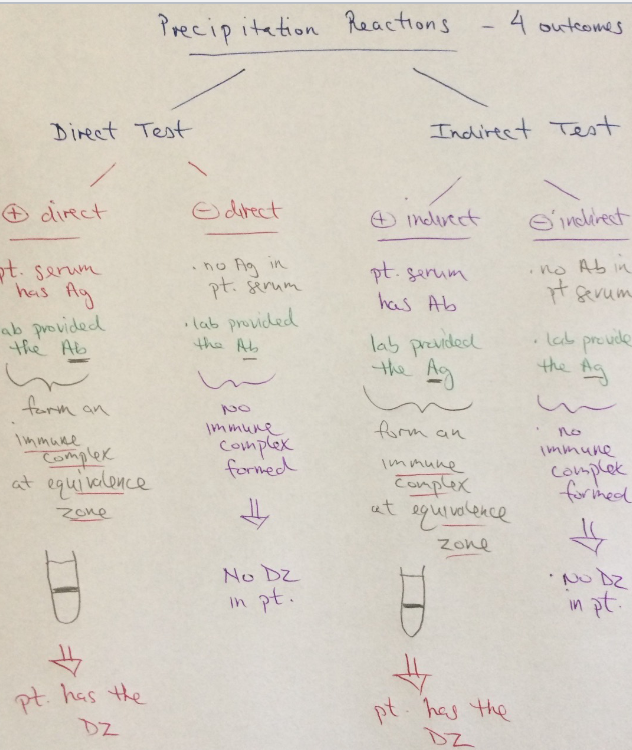
Precipitation Reactions: Components and Interpretation (+/-)
Components
• Involve Soluble antigens: “fallen off the pathogen” or “shed” from the pathogen
• Soluble antigens react with antibodies (IgM or IgG)
• Immune complex forms at the “equivalence zone” → Formation of a precipitin ring (a cloudy formation where there is a 1:1 ratio of Antigen to antibody) = positive test result (pt has dz)
Interpretation (+/-)
• Positive test result: immune complexes formed = Antigens or Antibodies are present in the patient’s serum sample = patient has the disease
Precipitation Reactions: Serology Test and Clinical application
Serology Test
• Direct testing for Antigen (Pathogen): Soluble Antigens in Patient’s Blood
• Indirect Testing: For Antibody production against the specific Antigen (Pathogen) in Patient’s Blood
Clinical application
• VDRL Testing: Venereal disease research laboratory – blood test for syphilis; Indirect testing (pt provide antibody, lab provides antigen)
Lancefield Classification of Streptococcal Species
• Classifies Streptococci species into groups
• Ex: GAS (Group A Streptococci) like Streptococcus pyogenes
Agglutination Reactions: Components and Interpretation (+/-)
Components
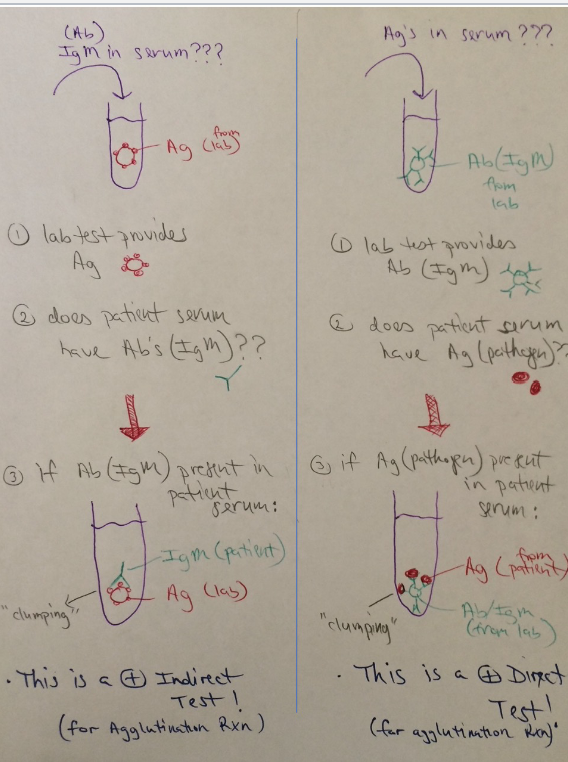
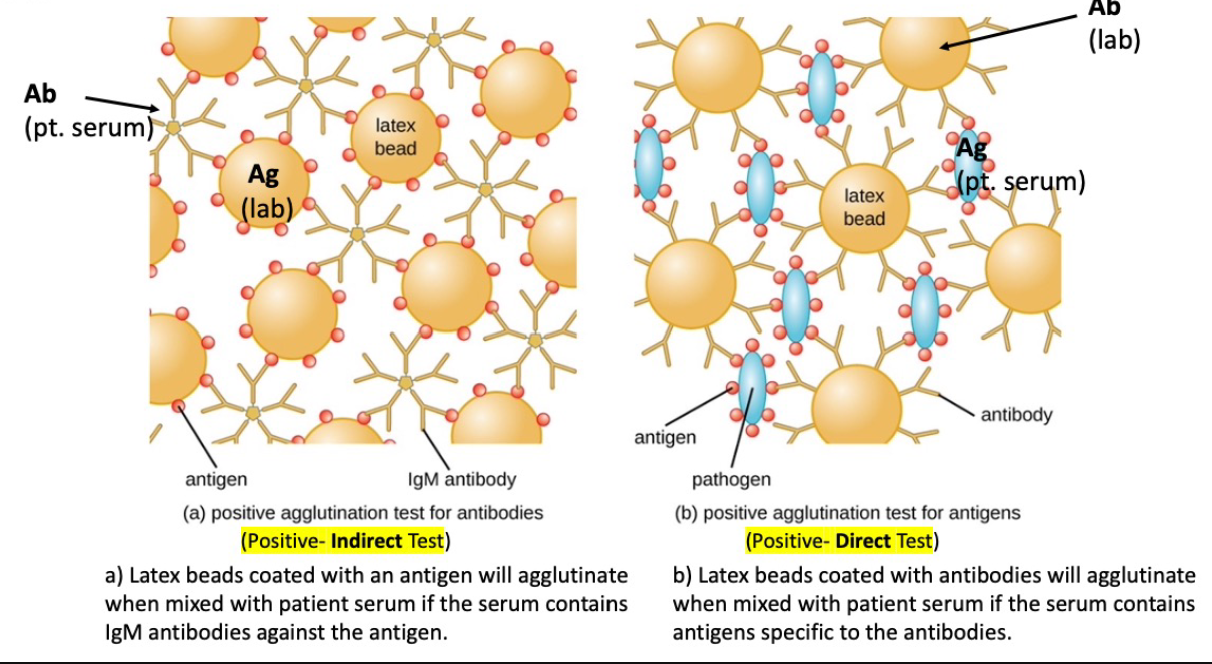
• Involve particulate antigens binding with antibodies to form visible aggregates
• Particulate antigens are not shed, they’re attached to the pathogen/antigen
• Involves latex beads with either Antibodies or Antigens (Pathogens) attached
Interpretation (+/-)
See image
Agglutination Reactions: Serology Test and Clinical application
Serology Test
• Exists in Indirect and Direct testing variants
• Particulate antigens linked to antibodies (IgM only) → form immune complexes (Antigen – Antibody complex)
Clinical application
Hemagglutination: For blood typing
• Agglutination of Red Blood Cell (RBC) surface antigens and complementary antibodies
Antibody Quantitation: Measuring the antibody concentration (or titer) in the patient’s serum
• Used to differentiate between primary vs secondary exposure
• Primary Exposure: High Ig M (1st peak) / Low Ig G (Class Switching)
Secondary Exposure: High Ig G / Low Ig M
Neutralization Reactions: Purpose of this reaction, different test of this reaction, and Applications/Uses
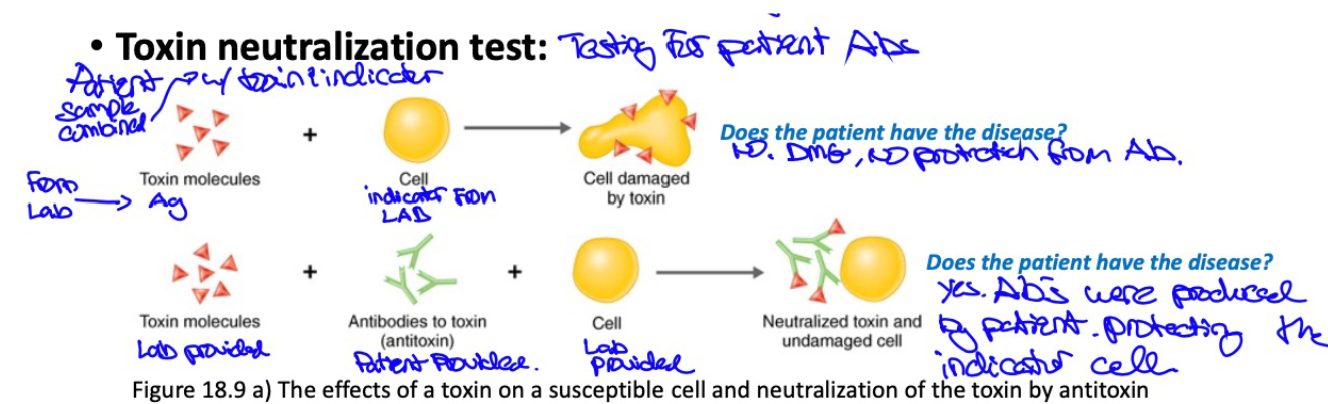
Purpose: Used to determine if antibodies to the toxin or virus are present in the patient’s serum sample
2 different tests: Toxin Neutralization & Viral hemagglutination inhibition test
Applications/Uses
• Diagnosis of bacterial diseases (toxin production) – toxin neutralization test
• Diagnosis of viral diseases
Neutralization Reactions: Toxin Neutralization Overview
Neutralization Reactions: Viral hemagglutination inhibition test Overview
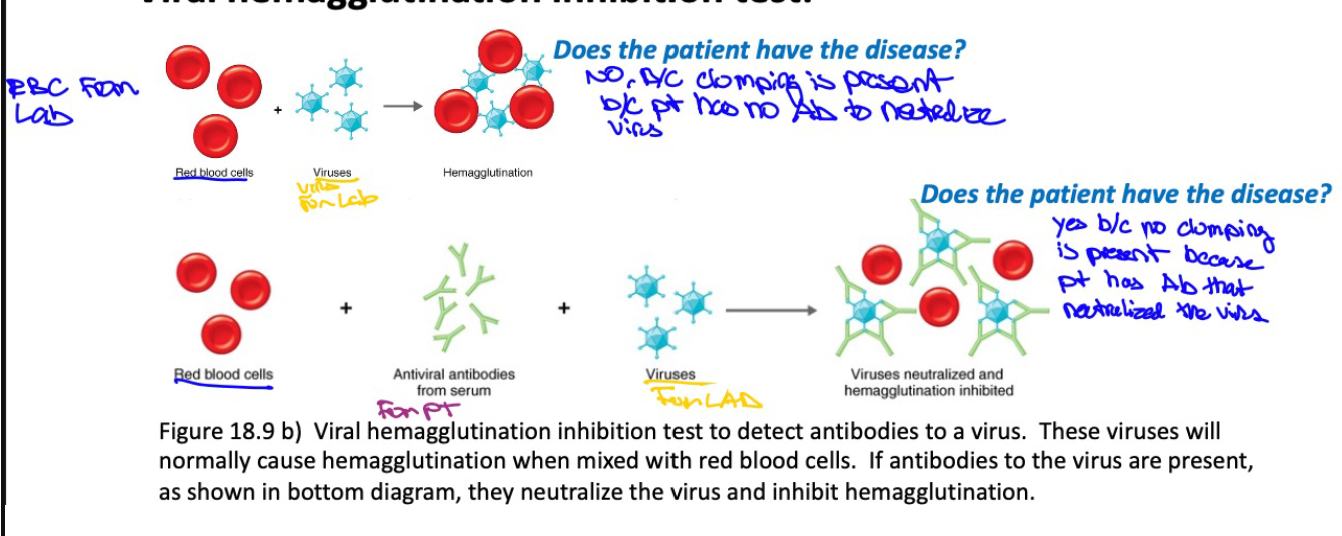
Fluorescent- Antibody Techniques: What does it use to mix with antibodies and what are the different types of test?
• Combines fluorescent dyes with Antibodies; (FL-Ab)
Comes in 2 types:
• Direct Fluorescent-Antibody Tests (FL Ab)
• Indirect Fluorescent-Antibody Tests (FL Ab)
Fluorescent- Antibody Techniques: Direct Fluorescent- Antibody (FL Ab) Test
Looking for a specific antigen (Pathogen) in a patient’s serum sample
Application/Use: To identify GAS (Group A streptococcus) from a patient’s throat sample
A diagnosis test for : Streptococcus pyogenes (GAS) → Strep throat/ Scarlet Fever/Rheumatic Fever
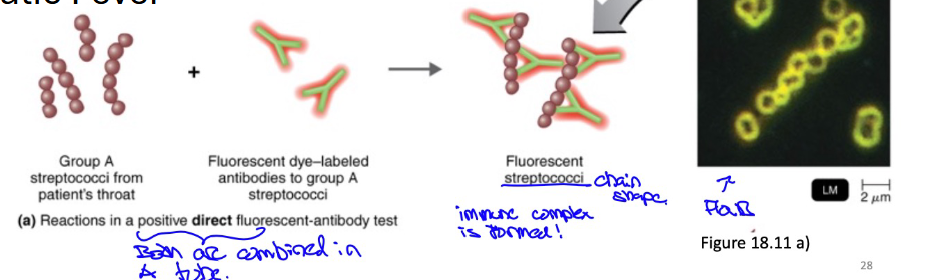
Fluorescent- Antibody Techniques: Indirect FL Ab test
• Looking for a specific antibody in the patient’s serum (Ig M)
• Fluorescent dye-labeled Anti-Human Antibody is added and will react with any human antibody in serum if the result is positive
• Antibodies that bind Only binds to human Antibodies
• Application/usage: To determine if T. Pallidum from patient’s blood sample is producing antibodies (causative agent: Syphilis)
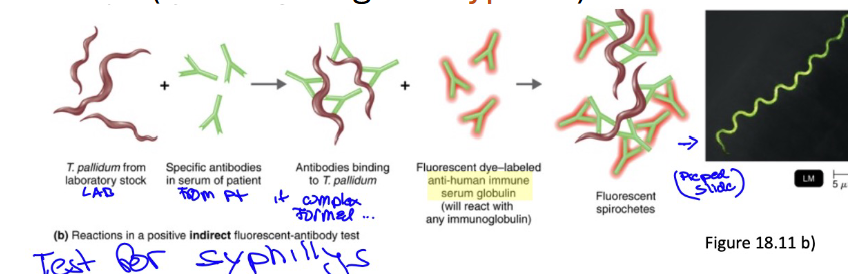
Complement-Fixation (CF) Reactions Overview
• Involves complement serum proteins
• Only exists in indirect form*
Directly looking for pathogen vs. indirectly looking for antibodies created against the pathogen
• All available complement proteins are bound to (Or “Fixed to”) the Antigen-Antibody complex (Immune complex) → No more circulating complement proteins available
Detects small amounts of antibodies = highly sensitive test
Two possible results: Positive and Negative (Indirect) CF Test
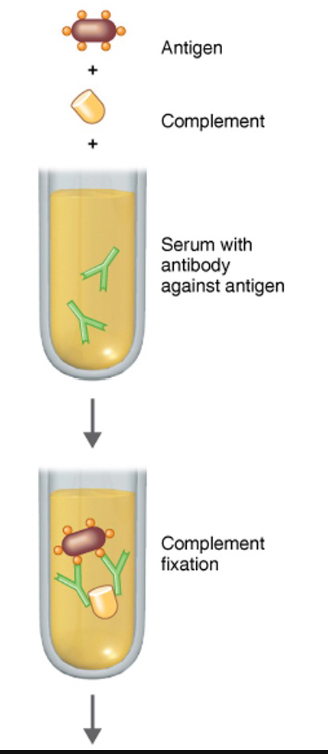
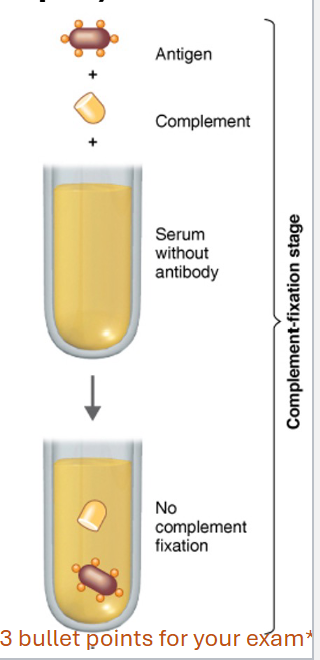
Complement fixation stage
This stage lets us know if there are any complements available.
Note in the positive test (Left), complements are fixed to the immune complex*
Positive: antibodies is in the serum → bind to antigen → form an immune complex → recruit complement proteins
Negative: no antibodies in serum→ no bind to antigen → no form an immune complex, complement proteins available to destroy still
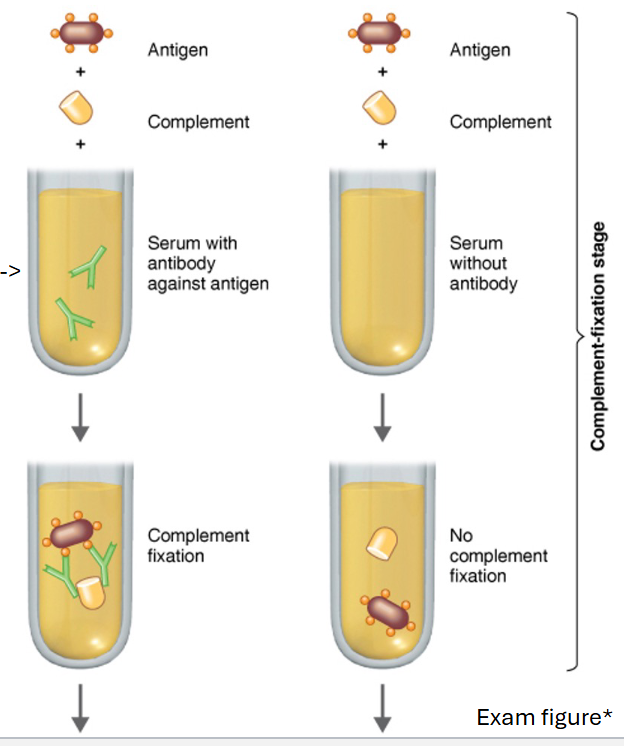
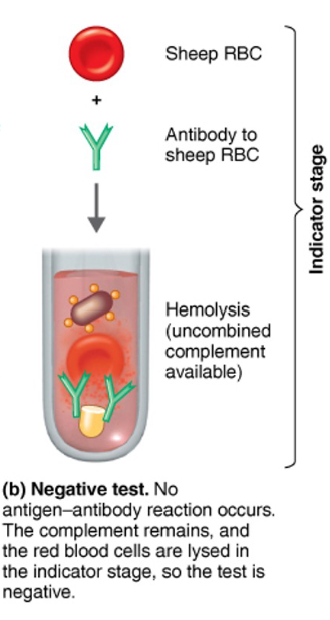
Indicator Stage
• If complements are not available (Fixed in the complement fixation stage), No RBC Hemolysis.
• Hemolysis of the RBC Indicates a negative test
Positive: Sheep RBC added → sheep antibody bind to the sheep RBC → complement proteins are unavailable because it is already bind to the immune complex → sheep RBC does not get lysed
Negative: Sheep RBC added → sheep antibody bind to the sheep RBC → complement proteins are available because it is not bind to the immune complex → sheep RBC gets lysed
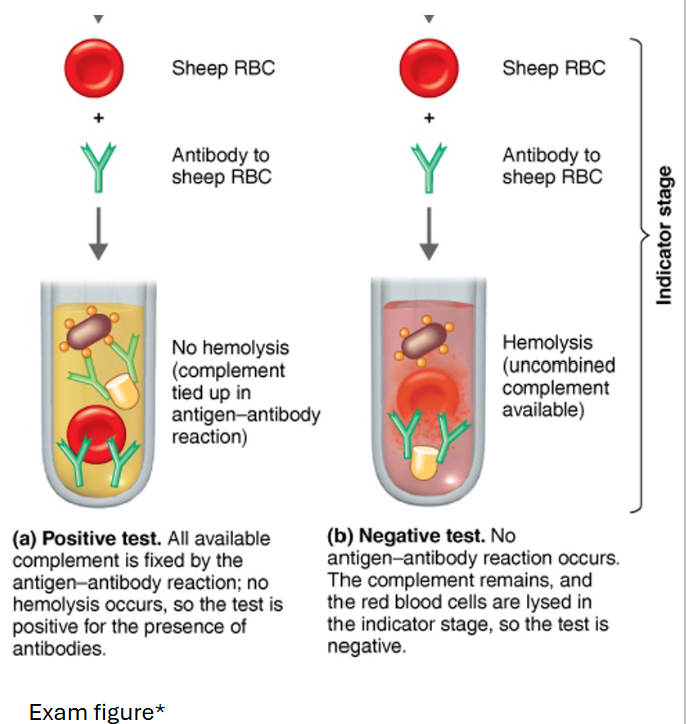
Positive Vs Negative Complement Fixation Test Results: Hemolysis, antibodies, disease present, and color change?
1. Positive Test
• No Hemolysis
• Yes Antibodies
• Yes Disease
• No color change
2. Negative Test
• Yes Hemolysis
• No Antibodies from patient
• No disease (RBC Damage, No compliments initially fixed)
• Color change
Positive Complement Fixation Test: Step 1 and 2
1. An Antigen and inactivated compliment are provided by the lab. These are added to a serum
sample containing the patient’s antibodies, which are specific to the Antigen. An immune complex will
form consisting of the Lab provided antigen (Ag) and the patient’s Antibodies (Ab)
2. As a result of the immune complex formation, the compliments get activated and compliment fixation
occurs (All available compliment binds to the Stem Region of the Patient’s antibodies of the immune complex. Since all the compliment got used-up, no more compliments will be available to bind to future immune complex formations
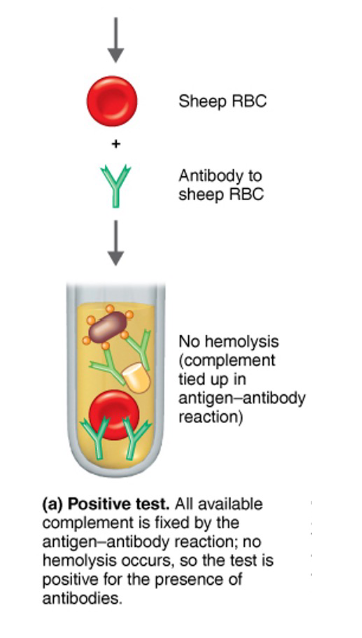
Positive Complement Fixation Test: Step 3 and 4
3. As a test indicator, sheep RBC are introduced into the patient’s serum sample. Antibodies against sheep RBC are also introduced into the patient’s serum sample. An immune complex will form between the Sheep’s RBCs and Antibodies against sheep RBCs.
4. No Hemolysis of sheep RBC occurs because the compliment did not bind to the Antibodies against sheep
RBC. This is part of the “indicator Stage” of the test. Compliment did not bind because it was all “used-up” and
already fixed (in the compliment fixation step) with the 1st immune complex. Thus, compliment is no longer available. No hemolysis of sheep RBC indicates a positive Test for the Patient’s Antibodies, and thus, positive for the disease.
Negative Complement Fixation Test: Step 1 and 2
1. An antigen and inactivated compliment are provided by
the lab. These are added to a serum sample that does NOT
contain the patient’s antibodies which would have been
specific for the Antigen. No immune complex is formed
because the patient’s serum sample has no Antibodies
against the lab provided Antigen.
2. As a result of NO immune complex formation,
complement does NOT get activated and compliment
fixation does not occur (Compliment does not bind to the
stem region of the Antibody of the immune complex). This is
part of the “Compliment Fixation Stage” of the test. Since
no compliment was “used-up”, they are available to bind to
future immune complex formations.
Negative Complement Fixation Test: Step 3 and 4
3. As a test indicator, Sheep RBCs are introduced into the
patient’s serum sample. Antibodies against the sheep’s RBCs
are also introduced into the patient’s serum sample. An immune
complex will form between the Sheep’s RBC and the Antibodies
against the Sheep’s RBCs
4. Hemolysis of the Sheep’s RBCs occur because complements
get activated and compliment fixation now occurs (All available
compliments bind to the stem region of the antibody against the
sheep’s RBCs). Compliment can bind to these antibodies
because they were not “used-up” nor fixed during the
compliment fixation stage (No immune complex was formed in
this stage, No patient Antibodies). Hemolysis of sheep RBCs
indicate a negative test for the Patient’s Antibodies,
therefore the patient is negative for the diseaseBre
Enzyme-Linked Immunosorbent Assay (ELISA): Specificity and sensitivity, Application/Usage, and Two Methods
• High specificity and sensitivity
Application/usage:
• Home pregnancy Test
• Drug Testing
• HIV Testing
Two Methods:
• Direct and indirect ELISA
Uses antihuman-anitbodies (like Flourescent testing)
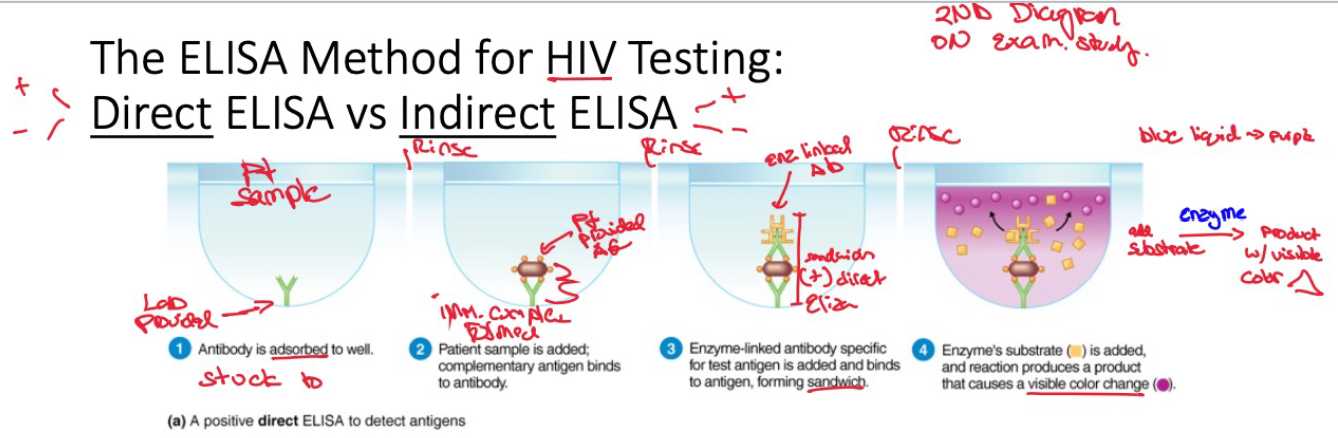
Direct ELISA
Antibody is absorbed/attached to the well (inside a test tube)
Patient blood serum sample is added. Complimentary antigen binds to antibody = immune complex is created
enzyme linked antibody specific for the test antigen is added + bind to antigen = forms a good sandwich
enzyme substrate is added → causes a reaction → produces a product → cause visible color change (yellow → pink)
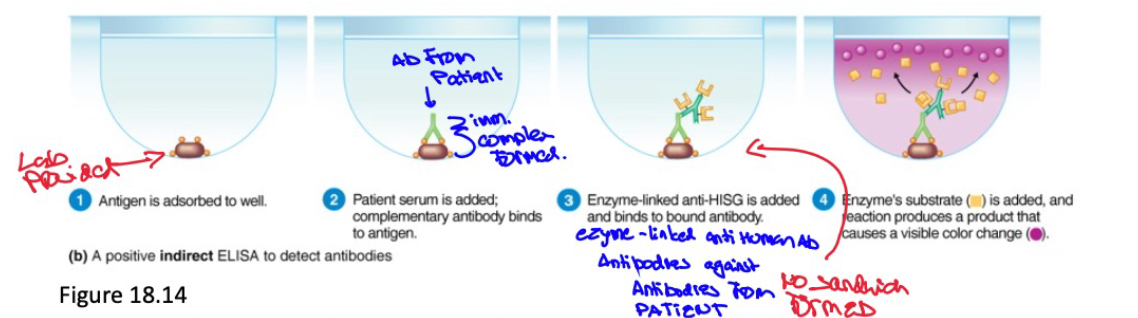
Indirect ELISA
Antigen is attached to the well
Patient blood serum is added. Complimentary antibody binds to antigen
Enzyme linked anti human antibody (from the lab) is added → bind to bound antibody
enzyme substrate is added → causes a reaction → produces a product → cause visible color change (yellow → pink)
Direct and Indirect ELISA: What are you looking for? Components of them? Applications/Uses?
What are you looking for?
Direct: Antigen
Indirect: Antibody
Components
Direct: Antigen + Antibody
Indirect: Antigen + Antibody + enzyme linked anti human antibody
Applications/uses
Direct: before or after seroconversion (looking for HIV in general)
Indirect: Pos-seroconversion: antibodies against HIV
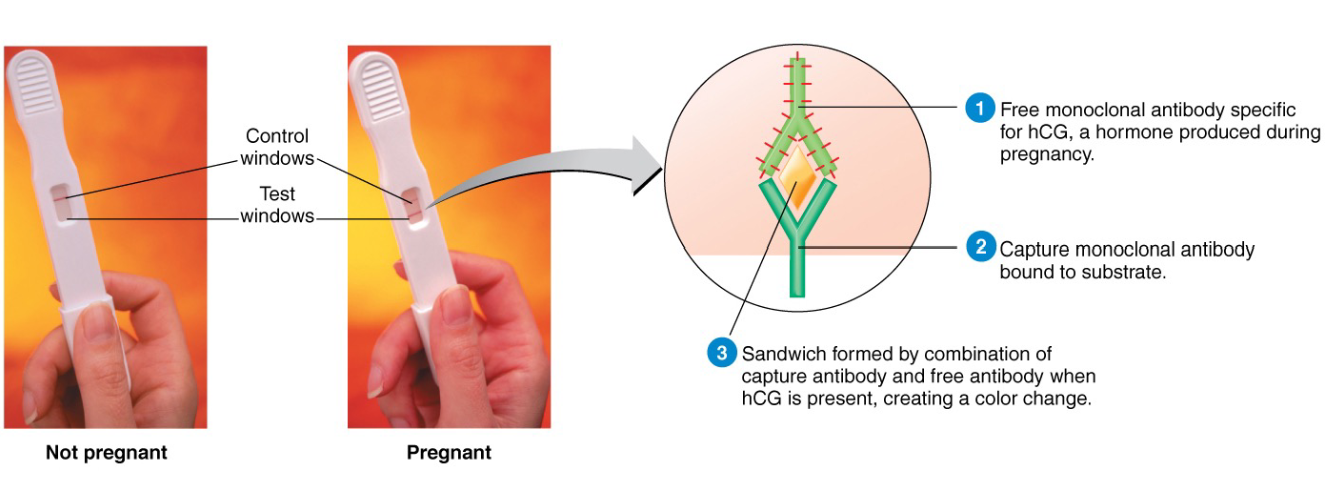
What happens in the ELISA: Home Pregnancy Test
Hormone acts as antigen
What are the Relative Sensitivities of Serological Tests
High Sensitivity
• Radioimmunoassay
• PCR
• Compliment fixation (CF) tests
• ELISA
Intermediate Sensitivity
• Agglutination reactions
• Neutralization Reactions
Low Sensitivity
• Precipitation reactions