Quest #4 (Chapters 13-15) - PSYC 001
 Call Kai
 Learn
Learn Practice Test
 Spaced Repetition
 Match
Match Flashcards
 Knowt Play
1/108

There's no tags or description
Looks like no tags are added yet.
Name | Mastery | Learn | Test | Matching | Spaced | Call with Kai |
|---|
No analytics yet
Send a link to your students to track their progress
109 Terms
What is someone's personality?
A person's characteristic thoughts, emotional responses, and behaviors — what makes each of us unique
Is personality dynamic?
Yes. It is impacted by both nature and nurture
Temperaments
Biologically based tendencies (this is nature) — can also be observed in infants by: activity level, emotionality (crying vs. not crying, etc.), and sociability
What is inhibited temperament in infants?
How withdrawn infants are, if they get overstimulated quickly, etc. — related to adult social anxiety
Trait theory
That every person has a low, average, or high amount of a trait — people's traits are measurable
What are the Big Five (OCEAN) traits?
Openness to experience, conscientiousness, extraversion, agreeableness, and neuroticism — most common way personality traits are measured (ex. to figure out how introverted or extroverted someone is)
How do humanist psychologists describe personality?
As a reflection of self-actualization (related to Maslow's hierarchy of needs)
Person-centered psychology
In order to understand someone's personality, you must treat someone with... unconditional positive regard, subjective experiences
Internal vs. external locus of control
There are certain things in life you are in control of (internal) and certain things that are out of your control (external) — internal locus of control (things you can control) affects personality more
Reciprocal Determinism Theory of Personality (Bandura)
You need to know about someone's personal features, environment, and behavior in order to understand their personality (basically just nature X nurture)
Do you act the same in every situation? How is personality impacted by different situations? What are two examples?
Obviously not! Personality is impacted by the power of the situation. Examples are self-monitoring and interactionism
Self-monitoring
People who change how they act based on the situation (ex. being quiet in class vs. loud when going out)
Interactionism
People act generally consistent in a given situation over time — your personality will describe how you are in one situation (ex. a shy person might not be shy in every context, but a shy person might consistently avoid large gatherings (one specific situation))
What are the two general approaches to measuring personality?
(1) Idiographic: person-centered; studying an individual; uniqueness (ex. asking for individual qualities). (2) Nomothetic: how people vary on common characteristics (ex. Big Five); studying principles of personality that apply to large groups of people
What are projective measures? What are the names of the two main tests?
Goal is to "tap into the unconscious" (Freud) through abstract tests like the Rorschach inkblot test and the Thematic Apperception Test (TAT).
Rorschach inkblot test
An abstract and ambiguous photo/painting that can be one of many different shapes/figures. They "show your thoughts" based on what you see in the photo

Thematic Apperception Test (TAT)
Showing someone a subjective photo and asking what they see is happening in the photo
What do self-report methods do and what are two examples?
They explicitly ask participants about their own traits. Examples: (1) Big Five. (2) Minnesota Multiphasic Personality Inventory (MMPI) — 567+ items
Do self-report measures involve response bias?
Yes, all self-report measures do
How is life history data used to measure personality?
Looking through one's personal history to gather information on personality — life stories (ex. the person who predicted Hitler would commit suicide a while before he did)
How is behavioral data used to measure personality?
Looking through one's behaviors to assess personality (connection to Bandura's Reciprocal Determinism)
How are observer measures used to measure personality?
Having someone else rate your personality — accuracy depends on the trait being measured. Based on high/low observability and evaluativeness
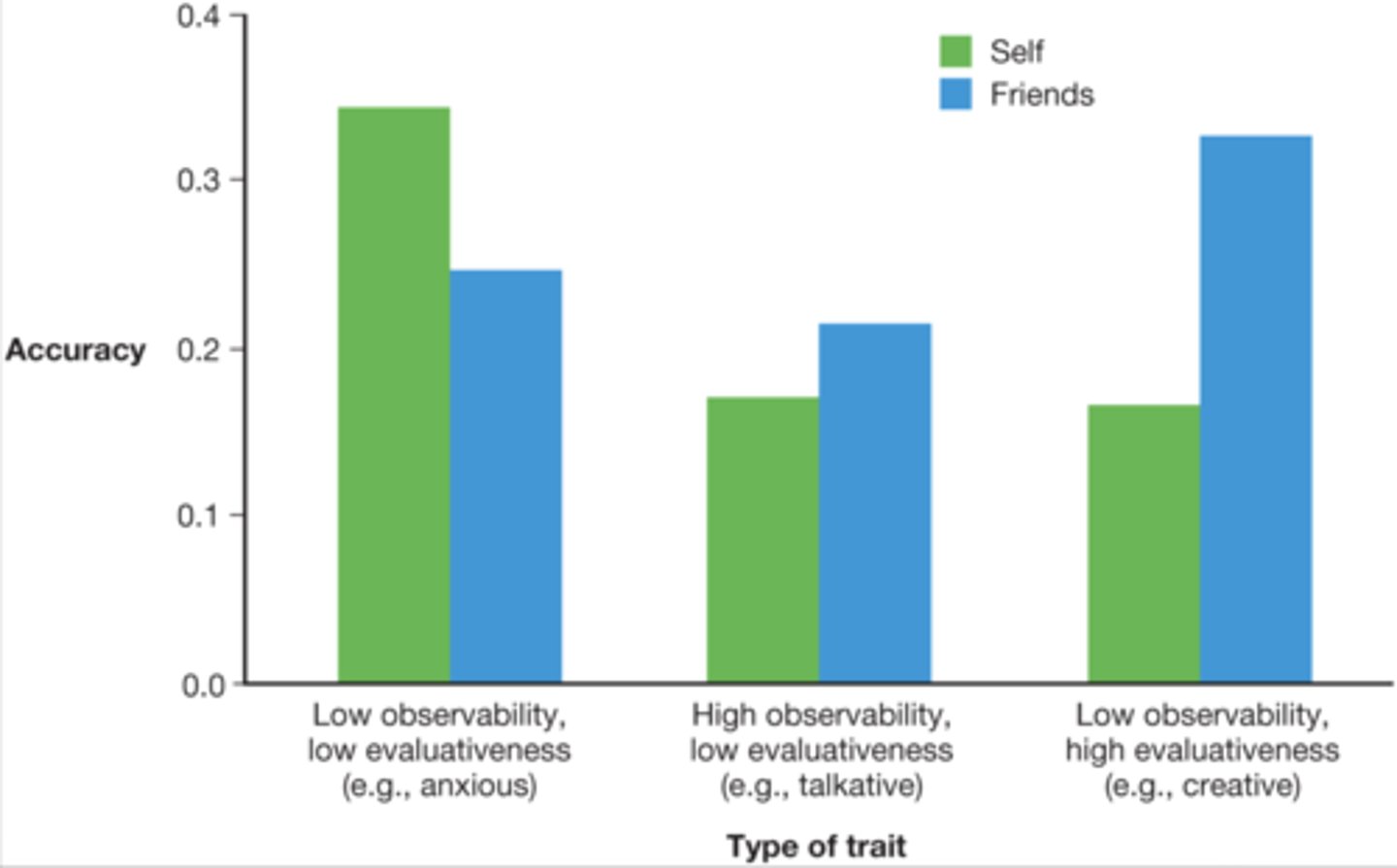
Is it more likely for yourself or your friends to accurately know your trait if it is low observability and low evaluativeness (ex. anxiety)?
Yourself
Is it more likely for yourself or your friends to accurately know your trait if it is high observability and low evaluativeness (ex. talkative)?
Equal odds
Is it more likely for yourself or your friends to accurately know your trait if it is low observability and high evaluativeness (ex. creativeness)?
Your friends
What is our self-concept (or "self")
Our concept of who we are as a person, consisting of self-knowledge
Self-schema
Just like a regular schema, but all about the self (schema: a mental representation of a situation)
Definition of self-esteem
How we evaluate ourselves (as good or bad) — usually based on how we believe other people see us
What changes one's self esteem?
Development: start with high self esteem → through puberty we start to judge ourselves → have better self esteem in 50s and 60s → as you get older it starts to go down with physical/mental changes. Sex differences: men usually have more self esteem than women
Sociometer theory
We have evolved to feel self-esteem because it tells us how well/bad we are doing things. There are weak/inconsistent relationships between self-esteem and success — high self-esteem does not mean success; successful doesn't mean high self esteem
Self-favoritism
People tend to like themselves more than other people. Even the letters in our initials — when people are asked to rank all the letters in the alphabet, people usually rank their initials first
Better-than-average effect
For anything you want to have, you think of yourself as better than average (how attractive you are, how smart you are, etc.) — because we want to view ourselves like that
Self-serving biases
Anything that goes well for you, you think it is because of you; anything that goes bad for you, you think it is because of someone else (ex. when you do well on a test, it is because of you; when you do bad on a test, it is because of the teacher)
Define psychopathology
Study of psychological disorders and mental illnesses
What is etiology
The study of the factors that lead to psychopathology
Can we determine if someone exhibits psychopathology based on normal or abnormal behavior?
Not really because normal is different for every person — what is normal for one person is not normal for another person
How common is psychopathology?
1 in 4 US adults exhibit something (but remember not to overanalyze yourself!)
Diagnostic and Statistical Manual of Mental Disorders (DSM-V-TR)
A "dictionary" of psychological disorders — tells you possible mental disorders based on symptoms
What is the dimensional nature of diagnoses
Diagnoses are not just "yes or no," there is a spectrum. But the diagnosis itself is categorical — especially for insurance purposes
What is the ongoing process when it comes to treating patients?
Observations → assessment → diagnosis → treatment → ongoing assessment → back to diagnosis and treatment
What are four factors that lead to psychopathology?
Diathesis-stress model, sex, cultural syndromes, nature X nurture
Diathesis-stress model
A theory that states that disorders come from a mix of vulnerability (diathesis) and external stressors — more likely to have a disorder with genetic predisposition and childhood trauma (but not guaranteed)
How does psychopathology differ by sex?
Males have more external disorders (ex. ADHD). Females have more internal disorders (ex. stress, anxiety)
Cultural syndromes means...
Psychopathology differs by culture
What are three types of anxiety disorders?
Phobias, social anxiety disorder, and generalized anxiety disorder
Specific phobias
An intense fear of an object, situation, or activity (ex. fear of heights)
Social anxiety disorder
Anxious in social situations (ex. in big groups)
Generalized anxiety disorder
Extra anxious all the time (maladaptive)
Biased perceptions of threat
All anxiety disorders are associated with an overestimate of fear/tension (thinking something is worse than it is)
What are the two main types of depressive disorders?
Major depressive disorder and persistent depressive disorder
Major depressive disorder
Extra deep sad state, for shorter amount of time
Persistent depressive disorder
Less extreme sad state, but for longer amount of time
Bipolar disorder and type I vs. type II
Switch between very positive (mania) and very negative (depression) behaviors. Type I: mania heavy. Type II: depression heavy
Learned helplessness
A feeling that one's life won't change because they've tried it before but it didn't work
What is suicide risk associated with? What are the two key aspects of it?
Associated with depression and bipolar disorders — suicide ideation vs. suicide capability
Suicidal ideation
Think about committing suicide because lacks a sense of belonging and sense of competence — can change this
Suicidal capability
Is able to attempt suicide — can't change this, can only change if they are thinking about it
Schizophrenia
A disorder that emphasizes thought disturbances (alters perceptions of reality)
General causes of schizophrenia
Nature and nurture (it's complicated!). Diathesis-stress may still apply
When is schizophrenia diagnosed?
Usually around 20 — some mild symptoms can occur in childhood (ex. social and motor differences/disturbances)
What does OCD stand for?
Obsessive Compulsive Disorder. Obsessions (thoughts) that cause compulsions (actions). There is also a checking behavior (related to conditioning) in which you keep on checking that something is done correctly
Explain OCD through an example of washing hands constantly
Anxiety (forced to shake hands) → compulsion (run to bathroom) → relief (wash hands) → obsession (fear of contamination)
What are the three main types of eating disorders?
Anorexia, bulimia, and binge eating disorder
Anorexia (nervosa)
Restriction of food intake
Bulimia (nervosa)
Binge eating and purging (forcing oneself to throw up)
Binge eating disorder
Binge eating episodes but no purging
Tolerance in terms of addiction
Needing more of a drug to get the desired outcome
Withdrawal in terms of addiction
Getting used to a drug and then having a negative reaction when it's taken away
Addiction potential
Related to several characteristics (why people take/try drugs): Sensation-seeking, risk-taking, and impulsivity (all personality traits) — subcortical region activity (reward, craving, etc.)
Post-Traumatic Stress Disorder (PTSD)
Frequent intrusive thoughts/flashbacks to past trauma (links to memory) — what happens when persistence becomes maladaptive
What are the two main types of dissociative disorders?
Dissociative amnesia (memory) vs. dissociative fugue (identity)
Dissociative identity disorder (MID)
Multiple identities in one person — formerly called "multiple personalities"
Borderline personality disorder
Unstable self — mood swings, unstable relationships, impulsive decisions, etc. (very different from bipolar disorder)
Antisocial personality disorder (APD)
The person typically doesn't care about other people — because of its extremity, a lifetime history of antisocial behavior is necessary to diagnose someone with ADP
Autism Spectrum Disorder (ASD)
People who have one or more of the following (dimensionality!): social impediments, communication difficulties, repetitive behavior, sensitivity to change and stimulation, motor difficulties, restricted interests (links to attention), etc.
Asperger's syndrome
The high-functioning version of autism (formerly known as autism)
Is there an overlap in ASD and ADHD? If so, why?
Yes, because they both change a person's attention skills
Do vaccines cause ASD? Who caused the controversy?
Obviously not. Wakefield published article linking MMR vaccine to cases of ASD — this has been discredited/debunked/retracted (there is no link). ASD symptoms just happen to occur at same time when children are supposed to get their vaccines (like growing adult teeth)
Why have more cases of ASD been diagnosed recently?
As our understanding of ASD symptoms has increased, more cases have been diagnosed (doesn't mean more people have it)
Some symptoms of ADHD
Impulsivity, restlessness, and inattention
Do boys or girls get diagnosed for ADHD more often?
Boys — probably mostly because of differences in maturation and socialization (not genetics)
Can people grow out of ADHD?
Not really, it often has long-term effects
Define comorbid
Medical conditions that exist simultaneously (but usually independently) of each other
Psychodynamic
Focusing on the unconscious; gaining insight; realizing what is unconscious and what you do not know (Neo-Freudian idea)
What does Cognitive-Behavioral Therapy (CBT) focused on? (HINT: think about the cognitive and behavioral aspects of this therapy)
Cognitive: restructuring/reappraisal — reframing situations in your daily life. Behavior: conditioning (learning!) — exposure (ex. used for phobias)
Client-centered therapy
Therapist gives patient empathy and unconditional support — lets the patient lead the session (humanist approach to motivation and personality (Carl Rogers))
Motivational interviewing
Asks the client questions to understand them — want to understand why they do what they do
What are three types of psychotropic (or psychoactive) medication?
Anti-anxiety drugs, anti-depressants, and anti-psychotics
Anti-anxiety drugs
Target GABA receptors (ex. Xanax) — deals with things like inhibition
Anti-depressants (ex. Prozac)
SSRIs (selective serotonin reuptake inhibitors) — increases activation of serotonin receptors
Anti-psychotics
Target dopamine receptors — treat things like Schizophrenia
Surgery
Lobotomy — takes out the frontal lobe. No longer done because has irreversible effects (a last resort treatment)
Electroconvulsive therapy (ECT)
Theory is it can "restart the brain" — still can have side effects (a last resort treatment)
Transcranial magnetic stimulation (TMS)
Rub magnets on the brain — sometimes can reset enough neural connections to get them out of an anxiety state (a last resort treatment)
Deep brain stimulation (DBS)
Like a "brain pacemaker" to help activate the brain when it is supposed to be (a last resort treatment)
How is research used to determine the effectiveness of treatments?
Research using control (placebo) groups vs. treatment groups. The goal is to show that the treatment is stronger than just the placebo effect. These studies can also be done for therapy (control groups would get a therapist who just talks with them normally) — keep in mind, sometimes the drug companies are the ones who pay for this research
What is the most effective treatment for anxiety disorders (phobias, social anxiety disorder, etc.)?
CBT is generally more effective than medication (because of exposure, restructuring, etc.)
What is systematic desensitization treatment?
Gradually exposes a person to a fear-inducing stimulus while simultaneously teaching them to relax
What is the most effective treatment for obsessive-compulsive disorder (OCD)?
Antidepressants and CBT are both effective, but CBT is more effective
What is response prevention treatment (for OCD)?
Prevent someone from doing the impulsive response — breaking the link, showing them that nothing bad happens