psych 104: learning and adaptation
 Call Kai
 Learn
Learn Practice Test
 Spaced Repetition
 Match
Match Flashcards
 Knowt Play
1/70

There's no tags or description
Looks like no tags are added yet.
Name | Mastery | Learn | Test | Matching | Spaced | Call with Kai |
|---|
No analytics yet
Send a link to your students to track their progress
71 Terms
what is learning
learning is a process by which experiences can lead to changes in behaviour and capabilities
measuring learning?
learning is measured through change in performance
e.g. sports games, achievement tests, learning how to walk (crawling - walking - running)
the big three
habituation (event alone)
classical conditioning (event event)
operant conditioning (behaviour event)
habituation + how does it differ from sensory adaptation?
we respond less strongly over time to a particular stimuli
through repeated presentations
occurs in the brain, not in the receptors (main difference between habituation and sensory adaptation)
habituation discovered by what animal?
sea slug
poking its gills over time - stops reacting
learns that the poking isn’t dangerous
learns how to react to poking
sensitization
opposite of habituation
an increase in the strength of response to a certain stimuli
specificity between habituation and sensitization
habituation: specific
sensitization: non specific
conditioning
British philosophers believed that we acquire almost all our knowledge via conditioning
conditioning = forming associations between stimuli
simple associations → complex tasks
Ivan Pavlov
digestive processes in animals
in the process, discovered classical conditioning
“conditioned reflexes”
Ivan pavlov - dog example
each morning, a person enters through a door with a bell and fed the dogs
dogs start salivating when the bell rings
dogs associate bell with food = elicits salivation!
classical conditioning
the process of association became known as classical (pavlovian) conditioning
a neutral stimulus (NS) becomes paired with the occurrence of another stimulus (US - unconditioned stimulus)
unconditioned stimulus
biologically significant stimulus that naturally produces a response
e.g. food → salivation
conditioned stimulus
previously neutral stimulus that eventually comes to elicit a conditioned response
e.g. bell → salivation
unconditioned response
the response associated with an unconditioned stimulus
conditioned response
with enough pairings of the CS with a US, the CS will come to elicit the same response as the paired US
if CS + US is big enough, the CS will elicit a conditioned response
Association
a relationship between two stimuli
US and CS
Acquisition
the time period during which association is being learned
the amount of time it takes for a neutral stimuli to turn into a conditioned stimulus
what must occur in order for CC to be effective?
the US must evoke a strong, bodily response
e.g. brain stimulation, drugs, loud noise, etc
the more intense the US is, the easier it is to produce a CS
to a limit
US can be classified as … (2)
appetitive: a stimulus that an individual finds pleasant
e.g. food
aversive: a stimulus that an individual finds unpleasant
e.g. loud noise
types of CS - US pairings (4)
forward short delay
forward trace
simultaneous
backwards
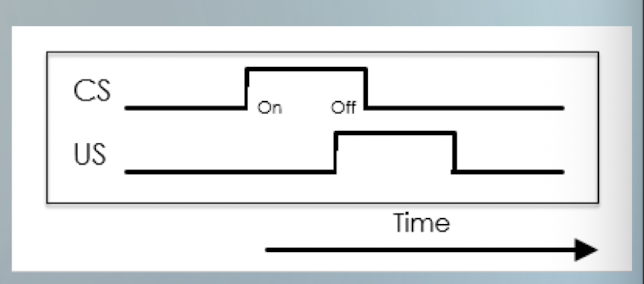
forward short delay
CS comes before the US
some overlap
e.g. the bell rings before the food is presented
most effective
forward trace
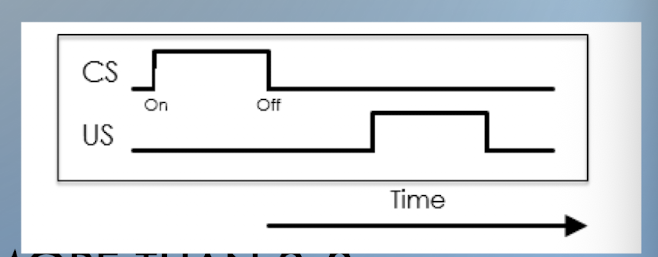
CS comes first, short gap, then the US
no overlap
e.g. bell rings → short pause → food presented
simultaneous
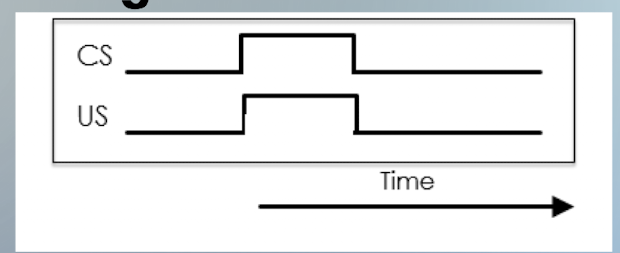
CS and US presented at the same time
turn on and off at the same time
learning is slower - acquisition is much slower
e.g. bell and food presented at the same time
Backward
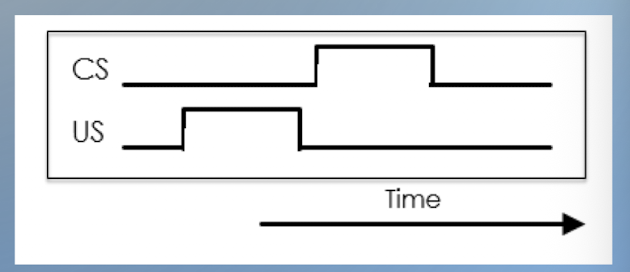
US presented first and then the CS
results in very little learning
usually accidental
e.g. food presented before the bell
enhancing acquisition: tips
present multiple CS / US pairings
aversive conditioning is learned faster than appetitive conditioning
e.g. this is how fears are created
use forward pairings (CS → US)
short interval between onset of CS with onset of US
ending an association is known as
extinction
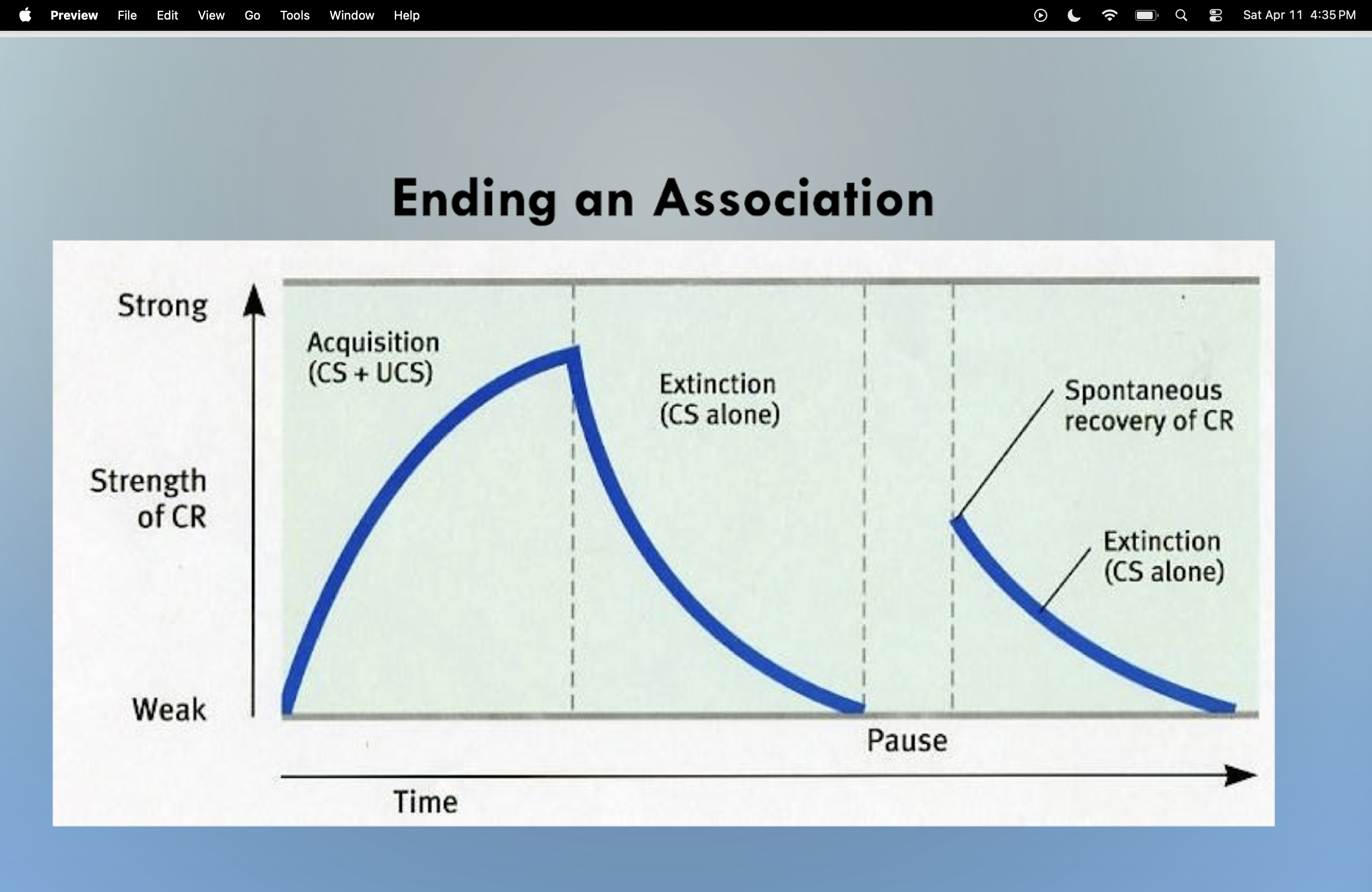
extinction
accidental or purposeful
a CS is presented in absence of US
causes CR to weaken → disappear
spontaneous recovery
if the CS is presented again following a delay after extinction, the CR reappears
but in weaker form
stimulus generalization
once a CS has been established, similar stimuli may produce a CR
e.g. bit by one breed of dog - this fear extends to all breeds of dogs
BUT the more similar the stimulus is to the old stimulus, the stronger the reaction
stimulus discrimination
an organism learns to respond only to a specific conditioned stimulus (CS) and not to similar stimuli.
non generalizable - CR occurs to one stimulus but no the other
e.g. only being scared by big dogs, not little dogs
higher order conditioning
a chain of events involving two CS
new neutral stimulus becomes a conditioned stimulus by being paired with an already established CS — not directly with the US.
e.g. conditioning can occur without US!
example of higher order conditioning
first order (same as normal)
US: food → UR: salivating
CS: bell → CR: salivating
eventually bell elicits salivation
second order
present new neutral stimuli: light bulb
pair lightbulb with the bell, NOT the food
lightbulb elicits salivation
exposure therapy
extinction of CR through exposure to CS
without prescence of US
clinical setting
e.g. fear of snakes: presenting snakes over and over time, ensuring pain is not present. over time, the “pain” associated with snakes goes away
systematic desensitization
muscular relaxation paired with gradual exposure to fear-inducing stimuli
flooding
exposure to fearful stimuli
“exposure therapy on steroids”
VR exposure therapy
effective for phobias
Little Albert experiment
little Albert was 11 months old
shown a white rat, which was paired with a loud noise (gong)
eventually, became terrified of white rats
he eventually generalized the stimuli to “soft and fuzzy” things
disgust
disgust reactions are tied to stimuli that are biologically important to us
animals or objects that are dirty or dangerous
easily acquired!
operant conditioning
learning controlled by the consequences of the organism’s behaviour
reward and punishment
AKA instrumental conditioning
order of operant conditioning
stimulus → response → reinforcer/feedback
the law of effect - discovered by who?
Edward thorndike
what is the law of effect
if something good or satisfying happens after a response, there will be a stronger relationship between the stimulus and the response
satisfying: more
unsatisfying: yes
S-R theories of learning
s: stimulus
r: response
everything you do is a result of S-R bonds
puzzle boxes
hungry cats placed in boxes with complicated escape routes (e.g. puzzles)
milk or food placed outside of box, used as motivation
faster escape = quicker access to food
first time, took longest for cat to find solution - but each subsequent performance improved
learning is incremental, NOT based on reasoning
BF Skinner
created the Skinner box
AKA operant chamber
Skinner box
electrically recorded animal’s activity
automatically provides reinformcent in response to specific actions
if he completed the task, he gets rewarded with food
green light + push bar = rewarded
red light + push bar = not rewarded
reinforcement
any outcome that strengthens the probability of a response
positive
negative
positive reinforcement
reward
the consequence consists of presenting something pleasant
adding a stimulus
negative reinforcement
punishment
the consequence consists of removing something unpleasant
removing a stimulus
increasing behaviour through ______
reinforcement
adding a stimulus
e.g studying for a test to get a good grade
decreasing behaviour through _____
punishment
removing a stimulus
e.g. removing a tantrum → give baby candy
punishment
any outcome that weakens the probability of a response
positive
negative
positive punishment
present an unpleasant stimulus
not studying for a test → receive a bad grade
negative punishment
take away a pleasant stimulus
e.g. taking away phone time to focus on HW
reward does not mean _____?
reinforcement
e.g. using an umbrella - using an umbrella doesn’t make the rain stop
discriminative stimulus (S^d)
any stimulus that signals the availability of reinforcement
e.g. cue light
e.g. Skinner box
when the light is green + push down on bar = rewarded
when the light is red + push down on bar = not rewarded
shaping
reinforce succesive approximations towards a final response - shaping one action (pushing down on the bar)
1. reward rat for facing the bar
2. reward rat for approaching the bar
3. reward rat for touching the bar
4. reward rat for pushing down on bar
must be able to do each task (step) successfully before moving to next step
chaining
reinforce each response with the opportunity to perform the next response - builds a sequence of behaviours
e.g. now that the rat can push down on a bar, try having them push down on a button
1. Go to lever
2. Press lever
3. Go to button
4. Press button
continuous reinforcement
being rewarded after every correct response
e.g. every time you do your chores, you get $5
partial reinforcement
being rewarded after some correct responses
e.g. rewarding dog for “sitting” every couple times
fixed vs variable
fixed: reinforcement after a fixed number of responses or interval of time
variable: reinforcement after a variable (average) of responses or interval of time
ratio vs interval
ratio: number of responses being reinforced
interval: passage of time being that must elapse before being reinforced
fixed ratio
reinforced after a fixed number of responses
fixed interval
reinforced after a fixed amount of time
variable ratio
reinforced after an average number of responses
variable interval
reinforced after an average amount of time
best form of reinforcement?
continuous
rapid learning
extinction more rapid
partial
slower learning
resistant to extinction
variable ratio is the best
avoids extinction
can’t predict when you will be rewarded (average)
escape and avoidance both based on _____?
negative reinforcement (removing a stimulus to increase response)
escape behaviour
getting away from something already happening
terminates aversive stimulus
SRO
stimulus - shock
response - cross barrier
outcome - removal of shock
avoidance behaviour
getting away from something before it happens
SRO
stimulus - light (the rat moves to other side before shock occurs)
response - cross barrier
outcome - avoidance of shock
two process theory
learning the avoidance response
1. classical conditioning of a fear response to CS
associate light with shock
seeing light leads to fear
2. operant conditioning of a escape response to fear evoking S^d
when the light turns on, rat runs over, avoids shock, reduces fear