Large Animal Nutritional Requirements
 Call Kai
 Learn
Learn Practice Test
 Spaced Repetition
 Match
Match Flashcards
 Knowt Play
1/44

There's no tags or description
Looks like no tags are added yet.
Name | Mastery | Learn | Test | Matching | Spaced | Call with Kai |
|---|
No analytics yet
Send a link to your students to track their progress
45 Terms
What is the primary purpose of 'flushing' in breeding females?
To increase the number of ovulations, thereby increasing the chances of multiple births (twins/triplets in sheep/goats, larger litters in pigs).
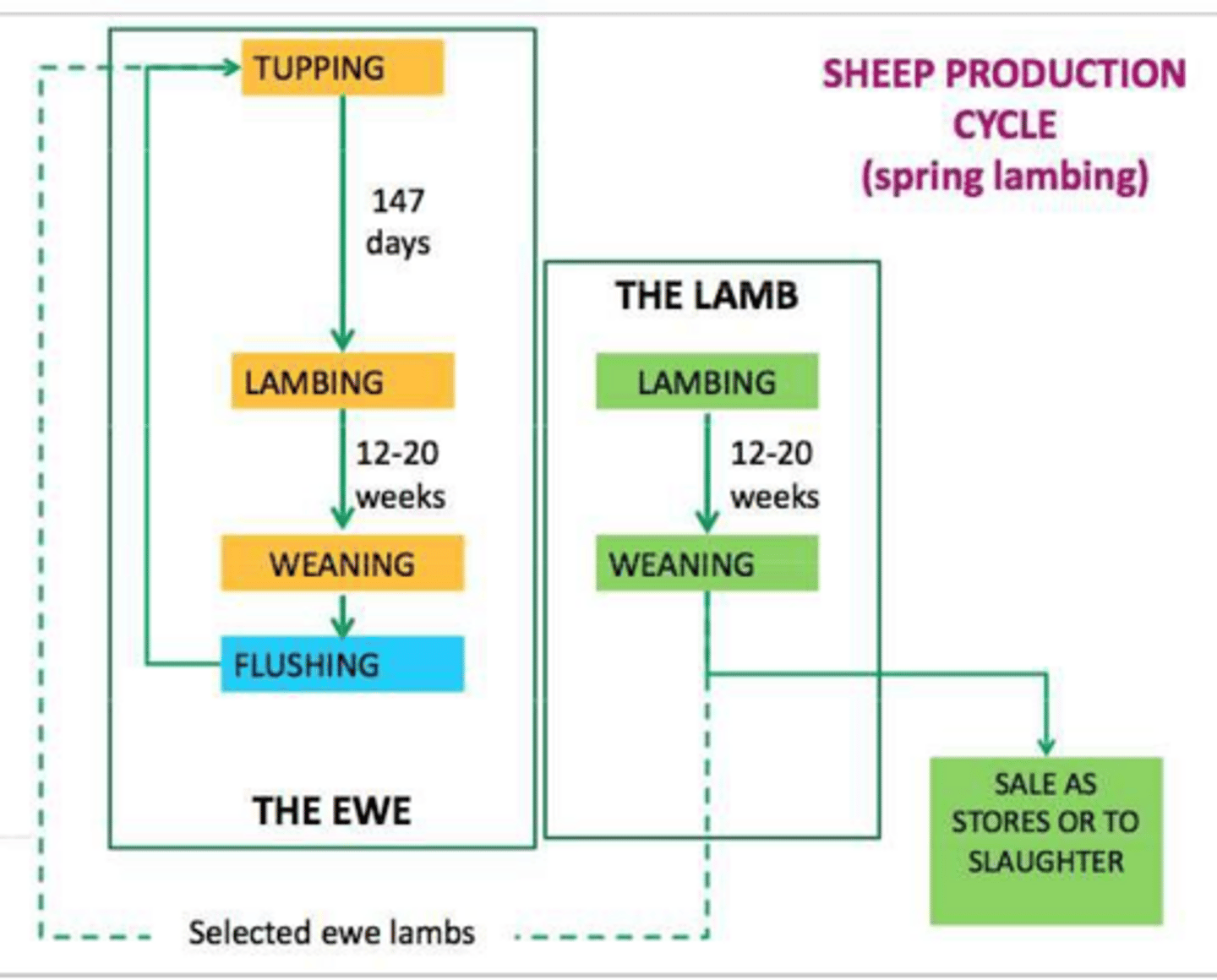
When is the 'flushing' process typically implemented in breeding females?
Two to four weeks prior to breeding.
What are the three general categories of the beef cattle production system?
The cow-calf segment, the backgrounding or stocker phase, and the finishing stage.
What is the main goal of the 'backgrounding' or 'stocker' phase in beef cattle production?
To add body weight to recently weaned calves, resulting in yearlings that are feedlot ready.
What is the primary function of the 'finishing' stage in beef cattle production?
To feed cattle until they reach market weight.
Why do performance animals require higher levels of dietary fats?
Fats are a dense source of energy that helps improve endurance.
What is the role of protein in the diet of performance animals?
It aids in muscle repair and maintenance.
Why is water intake critical for performance animals?
Dehydration negatively affects performance and recovery time.
What are the primary roles of carbohydrates in production/food animals?
They serve as the primary energy source for muscle movement, milk production, and body maintenance.
Which vitamins are fat-soluble and require dietary fats for absorption in production animals?
Vitamins A, D, E, and K.
What are the consequences of nutritional imbalances in breeding males?
Nutritional imbalances can reduce libido and fertility.
Which specific nutrients are essential for maintaining reproductive health in breeding males?
Proteins and minerals, specifically zinc, selenium, Vitamin E, and omega-3 fatty acids.
What is the primary goal of feeding mature females at 'maintenance levels'?
To support the immune system and organ health while preventing nutritional deficiencies when the animal is not pregnant, lactating, or performing.
What is Body Condition Scoring (BCS) used for in mature females?
To maintain weight and condition for a specific purpose, activity, or to prepare for the next breeding cycle.
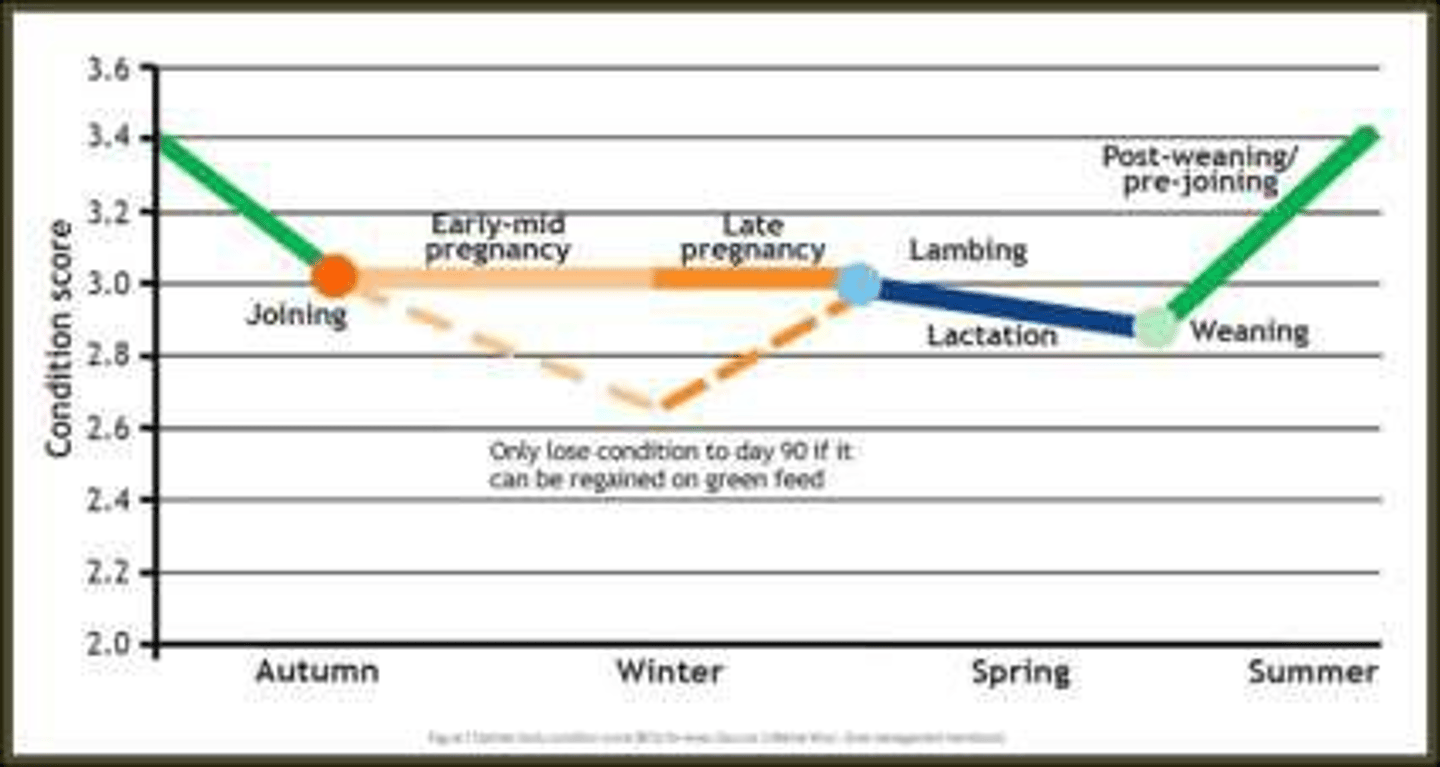
What happens to fetal growth during the 1st and 2nd trimesters of gestation?
There is minimal fetal growth, so the animal is typically fed a maintenance diet with supplements.
What percentage of fetal growth occurs during late gestation?
70 to 80 percent of total fetal growth.
Why do animals in late gestation require a nutrient-dense diet despite having a decreased stomach capacity?
Because of the rapid fetal growth (70-80%) and the high energy demands of the developing fetus.
How does carrying multiple fetuses affect a dam's dietary requirements?
Dams carrying multiple fetuses have significantly higher dietary nutrient requirements compared to those carrying singles.
What condition can develop in sheep and goats if dietary energy requirements are not met during late gestation?
Pregnancy Toxaemia.
What is the role of water in production animals?
It is essential for hydration, regulating body temperature, digestion, and the elimination of waste.
Which trace minerals are particularly important for sperm production in boars?
Zinc (Zn) and Selenium (Se).
What are the primary roles of protein in production/food animals?
It aids in muscle development, tissue repair, and immune function.
What are the primary benefits of proper nutrition during late gestation for offspring?
Development of strong offspring, high birth weights, good vigor (quick to stand and suckle), and support for maternal udder development and colostrum quality.
Why is the early stage of lactation considered the most demanding period for a dam?
Milk production has the highest energy demands, requiring increased dietary energy and protein intake.
What is the recommended supplementation for lactating dams to support milk quality and neonatal immunity?
Supplementation with Vitamin A and Vitamin E.
How does the water requirement for a lactating female compare to a non-lactating one?
Lactating females require 2 to 3 times more water.
What is the primary goal of the late lactation period for breeding females?
It serves as a transition period to replenish fat reserves before being bred again.
What are the health risks associated with poor nutrition during lactation?
Mastitis, ketosis, and calcium deficiency (milk fever).
Why is the first colostrum intake critical for a neonate?
It provides passive transfer of immunity, which is essential for developing the immune system and resisting diseases.
What is the recommended timeframe for the first colostrum intake in neonates?
Within the first 12 to 24 hours of life.
What is the standard volume of colostrum recommended for a single feeding in neonates?
10-12% of the animal's body weight, typically 3-4 liters.
What is the general daily milk feeding rate for young animals as a percentage of body weight?
10-15% of their body weight per day.
How do you calculate the daily milk volume requirement for a young animal?
Milk Volume = Body Weight × Feeding rate percentage.
What is the ideal Calcium to Phosphorus (Ca:P) ratio for most young animals?
2:1.
Why are Calcium and Phosphorus critical for young animals?
They are essential for bone development and skeletal strength.
What is the minimum protein requirement for creep feed in growing animals?
At least 16% protein in dry matter (DM).
At what age should neonates typically be introduced to solid food (creep feeding)?
As early as one week old.
What are the benefits of creep feeding for young animals?
Provides supplemental nutrients, develops healthy stomach/intestine function (rumen development), improves feed conversion rates, and reduces weaning stress.
What specific nutrients are required to support thermoregulation and organ growth in neonates?
High energy and digestible protein.
How does nursing multiple offspring (twins/triplets) affect a dam's nutrient requirements compared to a single offspring?
Dams nursing multiple offspring have significantly higher nutrient requirements than those nursing a single offspring.
What are the key components of a balanced diet for a lactating dam?
Carbohydrates, protein, fats, water, minerals, and vitamins.
What is the purpose of creep feeding in relation to weaning?
It helps transition the animal from milk to solids, resulting in less stress at the time of weaning.
What is the recommended Ca:P ratio specifically for creep feed to support bone growth?
1.5:1.
What are the long-term benefits of proper nutrition in young animals?
Ensures survival until weaning, boosts immunity, and increases the likelihood of lifetime productivity and health.
If a 4-day-old calf weighs 80kg and requires milk at 12% of its body weight, what is the total daily volume and volume per feeding (if fed 3 times daily)?
Total daily volume: 9.6 liters; Volume per feeding: 3.2 liters.