T4 Baena- To hunger or to thirst: plant water-use and photosynthesis
 Call Kai
 Learn
Learn Practice Test
 Spaced Repetition
 Match
Match Flashcards
 Knowt Play
1/6

There's no tags or description
Looks like no tags are added yet.
Name | Mastery | Learn | Test | Matching | Spaced | Call with Kai |
|---|
No analytics yet
Send a link to your students to track their progress
7 Terms
how is leaf conductance determined?
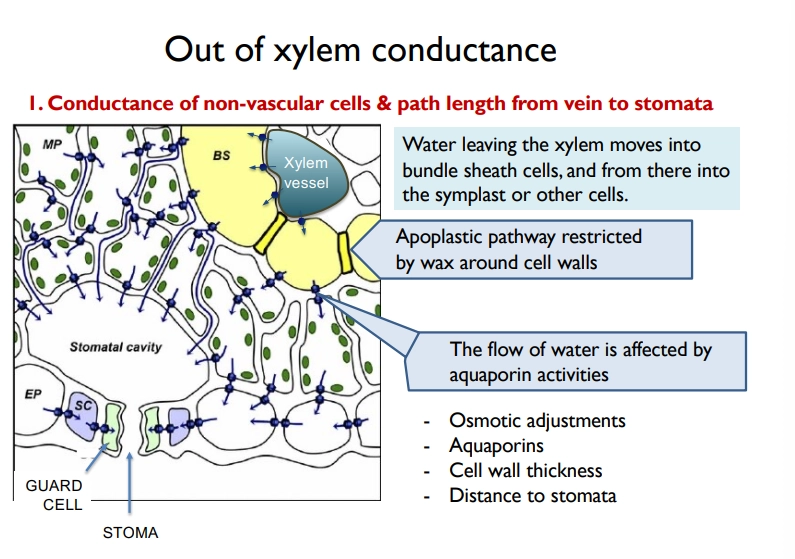
the conductance (efficiency of water transport) in leaves is determined by:
the xylem conductance- vessel composition, length, diameter + abundance and pit structure + density
out-of-xylem conductance- conductance of cells, path length to stomata (minimised by fine veins in angiosperms), stomatal density + aperture
the apoplastic pathway is initially restricted by the bundle sheath cells (lignin + suberin layer) around the xylem to control salts + pathogens- only path is through aquaporins
this means conductance is also dependent on aquaporin activity, osmotic adjustments + cell wall thickness
how is water use efficiency determined and how does it vary?
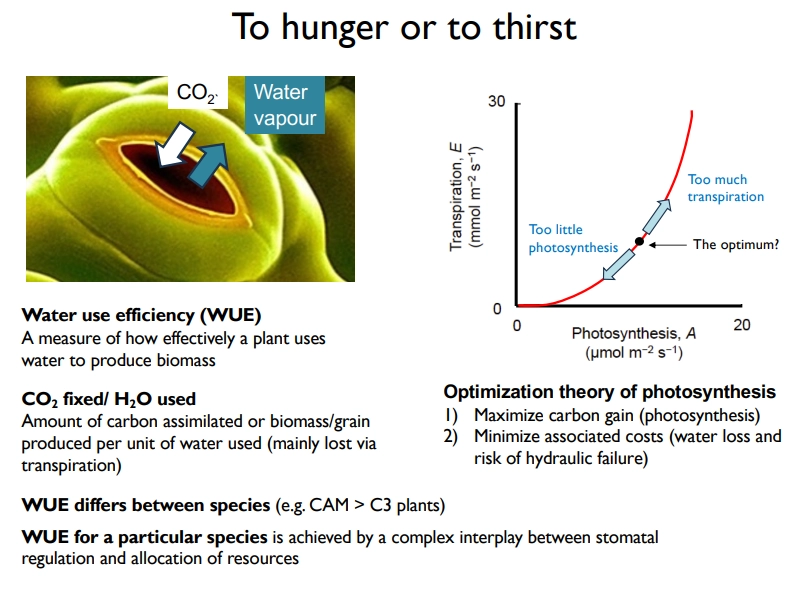
water use efficiency = CO2 fixed in biomass/H2O used (mainly lost in transpiration)
this is important due to the optimisation theory of photosynthesis- plants have to strike a balance between maximising carbon fixation by photosynthesis and minimising water loss + risk of hydraulic failure (trade-off)
this varies between species (due to different photosynthesis types) and is regulated by changing stomatal aperture and density + resource allocation
how is transpiration affected by temperature?
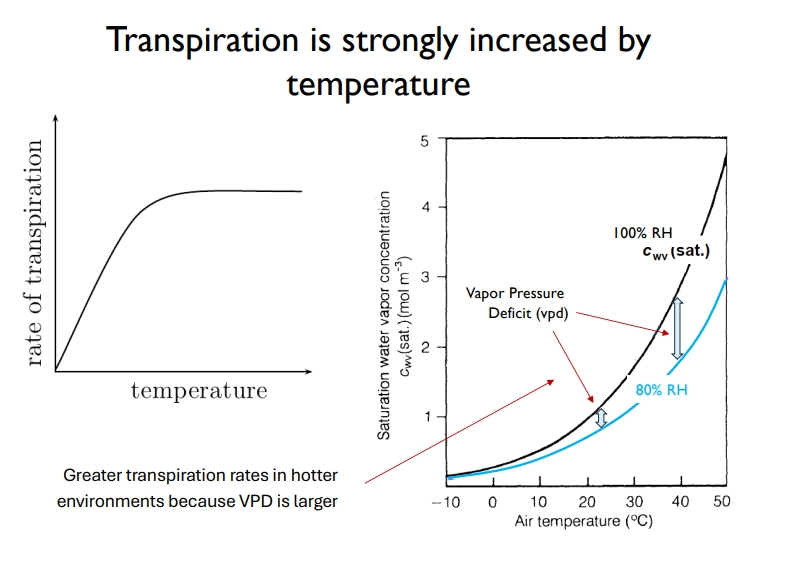
as temperature increases, the atmosphere has more capacity to hold water vapour (non-linear relationship)
at higher air temperatures, the difference between the maximum theoretical humidity and the real humidity is greater- greater vapour pressure deficit
this increases transpiration
how efficiently is solar energy used by plants?
only about 5% of solar energy goes into biomass
60% is not absorbed
some is lost as heat (reflection of long-wavelength radiation, ‘sensible’ conduction + convection of air, and ‘latent’ evaporative cooling from transpiration)
some is lost in metabolism, maintenance + repair
why did plants evolve leaves?
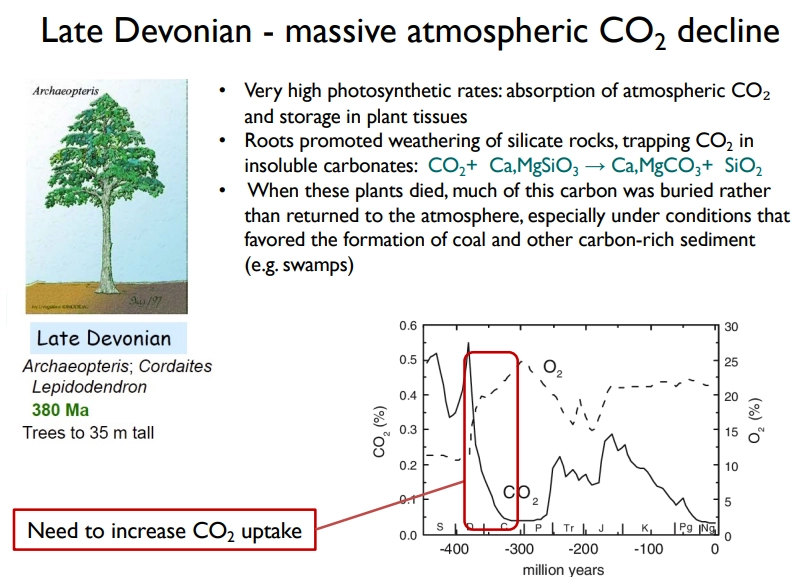
in the late devonian period, there was a massive decrease in atmospheric CO2 (in photo)
this required the evolution of leaves and an increase in stomatal density
how have plants adapted to survival in water-limited environments?
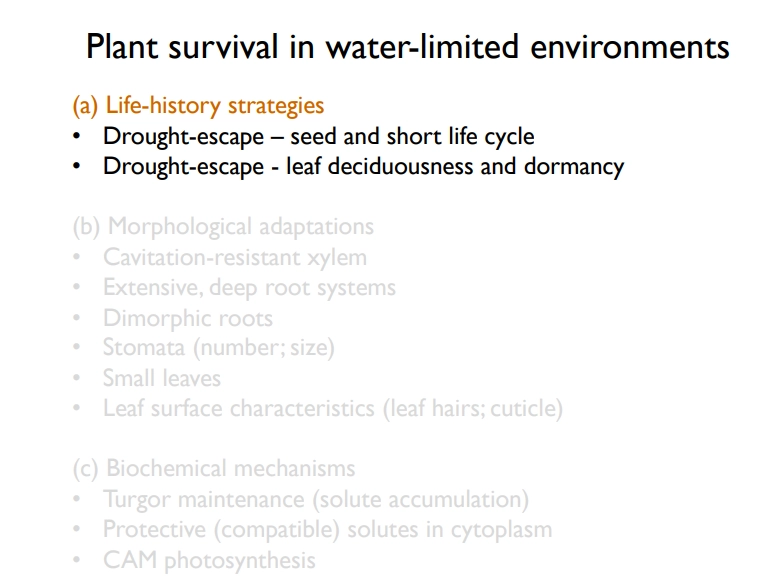
life history stratgeties:
drought escape- short, ephemeral life cycles with dormant seeds that germinate after rainfall
drought-deciduous- long-lived, enters dormancy + sheds leaves (fertile soil to regrow leaves)’
morphological features:
lignified tracheid pores to resist embolism
dimorphic roots- tap roots (reach deep water + hydraulic lift), lateral roots (nutrient uptake) and/or ephemeral surface roots (after rain, secrete acids to solubilise + absorb phosphate)
small leaves- less transpiration + more sensible heat loss
leaf hairs in summer leaves (less photosynthesis but more water conservation)
biochemical mechanisms:
accumulation of compatible solutes to lower protoplast water potential in high salinity
CAM photosynthesis
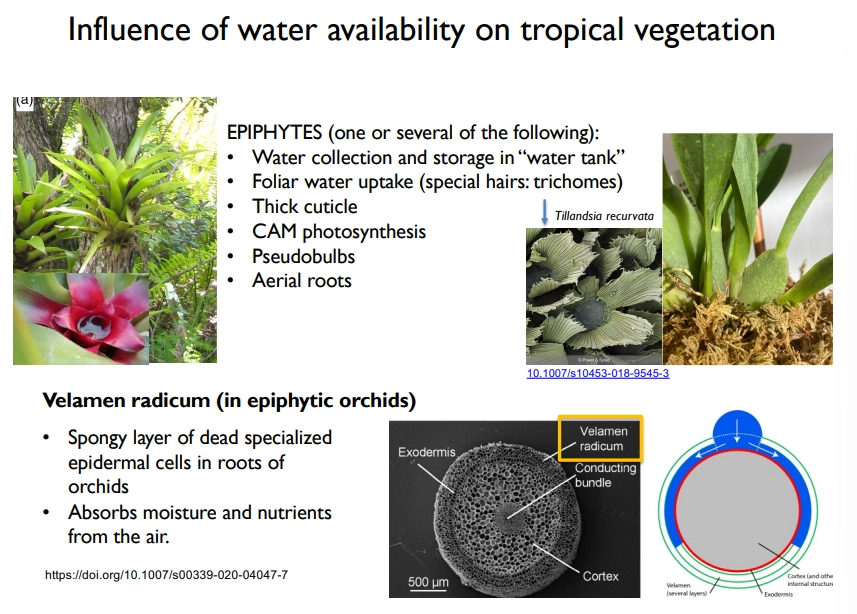
how do epiphytes adapt to water availability?
because epiphytes don’t live on the ground, their access to water is not reliable/consistent
they collect water and store it in water tanks
trichome hairs on leaves assist water capture
thick cuticle
CAM photosynthesis
pseudobulbs
aerial roots
specialised spongy epidermis around roots in epiphytic orchids