EG-182 Manufacturing technology
 Call Kai
 Learn
Learn Practice Test
 Spaced Repetition
 Match
Match Flashcards
 Knowt Play
1/203

Earn XP
Description and Tags
year 1 summer exams
Name | Mastery | Learn | Test | Matching | Spaced | Call with Kai |
|---|
No analytics yet
Send a link to your students to track their progress
204 Terms
what does manufacturing do?
It transforms raw materials into useful, functional items through controlled processes.
Technological definition
Application of physical and chemical processes to transform materials into products
Technological key idea
manufacturing adds value by changing material form or properties
Economic definition
Sequence of operations that add value to materials by turning them into products customers want
Economic key idea
Manufacturing adds value and utility making materials more useful and desirable
What is the share of UK output (GVA) from manufacturing?
8.8%
What is the share of employment in manufacturing?
7.9%
What is the global ranking (2022) of the UK in manufacturing?
dropped to 12th
What is the historical output in USD (2023) of the UK?
$279-284 billion
What are primary industries?
Extract raw, natural materials
What are secondary industries?
Process raw materials and create products
What are tertiary industries?
provide a service (probably using these products directly/ indirectly
What two main categories can final products made by manufacturing industries be grouped into?
Consumer good and capital goods
What are consumer goods?
bought by individuals for personal use (use it)
What are capital goods?
Bought by companies to make products or deliver services (use it to make something else)
Production quantity definition
the number of units produced annually of a given product type
Product variety definition
the number of different types of products made
What are the three ranges of production quantity?
Low production
Medium production
High production
How many units per year is low production?
up to 100
How many units a year is medium production?
100 to 10,000
How many units per year is high production?
10,000 to millions
What are the two basic types of manufacturing operations?
Processing operations
Assembly operations
What is processing operations?
transforms a work material from one state of completion to a more advances state that is closer to the final desired product - usuals performed on discrete work parts
What are assembly operations?
joins two or more components to create a new entity, called an assembly, subassembly, or other term.
When is casting most suitable?
When:
Geometry is complex
Internal features are required
Production volumes are medium to high
When might casting not be ideal?
When:
Very tight tolerances are required
Surface finish is critical
Production volume is very low
Casting of metals definition
Process in which molten metal flows by gravity or other force into a mould where it solidifies in the shape of the mould cavity
Steps of casting
Melt the metal
Pour it into a mould
Let it freeze
What is - Can create complex part geometries - an advantage of?
Casting
What is- Can create both external and internal shapes- an advantage of?
Casting
What is -some casting processes are net shape; other are near net shape- an advantage off?
Casting
What is net shape?
No further shaping/ machining necessary
What is - Can produce very large parts- an advantage of?
Casting
What is- some casting methods are suited to mass production- an advantage of?
Casting
What is- limitations on mechanical properties- a disadvantage off?
Casting
What is- Poor dimensional accuracy and surface finish for some processes- a disadvantage off?
Casting
What is- safety hazards to workers due to hot molten metals- a disadvantage off?
Casting
What is environmental problems a disadvantage off?
Casting
The mould in Casting:
Contains the cavity whose geometry determines part shape
Actual size and shape of cavity must be slightly enlarged to allow for shrinkage of metal during solidification and cooling
Moulds are made of a variety of materials, including sand, plaster, ceramic and metal
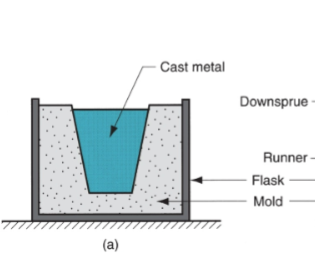
What type of casting mould is this? give description
open mould
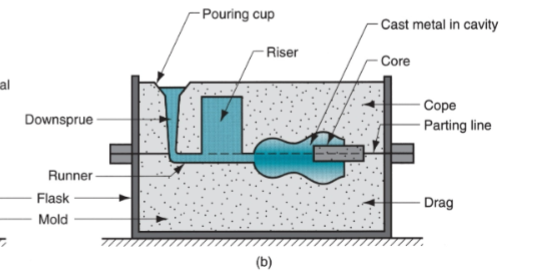
What type of casting mould is this? give description
closed mould for more complex mould geometry
with gating system leading into the cavity
What are the two categories of casting processes?
Expendable mould processes
Permanent mould processes
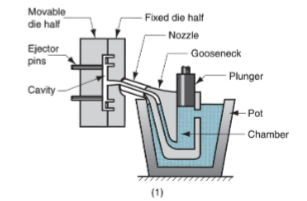
What are Permanent mould processes in casting?
Use a permanent mould which can be used to produce many casting
Made of metal (~or, less commonly, a ceramic refractory material)
What are Expendable mould processes in casting?
Use an expendable mould which must be destroyed to remove casting
Mould materials; sand, plaster and similar materials, plus binders
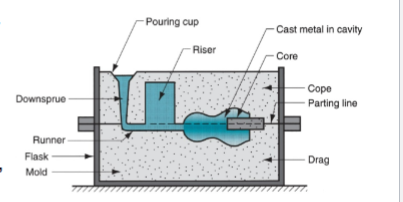
What are the advantages and disadvantages of an expendable mould?
mould is sacrificed to
remove part
Advantage: more complex shapes possible
Disadvantages: production rates often limited by the
time to make mould rather than casting itself
What are the advantages and disadvantages of a permanent mould?
mould is made of metal
and can be used to make many castings
Advantage: higher production rates, more economic
Disadvantage: geometries limited by need to open
mould
Why are most commercial castings made of alloys rather than pure metals?
Alloys are generally easier to cast, and properties of product
are better
Cast iron is most popular; tonnage exceeds that of all other
metals combined
What can casting alloys be classified as?
Ferrous
Non-ferrous
What are the advantages and disadvantages of steel?
Advantages: Highly attractive mechanical properties
Disadvantages: Steel readily oxides at pouring temp, must be isolated from air and have poor fluidity
What are the advantages and disadvantages of cast iron?
Advantages:
Attractive mechanical properties, lower pouring temp than steel
Most widely used material
Disadvantages:
Higher pouring temp than non- ferrous materials
What are the advantages and disadvantages of copper alloys (brass, bronze)?
Advantages:
Corrosion resistance
Attractive appearance
Disadvantages
High cost of copper
What are the advantages and disadvantages off Aluminium?
Advantages:
Highly castable
Light weight
Easy to machine
Heat treatment can improve mechanical properties
Disadvantages:
Mechanical properties not as great as ferrous materials
Soft metal
What are the advantages and disadvantages of zinc?
Advantages:
Very castable
Low pouring temp
Good fluidity
Disadvantages
Low creep strength
What is the pouring temp of steel?
1600
What is the pouring temp of Cast iron?
1400
What is the pouring temp of Copper alloys (brass, bronze)?
1085
What is the pouring temp of Aluminium?
419
What steps is the total heat required a sum off?
1. Heat the solid metal
From room temperature to melting point ( T0-Tm
2. Melt the metal
Energy required for solid → liquid (heat of fusion)
3. Heat the liquid metal
From melting point to pouring temperature ( Tm-Tp
What is the heat required equation ?
H=pV(Cs(Tm-To)+Hf+Cl(Tp-Tm))
What is the H in the heat required equation?
total heat required to raise the temperature of the metal to the pouring temperature, J
What is the p in heat required equation?
density, g/cm3
What is the Cs in the heat required equation?
weight specific heat for the solid metal, J/g-C
What is the Tm in the heat required equation?
melting temperature of the metal, C
What is the To in the heat required equation?
starting temperature—usually ambient, C
What is the Hf in the heat required equation?
heat of fusion, J/g
What is the Cl in the heat required equation?
weight specific heat of the liquid metal, J/g-C
What is the Tp in the heat required equation?
pouring temperature, C
What is the V in the heat required equation?
volume of metal being heated, cm3
What is the heat required equations in words?
Mass × energy to heat it + melt it + get it ready to pour
Why is the heat required equation not fully realistic?
Material properties change as temperature increases
Solid and liquid metals behave differently
Most engineering metals are alloys, not pure metals
Real furnaces lose heat to their surroundings
What is a cupola?
Vertical shaft furnace for continuous
melting of cast iron used in casting
What is a crucible?
Metal melted in a refractory crucible
(small batches) in casting
What is an electric arc?
Metal melted using heat from an
electric arc (mainly steel) used in casting
What is induction?
Metal melted by electromagnetic
heating with good control used in casting
What is an expendable mould process?
mould must be destroyed and reconstructed for each part
What is the sand casting production sequence?
1. Create a pattern of the final part
2. Create the mould
3. Pour the molten metal into sand mould
4. Allow time for metal to solidify
5. Break up the mould to remove casting
6. Clean and inspect casting
• Remove gating and riser system
7. Heat treatment of casting is sometimes required to improve metallurgical properties
What are the three pattern materials of sand casting?
Wood
Metal
Plastic
Why is wood used as a pattern material in sand casting?
common material because it is easy to work, but it warps
Why is metal used as a pattern material in sand casting?
more expensive to fabricate, but lasts longer
Why is plastic used as a pattern material in sand casting?
compromise between wood and metal
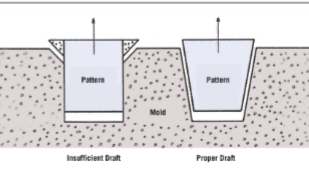
What must a pattern have to allow for a pattern?
A draft, gating and riser system
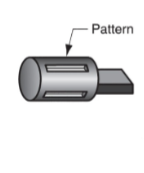
What type of pattern used in sand casting is this?
Solid pattern
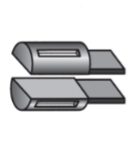
What type of pattern used in sand casting is this?
Split pattern
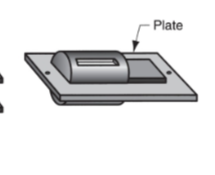
What type of pattern used in sand casting is this?
Match-plate pattern
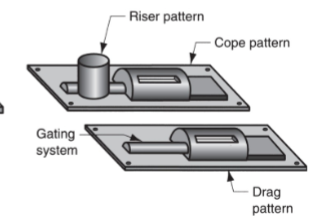
What type of pattern used in sand casting is this?
Cope and drag pattern
How is a cavity in a sand mould formed?
by packing sand around a pattern, then separating the mould into two halves
and removing the pattern
Describe the sand used for a sand mould
moist and contains a binder to maintain its shape
What must a sand mould have to have internal surfaces?
A core
What is a expendable process and how do it refer to a sand mould?
A new sand mould must be made for each part produced
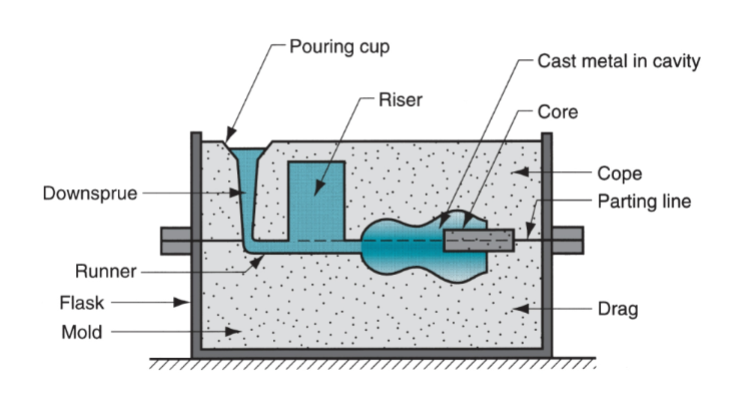
What is this a mould for?
Sand casting
What requirements do a mould have to have in sand casting?
Strength
Permeability
Thermal stability
Collapsibility
Reusability
What is the primary sand casting material used?
Foundry sand (Silica, Si02)
What is the ‘binder’ in sand casting ?
Sand is held together by a mixture of water and bonding
clay
What is the typical mix of ‘the binder’ in sand casting?
90% sand, 3% water, and 7% clay
What two halves does a mould consist of in sand casting?
Cope = upper half of mould
Drag = bottom half
What is the box called that contains the mould halves in sand casting?
A flask
What separates the two halves in sand casting?
the parting line
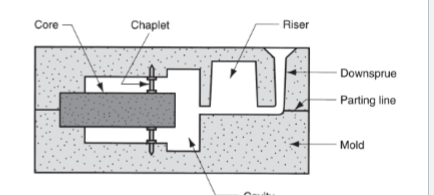
What is this diagram?
The core in sand casting
What is a chaplet in sand casting?
Made from metal with a higher melting temperature than the casting
metal
These chaplets bonded into the final casting – the protruding sections
are machined off
What is a gating system in sand casting?
Channel through which molten metal flows into cavity from
outside of mould