Purine & Pyrimidine Metabolism
 Call Kai
 Learn
Learn Practice Test
 Spaced Repetition
 Match
Match Flashcards
 Knowt Play
1/22

There's no tags or description
Looks like no tags are added yet.
Name | Mastery | Learn | Test | Matching | Spaced | Call with Kai |
|---|
No analytics yet
Send a link to your students to track their progress
23 Terms
Synthesis and degradation of nucleotides.
Biochemical Importance of Nucleotides
Nucleotides are precursors to DNA and RNA.
Nucleotides are precursors to metabolites like UDP-glucose (glycogen) and CDP-diacylglicerol (phosphoglicerides).
Nucleotides serve as metabolic regulators (through phosphorylation, etc.)
Intracellular messengers. (cAMP and cGMP)
Important diseases like gout, Lesh-Nyhan, and ADA deficiency.
Drugs like AZT, and anticancers drugs.
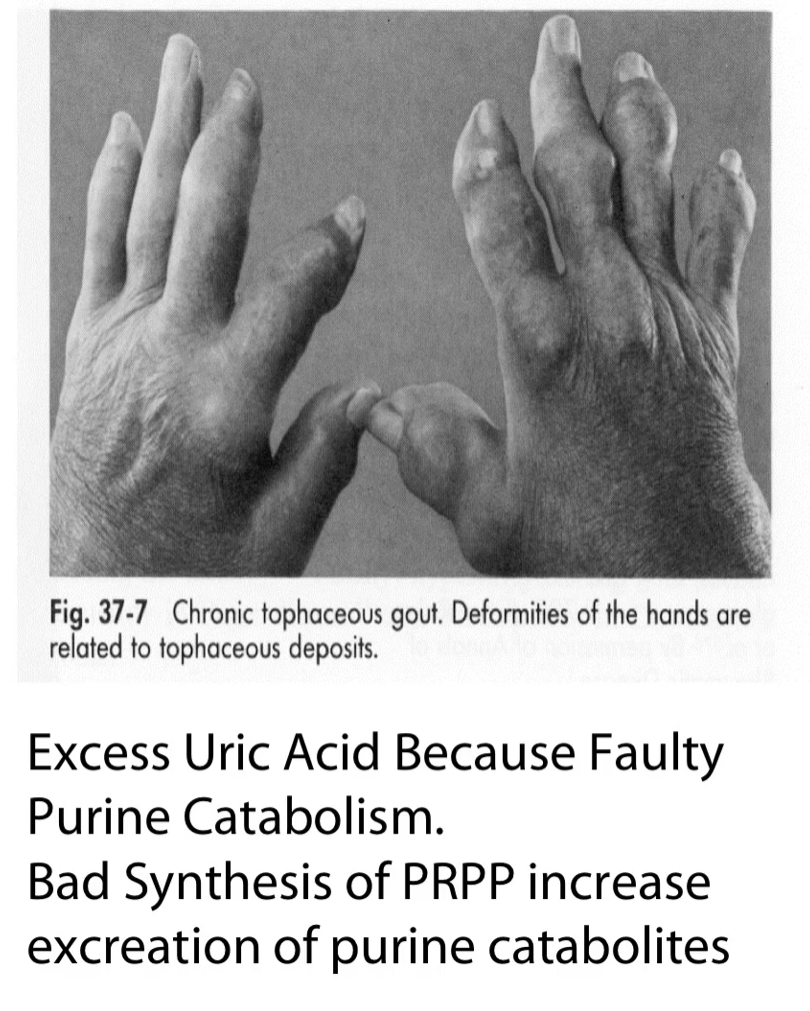
Gout
“goute” = drop
“drop” = uric acid crystal deposition
What it is
A metabolic disease caused by elevated uric acid (hyperuricemia)
Leads to crystal deposition in joints
Cause
Breakdown of purines → uric acid
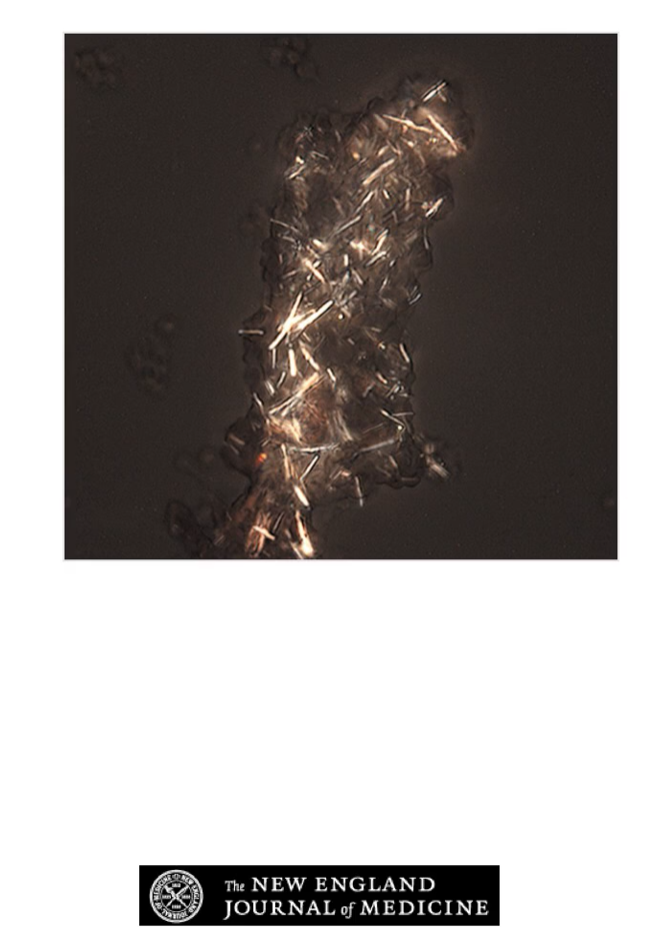
When uric acid is too high → forms monosodium urate crystals
These crystals deposit in joints → trigger inflammation
Classic presentation
Sudden, severe joint pain (acute gout attack)
Most commonly:
Big toe (1st MTP joint) → podagra
Other signs:
Redness
Swelling
Warmth
Pathophysiology
Uric acid crystals are recognized as “foreign”
Activate immune response → neutrophils → inflammation
Key connection to your slide
Gout is a disorder of nucleotide (purine) metabolism
👉 Excess breakdown → excess uric acid
Lesh-Nyhan Syndrome
Named after two physicians:
Michael Lesch
William Nyhan
They first described the disorder in 1964
Lesch–Nyhan syndrome
What it is
A genetic disorder of purine metabolism
Causes overproduction of uric acid
X-linked recessive (mostly affects males)
Cause
Deficiency of the enzyme:
Hypoxanthine-guanine phosphoribosyltransferase (HGPRT)
HGPRT = an enzyme that transfers a phosphoribosyl group to hypoxanthine and guanine
It recycles purines instead of making new ones
This enzyme is part of the purine salvage pathway
Pathophysiology (high-yield)
Normally: HGPRT recycles purines
Without it:
❌ Purines are not salvaged
↑ De novo purine synthesis
↑ Breakdown → ↑ uric acid
Leads to gout-like symptoms
Classic triad (VERY important)
Hyperuricemia
Gout
Kidney stones
“Orange sand” (urate crystals in diapers)
Neurologic dysfunction
Developmental delay
Choreoathetosis (abnormal movements)
Self-mutilation
Biting lips, fingers
This is the buzzword feature
ADA Deficiency
What is ADA?
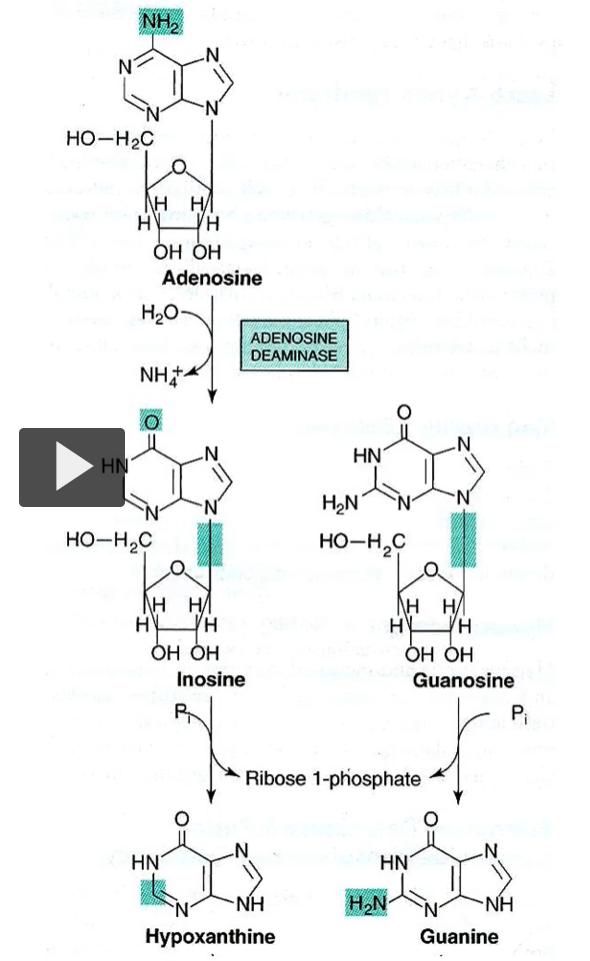
ADA = adenosine deaminase
Enzyme in purine metabolism
What happens in deficiency
ADA normally converts:
adenosine → inosine
Without ADA:
↑ adenosine
↑ deoxyadenosine
↑ dATP
dATP buildup is toxic to lymphocytes
Key effect
Inhibits ribonucleotide reductase
↓ DNA synthesis
Lymphocytes (T & B cells) cannot proliferate
Disease result
Severe Combined Immunodeficiency (SCID)
Both:
❌ T cells
❌ B cells
What is AZT?
AZT = Azidothymidine
Also called Zidovudine
A nucleoside reverse transcriptase inhibitor (NRTI)
Etymology
Azi-do → refers to an azide (–N₃) group
Thymidine → a DNA nucleoside (thymine + deoxyribose)
So AZT = a modified thymidine molecule
Mechanism (high-yield)
AZT mimics thymidine
Gets incorporated into viral DNA by reverse transcriptase
BUT:
Lacks a 3′-OH group
❌ DNA chain cannot elongate → chain termination
Use
Treatment of HIV
Prevents viral replication
Why it works
HIV relies on reverse transcriptase
AZT specifically targets this step
AZT = fake thymidine → stops HIV DNA synthesis (chain termination)
-thymine is DNA, uracil is RNA and replaces thymine.
anticancer drugs are nucleotide analogs, why?
Cancer cells:
Divide rapidly
Require constant DNA synthesis
Target DNA building → target cancer
How nucleotide analogs work
They are “fake nucleotides” that interfere with DNA/RNA synthesis:
1. Chain termination
Incorporated into DNA
Missing a 3′-OH
DNA cannot elongate
We will start start talking now on the synthesis of nucleotides.
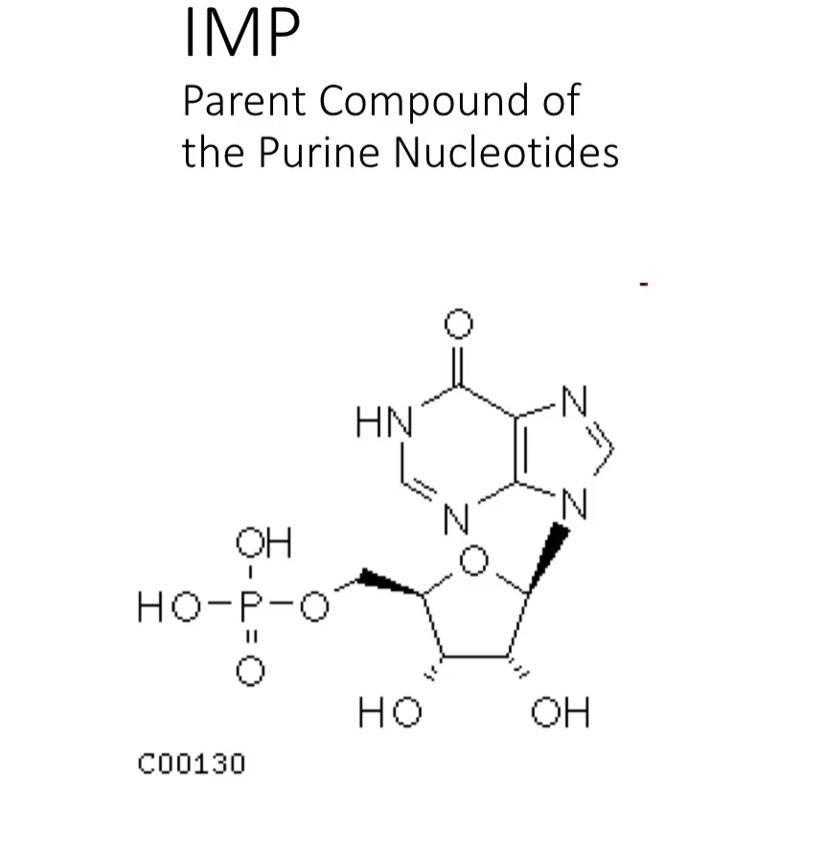
The parent compound for the purine nucleotides is IMP (inositol-monophosphate).
Both purine nucleotides are derived from IMP. (Because IMP (inosine monophosphate) is the first fully formed purine nucleotide made in the de novo synthesis pathway.)
(warning): there is a long sequence of reactions coming up.
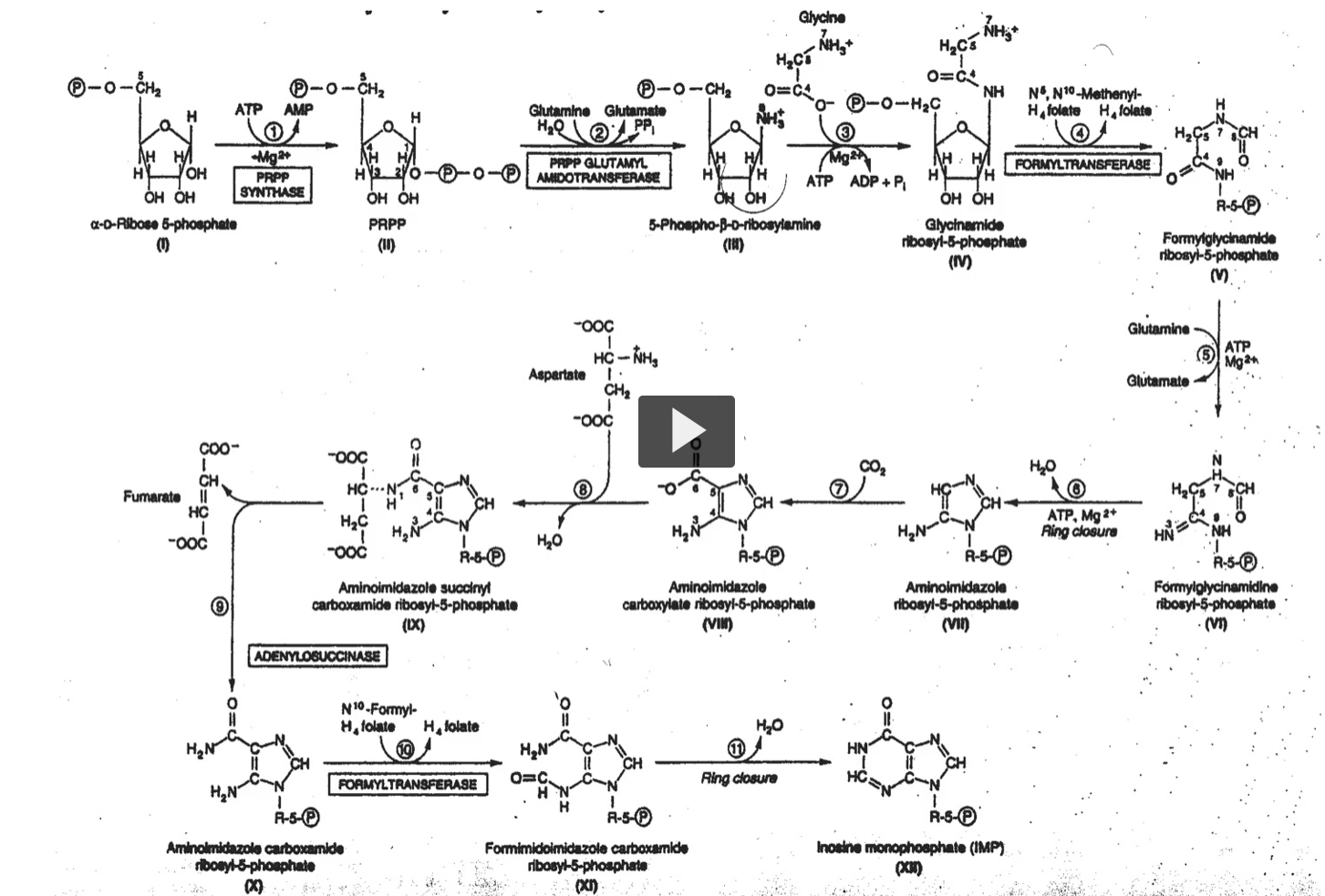
We will go reaction by reaction. This is the overall series of reactions that are involved in the synthesis of IMP.
IMP is the last molecule you see in this sequence. You need 11 reactions to get to IMP.
We will be looking at the reactions in some detail and notice that all the reactions have a number and will be referred to by that number.
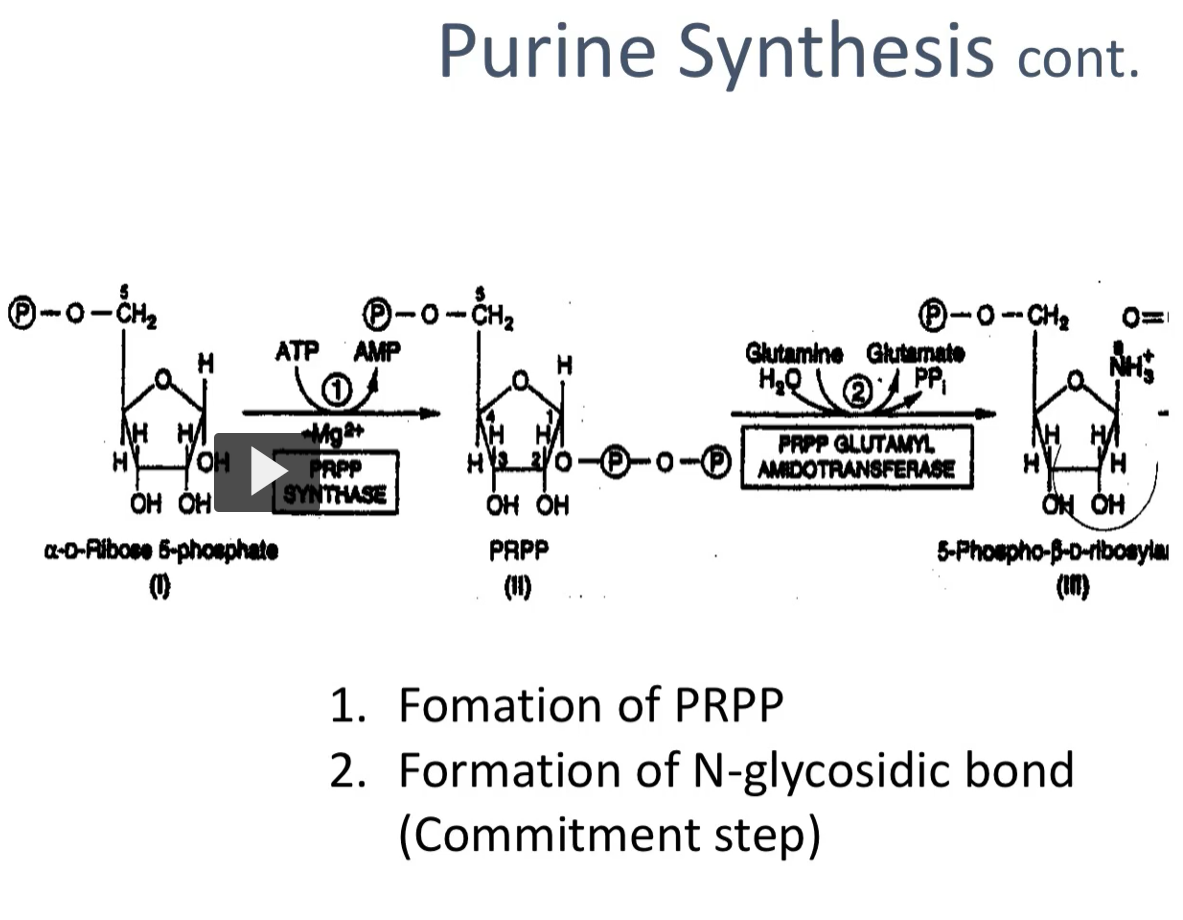
Purine Synthesis cont.
Formation of PRPP
Formation of N-glycosidic bond (Commitment step)
The first reaction is the synthesis of PRPP (phospho-ribo-pyro-phosphate).
a-D-ribose-5-phosphate (PRPP synthase) → PRPP
This first reaction requires ATP. The ATP will donate the pyro-phosphate (two phosphates)
PRPP (PRPP Glutamyl Amido-transferase) → 5-phospho-ribosylamine
PRPP Glutamyl Amido-transferase: Enzyme that transfers an amide nitrogen from glutamine to PRPP
Reaction #2 is the introduction of nitrogen. This nitrogen group is donated by glutamine. Glutamine will use the energy of the pyro-phosphates to move the ammonia into PRPP.
Reaction #2 is a very important reaction for two reasons. The first reason is it is the commitment step. It is the commitment step because there is no other use of 5-phospho-ribosylamine than to create Purine nucleotides.
The second reason is that, in reaction #2, once you put the nitrogen there, you are creating the glycosidic bond. The glycosidic bond is the bond that holds the nitrogen base to the sugar.
Purine Synthesis cont.
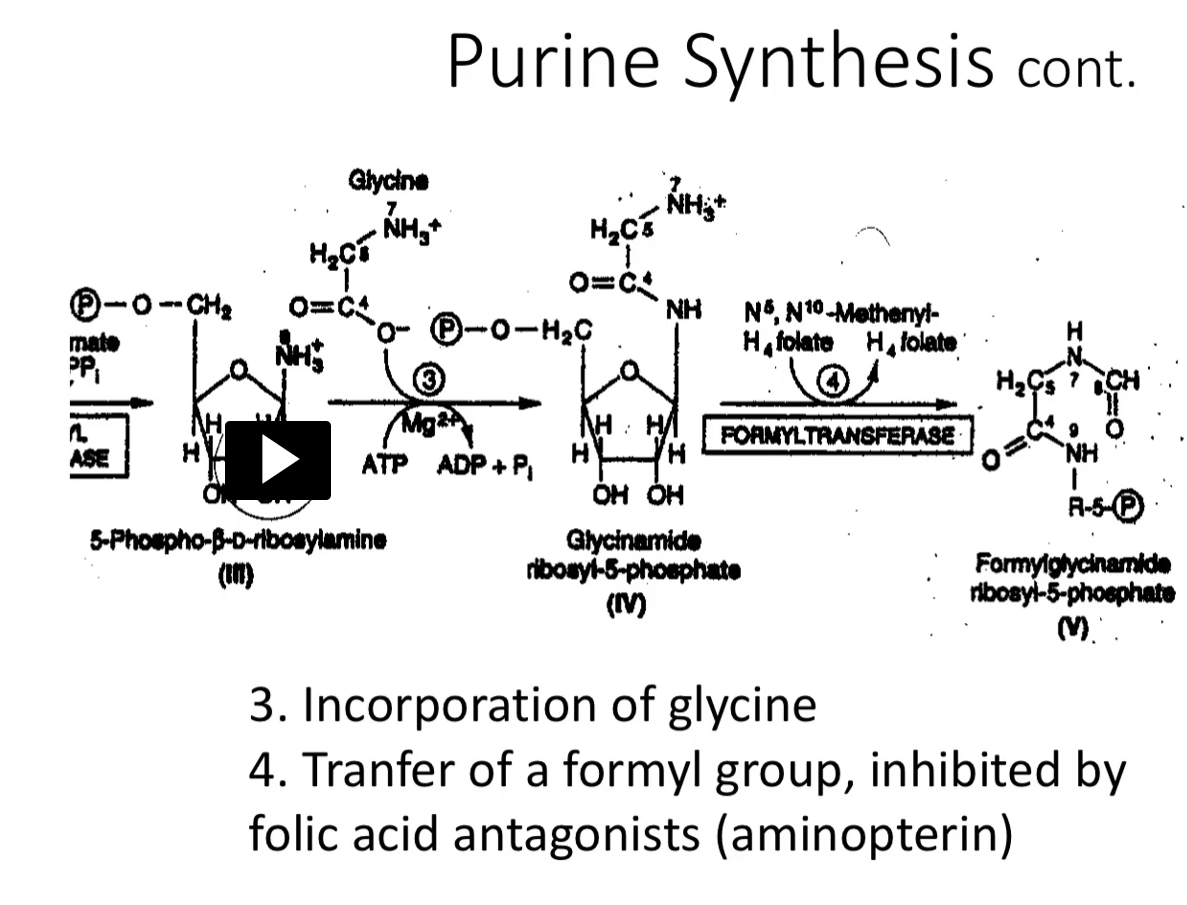
5-phospho-ribosylamine (Glycinamide ribonucleotide synthetase (GAR synthetase) → glycinamide ribosyl-5-phosphate
Incorporation of glycine
Brings in carbon from the amino acid glycine. Glycine will donate its skeleton, it’s attached to the nitrogen of the glycosidic bond and is the start of the nitrogen base. This reaction requires ATP, this reaction consumes one phosphate group. One phosphate group bond, the energy, is used to put glycine in place.
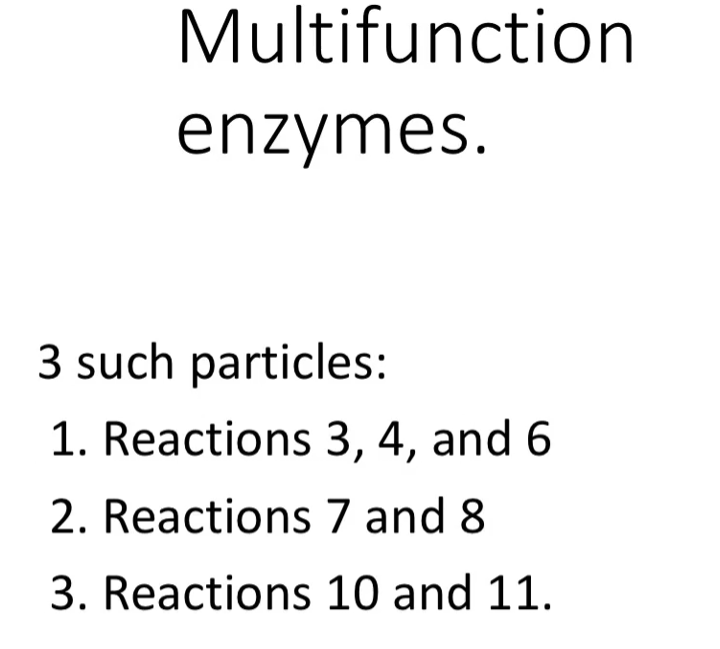
glycinamide ribosyl-5-phosphate (Formyl Transferase) → Formylglycinamide ribosyl-5-phosphate
Formyltransferase = enzyme that transfers a formyl (–CHO) group,
Uses: N¹⁰-formyl-tetrahydrofolate (THF) as the donor
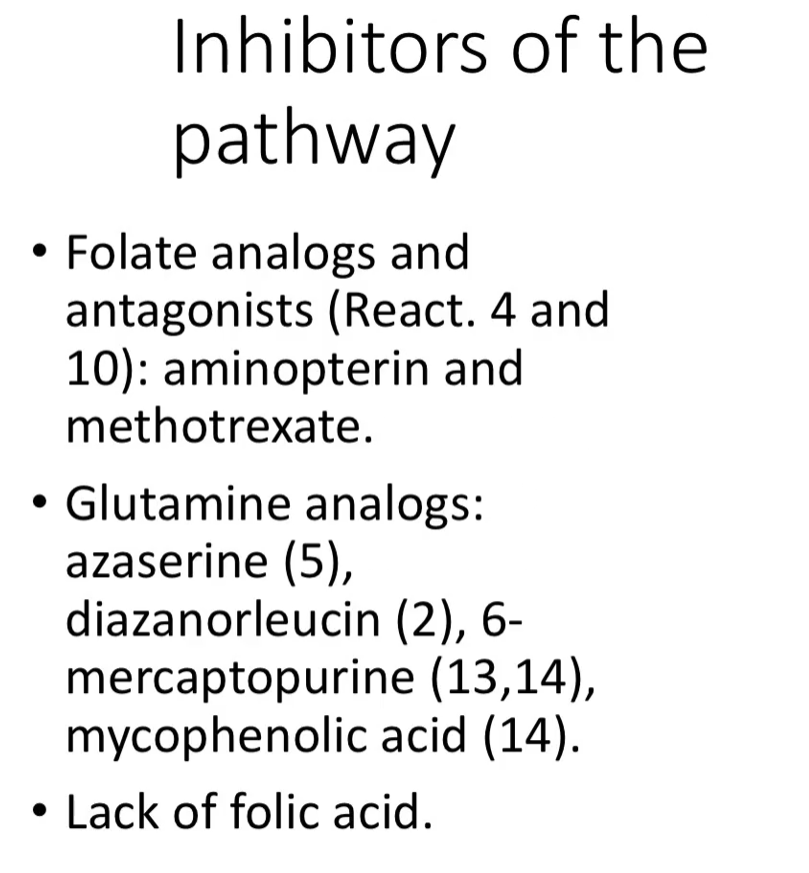
Transfer of a formyl group, inhibited by folic acid antagonists (aminopterin)
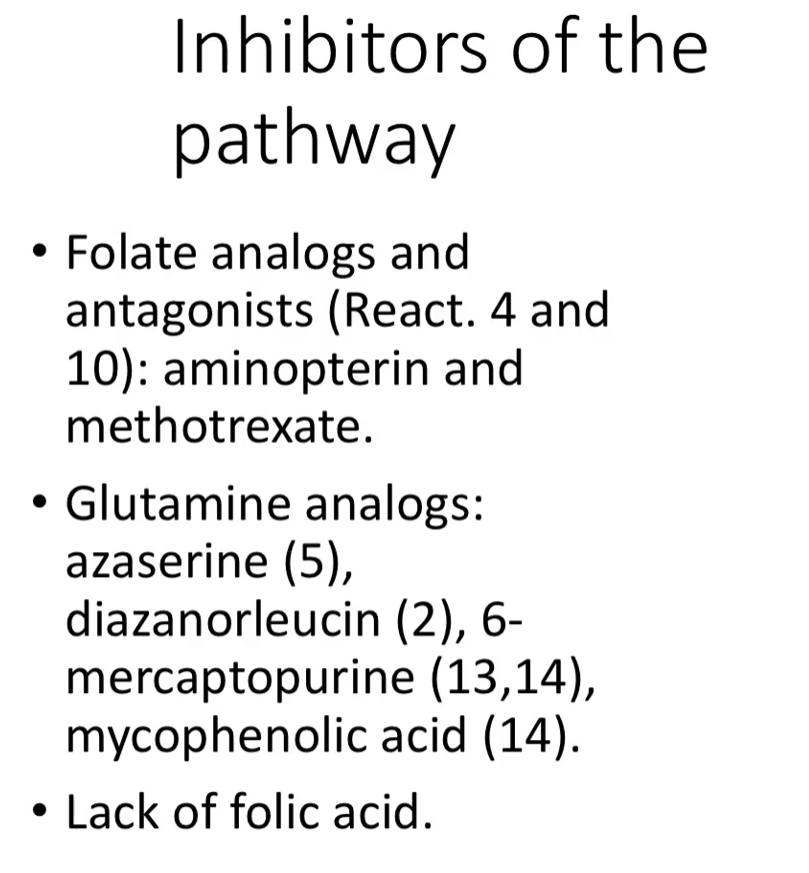
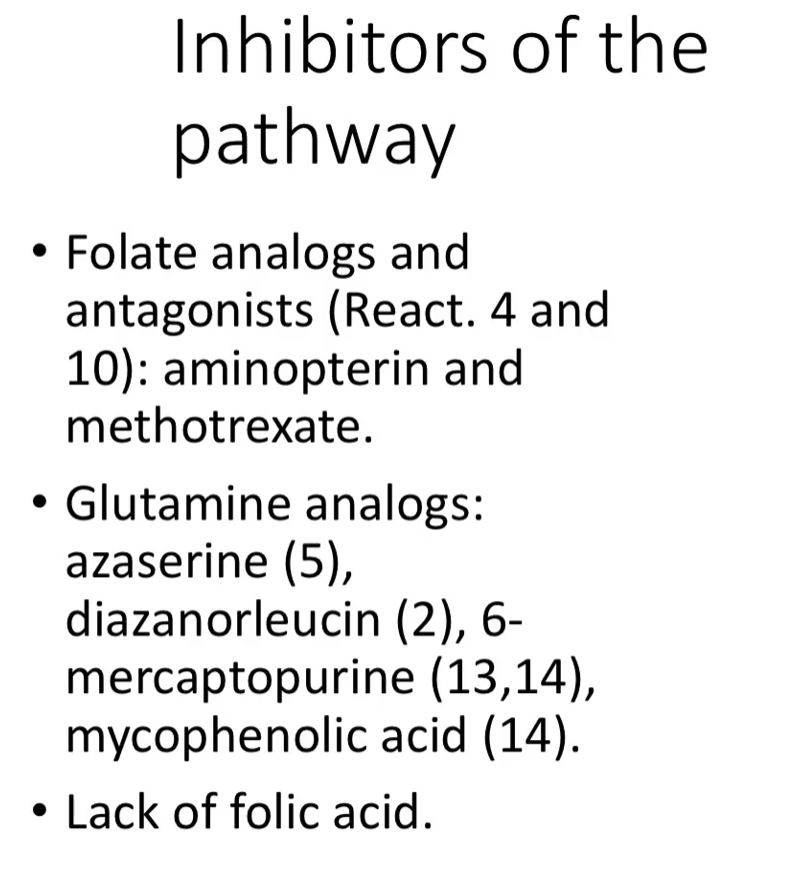
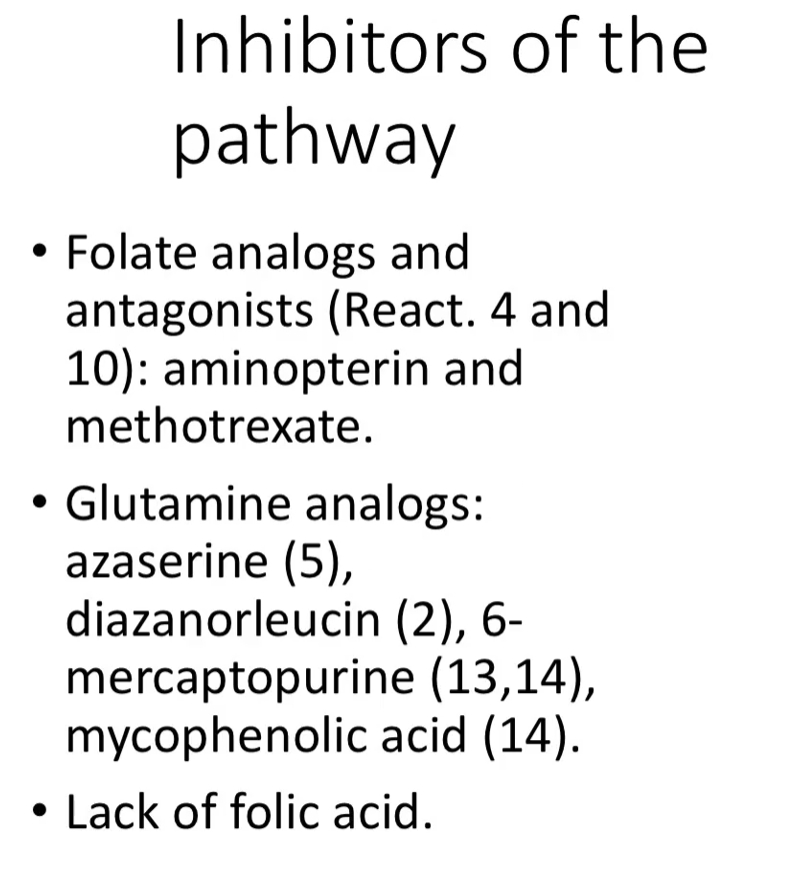
Folate antagonists (e.g., aminopterin, methotrexate):
↓ THF
❌ Block formyl transfer
❌ Stop purine synthesis → ↓ DNA synthesis
That’s why they’re used as anticancer drugs
Reaction #4 is the introduction of a formyl group, derived from formic acid. It’s a one carbon residue. The molecule that usually donates that one carbon units is methyl-tetra-hydryl-folate. This one carbon residue is introduced, this is a place where folic acid antagonists, like aminopterin, will inhibit.
Remember, we will be encountering a couple of reactions that need tetrahydrofolate, things that will inhibit tetrahydrolfolic, for example, lack of folic acid, or aminopterin will inhibit those specific reactions.
This is the first time we encounter the donation of the one carbon mioety of the tetrahydrolfolate.
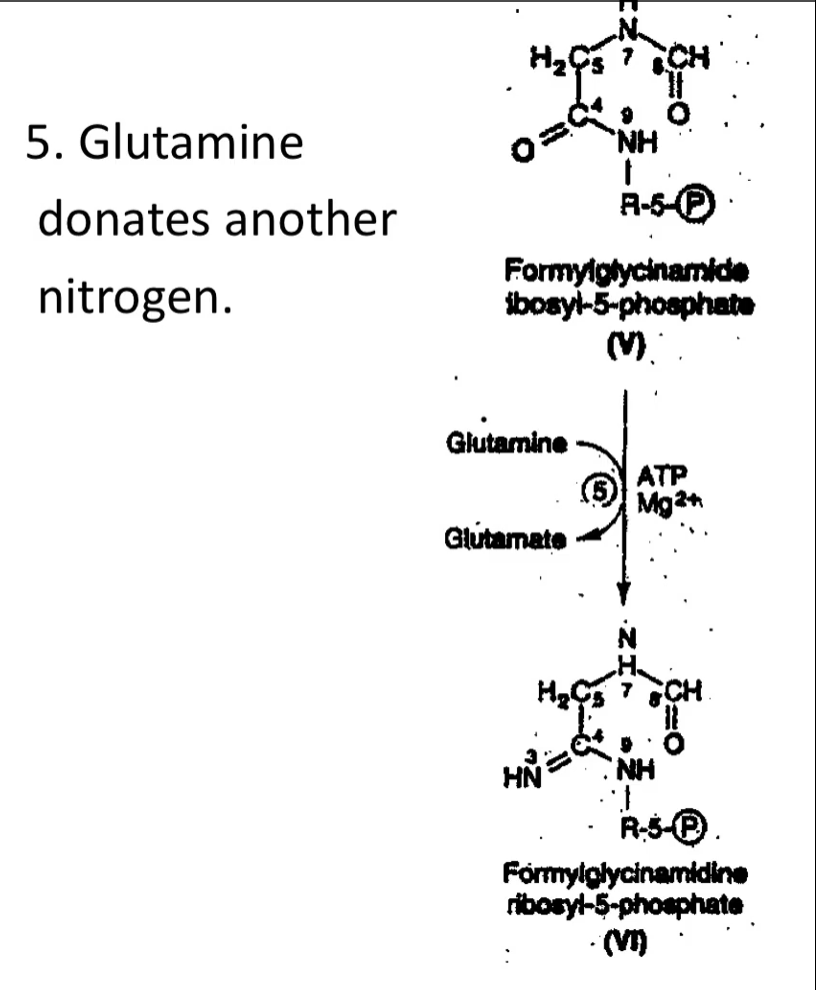
5. Glutamine donates another nitrogen.
Formylglycinamide ribosyl-5-phosphate (FGAR) → Formylglycinamidine ribosyl-5-phosphate (FGAM)
(with glutamine donating nitrogen, becomes glutamate)
FGAM synthetase
The next step, #5, is the introduction of another nitrogen. Nitrogen is brought in by glutamine and attaches to the oxygen. This is a mechanism that requires the presence of ATP, but ATP is hydrolyzed to provide the energy.
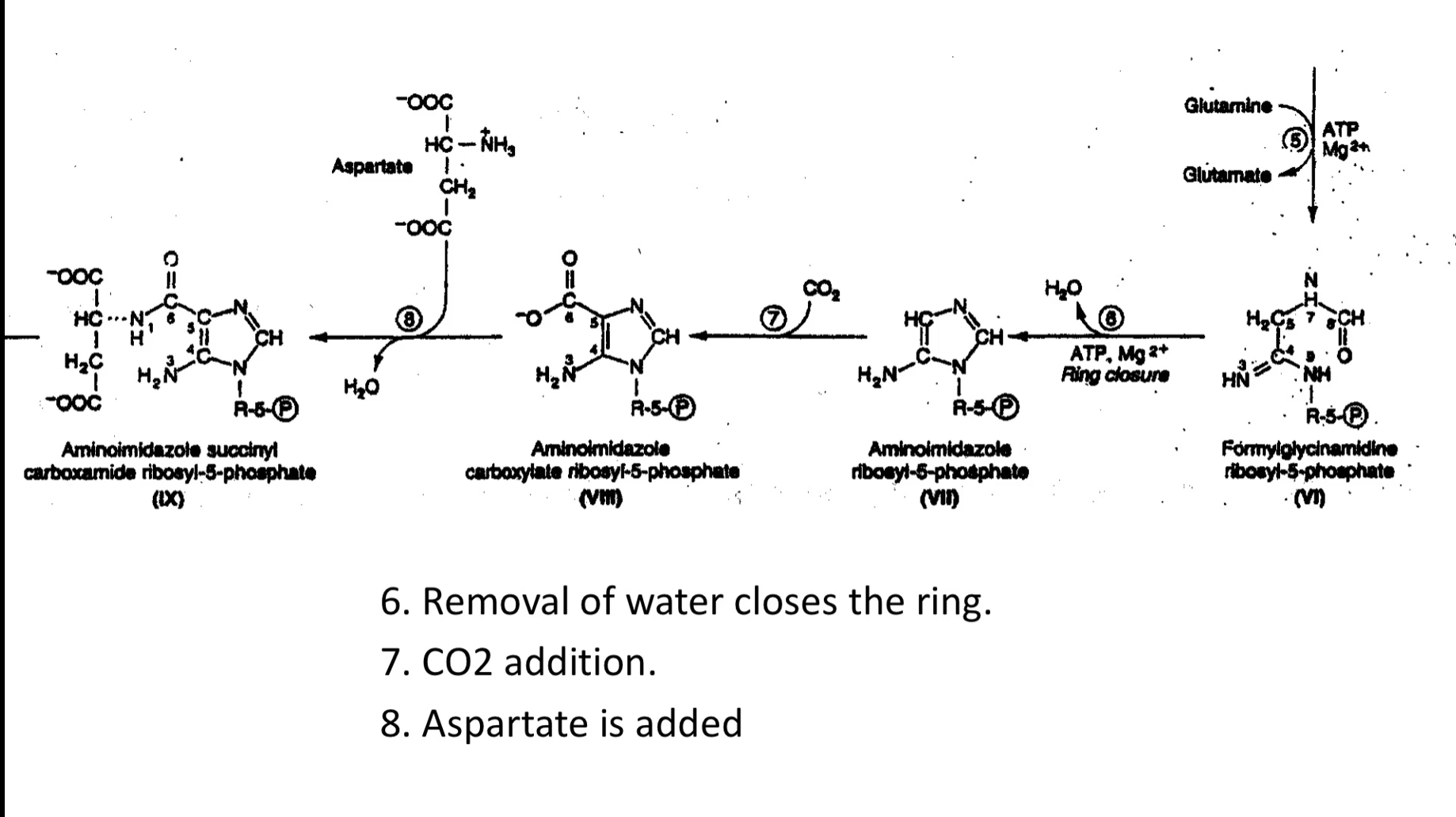
Formylglycinamidine ribosyl-5-phosphate (VI) → Aminoimidazole ribosyl-5-phosphate (VII)
is catalyzed by: AIR synthetase
Removal of water closes the ring. (Usually, in reactions where the circle is closed, you will see the removal of water).
Aminoimidazole ribosyl-5-phosphate (VII) → Aminoimidazole carboxylate ribosyl-5-phosphate (VIII)
CO₂ addition. Here, we are starting to build the larger ring of the purine nitrogen base.
Aminoimidazole carboxylate ribosyl-5-phosphate (VIII) → Aminoimidazole succinyl carboxamide ribosyl-5-phosphate (IX)
Aspartate is added. The donor of the nitrogen is Aspartate, it’s not glutamine. Aspartate will be bound to the molecule in reaction 8, and water will come out.
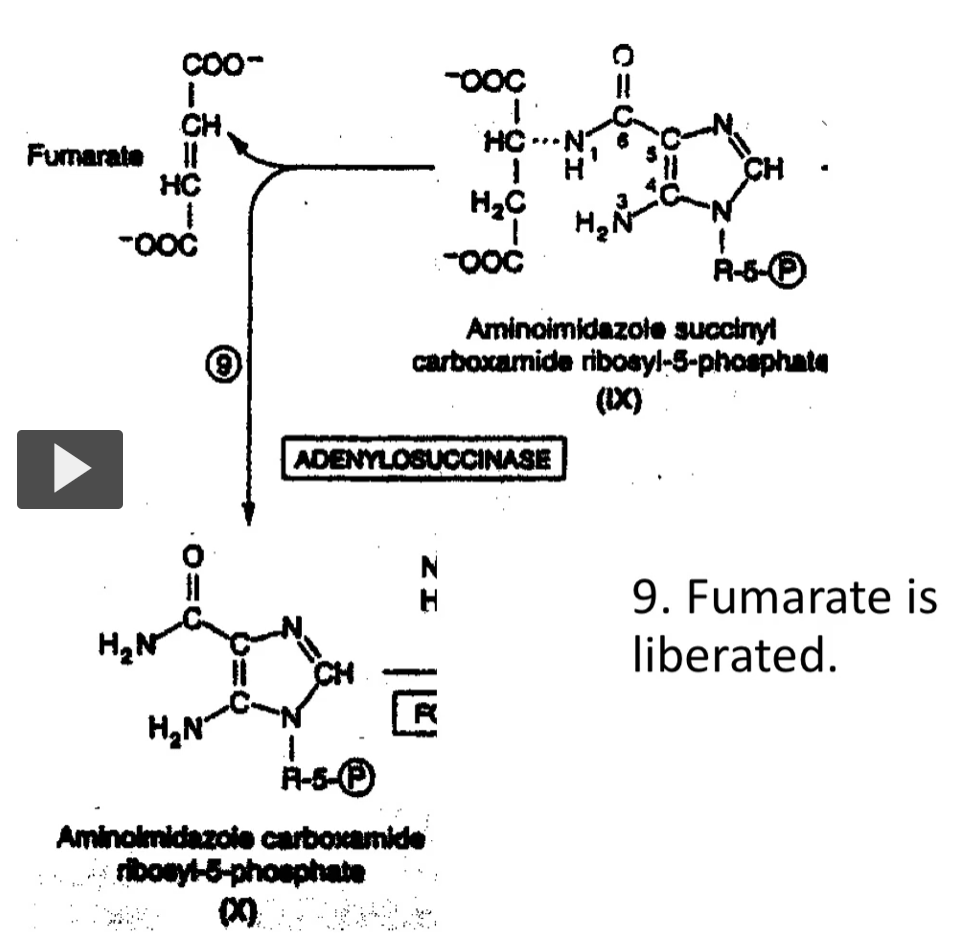
Aminoimidazole succinyl carboxamide ribosyl-5-phosphate (IX) → Aminoimidazole carboxamide ribosyl-5-phosphate (X)
ADENYLOSUCCINASE
Fumarate is liberated.
The molecule fumarate will exit, leaving behind the nitrogen. The nitrogen is brought in by aspartate, and then it’s cleaved and the nitrogen stays behind and fumarate leaves.
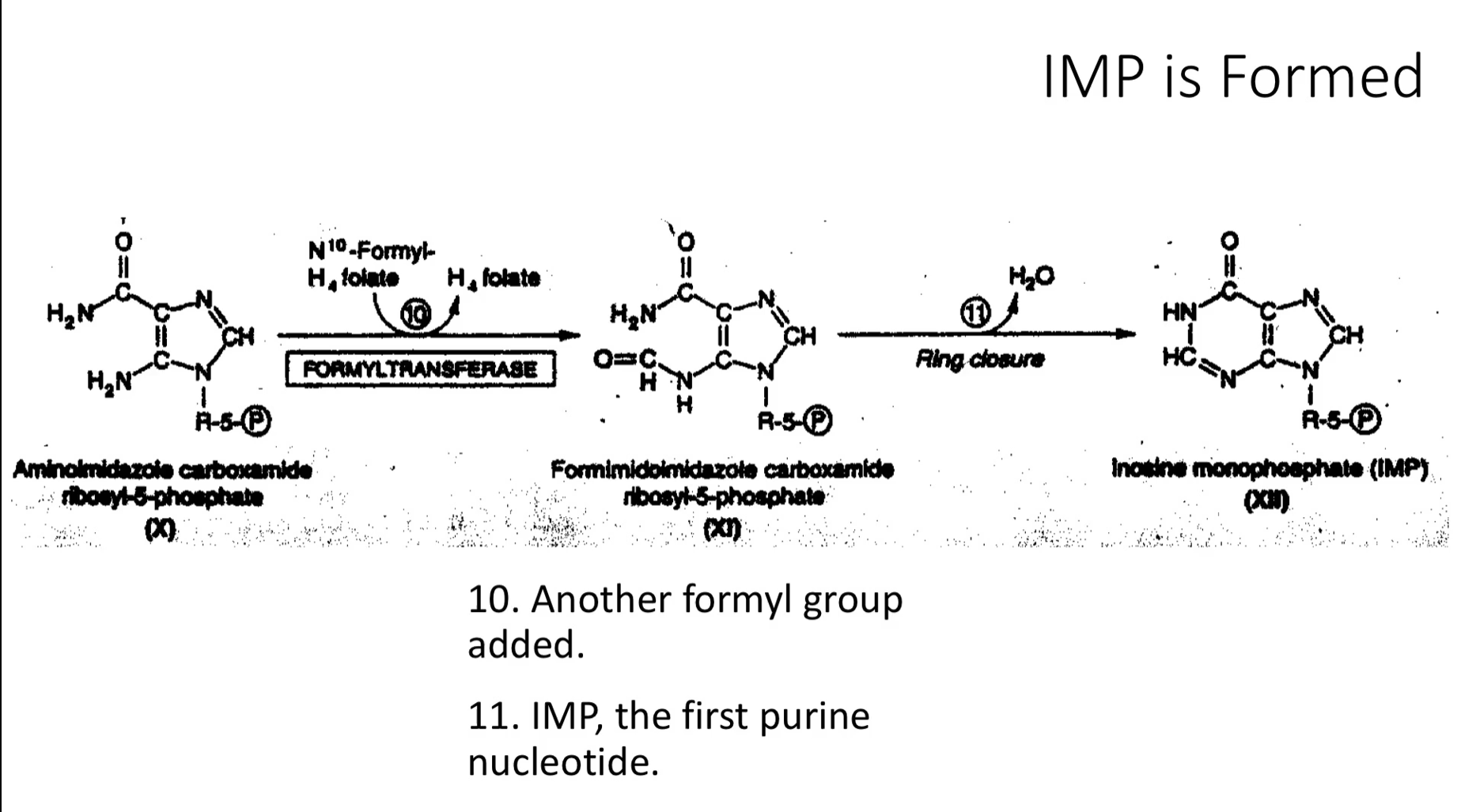
IMP is Formed
Aminoimidazole carboxamide ribosyl-5-phosphate (X) → Formimidoimidazole carboxamide ribosyl-5-phosphate (XI)
FORMYLTRANSFERASE
(again it comes from tetrahydrylfolate)
Another formyl group added.
Formimidoimidazole carboxamide ribosyl-5-phosphate → Inosine monophosphate (IMP)
H₂O leaves
Ring closure
IMP, the first purine nucleotide because IMP has the sugar, the phosphate and the nitrogen base, it’s a nucleotide.
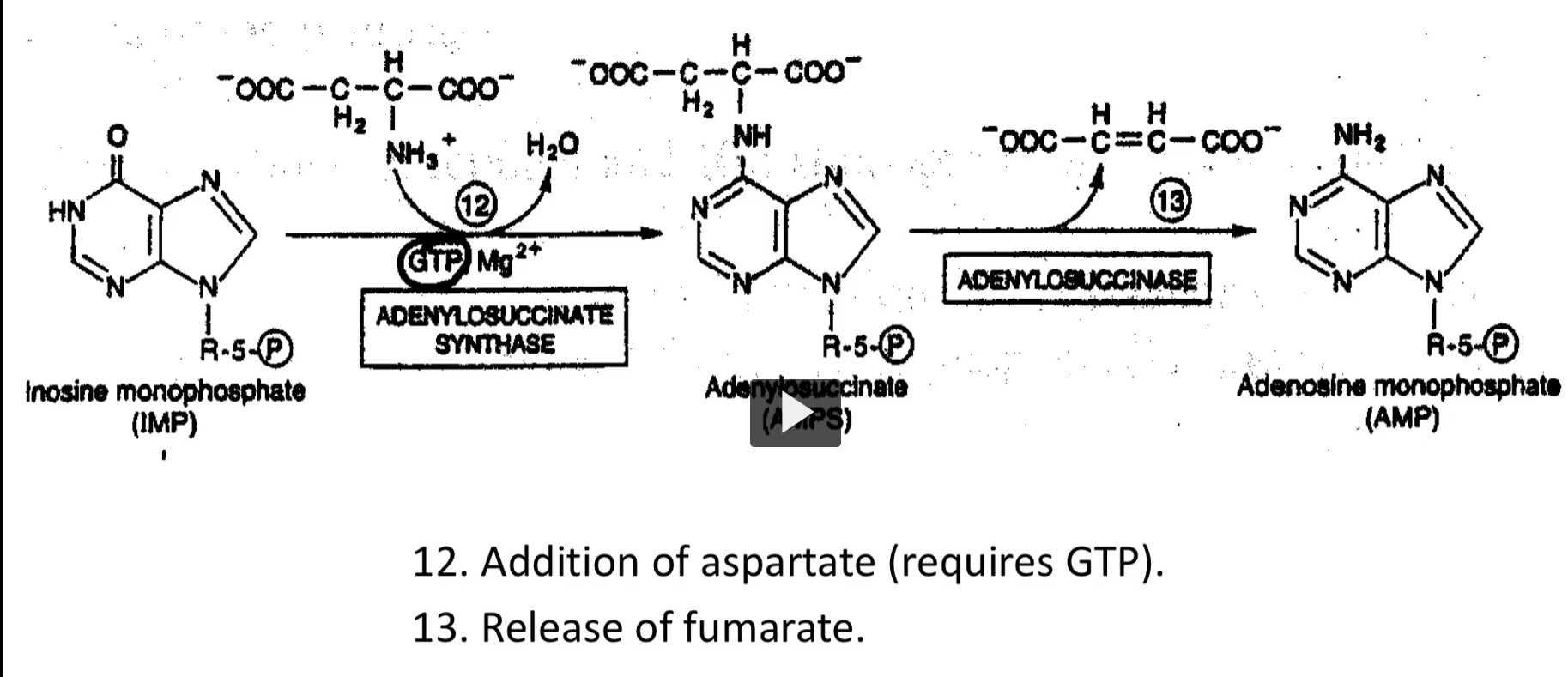
Inosine monophosphate (IMP) → adenylosuccinate (AMPS)
ADENYLOSUCCINATE SYNTHASE
GTP is needed , Mg²⁺
Reaction 12 is the donation of nitrogen by aspartate. Aspartate gets bound to the nitrogen base, leaving as fumarate, and leaves behind the nitrogen. In this way, you have AMP, Adenosine Monophosphate.
In Reaction 12, you need GTP to synthesize AMP. points to the circled GTP
adenylosuccinate (AMPS) → Adenosine monophosphate (AMP)
ADENYLOSUCCINASE
Reaction 12 and 13 is the formation of AMP. IMP is like a branch piont because it is the parent compound o both nitrogen bases, AMP and GMP.
You also need ATP to synthesize GMP.
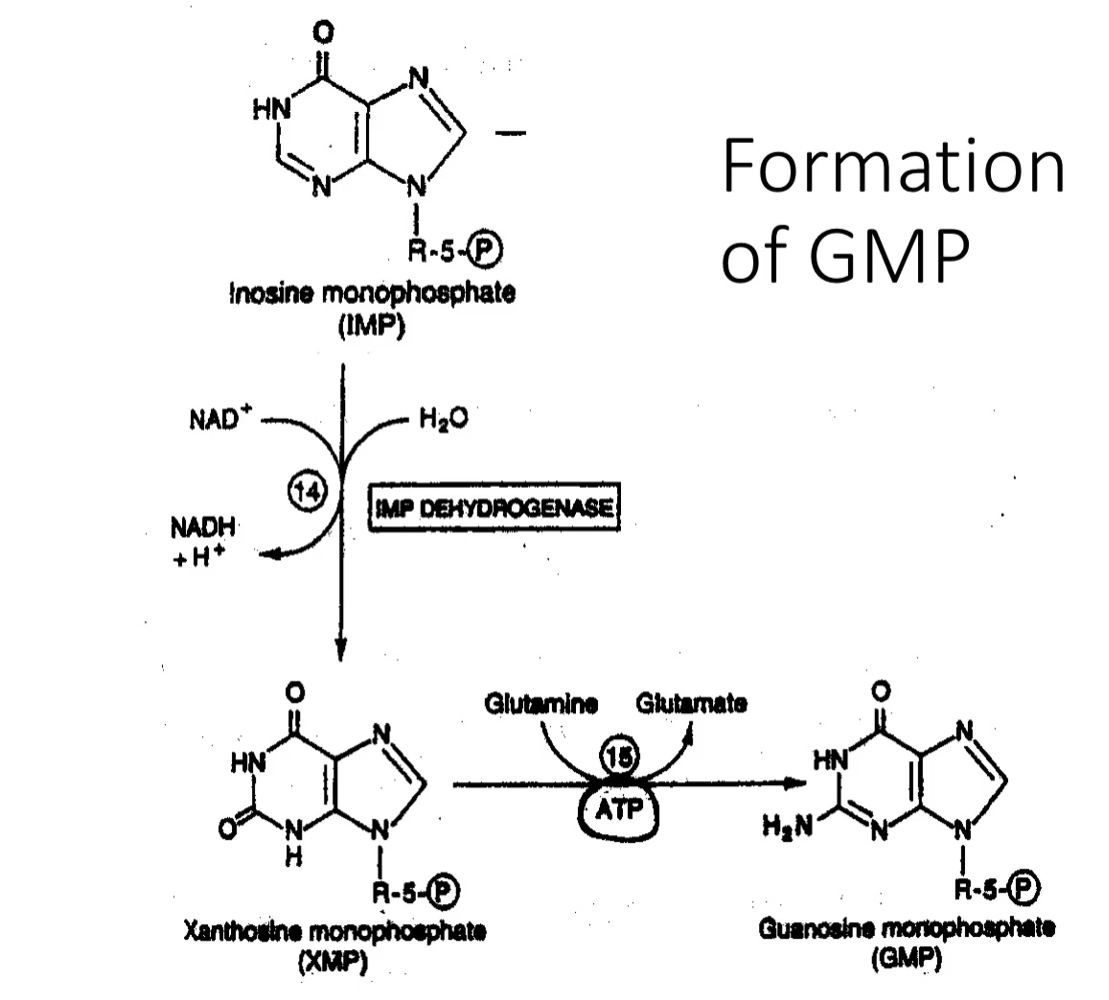
The formation of GMP requires ATP.
glycinamide ribosyl-5-phosphate (Formyl Transferase) → Formylglycinamide ribosyl-5-phosphate
Formyltransferase = enzyme that transfers a formyl (–CHO) group,
Uses: N¹⁰-formyl-tetrahydrofolate (THF) as the donor
Transfer of a formyl group, inhibited by folic acid antagonists (aminopterin)
Folate antagonists (e.g., aminopterin, methotrexate):
↓ THF
❌ Block formyl transfer
❌ Stop purine synthesis → ↓ DNA synthesis
That’s why they’re used as anticancer drugs
Aminoimidazole carboxamide ribosyl-5-phosphate (X) → Formimidoimidazole carboxamide ribosyl-5-phosphate (XI)
FORMYLTRANSFERASE
(again it comes from tetrahydrylfolate)
Another formyl group added.
Formylglycinamide ribosyl-5-phosphate (FGAR) → Formylglycinamidine ribosyl-5-phosphate (FGAM)
(with glutamine donating nitrogen, becomes glutamate)
FGAM synthetase
PRPP (PRPP Glutamyl Amido-transferase) → 5-phospho-ribosylamine
adenylosuccinate (AMPS) → Adenosine monophosphate (AMP)
ADENYLOSUCCINASE
Reaction 12 and 13 is the formation of AMP. IMP is like a branch piont because it is the parent compound o both nitrogen bases, AMP and GMP.
You also need ATP to synthesize GMP.
Folate antagonist — what it means
👉 A folate antagonist is a substance (often a drug) that blocks the function or metabolism of folate (vitamin B9).
Folate is essential for:
DNA synthesis
Making thymidine (dTMP)
Supporting rapidly dividing cells
1. Blocking folate activation
Inhibits Dihydrofolate reductase (DHFR)
Prevents formation of tetrahydrofolate (THF) (active form)
2. Mimicking folate (competitive inhibition)
Structurally resembles folate
Competes for enzymes → blocks normal functio
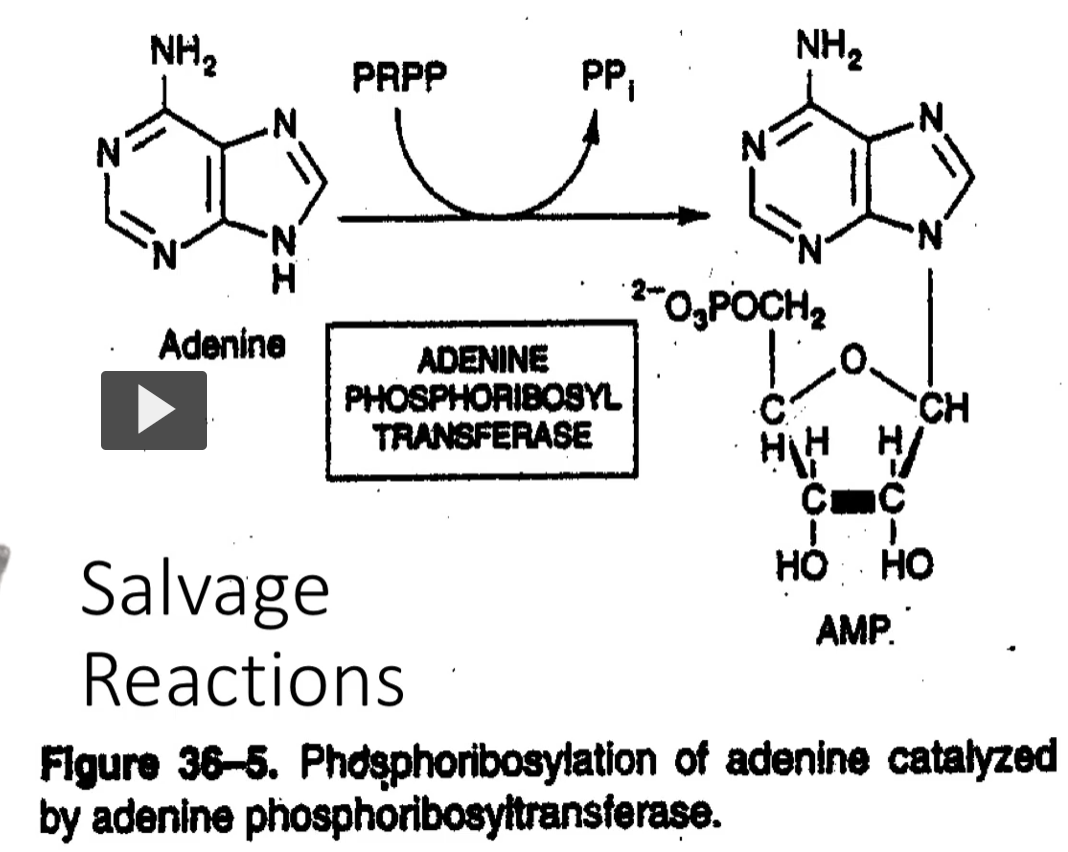
Adenine phosphoribosyltransferase (APRT) 🔤 Etymology (decode the name)
Adenine → the purine base
Phosphoribosyl → ribose sugar + phosphate group
Transferase → transfers a group
👉 “An enzyme that transfers a phosphoribosyl group onto adenine.”
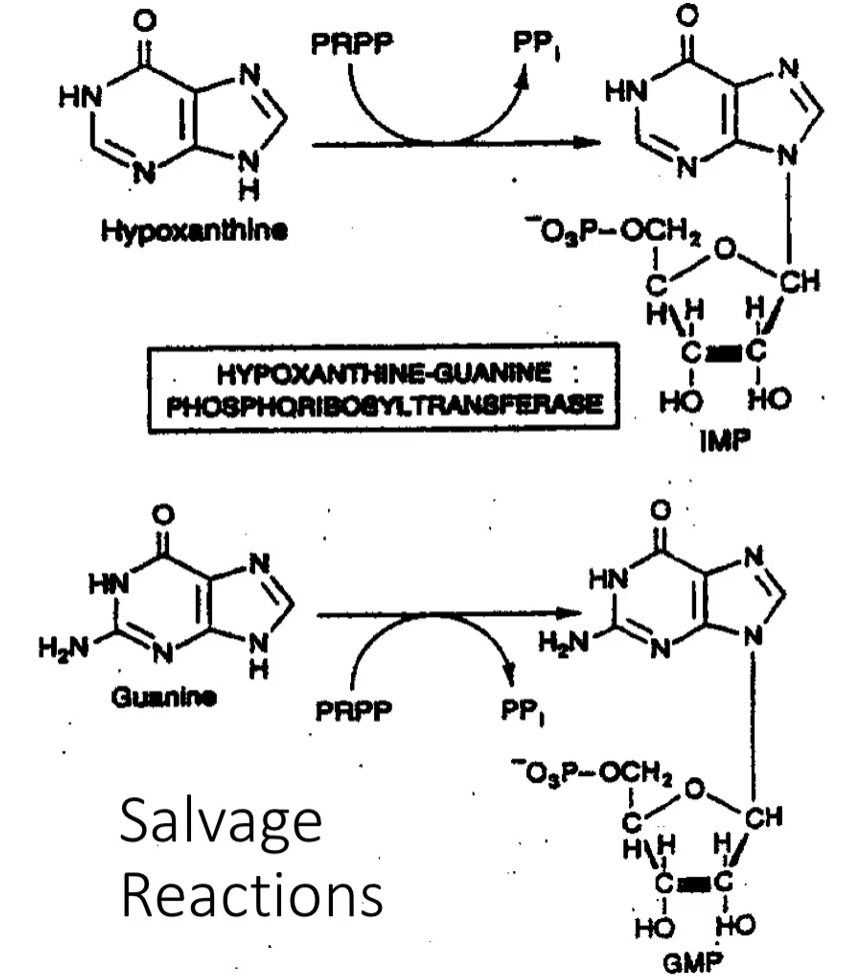
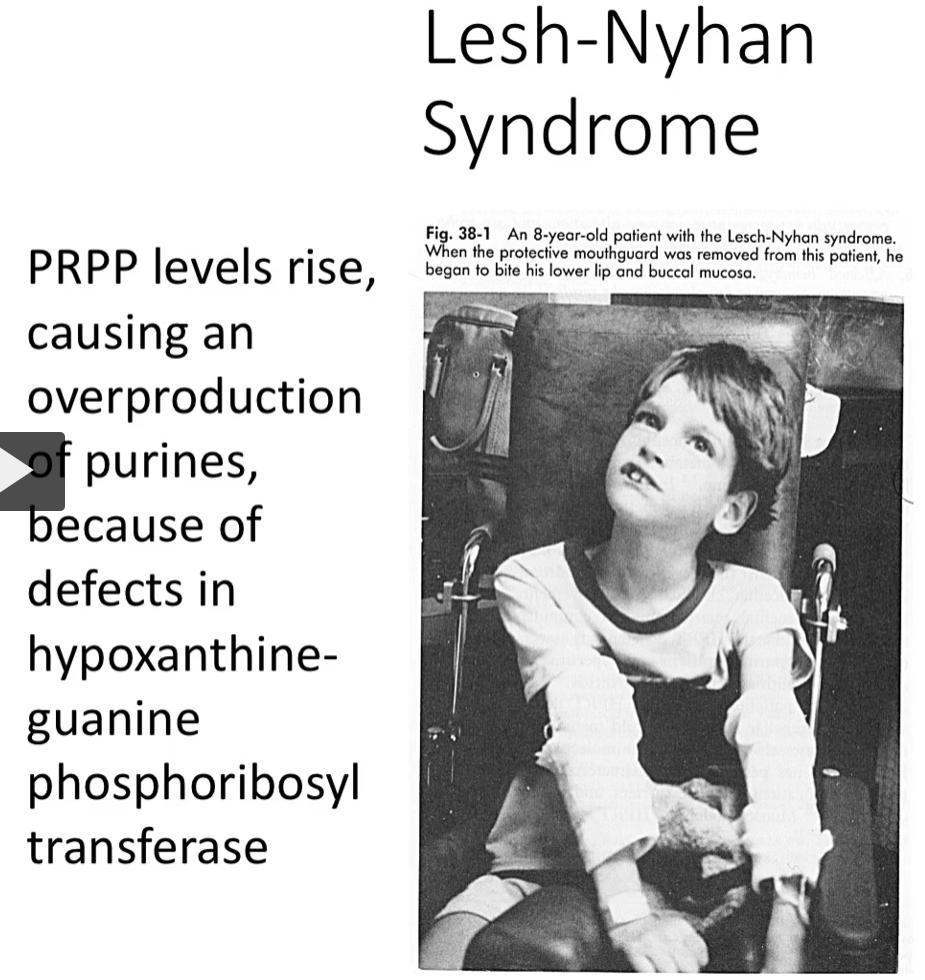
defects in hypoxanthine-guanine phospho ribosyl transferase
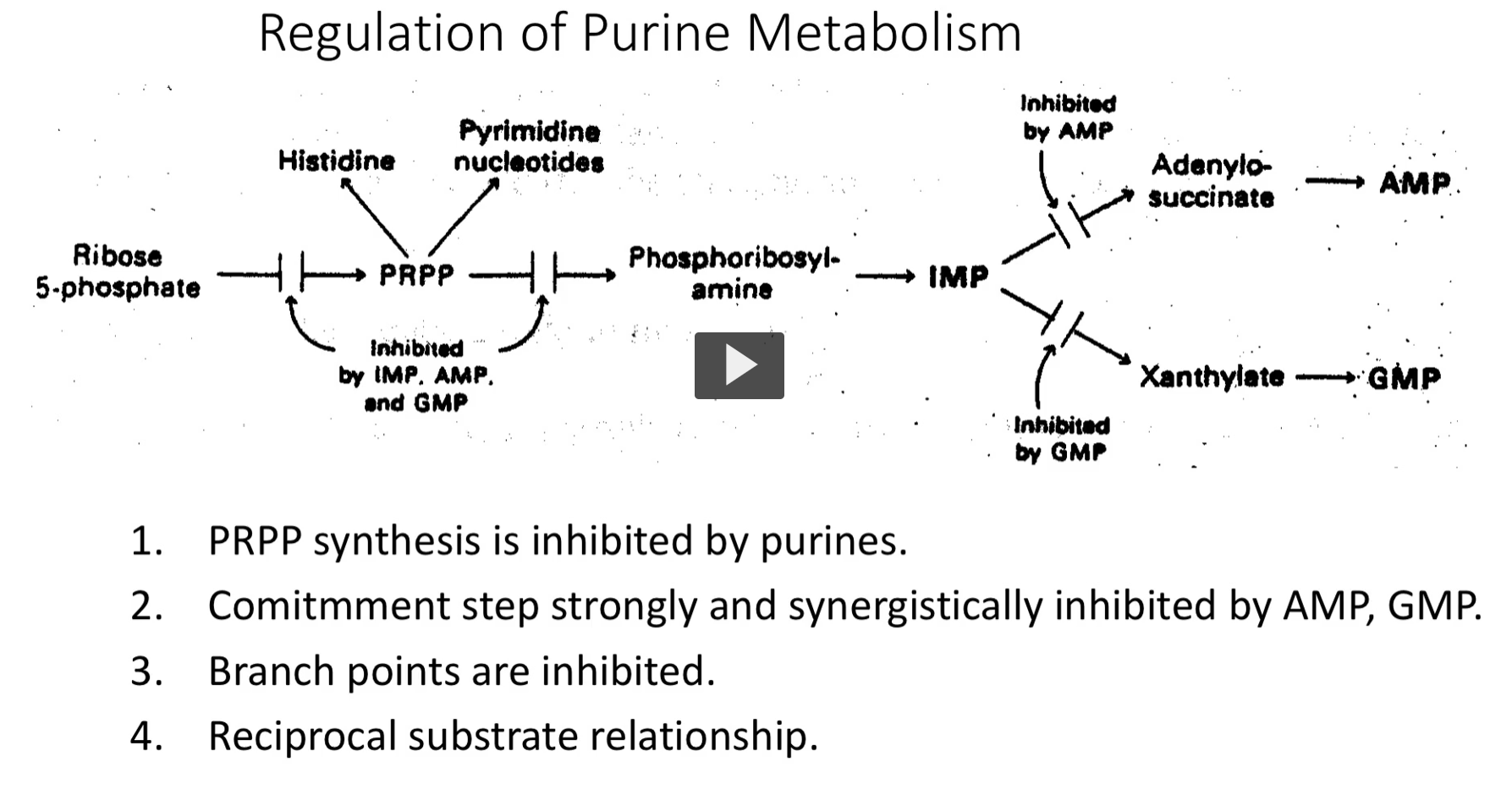
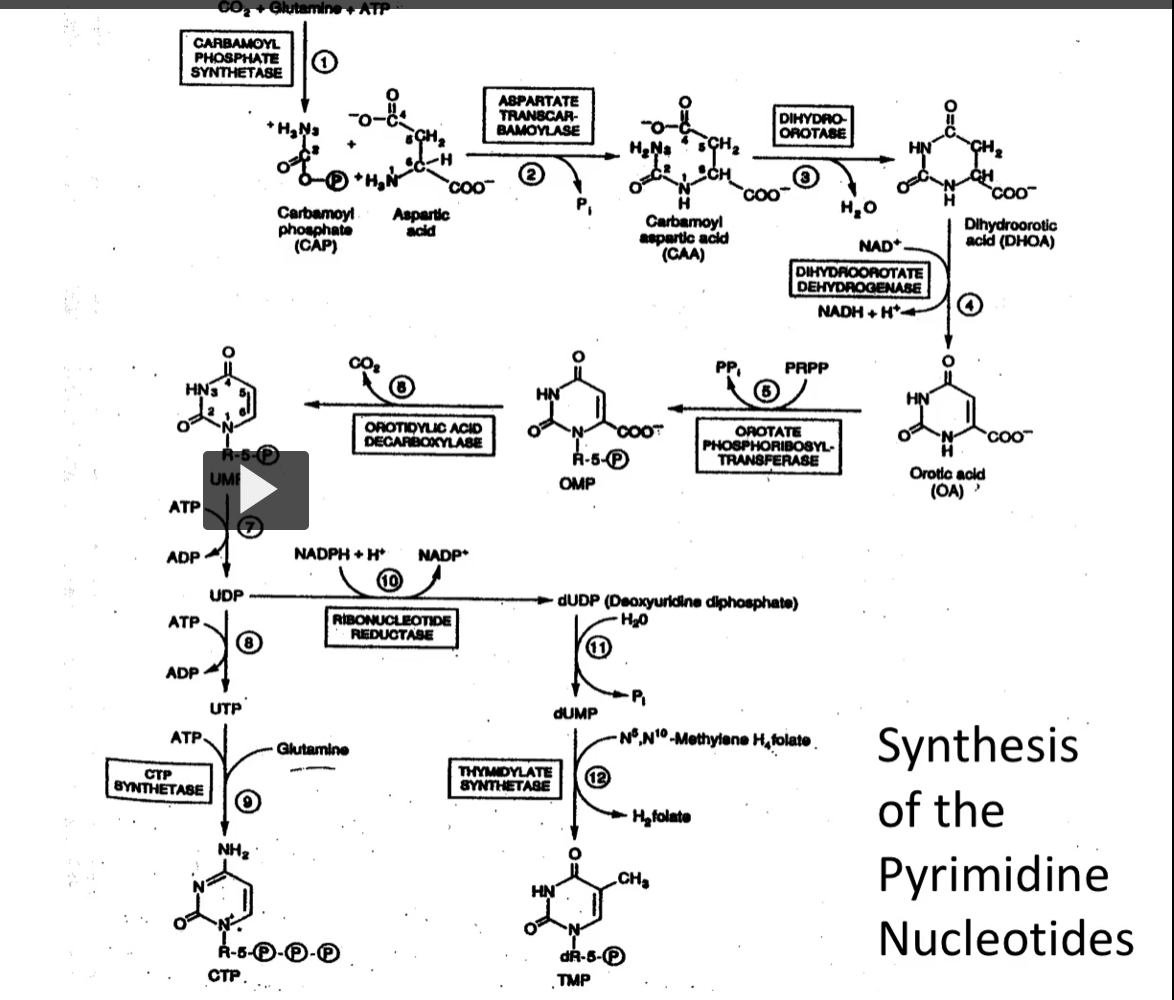
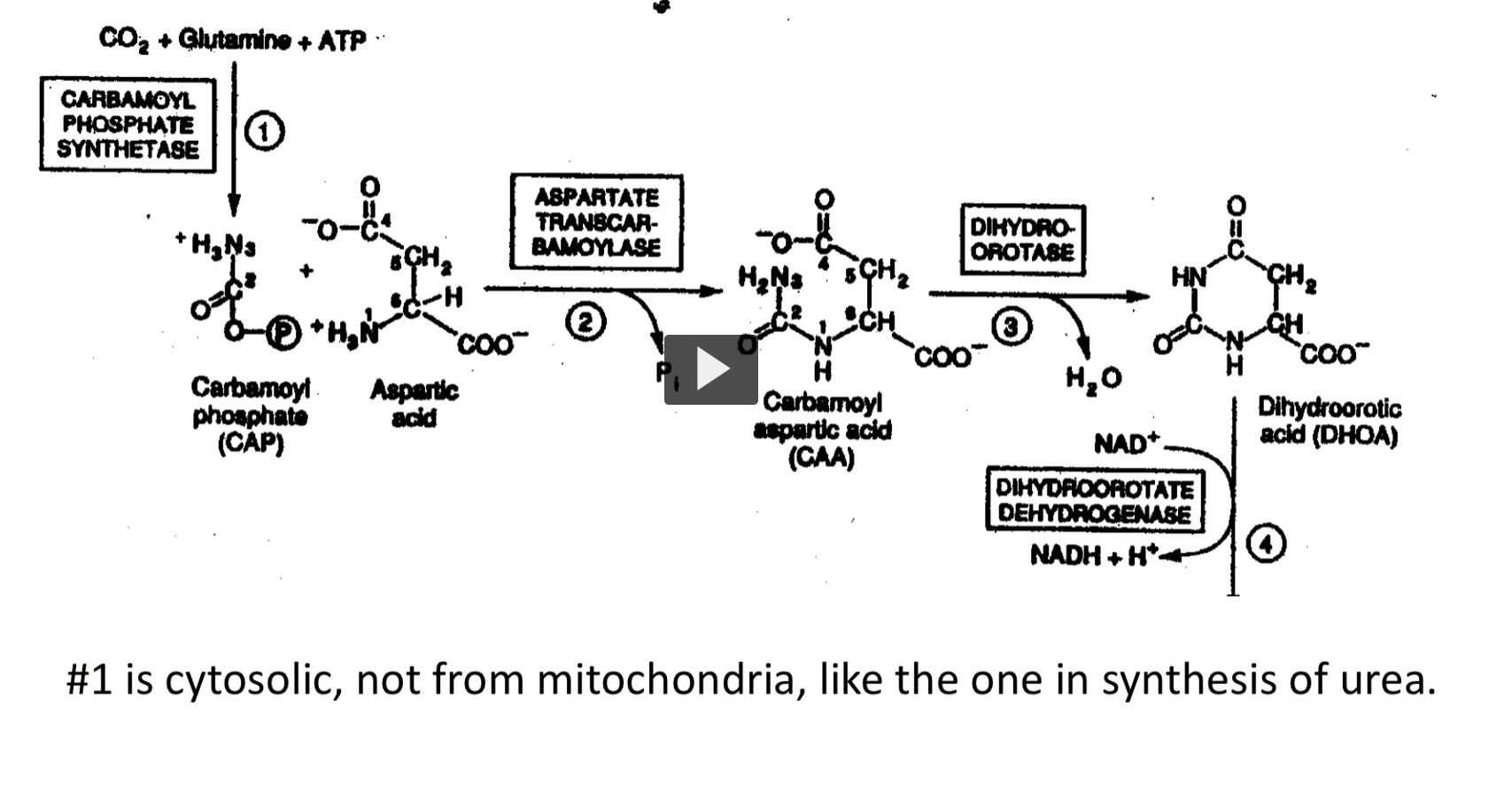
unlike purine synthesis, the nitrogen base is assembled independently of PRPP.
Location: cytosol
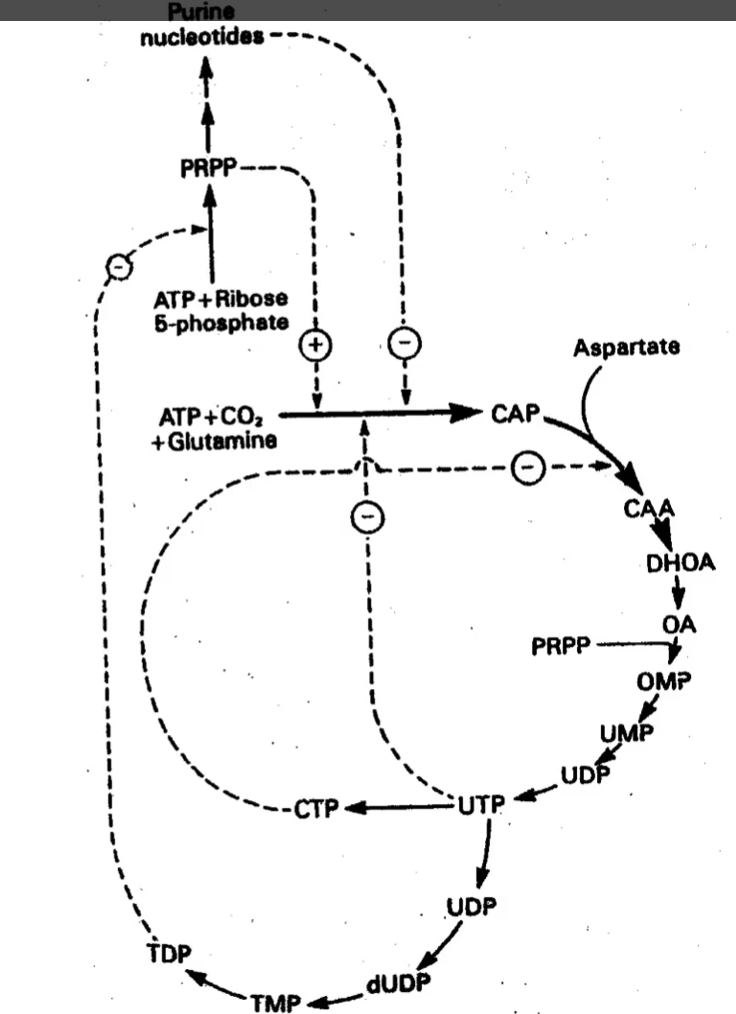
end product: DHOA
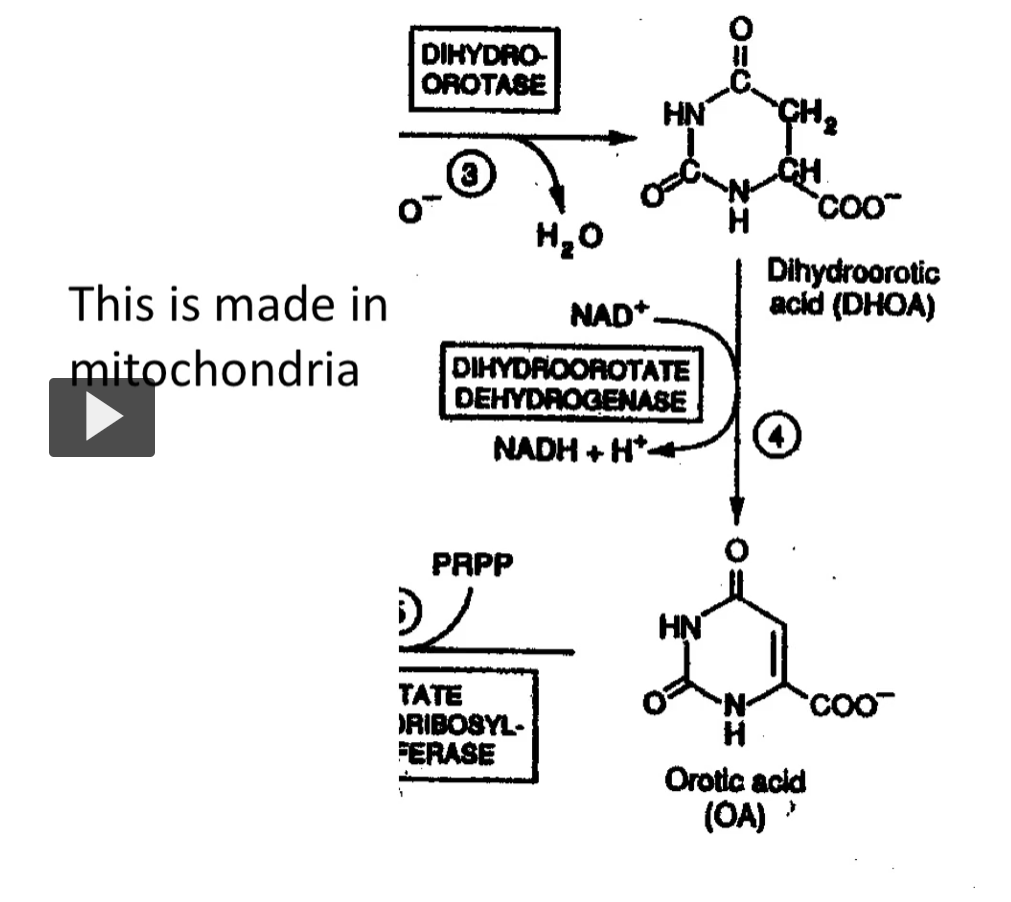
location: mitochondria
end product: DHOA → OA (Orotic Acid)
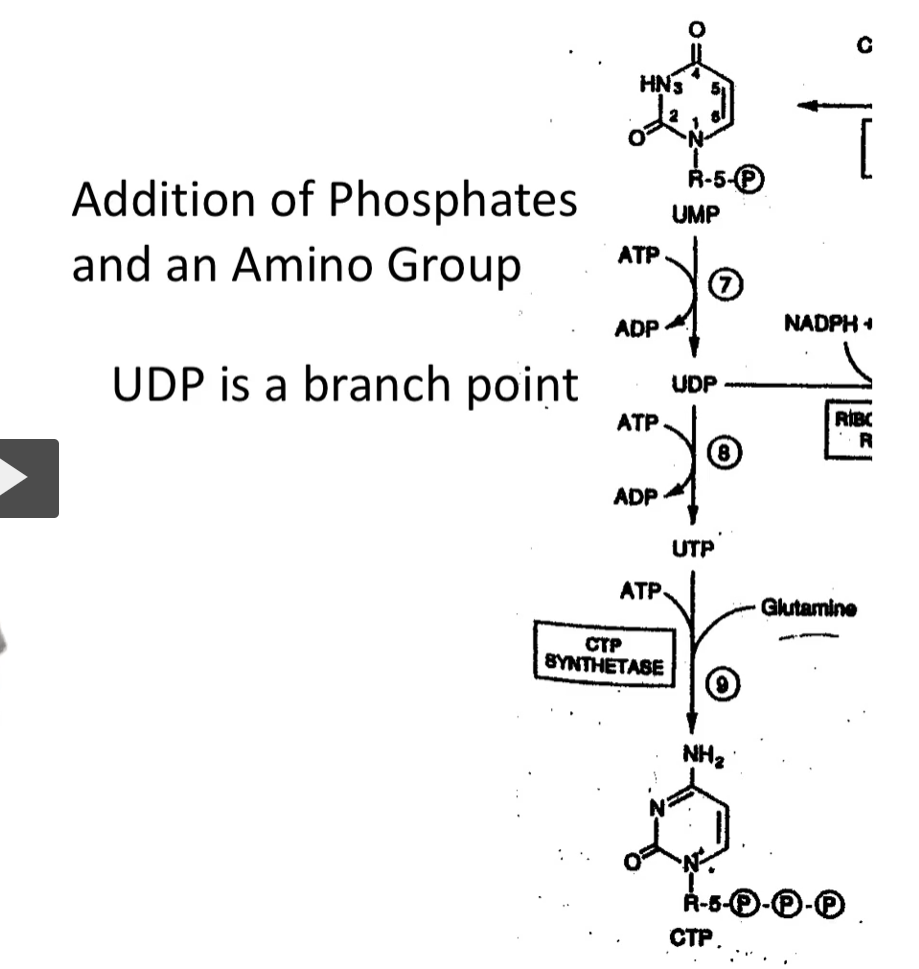
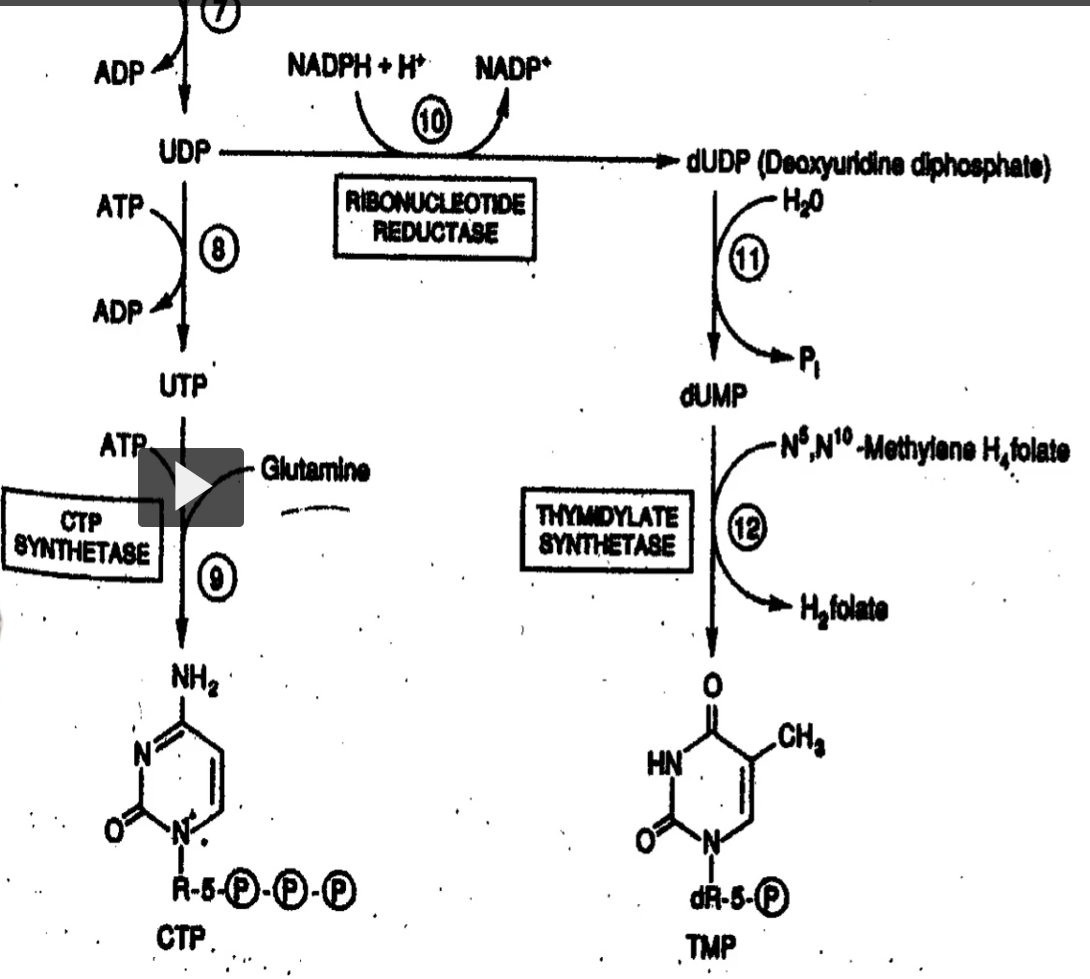
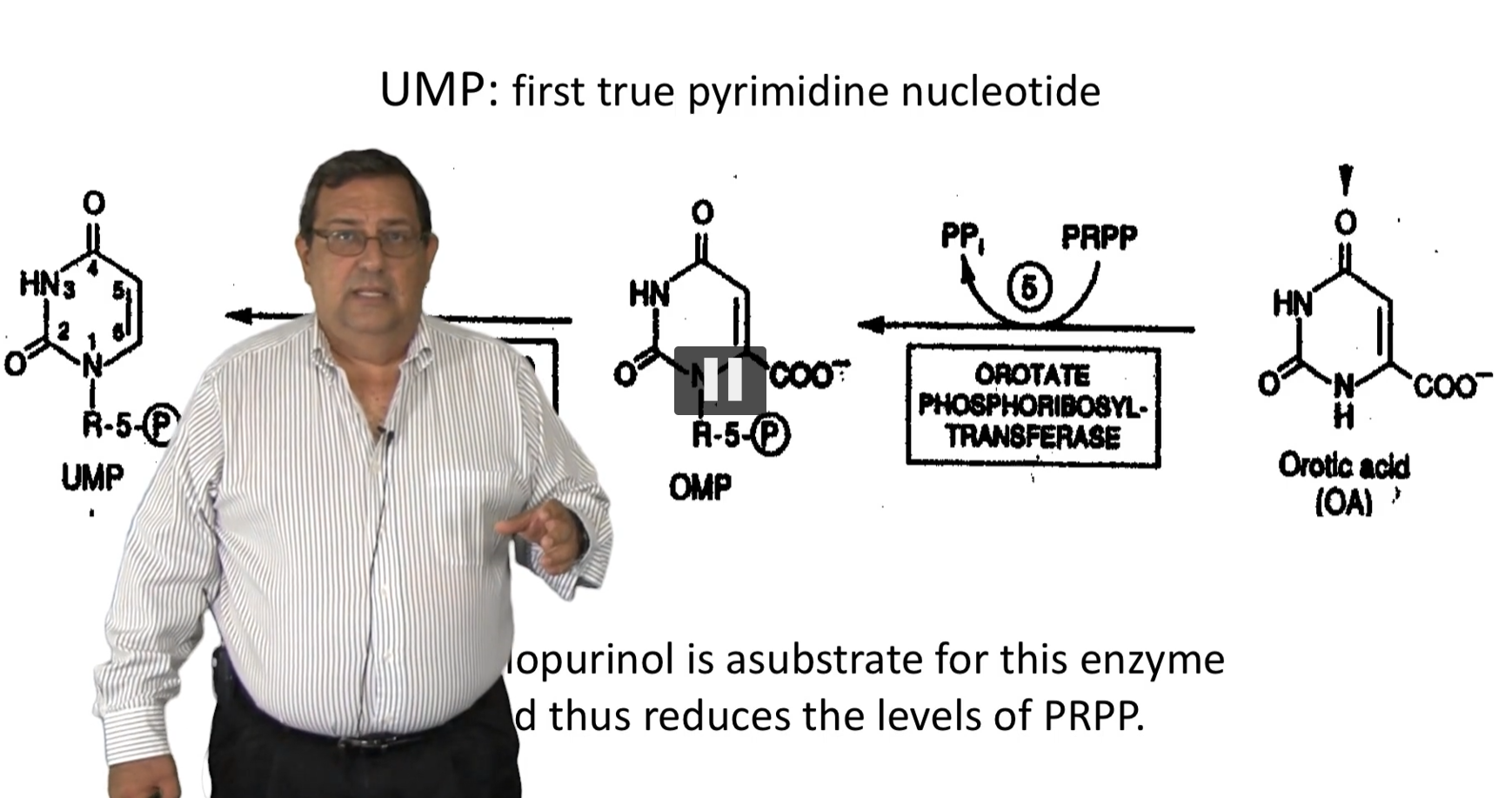
UMP: first true pyrimidine nucleotide, made from Orotic Acid
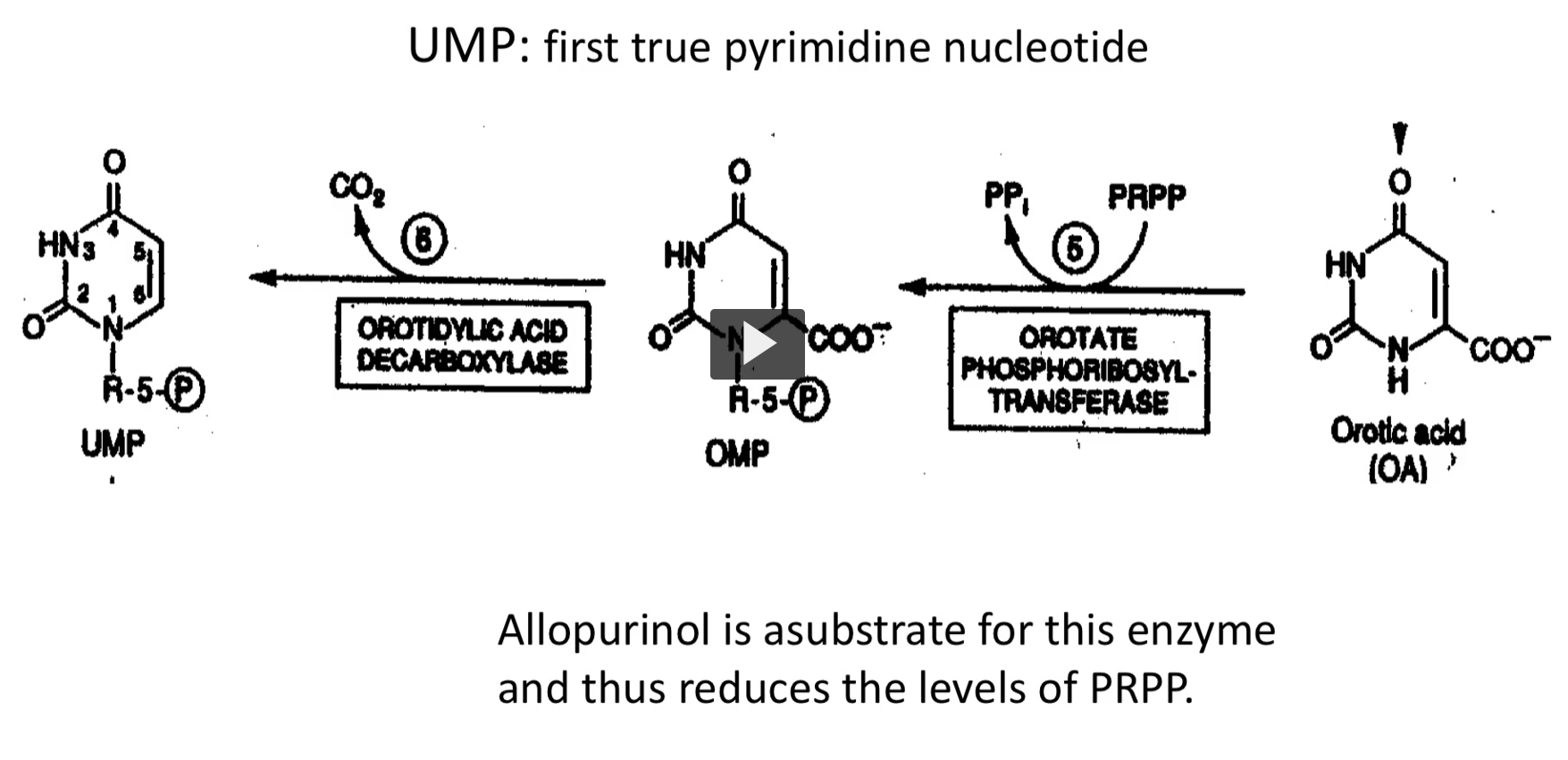
Allopurinol is NOT directly involved in pyrimidine synthesis.
It primarily affects purine metabolism.
What allopurinol actually does
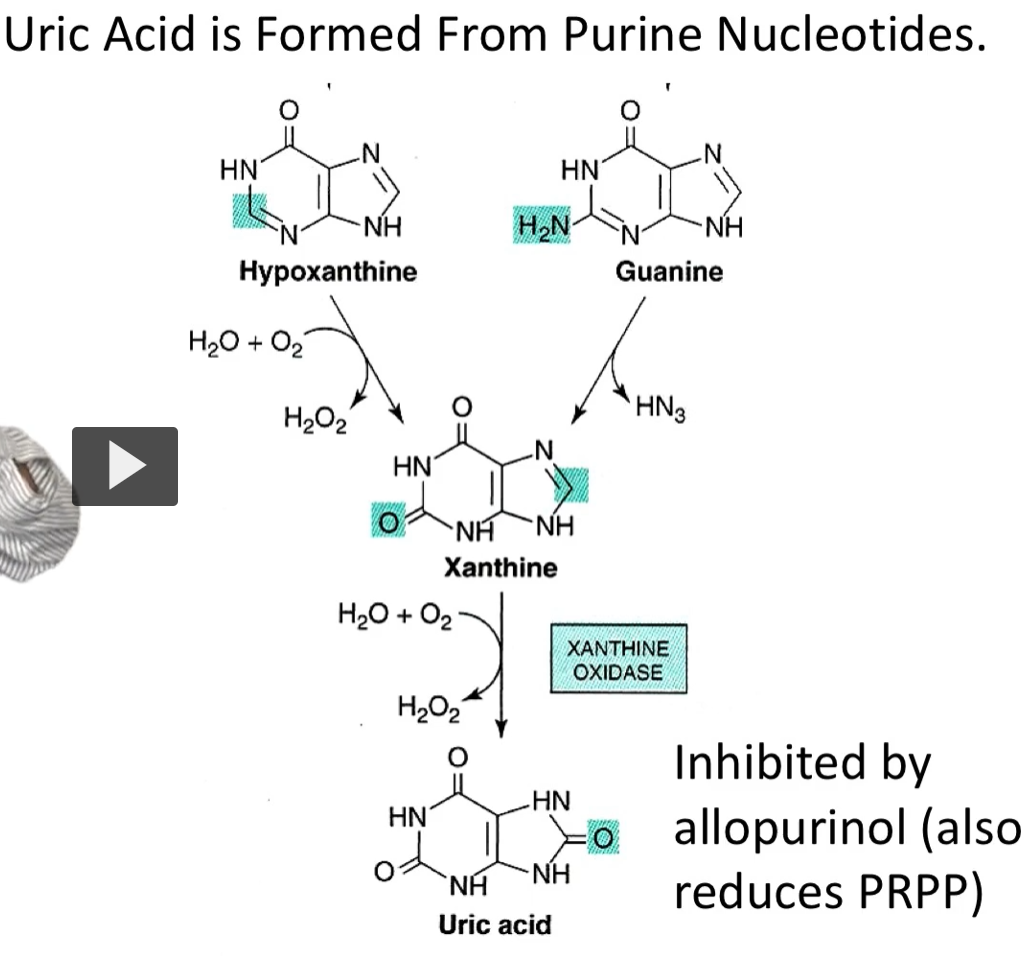
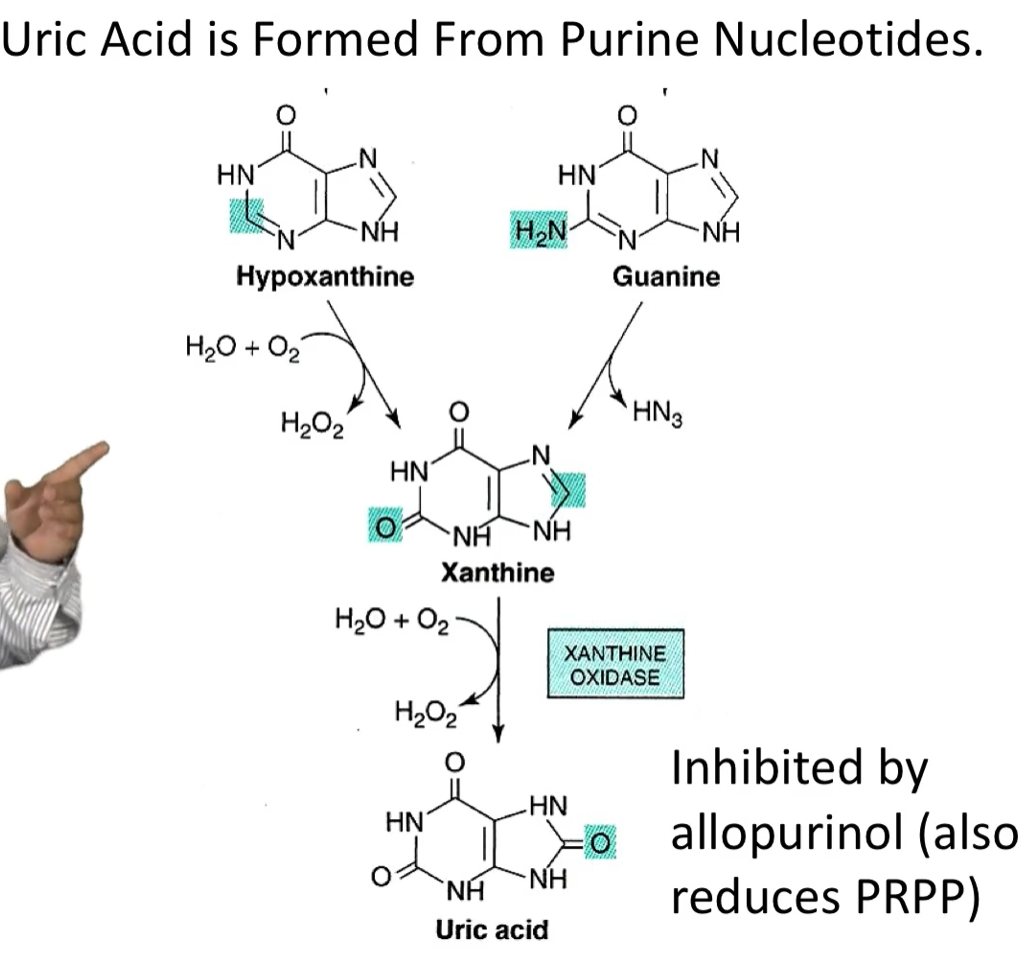
Inhibits Xanthine oxidase
Blocks:
Hypoxanthine → xanthine
Xanthine → uric acid
👉 Result:
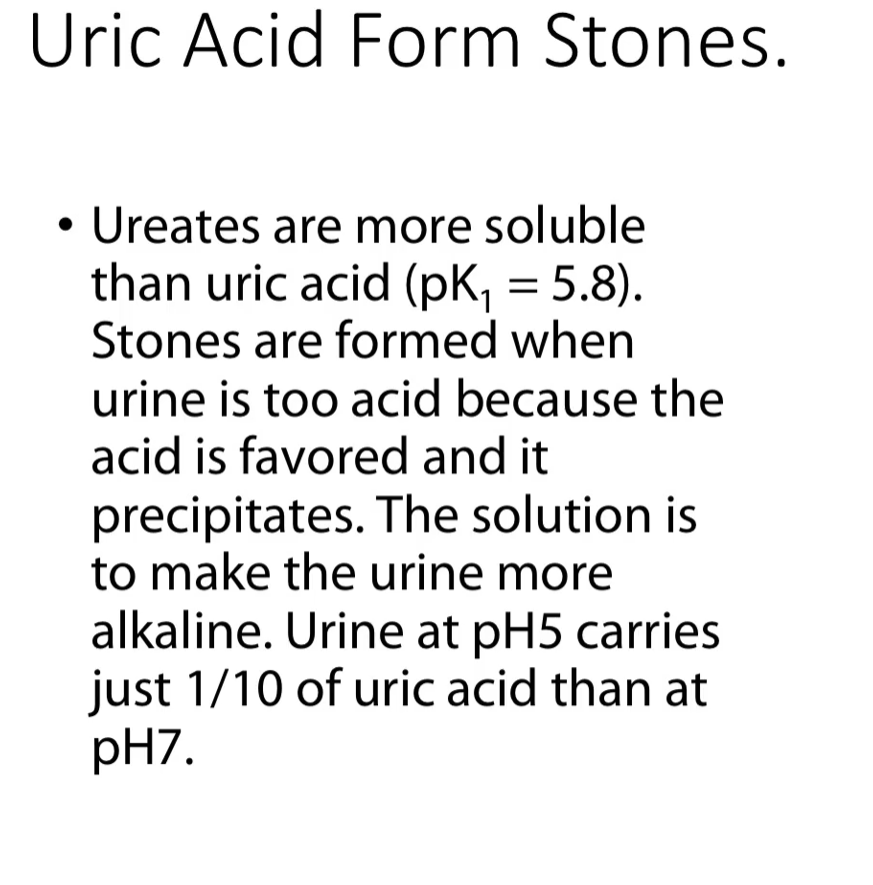
↓ uric acid (used for gout)
Uric acid 🔤 Etymology
Uric → from “urine” (it’s excreted there)
Acid → weak organic acid
👉 “The end product of purine breakdown that is excreted in urine.”