1.5-1.7- ATP and water
 Call Kai
 Learn
Learn Practice Test
 Spaced Repetition
 Match
Match Flashcards
 Knowt Play
1/15

There's no tags or description
Looks like no tags are added yet.
Name | Mastery | Learn | Test | Matching | Spaced | Call with Kai |
|---|
No analytics yet
Send a link to your students to track their progress
16 Terms
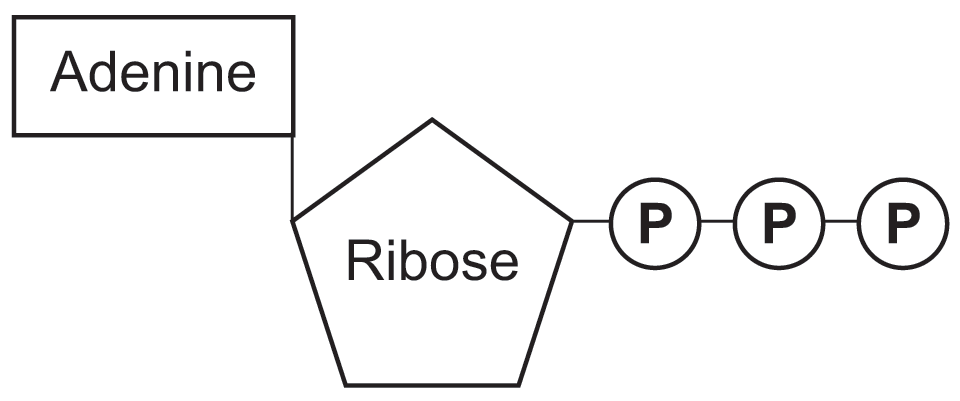
What does ATP consist of and draw?
organic base adenine, ribose sugar and three inorganic phosphate groups
how is ATP synthesised?
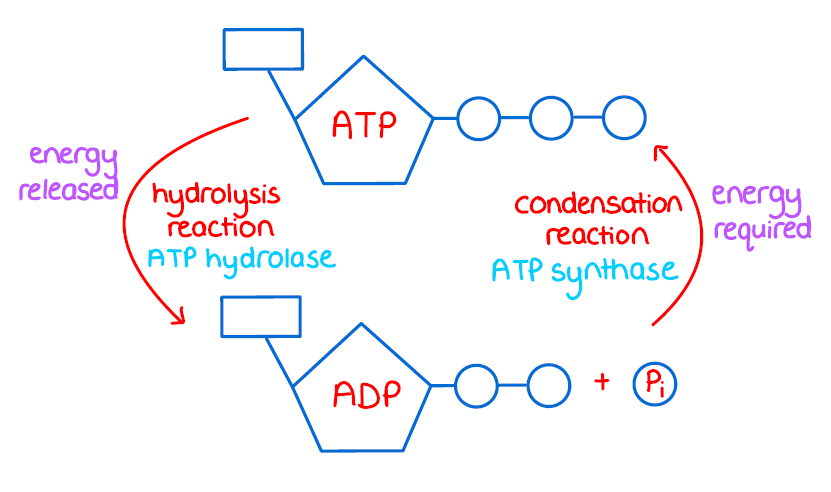
by addition of ADP to an inorganic phospjaye
condensation reaction catalysed by ATP synthase
phosphorylation
addition of phosphate molecule
what does ATP synthesis require and when does it occur?
when is some ATP made?
input of energy from a metabolic process and occurs during respiration
photosynthesis
how is ATP hydrolysed?
what is unstable?
inorganic phosphate removed, energy released and ATP becomes ADP
covalent bonds linking these phosphate groups is unstable and is easily broken by enzyme ATP hydrolase in a hydrolysis reaction
what is the role of ATP in active transport?
why are the protein pump also ATP hydrolase enzymes?
energy required to move substances against a conc. gradient using a carrier proteins in plasma membranes
they catalyse splitting of ATP to ADP and Pi and use the energy released to change shape and pump the molecule
what is the role of ATP in exocytosis?
energy required to make vesicles- synthesised by the golgi body ans used to package large molecules prior to secretion from cells
energy also required to bring large molecules into cells (endocytosis)
what is the role of ATP in biosynthesis?
energy is required to make polymers from monomers e.g synthesis of proteins by condensation of amino acids, or new DNA molecules by condensation of nucleotides before cell division
What is the role of ATP in movement?
energy required to muscle contraction
what is the role of ATP in the activation of other molecules?
name an example
ATP can transfer its phosphate group to other molecules, phosphorylating them and making them more reactive
e.g glucose requires phosphorylation at the start of the respiration to reduce the activation energy of the reaction
how is ATP useful in many biological processes? (name 5)
hydrolysis of ATP releases energy in small manageable amounts
formed in single reaction, makes energy immediately available
can be reformed again
phosphorylates substances- makes them more reactive
(soluble- easily move inside cells)
what are the properties of water?
metabolite in condensation and hydrolysis reactions
solvent so metabolic reactions can occur + substances can be transported
high specific heat capacity- buffer changes in temp
large latent heat of vapourisation- cooling effect thru evaporation
strong cohesion between water molecules so supports columns of water in plants and provides surface tension supporting smaller organisms
role of iron ions?
binds with oxygen in haemoglobin, allows it to be transported around the body
how does H+ determine pH?
what does pH affect?
the more H+ present, the lower the pH- more acidic
enzyme controlled reactions affected by pH
Role of sodium ions?
Co-transport- molecule of glucose or amino acid transported into cell alongside Na+
Na+ moved out by active transport- creates sodium conc. gradient-
Affects osmosis/water potential
Role of phosphate ions?
Used to produce ATP
Phosphate groups in DNA and RNA- allows nucleotides to form polynucleotides
Phosphorylates other compounds- more reactive
Hydrophilic part of phospholipid bilayer
Affects water potential/osmosis