Complex Analysis Part 2
 Call Kai
 Learn
Learn Practice Test
 Spaced Repetition
 Match
Match Flashcards
 Knowt Play
1/43

Earn XP
Description and Tags
Complex Integration to the end (wk 7-12)
Name | Mastery | Learn | Test | Matching | Spaced | Call with Kai |
|---|
No analytics yet
Send a link to your students to track their progress
44 Terms
C’ Path
gamma is a C’ Path if it is differentiable and its derivative is continuous
Smooth path
A path is smooth if it is infinitely differentiable
Integral over a C’ Path
∫fdz := ∫f(δ(t))*δ’(t)dt
(δ is the path, take the integral from the endpoints)
∫f(z) dz over p1+p2
∫f(z)dz over p1 + ∫g(z)dz over p2
Arc length of a path
l(p) = ∫|p’(t)|dt
Bounding integral lemma
| ∫f(z)dz | ≤ M * l(p), where M is a real number M>0 s.t. |f(z)| ≤ M
(M is a maximum of f(z))
Fundamental theorem of contour integrals
∫f(z) dz over p = F(p(b)) - F(p(a))
given: p is c’ path, f is continuous and defined on the same set as p, f has an integral.
T/F the integral of F over p is path dependent
F - depends only on endpoints
Morera Thoerem
∫f dz over p = 0,
given: p is a simple closed path, f is analytic.
∮ vs ∫
∮ is for closed paths.
Cauchy-Goursat Theorem
∮f(z)dz over C = 0.
where f is analytic in and on its boundary C.
Consequences of Cauchy’s Theorem
∫ f(z)dz over p1 = ∫ f(z)dz over p2 (path independence)
G(z) = ∫f(z)dz, then G is analytic
Cauchy Integral Fomulas
1/2ipi ∫ f(z)/z-a dz = f(a)
and
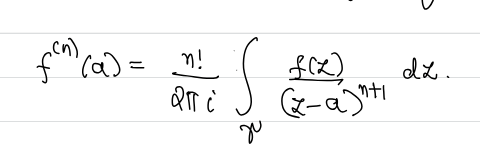
the nth derivative of f at a = n!/2ipi ∫f(z)/(z-a)^(n+1) dz (provided the nth deriative exists)
gamma must be a closed curve, f must be holomorphic on and inside gamma
Cauchy’s Inequalities
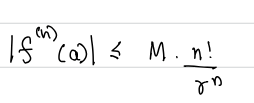
| f^n (a) | = M * n!/p^n for n∈W
where M = max{ |f(z)| : |z-a| = r } (the maximum value of f at the border of the circle
Louiville’s Thoerem
Every bounded, entire function is constant.
Fundamental theorem of Algebra
every non-constant polynomial in C has at least one root in C
Gauss’ mean value theorem
f(a) = 1/2pi * ∫p f(a+re^iθ) dθ
f os analytic in and on the circle |z-a| = r
Maximum Modulus Theorem
if f is analytic in and in a simple closed curve, fmax is on the boundary
Types of singularities
Isolated
Removable
Poles
Essential
Isolated Singularity
there are no other singularities right next to it
Removable Singularity
an isolated singularity where the lim f(z) at the singularity exists. check either by l’Hopital or factoring and cancelling.
Pole
isolated singularity where lim z→a of (z-a)n *f(z) exists and is non-zero
Essential Singularity
isolated singularity which is not removable or a pole
Argument Theorem
1/2ipi * ∮p f’/f dz = N - P
f is holomorphic and non-vanishing in and on p. N,P are counted with multiplicity
Rouche’s Theorem
if |g(z)| < |f(z)| ∀ z∈δ, then f and f+g have the same number of zeros inside δ
Entire/Analytic
differentiable at all points on the complex plane
Meromorphic
analytic everywhere except at a finite number of poles
Convergence Tests
Ratio
Root
Weierstass M Test
Ratio Test
let L:= lim | un+1 | / | un |, n→inf
if L<1, convergence
if L > 1 divergence
if L = 1, inconclusive
Root test
let L:= lim |un|1/n
the sum of un :
converges if L < 1
diverges if L > 1
inconclusive if L = 1
Wierstrass M-Test
if |un| ≤ Mn and ∑1infMn converges, then ∑1n uniformly converges
Properties of uniformly convergent series
if un is holomorphic and ∑1infun is uniformly convergent, then ∑1infun is holomorphic
If un is holomorphic, then u’(z) = ∑1infu’n (differentiate termwise)
Integrate termwise if un is continuous
Taylors Theorem
let f be holomorphic on and inside δ with center at w=a, then
f(w) = f(a) + f’(a) + f”(a)/2! (w-a)² + … + f(n)(a)/n!*(w-a)n
Laurent’s Theorem
f(z) = ∑1infa-n/(z-a)n + ∑0infan(z-a)n = ∑-infinfan(z-a)n
Residue
f is holomorphic on and inside a circle except at the center a, then
f(z) = ∑-infinfan(z-a)n
and an = 1/2ipi * ∮ f(z) / (z-a)n+1 dz,
an is called the residue.
Cauchy’s Residue Theorem
1/2ipi * ∮f(z)dz = sum of the residues
Residue Limit Formula
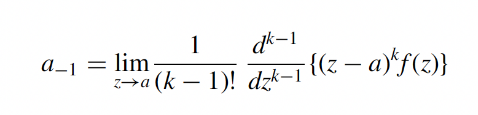
a-1 = limz→a 1/(k-1)! dk-1/dzk-1 (z-a)k * f(z)