cha[ter 9
 Call Kai
 Learn
Learn Practice Test
 Spaced Repetition
 Match
Match Flashcards
 Knowt Play
1/58

There's no tags or description
Looks like no tags are added yet.
Name | Mastery | Learn | Test | Matching | Spaced | Call with Kai |
|---|
No analytics yet
Send a link to your students to track their progress
59 Terms
which 2 processes facilitate the cycle of life
photosynthesis and cellular respiration
electrons from nadh go to which complex to handle and where do electrons of fadh2 go
nadh complex 1
fadh2 complex 2
aerobic respiration and anaerobic respiration make up what ( added up )
cellular respiration
what is fermentation
degradation of sugars without oxygen
what is aerobic respiration
consumption of organic molecules via oxygen to give atp
write down the reaction of glucose plus oxygen

do catabolic pathways directly power cell to do work
no , they provide necessary material for cell to make ATP, ATP provides the main power
what are the redox reactions
reactions in which electrons are transferred in reactants
what is oxidation , what is reduction
oxidation is the process of loss of electron, while reduction is the process of electron gain
who is the reducing agent
electron donor
who is the oxidizing agent
electron acceptor
what are some properites of oxygen
it is very electroneaggtivem - takes electrons , does not share electrons
is eneergy gained or taken when electrons move closer to oxygen
released
what type of process is cellular repiration
also photosynthesis vs cellular who is ender who is ever
redox process
photo - ender
resp - exer
in cellular repiration who is providing the high eneergy electrson
hydrogen does
the oxidation of glucose sends electrons from __ energy levesl to _ energy levels
high , low
hydrogen atoms are first passed to _ rather than —
electron carriers , oxygen
name of NAD plus as well as what is it (nicotine)
Nicotinamide Adenine Dinucleotide its a coenzyme that functions as electron carrier
how are enzymes that remove pair of hydrogen atoms from the substrate called
dehydrogenases
how many protons and electrons is passed to NAD plus
2p and 1 e
where is the electron trasnport chain located in eukaroyes vs prokrtyotes
inner membrane of mitochdnria
plasma membrane
harvesting energy from glucose has 3 stages list them
glycolysis - first stage in which glucose is converted to pyruvate
pyruvate oxidation and citric acid cycle- during eahc step co2 is released, and in this step glucose is full broken
oxidative phosphorylation
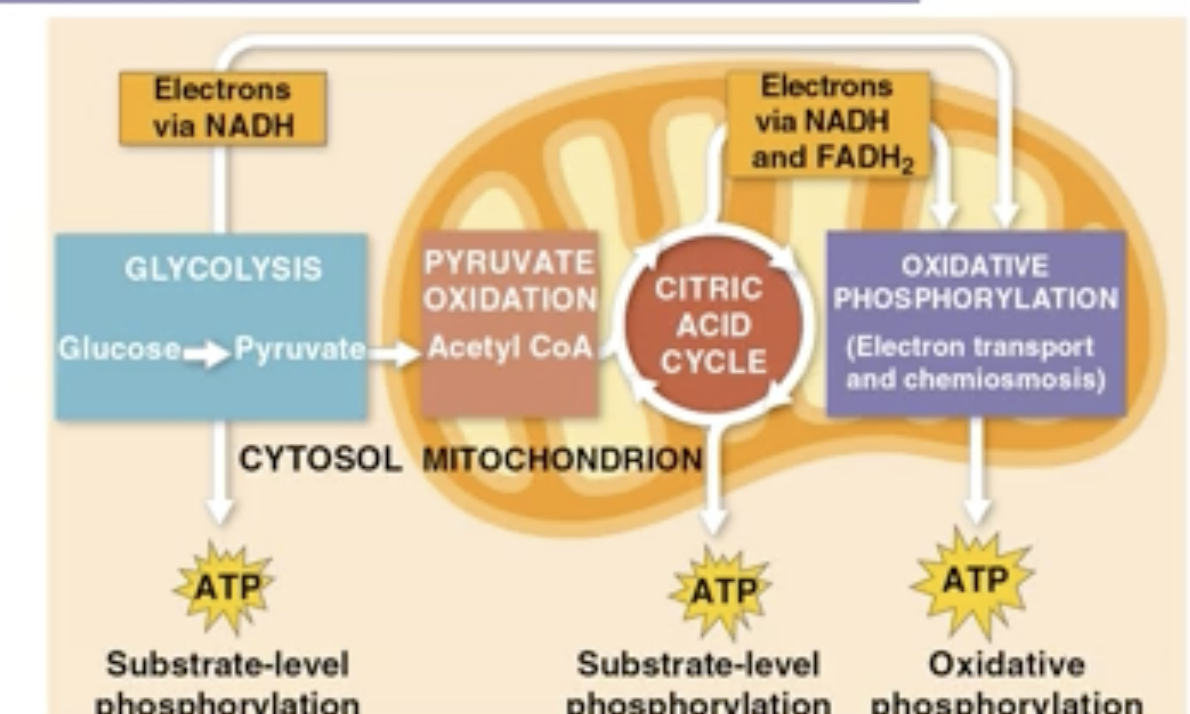
90 percent of atp is genedated by which step of repsiration
oxidative photpshorylation
what is substrate level phosphorylation
when enzyme takes the phosphate group from substrate and attaches to ADP
for each molecule of glucose how many atp molecules are produced
30 to 32
which step in respiation occurs with no need for O2
glycolysis
for whom is pyruvate useful in a sense, to aerobic organism or anaerobic ? explain
It’s more useful for aerobic organisms because pyruvate is then moved to the mitochondria to produce more ATP; whereas in anaerobic organisms, it’s used to recycle NADH and regenerate NAD+.
When we say some prokaryotes make 30 ATP per glucose, which factor is it a result of — being a prokaryote/eukaryote, or aerobic or anaerobic?"
the prokaryote has to be aerobic, and as long as it is it can make 30. just because its prokaryote does not mean it makes 2 atp
what does pyruvate has to become to enter krebs cycle and which enzyme does it
it has to become acetyl coa , and the pyruvate dehydrogenase does it
which 3 reactions does pyruvate dehydrogenase do to make pyruvate acetyl coa
oxidation of Co2
reduction of Nad plus to NADH
coA comes and attaches
via what does pyruvate enter into the mitochondrion
via a transport protein
how many times does krebs cycle run per glucose molecule and why is that
"It runs twice, because after glycolysis 2 pyruvates are made. So 2 pyruvates are made per glucose, and those 2 are finished only then — future glucoses come after."
how many co2 are released per turn during krebs
2 per turn
what products are generated during krebs PER TURN, and the n how many per glucose
1 per turn - atp nadh fadh2
2 per glucose
what are those folded parts of inner memrbane called and what is purpose of them in mitochdnria
cristae - increase surace area
what are those thing called in protein complexes that have iron atoms
cytochromes
is atp produced when electrons trasnfer from one protein complex to anothjer?
no
H plus protons go from where to where so that in future they power atp synthesis
mitochondrial matrix to inter membrane space
what is that turbine if u will called that spins to make atp at the last steps in oxidative phosophorylation
atp synthase
what is the process called when h plus movement powers atp synthesis via the synthase
chemioosomsis
how is the H plus gradient called
proton-motive force
when electrons come and attach to oxygen at which protein complex is it done
complex 4
is atp synthase’s atp recovery and oxygen oxidation happening in the same are ?
no oxygen takes electrons at complex 4 while atp synthase Is in difff location
which percent of glucose is actually converted to atp percent wise and atp amount wise
34 percent and about 30 to 32 atp
what is the final electron acceptor of anaerobic respiration
anything but oxygen
what is the amount of atp produced via glycolysis in aerobic vs anaerobic respiration
both do 2 with or without o2 both do 2
does fermentation use same mechanisms of regernation of NAD plus as the aerobic one does
no
types of fermentation
alchohol fermentation and lactic acid fermentation
in alchohol fermentaiton pyruvate is converted to __
ethanol
in lactic acid fermentation pyruvate becomes ??
lactate
what are similarities of fermentation and cellular respiration
both do glycolysis
both have nad plus as oxidizing agent
what is the difference between fermentation and cellular respiration
in cellular - pyruvate is not used as final electron acceptor, and respiration proceeds to yield more atp in future steps.
what are organisms called that cannot survive in the presence of oxygen and the ones basically that do only anaerobic respiration
obligate anaerobes
anaerobes that can do aerobic as well are called
facultative anaerobes
is respiration restricted to only glucose
no
when protein is consumed what does body do with it
it breaks it down into amino acids and then amino groups should be removed from them
process that removes amino groups is called
deamination
fats are digested into which compound that is essential for glycolysis
glycerol