Unit 5
 Call Kai
 Learn
Learn Practice Test
 Spaced Repetition
 Match
Match Flashcards
 Knowt Play
1/32

There's no tags or description
Looks like no tags are added yet.
Name | Mastery | Learn | Test | Matching | Spaced | Call with Kai |
|---|
No analytics yet
Send a link to your students to track their progress
33 Terms
Subsistence Farming
Grown for yourself/family.
fewer machines, more labor, small plots, multi cropping, and mostly women
Common in LDCs
Ex of Subsistence farming: shifting cultivation(slash and burn), intensive distance (rice/non rice), pastoral nomadism
Commercial Farming
Grow to sell
large farms, lots of machines, less labor, agribusiness(owned multiple parts of the operation = more revenue), monoculture, few women, and lots of capital benefits.
MDCs and some LDCs
Ex of Commercial farming: mixed crop and livestock, Dairying, grain, ranching, Mediterranean, commercial gardening, plantation(LDCs only)
Intensive farming
Less land and closer to market, high yield per acre, high labor and capital costs.
Extensive
Lots of land and far from market, low yield per acre, low capital and labor costs.
1st Agricultural Revolution
Independent domestication of plant and animal hearths.
Hearths: Fertile Crescent (SW Asia), Indus River Valley (South Asia), SE Asia, Central America, Sub-Saharan Africa.
Diffusion: Contagious
Diffusion of plants-animals from hearth(later on):
Relocation diffusion from trade and migration. Ex: Columbian Exchange
Advantages: Steady food supply, population increase, more jobs.
Costs: Food crops fail = starvation, spread of disease, hard to leave site.
2nd Agricultural Revolution
Introduction of crop rotation, new tech. and increased food production.
New Tech: Steel plow - 1819
Seed drill -1800’s
Reaper - 1981
Grain Elevators - 1849
Barbed wire - 1870’s
Fertilizer - 1903
Advantages: Better diets, longer life expectancy/population growth, economic growth, lead to industrial revolution.
Costs: Displacement of farmers(less farmers and bigger farms), profit driven(commercialization).
Green Rev.
Fully-mechanized farming(tractors and combines)
Access to new land and more intensive use of land(high-yield hybrid seeds), monoculture and monocropping.
Advantages: more food, efficient farming.
Costs: social inequalities(male vs. female workers), favors larger farms, environmental damage(soil erosion), less biodiversity.
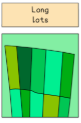
Long Lot Survey Method/Linear settlement pattern
Rectangle linear shaped lots, along waterways for easy transport, more equal quality of land.
Originates from France
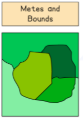
Metes and bounds survey method/clustered settlement pattern
Some physical features are used to place this settlement pattern(ex. creek or trees), more random looking, good for short distances.
Origin: UK - seen in Eastern US.
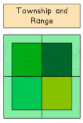
Township and range survey method/dispersed settlement pattern
Created from the Land Ordinance Act 1785, very orderly and efficient, technology used, geometric - rectangle linear or square-like grid, sectioned off and sold(6×6 sq mile), not equality quality of land, found in American Midwest.
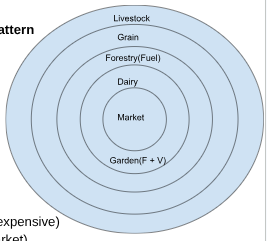
Von Thunen model 1826
Explains land use in proximity to market. Land costs - the closer you are to the market, the more expensive the land is. Transportation costs - the farther you are from the market, the more it costs to transport to market.
Rings:
Market gardens and dairy
forests/fuel
grains
livestock
Agribusiness
Focuses on production, processing, marketing, and lobbying. Helps give resources to mergy farms and buy expensive machinery. Mechanization = easier to have large farms. The more crop production, the more cost efficient it is.
Genetically Modified Organisms(GMO)
Plants or animals that scientist modified in a lab by extracting genes of one species and inserting them into the DNA of another species. Ex: Drought and Pest resistant. NOT hybrid seeds.
Aquaculture
Practice of raising and harvesting fish in water. Founded in China and SE Asia.
Blue Revolution
The fastest growing form of food production on the planet - 50% of the world’s seafood.
Urban Farming
Growing or producing food in a city or heavily populated area
Organic Farming
Focuses on sustainability, enhancing soil fertility, and biological diversity. Does not use fertilizers, pesticides, hormones, antibiotics, or GMOs. Makes up 1% of global farming.
Value-added Specialty Crops
Something new through packaging, processing, cooling, during extracting, or other processes that change a product from its original raw form. More expensive to buy than basic raw crops. helps small farmers compete with mass corporate farming.
Fair Trade - Empowering Small Farmers Globally
Purpose: designed to get more money into the hands of small farmers in poor countries.
Issue: Only 1/3 of price of good is returned to producer in LDCs.
Co-ops: Farmers banding together.
Impacts: Fair wages, environmental and safety standards, more expensive, targeting plantation crops(coffee, tea, bananas, and chocolate).
Agriculture Environmental Issues
Little biodiversity: less variety in crops(monocropping/monoculture)
Animal Waste: Feedlots - thousands of animals in very limited spaces - can create air and water pollution from concentrated waste.
Sustainability: maintaining soil without depleting it.
Chemicals and Fossil Fuels: fertilizers, pesticides, chemicals for animals, herbicides, limited fossil fuels.
Debt for Nature Swaps: a core country forgives peripheral debt for a focus on conservation projects in peripheral.
Consequences of Climate Change
Extreme Weather Events: climate change leads to more frequent and intense weather - tornadoes, hurricanes, etc;
Displacement leads to climate refugees and conflict over scarce resources.
Consequences of Desertification
Prolonged droughts and degradation cause widespread desertification.
irrigation
Using water to grow crops - can cause soil salinization(water-soluble salts accumulate in soil). Over irrigation = too many minerals in crops.
Commercial Grain Agriculture
Definition: Focuses on cultivating cereal crops like wheat, corn, barley, and rice.
Intensive or Extensive: Extensive - large-scale mechanization with the use of combines and tractors.
Subsistence or Commercial: Commercial - sells for human consumption
Where: Southeast United States, Eastern Europe(Ukraine), India, China, and Argentina.
Dairy
Definition: Raises livestock for dairy products near market - perishable products.
Intensive or Extensive: Intensive - relies on high inputs of feed, labor, and technology to maximize milk production per cow.
Subsistence or Commercial: Commercial - makes products for profit rather than personal consumption.
Where: Northeast United States, Southeast Canada, Northwest Europe, and India(largest producer).
Crop and Livestock
Definition: Uses most crops grown to feed animals. Animal manure can be used as a soil fertilizer.
Intensive or Extensive: Intensive - high levels of labor, capital, and inputs, but uses less land than regular livestock farming.
Subsistence or Commercial: Commercial - crops are grown to feed livestock and sell animal products.
Where: Midwest US and Canada, Central Europe.
Mediterranean
Definition: Grows multiple crops, specialized farming in regions with hot, dry summers and mild, wet winters. Focuses on growing drought resistant crops like olives, grapes, citrus, and figs. Uses dry farming and terracing to manage water scarcity and support local economies
Intensive or Extensive: Intensive - small plots of land
Subsistence or Commercial: Commercial - produced for export or processing.
Where: Southern coast of Europe(Mediterranean Sea), Northern coast of Africa, Pacific coast of the US(California), and Chile.
Market Gardening
Definition: Mass fruit and vegetable farming with intercropping in limited space.
Intensive or Extensive: Intensive(by market, so land is expensive)(high labor)
Subsistence or Commercial: Commercial, focuses on the production of high-value crops for profit.
Where: Southern and Western US, SE Australia, Latin America, and Southern Europe.
Pastoral Nomadism
Definition: Herding of domesticated animals and seasonal migration of livestock between mountains and lowland pastures.
Intensive or Extensive: Extensive - migrates over a large area of land
Subsistence or Commercial: Subsistence - primary goal is to provide food, milk, shelter, and clothing for the family.
Where: Southwest, Central, East Asia, and North Africa.
Livestock ranching
Definition: Grazing of livestock over a large area of land.
Intensive or Extensive: Extensive - grazing of livestock over a large area
Subsistence or Commercial: Commercial - raising animals and selling to make a profit.
Where: Western North America, Southeast South America, Central Asia, and Australia.
Plantation
Definition: Focused on growing one or a few cash crops(bananas, tea, coffee, sugarcane, cocoa, palm oil).
Intensive or Extensive: Intensive - high inputs of labor and capital(expensive to farm a large area)
Subsistence or Commercial: Commercial - monoculture farming to produce cash crops ot make a profit.
Where: Latin America, Sub-Saharan Africa, South Asia, and Southeast Asia.
Intensive Subsistence(Wet Rice)
Definition: Land used primarily for wet rice, field plowed, flooded, plant seedlings, and harvest(terraces are common).
Intensive or Extensive: Intensive - high labor input on small plots of land.
Subsistence or Commercial: Subsistence - focused on maximizing food for local families.
Where: Southeast Asia, South Asia, and East Asia(near large populations).
Shifting Cultivation(slash and burn)
Definition: Farmers clear forested land, burn the vegetation for nutrient-rich ash, and farm the plot for 3-5 years.
Intensive or Extensive: Extensive - large area of land, low labor.
Subsistence or Commercial: Growing for family needs, not large-scale sscale market sales.
Where: Latin America, Sub-Saharan Africa, and Southeast Asia.