Derivative rules
0.0(0)
Studied by 11 people0%Exam Mastery
Build your Mastery score
 AP Practice
Supplemental Materials Call Kai
Call KaiCard Sorting
1/53

Earn XP
Description and Tags
y'all you'd better memorize all of this. it's literally everything calculus is made up of. if you don't know any of these... well... good luck charlie!
Last updated 2:20 PM on 5/7/23
Name | Mastery | Learn | Test | Matching | Spaced | Call with Kai |
|---|
No analytics yet
Send a link to your students to track their progress
54 Terms
1
New cards
d/dx (c) = 0
derivative of a constant
2
New cards
d/dx (xⁿ) = nxⁿ⁻¹
Power rule (derivative of a power)
3
New cards
d/dx (f(x)g(x)) = f(x)g’(x)+g(x)f’(x)
product rule
4
New cards
d/dx (f(x)/g(x)) = (g(x)f’(x)-f(x)g’(x))/(g(x))²
quotient rule
5
New cards
d/dx (f(g(x)) = g’(x)(f’(g(x))
chain rule
6
New cards
d/dx (sinx) = cosx
derivative of sine
7
New cards
d/dx (cosx) = -sinx
derivative of cosine
8
New cards
d/dx (tanx) = sec²x
derivative of tan
9
New cards
d/dx (cotx) = -csc²x
derivative of cotangent
10
New cards
d/dx (secx) = tanxsecx
derivative of secant
11
New cards
d/dx (cscx) = -cscxcotx
derivative of cosecant
12
New cards
dy/dx f⁻¹(x) = 1/(f⁻¹(x))
derivative of an inverse
13
New cards
d/dx eⁿ = eⁿ
derivative of eⁿ (n meaning the whole exponent)
14
New cards
d/dx aⁿ = aⁿ(ln(a))n’
derivative of a number at a variable exponent (n meaning the whole exponent)
15
New cards
d/dx (ln(x)) = 1/x
derivative of ln(x)
16
New cards
d/dx (ln(u))= u’/u
derivative of a natural log (the whole exponent)
17
New cards
d/dx (logₙu) = (u’/uln(n))
derivative of the log of a number
18
New cards
d/dx (sin⁻¹x) = 1/(√(1-x²) )
derivative of arcsine
19
New cards
d/dx (cos⁻¹x) = -1/(√(1-x²))
derivative of arccosine
20
New cards
d/dx (tan⁻¹x) = 1/(1+x²)
derivative of arctan
21
New cards
d/dx (csc⁻¹x) = 1/(x√(x²-1))
derivative of arccosecant
22
New cards
d/dx (sec⁻¹x) = -1/(x√(x²-1))
derivative of arcsecant
23
New cards
d/dx (cot⁻¹x) = -1/(1+x²)d
derivative of arccotan
24
New cards
f’(x) = lim x→0 ((f(x+h)-f(x))/h)
definition of a derivative
25
New cards
you find the derivative of the function and plug in that point. (if you are only given the x value, plug it into the original function).
how do you find slope of the tangent line to a function at a point?
26
New cards
(f(b)-f(a))/(b-a) or ∆y/∆x
average rate of change (aka the way to find the derivative of the function at a secant line)
27
New cards
if f is continuous on \[a,b\] and d is any number between f(a) and f(b), then there is at least one number c between a and b such that f(c) = d
How do you use the intermediate value theorem?
28
New cards
if f(x) is continuous and if \[a,b\] and f(x) is differentiable (a,b), then there exists at least one c on (a,b) such that f’(c) = (f(b)-f(a))/(b-a)
\
1) find f(a) and f(b) and plug it into the expression
2) find the derivative of the given function. set the derivative equal to f’(c) and find c
\
1) find f(a) and f(b) and plug it into the expression
2) find the derivative of the given function. set the derivative equal to f’(c) and find c
how do you use the mean value theorem?
29
New cards
if a function is continuous on a closed interval, then the function is guaranteed to have and absolute maximum and absolute minimum in the interval
how do you use the extreme value theorem?
30
New cards
take the slope of the tangent line and the point and plug it into point slope formula (y-y₁ = m(x-x₁))
how do you find the equation of a tangent line?
31
New cards
take the slope of the tangent line and find the line perpendicular to the slope (negative reciprocal). then put it into the point-slope formula and use the same points
how do you find the equation of a normal line?
32
New cards
s(t)
position of a particle
33
New cards
s’(t)
velocity of a particle (aka v(t))
\
finds how quickly something is moving and it’s direction
\
finds how quickly something is moving and it’s direction
34
New cards
s”(t)
acceleration of a particle (aka a(t) or v’(t))
\
finds the rate of change of the velocity
\
finds the rate of change of the velocity
35
New cards
if velocity < 0
when does the particle move left?
36
New cards
if velocity > 0
when does the particle move right?
37
New cards
speed is increasing
if velocity and acceleration have the same sign
\
you can find this by using the number line method (stack two number lines on top of each other, one for velocity, one for acceleration) then seeing when the lines have the same signs at a certain point
\
you can find this by using the number line method (stack two number lines on top of each other, one for velocity, one for acceleration) then seeing when the lines have the same signs at a certain point
38
New cards
speed is decreasing
if velocity and acceleration have different signs
\
you can find this by using the number line method (stack two number lines on top of each other, one for velocity, one for acceleration) then seeing when the lines have the same signs at a certain point
\
you can find this by using the number line method (stack two number lines on top of each other, one for velocity, one for acceleration) then seeing when the lines have the same signs at a certain point
39
New cards
velocity = 0
acceleration ≠ 0
acceleration ≠ 0
the particle has stopped moving and is changing direction
40
New cards
|v|
speed
41
New cards
(pertaining to velocity and acceleration)
the slope of the line segment connecting the points for the time interval \[a,b\] (plug a and b into x(t) to find their respective y values and use the slope formula)
the slope of the line segment connecting the points for the time interval \[a,b\] (plug a and b into x(t) to find their respective y values and use the slope formula)
average velocity (you are NOT plugging this into x’(t) because by using the slope formula, you are already finding the derivative of x(t))
42
New cards
(pertaining to velocity and acceleration)
the slope of the line segment connecting the points for the time interval \[a,b\] (plug a and b into x’(t) to find their respective y values and use the slope formula)
the slope of the line segment connecting the points for the time interval \[a,b\] (plug a and b into x’(t) to find their respective y values and use the slope formula)
average acceleration (you are NOt plugging this into x”(t) because by using the slope formula, you are already finding the derivative of x’(t))
43
New cards
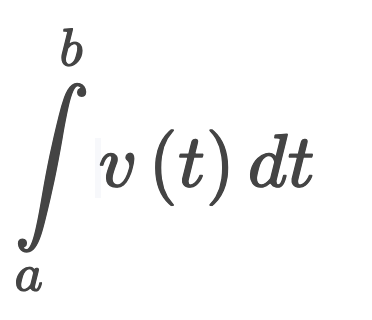
\
how much the particle is changing direction from a to b
(pos: moving right, neg: moving left)
(pos: moving right, neg: moving left)
44
New cards
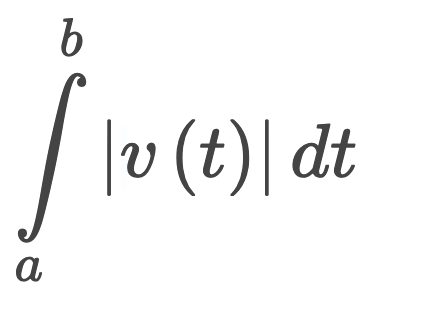
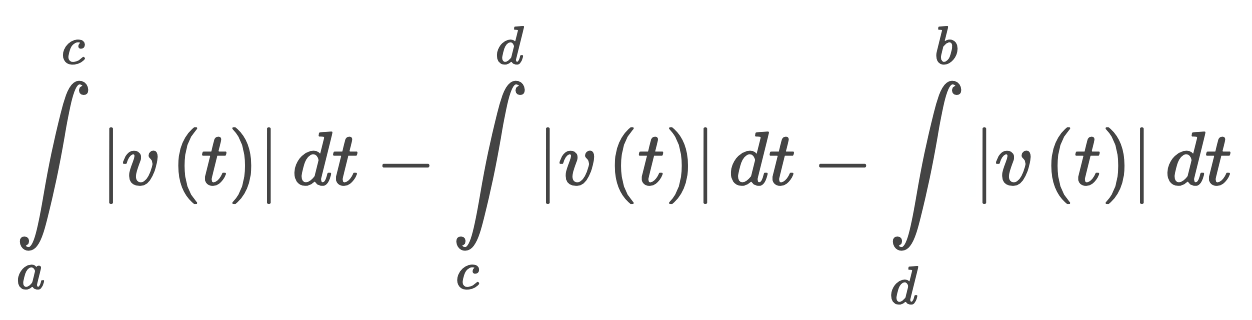
the total distance traveled from a to b
(you can do this by hand by finding the places where the particle stops then doing as shown in the photo (key: c and d are the sample stopping points)
(you can do this by hand by finding the places where the particle stops then doing as shown in the photo (key: c and d are the sample stopping points)
45
New cards
1) find the derivative of the given function and set it equal to zero
2) solve for the variable
3) find the second derivative to see if it’s a max/min
2) solve for the variable
3) find the second derivative to see if it’s a max/min
how do you solve for a word problem asking for the max/min
(don’t forget to write “local extrema occur at critical numbers which are when f’=0 or f’ DNE“ or “absolute extrema occur at endpoints or critical numbers which are when f’=0 or f’ DNE’)
(don’t forget to write “local extrema occur at critical numbers which are when f’=0 or f’ DNE“ or “absolute extrema occur at endpoints or critical numbers which are when f’=0 or f’ DNE’)
46
New cards
When f’(c)=0 or f’ is undefined at c
critical numbers
47
New cards
occur at critical numbers ONLY
relative/local extrema
48
New cards
occur at critical numbers AND endpoints
absolute extrema
49
New cards
first derivative test
1) relative minimum
2) relative maximum
1) relative minimum
2) relative maximum
let c be a critical number of a function f that is continuous on an open interval i containing c. if f is differentiable on the interval, except possibly at c, then f(c) can be classified as:
\
1) if f’(x) changes from negative to positive at c (or f changes from decreasing to increasing, then f(c) is a __________________ of f.
2) if f’(x) changes from positive to negative at c (or f changes from increasing to decreasing, then f(c) is a __________________ of f.
\
1) if f’(x) changes from negative to positive at c (or f changes from decreasing to increasing, then f(c) is a __________________ of f.
2) if f’(x) changes from positive to negative at c (or f changes from increasing to decreasing, then f(c) is a __________________ of f.
50
New cards
second derivative test
1) relative minimum
2) relative maximum
1) relative minimum
2) relative maximum
Left f be a function such that the second derivative of f exists on an open interval containing c. (Testing critical numbers in the second derivative)
\
1) if f’(c) = 0 and f”(c) > 0, then f(c) is a _____________.
2) if f’(c) = 0 and f”(c) < 0, then f(c) is a _____________.
\
1) if f’(c) = 0 and f”(c) > 0, then f(c) is a _____________.
2) if f’(c) = 0 and f”(c) < 0, then f(c) is a _____________.
51
New cards
test for concavity
1) upward
2) downward
1) upward
2) downward
Let f be a function for who second derivative exists on an open interval i. Find the x values where f“(x) = 0 or f”(x) is undefined. Evaluate values to the left and right.
\
1) if f”(x) > 0 for all x in i, then the graph of f is concave _______ in i.
2) if f”(x) < 0 for all x in i, then the graph of f is concave _______ in i.
\
1) if f”(x) > 0 for all x in i, then the graph of f is concave _______ in i.
2) if f”(x) < 0 for all x in i, then the graph of f is concave _______ in i.
52
New cards
definition of an inflection point
A function has an inflection point at (c, f(c))…
1) if f”(c) = 0 or f”(c) DNE
2) if **f”(x)** changes sign from positive to negative or negative to positive at x = c
***OR***
if **f’(x)** changes from increasing to decreasing or decreasing to increasing at x = c (aka has a hill/valley)
***OR***
if **f(x)** changes concavity at x = c
1) if f”(c) = 0 or f”(c) DNE
2) if **f”(x)** changes sign from positive to negative or negative to positive at x = c
***OR***
if **f’(x)** changes from increasing to decreasing or decreasing to increasing at x = c (aka has a hill/valley)
***OR***
if **f(x)** changes concavity at x = c
53
New cards
(f⁻¹(x))’ = 1/(f’(f⁻¹(x)) , f’(f⁻¹(x)) ≠ 0
***OR***
if g(x) is the inverse of f(x): g’(x) = 1/(f’(g(x))) , f’(g(x)) ≠ 0
***OR***
if g(x) is the inverse of f(x): g’(x) = 1/(f’(g(x))) , f’(g(x)) ≠ 0
derivative of an inverse function
54
New cards
If lim x→c f(x) = 0 and lim x→c g(x) = 0, then by L’Hopital’s rule…
lim x→c f(x)/g(x) = lim x→c f’(x)/g’(x) = lim x→c f’(c)/g’(c)
lim x→c f(x)/g(x) = lim x→c f’(x)/g’(x) = lim x→c f’(c)/g’(c)
L’hopital’s Rule