Psychology Unit 3 AOS 2
 Call Kai
 Learn
Learn Practice Test
 Spaced Repetition
 Match
Match Flashcards
 Knowt Play
1/62

There's no tags or description
Looks like no tags are added yet.
Name | Mastery | Learn | Test | Matching | Spaced | Call with Kai |
|---|
No analytics yet
Send a link to your students to track their progress
63 Terms
A) Learning
B) Conditioning
C) Behaviourist approaches to learning
Learning is the process of acquiring knowledge, skills, or behaviours through experience
Conditioning: process of learning associations between a stimulus in the environment and a behavioural response
It refers to learning --> so if one has conditioned to do something, it means that they have learnt it
Behaviourist approaches to learning are theories that propose learning occurs by interacting with the external environment
A) Classical conditioning/respondent conditioning
B) Stages involved
C) Classical conditioning is an example of a ____
Classical conditioning/respondent conditioning is a process of learning through the repeated association of two or more stimuli
It involves three stages:
1. Before conditioning
2. During conditioning
3. After conditioning
It is an example of a behaviourist approach to learning
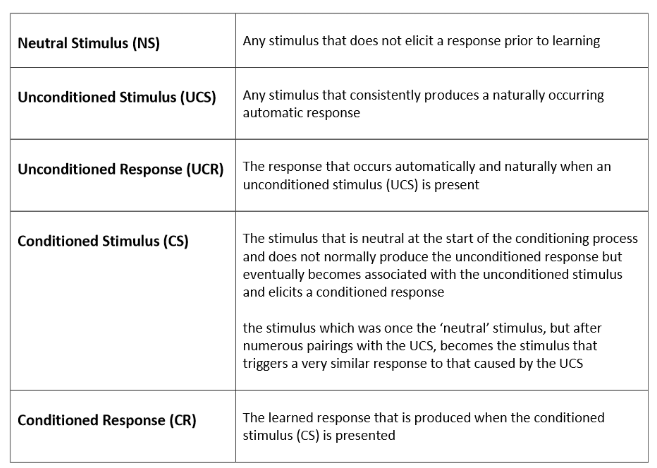
A) NS
B) UCS
C) UCR
D) CS
E) CR
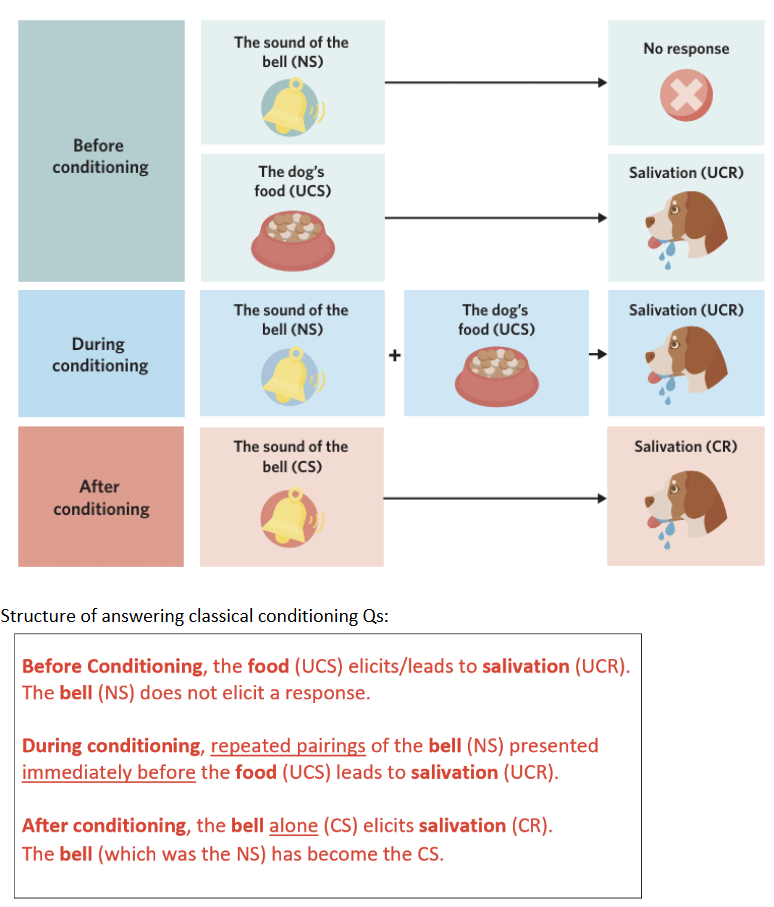
Outline the structure of answering classical conditioning Qs, then do one with reference to Ivan Pavlov dog experiment (hint: dog, bell, food, salivation)
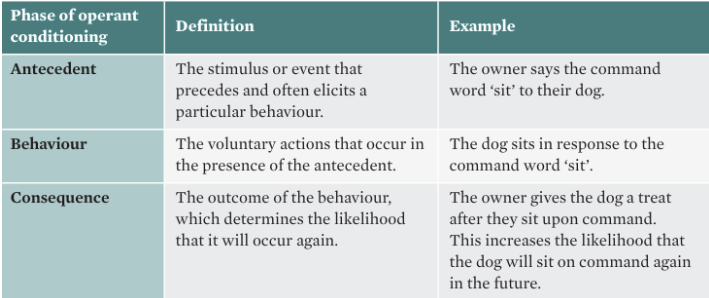
A) Operant conditioning/instrumental learning
It is an example of a _____
B) Phases - discuss them
Operant conditioning/instrumental learning is a type of learning whereby the consequences of a behaviour determine the likelihood that it will reoccur/be performed again in the future
It is an example of a behaviourist approach to learning
Operant conditioning has three phases (ABC):
Antecedent
Behaviour
Consequence
Identify and describe the two types of consequences and their subtypes
The two types are reinforcement and punishment:
Reinforcement refers to a desirable consequence that increases the likelihood of a behaviour reoccurring
This can occur in two ways:
Positive reinforcement: the addition of a desirable stimulus, which in turn increases the likelihood of a behaviour reoccurring
Negative reinforcement: the removal of an undesirable stimulus, which in turn increases the likelihood of a behaviour reoccurring
Punishment refers to an undesirable consequence that decreases the likelihood of a behaviour reoccurring
This can also occur in two ways:
Positive punishment/punishment: the addition of an undesirable stimulus, which in turn decreases the likelihood of a behaviour reoccurring
Negative punishment/response cost: the removal of a desirable stimulus, which in turn decreases the likelihood of a behaviour reoccurring
For these examples, outline the type of consequence they are:
A) Not being allowed to go to a party for bad behaviour at home
B) Studying hard for a test and then receiving a high mark
C) a person wears sunglasses to avoid the sun's glare
D) A friend criticising you for arriving late to a catch-up
E) Going for a run when you are stressed, which in turn helps to alleviate your feelings of stress
A) Negative punishment/ response cost - The removal of the desirable experience of going to a party acts as negative punishment for the bad behaviour at home. This decreases the likelihood that the behaviour (bad behaviour at home) will reoccur.
B) Positive reinforcement - the addition of the desirable stimulus of high marks will increase the likelihood of the behaviour (studying hard)
C) Negative reinforcement - This is negative as it involves removing an unpleasant stimulus --> the sun's glare + It is a reinforcement as is desirable
D) Positive punishment - The addition of your friend’s negative remarks acts as positive punishment for the behaviour of arriving late to a social catch-up, decreasing the likelihood that the behaviour (being late) will reoccur
E) Negative reinforcement - the removal of the undesirable experience of tension and discomfort acts as negative reinforcement for the behaviour of going for a run when you are stressed which increases the likelihood that the behaviour (going for a run) will reoccur
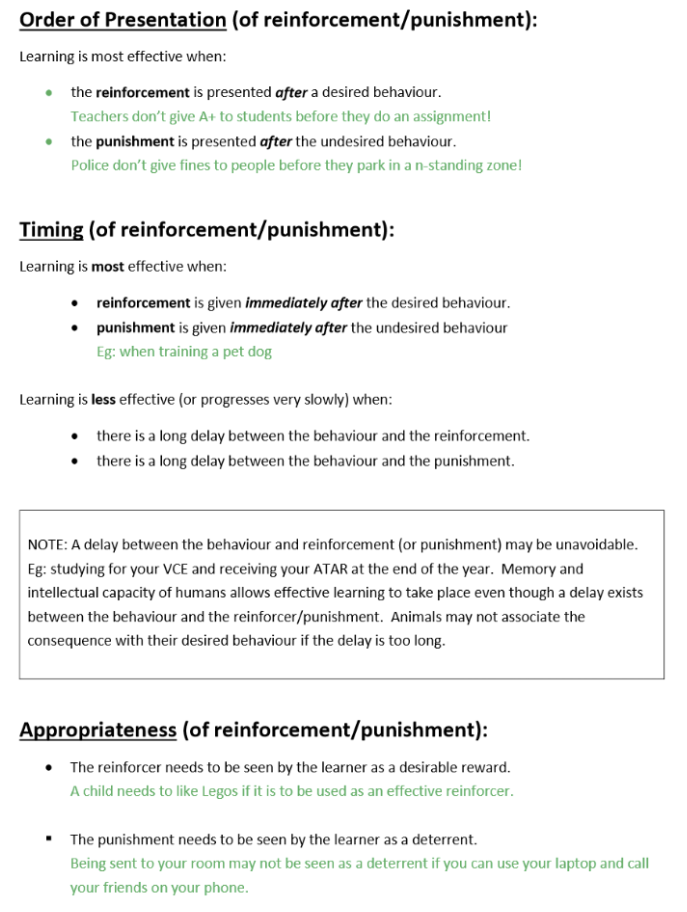
What are some factors that affect the effectiveness of reinforcement and punishment:
Compare classical and operant conditioning:
Similarities | Differences |
|
|
|
|
--> During classical conditioning, the neutral and unconditioned stimuli need to be repeatedly paired in order for learning to occur
--> In operant conditioning, learning is more likely to occur if the consequence occurs several times in response to a behaviour |
|
Social-cognitive approaches to learning
Social-cognitive approaches to learning involve theories that propose learning takes place in a social setting and involves various cognitive processes
A) Observational learning/ social-cognitive learning/ social learning/ modelling
B) Who are involved - what are they labelled as?
C) Is the learner active or passive?
D) It’s different stages (hint: acrostic)
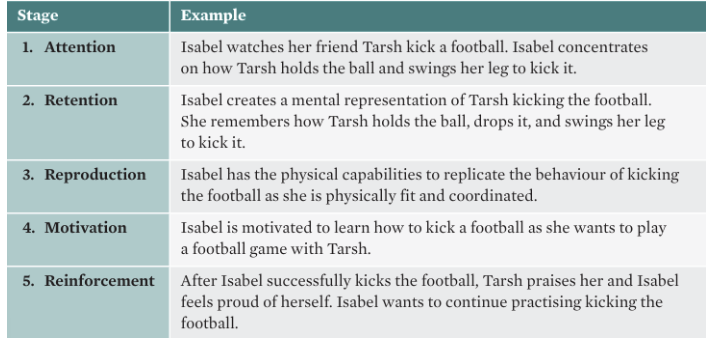
Observational learning is a process of learning that involves a person watching the behaviour of a model and the associated consequence/s of that behaviour to guide their future actions – described by Albert Bandura
In observational learning, there is a learner and a model, which is the individual who is performing the behaviour that the learner observes
The learner has an active role in learning as they need to watch and pay attention to the model in order to be able to imitate the behaviour
It’s different stages include:
Attention
Retention
Reproduction
Motivation
Reinforcement
Acrostic: all roads require maintenance regularly
Attention (social-cognitive learning)
The first stage of observational learning in which individuals actively focus on the model’s behaviour and the consequences of the behaviour
Bandura proposed that learners are more likely to pay attention to the model when the model is:
Perceived positively
Liked
Of high status (such as a celebrity)
Similar to the learner
Familiar to the learner
Visible and stands out from others
Behaving in a way that the learner believes can be imitated
Retention (social-cognitive learning)
The second stage of observational learning in which the learner creates a mental representation to remember the model’s demonstrated behaviour / mentally stores the behaviour
Reproduction
The third stage of observational learning in which the learner must carry out/imitate the behaviour --> they must have the physical and mental capabilities to replicate the behaviour
Motivation + compare intrinsic and extrinsic motivations
The fourth stage of observational learning in which the learner must want/have the desire to reproduce the behaviour
This motivation can be either intrinsic or extrinsic
Intrinsic motivations occur from within the individual, such as the desire to perform well on an exam
Extrinsic motivations occur from factors that are external to the individual, such as the desire to receive praise from your teacher for doing well on an exam
Reinforcement (social-cognitive learning) + give examples of the different types of reinforcement
The fifth stage of observational learning in which the individual receives a positive consequence for the behaviour which makes them more likely to reproduce the behaviour again in the future
There are many different types of reinforcement such as:
Self-reinforcement: the behaviour is reinforced through factors internal to the individual, such as feeling proud of themselves – intrinsic rewards
External reinforcement: the behaviour is reinforced by factors external to the individual, such as receiving an award – external rewards
Vicarious reinforcement: increases the likelihood of a learner behaving in a similar way to a model whose behaviour is being rewarded
Vicarious punishment: decreases the likelihood of a learner behaving in a similar way to a model whose behaviour is being punished
Using observational learning, explain how Isabel learns to kick a football by observing her friend Tarsh
Memory + its 3 fundamental processes (describe them)
Memory is the process of encoding, storing, and retrieving information acquired through learning – active processing system
It contains 3 fundamental processes:
Encoding – process of converting sensory info into a useable firm that can be stored in the brain
Storage – retention of the encoded info over time
Retrieval – process of recovering info from LTM into STM
The Atkinson-Shiffrin multi-store model of memory + sketch an annotated image of it
The Atkinson-Shiffrin multi-store model of memory is a model of memory which outlines the three separate stores of memory (sensory, short-term, and long-term) each of which interact through the processes of encoding, storage, and retrieval
(In the diagram, also include an arrow coming out of STM and pointing back to it called rehearsal)
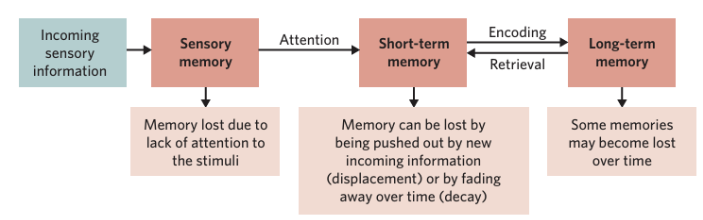
Compare structural features and control processes and talk about what they include:
Structural features are permanent, fixed features of each memory store that do not vary from one person to another
These include:
Function
Capacity (amount of info that can be held)
Duration (length of time it can hold info)
Control processes are the way individuals select and use info
These include:
Attention – choosing to attend to and select incoming sensory info
Rehearsal – consciously manipulating info to keep it in STM
Retrieval – recovery of stored info from LTM to conscious awareness
A) Sensory memory
B) Compare what happens when sensory info is and not attended to
C) Give examples of type of info retained by sensory memory
D) Where is sensory info transmitted to in the brain (where sensory memory is)
E) Sensory memory capacity
F) Duration of sensory memory
All incoming information enters sensory memory; a memory system which temporarily stores raw information detected by the senses
--> If this sensory information is attended to, then it is converted into a useable form and transferred to short-term memory + if sensory info is not attended to then it is lost
Examples of the type of information that can be retained by sensory memory include:
The faces of your classmates directly after looking at them
The sound of a bird chirping outside just after you hear it
The tag of your clothing that you might feel rubbing against your skin
The scent of your deodorant when you spray it
The taste of your food when you are eating lunch
It is where incoming sensory info is transmitted to a specific region of the cerebral cortex and stored for a very brief period – the info is in its raw/original sensory form
Sensory memory has an unlimited capacity
The duration of sensory memory is extremely brief and generally varies between 0.2 to 4 seconds
Incoming sensory info is assumed to be stored in separate sensory system called sensory registers
A) What is the sensory register for visual info?
Comment on its capacity
Comment on its duration
B) What is the sensory register for auditory info?
Comment on its capacity
Comment on its duration
A) Iconic memory is the sensory memory register for visual info --> think of it as 'eye'-conic
Capacity: potentially unlimited
Duration: 0.2 - 0.4 seconds
--> visual sensations are captured through movements of our eyes --> each movement produces a snapshot of info which sent to the primary visual cortex
The duration of the neural activation is very brief providing the illusion of a continuous visual experience rather than a series of static snapshots
B) Echoic memory is the sensory memory register for auditory info --> think of it as 'echo'
Capacity: potentially unlimited
Duration: 3 – 4 seconds
--> the relative longer duration of echoic memory is important for understanding speech, so you can still remember the beginning of a word by the time you hear the end of the word, therefore can comprehend what is being said
A) Short-term memory (STM)/working memory
B) The information in your STM can only come from your sensory memory. T or F?
C) STM capacity
D) Duration
E) Examples of info in STM
Short-term memory (STM)/working memory (as info is being actively processed) is a memory system that temporarily stores a limited amount of information that is consciously being attended to and actively manipulated
False. The information in your STM can come both from your sensory or long-term memory
STM has a limited capacity of 7 ± 2 items (or 5 to 9 items) - which is the number of items that can be actively ‘worked on’ at any one time
Has limited duration of STM is 18 to 30 seconds for most people (it is believed that information generally begins to fade after approximately 18 to 20 seconds)
Examples of info in STM
Interpretation of emotions/feelings, language-comprehension, daydreaming, problem-solving

Rehearsal
The controlled process that involves consciously repeating or manipulating information in STM which can increase the likelihood of information being encoded (the process of converting information into a useable form which can be manipulated and stored in the brain) into long-term memory
A) Displacement
B) Decay
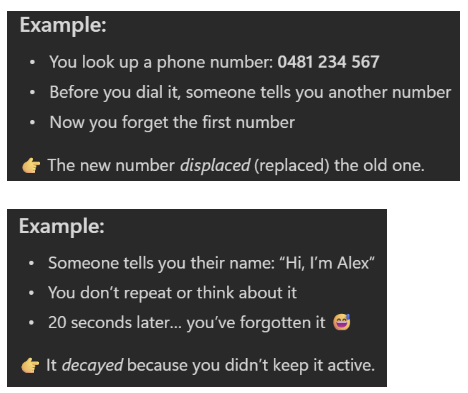
If the information in your short-term memory is not processed and encoded in long-term memory, it can be pushed out by new incoming information (displacement) or fade away on its own after the duration of STM has expired (decay)
Chunking + does chunking increase the capacity of items in STM
Chunking is the grouping of info into larger bits/units that can be remembered as single units
The capacity of STM is still 7, but info to be remembered is now 7 bigger 'bits'/chunks of info
A) Long-term memory (LTM)
B) What info does it store
C) Is it an active system + is the info in it in conscious awareness
D) LTM capacity
E) LTM duration
Long-term memory (LTM) is a memory store in which a potentially unlimited amount of information is stored for a relatively permanent amount of time
It contains all the information retained from past events, as well as knowledge of facts + Info in LTM is stored semantically (meaningfully)
Inactive system + Information stored in LTM is not in conscious awareness – to prevent us from being overwhelmed by the vast amount of info
Capacity: unlimited capacity
Duration: potentially permanent
Are we always able to retrieve all the info in LTM? What are some reasons for this?
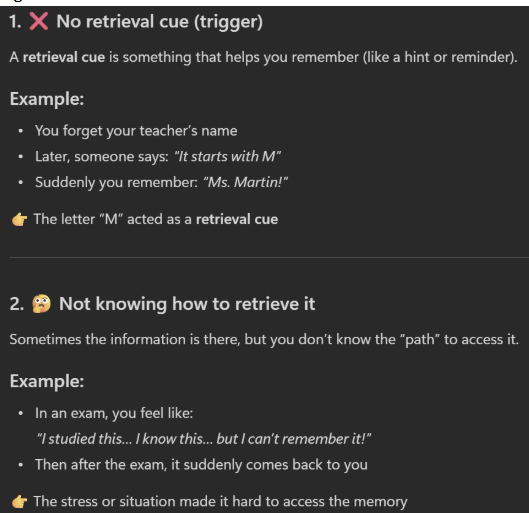
While LTM is considered to have a potentially unlimited amount of information, this does not mean that we have the capacity to retrieve all this information --> sometimes, we are unable to retrieve and access information in LTM as we may be unaware of how to retrieve it or are not prompted by the right retrieval cues
Retrieval
Information stored in LTM can also be retrieved which is the process of accessing information that has been stored in long-term memory and bringing it into our conscious awareness in short-term memory
Strengths and limitations of the Atkinson-Shiffrin Model Of Memory
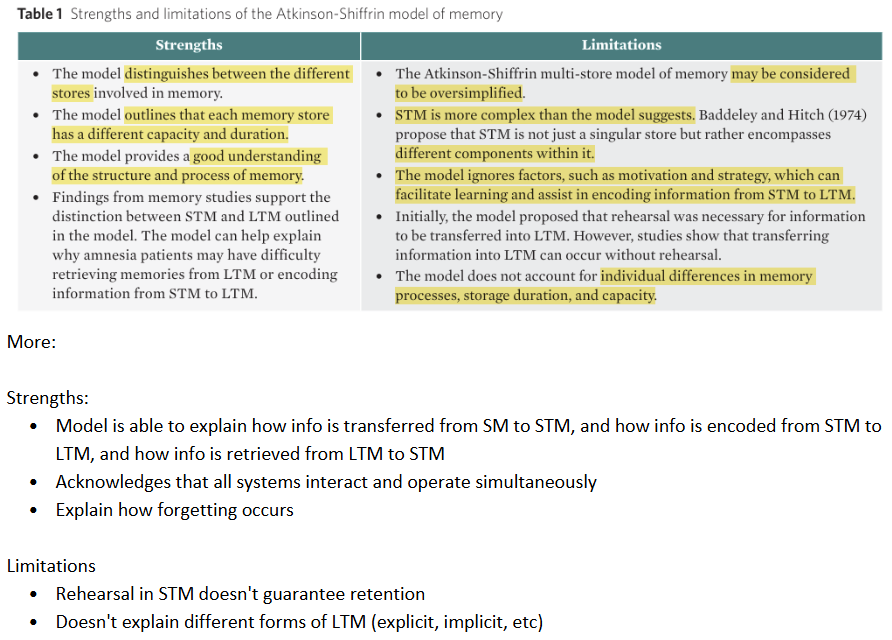
Identify the different types of LT memories and their subtypes
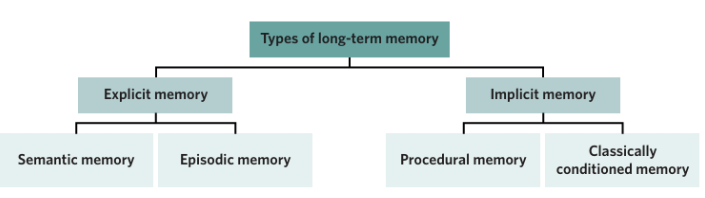
A) Explicit memory/declarative memory
B) Describe its subtypes + give examples
Explicit memory/declarative memory is a type of long-term memory that can be consciously retrieved and stated
These memories can be voluntarily retrieved & be declared or stated to someone else
'Knowing that'
A) Implicit memory
B) Describe its subtypes + give examples
Implicit memory is a type of long-term memory that does not require conscious retrieval
These memories are involuntarily retrieved & are linked to executing/feeling something rather than explaining it
'Knowing how to'
| Definition | Example |
Procedural memory | Procedural memory is a type of implicit memory that involves knowing how to carry out tasks that are facilitated by motor skills | Knowing how to: • tie your shoelaces • kick a ball • play the guitar |
Classically conditioned memory | Classically conditioned memory is a type of implicit memory that involves an involuntary conditioned response to a conditioned stimulus
| A child was caught in rough surf and repeatedly dumped by waves, creating a frightening experience. Through classical conditioning, they associated the ocean with fear. As a result, seeing the ocean later may automatically trigger a fear response |
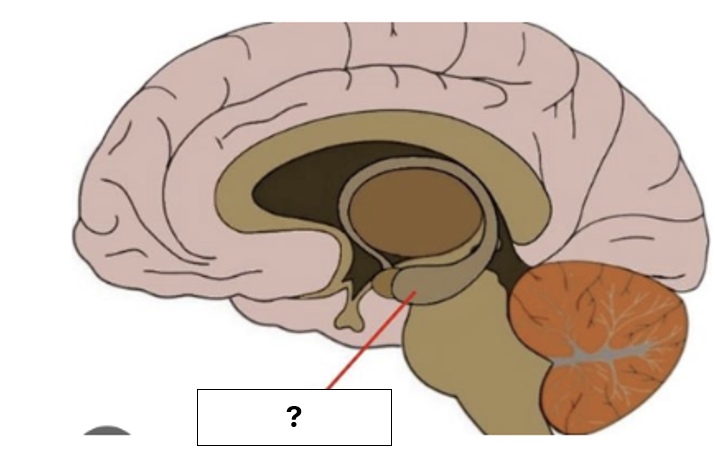
Hippocampus
Hippocampus
Where is it located?
How is it shaped like
There is a hippocampus in each hemisphere. T or F
It’s function
What happens when it’s damaged
Hippocampus is a brain structure that is primarily involved in encoding explicit memories
It is located in the middle of the brain – within the temporal lobe
Shaped like a seahorse
There is a hippocampus in each hemisphere
Function
Encoding and retrieving explicit memories
e.g.
The hippocampus encodes an explicit memory (e.g. personal experience) while later the hippocampus is involved in retrieving this info into conscious awareness when telling a friend
It also transfers newly encoded explicit memories to relevant parts of the brain for permanent long-term storage --> however is not a storage system
If the hippocampus is damaged:
A person cannot encode new explicit memories in LTM or retrieve old explicit memories from LTM
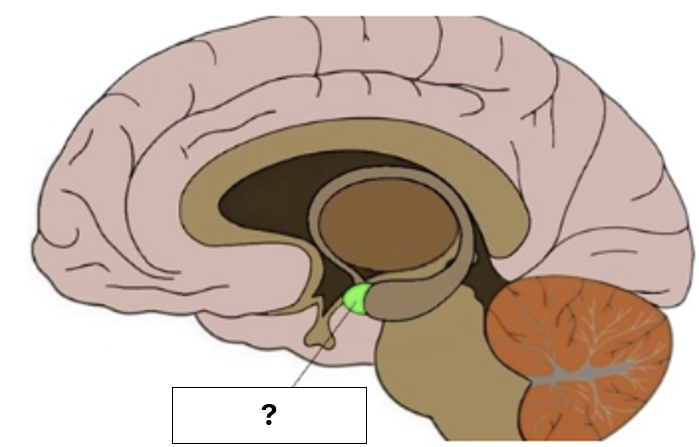
Amygdala
Amygdala
Where is it located
How is it shaped
It’s not located in each hemisphere of the brain. T or F?
It’s function
What happens when it’s damaged
The amygdala is a brain structure that is primarily involved in encoding the emotional component of memories
Located in the middle of the brain where it sits in front of the hippocampus and is often described as the ‘fear centre’ of the brain
Almond-shaped structure + located in each hemisphere of the brain
Function
Plays a role in encoding and retrieving implicit memories of unconscious emotions
If the amygdala is damaged, a person experiences:
An inability to encode strong emotional memories/implicit conditioned responses (e.g. fear)
An inability to experience strong emotions associated with episodic memories
Neocortex/cerebral cortex/cortex/grey matter
Function
Different components/senses that are related to an event are stored in different parts of the brain as an explicit memory. How are these components linked?
What happens when it’s damaged
The neocortex is a the 2-4mm thick outer covering of the brain that stores explicit memories
Function
Where once explicit memories are converted into a usable form in the hippocampus, they are stored within the neocortex to be retrieved for later use (e.g. holidays/concerts attended, psych notes)
—> these components are linked by neural networks to ensure they do not remain separate parts
The neocortex, particularly the frontal lobe is associated with STM – conscious awareness of info
The neocortex also stores implicit procedural memories
If the neocortex is damaged, a person:
Cannot store explicit memories of events and info they have experienced
Experiences problems with their STM
May experience difficulties performing implicit procedural memories
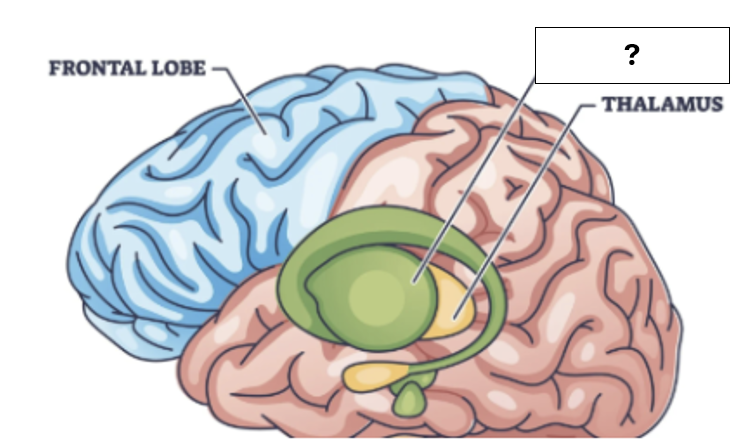
Basal ganglia
Basal ganglia
Function
What happens if its damaged?
The basal ganglia are a group of brain structures
Function
Involved in encoding and storing of implicit procedural memories and assists in the performance of smooth sequences of movements
Associated with reinforcement and reward learning
Associated with habit formation and learning routine behaviours
e.g. riding a bike, brushing teeth, writing with pen
The basal ganglia is active when we move a part of our body
When feeling accomplishment for trying something new or when action results in positive outcome --> the association between the action and reward is recognised --> the reward indicates to the basal ganglia that the behaviour is useful/worth remembering
If the structure is damaged
A person may not be able to perform smooth and fluid voluntary movement, form habits or learn from rewards
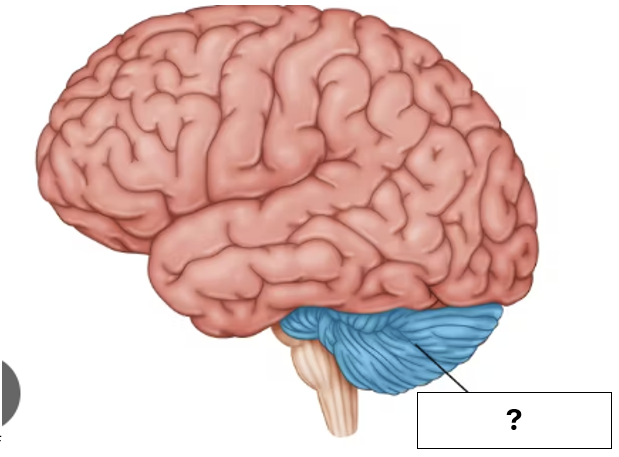
Cerebellum
Cerebellum
Function
What happens if its damaged?
The cerebellum is a brain structure located at the back of the brain alongside the brain stem
Function
Involved in encoding and temporarily storing implicit memories related to precise fine motor movements, balance, posture and coordination
e.g. kicking a ball, riding a bike
Also encodes, stores and retrieves implicit memories of classically conditioned simple reflexes
e.g. eye blink
If the cerebellum is damaged:
A person cannot acquire classically conditioning reflex response
Also experience difficulties in engaging in fine motor movements, balance and coordination
How does the hippocampus & amygdala interact
They work together to encode and link emotions to explicit long-term memories
The hippocampus encodes the explicit memories – context and details
While the amygdala encodes the emotions related to the event + processes the emotional intensity of an experience
--> the amygdala is activated during retrieval
--> Sympathetic NS reactions such as heart rate, goose bumps, sweating that have been linked to the memory may also recur
How does the hippocampus & neocortex interact
They work together to store and retrieve explicit long-term memories
Encoding a memory
The sensory info is processed/attended to in the neocortex (in STM)
The info then travels to the hippocampus where synaptic connections are formed – hippocampus encodes the explicit memory
The hippocampus transfers the memory back to relevant parts of the neocortex for storage
Retrieval of an explicit memory
Info is processed in the neocortex
Info is then sent to hippocampus – which retrieves the 'memory traces'
The retrieved info is then projected back to the neocortex where the event is reconstructed and consciously re-experienced
Each time the hippocampus-neocortex 'feedback loop' is activated, neural pathways for a memory are strengthened --> LTP is taking place
How does the cerebellum & basal ganglia & motor programming areas of the neocortex interact
They work together to encode, store, and retrieve implicit long-term memories – procedural/motor memories linked with habit formation, fine motor movements and simple reflexes
Neocortex (motor control region) initiates commands to perform a complex sequence of motor movements
The basal ganglia received input from the neocortex to perform a complex sequence of motor movements
The basal ganglia considers the input and refines the message so that movements are performed in a smooth and fluid manner
The basal ganglia sends two simultaneous messages to the neocortex and cerebellum to perform motor movements
--> release of dopamine from BG stimulates message to facilitate correct, intended smooth movements
--> release of GABA stimulates message to inhibit/block competing and unwanted movements
This 'motor loop' is primarily active when a sequence of movement has been well learnt
Autobiographical events
Autobiographical memory (ABM) + what does it consist of (give examples)
Autobiographical events refer to personally lived experiences (e.g. first day of school, memories from family vacation)
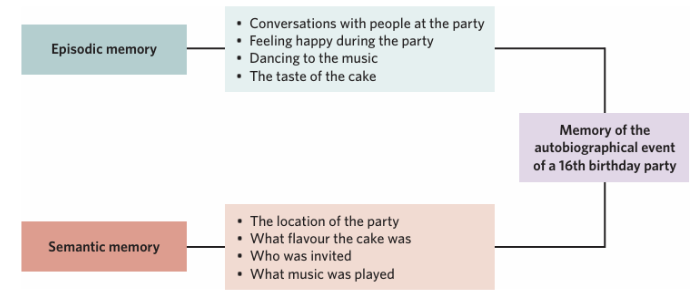
Autobiographical memory (ABM) is a memory system that is a combination of episodic memories and semantic memories based on a person's life events – these memories are explicit
ABM consists of:
Episodic autobiographical memory (EAM) - Which involve remembering past experiences/events - details involved (thoughts, emotions)
e.g. memory of the holiday at the beach
Feeling of sand, wind and sun
Feeling relaxes, happy
Conversations
Semantic autobiographical memory (SAM) - associated with knowledge about self, facts
--> organised in hierarchal structure of broad (e.g. childhood, adulthood), general (birthdays, holidays) and specific (16th birthday)
e.g. memory of the holiday at the beach
Recalling people you were with
Time of the year
Specific location of holiday
Autobiographical events involve an overlap of ___ and ___ memory
autobiographical events involve an overlap of episodic and semantic memory
episodic future thinking or possible imagined futures
What type of memories are involved
The brain regions involved in the retrieval of autobiographical memories are different to the regions activated when people construct possible imagined futures. T or F?
How does damage to the hippocampus affect imagined future scenarios?
In relation to episodic future thinking, a ____ is believed to be accessed first
Episodic and semantic memory are also involved in constructing episodic future thinking or possible imagined futures, which refer to hypothetical experiences/situations that an individual has the ability to create and conceptualise in their mind
False. The brain regions that are involved in the retrieval of autobiographical memories are also activated when people construct possible imagined futures
Studies have found that patients who sustained damage to their hippocampus struggled to imagine future scenarios --> as when individuals attempt to mentally construct a possible imagined future, they draw on elements of past experiences from their semantic and episodic memory
In relation to episodic future thinking, a semantic scaffold (SAM) is believed to be accessed first
e.g.
Imagining a job interview, the imagining ourselves in that job interview
Neurodegenerative diseases
Alzheimer’s disease + is it age-related?
Symptoms of Alzheimer’s disease
Neurodegenerative diseases are diseases characterised by the progressive loss of neurons in the brain
Alzheimer’s disease is a neurodegenerative disease characterised by the gradual widespread degeneration of brain neurons, progressively causing memory decline, deterioration of cognitive and social skills and personality changes
It is age related and common in adults over 65, but not normal part of the ageing process
Most common form of dementia
Some symptoms of Alzheimer’s disease include:
Progressive memory loss
A decrease in cognitive functions (e.g. planning, problem-solving)
Personality changes + decline in social skills
Changes in mood and emotion
Frequently becoming confused, disoriented and impaired attention
Difficulty with language and communication
Inability to perform familiar tasks
How can Alzheimer’s disease be diagnosed?
A proper diagnosis of Alzheimer’s disease was initially only be able to be made through a post-mortem examination which is an assessment of a brain/body after death
But now advances in new brain imaging techniques have enabled diagnosis in the early stages of the disease while people are still alive
What are some changes in the brain for someone with Alzheimer’s disease (don’t talk about brain lesions) and how do these changes affect certain abilities (don’t need to talk about all changes for this part of the question)
The brain of someone with Alzheimer's disease has:
Severe loss of hippocampal tissue -
--> this explains their inability to retrieve previously stored explicit memories + inability to form new explicit memories + loss of 'episodic future thinking'
Brain atrophy (brain shrinkage) - less cortical (cortex) matter
Enlarged ventricles (fluid-filled spaces in the brain)
Neocortex is damaged – affects their ability to store semantic memories + generating voluntary mental imagery
Damage to parietal lobes – linked with problems with spatial memory (e.g. likely to get lost in familiar surroundings)
Damage to occipital lobes – difficulty recognising familiar people and objects
In later stages, damage to cerebellum – leads to loss of implicit procedural functions
Damage to hindbrain (brain stem) affects breathing and heartrate functions
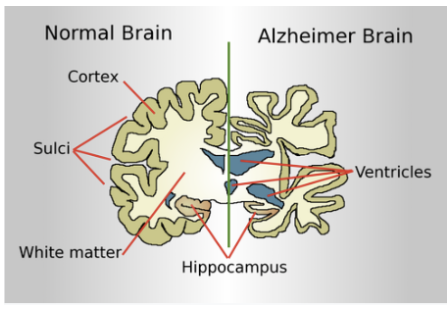
Brain lesions caused by Alzheimer's disease + sketch them
Amyloid plaques form outside a neuron and between neurons – where they are fragments of the protein beta-amyloid that accumulate into insoluble plaques that interfere with and inhibit communication between neurons
--> You can think of it as 'a'myloid plaques – 'a'round neurons
Neurofibrillary tangles that form inside a neuron (inside cell body) - which are an accumulation of the protein tau that forms insoluble tangles within neurons, which then inhibit/reduce the transportation of substances throughout the neuron and eventually kill the neuron
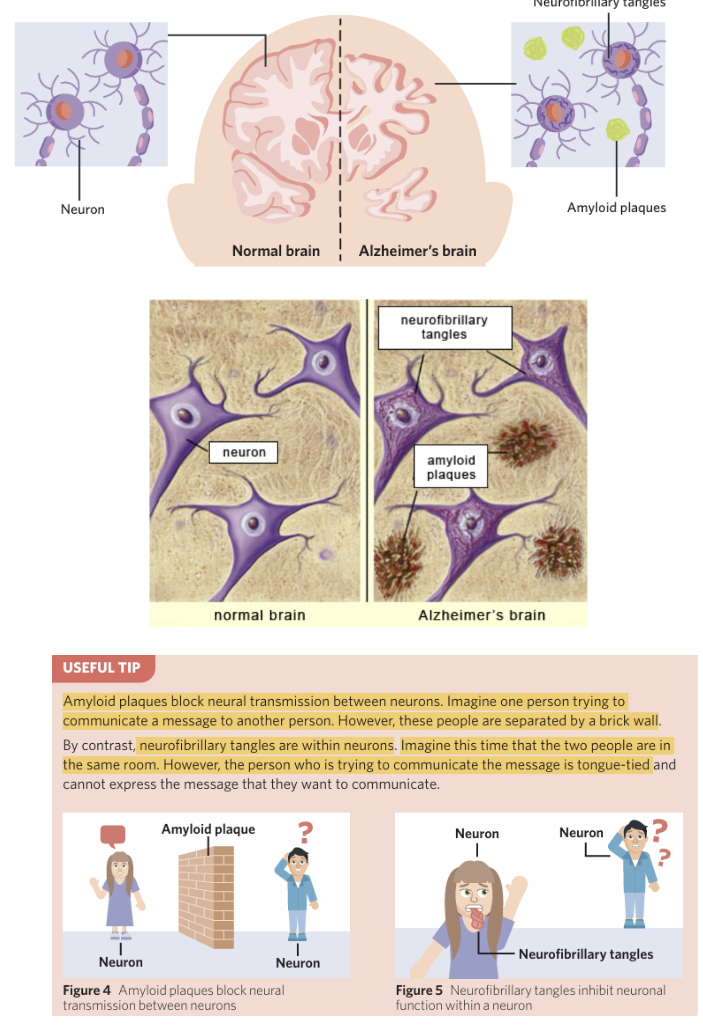
Alzheimer's disease is characterised by retrograde and anterograde amnesia - explain what these are:
Anterograde amnesia – inability to form new explicit memories --> which are early signs/at the start
e.g.
Difficulty remembering important upcoming events
Forgot where they are
Forgot was said in a conversation
Retrograde amnesia – inability to retrieve previously stored explicit LTM --> as the disease progresses
For those with Alzheimer's disease, their memories for more recent events are affected more than memories of long ago – so they seem to be living in the past
Aphantasia
Mental imagery
Sketch a diagram of comparing people with aphantasia with normal people
Aphantasia is a phenomenon in which individuals are unable to voluntarily visualize images in their mind
About 2-5% of the population have aphantasia
Evidence suggests that the ability to partake in mental imagery might exist on a spectrum – so people visualise things with varying levels of vividness
Mental imagery refers to perceiving an object, event or scene in the absence of external sensory stimuli
There are individual differences in the way people experience mental imagery
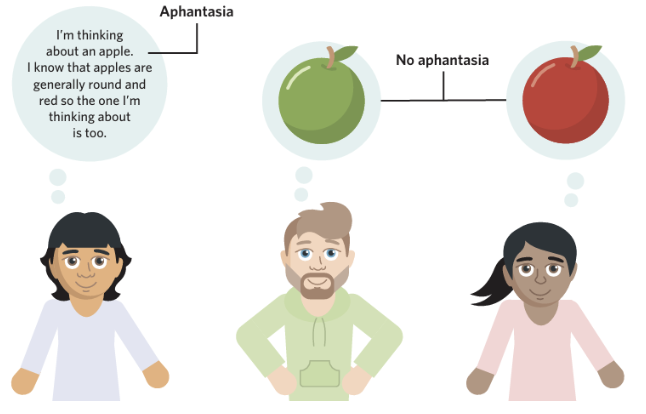
People with aphantasia may:
Struggle to remember/relive autobiographical memories - as they cannot generate vivid, detailed mental imagery of past autobiographical events from their long-term memory which this makes it difficult for people with aphantasia to construct possible imagined futures
Difficulty imagining future/hypothetic events
Problems with factual memory
Dream less & less vivid dreams
Decreased imagery involving other senses such as sound or touch
Trouble recognising faces
Written traditions
Mnemonics
Do mnemonic decrease the amount of info that needs to be stored?
How can mnemonics fail?
Written traditions are practices in which knowledge, stories, and customs are preserved and shared primarily through writing and reading
Mnemonics are devices or techniques used to aid the encoding, storage, and retrieval of information
They do this by organising and linking new information to fit in with existing information in long term memory, improving initial encoding of information
They also help to organise different pieces of information, such as unrelated items in a shopping list, into a more meaningful and cohesive whole
While mnemonics can assist in helping to learn and store information, they do not actually decrease the amount of information that has to be stored --> instead create meaningful links to strengthen the storage of information
Mnemonics can fail if an individual is unable to retrieve the mnemonic or if they fail to accurately interpret the mnemonic
A) Acronym
B) Examples
C) Are they the same as abbreviations?
An acronym is a mnemonic device in which the first letters of each word form a pronounceable word to aid memory
The word doesn’t have to be a proper word
Examples:
BODMAS
‘FAST’ --> help remember and detect symptoms of a stroke (Facial drooping, Arm weakness, Speech difficulties, and Time)
ANZAC
QANTAS
SEA – systematic errors = accuracy
Acronyms aren't the same as abbreviations:
Acronyms are pronounceable words while abbreviations are not
For example, the abbreviation AFL (Australian Football League) is not pronounced as one word but rather as individual letters + VCE
A) Acrostic
B) Examples
An acrostic is a mnemonic device in which the first letters of each word is used to create a phrase, rhyme, or poem for the info to be recalled
Helpful when you have to remember things in a certain order
Help link new information to familiar phrases or sentences we already know
Examples:
‘Never Eat Soggy Weet-bix’, which is an acrostic to help remember the compass directions (North, East, South, and West)
‘Every Good Boy Deserves Fruit’, which is an acrostic to help remember the music notes on the line of the treble clef (E, G, B, D, and F)
A) Method of loci
B) Memory palace
C) Steps involved in method of loci
The method of loci is a mnemonic device that converts information or items into mental images and links them to familiar locations, enabling easier recall by mentally or physically moving through those locations in sequence
The method of loci assists in the encoding and storage of memories by visually linking new information to familiar places or routes
It's particularly useful in remembering information in a certain order
Memory palace can be rooms of a familiar house, areas of well-known school and even body parts
Each room/space provides cues to recall info that has been visualised there
Visualise and imagine a familiar route or place (e.g. their house or walk to school)
Select several memorable places (landmarks) on the route or in their chosen place (e.g. their bedroom or a bus stop)
Create visual imagery for each item that needs to be remembered (e.g. a milk carton). Creating bizarre or funny mental imagery can help strengthen the likelihood of the item being remembered
Link each item to one of the identified memorable landmarks
Imagine they are walking through the house or along the familiar route and retrieve each item by observing the items at each landmark
e.g.
An individual may try to remember ingredients for a cake
An individual may choose to visualise their bedroom
They may then select particular landmarks, such as their bed, desk, or lamp.
Then they need to create visual imagery for each ingredient and link it to the landmarks (e.g. may visualise a bag of flour that has broken and spilt all over the bed or a chocolate bar hidden underneath a pillow.)
When they go to the supermarket to buy the ingredients, they may retrieve their list by mentally walking in their bedroom and retrieving the ingredients by observing them at the different landmarks
Oral traditions
Written cultures
Oral traditions are practices in which knowledge, stories, and customs are preserved and shared through speech and movement (including art, dance, music) and not in a written format
Many indigenous cultures are oral cultures
Written cultures are practices that record and communicate knowledge and information via a written format or typed text-based format
Western culture is a written culture
Sung narratives
Songlines + what do they consist of
Sung narratives are stories that share important cultural, ecological, and survival information through the use of singing, music and sometimes dance
--> think as 'sung' = music/sounds/rhythm and 'narratives' = story telling
Songlines is a sung narrative about Aboriginal and Torres Strait Islander knowledge and culture that is patterned on country and is shared on location via a physical journey or an imagined pathway
They are called "songlines" because people sing them while travelling through the landscape, but they are much more than songs. They combine:
Songs
Stories
Dance and performance
Movement
Paintings/rock art/sculpture
Knowledge of the land
Physical journeys across Country
Why are songlines important?
Songlines help people:
Navigate across Country
Find water, food, and shelter
Know where sacred places are
Learn cultural laws and responsibilities
Understand their connection to ancestors and Country
Astronomical knowledge (knowledge about stars and the sky)
Navigation, ethical and social laws
Land management
Plants and animals
Spiritual knowledge
They contain practical survival information as well as spiritual and cultural knowledge
Compare method of loci and songlines
The passage compares Songlines to the method of loci as they can be visualised as a set of locations
Similarities
Both effective mnemonic devices – aiding memory
Both rely on location (loci), place and space
Both can be navigated either physically or mentally
Differences
Songlines | Method Of Loci |
|
|
--> as a child is initiated higher in the culture, more detail is added to the knowledge at each location