Chemical Senses: Taste and Smell
 Call Kai
 Learn
Learn Practice Test
 Spaced Repetition
 Match
Match Flashcards
 Knowt Play
1/33

There's no tags or description
Looks like no tags are added yet.
Name | Mastery | Learn | Test | Matching | Spaced | Call with Kai |
|---|
No analytics yet
Send a link to your students to track their progress
34 Terms
Chemical Senses
Gustation & Olfaction. Oldest neural systems of the brain. Chemical stimuli transduce signals from the external environment. Responses to odorants and tastes trigger important behavioral reactions such as: Attraction, Reproduction, Feeding, Avoidance of dangerous situations.
Overview of Gustation
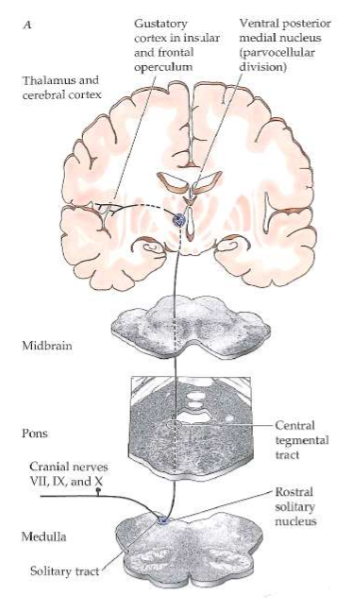
For survival? Pathway stays ipsilateral. 5 Taste Modalities: Sweet- Maintain energy stores, Umami/Savory- Maintain energy stores, Salty- Electrolyte balance, Sour-Maintain pH & avoidance of toxins, Bitter- Maintain pH & avoidance of toxins.
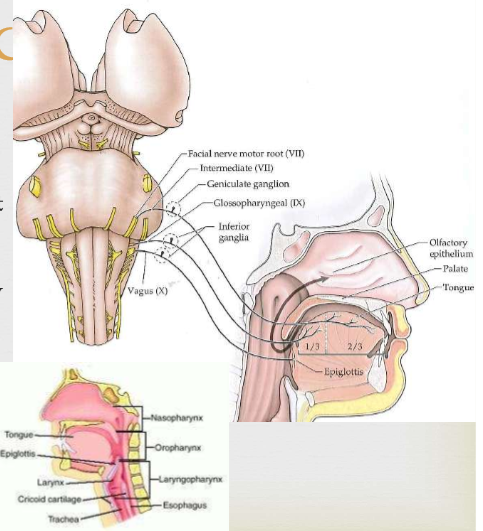
1.Taste Buds and Cranial Nerves
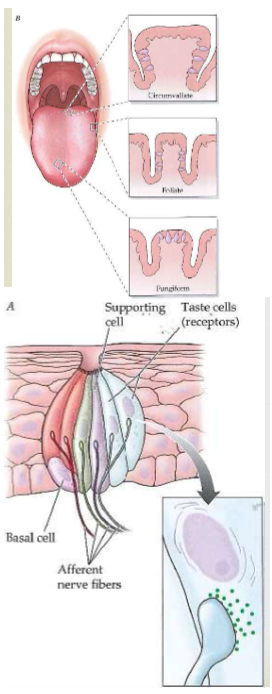
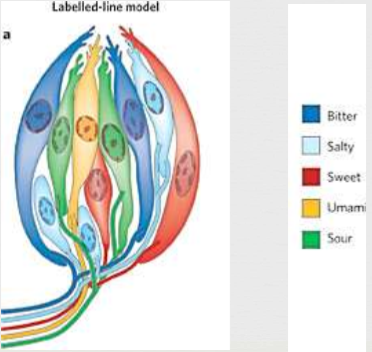
Found: Tongue, soft palate, epiglottis, pharynx & larynx, On tongue organized into papillae (3). Tastants. Taste bud is made up of: Taste receptor cells (regenerate every 10 days): pseudounipolar, Basal Cells (stem cells), Supporting cells. Each sensory fiber branches many times but contact receptor cells that are all of a single taste modality
1.Taste buds and Cranial Nerves: Labeled line code
1.Cranial Nerve Innervation
Tongue: Anterior 2/3 innervated by Facial nerve (VII) and its branches, Chorda tympani nerve that arises from intermediate root of VII, Posterior 1/3 innervated by
Glossopharyngeal (IX). Palate: VII (intermediate). Epiglottis & Larynx: Vagus (X). Pharynx: IX
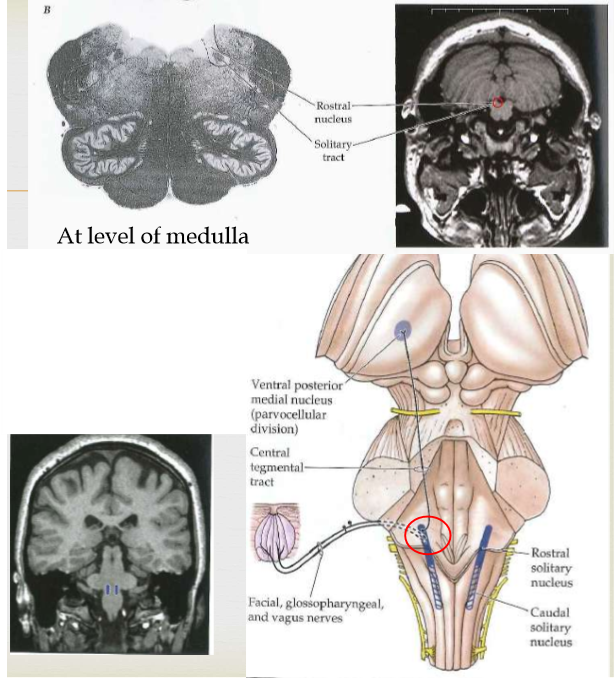
2.Solitary Tract/ Rostral Solitary Nucleus
Rostral solitary nucleus in blue
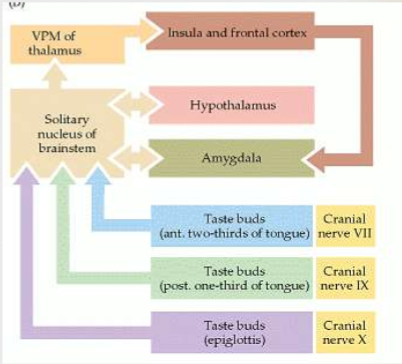
Aternative Pathways
Hypothalamus (feeding behaviors)
Amygdala (emotional behaviors, taste aversion)
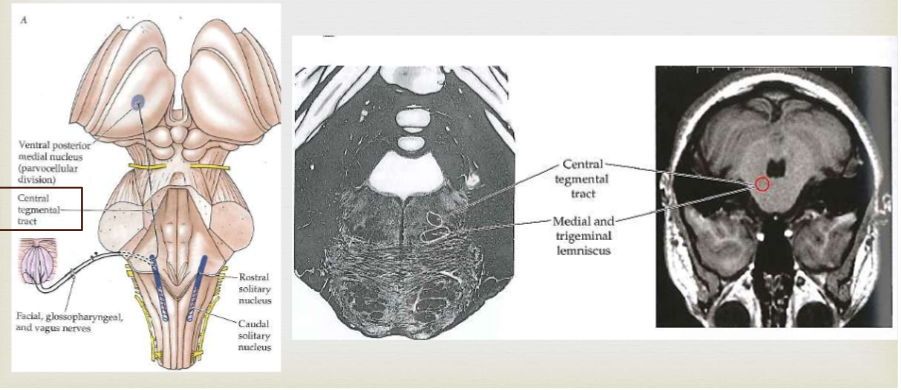
3.Central Tegmental Tract
Goes through pons and midbrain to thalamus
4 & 5. Thalamus and Internal Capsule
Ventral posterior medial nucleus (parvocellular portion). Ascend through internal capsule to next stop
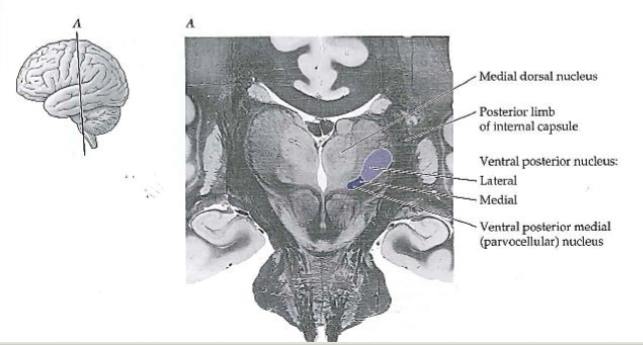
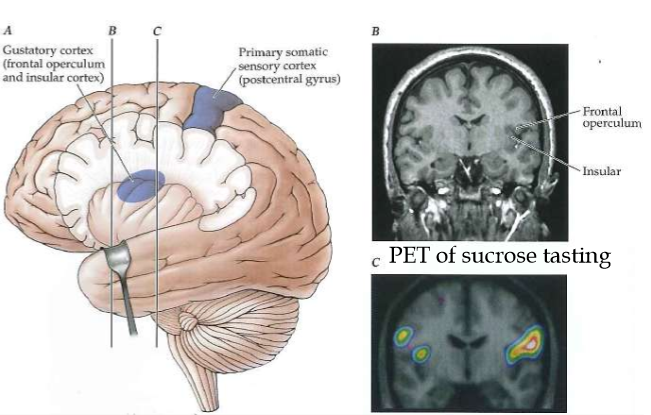
6.Insular Cortex and Operculum
Gustatory cortex = insular + operculum
Olfaction Overview
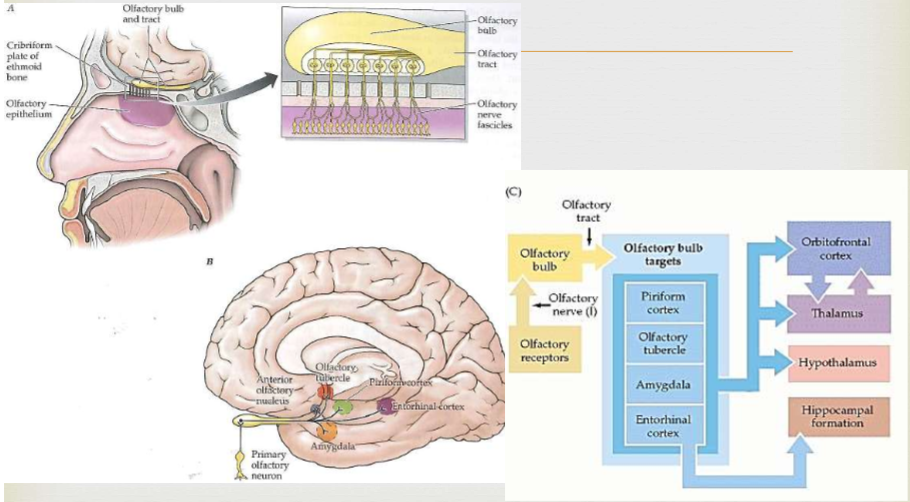
1.Olfactory Epithelium and Primary Olfactory Neurons
Epithelium: Superior nasal concha, middle septum & roof. CONTAINS: Primary Olfactory Neurons: Bipolar, Apical portion with olfactory cilia with receptors (receive chemical signal). Supporting cells (glial-like). Basal Cells (stem cells): Regenerate as well
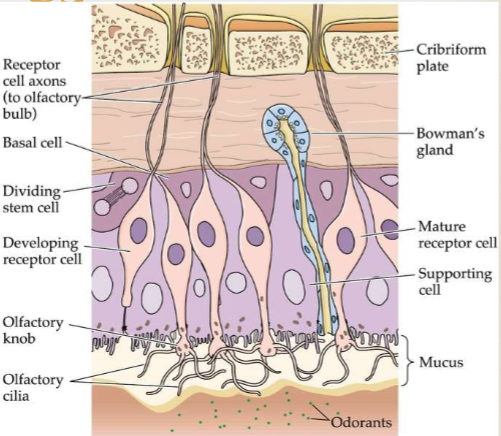
1. Olfactory Epithelium & Primary Olfactory Neurons
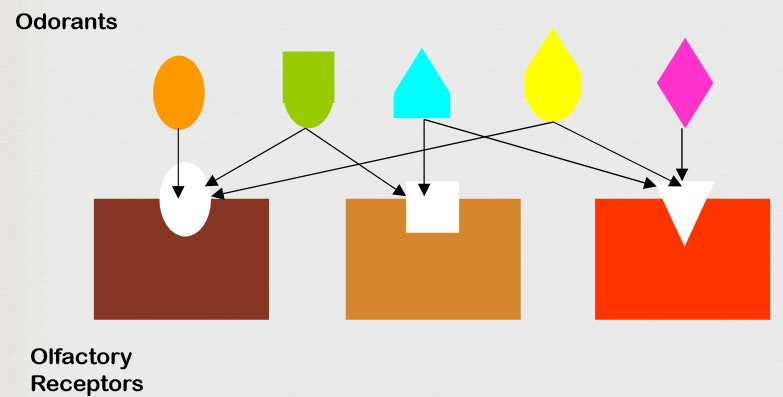
More on Primary Olfactory Neurons: Odorant recognized by the olfactory receptor protein on apical membrane. Individual primary olfactory neurons contain only 1 type of olfactory receptor protein, but can bind multiple odorants. Scattered throughout epithelium
Combinatorial Code of Olfactory Receptors
A single odorant is recognized by multiple receptors and a single odorant receptor can recognize multiple odorants.
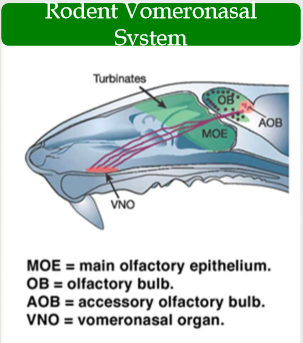
The Vomeronasal (VNO) System: The Second Olfactory System
Most mammals have a second olfactory system, termed the VNO, or accessory olfactory system. The VNO classically responds to pheromones to mediate sexual,
reproductive, and aggressive responses. The odorants that trigger these responses and are processed by the VNO are termed pheromones. Pheromones are often found in saliva, urine, or other bodily fluids and can thus encode sex and species specific information to influence animal behavior. Dispute if it actually functions in
humans
2. Olfactory Bulb
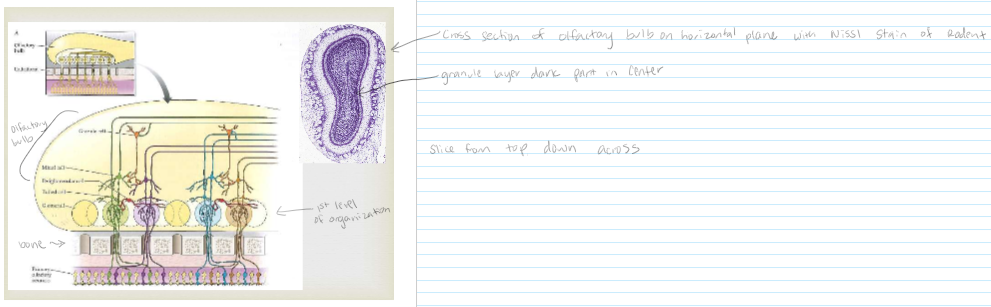
Axons of olfactory receptor cells synapse on 3 types of neurons in the olfactory bulb. These neurons are contained in units called glomeruli. Usually receive input from sensory neurons expressing the same type of olfactory receptor (convergence of axons and dendrites of neurons below) Mitral & tufted cells: projection neurons to olfactory tract. Periglomerular : Inhibitory interneuron. Granule cells: are also found in the OB, another inhibitory interneuron that receives excitatory input from mitral cells. All allow for odor discrimination
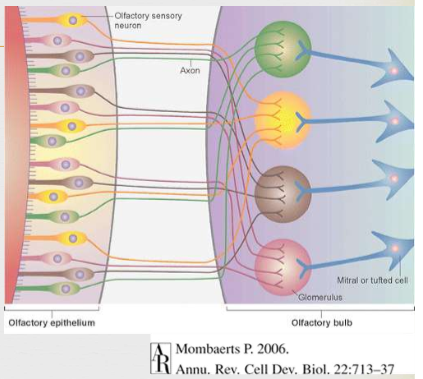
Glomeruli
Where stuff starts to get organized at this level
Mitral and Tufted cells
Projection neurons to olfactory tract
Periglomerular
Inhibitory interneuron
Granule cells
Are also found in the OB another inhibitory interneuron that receives excitatory input from mitral cells.
Olfactory Bulb breakdown
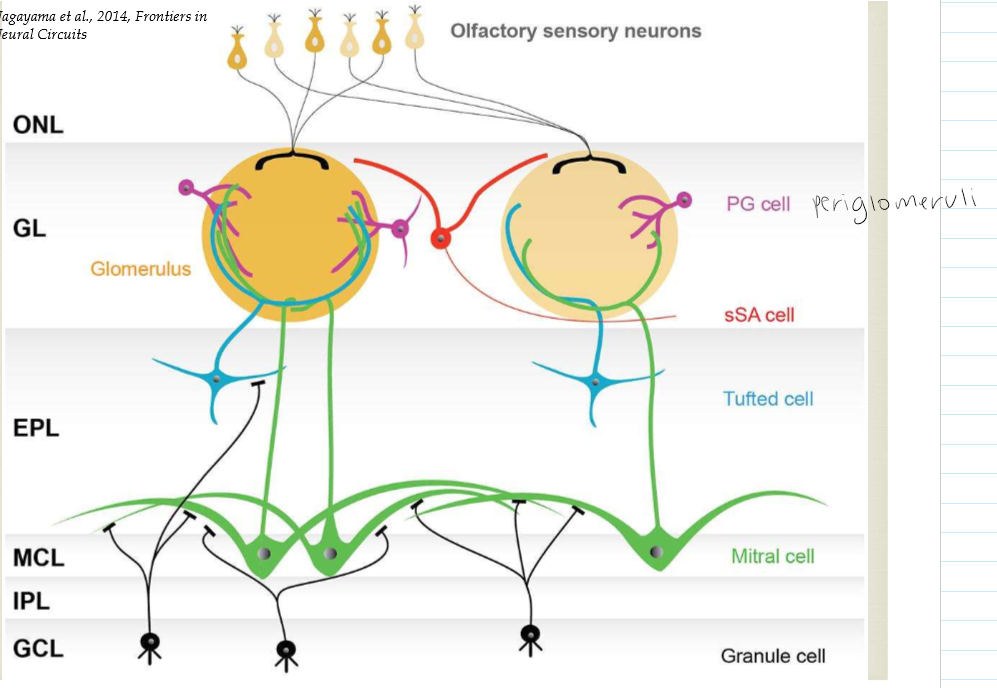
Olfactory bulb breakdown cross section
3. Ventral Brain Surface
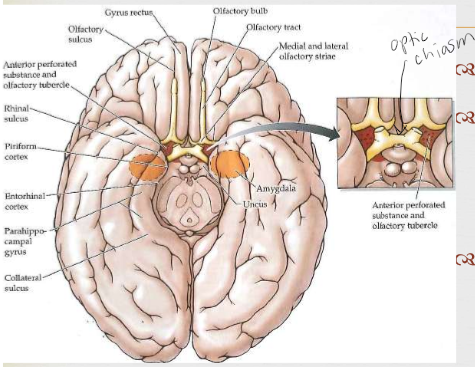
OB & tract lie on olfactory sulcus (frontal lobe). Olfactory tract bifuricates- Lateral olfactory stria- Axons from OB. Medial olfactory stria- Axons from other brain
regions. Anterior perforated substance: ACA perforate this area to reach basal ganglia & IC, Olfactory Tubercle found here. Bypasses thalamus!! Goes straight to cortex.
4. Primary Olfactory Cortex
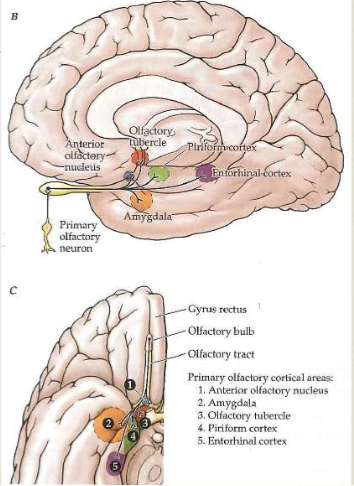
Subdivided into 5 areas. All are allocortex (less than 6 layers). Can all receive input from OB. 4A: Anterior Olfactory Nucleus: ACh neurons, Regulates early olfactory
processing, Projects back also to OB (ipsilaterally & contralaterally), Degenerates in AD-loss of smell (early symptom of alzheimers disease)
*Know what each area does or contributes*
4B. Amygdala
OB projects to the corticomedial nucleus of the amygdala (it has three parts, others being basolateral & central). Odor perception & discrimination. Also projects to hypothalamus to regulate food intake. Create odorant memories and smells can evoke memories.
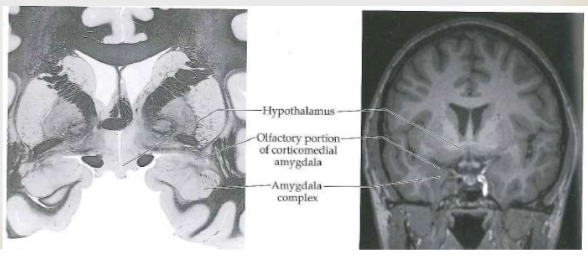
Amygada has 3 parts
Corticomedial nucleus, basolateral, central
4C. Olfactory Tubercle
Part of basal forebrain. Receives fewer OB projections in primates. Does receive input and provide input to structures related to emotion
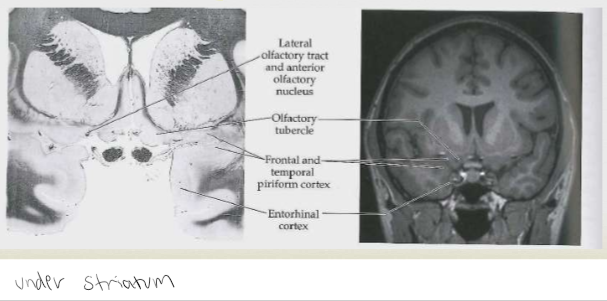
4. Piriform Cortex
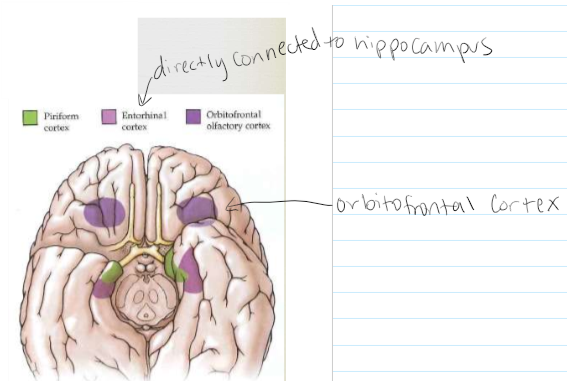
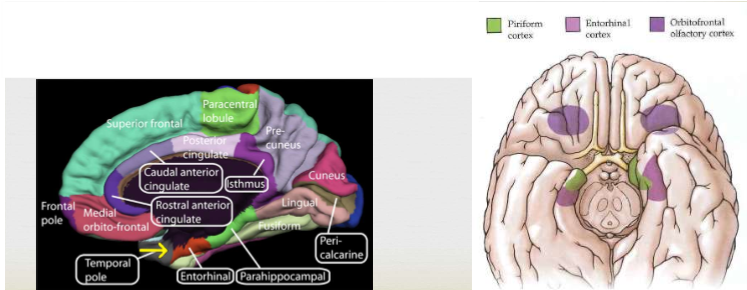
Piriform Cortex: Receives BIGGEST projection from OB: Named for its pear-like shape. Important in the initial processing of odors , leading to perception. Projects to directly & indirectly (via the medial dorsal nucleus of thalamus) to orbitofrontal cortex. Damage to orbitofrontal cortex impairs odor discrimination
4E. Rostral Entorhinal Cortex
Located on the para-hippocampal gyrus. Allows for a smell to evoke a memory. Projects to hippocampus
Summary
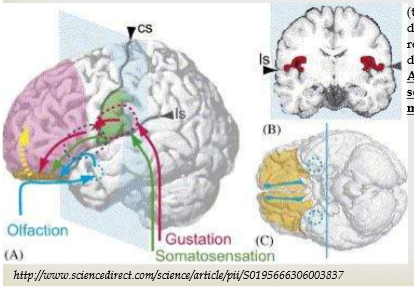
Olfaction & Gustation interact in the insular & orbitofrontal cortices for sensing flavors. We need both smell & taste to perceive flavor of foods.
Fig. 1. A schematic depiction of central pathways for gustation, olfaction, and oral somatosensation. cs, central sulcus; ls, lateral sulcus. (A) Left lateral view. Odor-evoked responses (cyan arrow) are conducted from the olfactory bulb to the primary olfactory cortex (piriform cortex: the area enclosed by a cyan dot-line). Gustatory (red arrow) and oral somato-sensory (green arrow) signals are conducted via spinal nerves to the primary gustatory cortex (around parietal operculum and superior posterior insula; the area enclosed by a red dot-line) and primary oral-somatosensory cortex (ventral part of post-central gyrus: the green area), respectively. The region around the frontal operculum and the anterior insula (the area enclosed by a purple dot-line) is also sometimes designated as a primary gustatory area, although it seems to receive the signal slightly later than does the area enclosed by a red dot-line. All of this sensory information is further processed in the secondary area (orbitofrontal cortex; the yellow area), where it may be integrated into flavor representation.
Cancer Smelling Canines
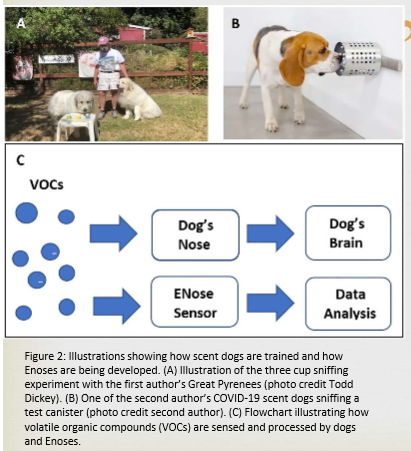
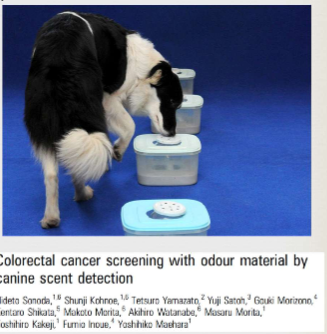
Dogs have 1094 olfactory receptors compared to 802 in humans (Dickey & Junqueira, 2023). 125-300 million olfactory cells vs. 5-6 million. 1/3 of dog’s brain devoted to olfaction; 5% in humans. Began as individual case studies with dogs
sniffing at owner’s moles, etc. Peer-reviewed studies now show that dogs can
accurately detect patients with early and late stage lung cancer (vs. healthy controls), as well as colon cancer patients. May result from the enhanced repertoire of odorant receptors in dogs versus humans. Scientists are currently using mass spectrometry to determine what are the chemical differences in healthy versus patient samples.
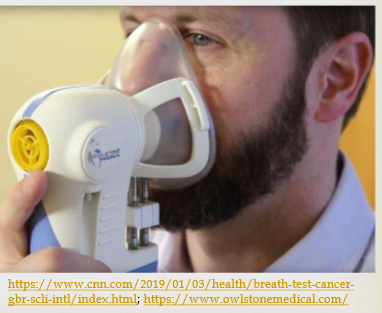
Breath test to detect multiple cancers early begins large trial
In the body's normal metabolic processes, molecules called volatile organic compounds (VOCs) are produced. It's thought that cancer can create a different pattern of VOCs, which researchers hope to identify using the device. "Our goal is, can we spot these subtle differences?," Billy Boyle, co-founder and CEO at Owlstone Medical which developed the device, told CNN.
Can dogs smell COVID?
Trial took place in the airport of Lebanon. The dogs screened 1,680 passengers and found 158 COVID-19 cases that were confirmed by PCR tests. The animals correctly identified negative results with 100% accuracy, and correctly detected 92% of positive cases, according to unpublished results
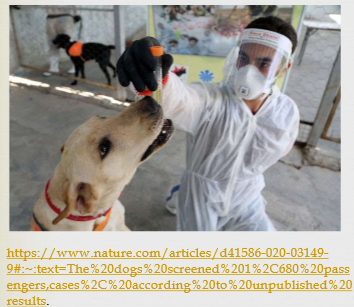
COVID-19 scent dog research highlights and synthesis during the pandemic of December 2019−April 2023
Dickey & Junqueira: Evaluated the strengths and weaknesses of using dogs to detect COVID-19. Compared with results of RT- PCR & Antigen Testing. ENose= mini electronic devices to detect multiple odors by mimicking dog or human olfactory system. Trained scent dogs can be effectively used to provide quick, non-invasive accurate results. Results were comparable or in some studies superior to PCR & Antigen testing