Topic 5 Crude oil
 Call Kai
 Learn
Learn Practice Test
 Spaced Repetition
 Match
Match Flashcards
 Knowt Play
1/29

There's no tags or description
Looks like no tags are added yet.
Name | Mastery | Learn | Test | Matching | Spaced | Call with Kai |
|---|
No analytics yet
Send a link to your students to track their progress
30 Terms
What is crude oil
Crude oil is a dark viscous liquid that is made from the anaerobic decay of organisms over a period of millions of years.
Is a mixture of compounds called hydrocarbons which contain the elements hydrogen and carbon only
What is the process of separating crude oil into its individual components?
Fractional distillation
Fractional Distillation
The crude oil is heated in a round bottomed flask.
Some of the molecules will evaporate and enter the fractionating column
Repeated evaporation followed by condensation in the fractioning column separates fractions with a similar boiling point
Eventually the fraction with the lowest boiling point reaches the top of the fractioning column and condensed in the condenser and collected.
What is the order of boiling points of the fractions in crude oil?
Lowest boiling point
Refinery Gases
Gasoline
Kerosene
Diesel
Fuel oil
Bitumen
Highest boiling point
What is the acronym to remember the order of boiling points in the fractions of crude oil?
Rich
Girls
Keep
Designer
Fancy
Bags
What are the qualities of refinery gases?
Boiling point - 160-120C
Colour - colourless
Number of carbon atoms - 1-4
Uses - fuel for gas ovens
What are the qualities of Gasoline?
Boiling point - 70-120C
Number of carbon atoms - 4-12
Uses - petrol for vehicles
Colour - colourless (slightly yellow)
What are the qualities of kerosene?
Colour - pale yellow
Boiling point - 120-170C
Number of carbon atoms - 6-16
Uses - heating and mainly aircraft fuel
What are the qualities of Diesel?
Colour - dark yellow
Boiling point - 170-230C
Number of carbon atoms - 15-19
Uses - Diesel/some car fuel
What are some qualities of Fuel oil?
Colour - dark brown
Boiling point - 320-350C
Number of carbon atoms - 30-40
Uses - fuel for central heating and for ships
What are some qualities of bitumen?
Colour - black
Boiling point - above 350C
Number of carbon atoms - 50+
Uses - tar
What is cracking?
A type of thermal decomposition reaction which uses
A high temperature between 600-700C
A catalyst of aluminium oxide
to break down large hydrocarbon molecules into smaller hydrocarbon molecules
What is a word equation for cracking?
large alkane molecule —> small alkane molecule + small alkene molecule(s)
What is an alkane?
Saturated hydrocarbons - all the bonds are single covalent
What is an example of an alkane?
Ethane - C2H6 (See photo)
Another example is Octane -C8H18
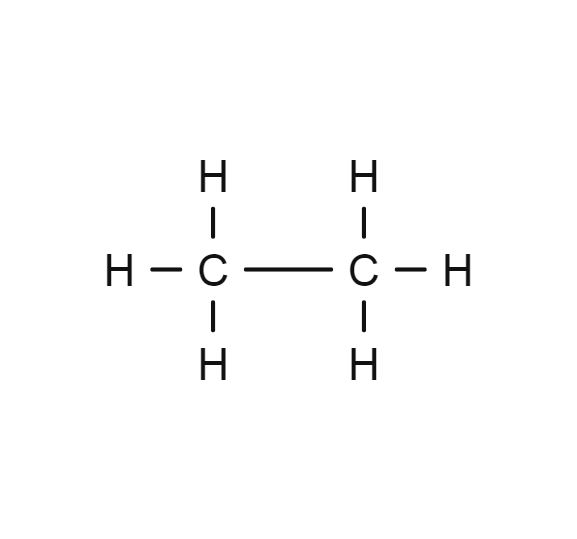
What is the general formula for an alkane?
CnH2n+2
What are the names of the two different hydrocarbons?
Alkanes and Alkenes
What is a hydrocarbon?
A compound that contains the elements hydrogen and carbon only
What is an alkene?
Unsaturated hydrocarbons, each molecule contains at least one carbon-carbon double bond (C=C)
What is an example of an alkene?
(See photo) Ethene - C2H4
Octene - C8H16
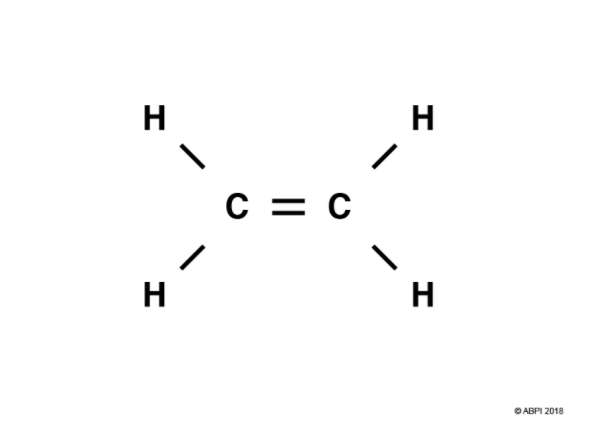
What is the general formula for an alkene?
CnH2n
What is the chemical test for unsaturation?
To add bromine water
It changes colour from orange —> colourless
Fuel
A substance which releases heat/thermal energy when it combusts
When fuels burn they react with oxygen from the air.
Complete combustion
In a plentiful supply of oxygen, the hydrocarbon reacts to produce carbon dioxide and water
hydrocarbon + oxygen —> carbon dioxide + water
True or False, the larger the hydrocarbon molecule, the more oxygen is needed for complete combustion?
True
What is a chemical equation example of complete combustion?
CH4+ 2O2 —> CO2 +2H2O
And
C8H18 +12.5O2 —> 8CO2 + 9H2O
Incomplete combustion
In a limited supply of oxygen, the hydrocarbon reacts to produce carbon monoxide and water or carbon and water.
hydrocarbon + oxygen —> carbon monoxide + water
hydrocarbon + oxygen —> carbon + water
What will happen if carbon is produced?
The flame will grow
What are some examples of incomplete combustion?
CH4 +1.5O2 —> CO + 2H2O
CH4 +O2 —> C +2H2O
C8H18 +8.5O2 —> 8CO +9H2O
C8H18 +4.5O2 —> 8C +9H2O
What are the problems of combustion?
Carbon dioxide and water vapour are greenhouse gases and trap heat in the atmosphere, leading to climate change, global warming and melting of polar ice caps
Carbon monoxide sticks to haemoglobin more readily than oxygen which reduces the capacity of blood to transport oxygen and ultimately leads to death. Carbon monoxide is toxic.
Particles of carbon (soot) can irritate the lungs potentially triggering asthma.