Section 5: An introduction to driving
 Call Kai
 Learn
Learn Practice Test
 Spaced Repetition
 Match
Match Flashcards
 Knowt Play
1/14

There's no tags or description
Looks like no tags are added yet.
Name | Mastery | Learn | Test | Matching | Spaced | Call with Kai |
|---|
No analytics yet
Send a link to your students to track their progress
15 Terms
parts of health that may affect driving
vision, hearing, fatigue and drowsiness, physical and mental, medications, & health
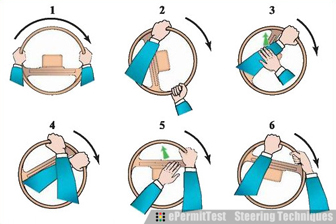
Hand-to-Hand Steering (Push/Pull)
Start with your hands at 9 and 3 o’clock or 8 and 4 o’clock.
Do not cross your hands over the middle of the steering wheel.
Keep your hands in these positions, even when making turns.
Hand-Over-Hand Steering
Start with your hands at 8 and 4 o’clock.
Reach across the steering wheel to grasp the opposite side.
Let go of the steering wheel with your other hand.
Reach across the arm still holding the wheel, grip the wheel, and pull up.
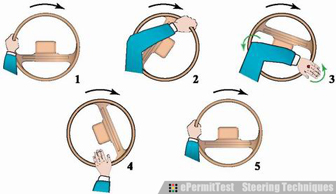
One-Hand Steering
The 2 situations where u would need to use this —>
1) When you are turning while backing up to see where you are going behind you. Place your hand at the 12 o’clock position on the steering wheel.
2)When you are operating vehicle controls that require you to remove a hand from the steering wheel.
When do you use signaling?
when you turn, change lanes, slow down, or stop
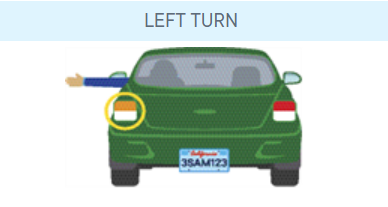
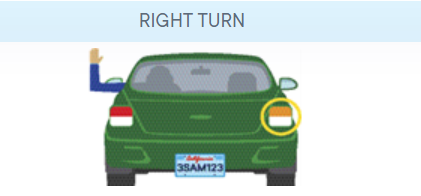
When do you use hand-and-arm signals?
If your signal lights are not functioning, or bright sunlight makes your signal lights hard to see
Left Turn Hand Signal
Right Turn Hand Signal
Slow or Stop Hand Signal
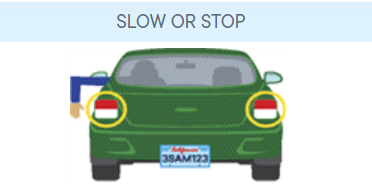
How do bicyclists signal their turns?
They signal a turn with their arm held straight out, pointing in the direction they plan to turn
When should you signal?
at least 100 ft before turn, before every lane change, at least 5 sec before u change lanes on freeway, before moving towards or away from curb, even when no other vehicles seem to be there, and when u plan to turn shortly after crossing the intersection
Purpose of a horn
let other drivers know of ur presence, warn others of a hazard which helps people avoid collisions and laert oncoming traffic on narrow mountain roads where u cannot see at least 200 ft ahead
Purpose of headlights
they help vehicle’s see ahead of themselves and make it easier for other driver’s to see ur vehicle. Dim them when a vehicle is close to u from behind or ahead. USE MAINLY WHEN too dark to see from 1k ft, beg 30 min after sunset, 30 min before sunrise, in bad weathers, in mountain roads and tunnels, when road signs explicity ask fo rit, to help other drivers see ur vehicle
How to use emergency flashers to warn drivers behind of u abotu a collision or hazard ahead
Turn on your emergency flashers.
Lightly tap your brake pedal three or four times.
Use a hand signal when slowing and stopping.
How to use emergency flashers to stop ur vehicle because of vehicle trouble
Turn on your emergency flashers. If your vehicle does not have emergency flashers, use your turn signals.
If possible, pull off the road away from all traffic.
If you cannot get completely off the road, stop where people can see you and your vehicle from behind.
Do not stop just over a hill or just around a curve. Other drivers may not see your vehicle in time to avoid a collision.
Call for emergency roadside assistance and stay in your vehicle until help arrives.