supply chain
 Call Kai
 Learn
Learn Practice Test
 Spaced Repetition
 Match
Match Flashcards
 Knowt Play
1/40

There's no tags or description
Looks like no tags are added yet.
Name | Mastery | Learn | Test | Matching | Spaced | Call with Kai |
|---|
No analytics yet
Send a link to your students to track their progress
41 Terms
GSCM 211: Globalization - WHO + business meaning
WHO: interconnectedness/interdependence and faster flows of goods, services, finance, people, and ideas. Business version: make-or-buy decisions across borders.
GSCM 211: Comparative vs absolute advantage
Comparative advantage = lower opportunity cost; linked to David Ricardo. Absolute advantage = can produce more efficiently/cheaply; linked to Adam Smith.
GSCM 211: Mercantilism vs protectionism vs Bretton Woods
Mercantilism = control trade to export more than import. Protectionism = barriers/tariffs; quiz logic says it does NOT raise overall growth/competitiveness. Bretton Woods = post-WWII trade/finance foundation, not euro-based.
GSCM 211: Thomas Friedman vs Milton Friedman vs Schumpeter
Thomas Friedman = world moves between round/high-barrier and flat/low-barrier eras. Milton Friedman = globalization can widen rich-country high-skill/low-skill wage gaps. Schumpeter = creative destruction.
GSCM 211: Creative destruction
Industries change or disappear because of innovation and changing consumer preferences; it demands a more flexible labor market.
GSCM 211: Globalization quiz traps
Benefits: efficiency, variety, falling extreme poverty. Criticisms: inequality/job disruption/flat incomes/nationalism. Do not pick "protectionism improves growth."
GSCM 211: "Unethical in all cultures" quiz trap
From the visible quiz: none of the listed issues was treated as universally viewed the same by all national cultures.
GSCM 211: International physical entry options
Greenfield = build from ground up. Lease/rent = use existing property. Outsource physical operations = third party manages operations, e.g. UPS distribution for Nike/Toshiba.
GSCM 211: International service operations
Self-governance = more control over quality/outcomes, possible lower cost, but risk from unknown local externalities. Outsourcing = may cost more, but improves local responsiveness.
GSCM 211: Ownership models - operational lens
Direct ownership/wholly owned subsidiary needs the most operational and supply chain support. Franchising/licensing needs less direct support. Joint venture shares ownership/control with a partner.
GSCM 211: PEST acronym + purpose
P = Political, E = Economic, S = Social/Sociocultural, T = Technological. Purpose: identify foreign-market opportunities/threats and adapt strategy/practices.
GSCM 211: PEST examples + non-example
Political = laws/regulations/stability/renewable requirements. Economic = currency/inflation/labor costs. Social = demographics/culture/language. Technological = digital infrastructure/innovation. NOT a PEST step: developing marketing strategies.
GSCM 211: "Did We Expand Too Quickly?" quiz facts
Overlooked PEST area: social. Initial problem: climber sued after falling 15 feet and hurting his back.
GSCM 211: Global sourcing
Global sourcing = buying production/services from global regions with comparative advantage. Main tradeoff: lower cost/expertise vs distance, culture, risk, and communication problems.
GSCM 211: TCO + setup/ordering cost in sourcing
Total cost of ownership = price plus ordering/communication/logistics/quality/risk/management costs. Setup/ordering cost = time/resources spent placing and managing the order.
GSCM 211: Technology clusters + tacit knowledge
Technology cluster = regional network of buyers/suppliers/complementary producers with shared expertise. Matters because proximity helps transfer tacit knowledge, which is hard-to-write-down know-how.
GSCM 211: Global manufacturing priorities
Cost, speed, dependability, quality. Normal tradeoff logic: firms usually excel at one to three, rarely all four at once.
GSCM 211: Sand cone model
Order: quality, dependability, speed/flexibility, cost. Core idea: capabilities can build cumulatively instead of always trading off; cost comes last after long-term capability building.
GSCM 211: Deloitte manufacturing competitiveness
Drivers include regulation, finance, education, infrastructure, cost, productivity, and talent. Low cost helps, but quality/talent/infrastructure can keep high-cost countries competitive.
GSCM 211: Global car + OEM + economies of scale
Global car lesson: "domestic" products use global multi-tier suppliers. OEM = original equipment manufacturer. Economies of scale = lower unit cost from larger standardized volumes.
GSCM 201: OSCM vs SCM vs logistics
OSCM = acquire materials, transform into higher-value outputs, deliver to customers. SCM = collaboratively manage value-added processes from suppliers' suppliers to customers' customers. Logistics = move materials into/out of the company.
GSCM 201: SCOR model
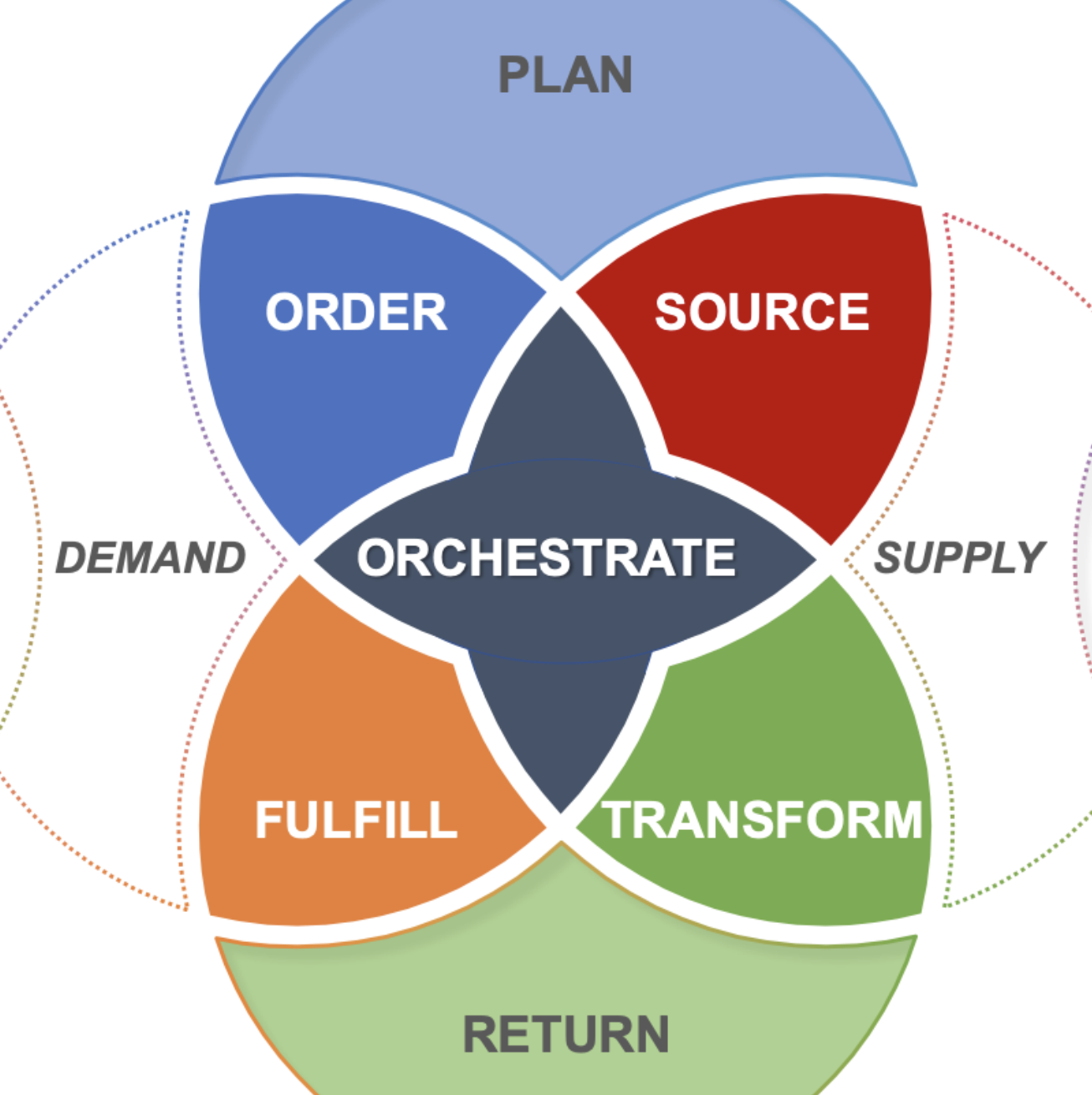
SCOR = Supply Chain Operations Reference model; benchmarks best practices across core value-added activities such as source, transform/operations, logistics, and return.
GSCM 201: Open systems + why operations matter
Open system = firm is affected by environment and must respond to opportunities/threats. Products can be copied; processes/culture are harder to copy.
GSCM 201: Design vs control decisions
Design decisions = long-term, hard-to-change asset/infrastructure choices. Control decisions = day-to-day choices about how work gets done.
GSCM 201: DFM + core design questions
DFM = design for manufacturability, making products easy/inexpensive to produce. Product design asks "what?" Process design asks "how?" Facility layout asks "arranged how?" Facility location asks "where?"
GSCM 201: EOQ + reorder point + safety stock
EOQ = economic order quantity, where order/setup costs and holding costs are balanced/minimized. Reorder point = inventory level that triggers replenishment. Safety stock = inventory kept for uncertainty.
GSCM 201: Bullwhip effect
Demand changes amplify upstream through the supply chain. Causes include poor information sharing, delays, and each member protecting itself with inventory. Reduce with better sharing/coordination.
GSCM 201: Service operations traits
Services have high customer contact and intangible offerings. Usually consumed as produced, cannot be inventoried, and are harder to standardize/measure.
GSCM 201: Five customer value dimensions
Cost, quality, delivery, agility, innovation. These are common supplier scorecard categories and can become order qualifiers, winners, or losers.
GSCM 201: Order qualifier vs winner vs loser
Order qualifier = minimum requirement to be considered. Order winner = factor that makes customer choose you. Order loser = factor that disqualifies you.
GSCM 201: Utility types
Form = transform inputs into value. Place = exactly where needed. Time = when needed. Possession = help customer evaluate/buy/possess the product/service.
GSCM 201: Six Sigma + DMAIC
Six Sigma aims to eliminate defects; 6 sigma = about 3.4 defects per million opportunities. DMAIC = Define, Measure, Analyze, Improve, Control.
GSCM 201: Hidden plant
Hidden plant = 15-40% of capacity used to find/fix poor-quality work. Test angle: improving quality can reduce cost, not just increase it.
GSCM 201: Value proposition + touch point + value gap
Value proposition = promise about how firm meets needs. Touch point = any customer-firm interaction. Moment of truth = touch point shaping perception. Value gap = mismatch in identifying/defining/delivering experience.
GSCM 201: ABC classification
ABC classification applies Pareto logic: A = most important, B = moderate, C = least important. Used for customers, suppliers, SKUs, etc.
GSCM 201: Purchasing/supply management + seven rights
Supply management = identify/acquire/access/position/manage needed resources. Seven rights: right product, quality, quantity, price/cost, time, place, and source/supplier.
GSCM 201: Strategic Sourcing Matrix - SSM
SSM dimensions: importance/spend volume and supply market complexity. Routine = low/low. Leverage = high spend/low complexity. Bottleneck = low spend/high complexity. Critical = high/high.
GSCM 201: SSM strategies
Routine: simplify/automate. Leverage: use buying power/competition. Bottleneck: assure supply and reduce risk. Critical: build close strategic supplier relationships.
GSCM 201: Procurement terms
P2P/procure-to-pay = order through receipt/payment. PO = purchase order. Maverick spend = buying outside approved process. Reverse auction = suppliers bid prices down online. Valid contract = offer, acceptance, consideration.
GSCM 201: Process + bottleneck/TOC
Process = repeatable tasks transforming inputs into outputs. Bottleneck = constraint limiting throughput. TOC steps emphasized: identify constraint, exploit it, subordinate other work to it. Improving non-bottlenecks will not raise throughput.
scor