8 - early autism interventions
 Call Kai
 Learn
Learn Practice Test
 Spaced Repetition
 Match
Match Flashcards
 Knowt Play
1/21

There's no tags or description
Looks like no tags are added yet.
Name | Mastery | Learn | Test | Matching | Spaced | Call with Kai |
|---|
No analytics yet
Send a link to your students to track their progress
22 Terms
what are early autism interventions?
take place in childhood, with children up to 6 y/o
greater family involvement and targets an array of aspects such as social communication and life skills, different goals overall to adult interventions
what early provisions are there?
nhs
local authority
charity support
private
different provisions target different domains
what does Wolf suggest are the goals of social validity in early interventions
social significance of intervention goals (goal is good)
social acceptability of intervention procedures (methods are ethical and acceptable)
the social importance of effects (we don’t accidentally harm children in the process)
what goals might the medical model of disability propose for early interventions
autism defined as behaviour, goals focused on normalisation - ‘prerequisites’ for further learning and skills, looking less autistic to facilitate socialisation and social skills
teaching eye contact, reducing stimming, reducing echolalia, ‘proper play’
what goals might the social model of disability propose for early interventions
autistic people might communicate and learn differently (gestalt langauage processing), more to friendship than ‘behaving normally’, authentic expression is important, can make the environment more suitable for the child.
more suitable goals supported by the autistic community
what are common goals chosen by autistic people
top 3; quality of life/wellbeing, support and accessibility, safety (reducing aggression and self harm)
slightly below: self-help, emotional skills, communication, social problem-solving
middle: participation in routine, motor skills, rules of interaction and conversation. academic skills
low: sensory tolerance, play, eye contact, reducing stimming, reducing special interest
what are important methods to keep in mind when employing support
autonomy and self-determination
mindless compliance - may be dangerous to individual in the future
what are adverse effects of behavioural studies?
studies asking for people’s experience and community discuss negative effects from behavioural interventions for some/many autistic people - compared to intervention studies where few limitations are mentioned
what type of demographics often appear in intervention studies
adults responding are usually white, female or non-binary, with higher education and relatively lower support needs and are diagnosed in adulthood
children who receive interventions are usually boys, identified or diagnosed early and usually have higher support needs or learning disability.
outline behaviourism
based on B.F Skinner’s operant conditioning, works with and focuses on observable behaviour, uses reinforcement (rewards and punishments) to increase or decrease behaviours
antecent - behaviour - consequence
Who is Ole Ivar Lovaas (1927-2010)
founded ABA (applied behaviour analysis), most people were considered beyond help.
one boy who was ignored when he cried stopped crying which was seen as an improvement, but obviously wasnt
ABA to such an extreme extent stopped in the 1980s as it was inhumane
many ‘achieved normal intellectual and educational functioning’
how did ABA change
~1980s physical punishments became less frequent, methods softened.
Naturalistic Developmental Behavioural Interventions - combined developmental and behavioural methods
what traits does modern ABA have
targets observable behaviours
can target a wide range of goals, including autism traits, daily life skills, safety, communication etc.
often adult-led
often intensive: several times a week for hours
mostly delivered by professionals
not frequently practised in the UK
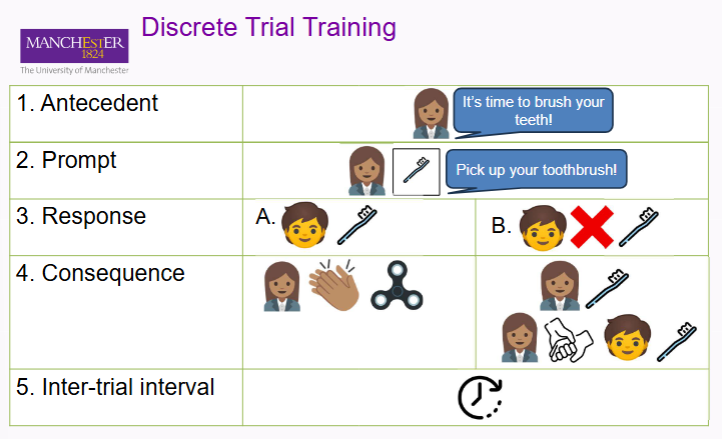
What is discrete trial training
structured, adult-led intervention
shapes behaviour using small, discrete components that are taught through repeated trials
5 stages - instead of punishment, gentle guidance
evidence for ABA
Gitimoghaddam et al. 2022 - a meta-analysis for ABA intervention
positive improvements in cognition, language development, social skills and communication, adaptive behaviour and reductions in problem behaviour
HOWEVER:
mostly case studies
64% of the studies recorded 3 or less pps
only behaviour-specific improvements vs overall skills, functionns or behaviours
what are wider concerns re: the evidence for ABA
conficts of interest
potential negative effects are not measured
goals are not neuro affirmative
little consideration for internal processes
extremely intensive
negative accounts in qualitative studies and community experience
what is the developmental approach (PACT)
developmental psychology - vygotsky
skill acquisition is built on the child’s active, self-directed engagement with a stimulating physical and social environment
zone of proximal development, scaffolding
what is paediatric autism communication therapy
child social communication therapy
enhances communication between children and caregivers, increasing parental sensitivity
work not directly with child, but changes their context
how is PACT used, and what techniques does it employ
suitable for children ages 2-11, mostly with language difficulties
available face-to-face or online
therapist sessions ~1-2 hours working with families
30 min daily practise
techniques include: imitation, animation, intentional communication, modelling/labelling, language expansion, routines (stories, songs, anticipation games) following the childs lead
evidence for PACT
randomised control trial - 152 children half recieved intervention
2 hours a week for 6 months
small reduction of ‘autism traits’ in PACT group
increased synchrony, child initiations and shared attention in parent-child interactions
small effects on language and social communication
longitudinal follow-up also showed reduction in ‘autism triats’ due to increased social communication and fewer restricted and repetitive behaviours
critique for PACT
some elements of original evidence outdated
intervention and outcomes not always aligned ‘autism traits’
not effective for all outcomes
child perspective not always included and high parental load
parental views on PACT
some practical challenges including sessions being too long
video feedback helped find drawbacks
most were very happy with process