1 nucleic acids & nucleotides - purines, pyrimidines, nucleosides, nucleotides
 Call Kai
 Learn
Learn Practice Test
 Spaced Repetition
 Match
Match Flashcards
 Knowt Play
1/15

There's no tags or description
Looks like no tags are added yet.
Name | Mastery | Learn | Test | Matching | Spaced | Call with Kai | Chat |
|---|
No analytics yet
Send a link to your students to track their progress
16 Terms
what are the different functions of nucleotides and their polymers
storage and decoding genetic information - DNA and RNA
as enzymes - RNA
in later parts:
oxidation-reduction reactions - Electron carriers within the cell as NADH/NADPH/FMNH2/FADH2
energy transfer - Contain “high energy” phosphoanhydride bonds like ATP/NTP
biosynthetic reactions - Coenzyme A
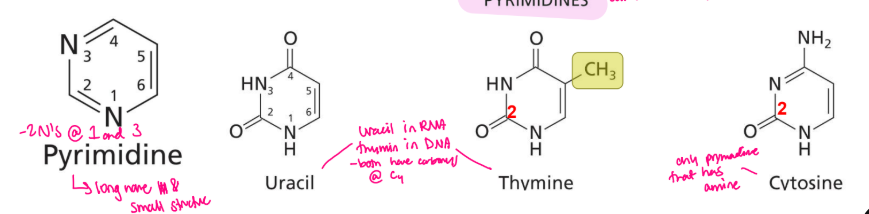
what are the 3 pyrimidine bases and how to identify them
have 2 nitrogens at C1 and 3
long name = small structure
carbonyls at C2
Uracil - in RNA, has another carbonyl at C4
Thymine - In DNA, has another carbonyl at C4, has methyl group
Cytosine - only pyrimidine that has 3 nitrogens
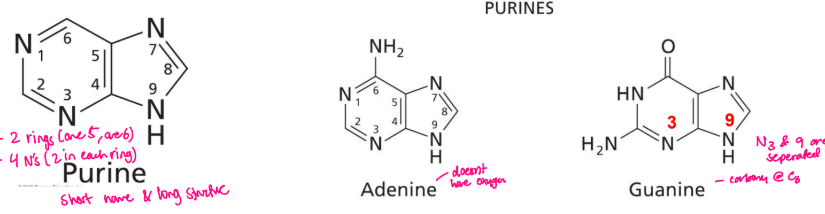
what are 2 purines and how to identify them
short name = long structure
2 rings - one 5 carbon and one 6 carbon
4 nitrogens (2 in each ring) - N3 & 9 are separated by 1 carbon and N1 and 7 are seperated by 2 carbons
adenine - doesnt have oxygen, 5 nitrogens
guanine - carbonyl at C6
what is common between pyrimidines and purines
There are other nitrogen bases, these are the ones commonly incorporated into DNA and RNA
All the bases are aromatic and heterocyclic
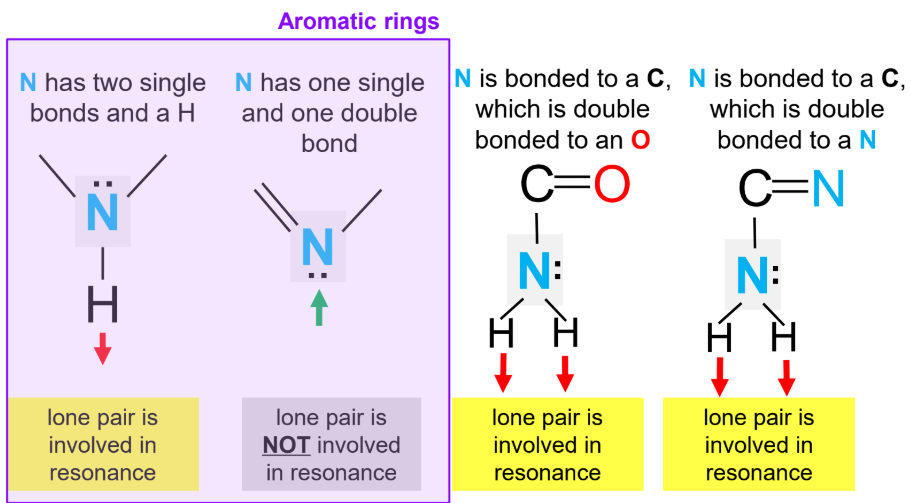
what does resonance describe
describes delocalized electrons in molecules where the bonding cannot be expressed by a single Lewis structure
Occurs in systems with neighboring pi-electrons (double bonds) or certain lone pairs
what do lone pairs in resonance cant do
Lone pairs in resonance cannot accept hydrogen bonds because they are not localized
resonance stabilizes molecules but reduces hydrogen bonding capacity
you will always be told which structures have resonance and are aromatic
how many hydrogen bonds can pyrimidine bases make as acceptors and donors
uracil - accepts 4 times and donates twice
thymine - accepts 4 times and donates twice
cytosine - accepts 3 times and donates 3 times
*each oxygen has 2 lone pairs to accept
how many hydrogen bonds can purine bases make as acceptors and donors
adenine - accepts 3 times and donates 3 times
guanine - accepts 4 times and donates 4 times
*check slides 12, 13
what are two things incorporated into the different nucleic acids
Ribonucleic Acid (RNA) - has OH in carbon 2 prime, C5 prime is the only carbon not apart of the ring structure
Polymer of G, A, C, U
Sugar portion is ribose
Deoxyribonucleic Acid (DNA) - missing an oxygen
Polymer of G, A, C, T
Sugar portion is deoxyribose
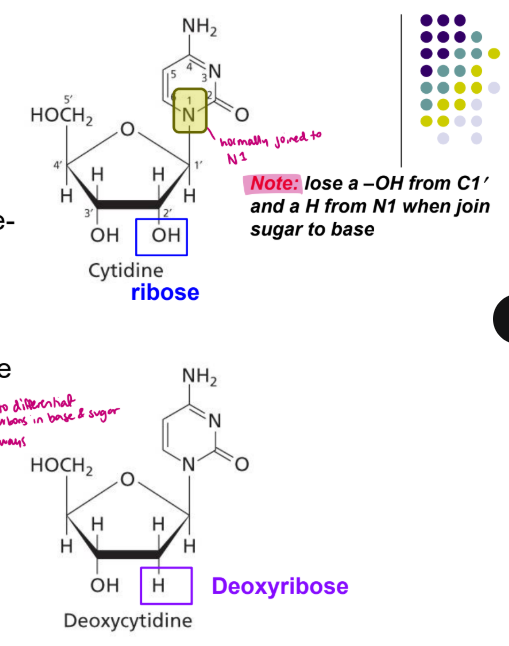
what are nucleosides
purine and prymidine bases linked to a 5 carbon sugar (pentose) to form a nucleoside, building block of nucleic acids
carbons in sugar ring are numbered 1’ to 5’ to differentiate, always clockwise
RNA has ribose sugar and DNA has 2’ deoxyribose
how do you name purine and pyrimidine nucleosides
-ine in purines become osine:
adenine + ribose=adenosine
adenine + deoxyribose= deoxyadenosine
guanine + ribose= guanosine
pyrimidines now end in idine
cytosine + ribose = cytidine ** cytosine ends in ‘osine’ but its a purimidine base not a purine nucleoside
thymine + deoxyribose = deoxythymidine
uracil + ribose = uridine
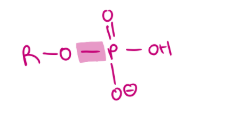
how do you make a phosphoester bond
linkage between phosphate and hydroxyl group
remove H from hydroxyl and OH from phosphate to remove water in dehydration and condensation reaction to give bond
what is a nucleotide
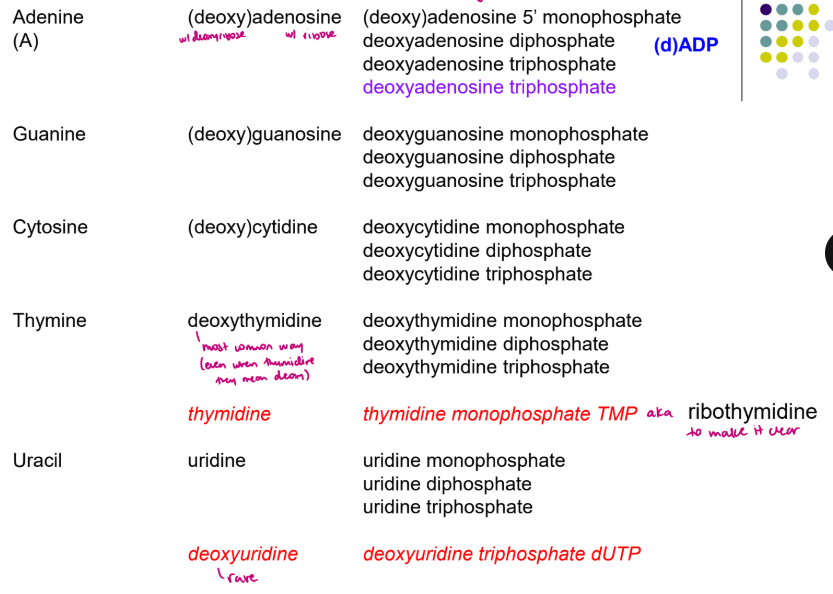
a nucleoside linked to one or more phosphates
ex. ATP
named by taking nucleoside and adding the number of phosphates attached
phosphates are usually added to C5’ OH if not it has to let reader know, is put in the name
what N’s are the sugar attached to in a purine and pyrimidine
Sugar attached to N1 in pyrimidines and N9 in purines
**see slides 21, 22, 25
what are the different names for (deoxy)nucleoside and (deoxy)nucleotides
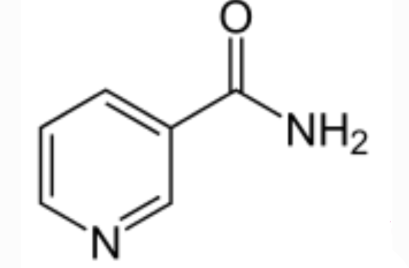
is this a pyrimidine base
no its a nitrogen base but not pyrimidine