T1 Fricker- Hormonal Signalling

0.0(0)
Studied by 0 people
call kaiCall Kai
learnLearn
examPractice Test
spaced repetitionSpaced Repetition
heart puzzleMatch
flashcardsFlashcards
GameKnowt Play
Card Sorting

1/6

encourage image

There's no tags or description

Looks like no tags are added yet.

Last updated 11:28 AM on 4/29/26
Name
Mastery
Learn
Test
Matching
Spaced
Call with Kai

No analytics yet

Send a link to your students to track their progress

7 Terms

1
New cards

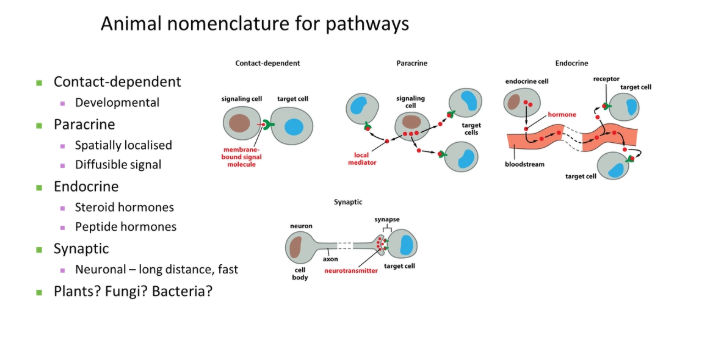
what are the different kinds of pathways in animal signalling?

in order of increasing distance:

  • contact-dependent

  • paracrine- short-distance localised signal

  • endocrine- bloodstream-transported signal

  • synaptic

<p>in order of increasing distance:</p><ul><li><p><strong>contact-dependent</strong></p></li><li><p><strong>paracrine</strong>- short-distance localised signal</p></li><li><p><strong>endocrine</strong>- bloodstream-transported signal</p></li><li><p><strong>synaptic</strong></p></li></ul><p></p>
2
New cards

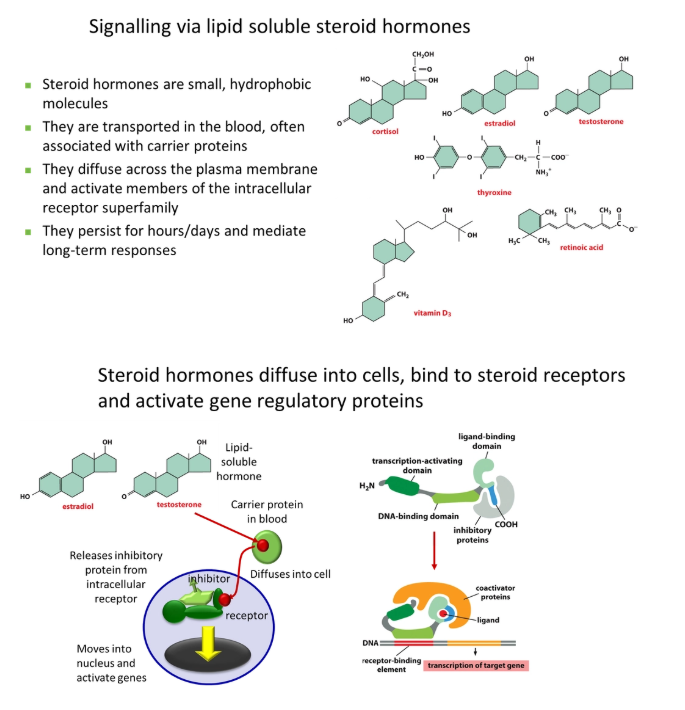
describe steroid hormone signalling and how it works

  • small + cheap to make (no N, P or S)

  • hydrophobic = able to cross membranes independently

  • persistent, generalised, long-term responses

  • the steroid hormone detaches from its carrier protein in the blood, diffuses into the target cell and binds to an intracellular receptor, often displacing an inhibitor protein

  • this activates the receptor (no signal amplification), exposing a DNA-binding site, so it can move into the nucleus and activate genes
<ul><li><p><strong>small </strong>+ <strong>cheap</strong> to make (no N, P or S)</p></li><li><p><strong>hydrophobic</strong> = able to cross membranes independently</p></li><li><p>persistent, generalised, <strong>long-term</strong> responses</p></li></ul><p></p><ul><li><p>the steroid hormone detaches from its <strong>carrier protein </strong>in the blood, <strong>diffuses </strong>into the target cell and binds to an <strong>intracellular receptor</strong>, often <strong>displacing </strong>an <strong>inhibitor </strong>protein</p></li><li><p>this <strong>activates </strong>the receptor (no signal amplification), exposing a <strong>DNA-binding site</strong>, so it can move into the nucleus and <strong>activate genes</strong></p></li></ul><p></p>
3
New cards

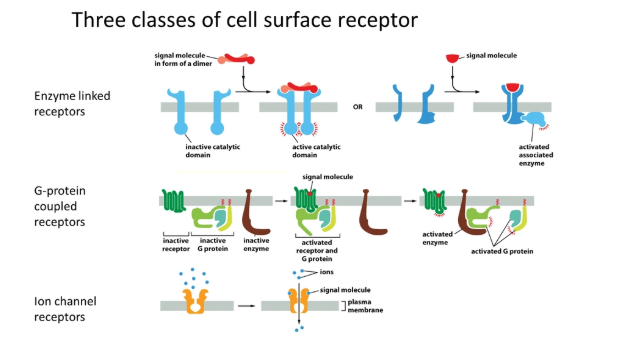
what are the three classes of cell surface receptor?

  • enzyme-linked receptors- binding of a ligand causes a conformational change in the receptor activating a catalytic domain, or recruiting/activating an enzyme eg. receptor tyrosine kinases (MAPKKK cascade)

  • G-protein coupled receptors- binding of a ligand causes a conformational change in the receptor, which activates a trimeric G protein intermediate, activating an enzyme in turn eg. cAMP signalling

  • ion channel receptors- binding of a ligand causes a conformational change that opens the channel for ion diffusion
<ul><li><p><strong>enzyme-linked receptors</strong>- binding of a ligand causes a conformational change in the receptor activating a catalytic domain, or recruiting/activating an enzyme eg. receptor tyrosine kinases (MAPKKK cascade)</p></li><li><p><strong>G-protein coupled receptors</strong>- binding of a ligand causes a conformational change in the receptor, which activates a trimeric G protein intermediate, activating an enzyme in turn eg. cAMP signalling</p></li><li><p><strong>ion channel receptors</strong>- binding of a ligand causes a conformational change that opens the channel for ion diffusion</p></li></ul><p></p>
4
New cards

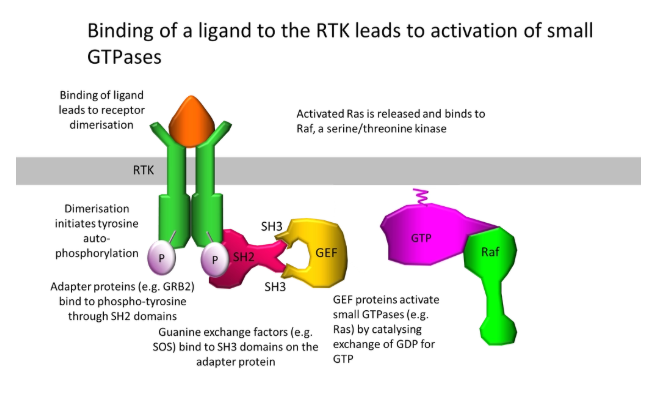
describe enzyme-linked receptor signalling and an example

enzyme-linked receptors- binding of a ligand causes a conformational change in the receptor activating a catalytic domain, or recruiting/activating an enzyme

  • most only have one transmembrane domain

example:

  • receptor tyrosine kinases, activated (eg. by growth factors), assemble as dimers and autophosphorylate their cytoplasmic tails at tyrosine residues

  • this scaffolding recruits a series of downstream components, including guanine exchange factors (GEFs), which temporarily activate small GTPases eg. Ras that swap GTP and GDP bound to proteins eg. Raf

  • Raf is a mitogen-activated protein kinase kinase kinase (MAPKKK), which phosphorylates MAPKK twice, in turn phosphorylating MAPK twice, which phosphorylates + activates transcription factors (an amplification module)
<p>enzyme-linked receptors- binding of a ligand causes a <strong>conformational change</strong> in the receptor <strong>activating</strong> a <strong>catalytic domain</strong>, or <strong>recruiting</strong>/activating an <strong>enzyme</strong></p><ul><li><p>most only have <strong>one </strong>transmembrane domain</p></li></ul><p></p><p>example:</p><ul><li><p>r<strong>eceptor tyrosine kinases</strong>, activated (eg. by growth factors), assemble as <strong>dimers </strong>and <strong>autophosphorylate </strong>their <strong>cytoplasmic tails </strong>at tyrosine residues</p></li><li><p>this scaffolding recruits a series of downstream components, including <strong>guanine exchange factors </strong>(GEFs), which temporarily <strong>activate </strong>small <strong>GTPases </strong>eg. Ras that <strong>swap GTP </strong>and <strong>GDP </strong>bound to proteins eg. Raf</p></li><li><p>Raf is a mitogen-activated protein kinase kinase kinase (<strong>MAPKKK</strong>), which phosphorylates <strong>MAPKK </strong>twice, in turn phosphorylating <strong>MAPK </strong>twice, which phosphorylates + <strong>activates transcription factors</strong> (an amplification module)</p></li></ul><p></p>
5
New cards

describe G-protein coupled receptor signalling and two examples

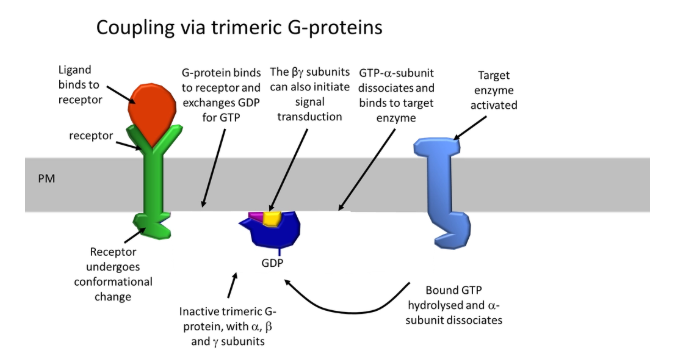
G-protein coupled receptors- binding of a ligand causes a conformational change in the receptor, which activates a trimeric G protein intermediate, activating an enzyme in turn

  • these receptors have 7 transmembrane alpha helix domains which bundle up

  • the N-terminus and extracellular loops bind the ligand, which causes a conformational change in the C-terminus and cytoplasmic loops, allowing them to interact with a GDP-bound G-protein

  • this changes its conformation so that it binds GTP (active)

  • the alpha subunit dissociates and binds to a target enzyme (eg. PLC), and hydrolyses the GTP to activate it

  • the other two subunits can also initiate signal transduction

example:

  • in cAMP signalling, adrenaline is secreted from the adrenal medulla into the bloodstream in response to stress

  • this binds to G-protein coupled receptors (sigmoidal binding) on the surface of muscle, liver and adipose cells

  • this causes the activation of adenylate cyclase, which produces cyclic AMP

  • this binds + activates protein kinase A (PKA), and releases it to phosphorylate phosphorylase kinase

  • this in turn phosphorylates glycogen kinase which initiates glycogenolysis

  • PKA also phosphorylates the receptor itself, inactivating + desensitising it

example:

  • in the inositol signalling pathway, the activated G protein is what activates the PLC (not in fertilisation)

  • this triggers calcium-induced calcium release to regulate many different factors
<p>G-protein coupled receptors- binding of a ligand causes a <strong>conformational change</strong> in the receptor, which activates a <strong>trimeric G protein intermediate</strong>, activating an enzyme in turn</p><ul><li><p>these receptors have <strong>7 </strong>transmembrane alpha helix domains which bundle up</p></li><li><p>the N-terminus and extracellular loops bind the ligand, which causes a conformational change in the C-terminus and cytoplasmic loops, allowing them to interact with a <strong>GDP-bound G-protein</strong></p></li><li><p>this changes its conformation so that it binds <strong>GTP </strong>(active)</p></li><li><p>the <strong>alpha subunit </strong>dissociates and binds to a <strong>target enzyme </strong>(eg. PLC), and hydrolyses the GTP to <strong>activate </strong>it</p></li><li><p>the other two subunits can also initiate signal transduction</p></li></ul><p></p><p>example:</p><ul><li><p>in <strong>cAMP </strong>signalling, <strong>adrenaline </strong>is secreted from the adrenal medulla into the bloodstream in response to stress</p></li><li><p>this binds to G-protein coupled receptors (<strong>sigmoidal </strong>binding) on the surface of muscle, liver and adipose cells</p></li><li><p>this causes the activation of <strong>adenylate cyclase</strong>, which produces <strong>cyclic AMP</strong></p></li><li><p>this binds + activates <strong>protein kinase A</strong> (PKA), and releases it to <strong>phosphorylate phosphorylase kinase</strong></p></li><li><p>this in turn <strong>phosphorylates glycogen kinase </strong>which initiates <strong>glycogenolysis</strong></p></li><li><p>PKA also phosphorylates the receptor itself, inactivating + <strong>desensitising </strong>it</p></li></ul><p></p><p>example:</p><ul><li><p>in the <strong>inositol</strong> signalling pathway, the activated<strong> G protein</strong> is what activates the <strong>PLC </strong>(not in fertilisation)</p></li><li><p>this triggers <strong>calcium-induced calcium release</strong> to regulate many different factors</p></li></ul><p></p>
6
New cards

describe ion receptor signalling and four examples

  • ion channel receptors- binding of a ligand causes a conformational change that opens the channel for ion diffusion

examples:

  • the acetylcholine receptor is a pentameric ligand gated channel, with two acetycholine binding sites- ACh binding opens the channel to allow diffusion of ions through (primarily sodium because it is far from the equilibrium of the membrane potential)

  • the GABA receptor is a pentameric ligand gated channel with one GABA binding site- GABA binding opens the channel for chloride ion diffusion to resist depolarisation of the membrane

  • ionotropic glutamate receptors bind to glutamate, and are specific to different ions for depolarisation

  • metabotropic glutamate receptors are G-protein coupled → activate ion channels

7
New cards

describe two examples of cross talk between signalling pathways

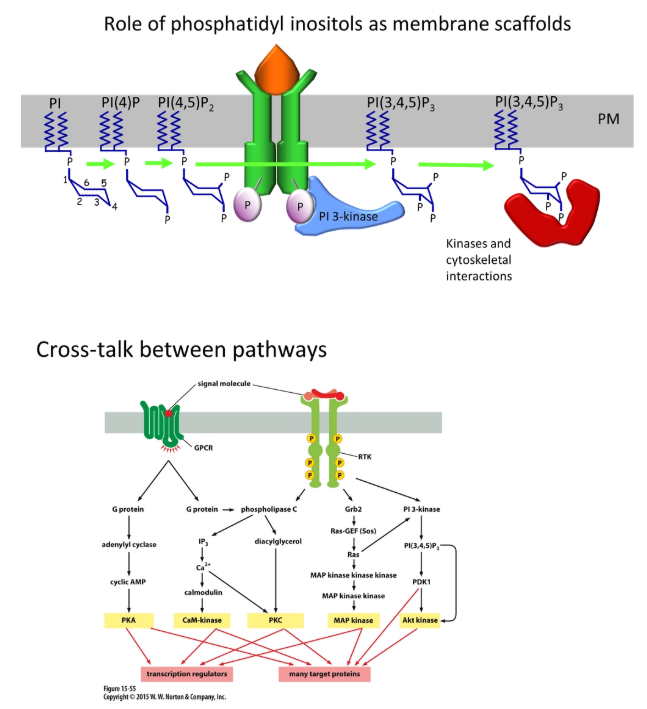
different signalling pathways can interact:

  • eg. activates receptor tyrosine kinases (enzyme-linked receptors) assemble as dimers and autophosphorylate their cytoplasmic tails at tyrosine residues

  • this can bind and activate IP3 kinase from the inositol signalling pathway

  • this phosphorylates PIP2 to produce PIP3

  • PIP3 can act as a scaffolding protein for cytoskeletal interactions

  • eg. metabotropic glutamate receptors are G-protein coupled, initiating the activation of adenylate cyclase, which produces cyclic AMP

  • this binds + activates protein kinase A (PKA), and releases it to phosphorylate + open a sodium ion channel to cause membrane depolarisation
<p>different signalling pathways can interact:</p><ul><li><p>eg. activates <strong>receptor tyrosine kinases </strong>(enzyme-linked receptors) assemble as dimers and autophosphorylate their cytoplasmic tails at tyrosine residues</p></li><li><p>this can bind and <strong>activate IP3 kinase</strong> from the <strong>inositol signalling pathway</strong></p></li><li><p>this phosphorylates PIP<sub>2</sub> to produce <strong>PIP<sub>3</sub></strong></p></li><li><p>PIP<sub>3</sub> can act as a <strong>scaffolding </strong>protein for <strong>cytoskeletal interactions</strong></p></li></ul><p></p><ul><li><p>eg. <strong>metabotropic </strong>glutamate receptors are <strong>G-protein coupled</strong>, initiating the activation of <strong>adenylate cyclase, </strong>which produces <strong>cyclic AMP</strong></p></li><li><p>this binds + activates<strong> protein kinase A</strong> (PKA), and releases it to <strong>phosphorylate </strong>+ open a <strong>sodium ion channel</strong> to cause membrane depolarisation</p></li></ul><p></p>