2.6 - Evidence on dynamic choice
 Call Kai
 Learn
Learn Practice Test
 Spaced Repetition
 Match
Match Flashcards
 Knowt Play
1/14

There's no tags or description
Looks like no tags are added yet.
Name | Mastery | Learn | Test | Matching | Spaced | Call with Kai |
|---|
No analytics yet
Send a link to your students to track their progress
15 Terms
Ways to test if people plan & how it relates to DC
Ask for plan and force them to follow it
incentivised but doesnt test dynamic consistency as plan turned into pre-commitment decision
Ask for plan and allow departure from it for a cost
incentive to stick to plan distorts test of Dynamic Consistency
Randomly select whether initial plan or final decision implemented for payoffs
Changes decision problem by adding a new chance node / randomisation
ALL FLAWED
Bone et al. (2009) vs Cubitt et al. (1998)
Bone
Test if people plan at all - Not what the specific plan is
Set up a decision problem with certain behaviours that no sensible plan could rationalise.
Then if we see those behaviours, we'll know there was no plan.
Cubitt
Reconceptualise theoretical framework so DC not a ‘within’ problem but now an ‘across’ problem
Across problem restriction used instead (Timing Independence used instead of DC)
Timing Independence vs Dynamic Consistency
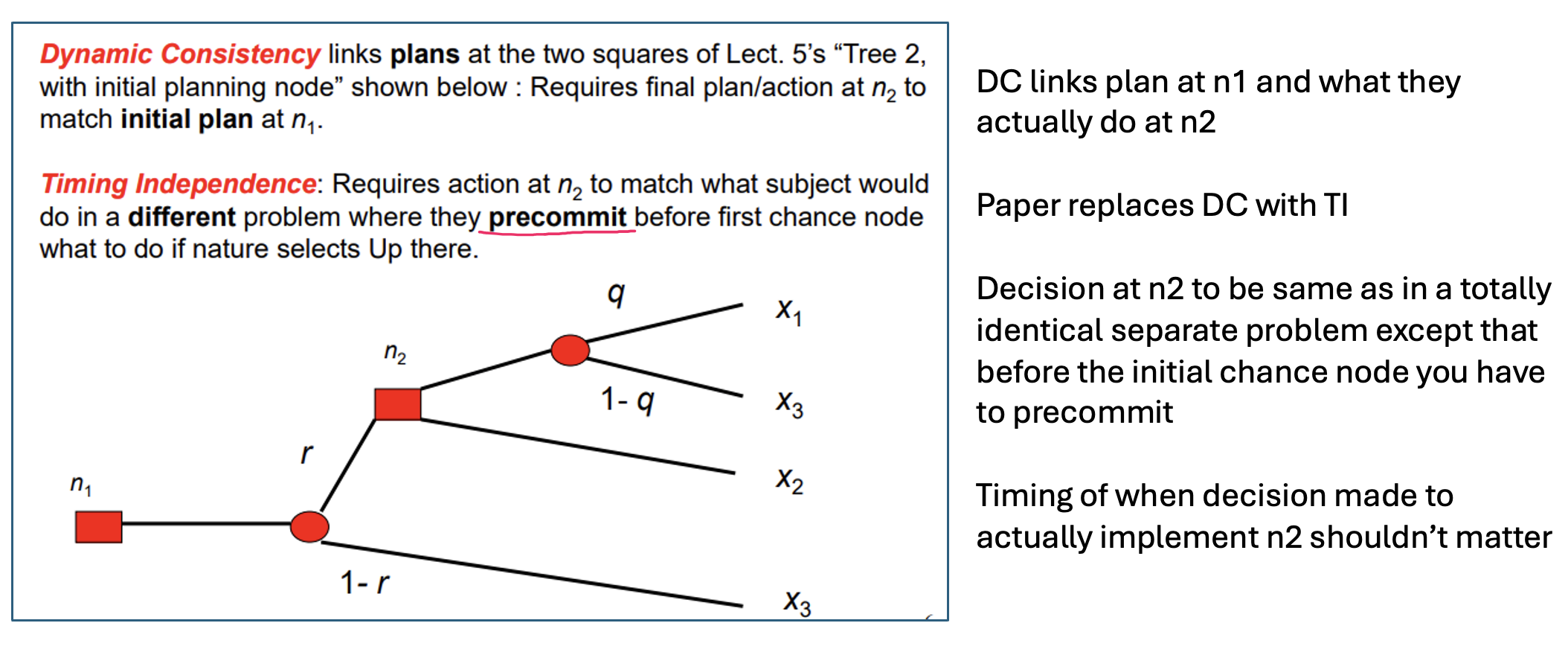
DC - Requires final plan / action to match initial plan
TI - Requires final action to match what subject would do in a different problem where they precommit before 1st chance node to both possibilities
Within-subject design flaws
Demand effect - Can lead to subject figuring out what relationship is and then doing results that obey that consistency
Incentive structure design flaws
Income effect - Paying out after every task can lead to income effects as subjects richer than at start (need randomisation of payoff round)
Randomisation of payoff - Subject could see whole experiment as 1 big dynamic choice problem with a chance node at the end (that determines payoff)
Not Testing same dynamic choice principles that want to test
Decision tree design flaws
Can’t be sure all subjects understand decision-trees
have to test frame independence as its not true by design
CCS approach - use words not trees to present decision problems
phrase same thing in 2 different ways but have same tree to test
Between subject design for DC testing (CCS approach for within subject flaws)
Each subject faces 1 task with real money outcomes
Different groups of subjects face each task - compare groups rather than individuals
compare proportions of subjects making same choice in a group
Random assignment of subjects to groups - no systematic differences in risk attitudes between groups (unless task causes it which we’re testing)
CRE example - CSS 1998 OVERVIEW
q - probability
r - Common ratio
When problem scaled down preference flips from certainty to riskier option
different versions of the same problem presented to subjects to test each different rational dynamic decision making assumptions
EUT says scaled UP vs Scaled down identical BUT CRE argues there is a difference
CRE example - CSS 1998 test of rational dynamic decision making
Test of separability - Scaled UP vs Prior lottery problem
Decision-maker is not asked to choose between Options A and B until (and unless) the outcome of the 1st stage lottery requires her to do so.
Test of Timing Independence - Prior lottery vs pre-commitment problem
same problem but required to pre-commit herself before resolution of 1st stage lottery (timing shouldn’t affect decision as same probability distribution of prizes)
Test of Frame independence - Pre-commit vs 2 stage problem
subject faces 2 2-stage lotteries (decision tree identical) BUT now 1st stage written into the options
Test of Reduction of compound lotteries - 2 stage vs Scaled DOWN
same problem but compound lotteries reduced to simple ones
CRE example - CSS 1998 RESULTS table
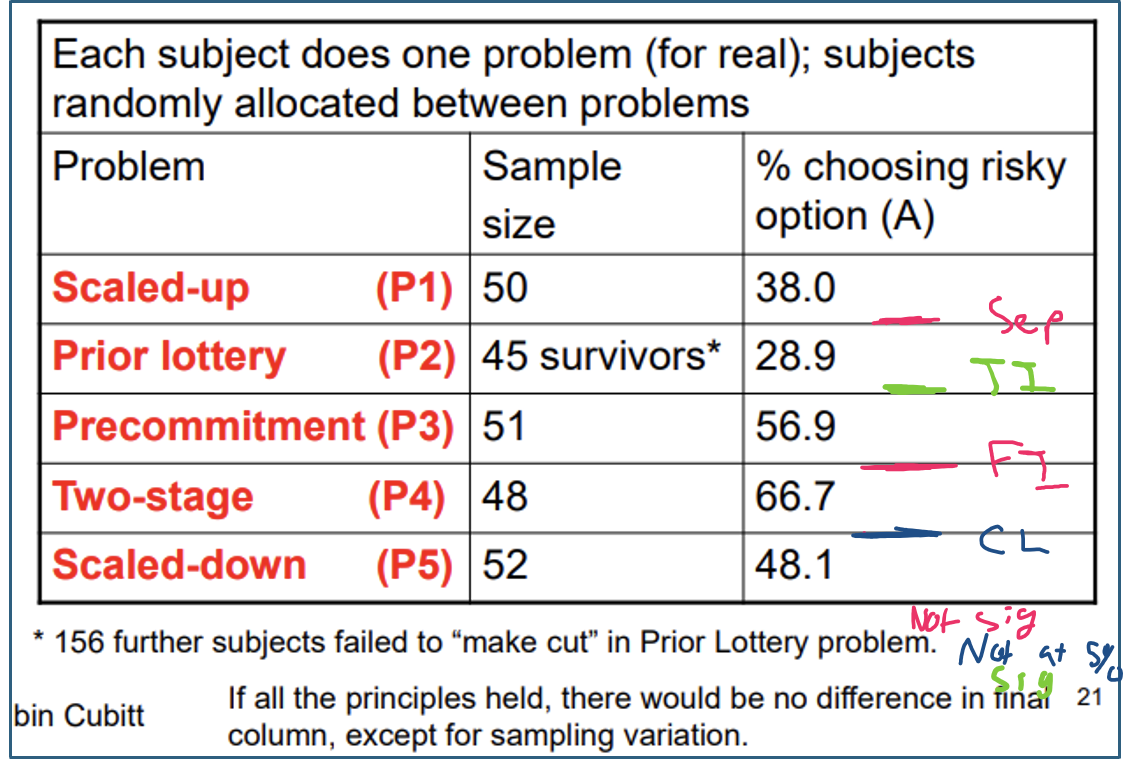
Subjects became more risk averse after the resolution of prior uncertainty
once subjects know the prior risk has fired and their decision is live and consequential, they become more cautious - safe option chosen
Pre-commitment
CRE example - CSS 1998 RESULTS explained + implication
Classic test of CRE - P1 vs P5 → Difference has direction of CRE but not sig at 5%
maybe from small samples
Dynamic CRE - P1 vs P4 → Difference has direction of CRE + stat sig
EUT violated
Pooled test - (P1 + P2) vs (P3 + P4 + P5) → Difference has direction of CRE + stat sig
People are taking the risky option more frequently when they can pre-commit to it, than when they can't - Violates TI principle
Robust evidence from other literature showing TI violated
CRE & CCE as violations of EUT
Violates EUTs property of linearity in probabilities
Need a model that is non-linear (e.g. prospect theory)
max something else
Timing independence definition
The final action taken by an individual should align with what they would choose in a scenario that allows for pre-commitment before encountering any uncertainty
Preferences over lotteries are unaffected by when uncertainty resolves.
The outcome of a decision should not vary based on the timing of when that decision is made
Bone et al. (2009) - OV
Test if people plan
subjects asked to choose at choice nodes for 4 different decision trees
If plan then will pick dominant strat - if not then pick best out of available
Individual No precommit vs I precommit vs Pairs
IPC only had precommit based on what nature did - doesnt include counterfactual so not forced to view all payoffs at once
Bone et al. (2009) - RESULTS
People pick best option at final stage BUT majority dont pick dominant strategy from the start
no improvement over time (experience)
Minority did plan - got all right BUT majority didnt plan
INPC & IPC have similar levels of no planning + Pairs has same as well ~ 30%
Reject null that chose at random - actively made incorrect choice