BIOL 206 Exam 2 - Donna Janes
 Call Kai
 Learn
Learn Practice Test
 Spaced Repetition
 Match
Match Flashcards
 Knowt Play
1/354

There's no tags or description
Looks like no tags are added yet.
Name | Mastery | Learn | Test | Matching | Spaced | Call with Kai |
|---|
No analytics yet
Send a link to your students to track their progress
355 Terms
T/F: Viruses are cells
False, viruses are NOT cells
Viruses are obligate intracellular parasites. What does this mean?
They must be living in a host and must be grown in a host
Viruses ______________ (do/do not) divide and grow
do not
T/F: viruses contain DNA and RNA
False, they contain DNA OR RNA (very few exceptions)
Which two viruses are unique in that they have both DNA and RNA?
Cytomegalovirus and mimivirus
List the four types of genomes a virus can have
dsDNA
ssDNA
dsRNA
ssRNA
Most DNA viruses are __________ (ds/ss) while most RNA viruses are ___________ (ds/ss)
ds, ss
What's the range in size for viruses?
10nm-500nm
How do viruses impact their host's ribosomes?
they steal the ribosomes from the host to replicate
_____________ + ____________ (protein coat) = nucleocapsid
nucleic acid, capsid
T/F: viruses have ribosomes
False
T/F: viruses have no ATP-generating mechanism
True
T/F: viruses are infectious
True
Viruses are medically ______________ (important/insignificant)
important
Herpes is a ___________ (small/large) family of viruses and includes what three relevant types for BIOL 206?
large family; includes cold sores, genital herpes, chicken pox
HPV is the cause of most _______________ in humans, but is most known for causing __________________ in women and __________________ in men
warts; cervical cancer, throat cancer
HPV affects ____________ (what type?) tissue
epithelial
T/F: there are many strains of HPV
True
Define virion
virus particle
T/F: viruses can be seen with a light microscope
False; requires a Electron Microscope
RBCs are __________ nm, E. coli is ______________ nm, virophages are ________________ nm
10,000, 1,000x3,000, 70
mamavirus is _____________ nm, poliovirus is___________ nm, smallpox virus is ______________ nm
390, 30, 200x300
_______________ (most/all/no) viruses have capsids
all
define a capsid in relation to viruses
a protein coat that encloses and protects the virus's nucleic acid
Capsids are constructed from ________________________________ (3 words) called __________________
identical protein subunits; capsomeres
What about the capsid triggers the human immune system to recognize the virus as foreign?
The repeating pattern of capsomeres which is foreign to the human body
List the four shapes of viruses
1) filamentous/helical (rigid or flexible)
2) icosahedral (soccer ball shaped with spikes coming off)
3) enveloped
4) complex morphology (includes a head and tail)
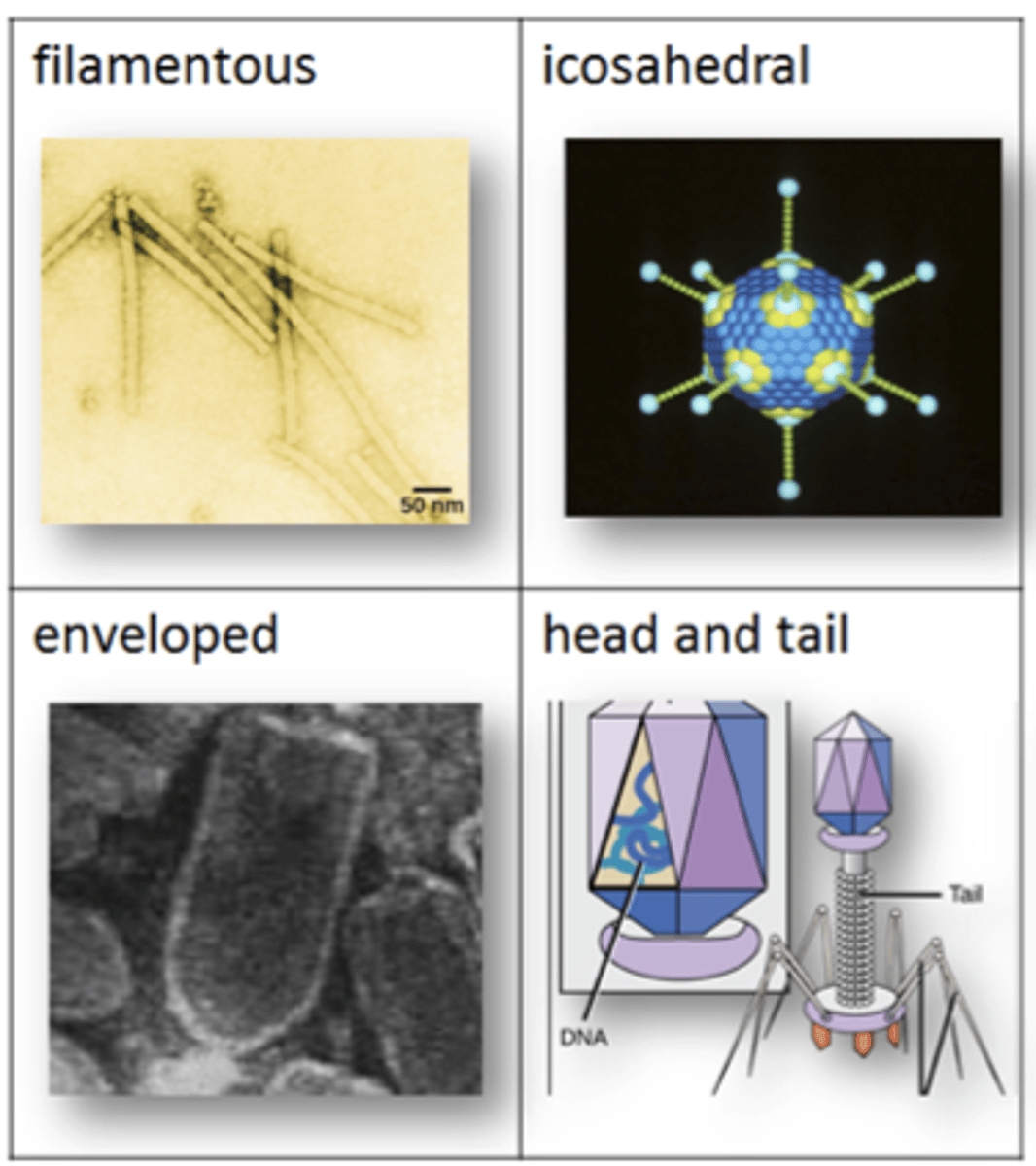
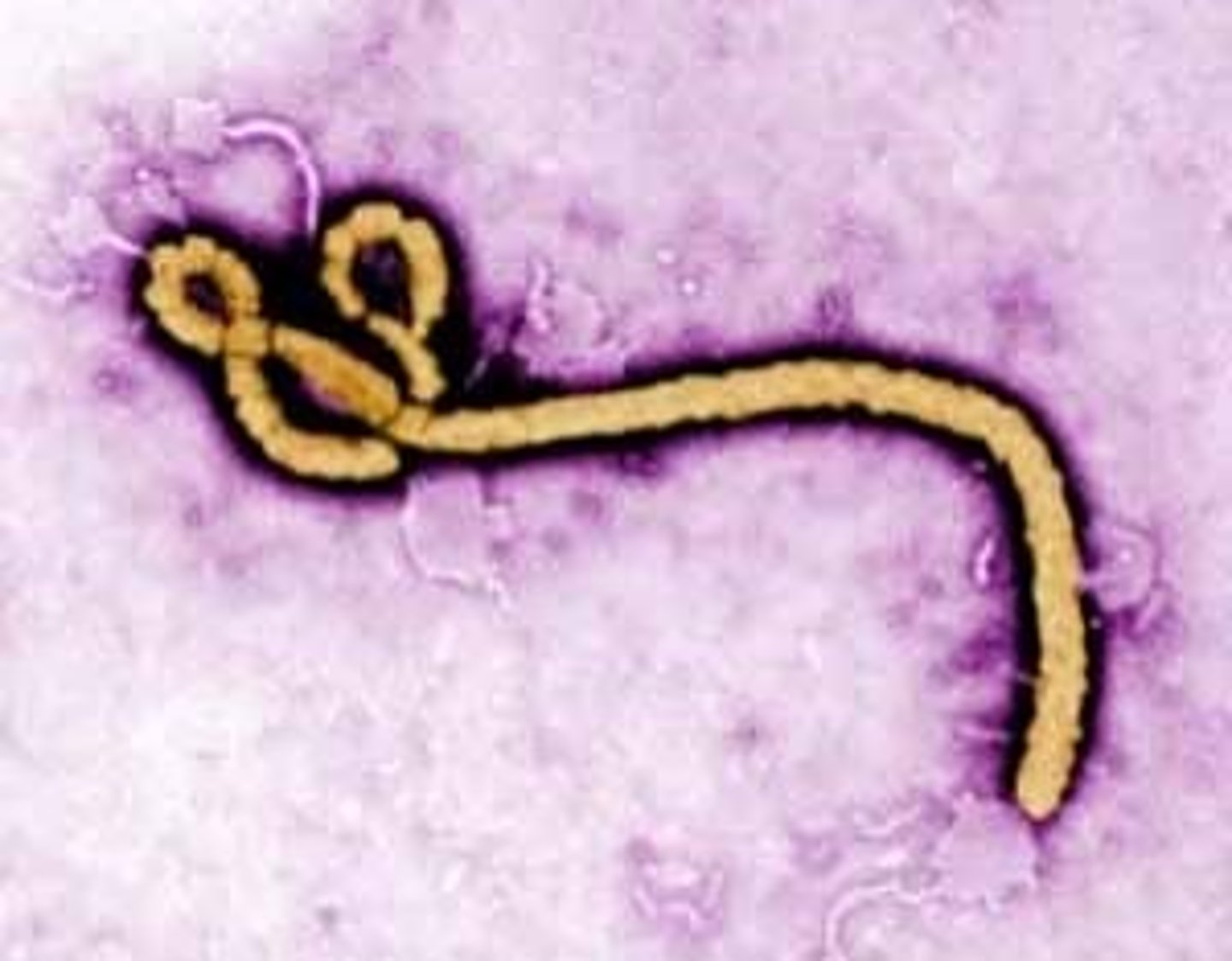
List two types of filamentous shaped viruses
tubulovirus (rigid), ebola (flexible)
Adenovirus is ____________ (what shape?)
icosahedral
Herpes virus is __________________ (what shape?)
enveloped
List two types of complex morphology/head and tail viruses and explain their effect on the host
T2 bacteriophage, T4 bacteriophage;
infect bacteria which can cause the human gut to become sterile resulting in diarrhea
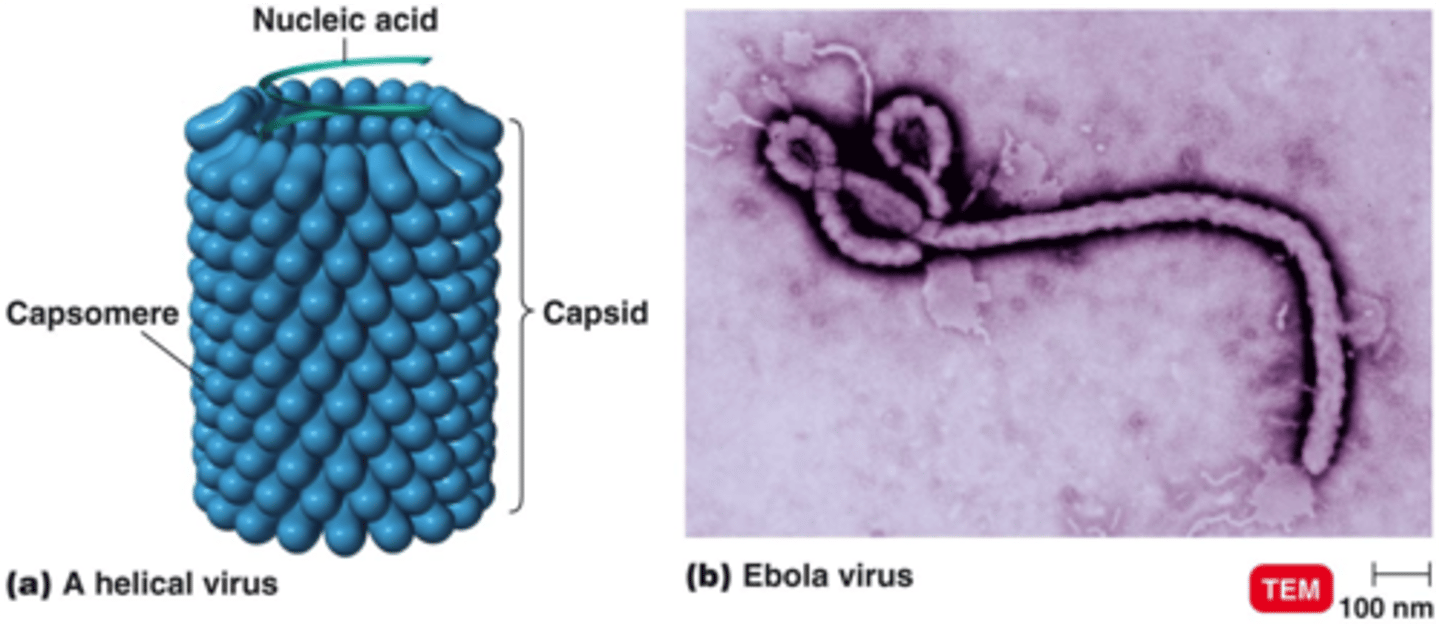
_________________ (shape) is a continuous helix of capsomers forming a cylindrical nucelocapsid
helical
Polyhedral/icosahedral viruses are ___________ sided with ____________ corners (number) and vary in number of __________________
20, 12, capsomers
Some polyhedral viruses are enveloped meaning what?
their membrane is external to the capsid
Rabies virus is ________________ shaped
bullet
This virus is an example of Ebola virus or ______________ shaped virus
helical
From where is the viral envelope derived?
host cell membrane
Why can't an enveloped virus get its envelope from a bacterial cell membrane?
Bacterial cells have cell walls protecting them from enveloped viruses
When does an enveloped virus acquire its envelope?
When it leaves or buds through the host cell
The exposed proteins on the outside of a viral envelope are called _________________ and are essential for what?
spikes/peplomers; essential for binding to the host receptor and for the infectivity of the host cell
What are viruses without an envelope called?
Naked viruses
COVID vaccines are made to attack what part of a virus?
the peplomers thus preventing the virus from binding to the host cell
An envelope is ________________ (required/optional) for the survival of enveloped viruses
required
List an advantage and a disadvantage of the viral envelope
Advantage: disguises the virus from the immune system because it is coated in the host cell membrane (molecular mimicry)
Disadvantage: soap and water dissolve the envelope thus killing the virus bc the envelope is required for survival
List the two functions of a viral envelope
1) protects the nucleic acid when the virion is outside the host cell
2) is used to bind to the receptor and infect the host cell
T/F: a naked cell can still infect a host cell
false; no envelope = no infectivity
Naked viruses bind to the host cell via ______________
its capsid
The viral envelope ____________________ with the host cell membrane allowing for its infectivity
fuses
Anything that damages the _________________ will damage the viral envelope
cell membrane
List factors which damage the viral envelope
Environmental conditions (temp, pH, pressure, toxins, detergents, etc);
Naked viruses are ___________________ (more/less) resistant to damaging environmental factors;
Advantage __________(in/out) of the body;
Disadvantage ____________ (in/out) of the body
more resistant, advantage in the body, disadvantage out of the body
Why is resistance to environmental conditions important?
Naked viruses can persist because it does not have a damaged/destroyed envelope
Why can't a virus with a damaged/destroyed envelope persist in the host?
it cannot interact with the complementary molecule/host cell receptor
T/F: viruses only grow in living cells
true; they are obligate intracellular pathogens
Animal viruses are grown in what three hosts?
1) living animals
2) embryonated eggs
3) cell cultures
Which is most commonly used to grow viruses in the lab?
a) living animals
b) embryonated eggs
c) cell cultures
Cell cultures
Explain what determines if a virus is "chosen for" and how this relates to COVID
viruses that best fit into the host receptor are chosen for; COVID mutates allowing it to continue to fit into the host receptor as the immune system becomes resistant to the current strain
Bacteriophages form plaques on a _________________ (3 words) bc they infect bacteria
lawn of bacteria
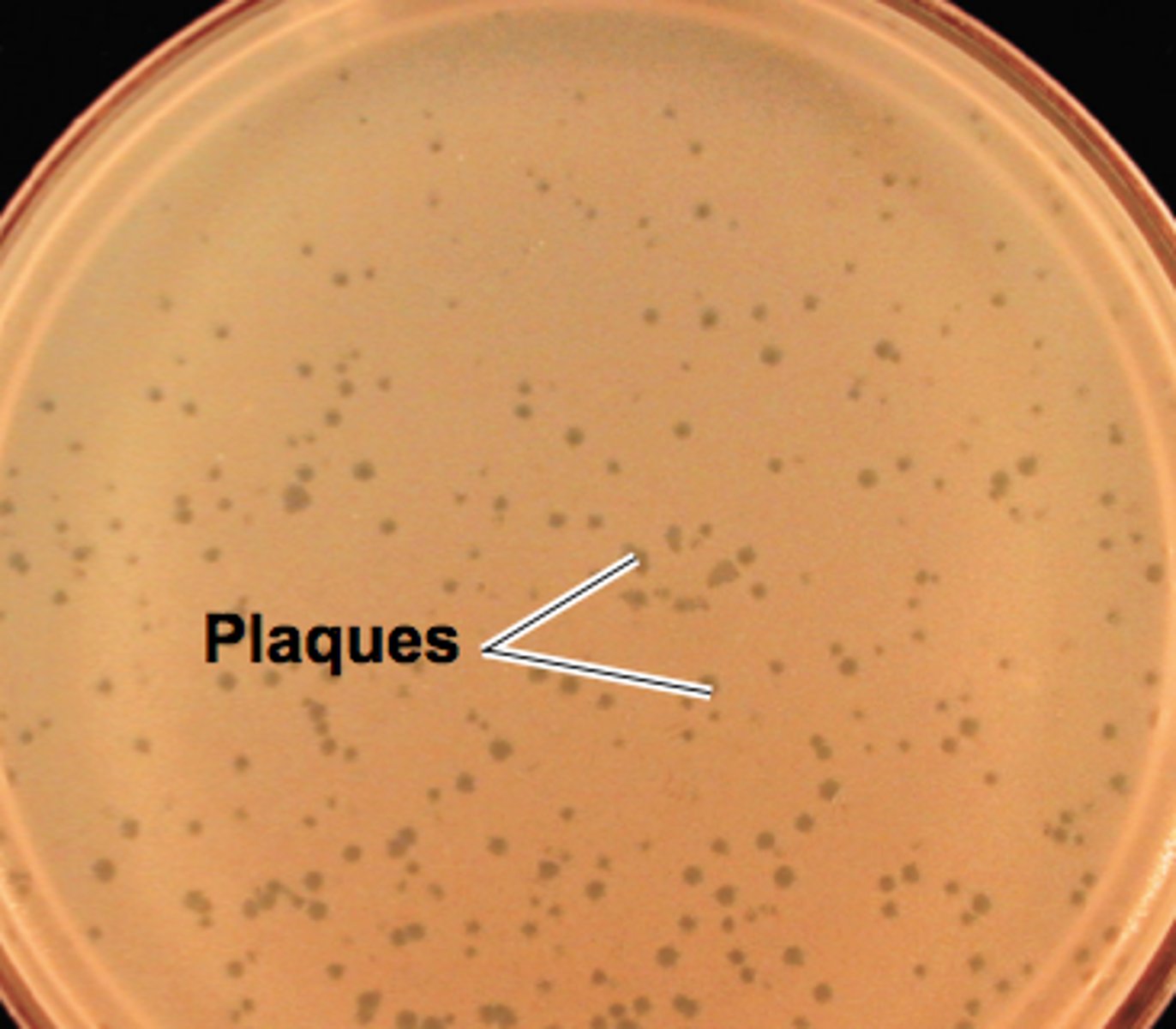
All viruses must do what to gain entry into the host
interact with a complementary host cell receptor
T/F: viruses are motile
false; they are nonmotile
How are viruses moved around/spread?
normal kinetic energy of air molecules moves the virus around
How does a virus know that it is near a host cell?
Chemical attraction allows the virus to sense the presence of the host cell
T/F: enveloped viruses infect bacteria
false; bacteria have a cell wall preventing the enveloped virus from getting through and coating itself in the bacterial cell membrane
List and explain the three mechanisms by which animal viruses enter a cell
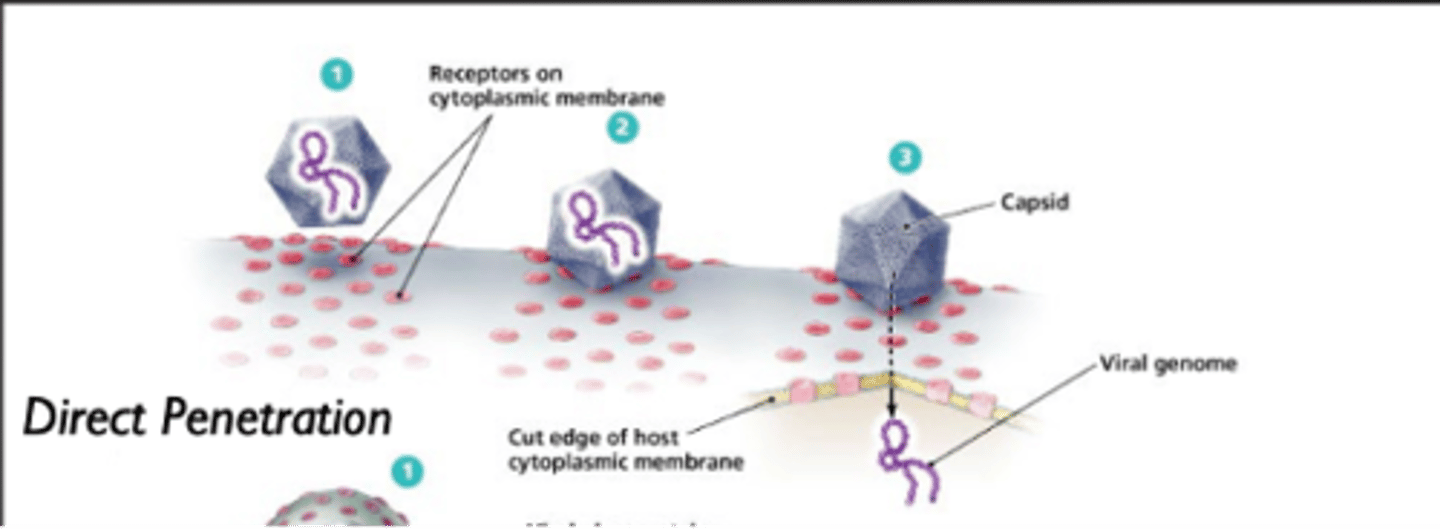
Direct penetration: only the nucleic acid enters the host cell
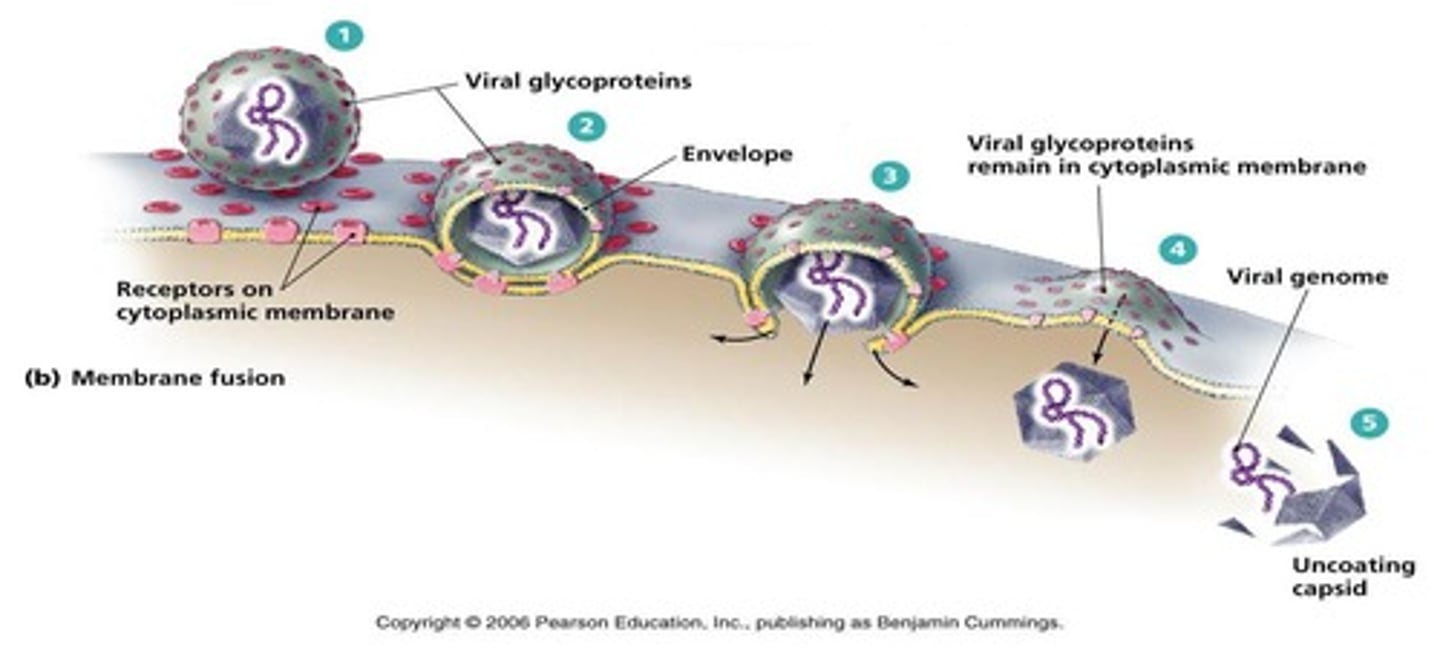
Membrane fusion: only the nucleocapsid enters
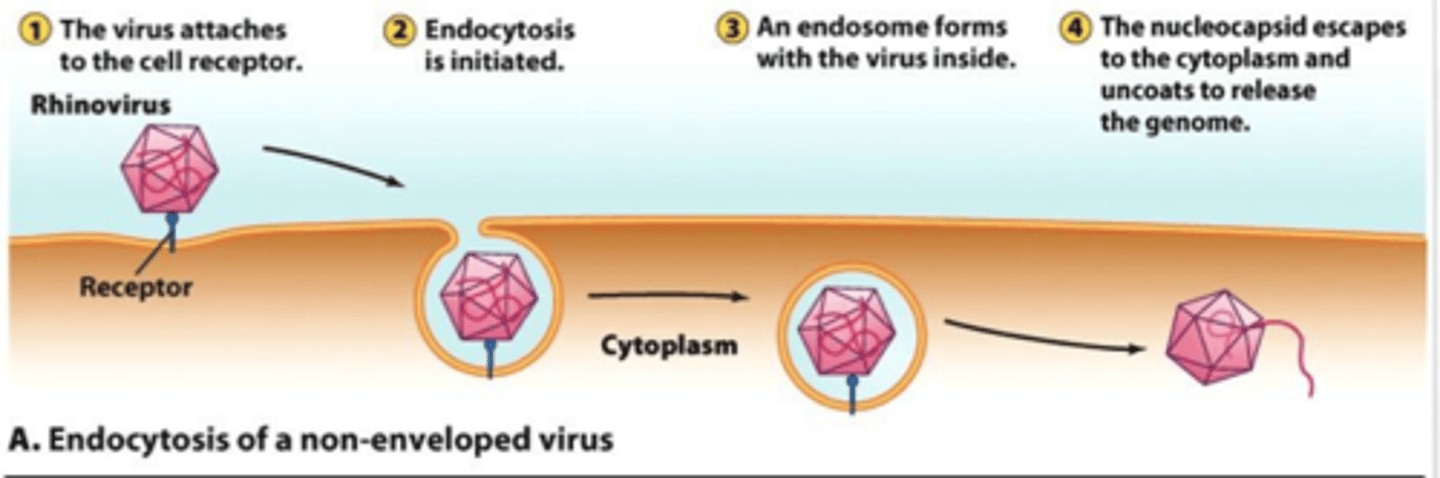
Endocytosis: the entire enveloped virus or naked virus enters the cell
Direct penetration is only a mechanism of entry for which type of virus?
naked viruses
Membrane fusion is only a mechanism of entry for which type of virus and why?
enveloped viruses because they are made of the same stuff as the cell membrane and can thus be undetected
Explain endocytosis in relation to viral entry into a host cell. How and why does it work?
Some complementary receptors trigger endocytosis; viruses may also use an amino acid shape to bind to the receptor and trigger endocytosis because the cell thinks it is taking in a protein molecule
Why are viruses species specific?
the host must have a complementary receptor to bind to viruses
Why are viruses tissue specific?
not every tissue expresses the same genomes which prevents the complementary receptor for the virus from being present on certain tissues
Why is rabies transmittable to any mammal if viruses are species specific?
Mammals have shared receptors for rabies
What is required to release the genome/nucleic acid (NA) into the cytoplasm? Why does the genome/NA need to be released into the cytoplasm?
Enzymes are needed to release the genome/NA into the cytoplasm for viral replication
List and explain the two ways in which a virus leaves the host cell
Budding/blebbing: exocytosis; nucleocapsid binds to the membrane which pinches off and sheds the virus gradually;
Lysis: viruses are released when the cell dies and ruptured
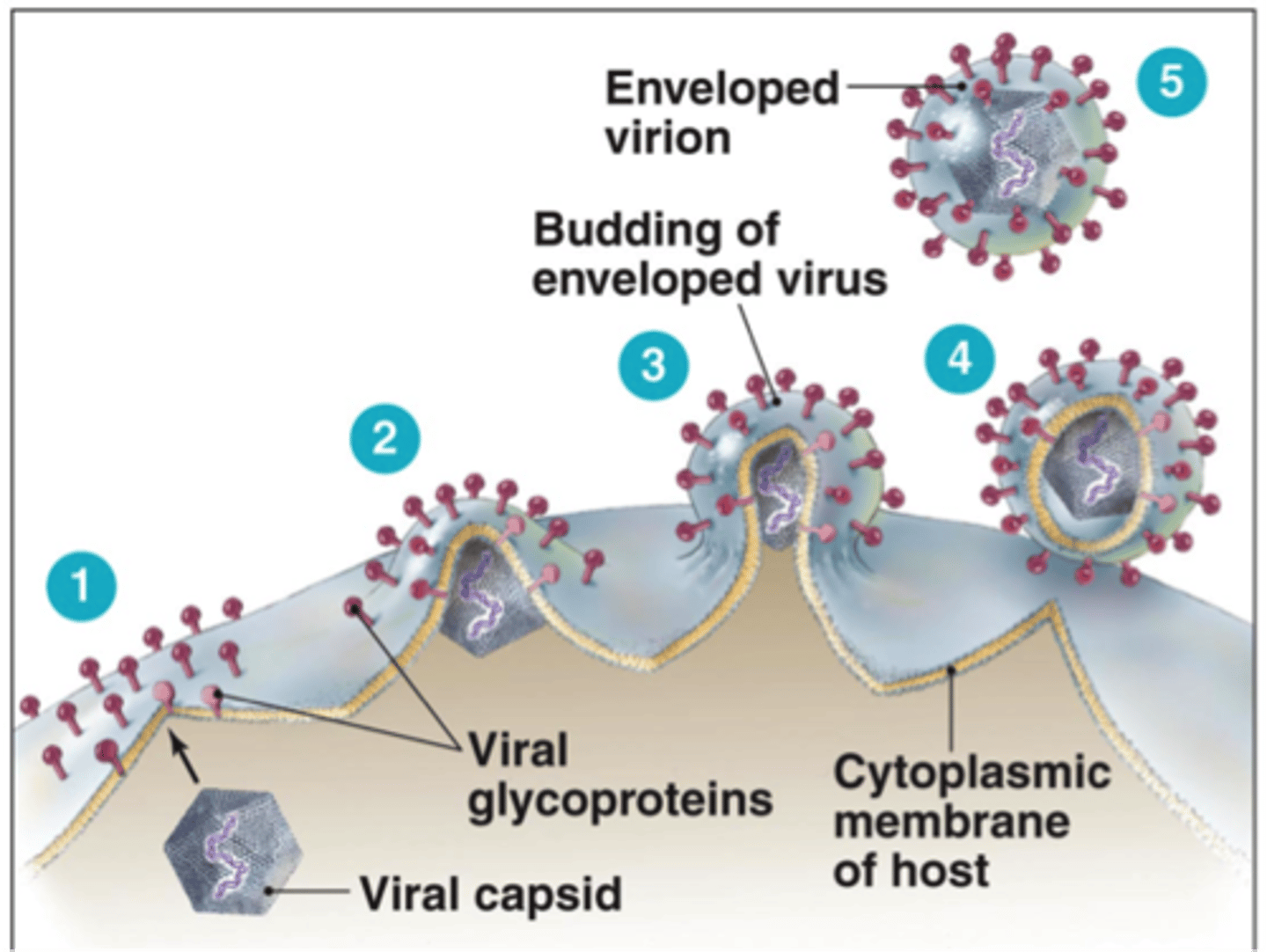
Lysis is only a mechanism of release for which type of virus?
Naked viruses
The number of viruses released during lysis ______________ (remains the same/varies) among different viruses
varies
Budding is an exit mechanism of ___________ viruses (all, naked, enveloped)
enveloped
Define molecular mimicry. How does the immune system react?
The enveloped virus looks like the host cell due to the presence of host cell membrane, but the immune response will eventually recognize the viral components
T/F: virus budding will kill the host cell
true; eventually kills the host cell
Some bacteriophages have a______ along with a_____and_____ (in relation to shape and structure)
polyhedral nucleocapsid; helical tail; attachment fibers
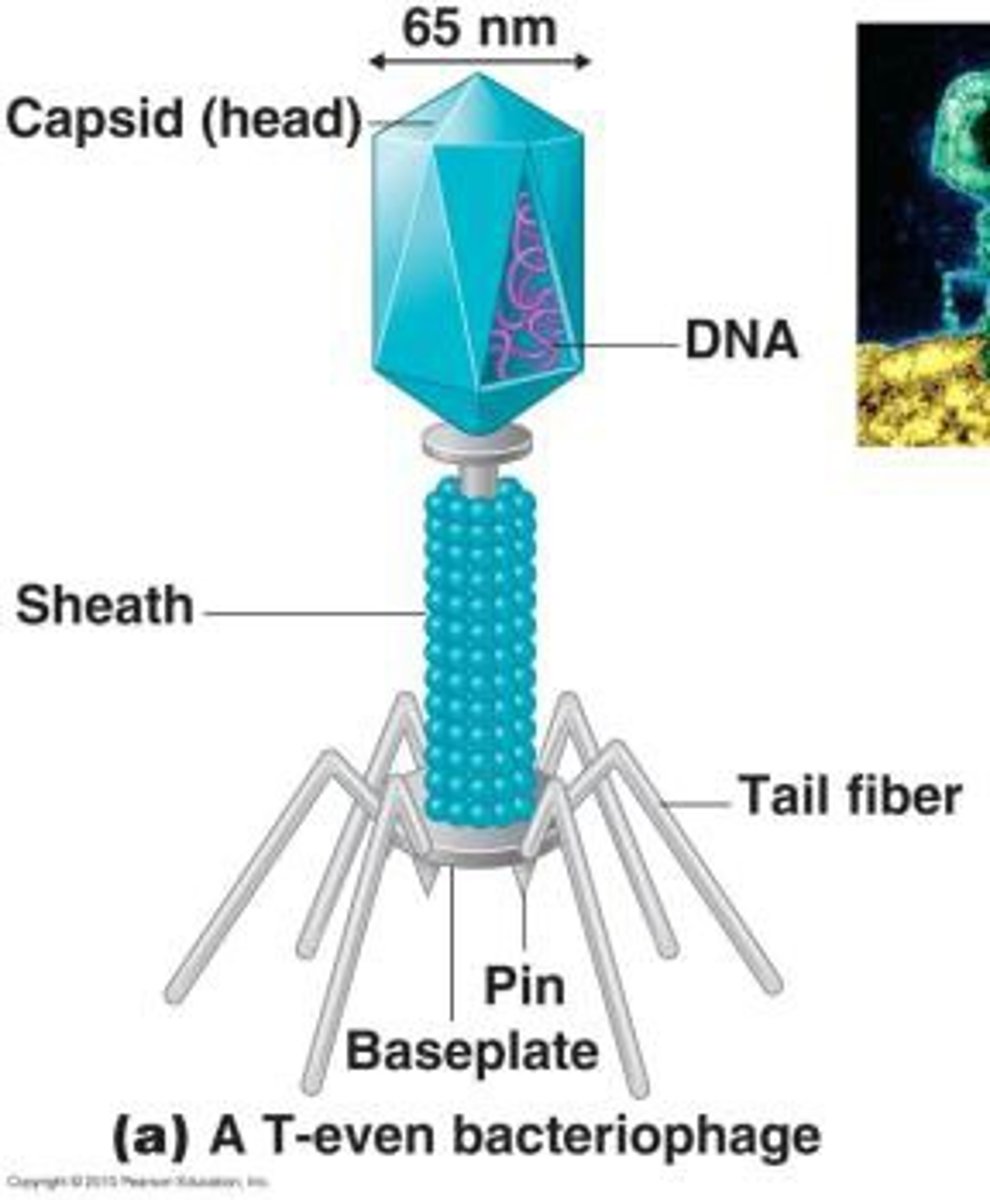
Bacteriophages are also referred to as what? Define what a bacteriophage is.
phages; bacterial viruses
Which bacteriophages are the most widely studied?
Those that infect escherichia coli
Describe the multiplication process of bacteriophages in relation to animal viruses
Bacteriophages go through similar stages as animal viruses
What part of the bacteriophage enters the cytoplasm?
only the nucleic acid
Release due to cell lysis is called what?
The lytic cycle
How do bacteriophages exit the host cell? Why is this?
Lysis; bacteriophages must be naked cells because bacterial cells have cell walls that would prevent enveloped viruses from getting through
The __________________ of the viral surface proteins for __________________ proteins (_______________) is responsible for the ability to infect the host cell
affinity; complementary; receptors
If the cell surface does not possess a receptor that interacts with the viral surface, what happens?
Nothing; no host receptor = no binding = no infectivity
The host range is determined by the presence of what?
the receptor/complementary molecule/protein
T4 bacteriophage infects what?
only E coli
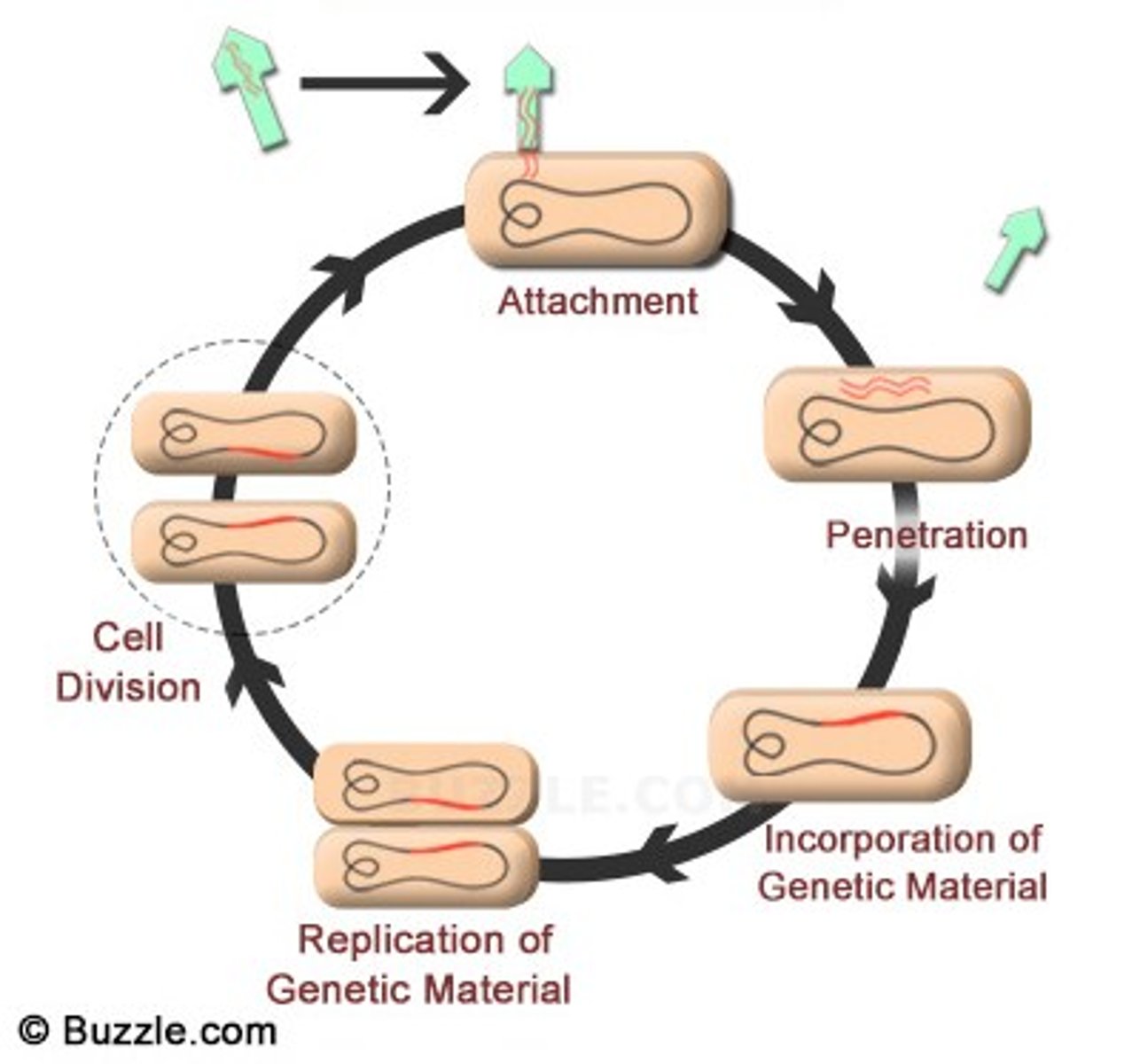
List and explain the 5 steps of phage replication in order
Attachment: binding of a virus to a specific molecule/receptor;
Penetration: genome/nucleic acid (NA) enters the host cell;
Biosynthesis: viral components are produced;
Maturation: assembly and completion of viral formation;
Release: viruses leave the cell via lysis to infect other cells
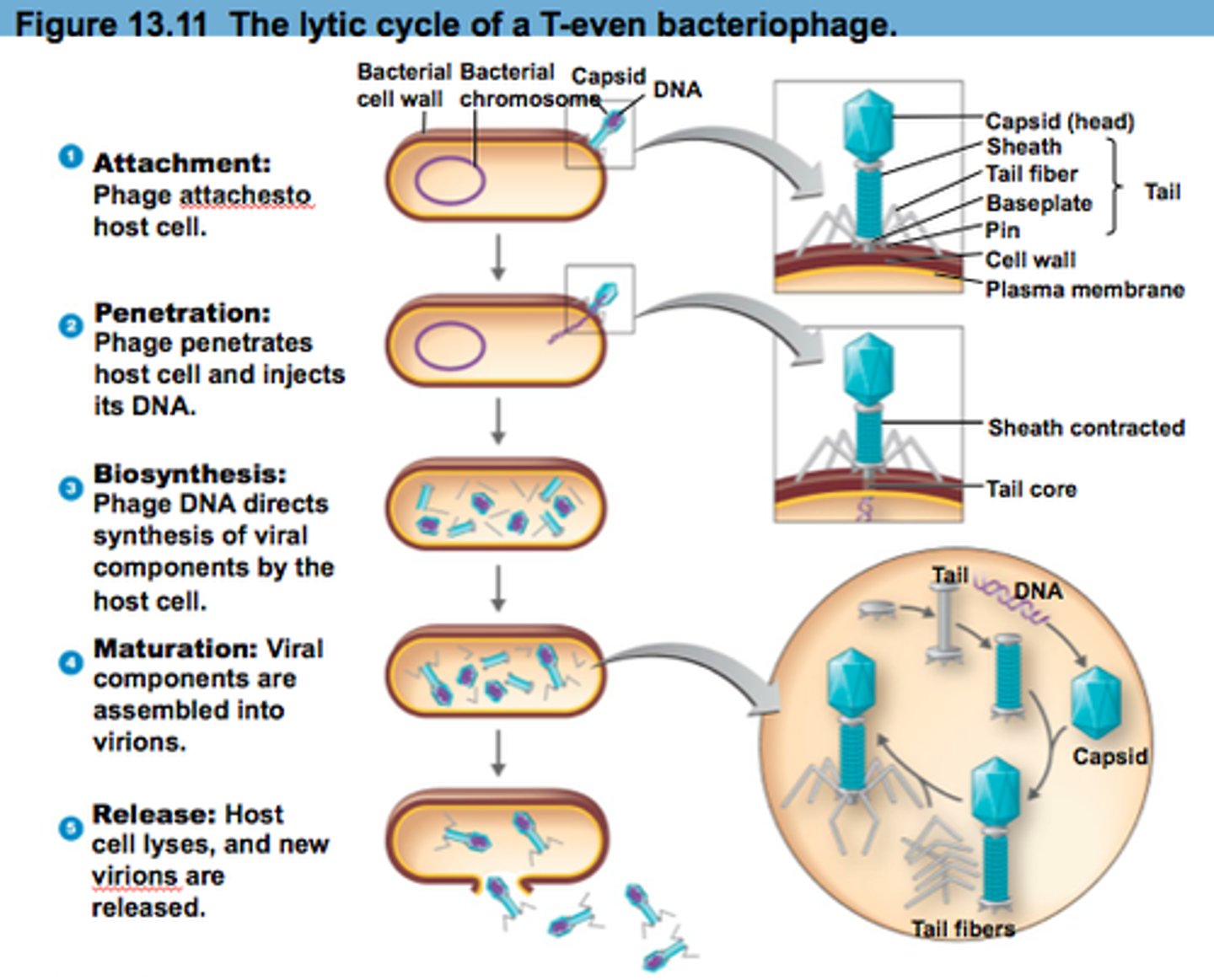
List some products of biosynthesis
making of enzymes that are needed to release the NA into the cytoplasm, makes nucleic acids for progeny (viral babies)
What component of the host cell do viruses use during biosynthesis?
ribosomes
Define burst time in relation to viruses
the time from attachment to lysis
Define burst size as it relates to viruses
the number of viral particles released
Bacteriophages release ________ to _________ visions. T4 bacteriophage specifically releases ____________ visions (numbers). This is a _____________ (large/small) quantity compared to bacteria size
50-300 virions; ~ 200 virions; large quantity
_______________ on the _____________ is the receptor for T4 on e coli meaning that T4 is a ______________ (gram positive/gram negative) stain
LPS on the outer membrane; gram negative
T4 produces ______________ which weakens the e coli's _____________ allowing for ______________ (part of the T4 cell) penetration
lysozyme; cell wall; allowing for viral tail penetration
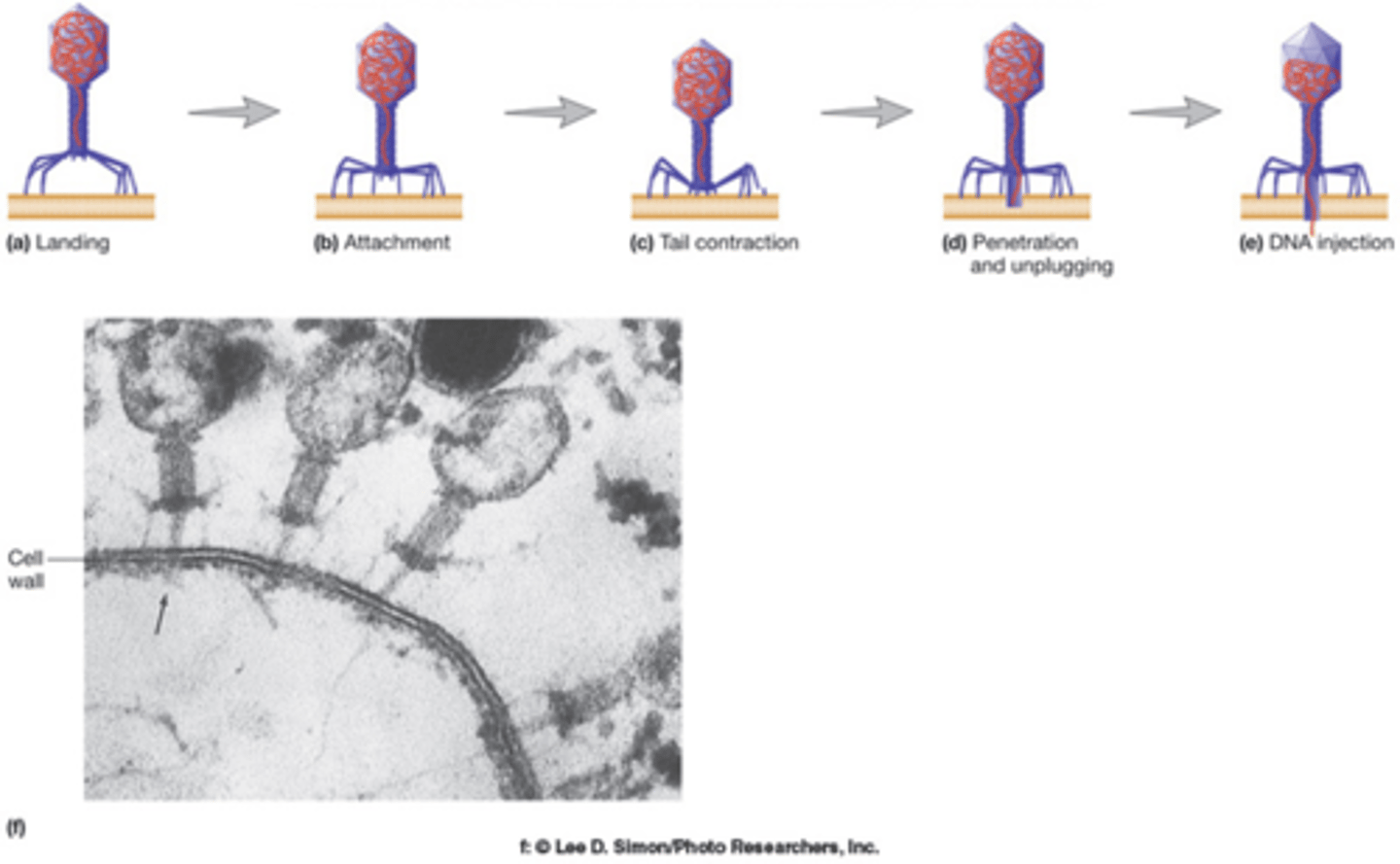
Maturation is a _______________ reaction but always occurs in the same __________________
spontaneous; order
What kind of virus has two life cycles?
temperate virus
Describe the lytic phase of a virus. When does it occur and give examples? What is its purpose?
Happens when the cell conditions are unfavorable for the virus such as in UV radiation, extreme heat, etc;
Signals the bacteria to hurry up to have babies (progeny) and get out of the host cell
Describe the lysogenic phase of a virus. When does it occur? Describe the process
Occurs when the host cell conditions are favorable AND the virus has invaded the immune system (required for the virus to stick around);
The viral chromosome implants itself in the bacterial chromosome so that every time the cell divides, so does the virus thus causing it to multiply and infect more cells