The behavioural approach to explaining phobias
 Call Kai
 Learn
Learn Practice Test
 Spaced Repetition
 Match
Match Flashcards
 Knowt Play
1/9

There's no tags or description
Looks like no tags are added yet.
Name | Mastery | Learn | Test | Matching | Spaced | Call with Kai |
|---|
No analytics yet
Send a link to your students to track their progress
10 Terms
AO1 What is the behavioural approach?
A way of explaining behaviour in terms of what is observable and in terms of learning
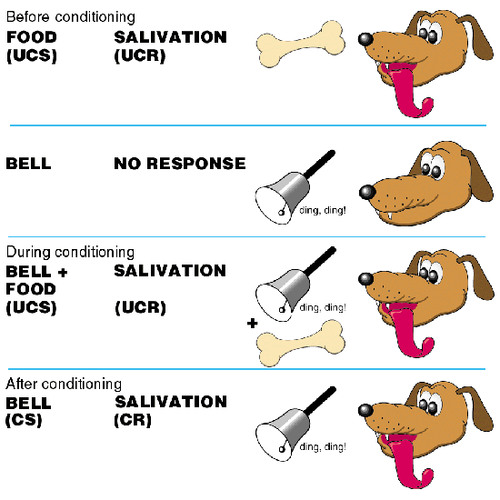
AO1: What is classical conditioning?
Learning by association. Occurs when two stimuli are repeatedly paired together - an unconditioned stimulus and a new "neutral" stimulus (NS)
The neutral stimulus eventually produces the same response that was first produced by the unlearned stimulus alone.
AO1: What is operant conditioning?
A form of learning in which behaviour is shaped and maintained by its consequences.
Possible consequences of behaviour include positive reinforcement, negative reinforcement or punishment.
AO1: Behaviour is reinforced or punished
Reinforcement tends to increase the frequency of a behaviour.
This is true of both negative reinforcement and positive reinforcement.
In the case of negative reinforcement an individual avoids a situation that is unpleasant.
Such a behaviour results in a desirable consequence which means the behaviour will be repeated.
Mowrer suggested that whenever we avoid a phobic stimulus we successfully escape the fear and anxiety that we would have suffered if we had remained there. This reduction in fear reinforces the avoidance behaviour and so the phobia is maintained.
AO1: Orval Hobart Mowrer (!960)
Proposed the two-process model to explain how phobias are learned
learned by classical conditioning and then maintained by operant conditioning
both processes are needed to explain why phobias are learned in the first place and then also continue.
As part of the two-process model, Classical Conditioning is used to explain the acquisition (beginning) of the phobia, whereas Operant Conditioning is used to explaining how the phobic behaviour is maintained.
AO1: Watson and Rayner (1920) - Little Albert
Classical conditioning involves learning to associate something of which we initially have no fear (called a neutral stimulus) with something that already triggers a fear response.
Watson and Rayner (1920) created a phobia in a 9 month old baby called "Little Albert". Albert showed no unusual anxiety at the start of the study. When shown a white rat he actually tried to play with it.
However, the experimenters then set out to give Albert a phobia.
Whenever the rat was presented they made a loud, frightening noise by banging an iron bar close to Albert's ear.
This voice is an unconditioned stimulus (UCS) which creates an unconditioned response (UCR) of fear.
When the rat (a neutral stimulus, NS) and the unconditioned stimulus are encountered close together in the time the NS becomes associated with the UCS and both now produce the fear response - Albert became frightened when he saw a rat.
The rat is now a learned or conditioned stimulus (CS) that produces a conditioned response (CR)
AO3: Real world application (Strength)
The two-process model was a definite step forward when it was proposed in 1960 as it went beyond Watson and Rayner's concept of classical conditioning.
It explained how phobias could be maintained over time and this had important implications for therapies because it explains why patients need to be exposed to the feared stimulus.
Once a patient is prevented from practicing their avoidance behaviour the behaviour ceases to be reinforced and so it declines.
The application to therapy is a strength of the two-process model.
AO3: Problem with findings (Limitations)
Not all avoidance behaviour associated with phobia seems to be the result of anxiety reduction, at least in more complex phobias like agoraphobia.
There is evidence to suggest that at least some avoidance behaviour appears to be motivated more by positive feelings of safety.
In other words the motivating factor in choosing an action like not leaving the house is not so much to avoid the phobic stimulus but to stick with the safety factor.
This explains why some patients with agoraphobia are able to leave their house with a trusted person with relatively little anxiety but not alone.
This a problem for the two process model, which suggests that avoidance is motivated by anxiety reduction.
AO3: More to aquiring a phobia (Limitation)
We easily acquire phobias of things that have been a source of danger in our evolutionary past, such as fears of snakes or of the dark.
It is adaptive to acquire such fears.
Seligman (1971) called this biological preparedness, the innate predisposition to acquire certain fears.
However it is quite rare to develop a fear of cars or guns which are actually much more dangerous to most of us today than spiders or snakes.
Presumably this is because they have only existed very recently and so we are not biologically prepared to learn fear responses from them.
This phenomenon of preparedness is a serious problem for the two factor theory because it shows there is more to acquiring phobias than simple conditioning.
AO3: Scientific (Strength)
The behavioural approach to psychopathology is scientific and its key principals can be measured in an objective way.
For example, the phobia developed by Little Albert was clear for all to see and measure, variables could be manipulated and controlled to ensure that Little Albert’s phobia development was as a result of a neutral stimulus being associated with an unconditioned response.
This is positive because it allows concepts such as classical conditioning to be demonstrated scientifically and has resulted in a large amount of empirical support for behavioural.