bio chapter 4 NSMO
 Call Kai
 Learn
Learn Practice Test
 Spaced Repetition
 Match
Match Flashcards
 Knowt Play
1/25

Name | Mastery | Learn | Test | Matching | Spaced | Call with Kai | Chat |
|---|
No analytics yet
Send a link to your students to track their progress
26 Terms
Diameter of egg cell
100 micrometers
Diameter of blood cells
7-8 micrometers
As a cell continues to grow,
its volume increases while the surface area decreases
Making it harder to obtain nutrients and remove wastes
Surface area formula for a cube
SA = LxWx6
Volume formula for cube
V = s3
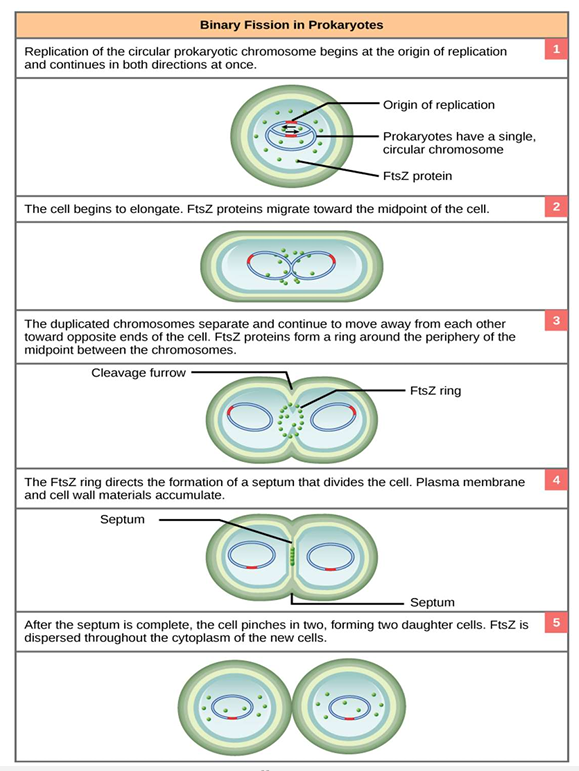
Cell division in bacteria
Binary fission
Cell cycle
Interphase
Mitosis (Equational Division)
Cytokinesis (Cytoplasmic Division)
Interphase
G1 Phase (first growth phase)
Begins immediately after cell division
The cell grows, organelles double, and preforms its normal functions
—
S Phase (DNA Synthesis phase)
The cells genetic material (DNA) is getting replicated and duplicated
—
G2 Phase (second growth phase)
Proteins are synthesized and the cell prepares for division

Mitosis
Occurs in somatic cells (2n) The duplicated genetic material separates, and the cell divides into two daughter cells, each having the same number of chromosomes (2n)
The purpose of mitosis is growth and replacement of damaged cells
Mitosis occurs in four stages
Prophase
The nuclear envelope disintegrates
The nucleolus disappears
Chromosomes condense and become visible
Spindle fibers form between the two poles of the cell

Metaphase
Chromosomes attach to the spindle fibers at the centromere
Chromosomes align along the equatorial plane of the cell
Anaphase
Spindle fibers contract and shorten
Sister chromatids are pulled toward opposite poles of the cell
Telophase
Chromosomes reach the opposite poles
A new nuclear envelope forms around each set of chromosomes
The nucleolus reappears
Chromosomes uncoil and return to a less condensed state
Spindle fibers disappear
Cytokinesis (Cytoplasmic Division)
In animal cells, the cell membrane constricts until the cell splits into two daughter cells, each containing the same number of chromosomes. In plant cells, a cell plate forms between the two newly formed nuclei, and then a cell wall develops, resulting in two genetically identical cells

CHEAT SHEET
Cytokinesis isn’t a stage of mitosis because mitosis is division of the nucleus and cytokinesis is the division of the cytoplasm, after all the stages of mitosis, cytokinesis finishes by separating the cell.
Cyclins (regulatory proteins) and kinase enzymes
both play a vital role in controlling normal progression of the cell cycle
Cells failing to respond
When cells fail to respond to the control mechanisms that regulate their life cycle, cancerous cells may result
Role of cyclins
Regulate the normal progression of the cell cycle
Activate the cell cycle in eukaryotic cells when they bind to cyclin - dependent kinases (CDKs), sending a signal to initiate cell division
Cancer
Uncontrolled and irregular growth and division of cells
Causes of cancer
Mutations or changes in segments of DNA that control the production of proteins responsible for regulating the cell cycle
Environmental factors and certain substances that cause cancer, known as carcinogens
Carcinogens
Asbestos, smoking, ultraviolet (UV) radiation, and X-rays
Apoptosis
Programmed cell death
It happens when cells shrink and condense in a controlled and organized manner
Apoptosis helps protect living organisms from the growth of cancerous cells
Stem cells
Undifferentiated cells capable of dividing and developing into specialized cells according to the type of tissue they join
Embryonic stem cells are more effective than adult stem cells
Stem cells contribute to treating many diseases, such as paralysis and organ dysfunction
Types of Stem cells
Embryonic stem cells
Adult stem cells
embryonic stem cells are more efficient than adult stem cells
Homologous chromosomes
Homologous chromosomes are pairs of chromosomes that have the same length, centromere position, and genes controlling the same inherited traits — one inherited from the father and the other from the mother. These pairs pair up during meiosis in a process called synapsis (crossing over)

Stages of meiosis
First stage - Meiosis I
Prophase I- Metaphase I- Anaphase I -Telophase I
In prophase I and metaphase I, the chromosomes appear as homologous pairs
In anaphase I and telophase I, the chromosomes appear as duplicated chromosomes
Cells in all phases of Meiosis I are diploid (2n) because the cell has not yet divided
Second stage Meiosis II
Prophase II – Metaphase II – Anaphase II – Telophase II
In prophase II and metaphase II, chromosomes appear as duplicated chromosomes
In anaphase II and telophase II, they appear as single chromosomes
In Meiosis II, the cells are haploid (1n)