IB MET L12: What are the issues in managing growth through innovation?
 Call Kai
 Learn
Learn Practice Test
 Spaced Repetition
 Match
Match Flashcards
 Knowt Play
1/11

There's no tags or description
Looks like no tags are added yet.
Name | Mastery | Learn | Test | Matching | Spaced | Call with Kai |
|---|
No analytics yet
Send a link to your students to track their progress
12 Terms
Invention vs Innovation
nvention
Creation of something new
May come from:
Technology push (“we can do this”)
Market pull (customer need)
Innovation
Successful diffusion/commercialisation of an invention in the market
Occurs when:
Technology push + market pull meet
Customers are willing to pay for it
👉 Key idea:
An invention becomes an innovation only when it creates market value and is adopted commercially.
Innovation Diffusion Theory & Moore’s Chasm
New technologies are adopted in stages:
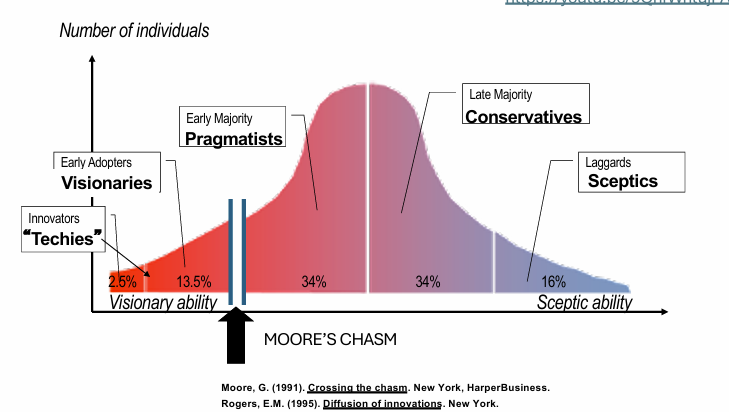
Innovators (“techies”) – 2.5%
Early adopters (“visionaries”) – 13.5%
Early majority (“pragmatists”) – 34%
Late majority (“conservatives”) – 34%
Laggards (“sceptics”) – 16%
Moore’s Chasm
A major challenge is moving from:
Early adopters → mainstream pragmatic customers.
Early adopers:
Like experimenting with new technology
Accept imperfections/compromises
Want novelty and strategic advantage
Pragmatists on the other side of the chasm:
Want technology to clearly improve daily life/business performance
Expect reliability, ease of use, support, and cost-effectiveness
Do not want major compromises or risky/unfinished products
Many firms fail at this transition.
Example:
Google Glass attracted innovators/visionaries but failed to convince mainstream users.
👉 Key idea:
Innovation succeeds when firms “cross the chasm” by turning exciting technology into reliable, practical value for mainstream customers.
Innovation Diffusion & Customer Segments
People adopt innovations at different speeds, so firms need different communication strategies for each group.
Adoption groups
Innovators → forward-thinking “techies”; try new tech first and share discoveries
Early adopters → influential trend setters; endorse innovations and help firms cross the chasm
Early majority → pragmatic users; adopt only once benefits are proven and innovation becomes accepted
Late majority → resistant to change; adopt mainly due to peer pressure and widespread use
Laggards → highly resistant; adopt only when innovation is fully mainstream and unavoidable
Crossing the chasm
The key challenge is moving from visionary early adopters to pragmatic majority users who:
Want reliability and clear benefits
Do not want compromises or risky products
Expect the innovation to improve life/work and become the new status quo
Examples
Social media diffused rapidly across groups
Solar power took decades to become mainstream
👉 Key idea:
Successful innovation requires adapting products and communication to different adopter groups and crossing the gap between visionary users and mainstream pragmatists.
Crossing the Chasm & Market Maturity
Early-stage innovations are often:
Expensive
Imperfect/unreliable
Socially awkward or difficult to use
Sometimes risky or impractical
This means early users must be highly passionate or visionary to adopt them.
Crossing the chasm
To reach mainstream markets, firms must improve the innovation by adding:
Reliability
Ease of use
More features
Better user experience
Solutions tailored to specific customer needs
Once the chasm is crossed:
Adoption accelerates
Products diversify into many variants for different market segments/niches
Examples
Social media spread rapidly once mainstream value became clear
Solar power took decades to mature and become widely adopted
👉 Key idea:
Innovations begin as niche products for passionate early users, but successful firms refine and adapt them until they become practical, mainstream solutions for broader markets.
The Relentless Decay of Customer Delight (Kano Model)
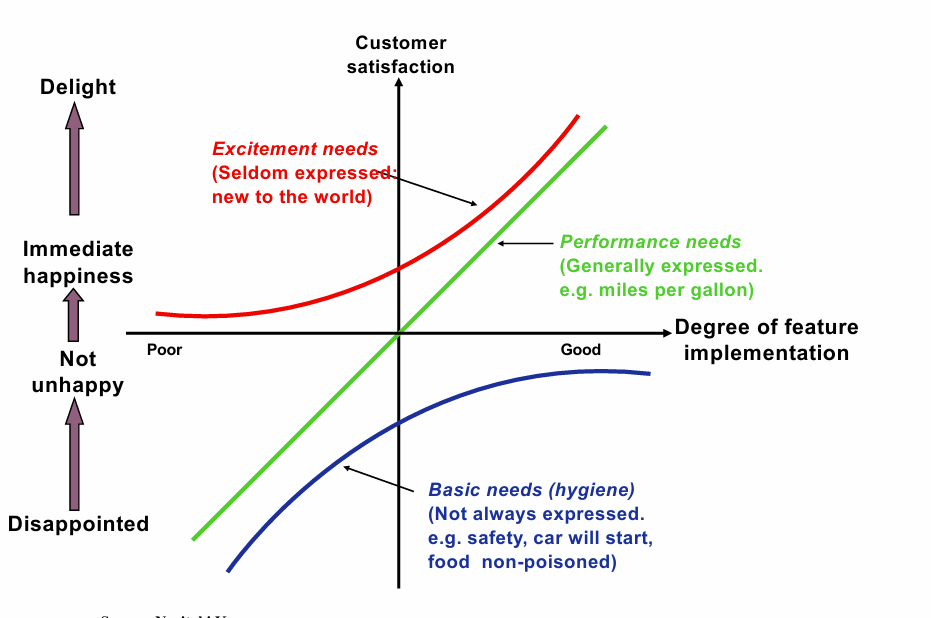
Customer expectations change over time.
Types of needs
Excitement/delighter needs
New/unexpected features
Create strong excitement initially
Performance needs
Customers compare quality/performance
Better performance = higher satisfaction
Basic/hygiene needs
Expected as standard
Missing them causes dissatisfaction
Key idea
Innovations often move through all three stages over time:
Start as exciting new features
Become competitive performance expectations
Eventually become basic requirements
Example:
Electric car starter → exciting innovation
Then reliable performance feature
Eventually expected basic functionality
Firms must continuously innovate because customer delight decays as features become normalised.
Types of Innovation (4Ps)
Companies must keep innovating to maintain growth and competitive advantage.
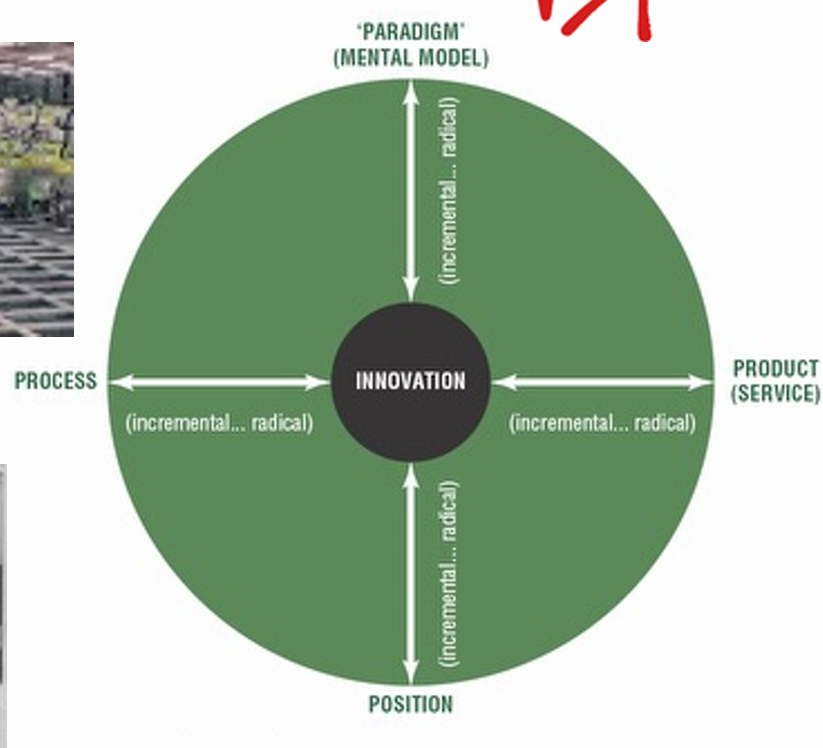
The 4Ps of Innovation
Product → new/improved products or services
e.g. new iPhone models, streaming services
Process → improved ways of operating/manufacturing
e.g. Amazon warehouse robotics, AI drive-thru systems
Position (Placement) → changing how products are marketed/perceived
e.g. Crocs repositioned as fashion products
Lucozade was initially a medicine
Paradigm → changing the business model itself
e.g. Virgin expanding from music into airlines, travel, space
Levels of innovation
Incremental innovation
Small continuous improvements
“Doing things better”
e.g. larger phone screens
Radical innovation
Major transformational change
“Doing things differently”
e.g. petrol → electric vehicles
👉 Key idea:
Innovation can involve products, processes, market positioning, or entire business models, and may be incremental or radical.
Incremental Innovation
Incremental innovation builds on an already successful idea with small improvements or variations.
Example:
Die Hard films reused the same successful formula in new situations
Similar approach: Fast & Furious franchise
Why incremental innovation works
Firms already understand customer preferences
“Give customers a little bit more of what they liked”
Easier market adoption
Existing brand/customer excitement helps “cross the chasm”
Lower risk and complexity
Existing production/process knowledge can often be reused with minimal changes
👉 Key idea:
Incremental innovation succeeds by refining proven ideas rather than creating entirely new markets.
Platform Innovation & Growth Challenges
Platform innovation
Companies can reuse a common engineering platform across many products.
Example:
Volkswagen Group (MQB/PQ35 platforms)
Shared across VW, Audi, SEAT, Skoda
Different engines, interiors, and body styles built from the same base platform
Benefits:
Lower development/manufacturing costs
Faster product development
Easier incremental innovation across product ranges
Growth and innovation
Small firms are often better at radical innovation because:
Simple structure
Fast communication
Low bureaucracy
Everyone sees the full project
Little to lose, high willingness to take risks
Large firms become more complex:
Specialised departments/functions
More coordination and structure needed
Employees become physically and organisationally distant
Innovation can become slower and harder to manage
Examples:
Apple, Google, HP all began as very small start-ups before scaling globally.
👉 Key idea:
Small firms often drive radical innovation, while large firms excel at scaling, organising, and exploiting innovations efficiently through structured platforms and processes.
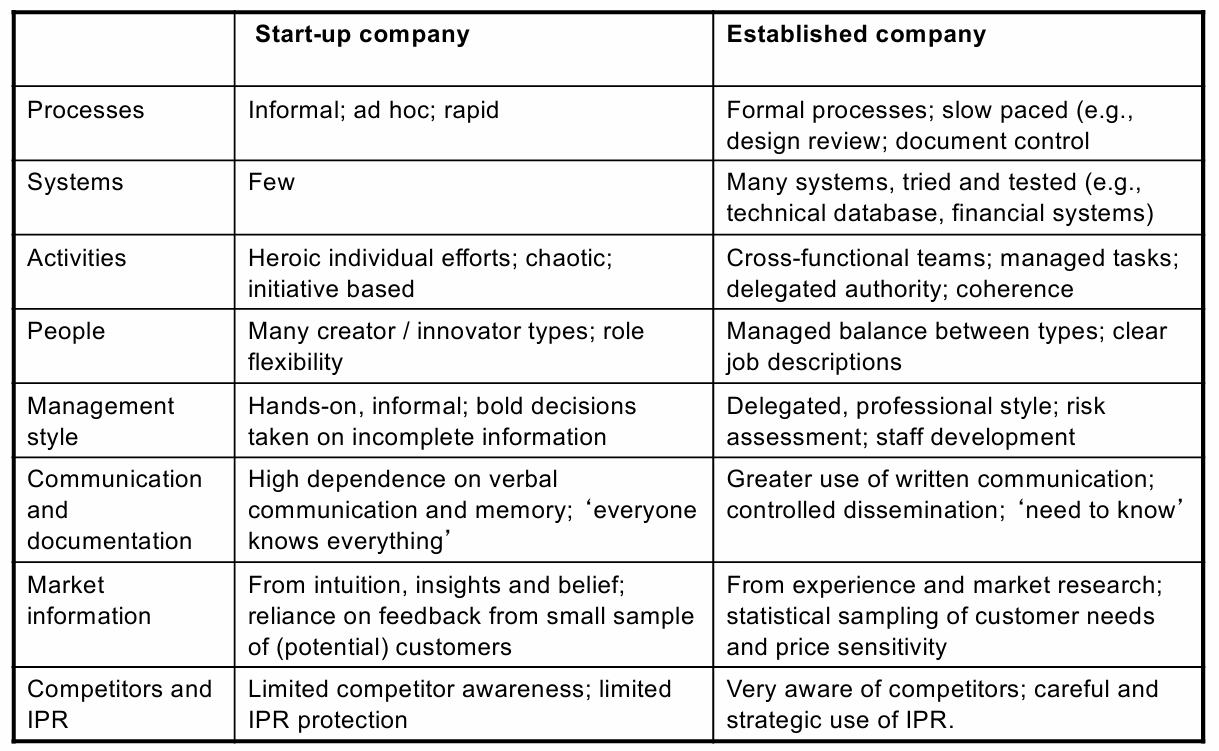
Start-ups vs Established Companies
Key ideas
Start-ups are not simply “small big companies” — they operate very differently.
Small firms are often faster and better at radical innovation.
Large firms are better at scaling, coordination, and exploiting innovations efficiently.
As start-ups grow, they must introduce more structure and systems to scale successfully.
Large firms increasingly collaborate with start-ups through open innovation.
Example:
Dyson successfully launched radical innovations many times, but not all succeeded (e.g. Dyson washing machine).
Balancing Risk and Reward in Innovation
Large firms manage portfolios of innovation projects with different:
Risks
Costs
Potential returns
Managers use tools (e.g. bubble charts) to prioritise projects and allocate budgets.
Innovation trade-off
Incremental innovation
Lower risk
Builds on existing products/processes
Easier to manufacture and sell
Radical innovation
Higher risk and cost
May require redesign of products, factories, supply chains, and skills
Can create entirely new markets and competitive advantage
Strategic challenge
Firms must balance:
Exploiting existing successful products
withInvesting in disruptive future technologies
Examples
Kodak (despite inventing digital camera, kodak refused to embrace digital technology to protect its film led to bankruptcy) and Nokia succeeded with incremental innovation but struggled with radical technological shifts.
Tesla pushed radical EV innovation, forcing incumbents to redesign products, manufacturing systems, suppliers, servicing, and infrastructure.
👉 Key idea:
Companies need both incremental and radical innovation — focusing only on incremental improvements risks falling behind disruptive technological change.
Key Problems in Managing Growth
Main growth challenges
Maintaining growth through:
New/existing markets
New products/services
Expansion strategy decisions
Growth strategies
Organic growth → growing internally
Acquisitions → buying other firms
Strategic alliances → partnerships/collaboration
Managing scale
Growth increases:
Number of people
Business functions
Organisational complexity
Other major issue:
Securing sufficient funding/investment
👉 Key idea:
Growing organisations must balance expansion opportunities with the increasing complexity, coordination, and resource demands that come with scale.
Industry Life Cycle & Innovation
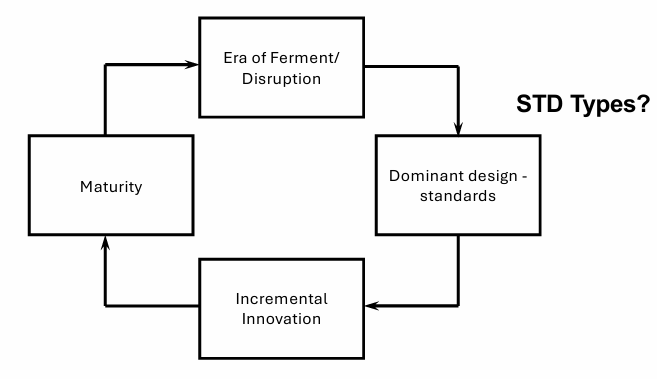
Industries often evolve through repeating stages:
1. Era of ferment/disruption
Many competing technologies/designs emerge
High uncertainty and experimentation
e.g. early cars: combustion vs electric vehicles
2. Dominant design / standards
One/few designs become industry standard
Customers and suppliers gain confidence
Encourages mass adoption and ecosystem growth
Types of standards:
De facto → widely adopted naturally (QWERTY)
Industry standards → agreed by firms (Bluetooth)
Legislated standards → imposed by government (UK plugs)
Market standards → dominant market platform (Windows)
3. Incremental innovation
Firms improve cost, quality, efficiency, and features
Innovation becomes more optimisation-focused
4. Maturity
Improvements become smaller/harder
Market growth slows
New disruptive technologies may restart the cycle
👉 Key idea:
Industries evolve from disruptive experimentation toward dominant standards and incremental improvement, until new technologies create another wave of disruption.