Series 66
 Call Kai
 Learn
Learn Practice Test
 Spaced Repetition
 Match
Match Flashcards
 Knowt Play
1/830

There's no tags or description
Looks like no tags are added yet.
Name | Mastery | Learn | Test | Matching | Spaced | Call with Kai |
|---|
No analytics yet
Send a link to your students to track their progress
831 Terms
Primary market
Represents securities being sold for the first time by a corporation, such an IPO
These new securities are sold through investment banking and underwriting activities of broker-dealers and investment bankers in the primary market
In primary market transactions, the funds from the sale of securities go to the issuer of the securities to finance business operations
Secondary market
Do not involve the issuers
These trades take place in different marketplaces such as on the floor of a stock exchange (known as listed transactions) and off the floor of a stock exchange (over the counter transactions)
Broker dealer firms buy and sell securities on behalf of customers either by directing the orders to a stock exchange or into and out of the firm’s own inventory
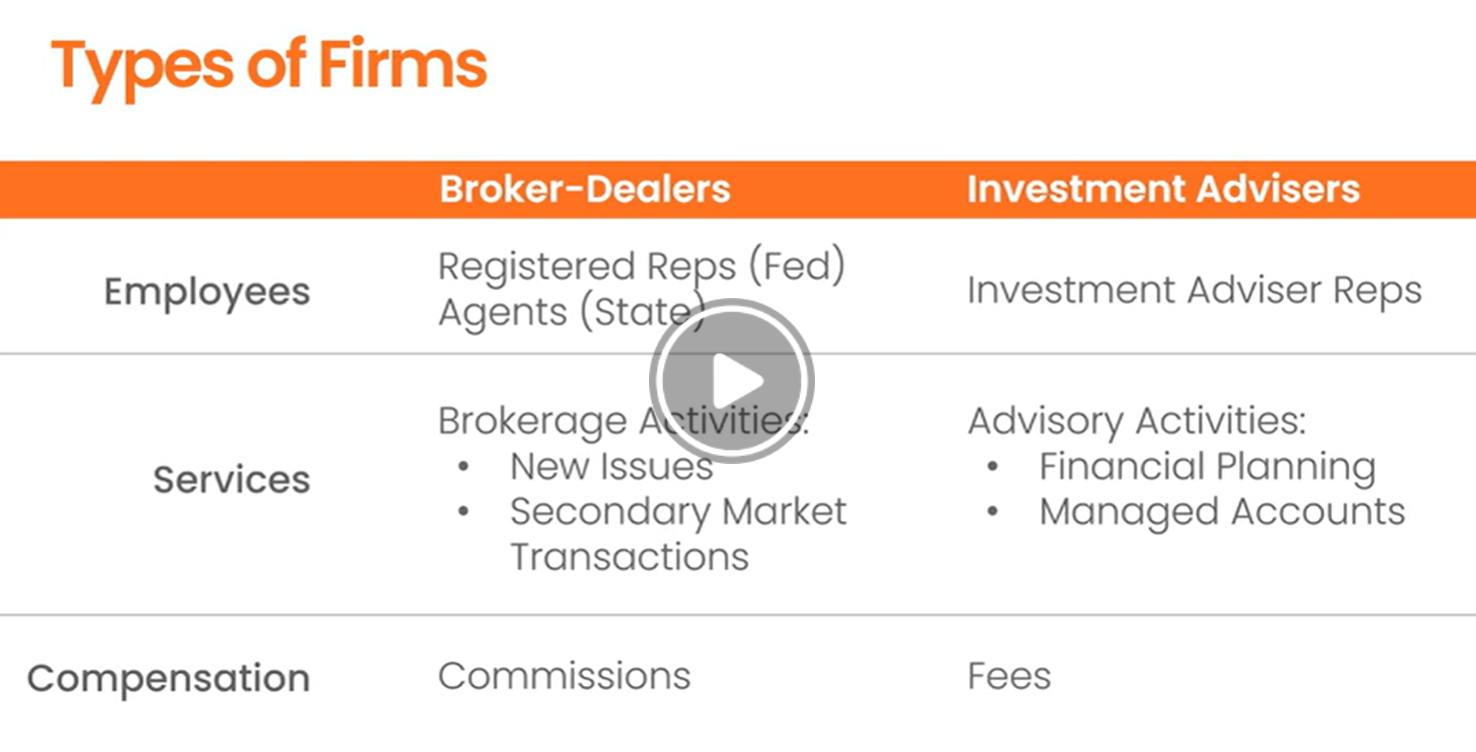
Broker-dealer’s are compensated with commissions and mark ups/downs on trades and agents share in that compensation.
True
True or false: Investment advisers are compensated with fees, and Investment Adviser Representatives share in those fees.
True
True or false:
Uniform Securities Act
State securities laws based on this model
Minimizes duplication of federal and state registration requirements, meaning that some people and securities must be registered only with the SEC and other must be registered only with the state(s)
Prevent fraud. State securities are also known as “blue sky laws” because they are intended to protect investors from buying into schemes that are nothing more than “blue sky”
True
True or false: A person is an individual or a legal entity.
Examples include: Individuals, corporations, partnerships, associations, trusts, unincorporated organizations, and governments or government subdivisions.
*Does not include minors
True
True or false:
Broker dealers do not include:
Agents
Issuers
Banks, savings institutions, and trust companies
A person that has no place of business
True
True or false: An individual who represents an issuer in the sale of an interest in a limited partnership is an agent and must be registered as such
True
True or false: Registered representatives are agents of their brokerage firms, including registered representatives who are independent contractors.
True
Any individual who represents a broker-dealer or an issuer in affecting or attempting to effect purchases or sales of securities. This definition refers to employees of a brokerage firm or a company issuing securities who execute transactions in the purchase or a company issuing securities who execute transactions in the purchase of sale of securities to the investing public.
True
True or false: If an agent represents more than one broker-dealer firm, registration with and supervision by both firms is required. (Dual registration)
True
True or false: The term agent does not include an individual who represents an issuer in effecting:
Transactions in some exempt securities
US gov securities
Municipal securities
Canadian government securities
Banks
Promissory notes
Others include:
Insolated non-issuer transactions, meaning secondary market transactions by investors
Transactions in covered securities, namely securities sold to qualified purchasers or securities sold in a private placement
Transactions with investing employees, partners, or directors of the issuer if no commission or other remuneration is paid
True
True or false: Would have to get registered as an agent for Insurance Co Securities and Federal Savings and Loans, even though they are technically exempt securities.
True
True or false: A partner, officer, or director of a broker-dealer or issuer would also not be Agents, unless they were to personally effect transactions.
For example: A president of a broker-dealer executing securities transactions then they would be an agent, but not if they are just filing reports with like the State.
True
True or false: An assistant or intern are permitted to be agents if they are registered. If not registered then they may not handle trades or make recommendations. ONLY can post and update account records.
True
True or false: Investment Advisers think ABC:
A - Provide advice about securities directly or indirectly
B - Engaged in the business
C - Received compensation for services
EXS: Portfolio managers and financial planners
*However, the requirement that a client implements the advice, or the firm manages the funds is NOT a requirement.
True
True or false:
Excluded from the definition of an investment adviser are:
Investment Adviser Representatives (IARs)
Institutions, such as banks, savings institutions, trust companies, investment companies, and other financial intermediaries, even if they charge a fee for advisory services
*Investment advisers that provide advice about securities issued by institutions, such as banks, would not be EXCLUDED from the definitionBroker dealers and their agents, if the advice is incidental to their normal brokerage activities and no extra compensation is charged
Publishers who give general advice
Federal covered advisers
Employee benefit plans like a 401(K)
LATE (Lawyers, Accountants, Teachers, Engineers) if their advice is incidental to the practice of their professions.
EX: If an accountant informs a client that they may be eligible for a tax break if the client invests in certain securities, this would be an example of investment advice that is incidental to the accountant’s practice as an accountant. If a finance professor at a university offers to create a financial plan for students at a cost of $250 pe student, this is an example of investment advice that is not incidental to the instructor’s profession.
True
True or false: An investment adviser may also be registered as a broker-dealer and be paid an advisory fee separate from any commissions it earns on securities transactions. Acting in both capacities on same transaction requires written disclosure to the client.
True
True or false: Investment Adviser Representatives would include solicitors who must be registered as IRAs under the Uniform Securities Act. Solicitors include salesperson and other who refer customers to IAs for compensation. Investment Adviser Representatives must be registered.
True
True or false: An Investment Adviser Representative doesn’t include those who:
Perform only clerical tasks, such as a receptionist OR
Only solicit sales of fixed annuities
True
True or false: If an Investment Adviser Representative is not required to register in a state, they would still be subject to the anti-fraud provisions.
True
True or false: If a federal Covered Adviser’s assets under management (AUM) fall below 90 mill, the adviser must withdraw its federal registration unless exception exists.
True
True or false:
Excluded from the definition of a Federal Covered Adviser are:
IAs who give advice on US government securities only
Banks and bank holding companies
Publishers of general advice about securities
LATE (Lawyers, accountants, teachers, and engineers)
True
True or false: To be considered a Federal Covered Adviser, the IA must actually register with the SEC. Persons who meet the federal definition, but have failed to registered with the SEC are NOT “Federal Covered Advisers”
True
True or false: When issuing certificates of interest in oil, gas, or mining titles or leases, the company is not considered to be an “issuer,” even though the Uniform Securities Act’s definition of “security” includes such certificates of interest.
True
True or false: An individual investor selling stock that he or she owns to another investor would be a non-issuer transaction.
True
True or false: Although an issue may have to file in a state when issuing securities, registration as a broker-dealer would not be required of the issuer .
Administrator
The designated state official who administers the Uniform Securities Act and enforces other securities regulations in a given state. May make public or private investigations within or outside of the state at any time.
True
True or false: Organizations that trade large volumes of securities. Examples include banks, insurance companies, employee benefits plans, and any other persons who are designated as such by rule or order of the administrator.
Security
Any evidence of an interest in a common enterprise in which the investor expects a profit from the promoter’s managerial efforts.
True
True or false: The 4 basic elements of an investment contract are: Investment of money, a common enterprise, an expectation of profits, and management by a third party ( per a Supreme Court decision known as the Howey decision)
True
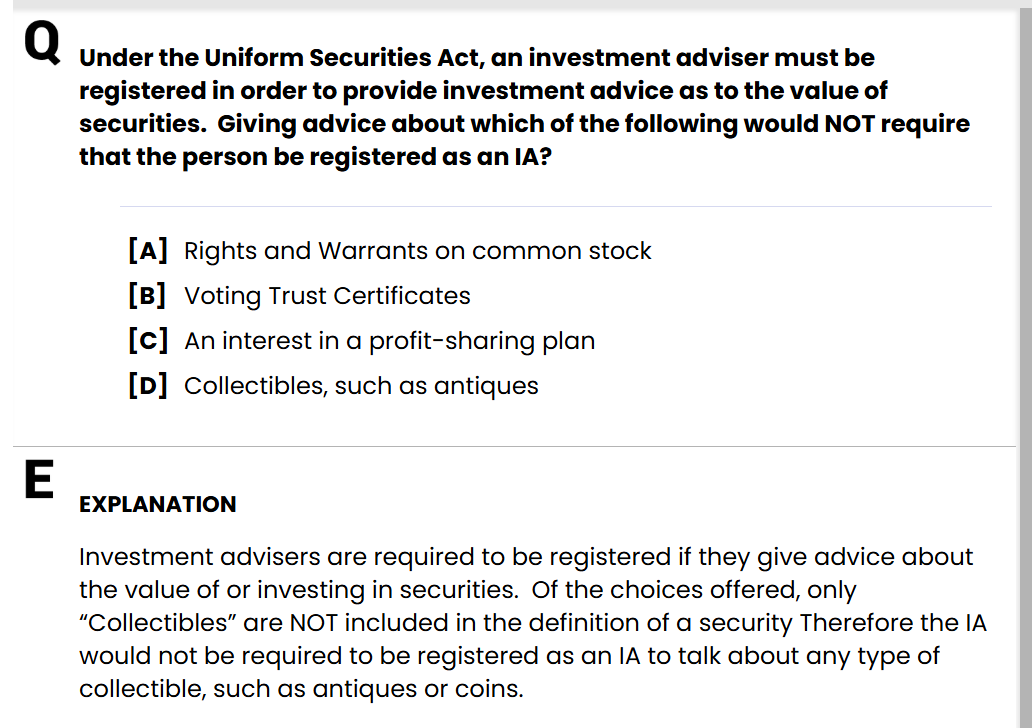
True or false: Firms and persons would not be required to register when giving advice about investment products excluded from the definition of a security. For example: A person giving advice about a fixed security would not have to be registered as an investment adviser, investment adviser representative, or as an agent of a broker-dealer.
True
Federally covered securities exempt from registration with SEC
US gov securities
Municipal bonds, but only if offered outside the state of issue (interstate)
Securities that are unregistered and issued as private placements under SEC rules, as Regulation D offerings
True
True or false:
The following are not included in the definition of a “Federal Covered Security” Therefore, states may or may not require registration.
Securities issued by non-profit organizations
Municipal bonds offered only in the state where the issue is located
Intrastate offerings
A security issued with a guarantee from another entity as to principal, interest OR dividends.
True
True or false: An offer to buy or offer to sell is not made when a newspaper or other publication:
Is not published in a state but is sold in a state
is published in a state but has had more than 2 thirds of its circulation outside of the state during the past 12 months
Assessable stock
A class of stock in which the issuing company has the ability to impose future levies on stockholders for additional funds.
* A '“gift” of assessable stock is considered a “sale” because the owner would no longer be liable for future assessments (received “value”) by gifting the stock.
True
True or false:
The following transactions are not to be considered sales:
A bona fide pledge or loan of securities
A stock dividend
Shares acquired as a result of a merger or reorganization
Converting a bond to a stock
True
True or false: “Purported Gifts” are not bona fide gifts. Purported gifts are sales that appear to be a gift, such as a gift of assessable stock.
Solicitation
Any oral, written, or other communication used to offer or sell investment company shares, excluding proxy statement, report to shareholders, or other disclosure document relating to a security covered under section 18(b)(2) of securities act of 1933.
State
Any state, territory, or possession of the United States, including the District of Columbia, and Puerto Rico.
Broker
A person engaged in the business of effecting transactions in securities for their account or for the account of others.
True
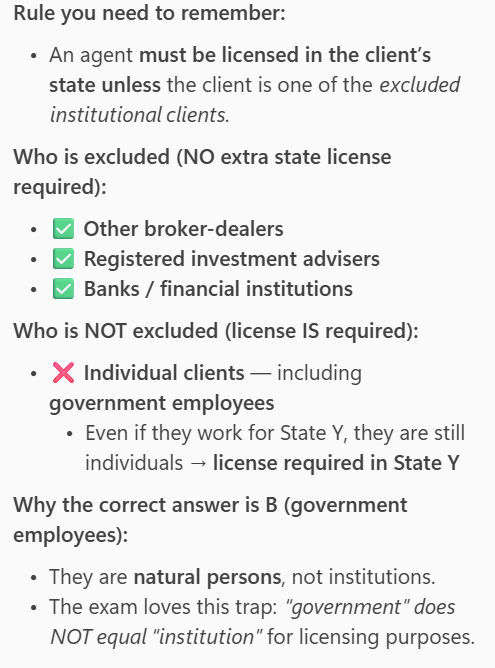
True or false
True
True or false

True
True or false: investment advisers may be subject to recordkeeping requirements in some states.
True
True or false:

D
True
True or false:
Assets of $100 million or less then you must register with state
Assets of $110 million or more then you must register with SEC.
True
True or false: If an IA is required to register with the SEC, that registration will be accomplished by filing Form ADV with the SEC.
True
True or false: If the IA is required to register with a state, that registration will be accomplished by the filing of Form ADV with the state (filing a copy with the SEC is not required)
true
true or false

True
True or false: 5 or less clients then exempt from registration. Institutional investors and officers of the investment adviser are not included when counting clients.
*Rule does not apply to broker-dealers or agents. ONLY Investment advisers/representative
True
True or false: It is unlaw for any broker-dealer and/or agent of a broker dealer to solicit or transact business in a state unless BOTH the agent and broker-dealer are registered in the state.
True
True or false: An applicant for registration cannot perform the functions of a registrant until the registration is effective, meaning they couldn’t sell a security or nothing to someone, however they could sell a fixed annuity.
True
True or false: Changes of a material fact (ex: a change in ownership or the fling of complaints) must be reported promptly to the administrator(s). A correct amendment is all that is necessary, not an entirely new application.
True
True or false: Registration as an IA, BD, or agent does not mean that the firm is approved or qualified.
True
True or false: Renewal applications for Canadian broker-dealers and agents must be filed annually by December 1st.
Renewals for normal US broker-dealers, agents, and IAs is December 31st annually.
True
True or false: If a Canadian person travels to the US and you are an agent in Canada, you can still contact them while they are in the US and do business.
True
True or false: The USA provides that a state administrator may require registered boke-dealer and investment adviser firms and individual agents of broker-dealers to post surety bonds (aka fidelity bonds) with the state Administrator if they are going to have custody of or discretion over their clients’ assets. The purpose of the bond is to ensure that the registrants have sufficient funds to cover losses to customers resulting from theft or other dishonesty for which they are legally liable. A formal proof is required to support a claim under the bond.
The bond must be kept in force for as long as the registrant is in business and for 3 years thereafter.
True
True or false: The 1934 act regulations specify that NO state may establish capital, custody, margin, financial responsibility, making and keeping records, bonding, or financial or operational reporting requirements for broker-dealers that differ from, or are in addition to, the requirements of the SEC under the Securities Exchange Act of 1934.
True
True or false: Broker dealers and Investments Advisers (IAs) have minimum capital requirements whereas agents do NOT.
True
True or false: Federal covered advisers are subject to the requirements of the Investment Advisers Act of 1940.
True
True or false: For Broker dealers, investment advisers, and agents, there is no set minimum requirement for the amount of a surety bond. The amount is determined by the administrator.
True
True or false: Administrators have the authority to require examinations for firms and individuals. The administrator can administer written exams, oral exams, or both.
True
True or false: Both the agent and the Broker-dealer are responsible for notifying the Administrator when an agent is terminated.
True
True or false:
For investment advisers registered with the state, the INVESTMENT ADVISER is responsible for prompt notification of the Administrator.
For federal covered advisers, the INVESTMENT ADVISER REPRESENTATIVE is responsible for prompt notification of the Administrator.
Internet Investment Advisers
Investment advisers that provide their services exclusively through an interactive website, without offering personalized investment advice through human interaction.
Must register with SEC instead of individual state regulators
Cannot offer advice through any other means, like in-person meetings, phone calls, or traditional mail
Must allow for 2 way communication.
True
True or false:
When initial registration is filing for Broker-dealers and IAs:
An application for registration
Registration fee
Consent to service to service of process: This allows the Administrator to be served with legal documents when the applicant is being sued. Serving the administration with legal documents would be as binding as serving the applicant.
Bond or surety bond: As the administrator may prescribe - Broker-dealers, agents, and investment advisors who have custody of or discretionary authority over client funds or securities may, by rule, or order, be required to pass bonds in the amount prescribed by the administrator.
True
True or false:
Every application for registration for Broker dealers and Investment Advisers must contain:
Applicant’s form and place of business
Business history
Any injunction or administrative order or conviction of a misdemeanor involving securities or the securities business and any conviction of a felony
Applicant’s financial condition and history
Any information to be furnished to clients
Form BD
True
True or false: Salaries of Officers and Partners as well as the names and SSNs of all employees DO NOT have to be disclosed.
True
True or false: An administrator may require an applicant to publish an announcement in one or more specific newspapers published in the state.
True
True or false: Registration becomes effective when determined by the Administrator. If there is no denial order in effect and no proceedings pending, registration will “automatically” become effective at noon on the 30th day after the application is filed.
True
True or false: Partners, officers, and directors of the successor firm would automatically be registered with the successor firm’s registration.
True
True or false:
The administrator may by order take the following actions:
Deny, suspend, or revoke any registration, or
Bar or censure any registrant from employment with a registered broker-dealer or investment adviser, or
Restrict a registrant as to any activity of the business
True
True or false:
If convicted the past 10 years of any misdemeanor involving securities must be reported as well al any felonies whatsoever.
Insolvency must be reported meaning liabilities exceed assets and cannot meet obligations as they come. THIS APPLIES TO THE FIRM NOT PRINCIPAL OF THE FIRM.
Also, has willfully violated the law of a foreign jurisdiction within the past 5 years
True
True or false: Registration is not filed by an Administrator or person appointed by an Administrator.
True
True or false: Minor rule infractions, accusations, and filings of civil lawsuits alone are not adequate ground for an administrator to deny, suspend, or revoke registration or application for registration.
True
True or false: Withdrawal from registration becomes effective 30 days after receipt of application for withdrawal (or sooner, if determined by the administrator) provided no proceedings are pending.
True
True or false: For a new issue of securities be offered to the public, the securities must generally be registered with the states in which they will be sold, unless they are exempt from registration or qualify as a Federal Covered Security.
*Like fixed annuities don’t need to be registered or like a gov security.
True
True or false: Federal Covered securities is one that is only registered with the SEC, not with the states.
True
True or false:
It is unlawful for any person to offer or sell any securities unless:
The security is registered under the Act (when the administrator has jurisdiction)
The security or transaction is exempt from registration
The security is a federal covered security
True
True or false: No registration with FINRA or other Self Regulatory Organizations (SROS), such as NASAA or the MSRB, is listed as a requirement under the Uniform Securities Act
True
True or false:
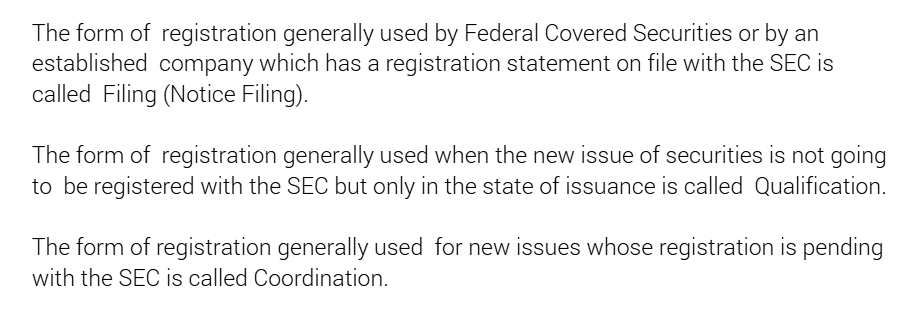
Filing (Notice filing): Is a form of registration generally used by Federal Covered Securities or by an established company that has a registration statement on file with the SEC.
The following conditions must be satisfied:
Must be actually engaged in business operations in the US for a period of at least 36 consecutive months.
Must have a class of securities held by 500 or more persons
Must have a total net worth of $4 million, or have a total net worth of $2 million and net pretax income from operations before allowances for extraordinary items for at least 2 of the 4 preceding fiscal years.
Filing (Notice filing)
The form of registration generally used by Federal Covered Securities r by an established company which has a registration statement on file with the SEC is CALLED?
Qualification
The form of registration generally used when the new issue of securities is not going to be registered with the SEC but only in the state of issuance is CALLED?
Coordination
The form of registration generally used for new issues whose registration is pending with the SEC is CALLED?
True
Filing think Reg A+ and Open end funds (Mutual funds)
True
True or false: All 3 forms of registration require consent to service of process form and filing fees Registration is generally effective for 1 year.
True
True or false:
No stop order may be entered without appropriate prior notice to:
The applicant or registrant
The issuer and
The person on whose behalf the securities are to be or have been offered
*SRO Notification is NOT required
True
True or false: An administrator may NOT institute a stop order simply because a company is a new company and has no operating history.
True
True or false: After a registration for a security becomes effective, the registration statement may only be amended to change the amount of securities to be offered or sold (EX: Increasing the number of shares to be sold) but the public offering price or syndicate compensation arrangements may not be changed.
True
True or false: The final prospectus must be received by customers purchasing new issues not later than with their purchase confirmation. The Administrator may require that a prospectus be sent before the sale of a security
True
True or false: A buyer of securities in a private placement receives unregistered securities.
True
True or false: An agent may not lawfully offer to sell securities in a pending underwriting. An offer may not be made until the registration becomes “effective”
True
True or false: All securities are subject to anti-fraud provisions, even if they are exempt securities.
True
True or false: A fixed annuity offered by an insurance company would NOT be subject to the anti-fraud provisions of securities law because a fixed annuity is not a security.
True
True or false:
Exempt securities (EXEMPT from state registration and advertising filing requirements include:
Gov securities
Municipal securities
Securities issued or guaranteed by Canada or its provinces (This exemption would NOT include securities listed on a Canadian Exchange or issued by Canadian companies, including Canadian insurance companies
Securities issued by US banks, savings, institutions, or trust companies (Securities issued by banks are exempt but securities issued by Holding Companies which may own banks would NOT be exempt)
Securities issued by a federal savings and loan association
Credit unions (federal or state chartered)
Securities issued by insurance companies (US only - not Canadian)
Stock exchange listed securities (Secured, unsecured, preferred stock and all can be convertible or non-convertible bonds or stock)
Non profit issues (Charitable/educational)
Promissory notes (Commercial paper/bills)
Public utility/common carrier
Investment contracts (Savings, pension, profit-sharing)
True
True or false: Registration would be required for interests in limited partnerships and intrastate offerings of corporate securities where more than 10 investors will participate.
True
True or false: A blank check, blind pool, or shell company
A) These forms of business typically have no stated investment objective and no intended investments upon formation.
B) Though these forms of business are often legitimate, they have been used for unethical/fraudulent purposes, thus do NOT qualify for exempt transaction status.
True
True or false: Exempt transactions include broker-dealers who make purchases for their own account, but not for the PUBLIC.