Population Growth and Carrying Capacity
0.0(0)
Studied by 0 people Call Kai
 Learn
Learn Practice Test
 Spaced Repetition
 Match
Match Flashcards
 Knowt Play
Card Sorting
1/60

There's no tags or description
Looks like no tags are added yet.
Last updated 1:53 PM on 4/11/26
Name | Mastery | Learn | Test | Matching | Spaced | Call with Kai |
|---|
No analytics yet
Send a link to your students to track their progress
61 Terms
1
New cards
Population
A group of organisms of the same species living in the same geographical area at the same time.
2
New cards
Population change
Changes in the number of individuals in a population over time.
3
New cards
Births (B)
Add individuals to a population through reproduction.
4
New cards
Deaths (D)
Remove individuals from a population through mortality.
5
New cards
Immigration (I)
Addition of individuals into a population from other populations.
6
New cards
Emigration (E)
Movement of individuals out of a population into other populations.
7
New cards
Population gain mechanisms
Populations increase through births and immigration.
8
New cards
Population loss mechanisms
Populations decrease through deaths and emigration.
9
New cards
Ideal population growth conditions
Abundant food, no predators, no disease, no competition, optimal temperature and favourable environment.
10
New cards
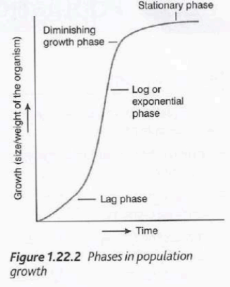
Lag phase
Slow population growth due to few reproducing individuals and low population density.
11
New cards
Log phase
Exponential growth where population increases at biotic potential; birth rate exceeds death rate.
12
New cards
Diminishing growth phase
Growth slows due to increasing environmental resistance and competition for resources.
13
New cards
Stationary phase
Population stabilises as carrying capacity is reached; birth rate equals death rate.
14
New cards
Population growth rate
Change in number of individuals in a population per unit time.
15
New cards
Population size
Total number of individuals in a population.
16
New cards
Population density
Number of individuals per unit area.
17
New cards
Population growth
Change in number of individuals in a population over time (can be positive or negative).
18
New cards
Factors increasing population size
Adequate food, water, habitat space, disease resistance, low predation, high reproductive rate, stable abiotic conditions.
19
New cards
Factors decreasing population size
Limited food, water, space, disease susceptibility, high predation, low reproductive rate, unstable abiotic conditions.
20
New cards
Biotic factors (population)
Living factors such as predation, competition and disease affecting population size.
21
New cards
Abiotic factors (population)
Non-living factors such as temperature, rainfall and disasters affecting population size.
22
New cards
Density-dependent factors
Factors that affect population size depending on population density; include food availability, predation and disease.
23
New cards
Density-independent factors
Abiotic factors that affect populations regardless of size; include weather events and natural disasters.
24
New cards
Effect of density-dependent factors
Stronger effect when population density is high.
25
New cards
Effect of density-independent factors
Equal effect regardless of population size or density.
26
New cards
Biotic potential
Maximum rate of population growth under ideal conditions with unlimited resources.
27
New cards
Fecundity
Reproductive capacity of a species affecting biotic potential.
28
New cards
Factors affecting biotic potential
Age of reproductive maturity, litter size, number of reproductive events, survival rate of offspring.
29
New cards
Environmental resistance
Factors that limit population growth and prevent indefinite exponential increase.
30
New cards
Population growth limitation
Occurs because environmental resistance restricts survival and reproduction.
31
New cards
Population movement types
Birth, death, immigration and emigration (BIDE model).
32
New cards
Immigration in animals
Movement of individuals into a population from other populations.
33
New cards
Immigration in plants
Occurs mainly through seed or spore dispersal.
34
New cards
Emigration effect
Reduces population size as individuals leave the population.
35
New cards
Population equilibrium
Balance between births, deaths, immigration and emigration.
36
New cards
Carrying capacity
The maximum population size that can be sustained by a particular environment over a long period of time.
37
New cards
Environmental carrying capacity
The theoretical equilibrium population size at which a population stabilises when resources remain constant.
38
New cards
Sustainable population size
The maximum population that can be supported indefinitely without degrading the habitat or limiting future generations.
39
New cards
Overpopulation
Occurs when population size exceeds the carrying capacity of the environment.
40
New cards
Overshooting carrying capacity
Rapid population growth beyond carrying capacity, usually during exponential growth phase.
41
New cards
Boom-and-bust population
Population that grows rapidly (boom), overshoots carrying capacity, then crashes (bust).
42
New cards
Effect of overpopulation
Habitat degradation and reduction in carrying capacity.
43
New cards
Environmental limitation on population
Population growth is limited by resources such as water, space, nutrients and environmental conditions.
44
New cards
Factors affecting carrying capacity
Water availability, space, nutrients, and extreme weather events such as droughts, floods and temperature extremes.
45
New cards
Environmental resistance
Factors that prevent populations from exceeding carrying capacity by limiting growth and survival.
46
New cards
Biotic potential vs environmental resistance
Biotic potential increases population growth while environmental resistance limits it.
47
New cards
Population equilibrium
Balance between biotic potential and environmental resistance that maintains population size around carrying capacity.
48
New cards
Ester Boserup theory
Carrying capacity is not fixed and can increase due to human technology and innovation.
49
New cards
Technology and carrying capacity
Improvements in technology increase carrying capacity by increasing resource production.
50
New cards
Example of Boserup theory
Use of artificial fertilisers increases food production and supports larger populations.
51
New cards
Per capita consumption
Higher consumption levels reduce carrying capacity for a given population.
52
New cards
Key idea of Boserup
Population growth can drive technological innovation that increases resource availability.
53
New cards
Thomas Robert Malthus theory
Population increases exponentially while resources increase linearly, leading to eventual resource shortage.
54
New cards
J-shaped population growth curve
Exponential growth curve showing rapid increase in population size.
55
New cards
Resource limitation
Occurs when population growth exceeds availability of resources.
56
New cards
Carrying capacity in Malthus theory
Upper limit to population growth caused by resource limitation and environmental degradation.
57
New cards
Population collapse
If carrying capacity is exceeded, population size decreases due to lack of resources.
58
New cards
Sustainability (carrying capacity context)
Use of resources in a way that does not harm future generations or degrade ecosystems.
59
New cards
Human carrying capacity
More complex concept including environmental, cultural and social limits.
60
New cards
Impact on future generations
Overuse of resources reduces ability of ecosystems to support future populations.
61
New cards
Relationship between population and environment
Population growth must remain balanced with resource availability and environmental health.