unit 3 AOS 2: learning and memory theory
 Call Kai
 Learn
Learn Practice Test
 Spaced Repetition
 Match
Match Flashcards
 Knowt Play
1/48

There's no tags or description
Looks like no tags are added yet.
Name | Mastery | Learn | Test | Matching | Spaced | Call with Kai | Chat |
|---|
No analytics yet
Send a link to your students to track their progress
49 Terms
Classical conditioning:
type of learning and type of conditioning
involves learning that two events are associated after we experience them occurring together repeatedly.
Characteristics of Classical Conditioning:
- Nature of the response: Reflexive, involuntary response to stimulus.
- Timing of the stimulus and response: Something must be presented before a response is made.
- Role of the learner: Passive, learner does not need to apply effort
Ivan Pavlov and Pavlov’s Dogs Experiment:
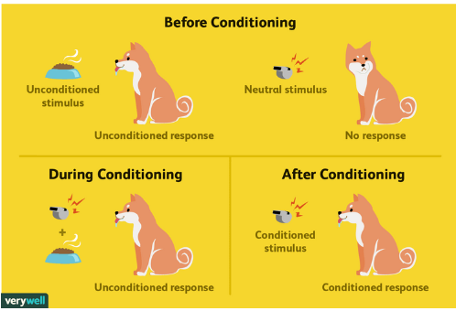
Classical conditioning was first proposed by Russian physiologist Ivan Pavlov in 1899. Interested in role of salivation as a reflex and response to the presentation of food. Notice that dog was salivating at sight of food, sight or sound of lab technician. The association made between the food and a new stimulus (the sight/sound of the lab technician) is the essence of the process of classical conditioning. Clear evidence that was based on repeated association of two different stimuli.
Elements of Classical Conditioning:
Neutral Stimulus (NS): A stimulus, does not normally produce a predictable response. (the sound of a bell).
Unconditioned Stimulus (UCS): A stimulus that produces a natural, automatic response. (the presentation of food).
Unconditioned Response (UCR): The response that automatically occurs when the UCS is presented. ( salivation in response to food).
Conditioned Stimulus (CS): A stimulus that eventually becomes associated with the UCS, and because of the learning, will evoke a response. In P’s experiment: sound of a bell.
Conditioned Response (CR): The learned response to the conditioned stimulus. In P’s experiment: salivation in response to the sound of the bell.
The Three-Phase Model of Classical Conditioning:
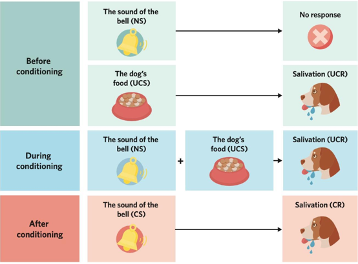
Phase 1: Before Conditioning: Neutral Stimulus = No response. Unconditioned Stimulus = Unconditioned Response.
Phase 2: During Conditioning (acquisition phase): Neutral Stimulus + Unconditioned Stimulus = Unconditioned Response. The stimuli are paired together repeatedly, with the NS being presented just before the UCS.
Phase 3: After Conditioning: Conditioned Stimulus (previously the Neutral Stimulus) = Conditioned Response. Learning is demonstrated when the Conditioned Stimulus is presented alone and it elicits the Conditioned Response.
Explanation of the Three-Phase Model A Template: Before conditioning, the NS elicits no response, while the UCS leads to the UCR. During conditioning, the NS is repeatedly presented just before the UCS, which leads to the UCR. After conditioning, the CS now leads to the CR, even when presented alone (i.e. without the UCS).
OPERANT CONDITIONING
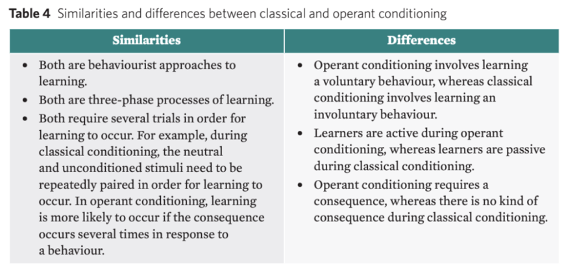
Behaviourist approach to learning
Three-phase learning process that involves an antecedent, behaviour, and consequence. Consequence of a behaviour determines the likelihood that it will reoccur.
Nature of the response: Voluntary – consciously carries out a behaviour.
Timing of the stimulus and response: Reinforcement / Punishment occurs after the correct or incorrect behaviour is carried out.
Role of the learner: Active role: choosing to respond to receive a particular reward or avoid punishment.
BACKGROUND INFORMATION ON OPERANT CONDITIONING: B.F. Skinner
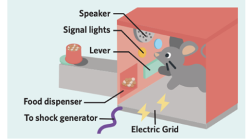
Developed after classical conditioning. Developed in 1930s by B.F. Skinner. He created a device called the operant chamber (‘Skinner box’). This device ensured that test animals (rats and pigeons) were not exposed to external environment, and could be controlled by experimenter alone. Skinner found that the consequences of an animal’s behaviour (such as an electric shock or food) would influence the likelihood that the behaviour would be repeated.
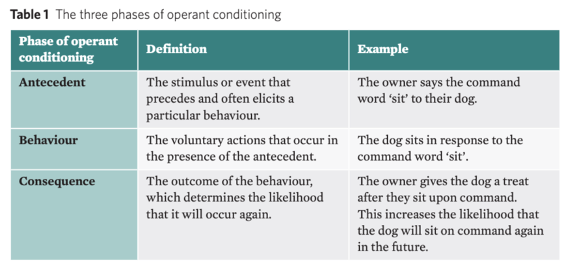
THREE PHRASES: for operant
antecedent: stimulus that precedes / elicits a particular behaviour
behaviour: voluntary behaviour that occur in presence of antecedent.
consequence: outcome, determines likelihood that it will be repeated.
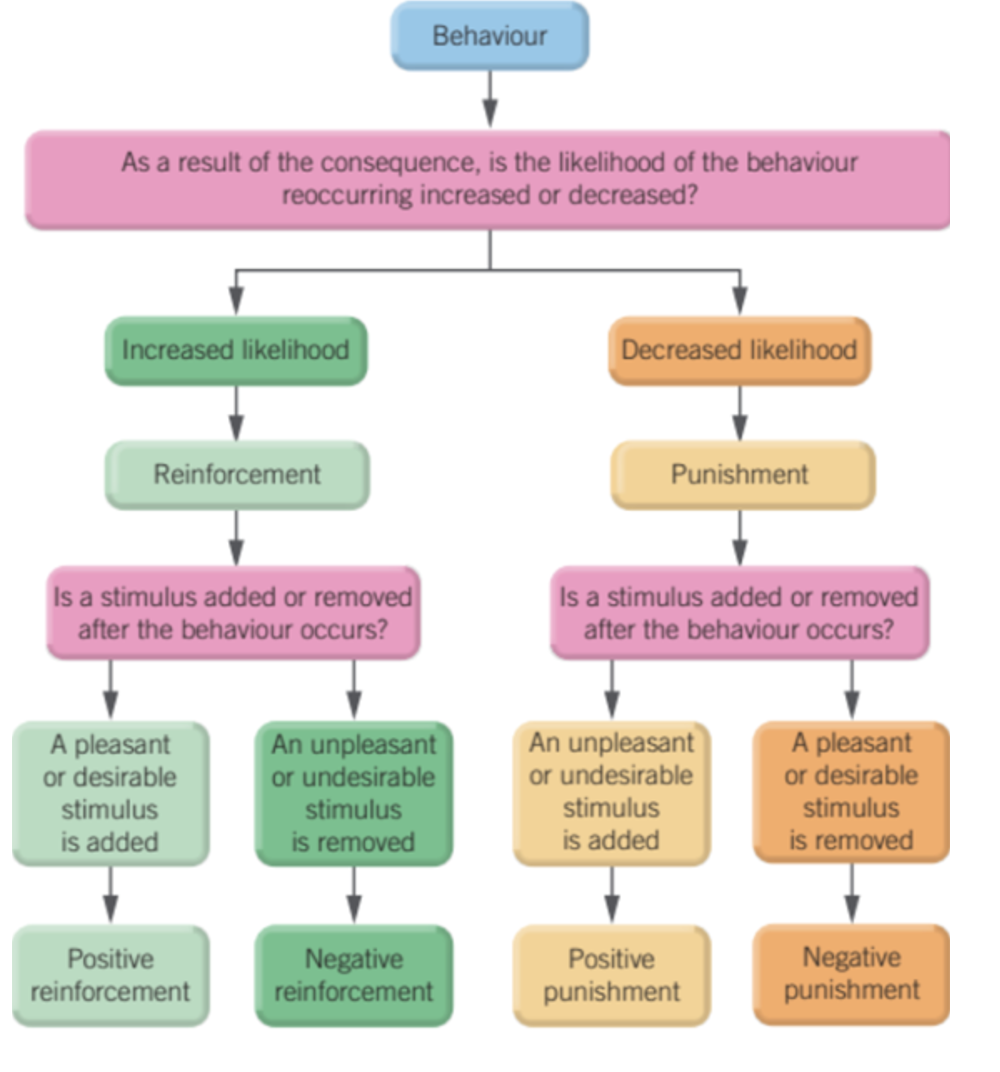
TYPES OF CONSEQUENCES: REINFORCEMENT:
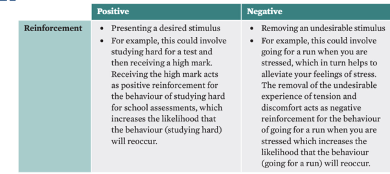
increases likelihood of behaviour reoccurring. In two ways:
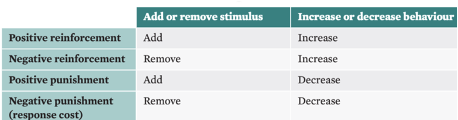
- Positive reinforcement (addition of a desirable stimulus) = increases the likelihood of a behaviour reoccurring.
- Negative reinforcement (removal of an undesirable stimulus) = increases the likelihood of a behaviour reoccurring.
TYPES OF CONSEQUENCES: PUNISHMENT:
decreases the likelihood of a behaviour reoccurring. Occurs in two ways:
Positive punishment (addition of an undesirable stimulus) = decreases the likelihood of a behaviour reoccurring.
Negative punishment (removal of a desirable stimulus) = decreases the likelihood of a behaviour reoccurring. There is a cost for making a response (if you get a speeding fine your money (a valued stimulus) is taken away from you.).
FACTORS THAT INFLUENCE THE EFFECTIVENESS OF REINFORCEMENT AND PUNISHMENT:
TIMING: Reinforcers should be presented as close in time to the desired response as possible.
ORDER OF PRESENTATION: Reinforcement must be presented after desired response. Helps ensure that the organism learns consequences of a particular response.
APPROPRIATENESS:
Reinforcers: provide a pleasing consequence for its recipient.
Punishment: provide a consequence that is unpleasant. Punishment must ‘fit the crime’ – it cannot be too severe, or it may cause fear. It only tells the person or animal the ‘wrong’ behaviour and not what is the right or desired response.
marking guide for OPERANT CONDITIONING, and similarities and difference between operant and classical.
Marking: 4 marks
One for antecedent:
One for behaviour:
One for consequence:
One for explaining what type and effect on behaviour: this is negative reinforcement and will increase the likelihood of behaviour being repeated.
OBSERVATIONAL LEARNING:
Process of learning
watching behaviour of a model and consequences associated, then decides whether to imitate. Can be indirectly conditioned by watching someone else’s conditioning. (vicarious conditioning).
Albert Bandura (1960s) :The “Bobo Doll” Experiment:
The “Bobo Doll” Experiment: Conducted studies investigating how children (pre-school aged children) learn by imitating others (adults interacting with a Bobo doll). Suggested learning occurs in a social setting and behaviours can be learnt by watching and imitating others in these settings. Experiments involved determining if pre-school children can learn aggressive behaviour through observational learning. Then proposed the Social Learning Theory: Behaviours are learned through observation and imitation of others.
- Main Findings: Learning can occur through observation of models. Children likely to model adult behaviour (regardless of if they are live, video, cartoon). Live is most influential. Reinforcement increases likelihood that observationally learned behaviours will be reproduced. Controlling aggression can be learned by observing aggressive models being punished. Boys are more likely to be physically aggressive than girls.
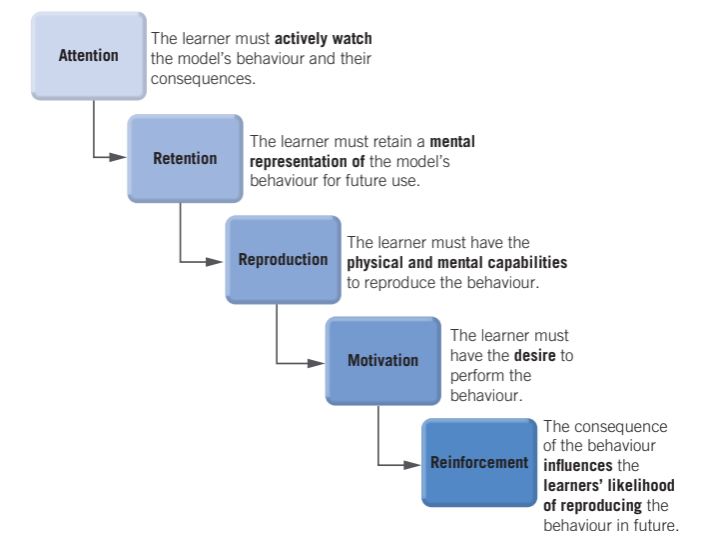
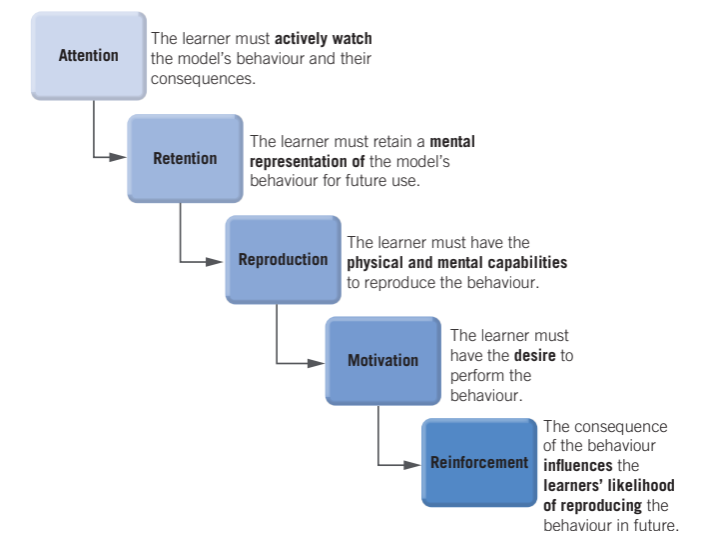
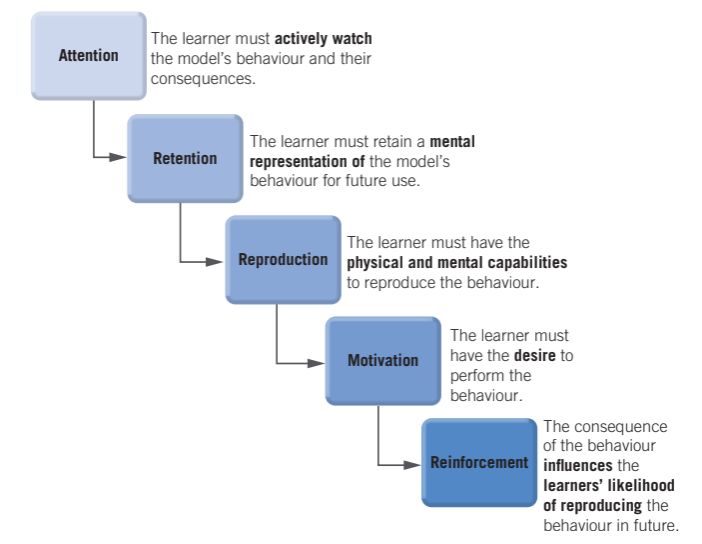
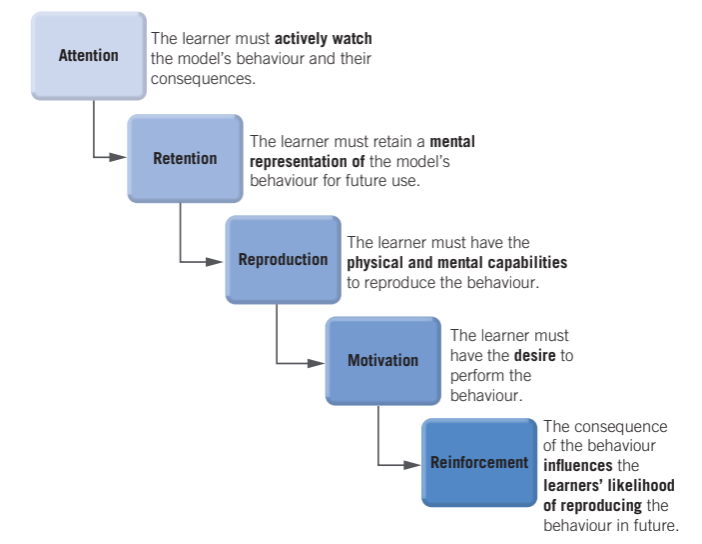
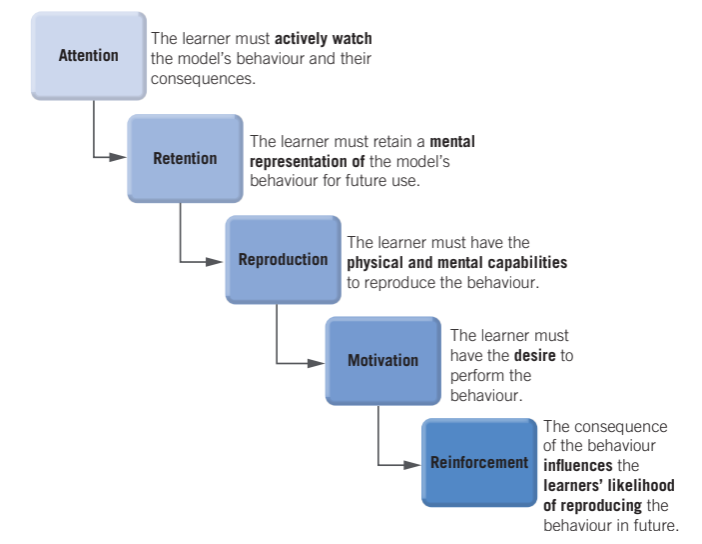
Stages of observational learning: ARRMR
Must progress through five stages:
Attention: To learn through observation, must pay actively focus to model’s behaviour.
Influenced by several factors: sensory capabilities, motivation and interest level, situation, kinds of distractions, and characteristics of model.
Likely to imitate if characteristics: perceived positively, high status, perceived similarities, behaviour is visible and stands out, Model is demonstrating behaviour which the observer perceives as being able to imitate.
must actively focus , paying close attention
Stages of observational learning: ARRMR
Retention: Memory, important role in observational learning. Behaviour must be stored in memory as mental representation so can be utilised later. More meaningful that image, the more accurately we will be able to replicate the behaviour. Responses learned by modelling are often not needed until sometime after they have been acquired.
mental representation,store it to memory.
Stages of observational learning: ARRMR
Reproduction: Learner must have physical and mental ability to convert these mental representations into actions. (a child must be old enough to be able to use the kitchen equipment for making pancakes).
physical and mental ability
Stages of observational learning: ARRMR
Motivation: Must want to imitate learnt behaviour. Depend on whether learner believes that there will be a desirable consequence for reproducing learnt behaviour. Intrinsic motivations: from within individual (desire to perform well on an exam). Extrinsic motivations: from factors that are external to individual (desire to receive praise from your teacher for doing well on an exam). want to be able to successfully
Stages of observational learning: ARRMR
Reinforcement: Three aspects of reinforcement: External reinforcement (praise or reward for behaviour), Vicarious reinforcement (model behaviour being reinforced by seeing others getting reinforced), Self-reinforcement (reach standard set for self, +/- ). Once the learner has successfully performed behaviour, receiving reinforcement will increase likelihood that the behaviour will be repeated.
reinforced
example of OBSERVATIONAL LEARNING:
Example: Jeanie sees her older sister Molly playing on the monkey bars, able to swing from one bar to the next. With reference to observational learning, explain how Jeanie would be able to learn this behaviour.
· Attention: Jeanie must actively focus when Molly is swinging on the monkey bars, by paying close attention to how Molly swings from one bar to the next.
· Retention: Jeanie must create a mental representation of Molly swinging on the monkey bars and store it to memory.
· Reproduction: Jeanie must have the physical and mental ability to be able to successfully carry out the behaviour of swinging on the monkey bars
· Motivation: Jeanie must want to be able to successfully swing on the monkey bars.
· Reinforcement: If Jeanie successfully swings on the monkey bars, she should be reinforced. Molly might run up to her and give her a hug (external reinforcement).
Aboriginal and Torres Strait Islander Approaches to Learning: Learning as a multimodal system of knowledge (systems of knowledge):
Developed by communities working together and sharing traditional expertise/knowledge.
Informed by culture, including who can learn what and where.
Consist of information that is highly relevant to day-to-day living and survival.
Informed by spiritual and ancestral knowledge (Dreaming stories/ Dreamtime Stories).
Consist of information that is highly interconnected, are patterned (created) on Country.
Learning embedded in Relationships:
Relationships between concepts.
Relationships between learner and teacher.
Relationships between individuals, families, and communities.
Relationships between all the above and Country.
Connection to culture
Connection to country
Connection to community
Knowledge is deeply interconnected within complex systems and embedded within Country.
Learning is holistic (looking at the whole system) and involves understanding the relationships between things, living beings, spirituality.
example question for 8 ways of knowing, and suggested answer.
Using knowledge of theory: In VCE Psychology exams, to answer a question about or in terms of suggests that you are using your knowledge of a concept or theory to explain something. Responses should use the relevant psychological terminology.
Question: An Indigenous Elder is teaching a child within their community how to fish, by using some of the ways of knowing. The Elder starts with a story about the importance of fish to the land and draws a picture in the sand that their ancestors drew for them as they share the story. During this yarning session, the elder jumps to their feet and starts dancing around as they act out how to carve a fishing spear and how to use a fishing spear. The Elder and the child then sit and listen to the weather in silence for a while. The Elder then starts singing a song related to their fishing expedition as they pick up a spear and begin throwing it into the shallows of the water. The pair then sit and yarn a little longer about the type of fish in that water and its significance to that area of land. The young child then picks up the spear to practise his fishing.
In reference to ‘Indigenous ways of knowing’ explain how the child is being viewed as part of the system with knowledge by the Elder in their community.
Suggested answer for full marks: Non-verbal ways of learning use body movements (kinaesthetic skills), facial expressions, gestures and dance to help Indigenous people to think and learn about fishing. Repetition of the same movements reinforces memory and learning. For example, the Elder’s dance could be created and performed to help the child learn about the way in which to throw a spear into the water.
Process of Memory:
Information processing model of memory includes three processes:
Encoding – process that converts info into useable form (code), can be stored & represented in memory system. For encoding process to begin, must pay attention to info. Begins when senses take in raw, meaningless sensory information
Storage –retention of info in memory system over time. If we store info in an organised way, it will make it easier to recover memories when needed.
Retrieval – process of locating info, stored in memory by bringing it into consciousness when needed. Relies on using the right cues so that can locate correct piece of info in vast network of our memories.

Atkinson-Shiffrin Model:
Multi-store model of memory (consist of multiple memory levels through which a stream of data flows for processing). Emphasises storage structures of memory & suggests that info must pass through three memory stores to be stored for a long time. These 3 independent stores function simultaneously and interact with each other to process information: Sensory memory, Short-term memory (STM), Long-term memory (LTM). Widely accepted models of memory because of its explanatory power (how well it explains memory).
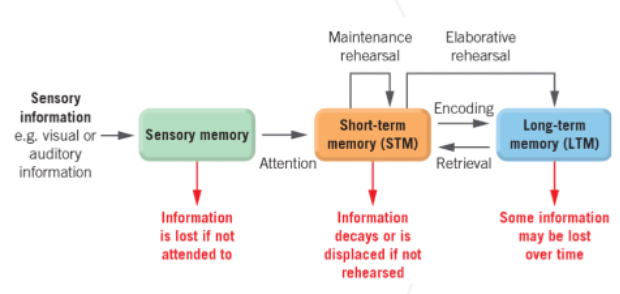
1st: Sensory Memory:
amount of info: unlimited
duration: 0.2–4 seconds
Receives & stores raw, sensory information. Only select certain things attended (relevant, important) (avoid being overwhelmed). Stores sensory impressions long enough for each impression to slightly overlap the first, allows to perceive world as continuous. Held long enough to encode it into useable form & transfer it to STM for further processing.
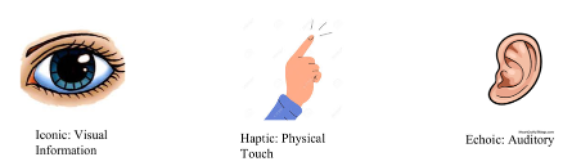
Sensory register: subsystem of sensory memory, receives and stores specific sensory info received from the sense organ. Entry point for memory. Different subtypes of sensory memory that process stimuli from each of your five senses. However, only 3 subtypes have been studied extensively:
Information that enters our auditory/echoic register has a longer duration than information that enters our visual/iconic register.
2nd and most active, working memory: Short-Term memory: (STM):
Holds limited info that is consciously being attended to and actively manipulated. Info can come both from sensory or long-term memory. STM holds all thoughts, info. & experiences at any given point in time. If info is not attended to, it drops out of the system. If attended to, further processing & encoding occurs.
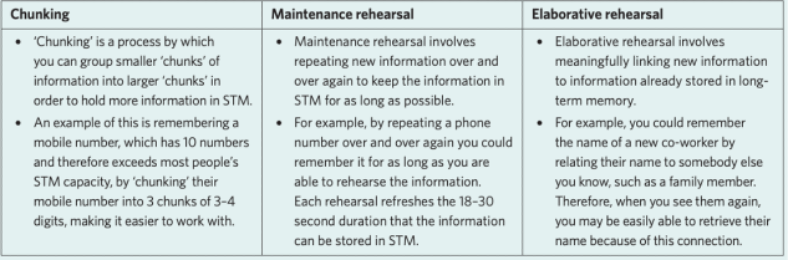
- Capacity: capacity of 7 ± 2 items ( 5 to 9 items). When full, new single items can be added only by dropping (displacing) old ones. Capacity can be increased by chunking info: Grouping separate items of info to form larger single info unit (chunk) to increase STM capacity.
- Duration: approximately 18 – 30 seconds. Can be prolonged by rehearsal (active manipulation of info). Two types of rehearsal are: Maintenance rehearsal, Elaborative rehearsal.
Ways to retain Info:
Elaborative rehearsal: is a memory technique that moves information from short-term to long-term memory by connecting new data to existing knowledge, focusing on meaning rather than rote repetition.
Maintenance rehearsal: is a cognitive process of repeating information—verbally or mentally—to keep it in short-term or working memory without creating deep, lasting meaning.
Manipulation of STM:
3rd: Long Term Memory:
- Duration: relatively permanent storage
- Capacity: unlimited amount of info
Memories are in LTM & retrieved back into conscious awareness (STM) when required. Info is stored in an organised manner based on its meaning & importance. Sometimes retrieval of a memory is not possible, but the memory has not been lost from LTM. Stored information can decay because of physical/psychological factors, particularly through disuse of memories and brain diseases (Alzheimer’s disease and other dementias).
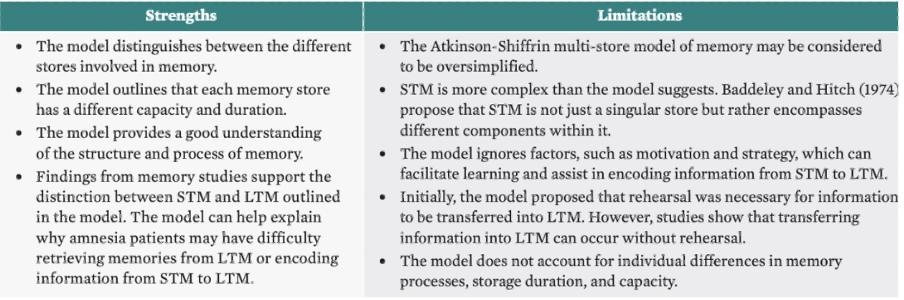
Limitations/Strengths: Atkinson-Shiffrin Model:
S: distuinguish between dif stores involved in memory, good understanding of structure and process of memory.
L: oversimplified, ignores factors like motivation and strategy assisting in encoding/learning and memory.
Explicit Memory: (Declarative Memory):
Memories voluntarily retrieved from long term memory and brought into conscious awareness. “Knowing that” info
- Two subtypes: Episodic (episode) Memory and Semantic (semester of school) Memory.
- Semantic: Impersonal factual knowledge about the world (names of objects, days of the week, months of the year, simple maths skills, words & language). These memories are hard to forgot.
- Episodic: Personally significant events that are related to specific time/place. (special birthday celebration, first day of secondary school). These memories are most easily forgotten (compared to semantic). new info is constantly pouring into, difficult to attend, encode, store each new memory of a personal event.
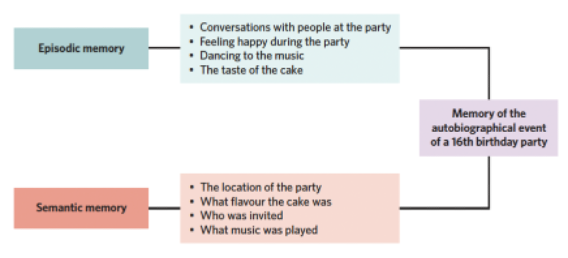
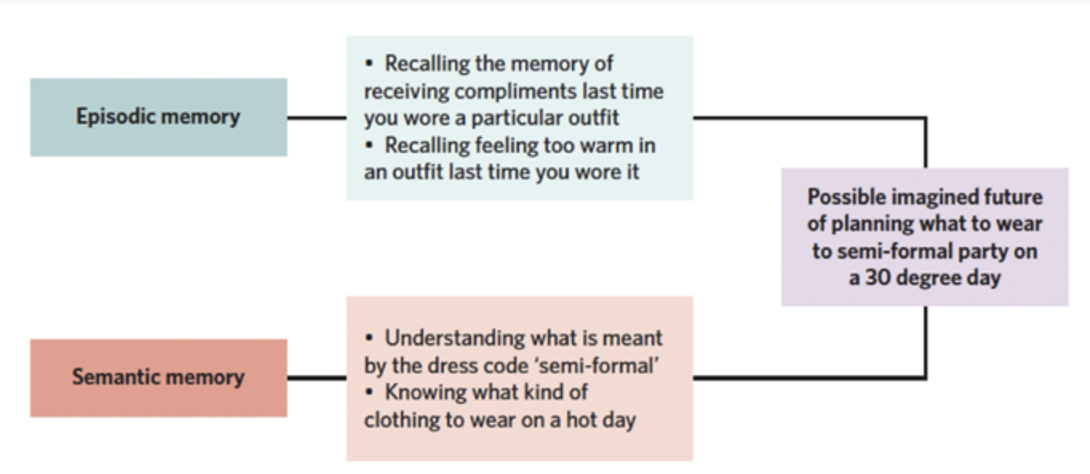
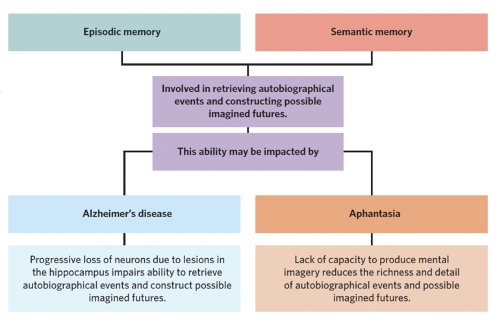
Episodic and semantic memories interact to retrieve past events and to imagine future events. Semantic and episodic systems store different info but often work together in forming new memories = autobiographical memories.

Implicit memory (HOW):
type of long-term memory that is unconsciously/involuntarily retrieved. “How to” knowledge = stored routines and emotional responses, conditioned memory. These are very hard to forget.
- Categorised by 2 forms of implicit memory: Procedural Memory, Classically Conditioned memory:
- Procedural: LTM of learnt actions & skills that can usually only be fully expressed as actions (how to walk, talk, juggle, ride a bike).
- Classical Conditioning: involves an involuntary response, (fear and formation of these fear responses). Usually emotionally charged. Retrieved involuntary and can be reflexive. Can cause formation of involuntary habit (biting nails). (Fear of spiders and reaction to the sight/thought of a spider).
Long Term Memory and the Brain:
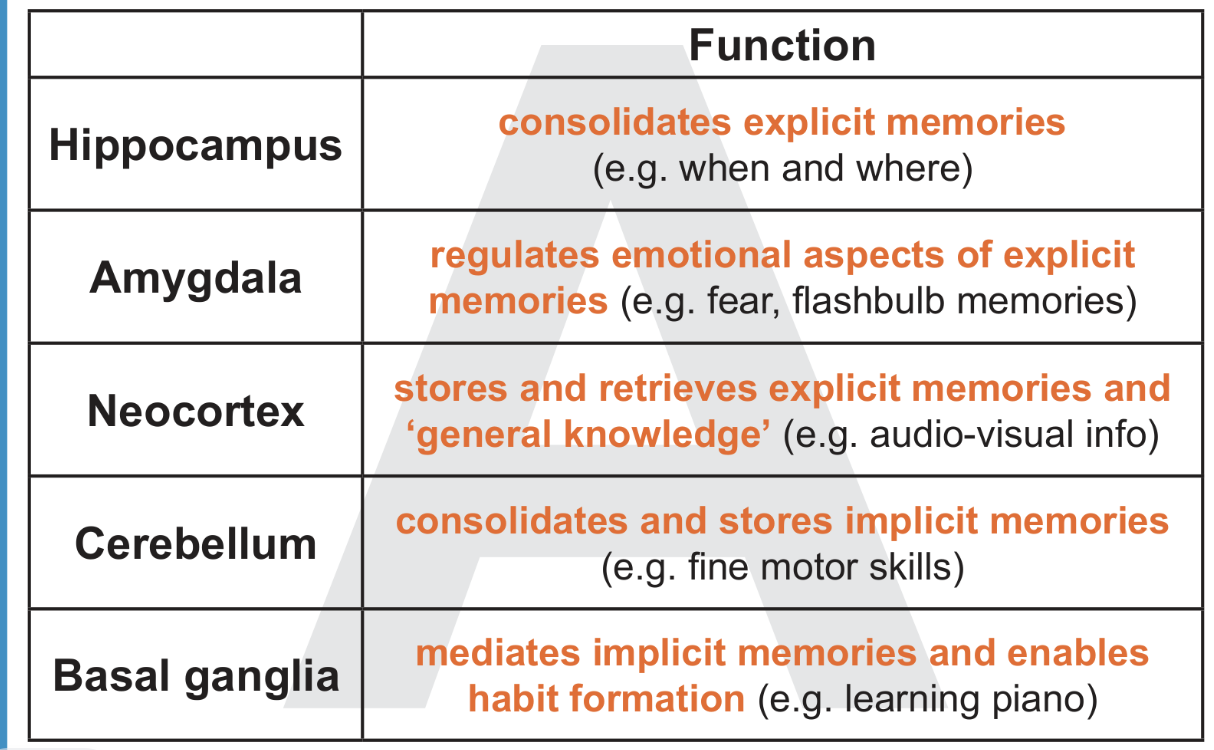
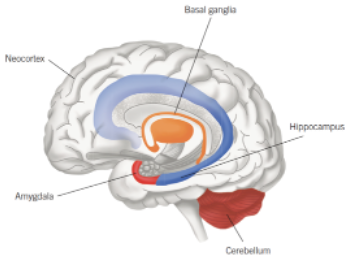
Type of memory will determine where it is stored and whether it is stored in a specific location (simple memories) or across multiple brain areas (for more complex memories) that are connected via neural pathways.
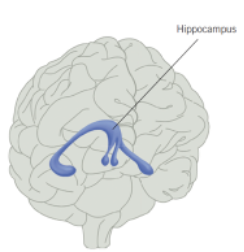
Hippocampus
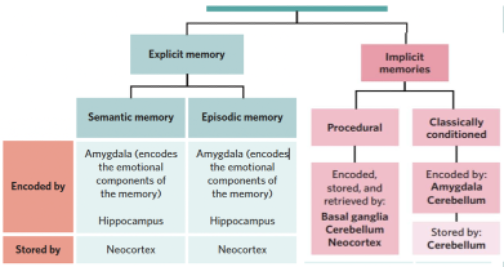
Involved in encoding, consolidating and retrieving explicit memories.
Transfers newly encoded explicit memories to relevant parts of the brain for permanent LTM storage.
Interacts with the Amygdala to link emotions to memories (hippocampus encodes explicit memories of event, whereas amygdala encodes emotions related to event).
When you retrieve memory from neocortex, hippocampus will enable recall of where, when, who about event. Your amygdala will also be activated during retrieval, so remember your emotions during the event. Sympathetic nervous system reactions (heart rate, goosebumps and sweating) that have been linked to memory may also recur.
Amygdala:
Located in middle of the brain (fear centre).
Encoding emotional component of memories of classically conditioned and explicit memories.
Helpful in labelling emotional components of memory.

Neocortex:
Consists of 6 layers, is part of the Cerebral Cortex, covers most of brain & consist of the 4 lobes. Involved in high-order mental processes (language, attention and memory).
Stores explicit Memories: Memories are stored within locations depending on type of sensory memory and where it is processed.
Due to long-term memories being stored in various locations within neocortex, neural connections can be formed between different memories.

Basal Ganglia:
Located in middle of the brain.
Primary roles in learning, procedural memory, routine behaviours and emotions.
Involved in encoding and storing procedural memories and classically conditioned memories: Via connection with cerebellum. Work to form habits by associating movement with reward.
Are active when we move a part of our body in a new way when stimulated by a cue. (we might encounter roadworks on our journey home and therefore take a route that results in getting home more quickly).
When action results in a positive outcome, association between reward and action is recognised. The reward indicates to the basal ganglia that the behaviour is useful and worth remembering for future.
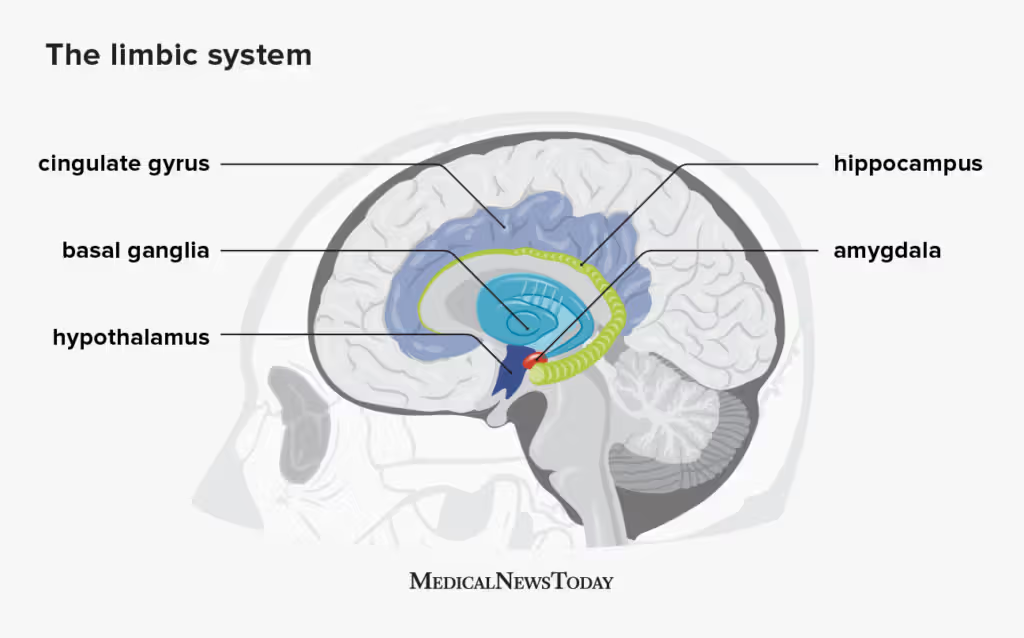
Cerebellum:
Located at the base of the Brain.
Encodes and temporarily stores implicit Procedural memories for motor skills, more specifically for those created by classical conditioning.
Has a role in coordinating fine muscle movements and regulating posture and balance.
Role of Episodic & Semantic Memory in: Autobiographical Events:
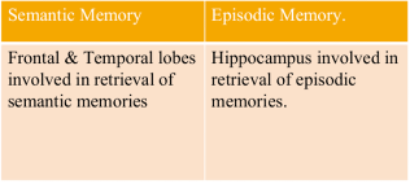
Autobiographical Memory: Personally lived experiences (first day of school, stored in LTM), retrieval of Autobiographical Memory uses both episodic and semantic memory forms.
May occur due to;
events being semantic (general event knowledge, personal facts without context)
having episodic components (sensory details, thoughts and emotions, details that relate to times and places).
Is to support our sense of self and identity, create personal history.
The function of autobiographical memory:
Is to support our sense of self and identity.
Includes representations of our personal characteristics such as our traits (‘I am timid’), general knowledge about events in our life (‘When I was in primary school, we used to visit my grandma on Sundays’), and memories of our past ( ‘The time I broke my leg in grandma’s garden’).
Autobiographical memory = links past events together into a personal history that relates self through past, present and future, form a life narrative.
Recalled long-term memory is not an accurate representation of what happened tend to include inaccurate bits of info about event that were not part of OG experience, because when we reconstruct a memory, we unconsciously alter event to make more sense to us.
Role of Episodic & Semantic Memory in: Constructing Possible Imagined Futures:
Rearrange memories of past to put together a vision of what future might look like. Autobiographical memories and episodic future thinking occur in the same regions of brain and appear to use same underlying processes.
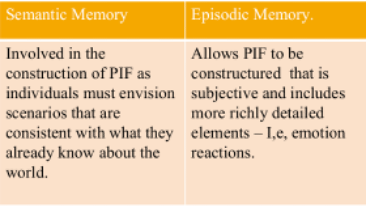
S: help construct future that is consistent to what already know (semi formal dress code)
E: add subject elements and details (emotions), recall compliments when wore outfit last.
Damage to Hippocampus can cause issues to remembering past events and constructing PIF (they drawn on past experiences stored in semantic and episodic memories).
Alzheimer's
a neurodegenerative disease
Involves progressive loss of neurons in the brain and is characterised by memory decline.
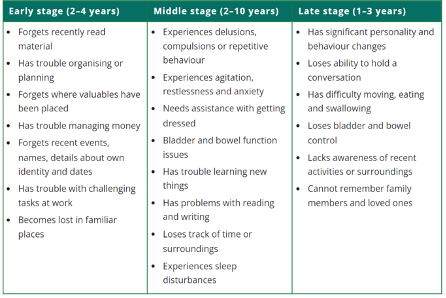
Typically progresses slowly in three general stages: early/mild, middle/moderate and late/severe. Each person may experience symptoms or progress through stages differently.
Incurable, and most people die within 8–10 years of onset. No simple diagnostic test to identify presence of Alzheimer’s disease. What we know about Alzheimer's comes from brain imaging & postmortem examinations.
Alzheimer’s disease diagnosis:
Way can assist in diagnosing = using brain scans, examining brain activity and tissues.
- Computed tomography (CT)/ magnetic resonance imaging (MRI): Standard evaluation for Alzheimer’s disease. They reveal anatomic structure of the brain and used to rule out such problems as tumour, haemorrhage (bleeding of the brain) and stroke, which can mask Alzheimer’s disease. Show loss of brain mass associated with Alzheimer’s disease in the middle/ later stages of the disease.
- Positron emission tomography (PET) and single-photon emission computed tomography: images of brain activity based on blood flow, oxygen consumption/ glucose use. Help narrow down a diagnosis by revealing neural abnormalities common in Alzheimer’s disease.
However, cannot show microscopic lesions (areas of abnormal tissue) in brain tissue that characterise Alzheimer’s disease and therefore cannot identify the disease with certainty. A diagnosis can only be confirmed when a post-mortem is conducted.
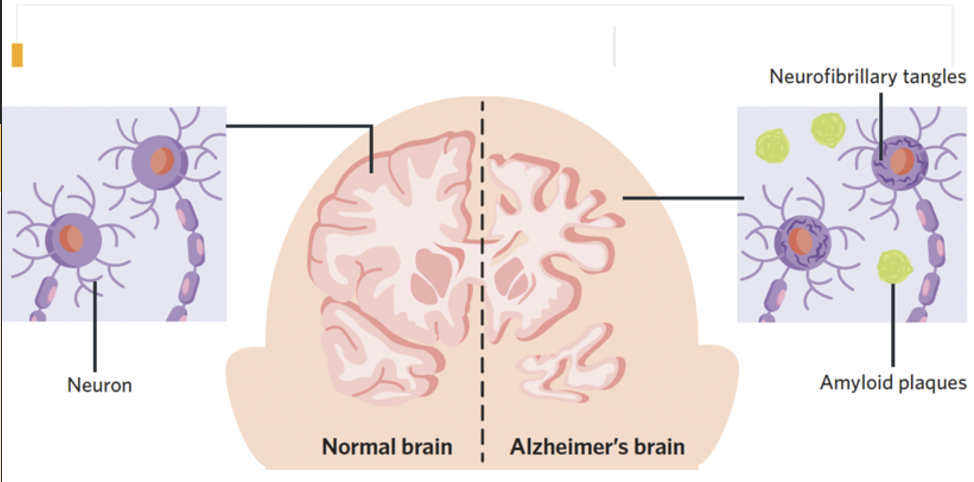
Alzheimer’s disease & the Brain: Identified through lesions (damaged tissue).
- Lesions predominantly identified in the hippocampus
- 2 primary lesions associated are: Amyloid Plaques (fragment of protein accumulate and inhibit communication between neurons), Neurofibrillary tangles (accumulation of protein forms tangles within neurons, inhibit transportation of substance which eventually kills neuron).
Later stages of the disease show significant reduction in brain matter size. Lack of the important memory neurotransmitter, acetylcholine. Alzheimer’s disease destroys the neurons that produce acetylcholine.
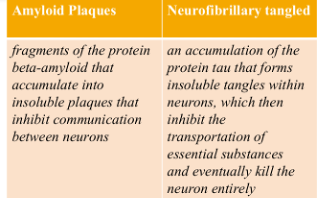
Alzheimer’s disease & Episodic and Semantic Memory:
Brain damage predominantly occurs in Hippocampus. New explicit memories cannot be encoded and consolidated, resulting in anterograde amnesia.
Damage spreads to the cerebral cortex: Resulting in loss of stored explicit (episodic, semantic and autobiographical) long-term memories (retrograde amnesia), problems with attention and changes to personality and emotions. Lack capacity to draw on episodic and semantic memories in order to construct new future scenarios.
Finally, the damage to neurons extends to rear of cortex, the hindbrain: Has a role in regulating automatic functions (breathing and heart rate). Towards the final stages of Alzheimer’s disease, neurons of hindbrain start to degenerate, and this is when death occurs.
What is Aphantasia:
A phenomenon, individuals lack capacity to generate mental imagery.
Mental imagery = visual representations of sensory information without presence of sensory stimuli.
Can vary in detail & vividness. Unable to produce mental imagery. The word ‘aphantasia’ = means ‘imagination’ + ‘without’.
Not sure what causes aphantasia; however, it has been suggested that areas of brain involved in visual imagery ( visual cortex), may be underactive. Others suggest that people with aphantasia do experience mental imagery but cannot access image in their conscious thoughts.
2 forms of aphantasia: congenital (present from birth) and, acquired (present after brain injury or significant psychological event, such as depression or anxiety).
Aphantasia & Episodic and Semantic Memory:
People with aphantasia might:
- struggle to remember or ‘relive’ autobiographical events
- have difficulty imagining future or hypothetical events
- have problems with factual memory
- dream less
- have decreased imagery involving other senses such as sound or touch
- have trouble recognising faces.
Mental imagery is created using sensory information that is organised in the STM. Those without aphantasia are likely to draw upon both episodic and semantic memory when creating mental imagery, in the form of images of past experiences. May not be able to visualise detailed and vivid memories. Struggle to retrieve autobiographical events and construct possible imagined futures.
No known ‘cure’ for congenital aphantasia. Some people with acquired aphantasia have reported regaining imagery abilities after therapy. Not a disability but a unique variation in human experience. Not inhibit someone’s success in life.
Mnemonics:
techniques that help with the encoding, storage, and retrieval of information by creating meaningful links and organising information clearly.
They work best for memorising lists or facts that may not be fully understood and can be used in written or oral forms through rhythm, rhyme, or imagery.
Types
Acronyms – first letters form a word
Acrostics – sentence prompts memory
Method of Loci – linking information to familiar places
Strengths
Improve memory through associations
Help organise information meaningfully
Limitations
Still require rehearsal and learning
Can fail if the mnemonic is forgotten or misinterpreted
Do not reduce the amount of information to remember
Method of Loci (as memory palace):
a mnemonic device that converts items into mental images and associates them with specific locations to aid memory. The method of loci assists in the encoding and storage of memories by visually linking new information to familiar places or routes.
5 steps involved in method of Loci:
1. Visualise & image a familiar route/place. Need to have mental imagery of a place already stored in LTM.
2. Select several memorable places on route. And have a familiar already stored in LTM.
3. Create visual imagery for each item can be bizarre or funny. Need to represent each item on their list with memorable mental imagery.
4. link each item to one of the identified memorable landmarks. To encode this list, they would need to place the mental image of each item at a memorable location in their memory palace.
5. Imagine you are following that path. To retrieve the list items, they relive the memory palace route, retrieving the mental images from the list at each.
Works well when listed items are embedded into a story that includes vivid and memorable characters.
Oral traditions:
practices in which knowledge, stories, and customs are preserved and shared through spoken word and movement
Great part of Cultures. Effective way to preserve and celebrate knowledge, stories & customs.
Differ from each community. Include many different forms:
- Dance
- Performance
- Learning through observation
- Practice
- Repetition
- Yarning
Important to note that Songlines and Sung Narratives cannot be viewed in isolation as purely ‘oral traditions’ because they are always interconnected with non-oral forms of cultural knowledge and practices.