Emerging Adulthood
 Call Kai
 Learn
Learn Practice Test
 Spaced Repetition
 Match
Match Flashcards
 Knowt Play
1/4

There's no tags or description
Looks like no tags are added yet.
Name | Mastery | Learn | Test | Matching | Spaced | Call with Kai |
|---|
No analytics yet
Send a link to your students to track their progress
5 Terms
The passage to adulthood determined by milestones and social constructs
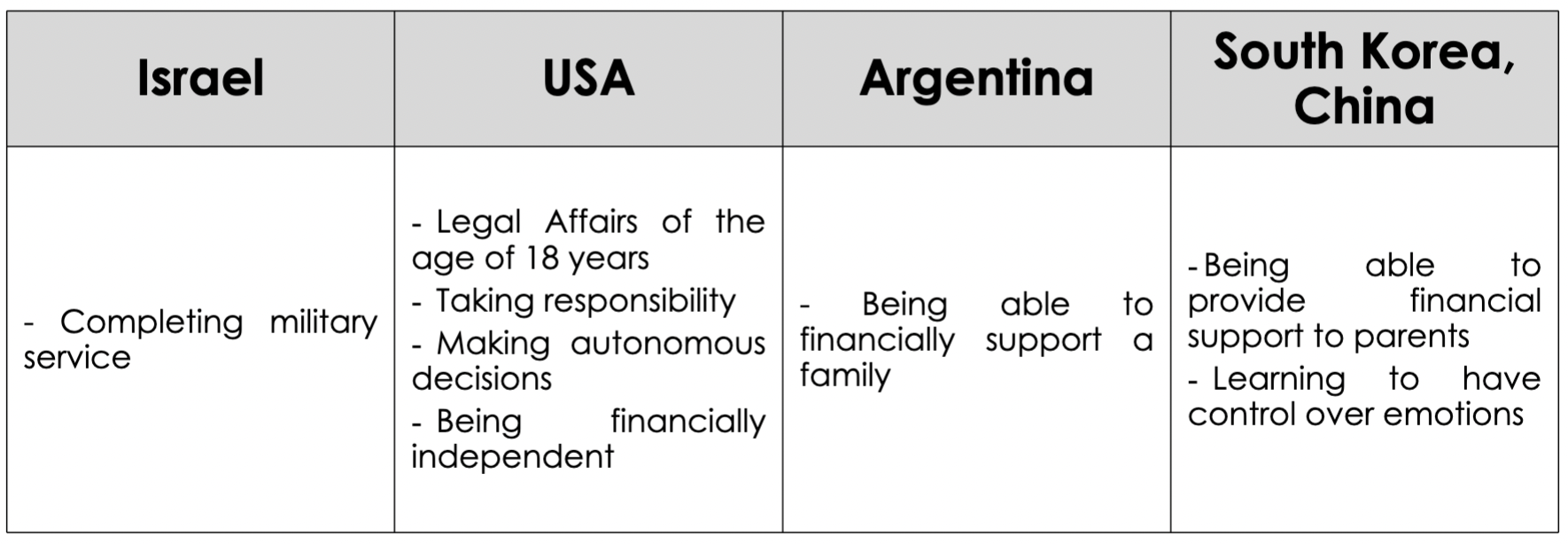
When does a person become an adult?
▪ Legal Affairs
▪ Sexual maturity
▪ Cognitive maturity
▪ Sociological maturity (work, family)
▪ Psychological maturity (identity, autonomy, values)
Adulthood is defined by three criteria
▪ Taking responsibility.
▪ Make independent decisions.
▪ Become financially independent.
In modern industrialised countries, achieving these goals takes longer and involves more varied routes than in the past.
Emerging adulthood
• Transition between adolescence and adulthood.
• Exploratory stage of different ways of life.
• 18/19-25/29 years. (It is between the ages of 18 and 25. Although, especially in certain European
countries, it could be extended to the age of 30).
Exploring identity:
The stage that offers the greatest opportunities for exploring real identity, options in the areas of love, work and worldview, and opening up to new directions in life.
Diversity of situations and instability in the search for experiences that provide security:
Ongoing reviews of the life plan, changes of direction in relationships, work, education and housing.
Self-centred:
Few ties that involve daily obligations and commitments to others, so they
base almost all their decisions on themselves, both daily and core (What should I do for dinner? Should I change careers?)
They feel "between" two stages of life:
Self-perception of "yes, but not yet" (ambivalence): they perceive themselves as being on the way to adulthood without having reached it.
The Age of Possibility:
A time of aspiration and high expectations: few doors are completely closed and dreams and illusions are still alive.
From family conflict to seeing "parents as people":
Changes in family relationships: Parents begin to be seen as equals, emotional autonomy is greater and family satisfaction increases, especially among those who have already left home.
Questions you begin to ask yourself:
• What do I really want to do with my life?
• How do I notice that I have changed?
• Do others notice?
Health status in adolescence/early adulthood
● Laying the foundations for physical functioning.
● Physical ability begins to decline, although the decline is barely noticeable.
● Behavioural factors contribute to health and well-being → epigenetic changes in the expression of some genes that may be permanent.
● Health problems at this stage → reflect problems during adolescence.
● Most common causes of activity limitation → Arthritis and other musculoskeletal conditions.
● Leading cause of death → Accidents.