UK Highway Code
 Call Kai
 Learn
Learn Practice Test
 Spaced Repetition
 Match
Match Flashcards
 Knowt Play
1/392

Earn XP
Description and Tags
Flashcards for the Highway Code
Name | Mastery | Learn | Test | Matching | Spaced | Call with Kai |
|---|
No analytics yet
Send a link to your students to track their progress
393 Terms
How should you position yourself on a pavement near the kerb?
Avoid standing with your back to traffic near the kerb where possible.
Which side of the road should you walk on if there is no pavement?
Walk on the right-hand side facing oncoming traffic.
What extra care should you take when walking on roads without pavements?
Walk close to the side of the road
Be prepared to walk in single file
Take extra care on narrow roads or in poor light
What should you do near a sharp right-hand bend if there is no pavement?
Cross before the bend so traffic can see you, then cross back after the bend.
How can pedestrians make themselves more visible in poor daylight?
Wear or carry something light-coloured, bright, or fluorescent.
What should pedestrians wear at night to be seen?
Reflective materials such as armbands, jackets, or reflective footwear.
Why is reflective clothing important at night?
Drivers can see reflective materials up to three times farther away than non-reflective ones.
How should adults keep young children safe near roads?
Keep between the child and traffic
Hold their hand firmly
Use reins or strap very young children into pushchairs
What should you avoid doing with a buggy when checking to cross?
Do not push the buggy into the road first, especially between parked cars.
Where should organised walking groups or parades walk?
Use the pavement if possible; if not, keep to the left-hand side of the road.
What safety measures should organised walking groups use?
Look-outs at the front and back
Fluorescent clothing in daylight
Reflective clothing in the dark
What lights should be used at night?
Front: white light
Back: red light
Are pedestrians allowed on motorways or slip roads?
No—pedestrians MUST NOT be on motorways or slip roads, except in an emergency.
Who should follow the Green Cross Code?
All pedestrians.
Why should children not go out alone until they understand the Green Cross Code?
Many children cannot judge speed or distance safely.
How do children best learn the Green Cross Code?
By adults setting a good example and using the Code properly.
What is the first step of the Green Cross Code?
Find a safe place to cross and use a crossing if possible.
What crossing places are safest for pedestrians?
Zebra crossings
Pelican crossings
Puffin crossings
Toucan crossings
Footbridges
Subways
Traffic-controlled crossings
Where should you avoid crossing the road?
Between parked cars
On blind bends
Near the brow of a hill
Should you cross the road diagonally?
No — always cross straight across.
What should you do before reaching the kerb?
Stop just before the kerb and avoid standing too close to traffic.
Why is listening important before crossing?
You may hear traffic before you see it.
Even if traffic looks far away, what should you remember?
Vehicles may be approaching very quickly.
What road users should you especially watch for between traffic lanes?
Cyclists and motorcyclists.
At a junction, what should turning traffic do for pedestrians crossing?
Give way to pedestrians.
If you have already started crossing at a junction, who has priority?
The pedestrian has priority.
How should you cross where pedestrian barriers are present?
Only use the gaps provided for pedestrians.
What is tactile paving used for?
To help guide and warn blind or partially sighted people.
What do raised studs in tactile paving usually indicate?
Crossing points with dropped kerbs.
What do raised bars in tactile paving usually indicate?
Hazards such as level crossings or steps.
What should you check before crossing a one-way street?
The direction traffic is moving.
Why should you take extra care near bus and cycle lanes?
Traffic may move faster or in the opposite direction.
What separates some cycle tracks from footpaths?
Kerbs
White lines
Verges
Different materials
What should pedestrians and cyclists do on shared routes?
Respect each other’s safety and avoid obstruction.
If crossing between parked cars, where should you stop first?
At the outside edge of the parked vehicles.
Why is crossing near parked vehicles dangerous?
Drivers may not be able to see you clearly.
Should you cross in front of or behind a vehicle with its engine running?
No — especially not large vehicles.
What signs show a vehicle may be reversing?
White reversing lights
Warning sounds
Where should you cross at night if there is no pedestrian crossing nearby?
Near a street light so drivers can see you more easily.
Where should you walk when using a crossing?
Between the studs or over the zebra markings.
Where shouldn’t you cross on a zebra crossing?
On the zig-zag lines or at the side of a crossing
Why do vehicles need extra stopping time on slippery roads?
Because stopping distances are longer.
When should you cross at a zebra crossing?
When traffic from both directions has stopped or the road is clear.
When MUST drivers give way at a zebra crossing?
When pedestrians are on the crossing.
What should you do at the island in the middle of a zebra crossing?
Wait on the island and treat the second half as a separate crossing.
If there are no pedestrian signals, when should you cross?
When traffic lights are red and traffic has stopped.
What should you watch for at traffic-light crossings?
Vehicles turning corners or moving in other lanes.
How do you activate a pelican crossing?
Press the control button.
What should you do when the steady green figure shows at a pelican crossing?
Check traffic has stopped, then cross carefully.
What is different about puffin crossings compared to pelican crossings?
The signals are on your side of the road and there is no flashing green figure.
What should you do at a puffin crossing?
Press the button and wait for the green figure.
Why should you still wait for the crossing signal in congested traffic?
Traffic on the other side of the road may still be moving.
Who can use a toucan crossing?
Pedestrians and cyclists.
What signals may crossings have for blind or partially sighted people?
Bleeping sounds or voice signals.
What signals may help deafblind people at crossings?
Tactile signals.
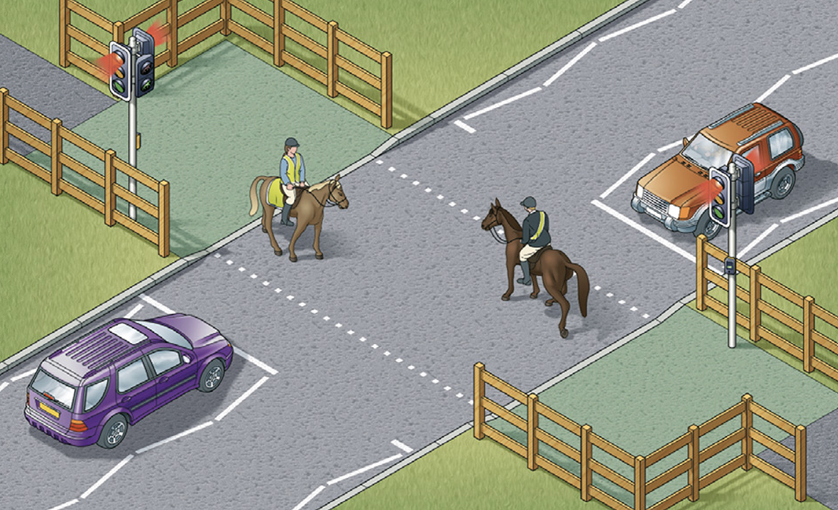
What features help identify equestrian crossings?
Wider crossings
Horse-and-rider symbols
Higher control panels
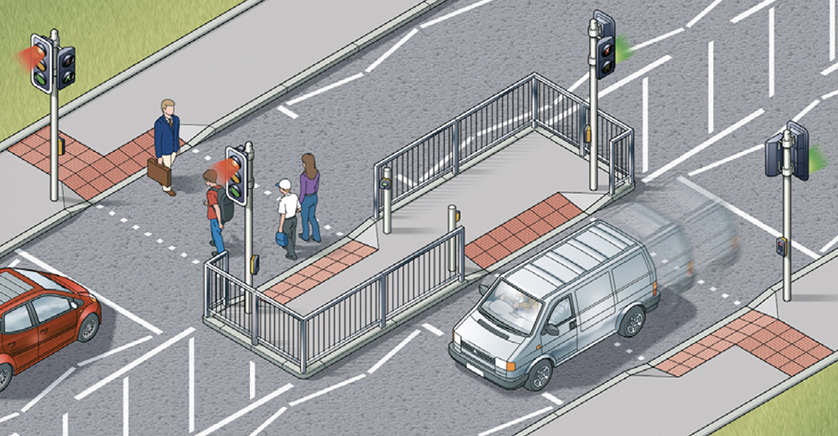
How should staggered pelican, zebra or puffin crossings be treated?
As two separate crossings.
When should you cross if a police officer or school crossing patrol is controlling traffic?
Only when signalled to cross.
How should you cross in the presence of a crossing patrol officer?
In front of them.
If there is no controlled crossing, where is it safer to cross?
Where there is an island in the middle of the road.
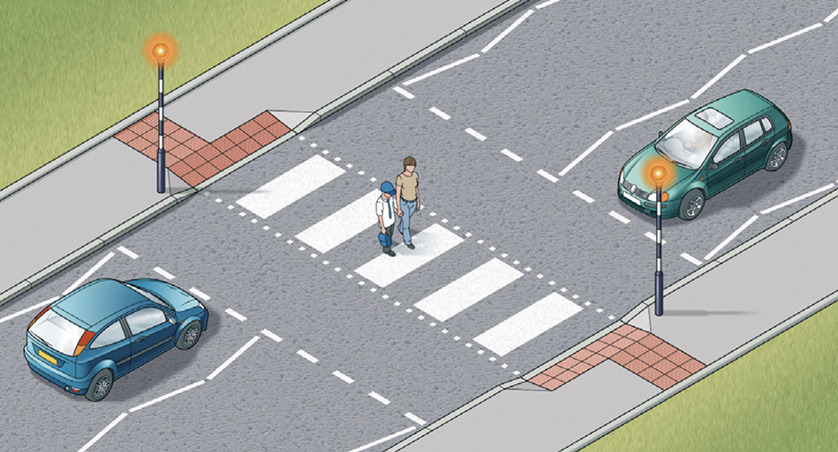
Zebra crossing
black & white stripes
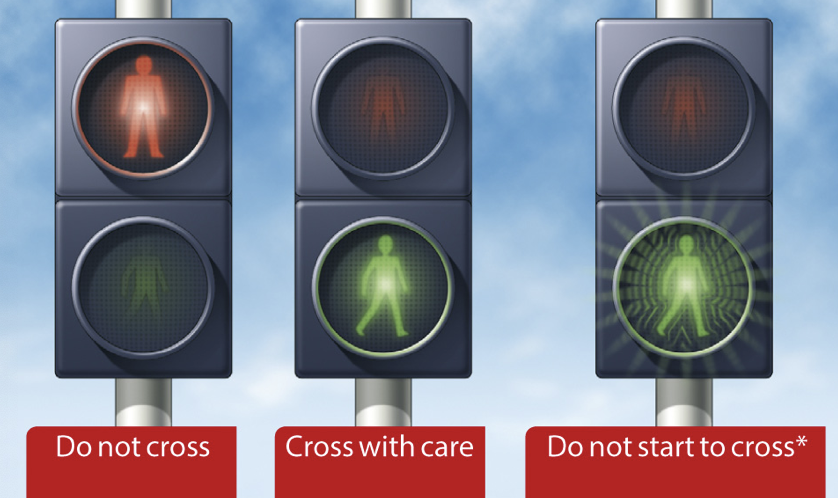
Pelican crossing
flashing green
Puffin crossing
no flashing green
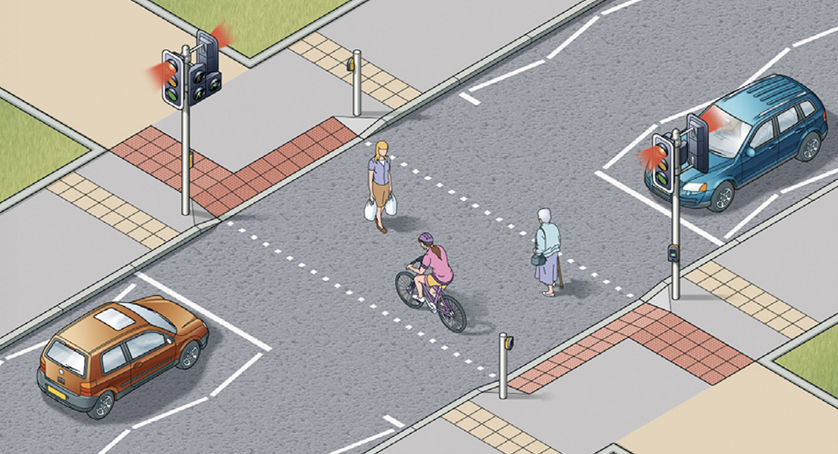
Toucan crossing
two can cross (cyclists + pedestrians)
What signals might an emergency vehicle use?
Flashing blue lights
Headlights
Sirens
When is it safe to cross after getting off a bus?
When the bus has moved off and you can see clearly in both directions.
How may tram routes be marked in pedestrian areas?
Shallow kerbs
White lines
Yellow dots
Different paving or road surfaces
Where should you cross tram tracks if possible?
At designated crossings.
Why is walking along tram tracks dangerous?
Trams are quiet and cannot steer to avoid you.
When MUST you NOT cross a railway level crossing?
When red lights show
When alarms sound
When barriers are lowering
What may a change in the crossing alarm tone on tracks mean?
Another train is approaching.
What tactile paving may warn visually impaired people of a level crossing?
Rounded raised bars across the direction of travel.
Why might a pavement be temporarily closed?
Because it is unsafe due to repairs.
How many classes of wheelchairs and mobility scooters are there?
1 class of manual wheelchair
2 classes of powered wheelchairs/mobility scooters
What is the maximum speed of a Class 2 mobility vehicle?
4 mph (6 km/h).
Where are Class 2 mobility vehicles designed to be used?
On pavements.
What is the maximum speed of a Class 3 mobility vehicle?
8 mph (12 km/h).
Where can Class 3 mobility vehicles be used?
On roads and pavements.
What type of kerb should mobility scooter users try to use when moving to the road?
Dropped kerbs.
How should you approach a kerb when climbing or descending it?
At right angles.
Why should mobility scooter and wheelchair users take extra care on roads?
they travel slowly (max 8 mph) and may be less visible to other traffic.
What are two safer alternatives for difficult right turns on a mobility scooter?
Wait on the left for a safe gap
Use the pavement and cross like a pedestrian
When MUST a mobility vehicle use a flashing amber beacon on a dual carriageway?
When used on dual carriageways with speed limits over 50 mph.
What safety equipment should all horse-drawn vehicles have?
Two red rear reflectors.
Who MUST wear a riding helmet when horse riding?
Children under 14.
Which hand should carry a light when leading a horse at night?
The right hand.
What should you check before taking a horse onto the road?
Tack fits properly
Tack is in good condition
You can control the horse
What should horse riders do before riding off or turning?
Look behind and give a clear arm signal.
When should horse riders ride in single file?
On narrow roads
On busy roads
Around bends
What type of route should horse riders use where possible?
Bridleways.
What signals should horse riders give on roundabouts?
Signal right when passing exits
Signal left before leaving
How many abreast can horse riders ride?
No more than two abreast.
How should dogs be controlled near roads?
Keep them on a short lead.
How should animals be restrained in a car?
Using a seat belt harness, pet carrier, dog cage, or dog guard.
Why should animals be restrained in vehicles?
To stop them distracting the driver or causing injury in sudden stops.
What reflectors MUST a bicycle have at night?
Red rear reflector
Amber pedal reflectors (if made after 1 October 1985)
What type of front light is recommended in areas without street lighting?
A steady front light.
Can cyclists use most bus lanes?
Yes — if signs allow it.
How much space should cyclists leave when passing parked cars?
About a door’s width or 1 metre.
At advanced stop lines, which stop line may cyclists cross on red?
The first stop line only.