Nasopharynx
 Call Kai
 Learn
Learn Practice Test
 Spaced Repetition
 Match
Match Flashcards
 Knowt Play
1/14

Earn XP
Description and Tags
Dos 543
Name | Mastery | Learn | Test | Matching | Spaced | Call with Kai |
|---|
No analytics yet
Send a link to your students to track their progress
15 Terms
Nasopharynx – Location
A cuboidal chamber located below the base of the skull and behind the nasal cavity; extends to the junction of C1–C2.
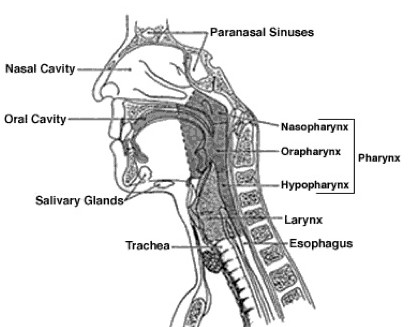
Borders of the Nasopharynx
Anterior: Posterior choanae
Posterior: Clivus and first two cervical vertebrae
Superior: Body of the sphenoid
Inferior: Soft palate
Epidemiology
Uncommon worldwide but common in China, Southeast Asia, and Eskimo populations; peaks in 4th–5th decade of life.
Major Etiologic Factors
Viral: Epstein-Barr Virus (EBV)
Genetic: HLA predisposition
Environmental: Poor ventilation, exposure to smoke/dust, and diet
Most Common Histology
Epidermoid or squamous cell carcinoma (~90% of cases).
Common Lymphatic Spread
~85% present with lymphadenopathy; most commonly to retropharyngeal (69%) and level II cervical nodes (70%).
Preferred Treatment
Radiation therapy is the treatment of choice; chemotherapy often added for improved survival. Surgery resection is not possible.
Common RT Technique
IMRT is most commonly used, using shrinking field or simultaneous integrated boost techniques to cover large and complex volumes.
Target Volumes
Volumes include: nasopharynx, adjacent parapharyngeal tissues, cervical lymphatics (jugular, spinal accessory, and supraclavicular nodes), posterior ethmoid cells, sphenoid sinus, and basisphenoid, base of skull, posterior nasal cavity and maxillary antrum, and lateral and posterior pharyngeal wall to the lower pole of tonsil, in addition to the retropharyngeal, upper cervical, mastoid, and posterior cervical lymph nodes
Bilateral anterior supraclavicular nodes are always included
Typical Dose Prescription
66–70 Gy (2.0 Gy/fx) to the primary tumor site.
Field Border – Anterior
Posterior 2 cm of nasal cavity (or 2 cm beyond tumor extension); posterior 1/3 of maxillary sinus; posterior ethmoid sinuses; posterior ¼ of orbit.
Field Border – Posterior
Extends behind spinous processes to include retropharyngeal nodes, posterior pharyngeal wall, and deep cervical nodes.
Field Border – Superior
Includes entire sphenoid sinus, cavernous sinus, and base of skull with at least a 0.5 cm margin.
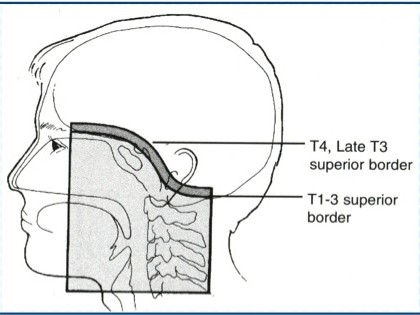
Lower Neck and Supraclavicular Coverage
Bilateral anterior supraclavicular nodes and lower cervical nodes are included due to high risk of spread.
Brachytherapy Use
May be used as interstitial or intracavitary implants or recently HDR afterloading to boost residual nasopharyngeal disease.