Gram Positive Cocci

0.0(0)
Studied by 0 people
call kaiCall Kai
learnLearn
examPractice Test
spaced repetitionSpaced Repetition
heart puzzleMatch
flashcardsFlashcards
GameKnowt Play
Card Sorting

1/24

encourage image

There's no tags or description

Looks like no tags are added yet.

Last updated 2:45 PM on 4/13/26
Name
Mastery
Learn
Test
Matching
Spaced
Call with Kai

No analytics yet

Send a link to your students to track their progress

25 Terms
1
New cards
term image
knowt flashcard image
2
New cards
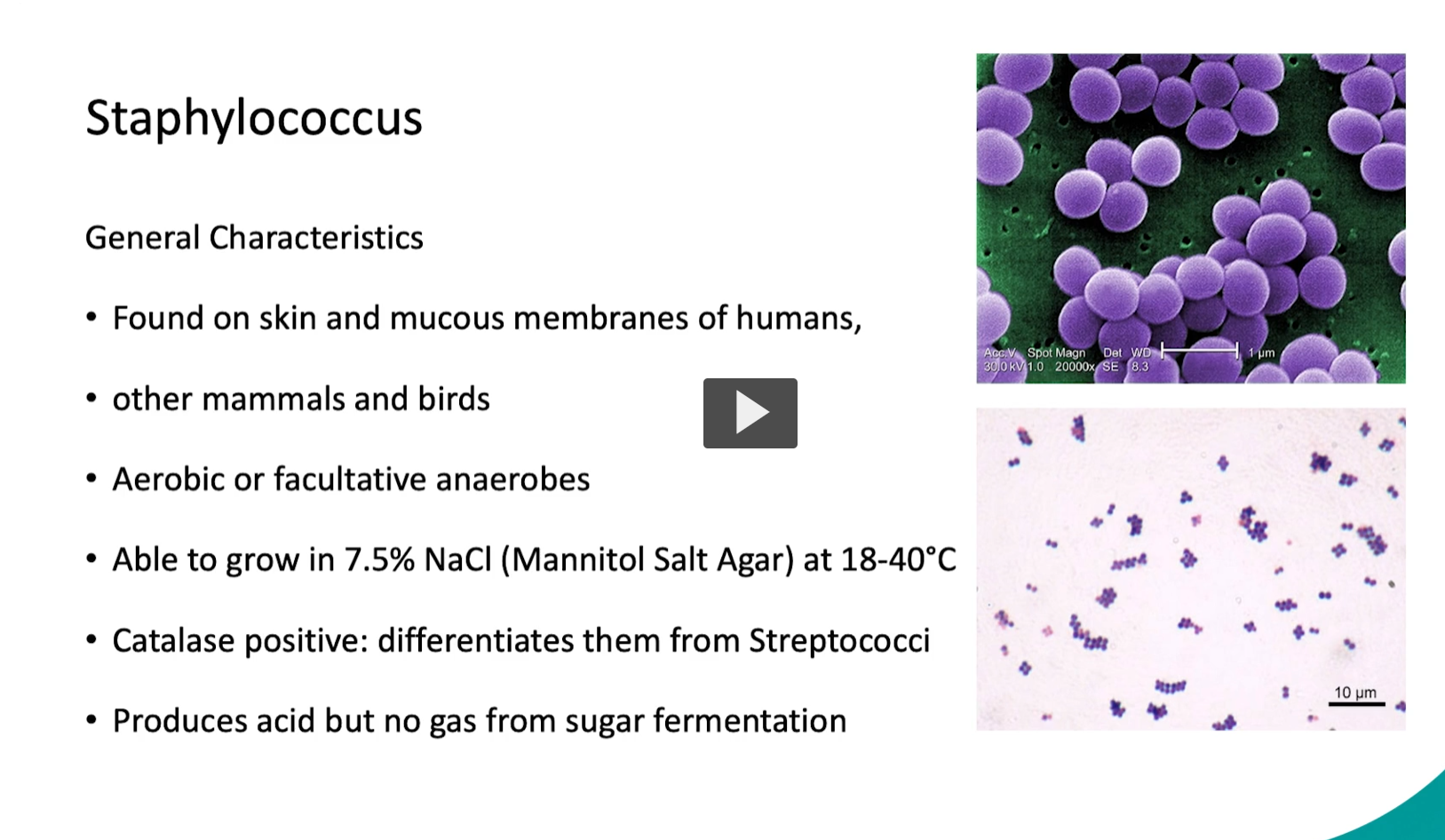
<p><strong>Etymology</strong> </p><ul><li><p><strong>“staphylo-”</strong> → from Greek <em>staphylē</em> = <strong>“bunch of grapes” </strong><span data-name="grapes" data-type="emoji">🍇</span></p></li><li><p><strong>“-coccus”</strong> → from Greek <em>kokkos</em> = <strong>“berry” or “round grain”</strong></p></li></ul><p><span data-name="point_right" data-type="emoji">👉</span> So literally:<br><strong>“grape-like clusters of round bacteria”</strong></p><p><strong>Staphylococcus</strong> =<br>A genus of <strong>Gram-positive, spherical (cocci) bacteria</strong> that:</p><ul><li><p>Appear in <strong>grape-like clusters</strong> under the microscope</p></li><li><p>Are commonly found on <strong>skin and mucous membranes</strong></p></li><li><p>Are <strong>catalase-positive</strong> (helps distinguish from Streptococcus)</p></li><li><p>Can be <strong>aerobic or facultative anaerobes</strong></p></li><li><p>Some species are <strong>normal flora</strong>, while others cause infections (e.g., skin infections, abscesses)</p></li></ul><p></p>

Etymology

  • “staphylo-” → from Greek staphylÄ“ = “bunch of grapes” 🍇

  • “-coccus” → from Greek kokkos = “berry” or “round grain”

👉 So literally:
“grape-like clusters of round bacteria”

Staphylococcus =
A genus of Gram-positive, spherical (cocci) bacteria that:

  • Appear in grape-like clusters under the microscope

  • Are commonly found on skin and mucous membranes

  • Are catalase-positive (helps distinguish from Streptococcus)

  • Can be aerobic or facultative anaerobes

  • Some species are normal flora, while others cause infections (e.g., skin infections, abscesses)

Key Species (with meaning)

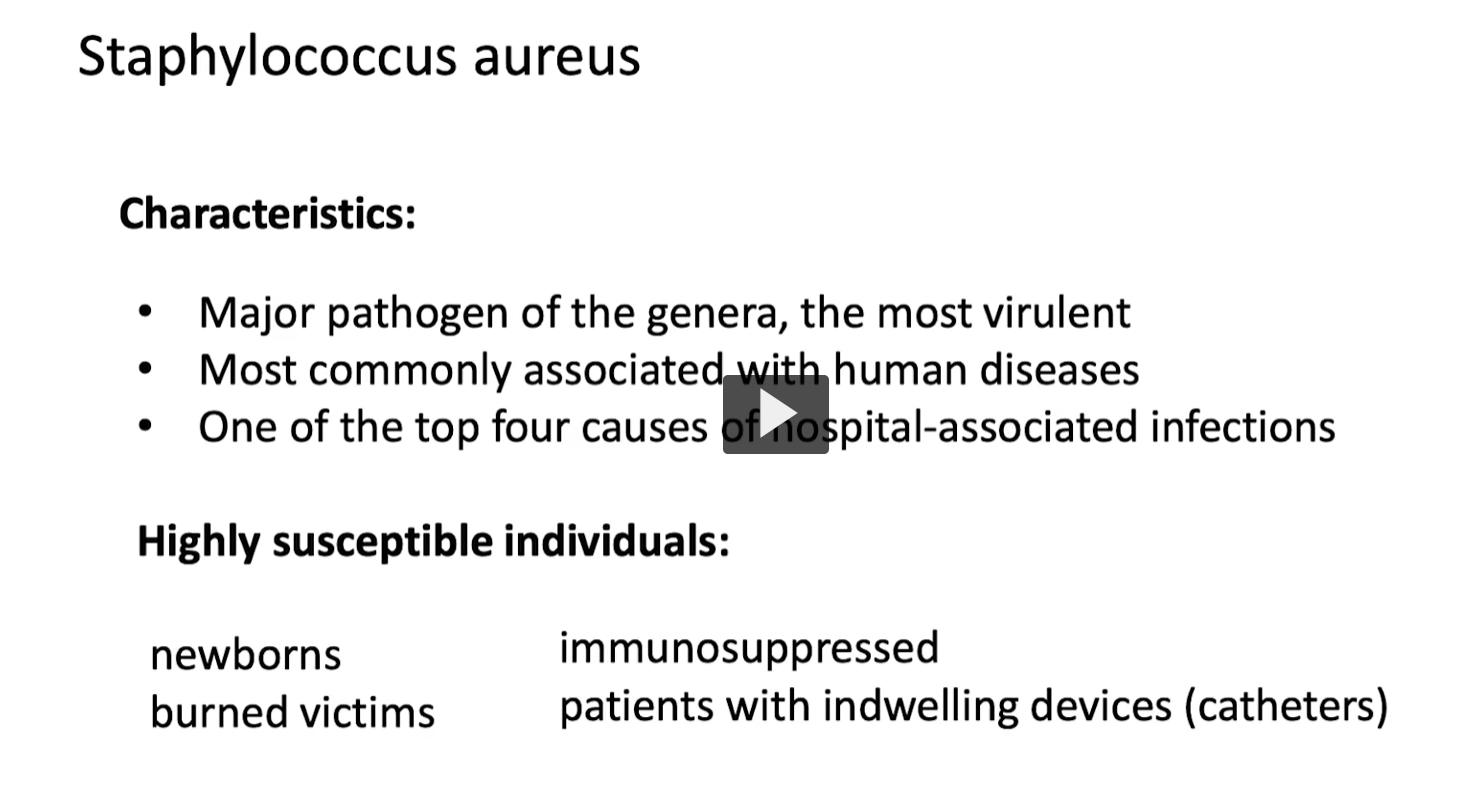
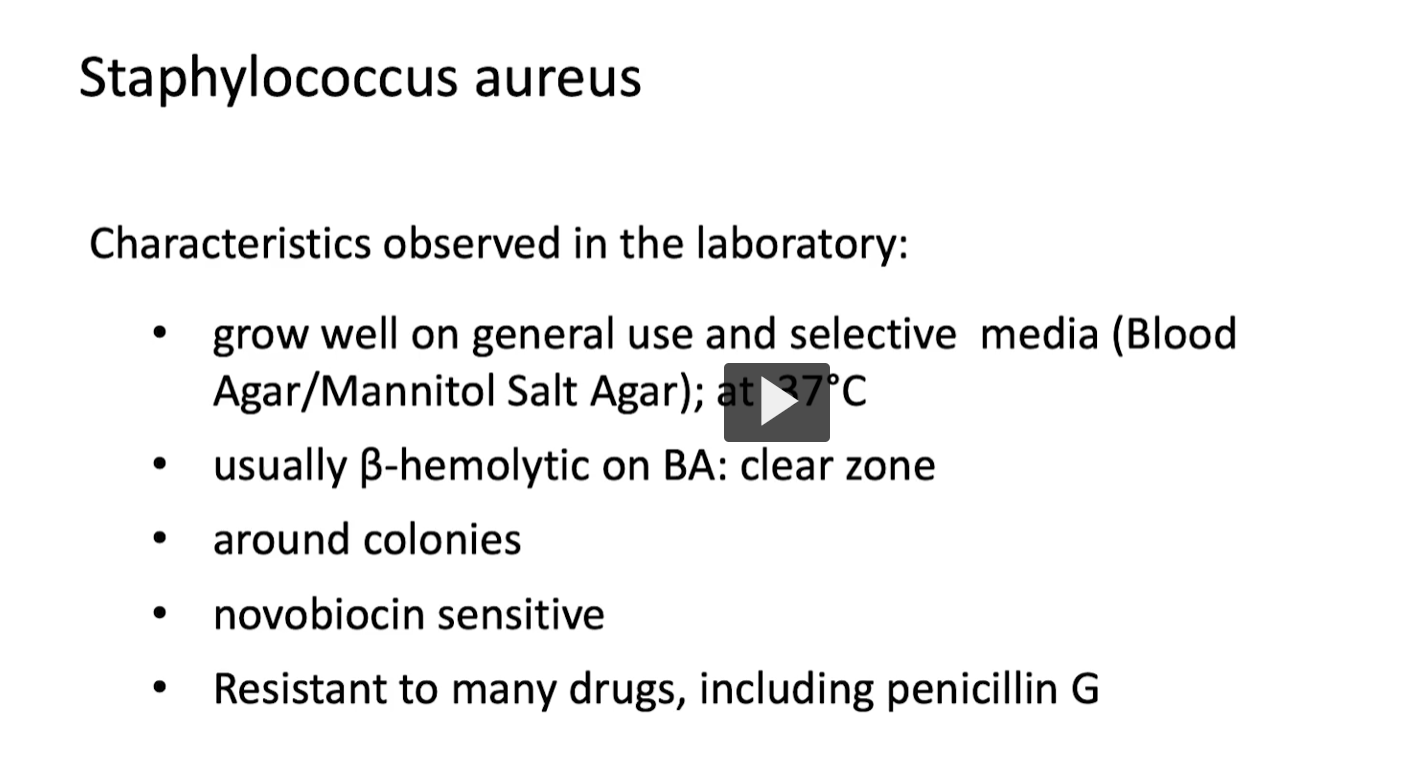
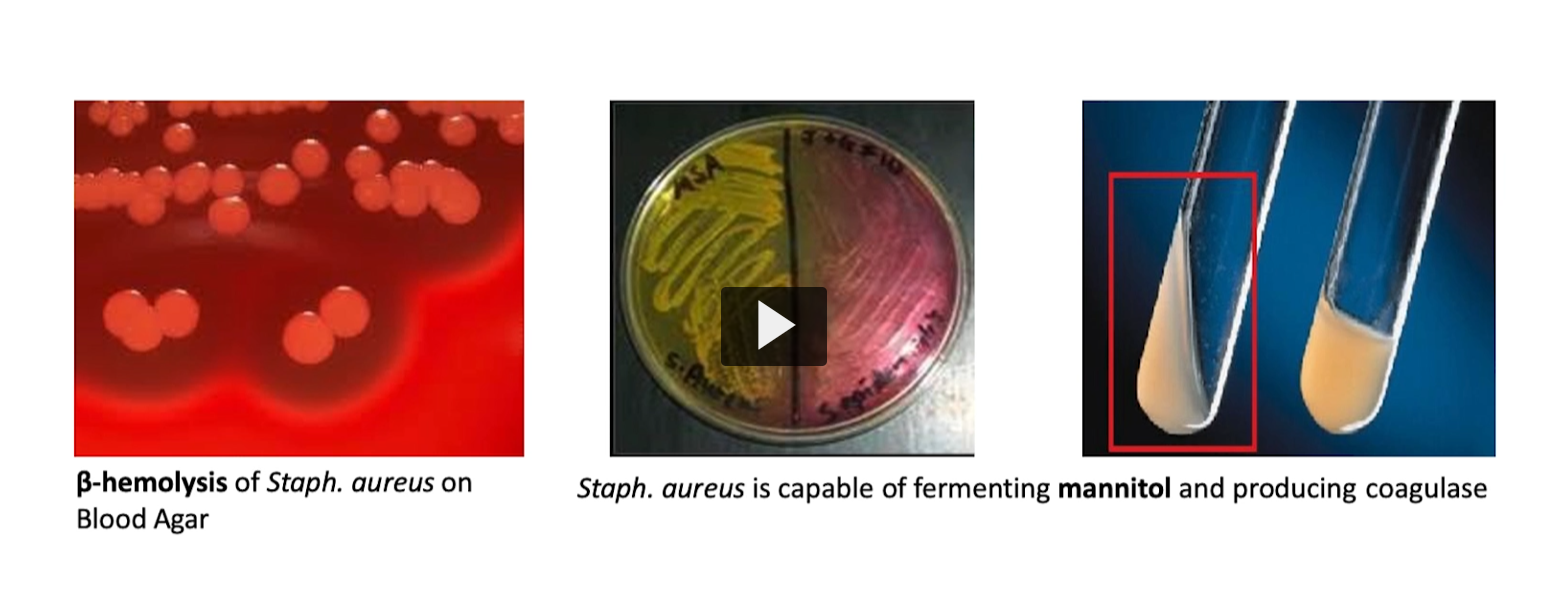
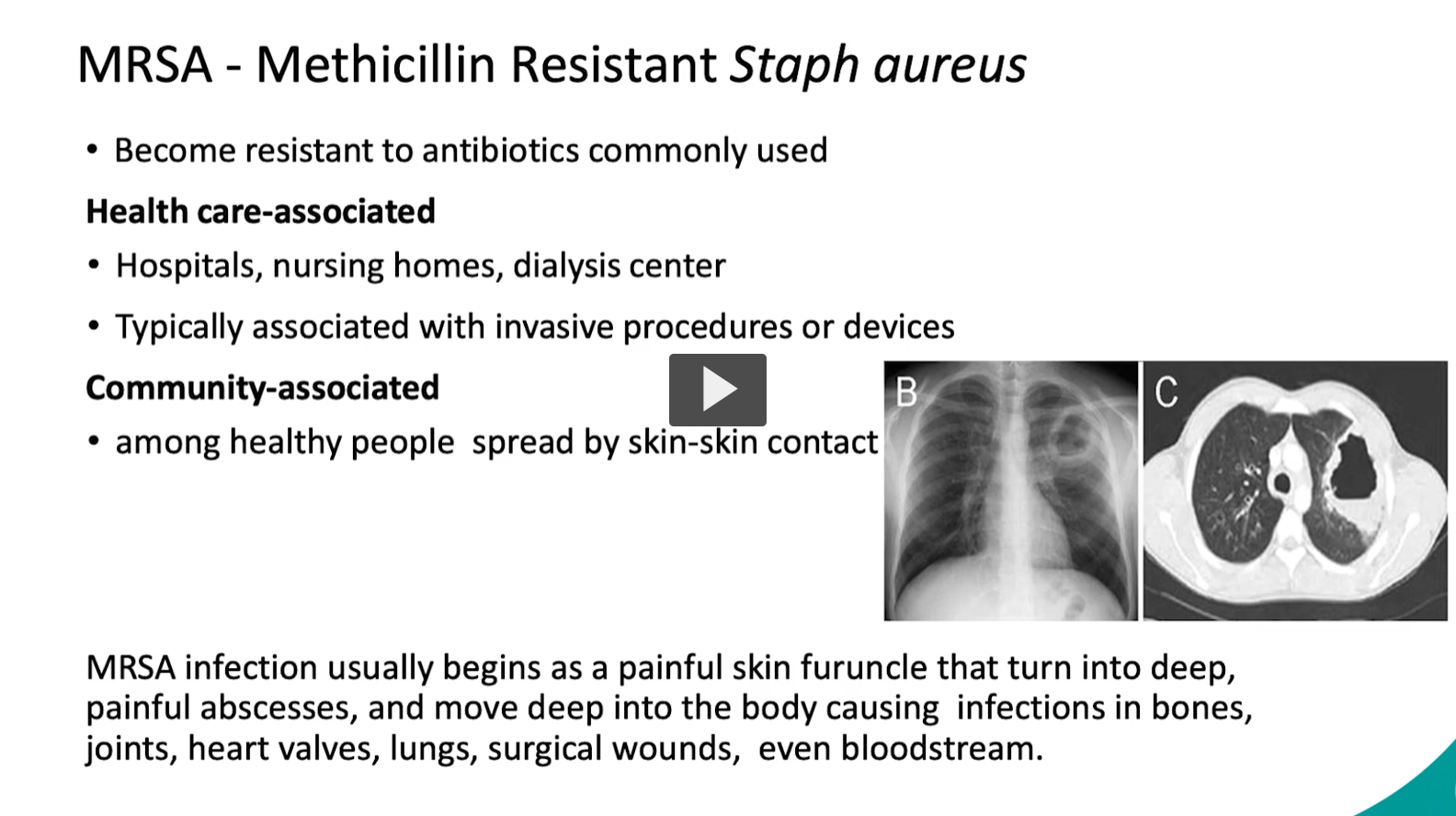
  • Staphylococcus aureus

    • aureus = Latin “golden” → forms gold-colored colonies

  • Staphylococcus epidermidis

    • epidermidis = “of the skin” → normal skin flora

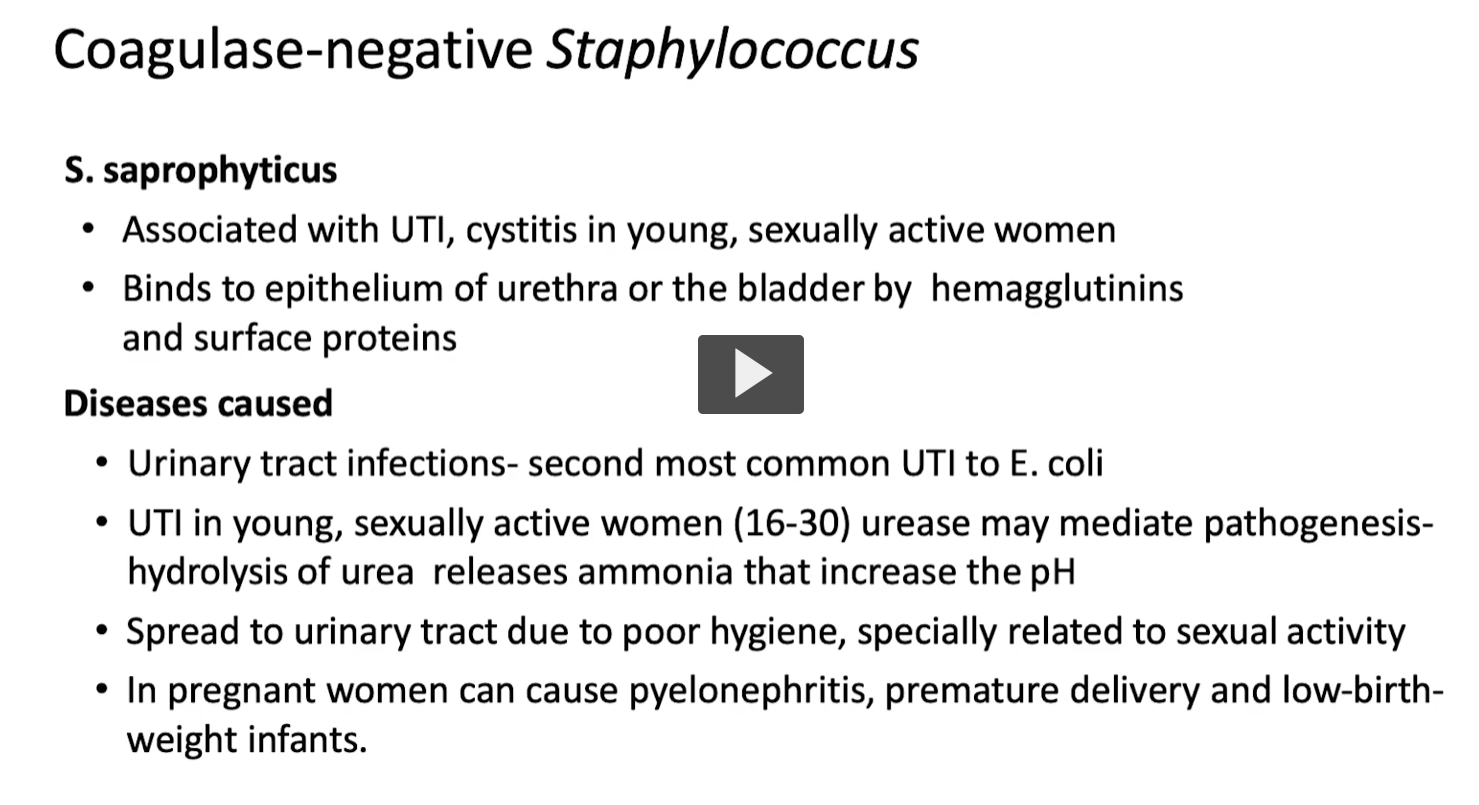
  • Staphylococcus saprophyticus

    • saprophyticus = “feeding on dead/organic matter

Clinical Features (from your slide, explained)

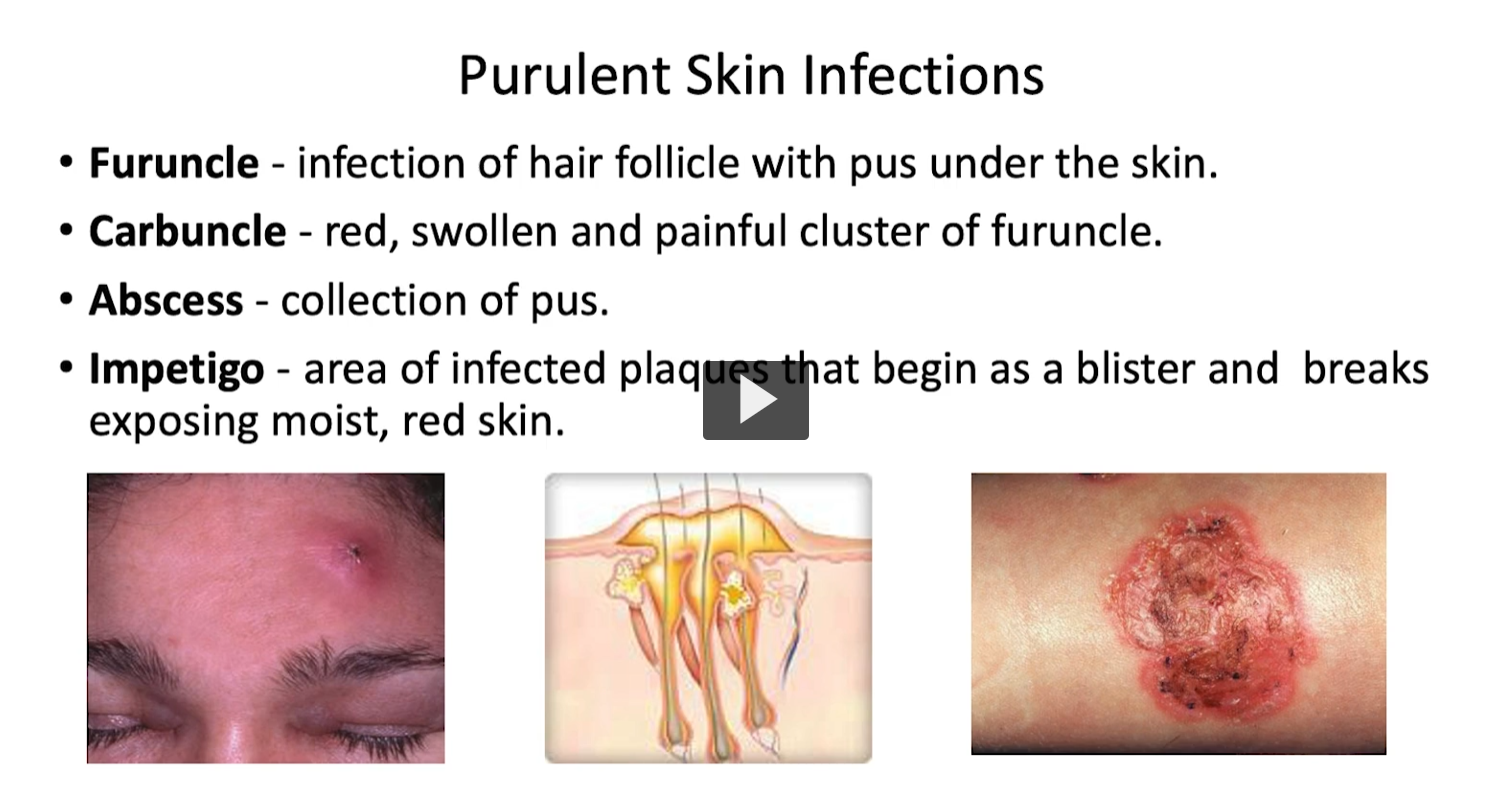
1. Purulent skin infections

  • Folliculitis → infection of hair follicles

  • Impetigo → superficial skin infection (often honey-colored crusts)

  • Carbuncles → deeper, connected abscesses
    👉 Mostly caused by S. aureus

2. UTI

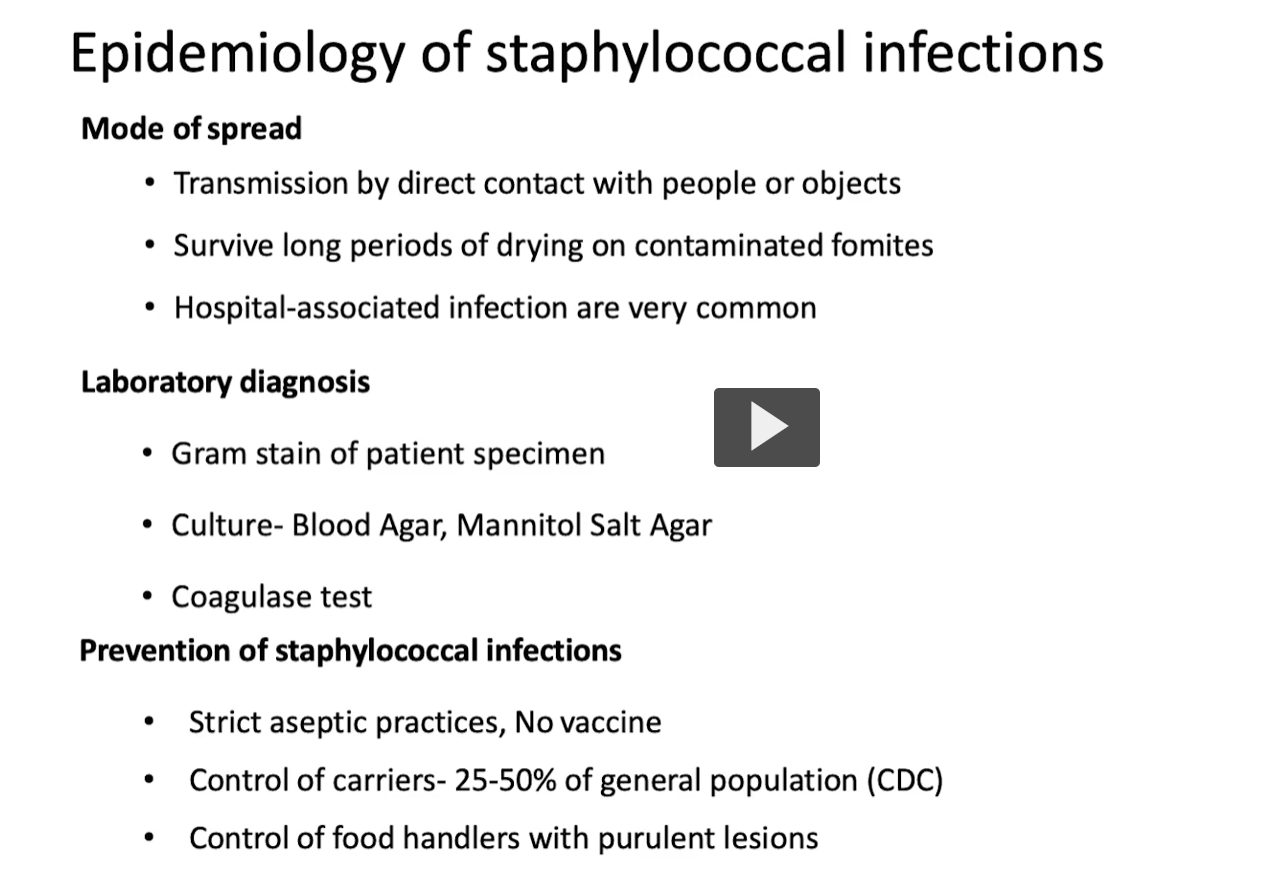
  • Commonly caused by S. saprophyticus
    👉 Especially in young sexually active women

3. Opportunistic / Hospital-acquired infections

  • Seen in hospitalized or immunocompromised patients
    👉 Often S. epidermidis (less virulent but opportunistic)

4. Systemic diseases

  • Pneumonia

  • Bacteremia (bacteria in blood)

  • Wound infections
    👉 Mainly S. aureus → more aggressive
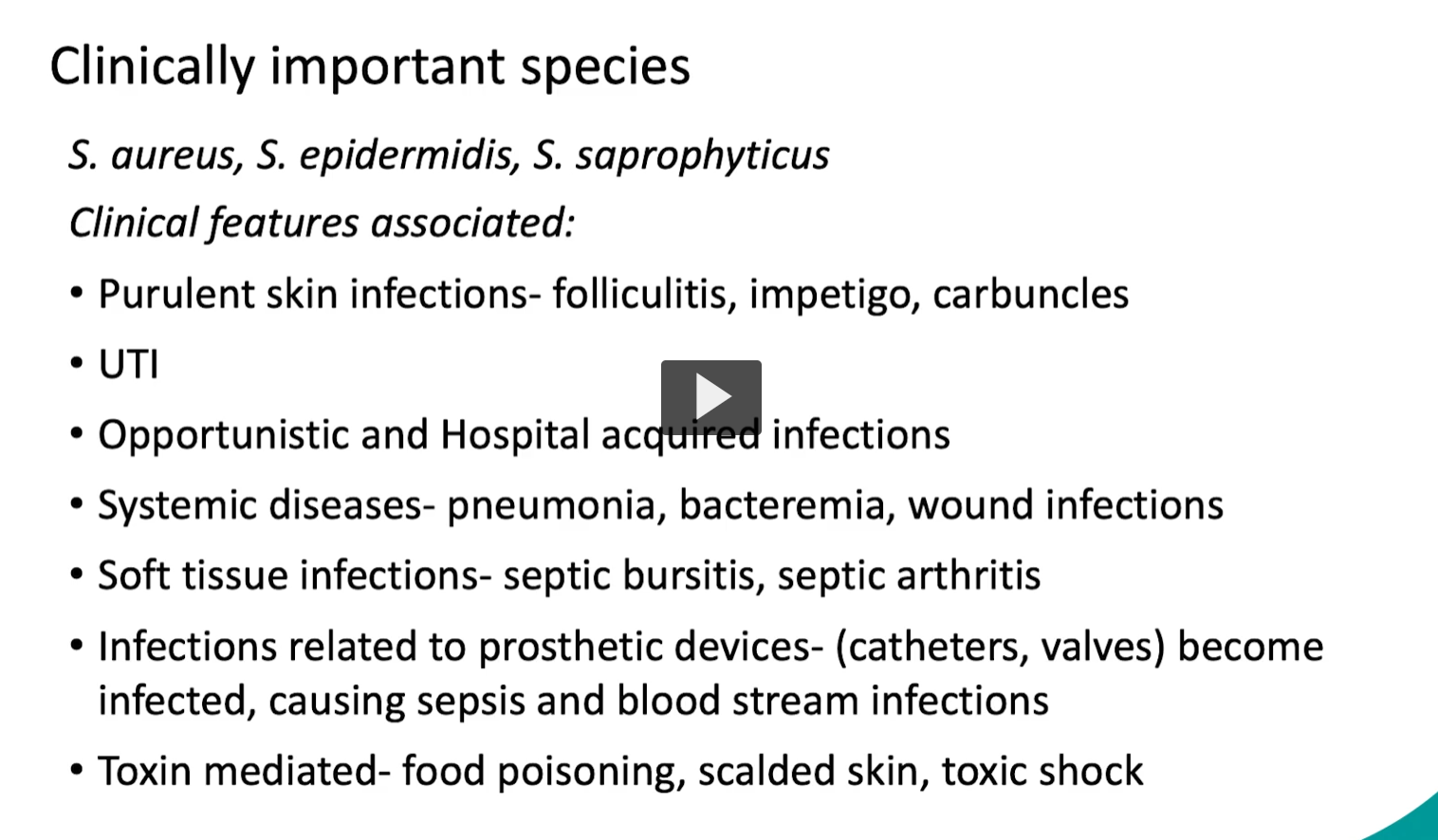
<p>Key Species (with meaning) </p><ul><li><p><strong>Staphylococcus aureus</strong></p><ul><li><p><em>aureus</em> = Latin <strong>“golden”</strong> → forms <strong>gold-colored colonies</strong></p></li></ul></li><li><p><strong>Staphylococcus epidermidis</strong></p><ul><li><p><em>epidermidis</em> = <strong>“of the skin”</strong> → normal <strong>skin flora</strong></p></li></ul></li><li><p><strong>Staphylococcus saprophyticus</strong></p><ul><li><p><em>saprophyticus</em> = <strong>“feeding on dead/organic matter</strong></p></li></ul></li></ul><p>Clinical Features (from your slide, explained) </p><p><strong>1. Purulent skin infections</strong> </p><ul><li><p><strong>Folliculitis</strong> → infection of hair follicles</p></li><li><p><strong>Impetigo</strong> → superficial skin infection (often honey-colored crusts)</p></li><li><p><strong>Carbuncles</strong> → deeper, connected abscesses<br><span data-name="point_right" data-type="emoji">👉</span> Mostly caused by <strong>S. aureus</strong></p></li></ul><p><strong>2. UTI</strong> </p><ul><li><p>Commonly caused by <strong>S. saprophyticus</strong><br><span data-name="point_right" data-type="emoji">👉</span> Especially in <strong>young sexually active women</strong></p></li></ul><p><strong>3. Opportunistic / Hospital-acquired infections</strong> </p><ul><li><p>Seen in hospitalized or immunocompromised patients<br><span data-name="point_right" data-type="emoji">👉</span> Often <strong>S. epidermidis</strong> (less virulent but opportunistic)</p></li></ul><p><strong>4. Systemic diseases</strong> </p><ul><li><p><strong>Pneumonia</strong></p></li><li><p><strong>Bacteremia</strong> (bacteria in blood)</p></li><li><p><strong>Wound infections</strong><br><span data-name="point_right" data-type="emoji">👉</span> Mainly <strong>S. aureus</strong> → more aggressive</p></li></ul><p></p>
3
New cards

Folliticulis: S. aureus

Etymology

  • “follicul-” → from Latin folliculus = “small bag” or “sac” (hair follicle)

  • “-itis” → Greek = “inflammation”

Folliculitis = inflammation of a hair follicle

Common Causes

  • Most common: Staphylococcus aureus

why?

Step-by-Step Mechanism 1. Normal colonizer of skin

  • S. aureus commonly lives on:

    • Skin

    • Nose (nares)
      👉 So it’s already in the right place


2. Entry into hair follicle

  • Hair follicles are natural openings in the skin

  • Entry is easier when:

    • Shaving (micro-cuts)

    • Friction (tight clothes)

    • Sweat/occlusion

👉 Bacteria get trapped inside the follicle


3. Adhesion + colonization

  • S. aureus has adhesins (surface proteins) that stick to:

    • Keratin

    • Extracellular matrix

👉 Helps it anchor inside the follicle


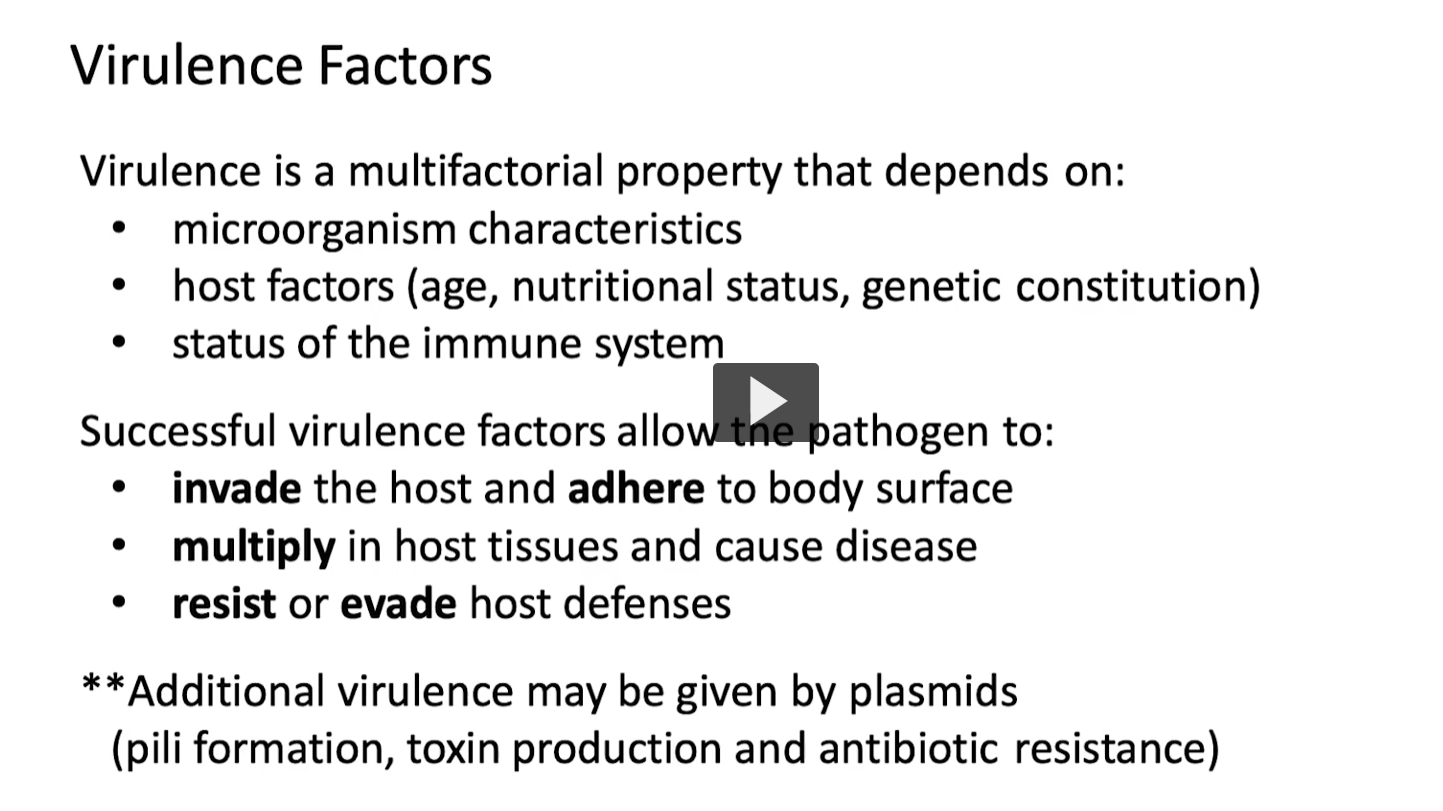
4. Virulence factors → tissue damage

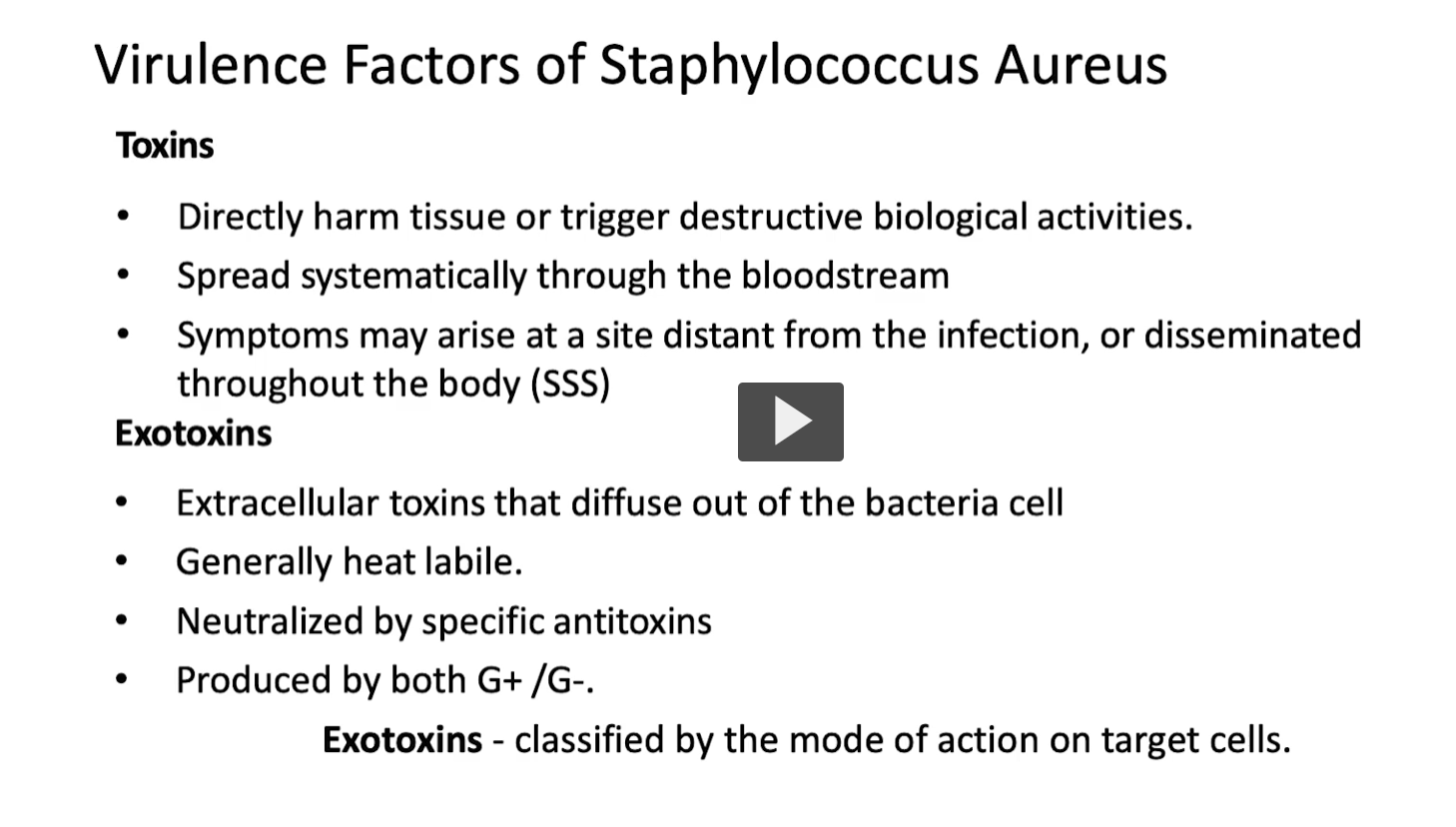
S. aureus produces:

  • Coagulase → forms fibrin “shield” (hides from immune system)

  • Cytotoxins (e.g., leukocidins) → kill immune cells

  • Enzymes → break down tissue

👉 This allows local invasion and survival


5. Strong neutrophil response → PUS

  • Immune system sends neutrophils

  • Bacteria + dead neutrophils + debris = pus

👉 That’s why folliculitis looks like:

  • Small pustules centered on hair

Opportunistic / Hospital-acquired infections

  • Seen in hospitalized or immunocompromised patients
    👉 Often S. epidermidis (less virulent but opportunistic)

4
New cards

2. UTI

  • Commonly caused by S. saprophyticus
    👉 Especially in young sexually active women

Because S. saprophyticus colonizes the genital/perineal area, adheres strongly to the urinary tract, and is mechanically introduced into the bladder during sexual activity.

Step-by-step explanation 1. Normal colonization near the urethra

  • S. saprophyticus lives in:

    • Perineum (skin around genitals)

    • Vaginal flora

👉 So it’s already right next to the urethral opening

2. Female anatomy = short urethra

  • Female urethra is:

    • Short (~4 cm)

    • Close to vagina + anus

👉 Bacteria have a very short distance to reach the bladder

3. Sexual activity = mechanical transfer

  • During intercourse:

    • Bacteria are pushed into the urethra

👉 This is why UTIs are sometimes called:

  • “Honeymoon cystitis”

5
New cards
term image
knowt flashcard image
6
New cards
term image
knowt flashcard image
7
New cards
term image
knowt flashcard image
8
New cards
<p></p>

α-toxin (most high-yield)

a-toxin (alpha-toxin) is named for being the first of several hemolysins identified from Staphylococcus aureus.

Mechanism: Forms pores in cell membranes

Effects:

  • Damages:

    • RBCs

    • WBCs

    • Platelets

  • Disrupts smooth muscle in blood vessels

  • Causes:

    • Tissue necrosis

    • Severe local damage

👉 Think: “punches holes in cells → everything leaks out → cell dies”


⚠ β-toxin

  • Works with α-toxin

  • Enhances tissue destruction

β-toxin = “the second classified toxin” produced by the bacterium

  • The Greek letters (α, β, Îł, δ) are just a naming system, not describing structure directly

  • So β-toxin literally means: “the second toxin (poison) identified in this group


Why this matters clinically

These toxins explain why S. aureus causes:

  • Pus (kills neutrophils)

  • Abscesses (localized destruction)

  • Necrotic skin infections

<p><strong>α-toxin (most high-yield)</strong></p><p>a-toxin (alpha-toxin) is named for being the first of several hemolysins identified from <em>Staphylococcus aureus</em>.</p><p><strong>Mechanism: </strong>Forms <strong>pores in cell membranes</strong></p><p><strong>Effects:</strong></p><ul><li><p>Damages:</p><ul><li><p><strong>RBCs</strong></p></li><li><p><strong>WBCs</strong></p></li><li><p><strong>Platelets</strong></p></li></ul></li><li><p>Disrupts <strong>smooth muscle in blood vessels</strong></p></li><li><p>Causes:</p><ul><li><p><strong>Tissue necrosis</strong></p></li><li><p><strong>Severe local damage</strong></p></li></ul></li></ul><p><span data-name="point_right" data-type="emoji">👉</span> Think: <strong>“punches holes in cells → everything leaks out → cell dies”</strong></p><div data-type="horizontalRule"><hr></div><p><span data-name="warning" data-type="emoji">⚠</span> <strong>β-toxin</strong></p><ul><li><p>Works <strong>with α-toxin</strong></p></li><li><p>Enhances <strong>tissue destruction</strong></p></li></ul><p><strong>β-toxin = “the second classified toxin” produced by the bacterium</strong></p><ul><li><p>The <strong>Greek letters (α, β, γ, δ)</strong> are just a <strong>naming system</strong>, not describing structure directly</p></li><li><p>So <strong>β-toxin</strong> literally means: <strong>“the second toxin (poison) identified in this group</strong></p></li></ul><div data-type="horizontalRule"><hr></div><p><strong>Why this matters clinically</strong></p><p>These toxins explain why <em>S. aureus</em> causes:</p><ul><li><p><strong>Pus (kills neutrophils)</strong></p></li><li><p><strong>Abscesses (localized destruction)</strong></p></li><li><p><strong>Necrotic skin infections</strong></p></li></ul><p></p>
9
New cards
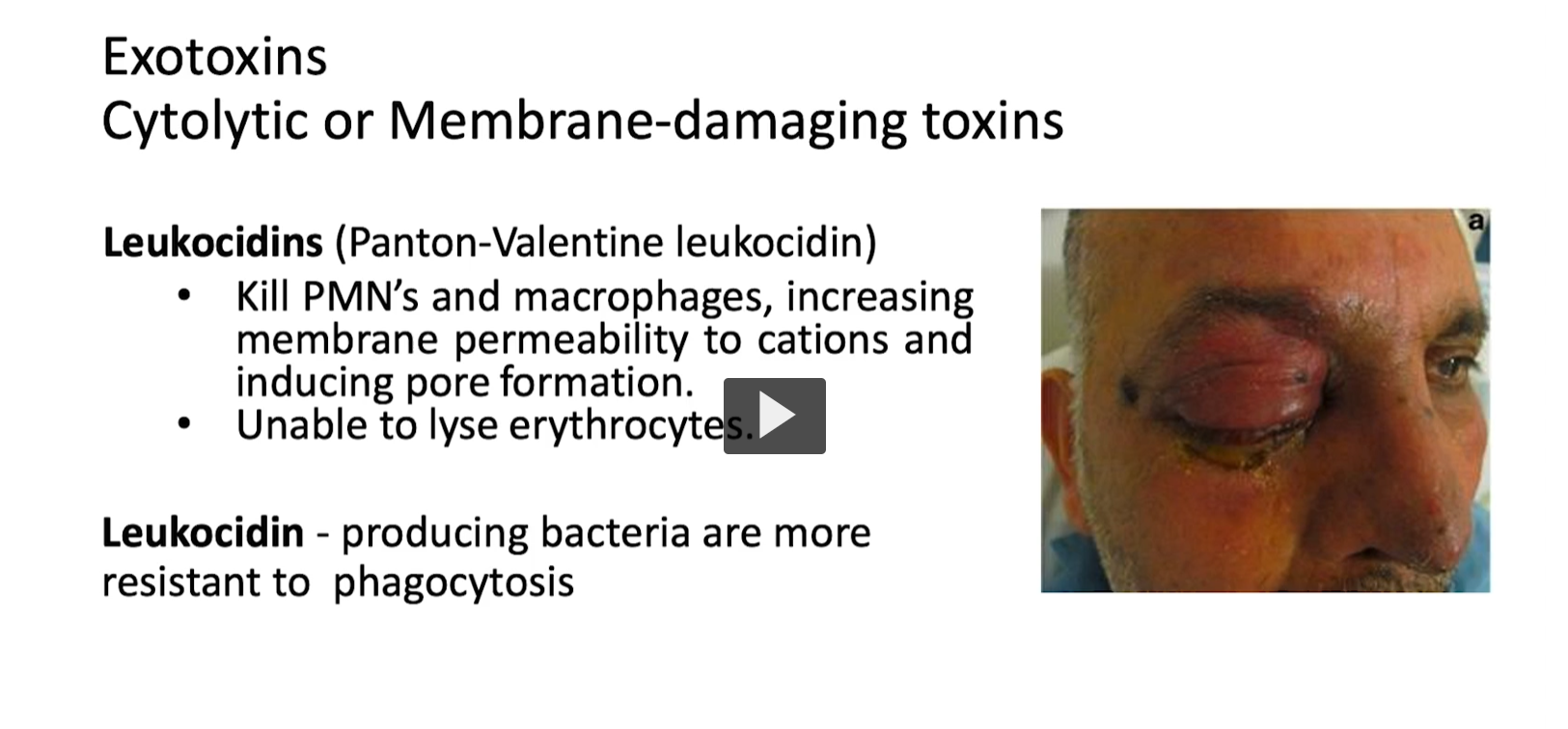
<ul><li><p><strong>“leuko-”</strong> → from Greek <em>leukos</em> = <strong>“white”</strong></p></li><li><p><strong>“-cidin”</strong> → from Latin <em>caedere</em> = <strong>“to kill”</strong></p></li></ul><p><span data-name="point_right" data-type="emoji">👉</span> <strong>Leukocidin = “white cell killer”</strong></p><div data-type="horizontalRule"><hr></div><p><strong>Definition</strong></p><p><strong>Leukocidins</strong> are <strong>exotoxins</strong> produced by <em>Staphylococcus aureus</em> that:</p><ul><li><p><strong>Kill white blood cells</strong> (especially neutrophils and macrophages)</p></li><li><p>Work by:</p><ul><li><p><strong>Forming pores in cell membranes</strong></p></li><li><p>Increasing permeability → cells swell and burst</p></li></ul></li></ul><p></p>
  • “leuko-” → from Greek leukos = “white”

  • “-cidin” → from Latin caedere = “to kill”

👉 Leukocidin = “white cell killer”


Definition

Leukocidins are exotoxins produced by Staphylococcus aureus that:

  • Kill white blood cells (especially neutrophils and macrophages)

  • Work by:

    • Forming pores in cell membranes

    • Increasing permeability → cells swell and burst

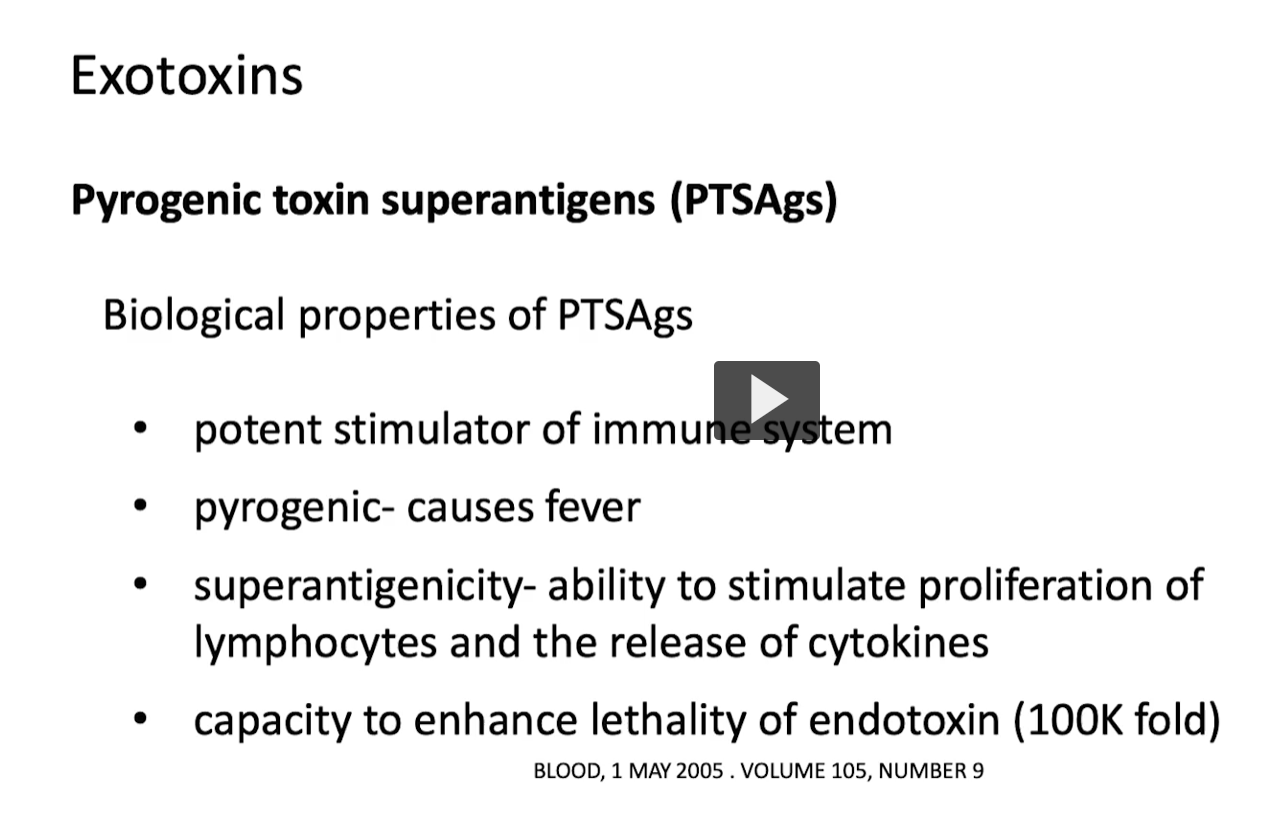
1. Pyrogenic

  • “pyro-” → Greek pyr = fire 🔥

  • “-genic” → “producing”

👉 Pyrogenic = “fever-producing”


2. Toxin

  • From Greek toxikon = poison (originally arrow poison)

👉 Toxin = a poisonous substance produced by organisms


3. Superantigen

  • “super-” = excessive / above normal

  • “antigen” = substance that stimulates immune response

👉 Superantigen = an antigen that overstimulates the immune system


Definition

Pyrogenic toxin superantigens (PTSAgs) are exotoxins produced by Staphylococcus aureus that:

👉 Massively activate the immune system in a non-specific way, causing:

  • Widespread T-cell activation

  • Huge cytokine release (cytokine storm)

  • Fever and systemic inflammation

<p><strong>1. Pyrogenic</strong> </p><ul><li><p><strong>“pyro-”</strong> → Greek <em>pyr</em> = <strong>fire </strong><span data-name="fire" data-type="emoji">🔥</span></p></li><li><p><strong>“-genic”</strong> → “producing”</p></li></ul><p><span data-name="point_right" data-type="emoji">👉</span> <strong>Pyrogenic = “fever-producing”</strong></p><div data-type="horizontalRule"><hr></div><p> <strong>2. Toxin</strong> </p><ul><li><p>From Greek <em>toxikon</em> = <strong>poison (originally arrow poison)</strong></p></li></ul><p><span data-name="point_right" data-type="emoji">👉</span> <strong>Toxin = a poisonous substance produced by organisms</strong></p><div data-type="horizontalRule"><hr></div><p> <strong>3. Superantigen</strong> </p><ul><li><p><strong>“super-”</strong> = excessive / above normal</p></li><li><p><strong>“antigen”</strong> = substance that stimulates immune response</p></li></ul><p> </p><p><span data-name="point_right" data-type="emoji">👉</span> <strong>Superantigen = an antigen that overstimulates the immune system</strong></p><div data-type="horizontalRule"><hr></div><p> <strong>Definition</strong> </p><p><strong>Pyrogenic toxin superantigens (PTSAgs)</strong> are <strong>exotoxins</strong> produced by <em>Staphylococcus aureus</em> that:</p><p><span data-name="point_right" data-type="emoji">👉</span> <strong>Massively activate the immune system in a non-specific way</strong>, causing:</p><ul><li><p><strong>Widespread T-cell activation</strong></p></li><li><p><strong>Huge cytokine release (cytokine storm)</strong></p></li><li><p><strong>Fever and systemic inflammation</strong></p></li></ul><p></p>
10
New cards
term image

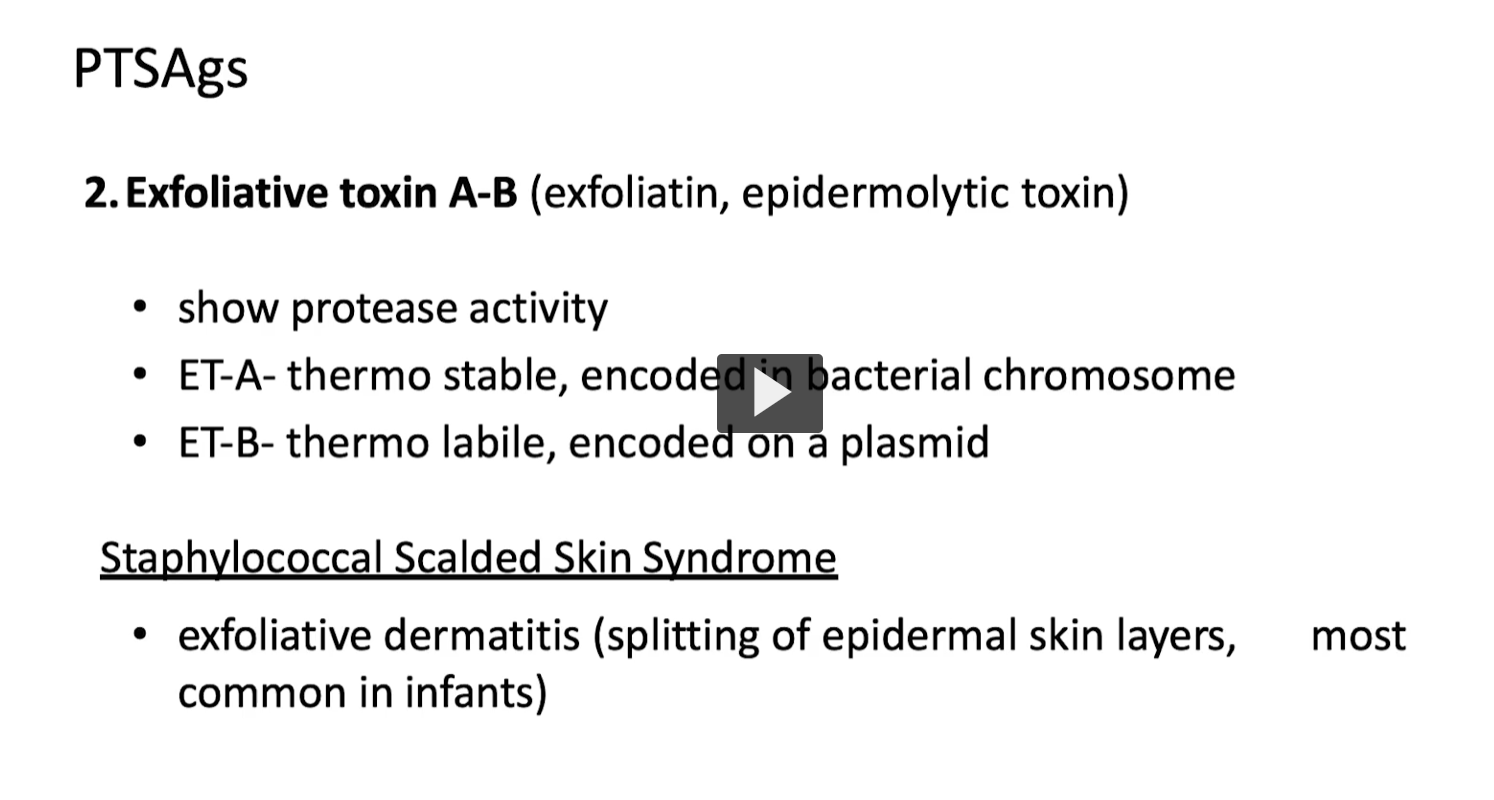
Exfoliative

  • “ex-” = out / away

  • “folium” (Latin) = leaf

👉 Exfoliate = “to peel off like leaves”


2. Toxin

  • From Greek toxikon = poison


3. Exfoliatin / Epidermolytic

  • “epidermo-” = epidermis (outer skin layer)

  • “-lytic” = breaking

👉 Epidermolytic toxin = “breaks the outer skin layer”


Definition

Exfoliative toxin (A & B) is an exotoxin produced by Staphylococcus aureus that:

👉 Acts as a protease to:

  • Break down proteins that hold skin cells together


🔬 Mechanism (HIGH-YIELD)

  • Targets desmoglein-1 (cell adhesion protein in epidermis)

  • Causes:

    • Separation of epidermal layers

    • Skin cells lose attachment → peeling

👉 Think:
“cuts the glue between skin cells”


âš  Types (from your slide)

  • ET-A

    • Heat (thermo) stable

    • Chromosome-encoded

  • ET-B

    • Heat labile

    • Plasmid-encoded


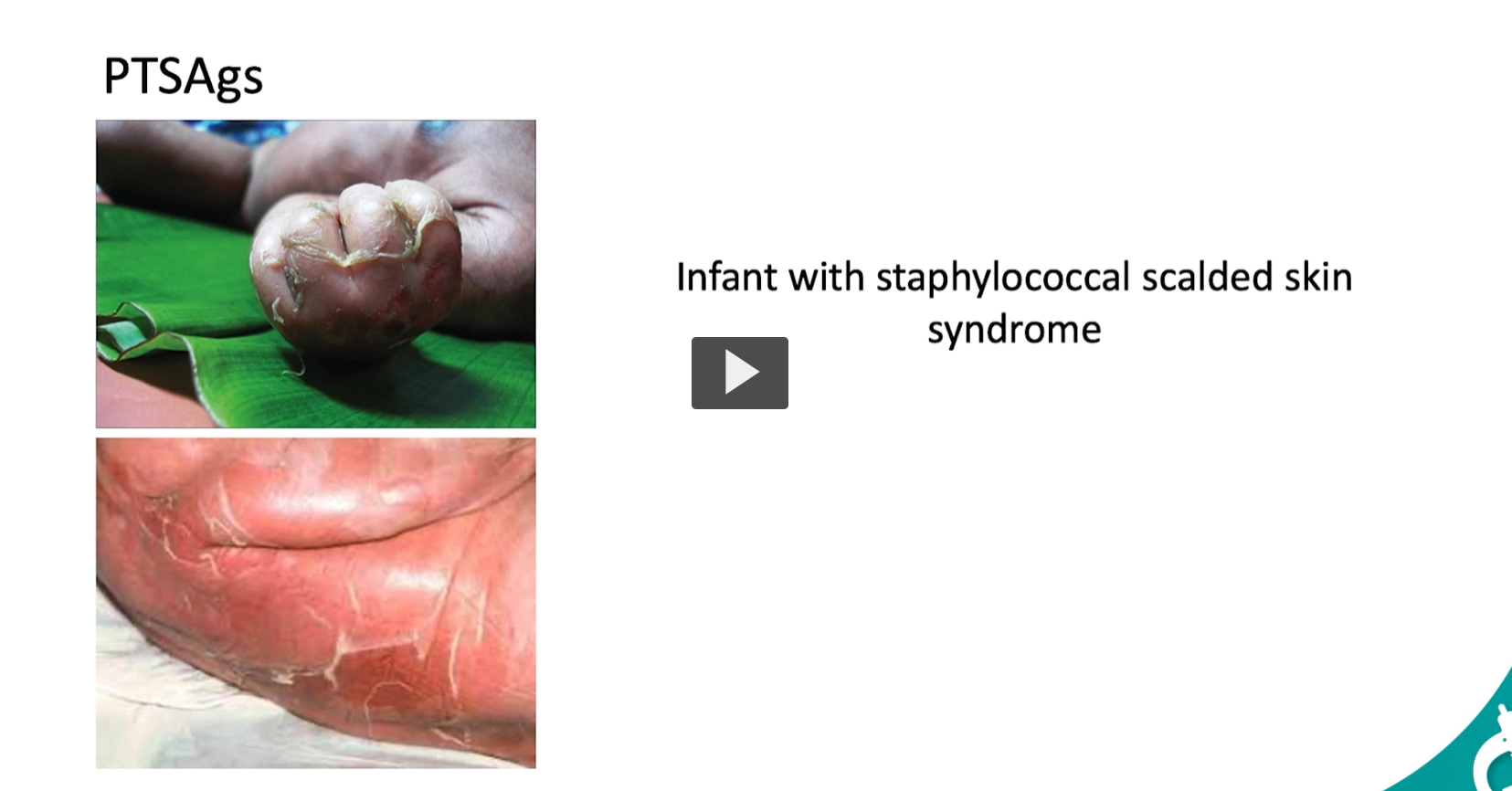
🩺 Clinical Effect Staphylococcal Scalded Skin Syndrome (SSSS)

  • Skin looks like it’s been burned/scalded

  • Features:

    • Blistering

    • Peeling (exfoliation)

    • Positive Nikolsky sign (skin slips off easily)

  • Most common in:

    • Infants

<p><strong>Exfoliative</strong></p><ul><li><p><strong>“ex-”</strong> = out / away</p></li><li><p><strong>“folium” (Latin)</strong> = leaf</p></li></ul><p><span data-name="point_right" data-type="emoji">👉</span> <strong>Exfoliate = “to peel off like leaves”</strong></p><div data-type="horizontalRule"><hr></div><p><strong>2. Toxin</strong></p><ul><li><p>From Greek <em>toxikon</em> = <strong>poison</strong></p></li></ul><div data-type="horizontalRule"><hr></div><p><strong>3. Exfoliatin / Epidermolytic</strong></p><ul><li><p><strong>“epidermo-”</strong> = epidermis (outer skin layer)</p></li><li><p><strong>“-lytic”</strong> = breaking</p></li></ul><p><span data-name="point_right" data-type="emoji">👉</span> <strong>Epidermolytic toxin = “breaks the outer skin layer”</strong></p><div data-type="horizontalRule"><hr></div><p><strong>Definition</strong></p><p><strong>Exfoliative toxin (A &amp; B)</strong> is an <strong>exotoxin</strong> produced by <em>Staphylococcus aureus</em> that:</p><p><span data-name="point_right" data-type="emoji">👉</span> <strong>Acts as a protease</strong> to:</p><ul><li><p><strong>Break down proteins that hold skin cells together</strong></p></li></ul><div data-type="horizontalRule"><hr></div><p><span data-name="microscope" data-type="emoji">🔬</span> <strong>Mechanism (HIGH-YIELD)</strong></p><ul><li><p>Targets <strong>desmoglein-1</strong> (cell adhesion protein in epidermis)</p></li><li><p>Causes:</p><ul><li><p><strong>Separation of epidermal layers</strong></p></li><li><p>Skin cells lose attachment → <strong>peeling</strong></p></li></ul></li></ul><p></p><p><span data-name="point_right" data-type="emoji">👉</span> Think:<br><strong>“cuts the glue between skin cells”</strong></p><div data-type="horizontalRule"><hr></div><p><span data-name="warning" data-type="emoji">⚠</span> <strong>Types (from your slide)</strong></p><ul><li><p><strong>ET-A</strong></p><ul><li><p>Heat (<strong>thermo</strong>) stable</p></li><li><p>Chromosome-encoded</p></li></ul></li><li><p><strong>ET-B</strong></p><ul><li><p>Heat labile</p></li><li><p>Plasmid-encoded</p></li></ul></li></ul><div data-type="horizontalRule"><hr></div><p><span data-name="stethoscope" data-type="emoji">🩺</span> <strong>Clinical Effect</strong> <strong>Staphylococcal Scalded Skin Syndrome (SSSS)</strong></p><ul><li><p>Skin looks like it’s been <strong>burned/scalded</strong></p></li><li><p>Features:</p><ul><li><p><strong>Blistering</strong></p></li><li><p><strong>Peeling (exfoliation)</strong></p></li><li><p>Positive <strong>Nikolsky sign</strong> (skin slips off easily)</p></li></ul></li><li><p>Most common in:</p><ul><li><p><strong>Infants</strong></p></li></ul></li></ul><p></p>
11
New cards
<p></p>

Toxic-Shock-Syndrome Toxin-1

Etymology 1. Toxic

  • Greek toxikon = poison

2. Shock

  • From French choc = sudden impact/collapse
    👉 In medicine: circulatory collapse (low blood pressure)

3. Syndrome

  • Greek:

    • “syn-” = together

    • “dromos” = running/course

👉 Syndrome = a group of symptoms occurring together

4. Toxin (TSST-1)

  • TSST-1 = Toxic Shock Syndrome Toxin-1
    👉 The first identified toxin causing this syndrome


Definition

TSST-1 is a superantigen exotoxin produced by Staphylococcus aureus that:

👉 Triggers massive, non-specific activation of T-cells
→ leads to a cytokine storm
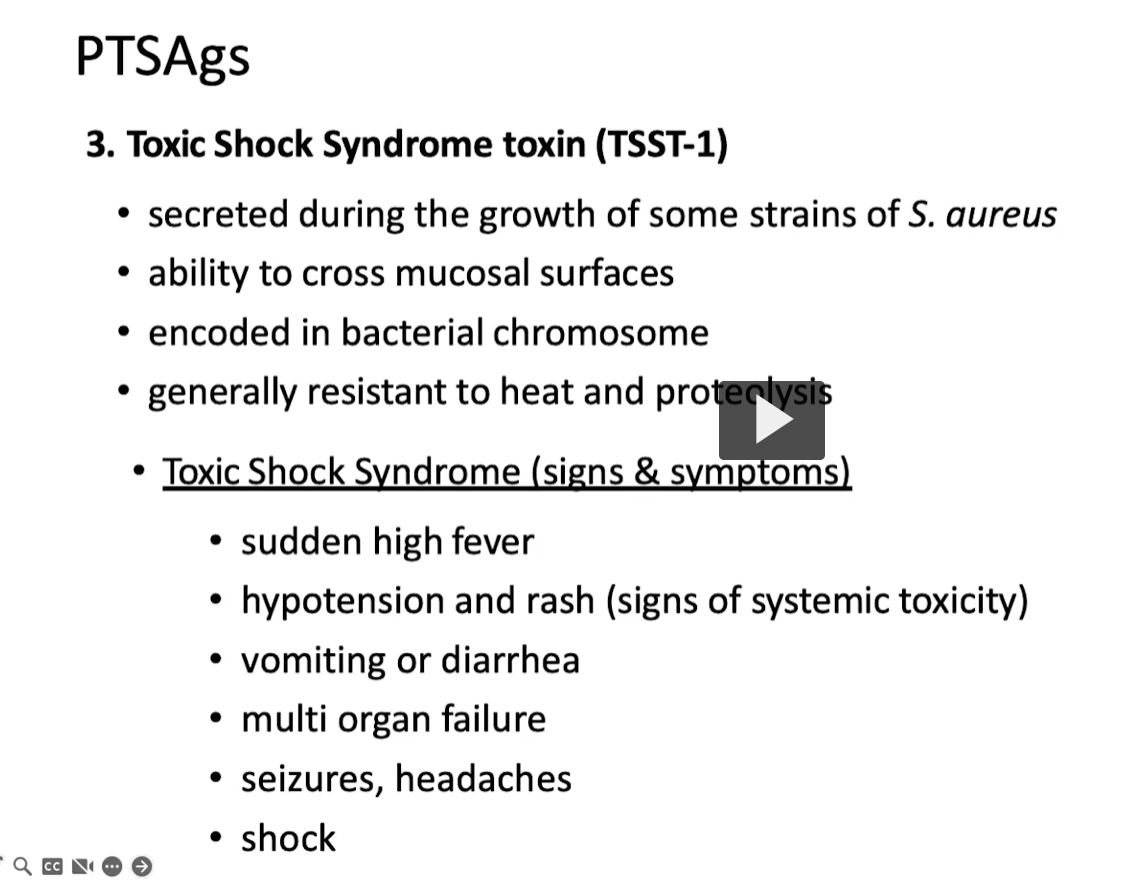
<p>Toxic-Shock-Syndrome Toxin-1</p><p><strong>Etymology</strong> <strong>1. Toxic</strong> </p><ul><li><p>Greek <em>toxikon</em> = <strong>poison</strong></p></li></ul><p> <strong>2. Shock</strong> </p><ul><li><p>From French <em>choc</em> = <strong>sudden impact/collapse</strong><br><span data-name="point_right" data-type="emoji">👉</span> In medicine: <strong>circulatory collapse (low blood pressure)</strong></p></li></ul><p> <strong>3. Syndrome</strong> </p><ul><li><p>Greek:</p><ul><li><p><strong>“syn-”</strong> = together</p></li><li><p><strong>“dromos”</strong> = running/course</p></li></ul></li></ul><p><span data-name="point_right" data-type="emoji">👉</span> <strong>Syndrome = a group of symptoms occurring together</strong></p><p> <strong>4. Toxin (TSST-1)</strong> </p><ul><li><p><strong>TSST-1 = Toxic Shock Syndrome Toxin-1</strong><br><span data-name="point_right" data-type="emoji">👉</span> The <strong>first identified toxin</strong> causing this syndrome</p></li></ul><div data-type="horizontalRule"><hr></div><p> <strong>Definition</strong> </p><p><strong>TSST-1</strong> is a <strong>superantigen exotoxin</strong> produced by <em>Staphylococcus aureus</em> that:</p><p><span data-name="point_right" data-type="emoji">👉</span> <strong>Triggers massive, non-specific activation of T-cells</strong><br>→ leads to a <strong>cytokine storm</strong></p>
12
New cards
<p><strong>Normal Antigen Presentation</strong> </p><ul><li><p>Antigen sits in <strong>MHC II groove</strong></p></li><li><p>TCR recognizes <strong>specific antigen</strong></p></li></ul><p><span data-name="point_right" data-type="emoji">👉</span> Activates:</p><ul><li><p><strong>~1 in 10,000 T cells</strong> (very controlled)</p></li></ul><div data-type="horizontalRule"><hr></div><p> <span data-name="red_circle" data-type="emoji">🔴</span> <strong>Superantigen Mechanism (TSST-1)</strong> </p><p>Produced by <em>Staphylococcus aureus</em></p><p><span data-name="point_right" data-type="emoji">👉</span> Instead of normal binding:</p><ul><li><p>Superantigen <strong>links MHC II directly to TCR</strong></p></li><li><p><strong>Bypasses the antigen-binding groove</strong></p></li></ul><p><span data-name="point_right" data-type="emoji">👉</span> Result:</p><ul><li><p>Activates:</p><ul><li><p><strong>1 in 5 T cells (~20%)</strong></p></li></ul></li></ul><div data-type="horizontalRule"><hr></div><p> <span data-name="high_voltage" data-type="emoji">⚡</span> <strong>What happens next?</strong> </p><p>Massive activation → <strong>cytokine storm</strong></p><p>Releases:</p><ul><li><p>IL-1 → <strong>fever</strong></p></li><li><p>TNF-α → <strong>hypotension (shock)</strong></p></li><li><p>IL-2 → <strong>T-cell proliferation</strong></p></li></ul><p></p>

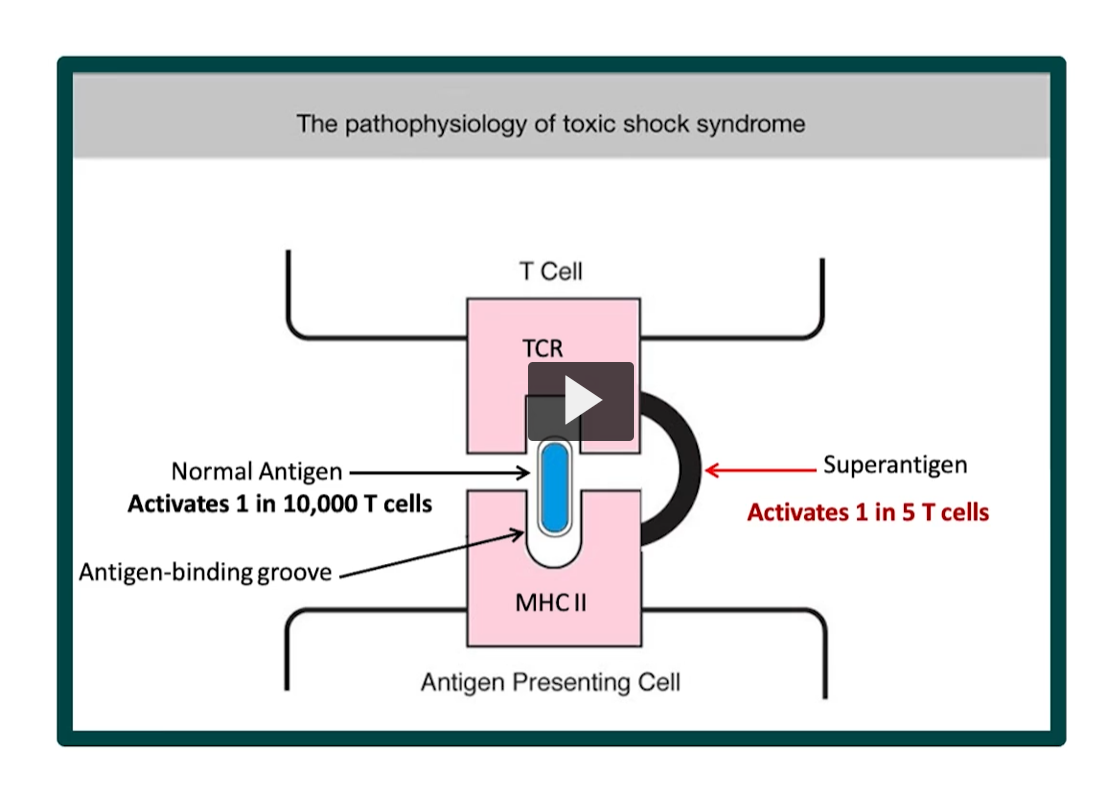
Normal Antigen Presentation

  • Antigen sits in MHC II groove

  • TCR recognizes specific antigen

👉 Activates:

  • ~1 in 10,000 T cells (very controlled)


đź”´ Superantigen Mechanism (TSST-1)

Produced by Staphylococcus aureus

👉 Instead of normal binding:

  • Superantigen links MHC II directly to TCR

  • Bypasses the antigen-binding groove

👉 Result:

  • Activates:

    • 1 in 5 T cells (~20%)


⚡ What happens next?

Massive activation → cytokine storm

Releases:

  • IL-1 → fever

  • TNF-α → hypotension (shock)

  • IL-2 → T-cell proliferation

knowt flashcard image
13
New cards
term image
knowt flashcard image
14
New cards
term image
knowt flashcard image
15
New cards
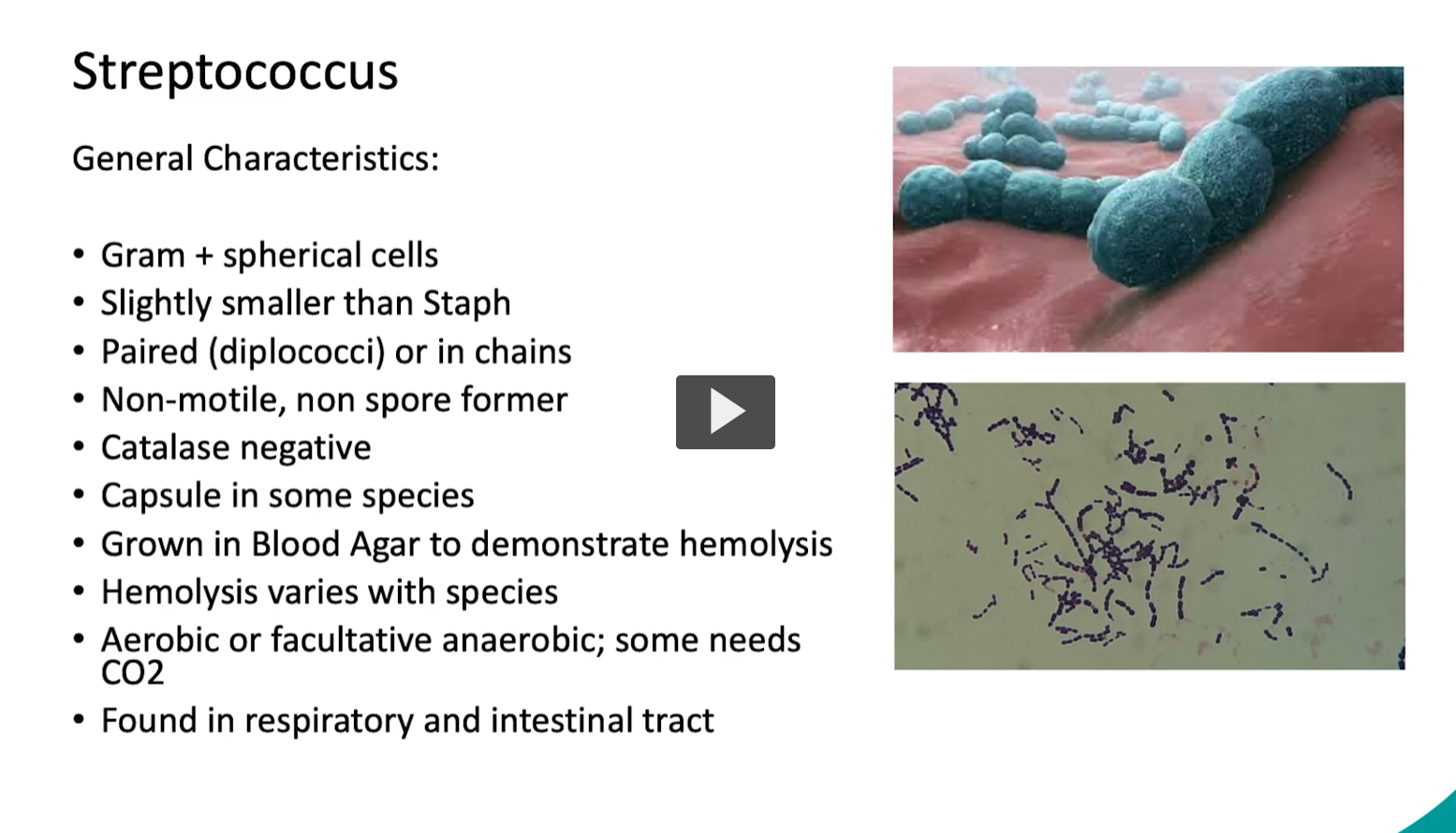
<ul><li><p><strong>“strepto-”</strong> → from Greek <em>streptos</em> = <strong>“twisted” or “chain-like”</strong></p></li><li><p><strong>“-coccus”</strong> → from Greek <em>kokkos</em> = <strong>“berry” or “round”</strong></p></li></ul><p><span data-name="point_right" data-type="emoji">👉</span> <strong>Streptococcus = “chains of round (spherical) bacteria”</strong></p><div data-type="horizontalRule"><hr></div><p><strong>Definition</strong></p><p><strong>Streptococcus</strong> is a genus of <strong>Gram-positive, spherical (cocci) bacteria</strong> that:</p><ul><li><p>Grow in <strong>chains or pairs (diplococci)</strong></p></li><li><p>Are <strong>catalase-negative</strong> (key distinction from Staphylococcus)</p></li><li><p>Are <strong>non-motile</strong> and <strong>non–spore forming</strong></p></li><li><p>Often live in the:</p><ul><li><p><strong>Respiratory tract</strong></p></li><li><p><strong>Gastrointestinal tract</strong></p></li></ul></li></ul><div data-type="horizontalRule"><hr></div><p><span data-name="microscope" data-type="emoji">🔬</span> <strong>Key Characteristics (from your slide, explained)</strong><span data-name="purple_circle" data-type="emoji">🟣</span> <strong>Gram-positive cocci</strong></p><ul><li><p>Thick peptidoglycan → stain <strong>purple</strong></p></li></ul><p></p>
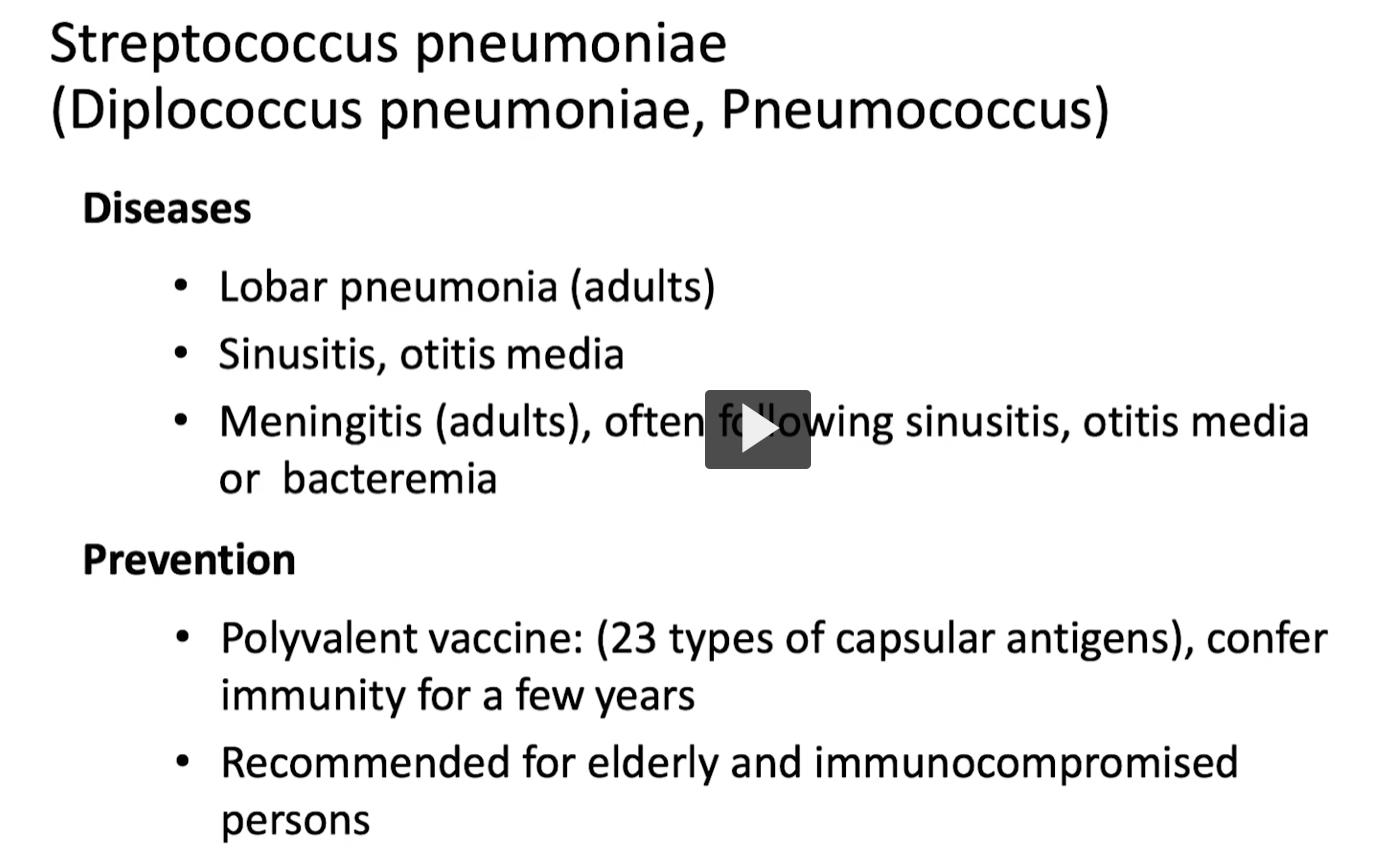
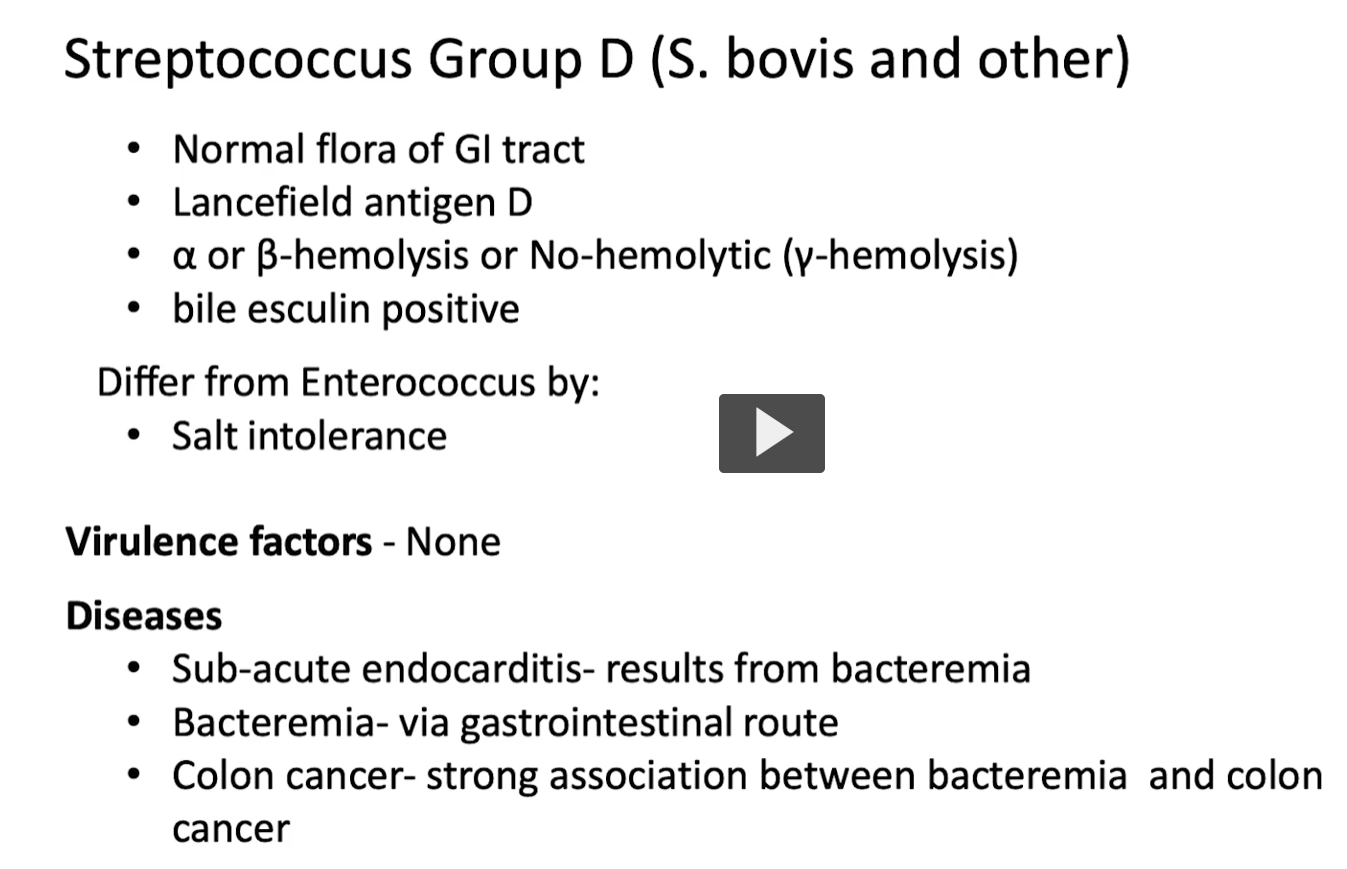
  • “strepto-” → from Greek streptos = “twisted” or “chain-like”

  • “-coccus” → from Greek kokkos = “berry” or “round”

👉 Streptococcus = “chains of round (spherical) bacteria”


Definition

Streptococcus is a genus of Gram-positive, spherical (cocci) bacteria that:

  • Grow in chains or pairs (diplococci)

  • Are catalase-negative (key distinction from Staphylococcus)

  • Are non-motile and non–spore forming

  • Often live in the:

    • Respiratory tract

    • Gastrointestinal tract


🔬 Key Characteristics (from your slide, explained)🟣 Gram-positive cocci

  • Thick peptidoglycan → stain purple

knowt flashcard image
16
New cards
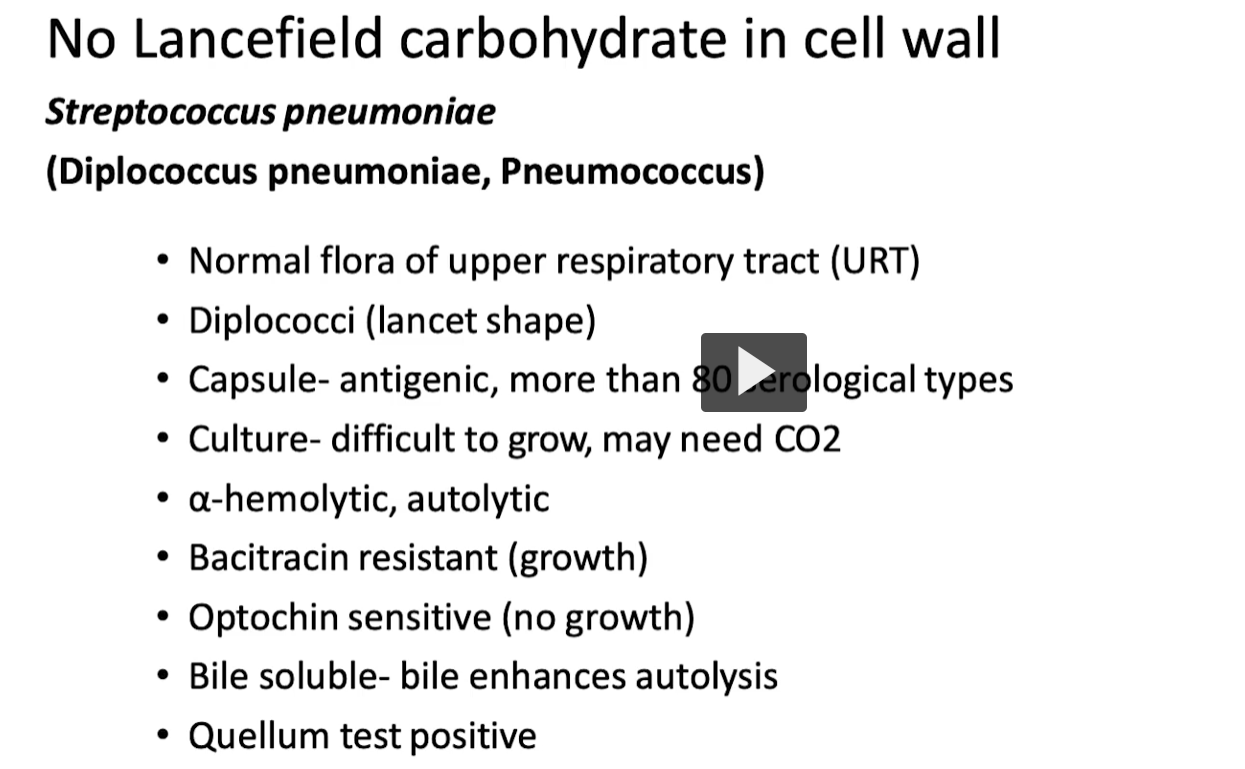
<p><strong>Important Exception</strong> </p><ul><li><p><strong>Streptococcus pneumoniae</strong></p></li><li><p><strong>Viridans streptococci</strong></p></li></ul><p><span data-name="point_right" data-type="emoji">👉</span> <strong>DO NOT have Lancefield antigens</strong><br>→ Cannot be classified this way</p>

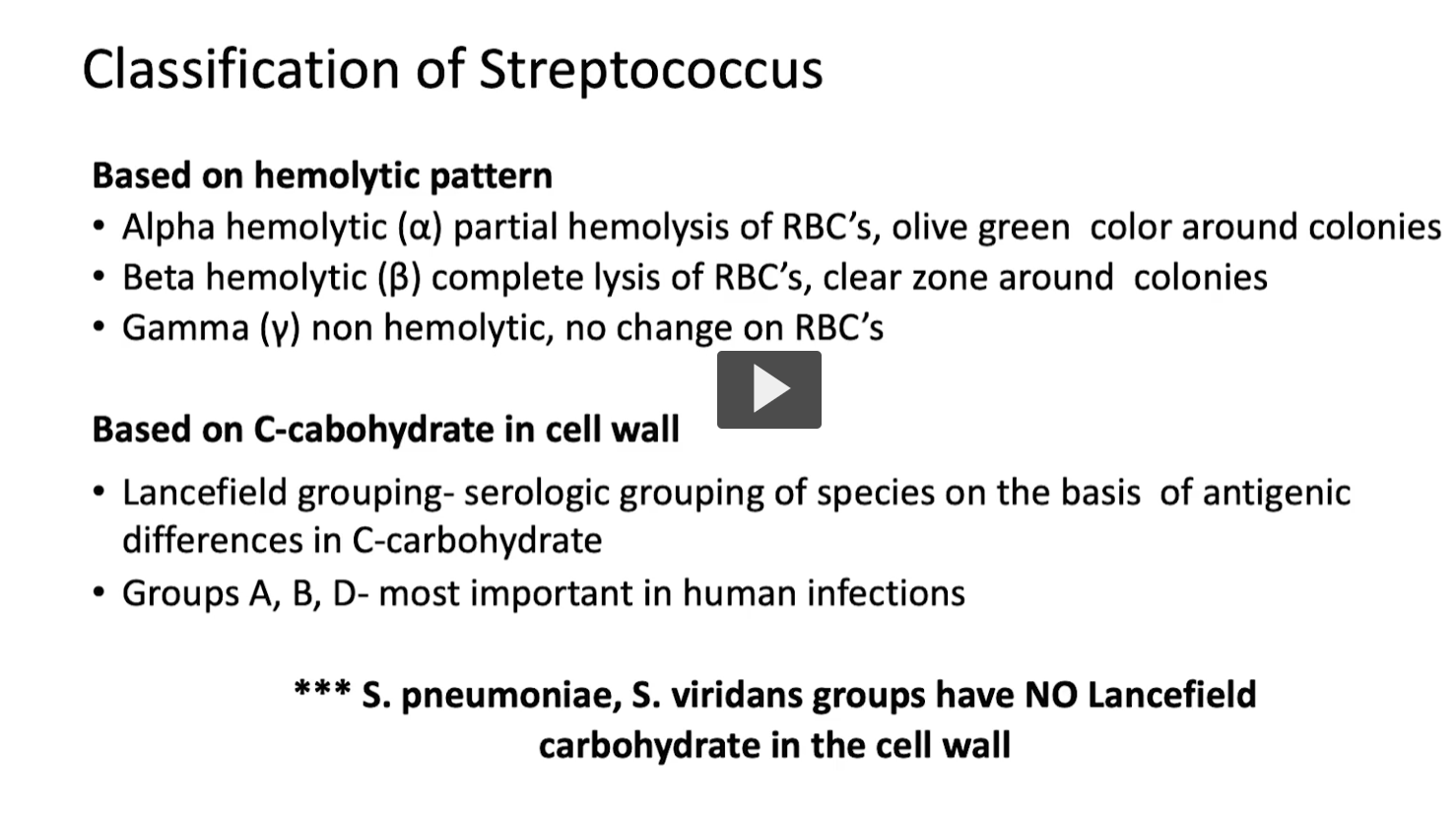
Important Exception

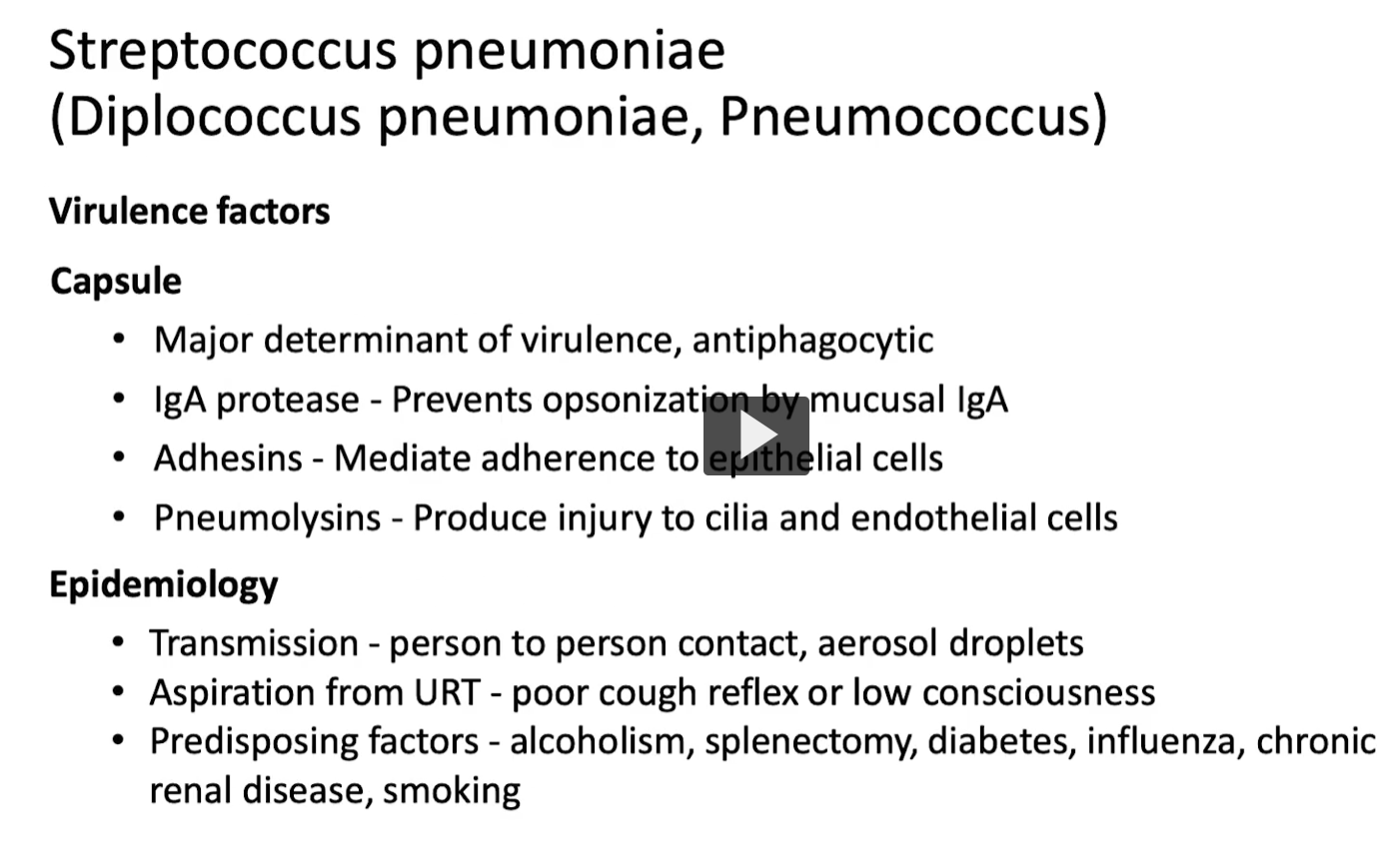
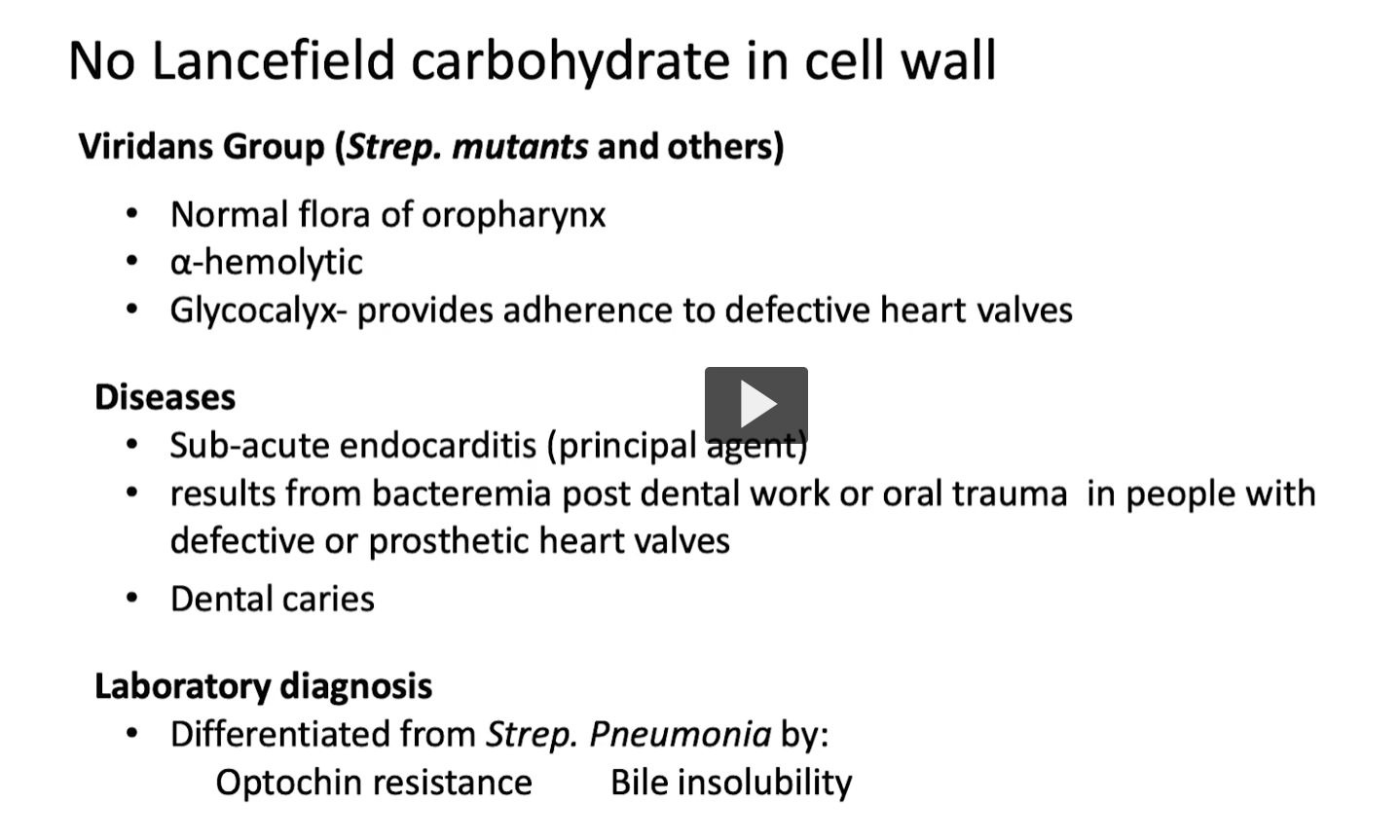
  • Streptococcus pneumoniae

  • Viridans streptococci

👉 DO NOT have Lancefield antigens
→ Cannot be classified this way
knowt flashcard image
17
New cards
term image

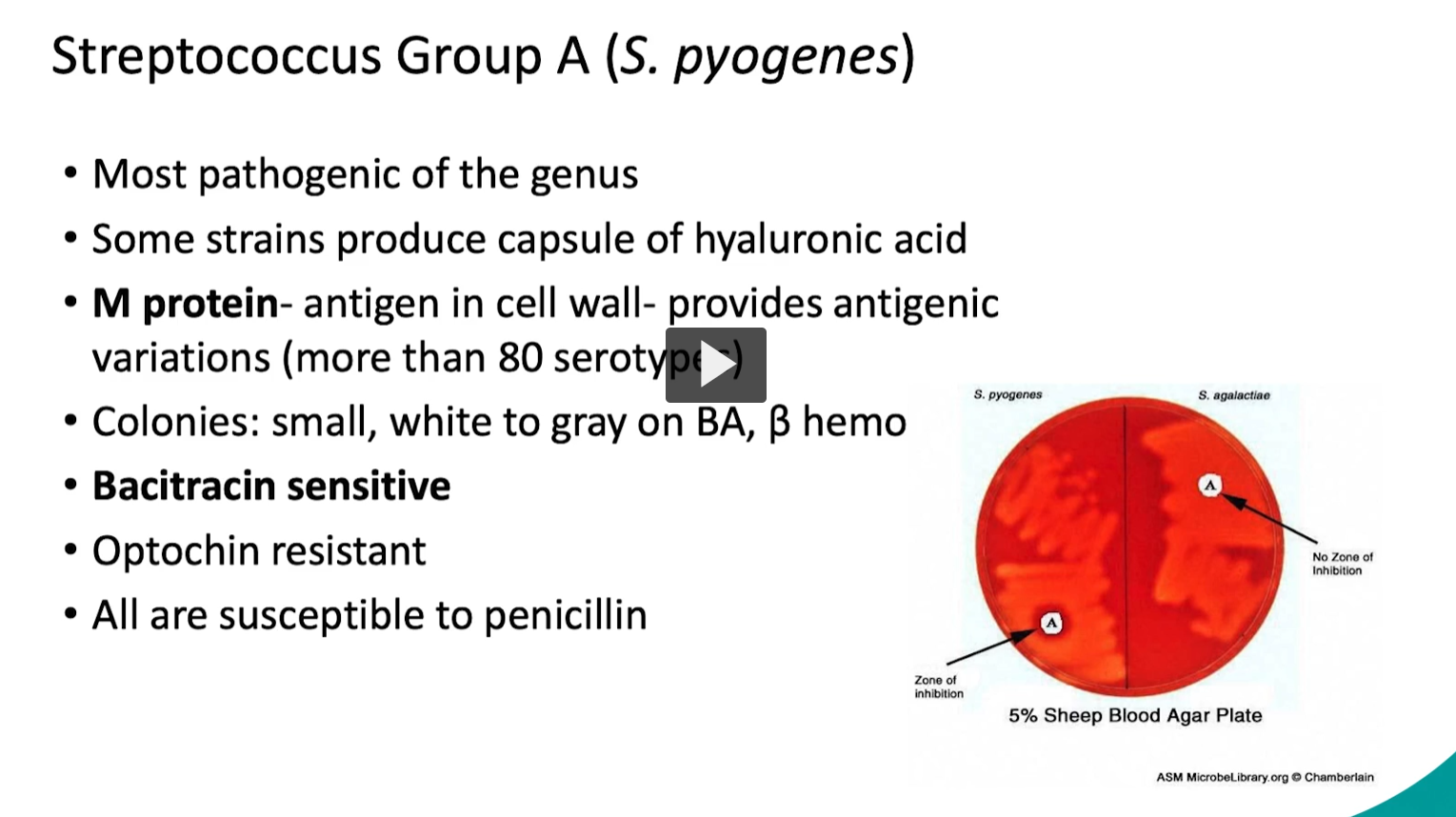
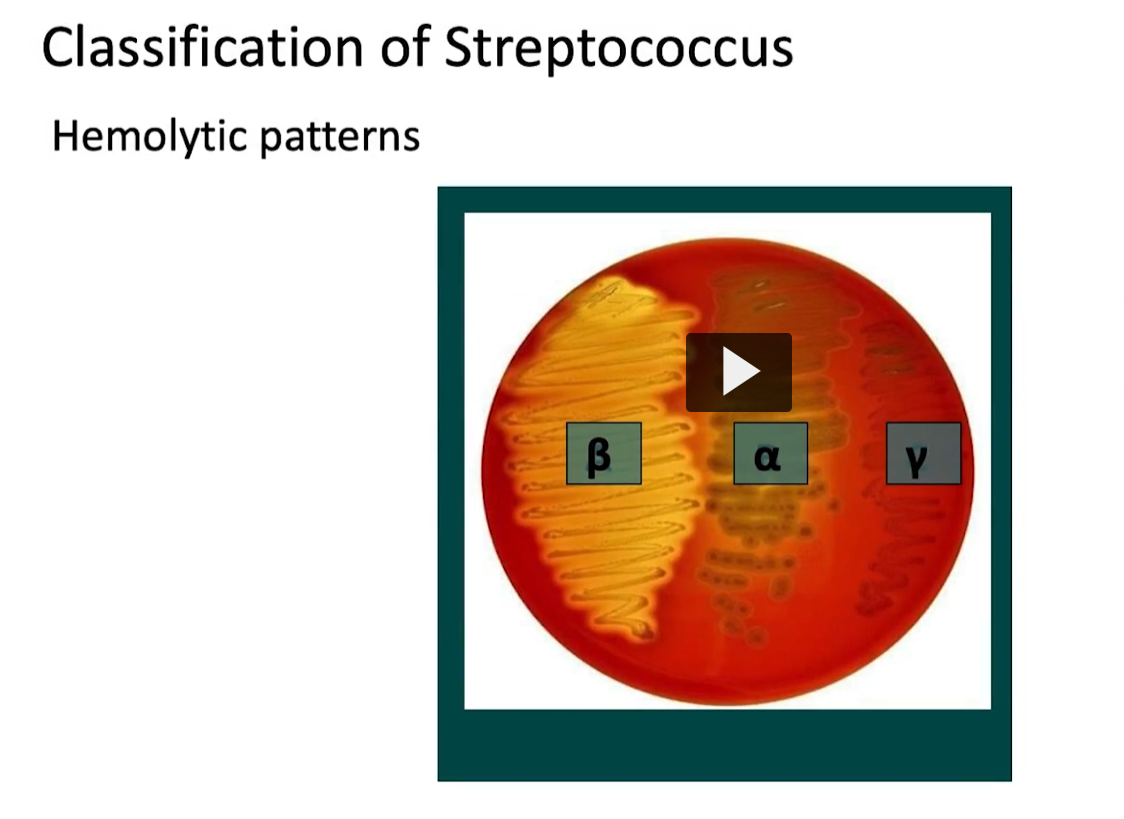
S. pyogenes produces hemolysins = toxins that destroy red blood cells (RBCs) → causes β-hemolysis (clear zone on blood agar)

👉 Two main ones:

  • Streptolysin O

  • Streptolysin S


đź”´ 1. Streptolysin O (SLO) đź“– Key Features

  • O = Oxygen-labile (inactivated by oxygen ❌)

  • Works only in anaerobic (low Oâ‚‚) conditions

👉 That’s why:

  • Hemolysis is better seen below the agar surface


đź’Ą What it does

  • Forms pores in cell membranes

  • Kills:

    • RBCs

    • WBCs

    • Platelets


đź§Ş Clinical importance

  • Highly antigenic → body makes antibodies

  • These are measured as:

    • ASO (Anti-Streptolysin O) titer

👉 Used to diagnose:

  • Rheumatic fever

  • Post-strep infections


🟡 2. Streptolysin S (SLS) 📖 Key Features

  • S = Stable in oxygen âś…

  • Works on surface of agar

👉 Responsible for:

  • The visible β-hemolysis (clear zone) you see in lab


đź’Ą What it does

  • Also destroys RBCs → contributes to hemolysis


âť— Key difference

  • NOT antigenic
    👉 No antibody formation → no diagnostic test
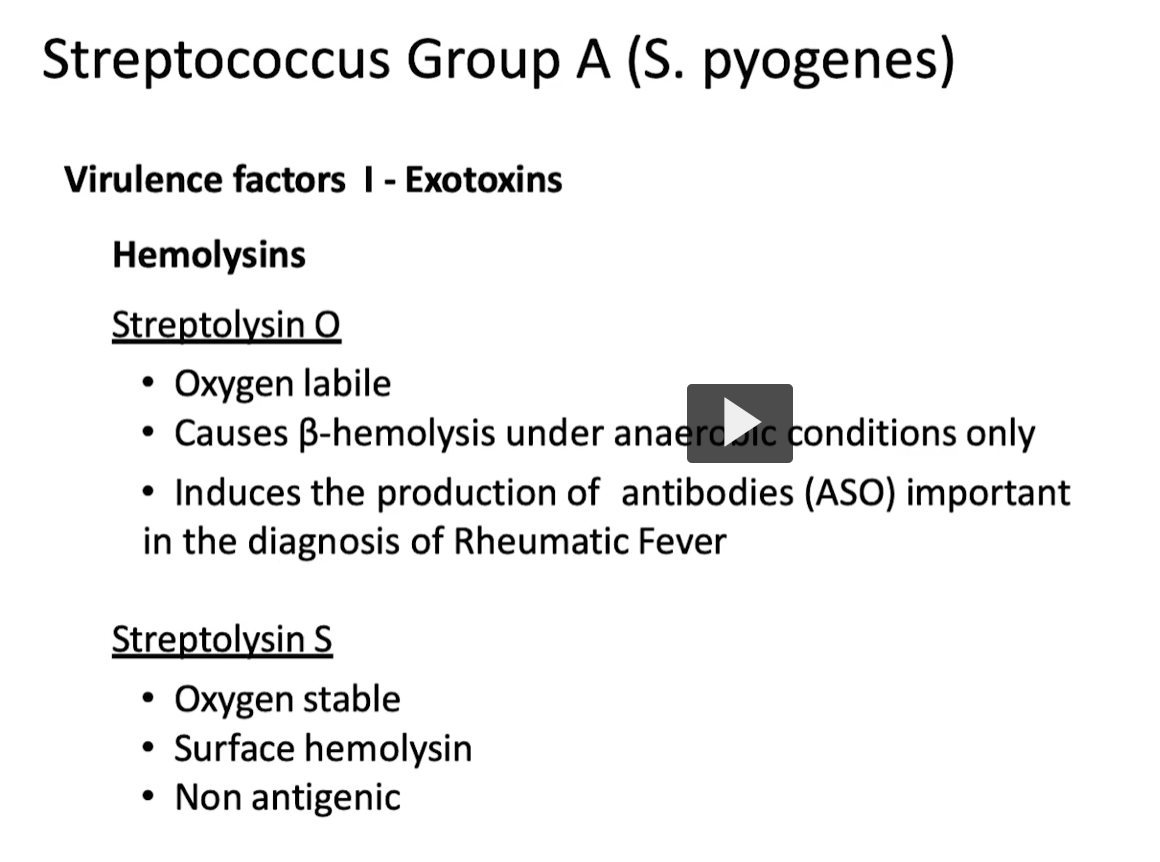
<p><em>S. pyogenes</em> produces <strong>hemolysins</strong> = toxins that <strong>destroy red blood cells (RBCs)</strong> → causes <strong>β-hemolysis (clear zone on blood agar)</strong></p><p><span data-name="point_right" data-type="emoji">👉</span> Two main ones:</p><ul><li><p><strong>Streptolysin O</strong></p></li><li><p><strong>Streptolysin S</strong></p></li></ul><div data-type="horizontalRule"><hr></div><p><span data-name="red_circle" data-type="emoji">🔴</span> <strong>1. Streptolysin O (SLO)</strong> <span data-name="book" data-type="emoji">📖</span> Key Features </p><ul><li><p><strong>O = Oxygen-labile</strong> (inactivated by oxygen <span data-name="cross_mark" data-type="emoji">❌</span>)</p></li><li><p>Works <strong>only in anaerobic (low O₂) conditions</strong></p></li></ul><p><span data-name="point_right" data-type="emoji">👉</span> That’s why:</p><ul><li><p>Hemolysis is better seen <strong>below the agar surface</strong></p></li></ul><div data-type="horizontalRule"><hr></div><p> <span data-name="boom" data-type="emoji">💥</span> What it does </p><ul><li><p>Forms <strong>pores in cell membranes</strong></p></li><li><p>Kills:</p><ul><li><p>RBCs</p></li><li><p>WBCs</p></li><li><p>Platelets</p></li></ul></li></ul><div data-type="horizontalRule"><hr></div><p> <span data-name="test_tube" data-type="emoji">🧪</span> Clinical importance </p><ul><li><p><strong>Highly antigenic</strong> → body makes antibodies</p></li><li><p>These are measured as:</p><ul><li><p><strong>ASO (Anti-Streptolysin O) titer</strong></p></li></ul></li></ul><p><span data-name="point_right" data-type="emoji">👉</span> Used to diagnose:</p><ul><li><p><strong>Rheumatic fever</strong></p></li><li><p>Post-strep infections</p></li></ul><div data-type="horizontalRule"><hr></div><p><span data-name="yellow_circle" data-type="emoji">🟡</span> <strong>2. Streptolysin S (SLS)</strong> <span data-name="book" data-type="emoji">📖</span> Key Features </p><ul><li><p><strong>S = Stable in oxygen</strong> <span data-name="check_mark_button" data-type="emoji">✅</span></p></li><li><p>Works on <strong>surface of agar</strong></p></li></ul><p><span data-name="point_right" data-type="emoji">👉</span> Responsible for:</p><ul><li><p>The <strong>visible β-hemolysis (clear zone)</strong> you see in lab</p></li></ul><div data-type="horizontalRule"><hr></div><p> <span data-name="boom" data-type="emoji">💥</span> What it does </p><ul><li><p>Also destroys RBCs → contributes to hemolysis</p></li></ul><div data-type="horizontalRule"><hr></div><p> <span data-name="exclamation" data-type="emoji">❗</span> Key difference </p><ul><li><p><strong>NOT antigenic</strong><br><span data-name="point_right" data-type="emoji">👉</span> No antibody formation → <strong>no diagnostic test</strong></p></li></ul><p></p>
18
New cards
<p><em>S. pyogenes</em> produces <strong>exotoxins</strong> that:<br><span data-name="point_right" data-type="emoji">👉</span> Spread beyond the throat/skin<br><span data-name="point_right" data-type="emoji">👉</span> Cause <strong>systemic disease</strong> (rash, shock, tissue destruction)</p><div data-type="horizontalRule"><hr></div><p><span data-name="red_circle" data-type="emoji">🔴</span> <strong>1. Erythrogenic toxin (Pyrogenic exotoxin)</strong> <span data-name="book" data-type="emoji">📖</span> What it does </p><ul><li><p>Causes the <strong>rash of scarlet fever</strong></p></li></ul><p> <span data-name="brain" data-type="emoji">🧠</span> Mechanism </p><ul><li><p>Acts as a <strong>superantigen</strong> → massive cytokine release</p></li><li><p>Leads to:</p><ul><li><p>Fever</p></li><li><p>Red “sandpaper” rash</p></li><li><p><strong>Strawberry tongue</strong></p></li></ul></li></ul><p> <span data-name="warning" data-type="emoji">⚠</span> Key idea </p><ul><li><p>Bacteria stay in the <strong>pharynx</strong></p></li><li><p>But toxin <strong>spreads through bloodstream</strong></p></li></ul><p><span data-name="point_right" data-type="emoji">👉</span> Disease = toxin-mediated, not direct invasion</p><div data-type="horizontalRule"><hr></div><p><span data-name="high_voltage" data-type="emoji">⚡</span> <strong>2. Pyrogenic Exotoxin A (SpeA)</strong> <span data-name="book" data-type="emoji">📖</span> What it does </p><ul><li><p>Causes <strong>Strep toxic shock–like syndrome</strong></p></li></ul><p> <span data-name="brain" data-type="emoji">🧠</span> Mechanism </p><ul><li><p><strong>Superantigen</strong></p></li><li><p>Activates huge numbers of T-cells → <strong>cytokine storm</strong></p></li></ul><p> <span data-name="boom" data-type="emoji">💥</span> Results </p><ul><li><p>High fever</p></li><li><p>Hypotension</p></li><li><p>Multi-organ failure</p></li></ul><p><span data-name="point_right" data-type="emoji">👉</span> Very similar to <em>S. aureus</em> TSST-1</p><div data-type="horizontalRule"><hr></div><p><span data-name="skull" data-type="emoji">💀</span> <strong>3. Exotoxin B (SpeB)</strong> <span data-name="book" data-type="emoji">📖</span> What it is </p><ul><li><p>A <strong>protease enzyme</strong></p></li></ul><p> <span data-name="brain" data-type="emoji">🧠</span> What it does </p><ul><li><p><strong>Breaks down proteins in tissue</strong></p></li><li><p>Rapidly destroys:</p><ul><li><p>Fascia</p></li><li><p>Muscle</p></li></ul></li></ul><p> <span data-name="warning" data-type="emoji">⚠</span> Clinical effect </p><p><span data-name="point_right" data-type="emoji">👉</span> <strong>Necrotizing fasciitis (“flesh-eating disease”)</strong></p><ul><li><p>Extremely fast spreading</p></li><li><p>Severe pain</p></li><li><p>Tissue death (necrosis)</p></li></ul><p></p>

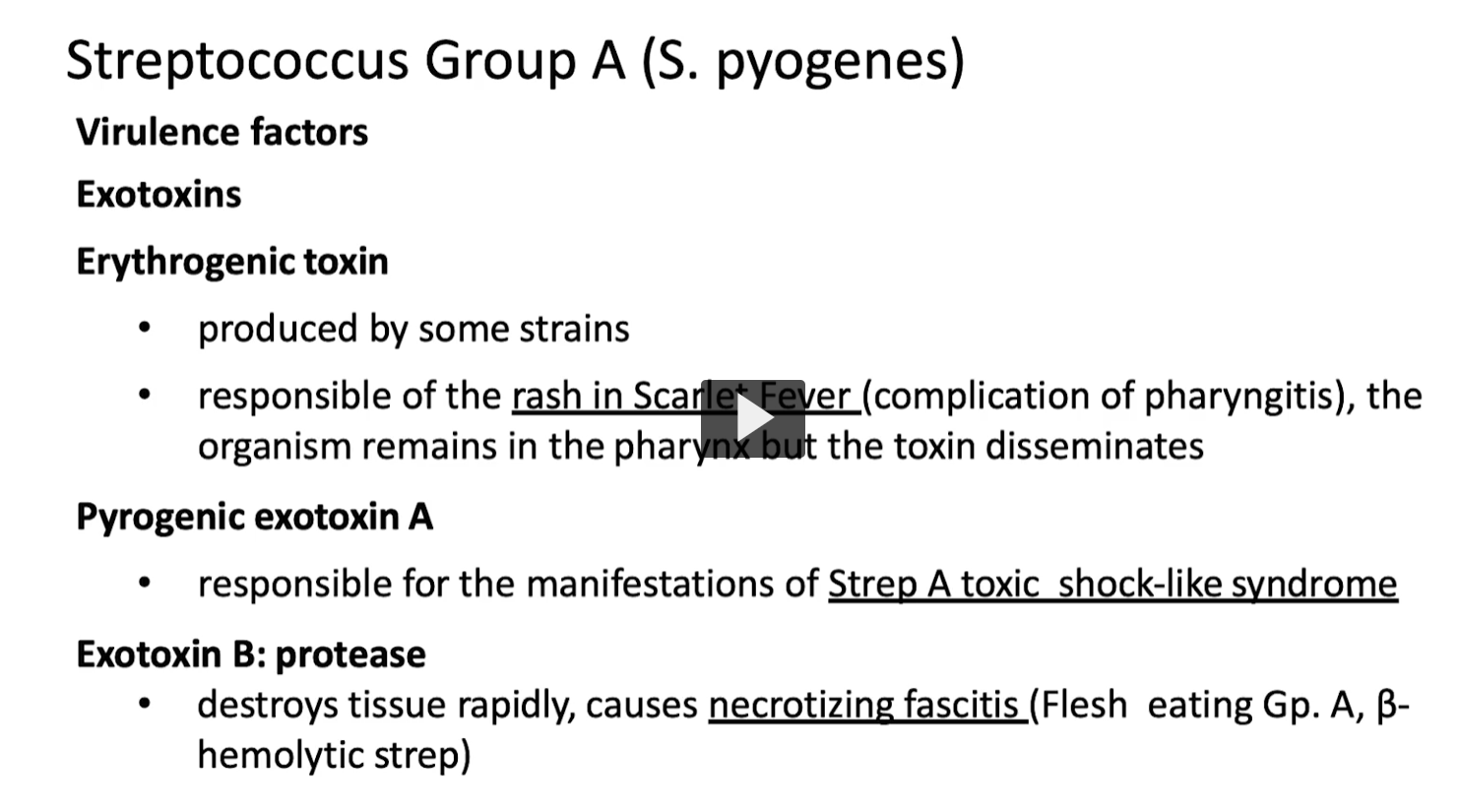
S. pyogenes produces exotoxins that:
👉 Spread beyond the throat/skin
👉 Cause systemic disease (rash, shock, tissue destruction)


đź”´ 1. Erythrogenic toxin (Pyrogenic exotoxin) đź“– What it does

  • Causes the rash of scarlet fever

đź§  Mechanism

  • Acts as a superantigen → massive cytokine release

  • Leads to:

    • Fever

    • Red “sandpaper” rash

    • Strawberry tongue

âš  Key idea

  • Bacteria stay in the pharynx

  • But toxin spreads through bloodstream

👉 Disease = toxin-mediated, not direct invasion


⚡ 2. Pyrogenic Exotoxin A (SpeA) 📖 What it does

  • Causes Strep toxic shock–like syndrome

đź§  Mechanism

  • Superantigen

  • Activates huge numbers of T-cells → cytokine storm

đź’Ą Results

  • High fever

  • Hypotension

  • Multi-organ failure

👉 Very similar to S. aureus TSST-1


đź’€ 3. Exotoxin B (SpeB) đź“– What it is

  • A protease enzyme

đź§  What it does

  • Breaks down proteins in tissue

  • Rapidly destroys:

    • Fascia

    • Muscle

âš  Clinical effect

👉 Necrotizing fasciitis (“flesh-eating disease”)

  • Extremely fast spreading

  • Severe pain

  • Tissue death (necrosis)

These are physical components on the bacteria (not toxins) that help it:

👉 Stick to cells
👉 Avoid the immune system
👉 Survive and spread


🔴 1. M Protein (MOST IMPORTANT) 📌 What it does 🧲 Adherence

  • Helps bacteria attach to throat (pharyngeal) epithelial cells

👉 First step in infection


🛡 Blocks opsonization

  • Prevents complement (C3b) from coating the bacteria

👉 Without opsonization:

  • Immune cells can’t recognize it easily


đźš« Antiphagocytic

  • Stops neutrophils/macrophages from engulfing (phagocytosis)
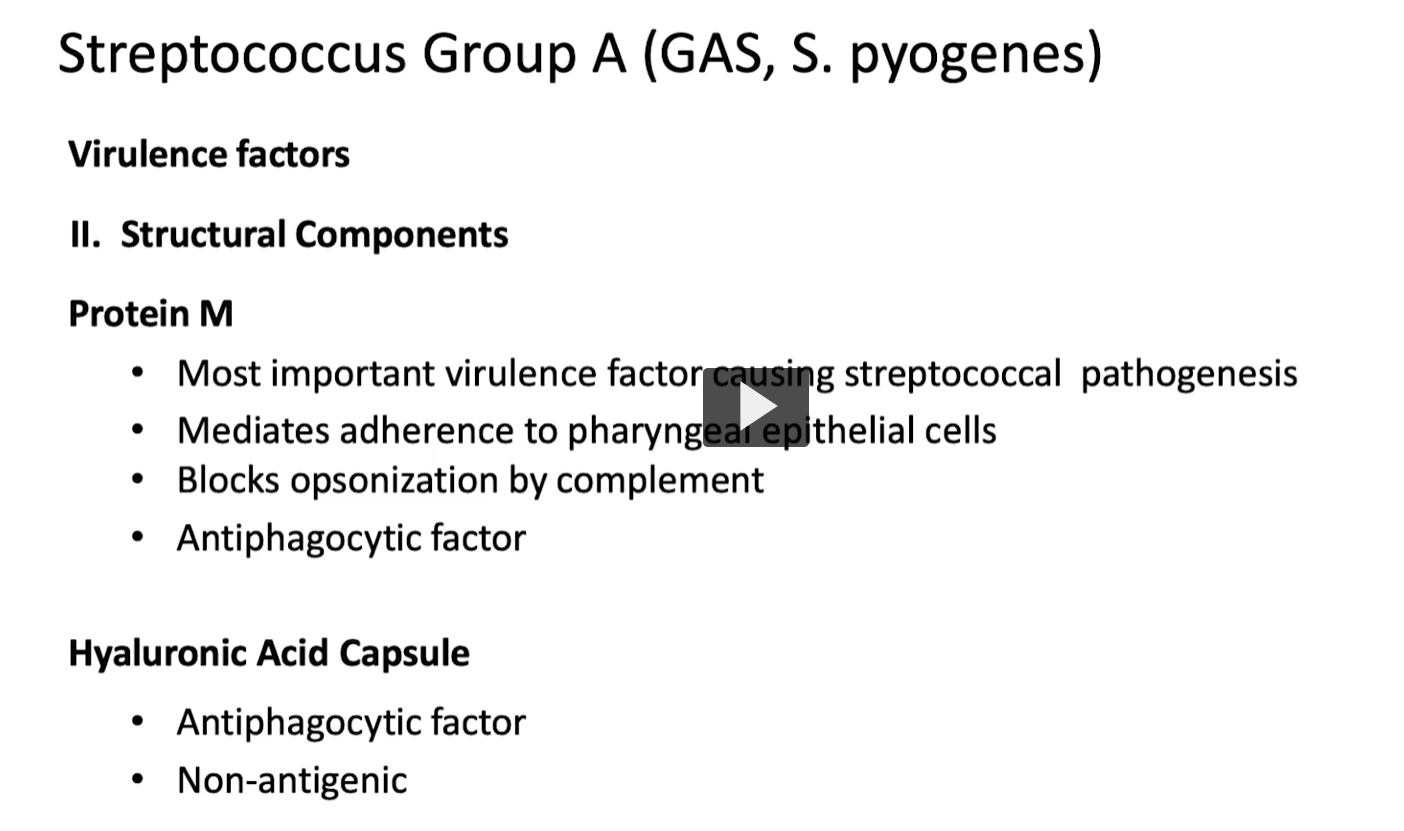
<p>These are <strong>physical components on the bacteria</strong> (not toxins) that help it:</p><p><span data-name="point_right" data-type="emoji">👉</span> <strong>Stick to cells</strong><br><span data-name="point_right" data-type="emoji">👉</span> <strong>Avoid the immune system</strong><br><span data-name="point_right" data-type="emoji">👉</span> <strong>Survive and spread</strong></p><div data-type="horizontalRule"><hr></div><p><span data-name="red_circle" data-type="emoji">🔴</span> <strong>1. M Protein (MOST IMPORTANT)</strong> <span data-name="pushpin" data-type="emoji">📌</span> What it does <span data-name="magnet" data-type="emoji">🧲</span> <strong>Adherence</strong></p><ul><li><p>Helps bacteria <strong>attach to throat (pharyngeal) epithelial cells</strong></p></li></ul><p><span data-name="point_right" data-type="emoji">👉</span> First step in infection</p><div data-type="horizontalRule"><hr></div><p><span data-name="shield" data-type="emoji">🛡</span> <strong>Blocks opsonization</strong></p><ul><li><p>Prevents <strong>complement (C3b)</strong> from coating the bacteria</p></li></ul><p><span data-name="point_right" data-type="emoji">👉</span> Without opsonization:</p><ul><li><p>Immune cells <strong>can’t recognize it easily</strong></p></li></ul><div data-type="horizontalRule"><hr></div><p><span data-name="no_entry_sign" data-type="emoji">🚫</span> <strong>Antiphagocytic</strong></p><ul><li><p>Stops neutrophils/macrophages from <strong>engulfing (phagocytosis)</strong></p></li></ul><p></p>
19
New cards
<p><strong>Big Picture</strong> </p><p>These enzymes are called <strong>“spreading factors”</strong> because they help bacteria:</p><p> </p><p><span data-name="point_right" data-type="emoji">👉</span> <strong>Break through tissue barriers</strong><br><span data-name="point_right" data-type="emoji">👉</span> <strong>Escape immune traps</strong><br><span data-name="point_right" data-type="emoji">👉</span> <strong>Spread rapidly through the body</strong></p><p> </p><div data-type="horizontalRule"><hr></div><p> <span data-name="test_tube" data-type="emoji">🧪</span> <strong>1. DNases (Deoxyribonucleases)</strong> <span data-name="pushpin" data-type="emoji">📌</span> What they do </p><ul><li><p><strong>Break down DNA</strong></p></li></ul><p> <span data-name="brain" data-type="emoji">🧠</span> Why that matters </p><ul><li><p>Infection sites contain lots of <strong>dead cells + neutrophils</strong></p></li><li><p>These release <strong>DNA → thick pus</strong></p></li></ul><p> </p><p><span data-name="point_right" data-type="emoji">👉</span> DNase:</p><p> </p><ul><li><p><strong>Liquefies pus</strong></p></li><li><p>Helps bacteria <strong>move through infected tissue</strong></p></li></ul><p> </p><div data-type="horizontalRule"><hr></div><p> <span data-name="test_tube" data-type="emoji">🧪</span> Clinical clue </p><ul><li><p>Body makes <strong>anti-DNase antibodies</strong><br><span data-name="point_right" data-type="emoji">👉</span> Used to detect <strong>recent strep infection</strong> (like ASO)</p></li></ul><p> </p><div data-type="horizontalRule"><hr></div><p> <span data-name="dna" data-type="emoji">🧬</span> <strong>2. Hyaluronidase</strong> <span data-name="pushpin" data-type="emoji">📌</span> What it does </p><ul><li><p>Breaks down <strong>hyaluronic acid</strong></p></li></ul><p> <span data-name="brain" data-type="emoji">🧠</span> Why that matters </p><ul><li><p>Hyaluronic acid = <strong>“glue” of connective tissue</strong></p></li></ul><p> </p><p><span data-name="point_right" data-type="emoji">👉</span> When broken:</p><p> </p><ul><li><p>Tissue becomes <strong>loose</strong></p></li><li><p>Bacteria can <strong>spread between cells</strong></p></li></ul><p> </p><div data-type="horizontalRule"><hr></div><p> <span data-name="bulb" data-type="emoji">💡</span> Nickname </p><p><span data-name="point_right" data-type="emoji">👉</span> <strong>“Spreading factor” (classic exam term)</strong></p><p> </p><div data-type="horizontalRule"><hr></div><p> <span data-name="drop_of_blood" data-type="emoji">🩸</span> <strong>3. Streptokinase</strong> <span data-name="pushpin" data-type="emoji">📌</span> What it does </p><ul><li><p>Breaks down <strong>fibrin clots</strong></p></li></ul><p> <span data-name="brain" data-type="emoji">🧠</span> Why that matters </p><ul><li><p>Body tries to <strong>trap bacteria in clots</strong></p></li></ul><p> </p><p><span data-name="point_right" data-type="emoji">👉</span> Streptokinase:</p><p> </p><ul><li><p><strong>Dissolves the clot</strong></p></li><li><p>Frees bacteria → <strong>spreads infection</strong></p></li></ul><p></p>

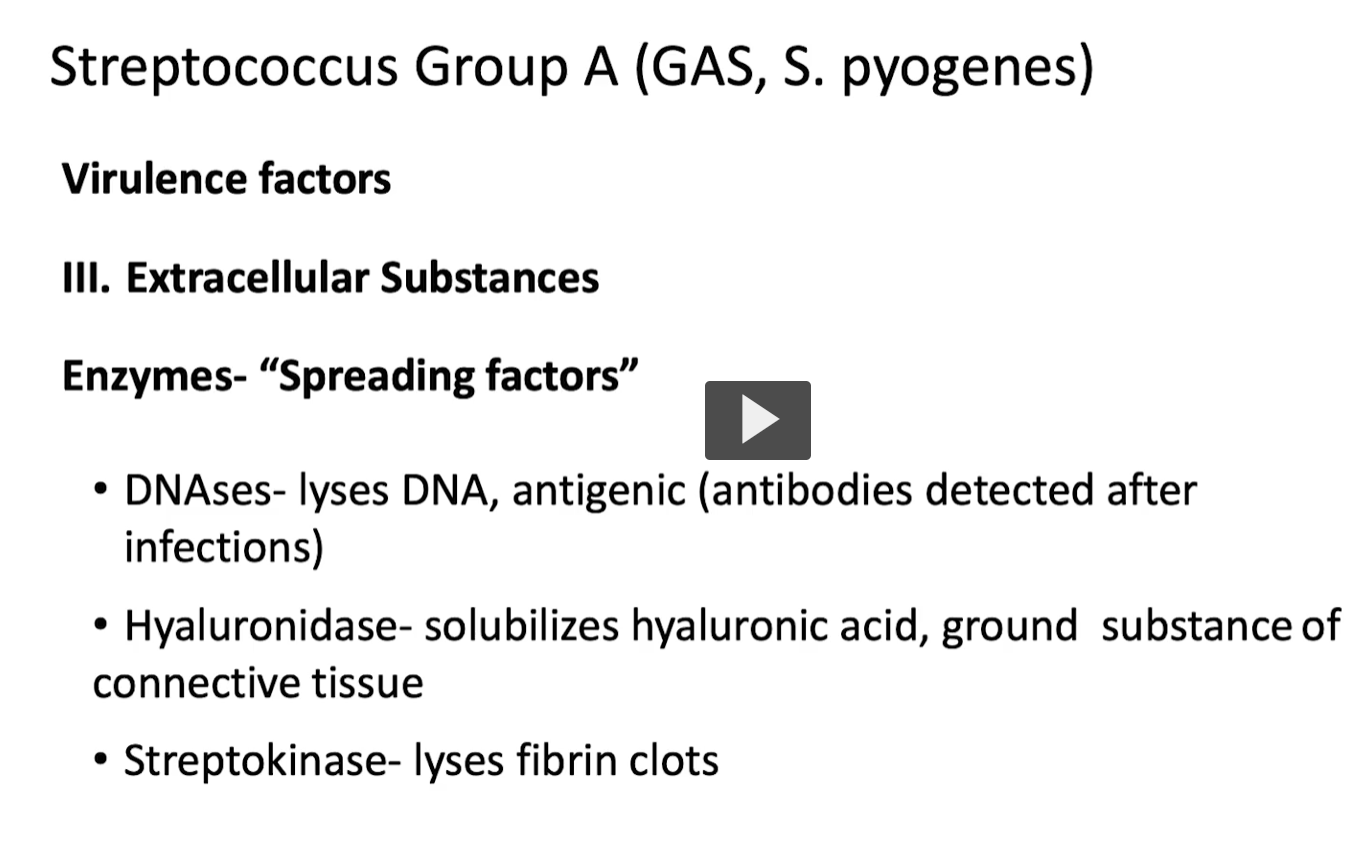
Big Picture

These enzymes are called “spreading factors” because they help bacteria:

👉 Break through tissue barriers
👉 Escape immune traps
👉 Spread rapidly through the body


🧪 1. DNases (Deoxyribonucleases) 📌 What they do

  • Break down DNA

đź§  Why that matters

  • Infection sites contain lots of dead cells + neutrophils

  • These release DNA → thick pus

👉 DNase:

  • Liquefies pus

  • Helps bacteria move through infected tissue


đź§Ş Clinical clue

  • Body makes anti-DNase antibodies
    👉 Used to detect recent strep infection (like ASO)


🧬 2. Hyaluronidase 📌 What it does

  • Breaks down hyaluronic acid

đź§  Why that matters

  • Hyaluronic acid = “glue” of connective tissue

👉 When broken:

  • Tissue becomes loose

  • Bacteria can spread between cells


đź’ˇ Nickname

👉 “Spreading factor” (classic exam term)


🩸 3. Streptokinase 📌 What it does

  • Breaks down fibrin clots

đź§  Why that matters

  • Body tries to trap bacteria in clots

👉 Streptokinase:

  • Dissolves the clot

  • Frees bacteria → spreads infection

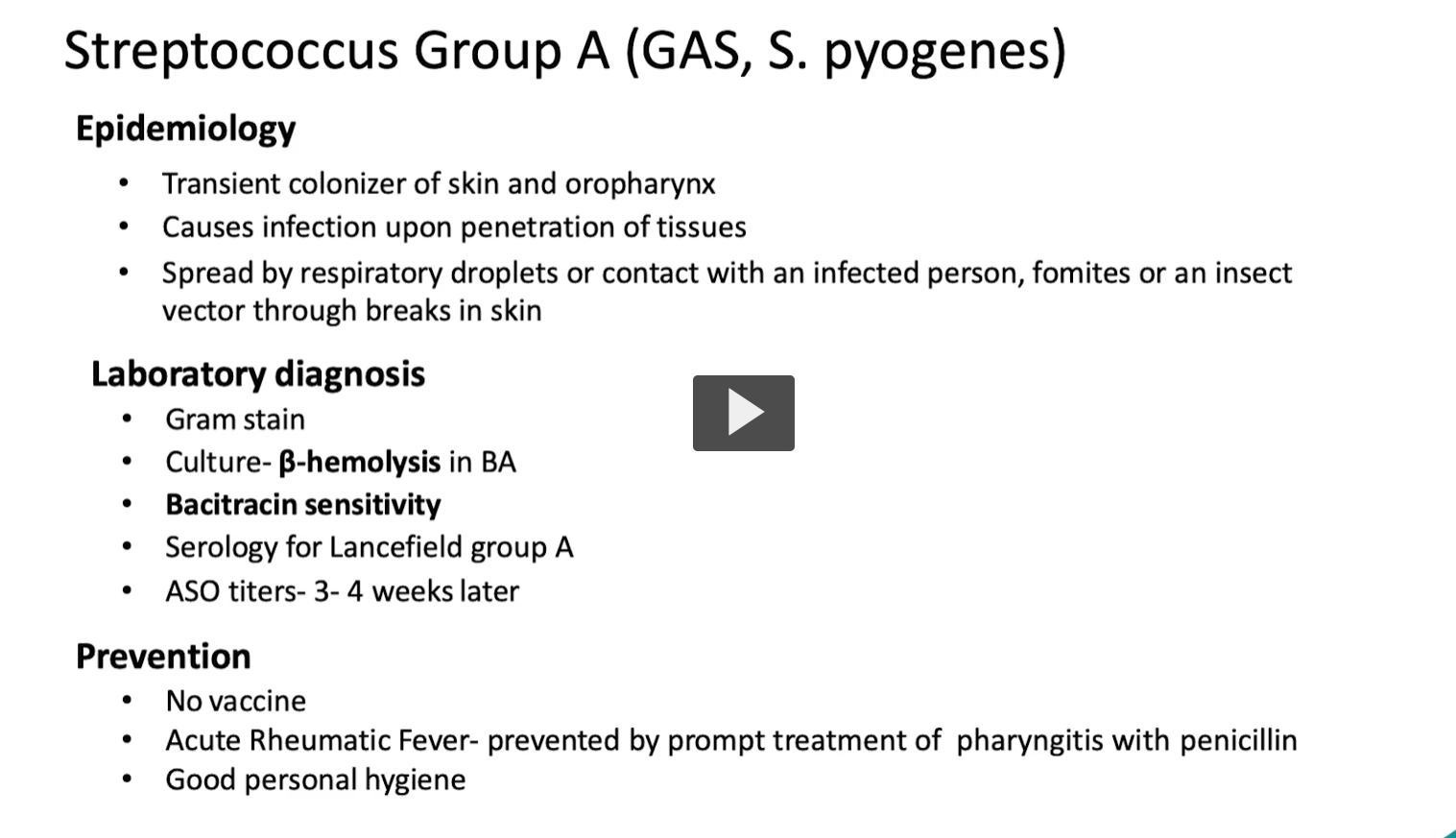
Group A Strep causes 2 categories of disease:

🔥 1. Suppurative (pus-forming, ACTIVE infection)

👉 Bacteria are present and invading tissue

âš  2. Non-suppurative (post-infectious, IMMUNE-mediated)

👉 Bacteria are gone, but immune system causes damage
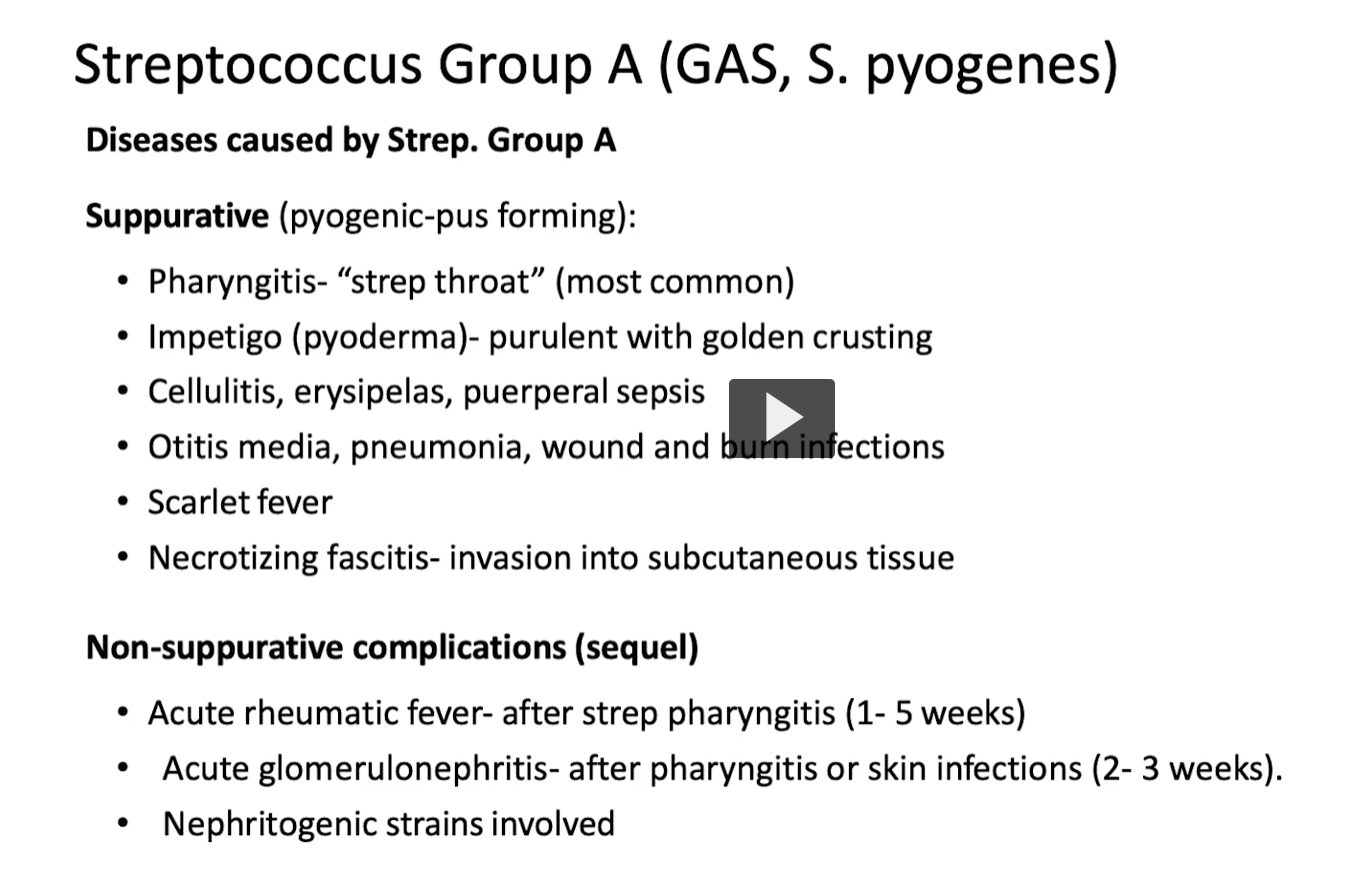
<p>Group A Strep causes <strong>2 categories of disease</strong>:</p><p><span data-name="fire" data-type="emoji">🔥</span> 1. <strong>Suppurative (pus-forming, ACTIVE infection)</strong></p><p><span data-name="point_right" data-type="emoji">👉</span> Bacteria are <strong>present and invading tissue</strong></p><p><span data-name="warning" data-type="emoji">⚠</span> 2. <strong>Non-suppurative (post-infectious, IMMUNE-mediated)</strong></p><p><span data-name="point_right" data-type="emoji">👉</span> Bacteria are <strong>gone</strong>, but immune system causes damage</p>
20
New cards
<p></p>

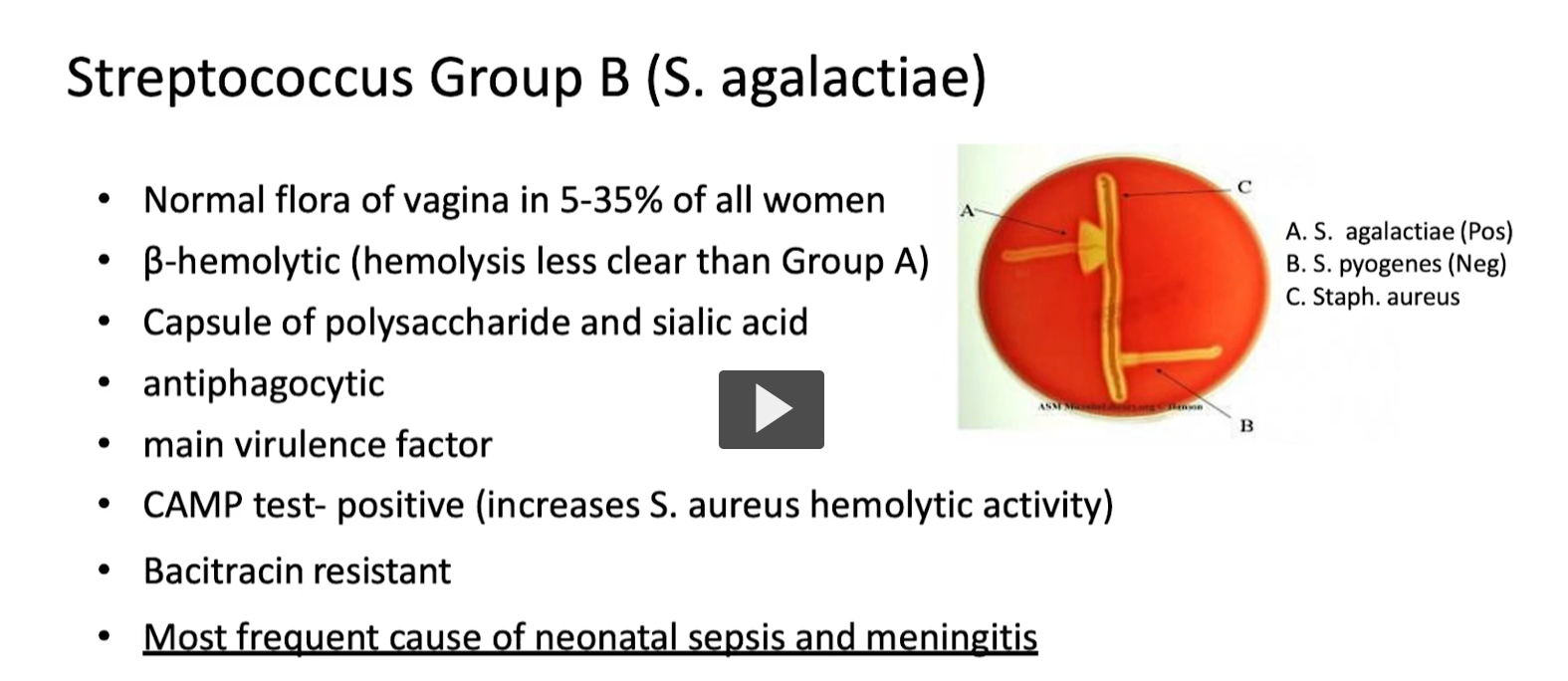
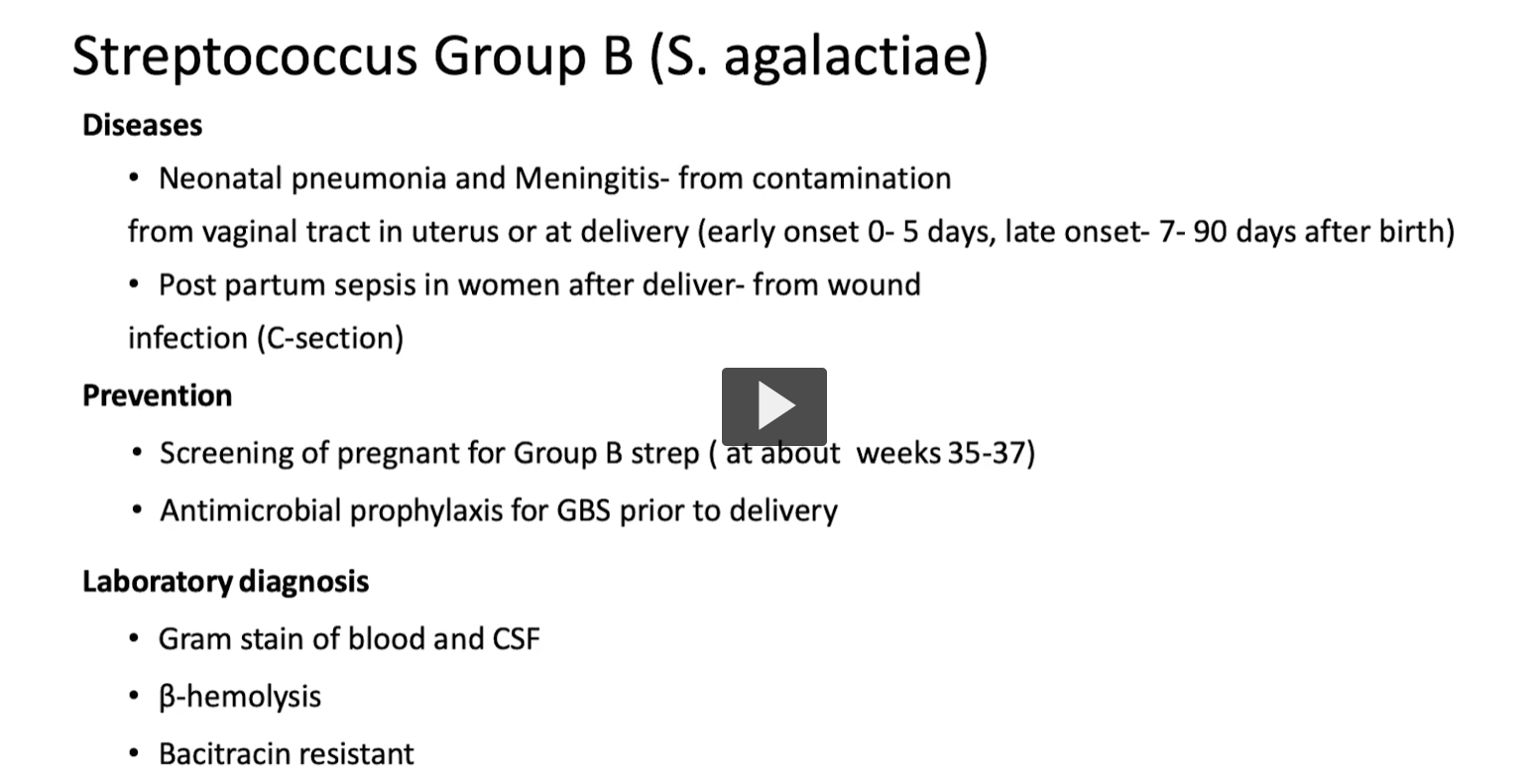
Streptococcus agalactiae etymology combines Greek and Latin roots meaning "chain-forming berry without milk." It derives from streptos (twisted/chain), kokkos (berry/sphere), and agalactiae (no milk), referencing its chain-like structure under a microscope and its historical identification as a cause of bovine mastitis that stops milk production

Big Picture

Group B Strep is:
👉 Normal flora in women
👉 But becomes dangerous when transmitted to newborns


🌍 1. Normal Flora

  • Found in vagina (5–35% of women)
    👉 Usually harmless in adults


🔬 2. Hemolysis

  • β-hemolytic (like Group A)

  • But:

    • Less clear hemolysis

👉 Lab clue: weaker clearing on blood agar

. MOST IMPORTANT CLINICAL POINT

👉 Most common cause of:

  • Neonatal sepsis

  • Neonatal meningitis

<p><em>Streptococcus agalactiae</em><span> etymology </span><strong><mark data-color="rgba(0, 0, 0, 0)" style="background-color: rgba(0, 0, 0, 0); color: inherit;">combines Greek and Latin roots meaning "chain-forming berry without milk."</mark></strong><span> It derives from </span><em>streptos</em><span> (twisted/chain), </span><em>kokkos</em><span> (berry/sphere), and </span><em>agalactiae</em><span> (no milk), referencing its chain-like structure under a microscope and its historical identification as a cause of bovine mastitis that stops milk production</span></p><p><strong>Big Picture</strong> </p><p>Group B Strep is:<br><span data-name="point_right" data-type="emoji">👉</span> <strong>Normal flora in women</strong><br><span data-name="point_right" data-type="emoji">👉</span> But becomes dangerous when <strong>transmitted to newborns</strong></p><div data-type="horizontalRule"><hr></div><p> <span data-name="earth_africa" data-type="emoji">🌍</span> <strong>1. Normal Flora</strong> </p><ul><li><p>Found in <strong>vagina (5–35% of women)</strong><br><span data-name="point_right" data-type="emoji">👉</span> Usually harmless in adults</p></li></ul><div data-type="horizontalRule"><hr></div><p> <span data-name="microscope" data-type="emoji">🔬</span> <strong>2. Hemolysis</strong> </p><ul><li><p><strong>β-hemolytic</strong> (like Group A)</p></li><li><p>But:</p><ul><li><p><strong>Less clear hemolysis</strong></p></li></ul></li></ul><p><span data-name="point_right" data-type="emoji">👉</span> Lab clue: weaker clearing on blood agar</p><p></p><p><strong>. MOST IMPORTANT CLINICAL POINT</strong> </p><p><span data-name="point_right" data-type="emoji">👉</span> <strong>Most common cause of:</strong></p><ul><li><p><strong>Neonatal sepsis</strong></p></li><li><p><strong>Neonatal meningitis</strong></p></li></ul><p></p>
21
New cards
term image
knowt flashcard image
22
New cards
term image
knowt flashcard image
23
New cards
term image
knowt flashcard image
24
New cards
term image
knowt flashcard image
25
New cards
term image