Primary Progressive Aphasia
 Call Kai
 Learn
Learn Practice Test
 Spaced Repetition
 Match
Match Flashcards
 Knowt Play
1/10

There's no tags or description
Looks like no tags are added yet.
Name | Mastery | Learn | Test | Matching | Spaced | Call with Kai |
|---|
No analytics yet
Send a link to your students to track their progress
11 Terms
Atrophy Patterns
Atrophy patterns in PPA start relatively focal before becoming more diffuse over time
not limited to the vasculature as with stroke
PPA Classification Basis
Speech production features (grammar, motor speech, sound errors, word- finding pauses)
Repetition
Single word/syntax comprehension
Reading/spelling
Naming
Semantic knowledge
PPA Diagnosis
● A type of dementia where language processes affected first
● At least two years of isolated language impairment
● Memory problems, visuospatial deficits, and behavioral/personality change must not be present during this time
● Activities of daily living are limited only by the language problem
● There must be no focal lesion (e.g., stroke) that could have caused the language problem
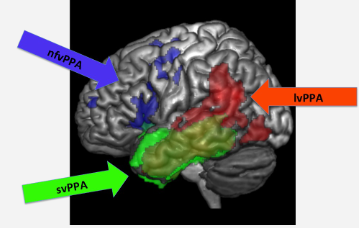
Semantic Variant (svPPA)
● Impairment of semantic memory
● Naming & single-word comprehension severely impaired
● Impaired object knowledge, particularly for low frequency or low familiarity items
● Reduced category fluency
● Surface dyslexia/dysgraphia (letter-by-letter reading)
● Relative spared grammatical and phonological elements
● Atrophic regions primarily in bilateral (but L>R) anterior temporal lobes
Relevant svPPA Assesments
Impaired confrontation naming
Boston Naming test
Impaired object knowledge, particularly for low frequency or low familiarity items
Pyramids and palm trees
may use very general language in sample
synonym judgement
Surface dyslexia/dysgraphia
inability to spell irregularly spelled words (damaged orthographic lexicon) relying on phonological system
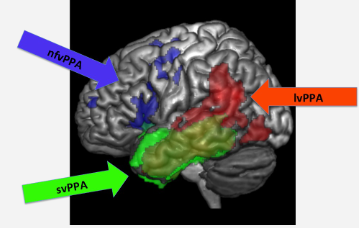
Nonfluent/Agrammatic Variant (nvPPA)
● Effortful. Halting speech, hesitations, speech-sound errors
● Reduced length of utterances
● Poor sentence construction
● Comprehension may be spared early on
● Motor speech disorders may be present (e.g., apraxia of speech),
● Atrophic regions primarily in anterior perisylvian region – left posterior fronto- insular atrophy.
Relevant nvPPA Assessments
Motor control tasks
will perform poorly on tasks requiring motor control of articulators
picture description task
will reveal effortful, halting, agrammatic speech
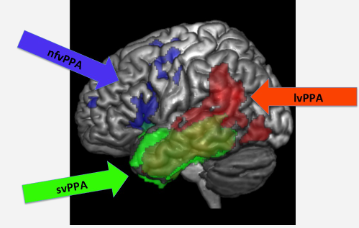
Logogenic Variant (lvPPA)
● Anomia
● Phonological errors, leading to impaired repetition
● Slowed speech rate
● Spared motor speech
● Spared single word comprehension and object knowledge
● Absence of frank agrammatism
● Atrophy primarily in the left temporo-parietal
region, including:
○ Posterior temporal cortex
○ Supramarginal and angular gyri
Relevant lvPPA Assessments
Impaired confrontation naming
Boston Naming test
Impaired repetition of sentences and phrases
especially for unpredictable phrases, as they can’t hold information in phonological working memory
Phonological errors in spontaneous speech and naming
phonological paraphasias
difficulty with phoneme blending tasks
PPA Progression
First complaint:
Often anomia: “I know what it is, but I just can’t say the name of it...”
Impaired confrontation naming
Word-finding difficulty in conversation
Occasionally slurring speech or reduced verbal production
From there, progresses fluent or non-fluent aphasia
Possible presentation of more than one variant time as symptoms progress?
Impairment in other cognitive domains may begin to emerge
End stage: mutism and global cognitive impairment
Treatment for PPA
• Common aphasia treatments may be implemented for individuals with PPA
• People with PPA can improve communication through speech-language therapy
• Improvements in communication can be maintained for months following treatment
• Possibly, (lots) of practice can help preserve communication despite the inevitability of progression
• Trained items may be preserved longer than generalized treatment effects
• Always plan for future decline and adjust treatments as needed