Cellular Energetics (Unit 4)
 Call Kai
 Learn
Learn Practice Test
 Spaced Repetition
 Match
Match Flashcards
 Knowt Play
1/43

Earn XP
Description and Tags
See paper for expansion on the systems and explanations (diagrams)
Name | Mastery | Learn | Test | Matching | Spaced | Call with Kai |
|---|
No analytics yet
Send a link to your students to track their progress
44 Terms
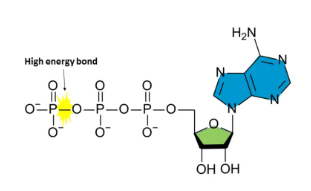
Describe the structure of ATP
Adenosine (Adenine nitrogenous base + ribose), and then 3 (tri) phosphate groups, with the last bond being a high energy bond, making ATP a high energy molecule.
Function of ATP
Powers all cellular work (Chemical, Mechanical, Transport)
Why is ATP the energy currency of the cell?
Because it powers, or pays for, all of the cellular work, by storing energy in its easily breakable phosphate bonds, allowing for easy and quick usable energy for cellular work. Easily transferred, universally accepted, and spent to buy energy for cellular activities and is constantly replenished.
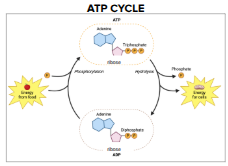
ATP cycle
“Starts“ with ATP, a high energy molecule. Then through hydrolysis, the third phosphate bond is broken, releasing the phosphate and the high amount of energy stored in it (for cells). Now it is ADP and a phosphate, which due to energy from food, is able to through phosphorylation rebind with the other two phosphates, becoming ATP again.
Where does the mass of a plant come from?
The mass of a plant comes primarily from the carbon dioxide, as most macromolecules are carbon based, and are the primary makeup of the plant, and this carbon comes from carbon dioxide. MOST OF IT COMES FROM MOLECULES IN THE AIR THAT CAME IN THROUGH THE HOLES IN THE PLANT’S LEAVES.
Photosynthesis
6CO2 + 6H2O ——> (With sunlight) C6H12O6+6O2. Essentially in words, this is that 6 carbon dioxide with 6 water molecules → by sunlight to 1 glucose molecule and 6 oxygen molecules.
How do plants obtain carbon dioxide
Plants obtain carbon dioxide though their stomata.
How do plants obtain water
Plants obtain water through the roots, adhesion and cohesion capillary action to be brought to leaf for photosynthesis.
How do plants utilize glucose
Immediate energy in cellular respiration primarily, as well as storage and building materials in different forms. It fuels all growth, repair and life processes (food source of the plant).
How do plants utilize oxygen
Oxygen is also used for breaking down glucose to release the energy to the cell, as well as it is released as it is necessary for our atmosphere.
Why is photosynthesis a endergonic process?
Since it takes in outside energy for the transformation/chemical reaction to occur, it uses light energy from the cell. Despite using energy to break bonds, it also forms new bonds, storing that energy in the products, creating the energy for the cell.
Structure of the leaf
Stomata - The opening on the bottom of the leaf controlled by guard cells that lets in gases and releases water.
Guard cells - Control the opening and closing of the stomata
Cuticle - repels water, and is airtight, making the stomata the only entry point and exit point for the leaf.
Lower epidermis - typically has the guard cells and stomata
Upper epidermis - between cuticle and palisade mesophyll
Palisade mesophyll - Contains chloroplasts
Chloroplasts - Site of photsynthesis
Spongy mesophyll - Has air space/pockets for the gasses entering through the stomata.
Xylem - Transports water and nutrients throughout the plant (water → leaves)
Phloem - Transports sugars throughout the plant (including glucose)
Structure impact on photosynthesis
Photosynthesis occurs in the chloroplast found in the palisade mesophyll. The reactants enter through the stomata and the veins leading to it. Then the product sugars are transported via the phloem for growth and energy. Oxygen released via stomata.
How guard cells control gas exchange in leaves.
Central vacuole goes flaccid/shrinks, causes the stomata to close, versus when the central vacuole goes turgid and expands, causing the stomata to open. Think about it with a balloon drawing. Also swelling versus non swelling and pushing apart.
Transpiration
Leaves are the primary site of transpiration, primarily through the stomata, where the pull of evaporation pulls the continuous column of water (due to cohesion and adhesion) out.
For roots to leaves transpiration
More so with adhesion and cohesion through the xylem (with hydrogen bonds between water and cellulose in cell wall in xylem), and with the pull of evaporation is brought up (CAPILLARY ACTION!!!).
Structure of the chloroplast
Site of light dependent reactions →Thylakoid
Site of Calvin Cycle → Stroma
Lots of membrane (Surface area to absorb light energy)
Green pigments [chlorophyll a and b] to absorb specific wavelengths of light.
![<p>Site of light dependent reactions →Thylakoid</p><p>Site of Calvin Cycle → Stroma</p><p>Lots of membrane (Surface area to absorb light energy)</p><p>Green pigments [chlorophyll a and b] to absorb specific wavelengths of light.</p>](https://knowt-user-attachments.s3.amazonaws.com/163be8b9-f32a-4e23-a9da-d6546dde43a3.png)
How does the thylakoid membranes facilitate photosynthesis?
Photosystem II takes in sunlight which is absorbed by the chlorophyll which causes the electrons to energize, but then they lose their energy because the energy is used to move hydrogen from a high to low concentration. Then Photosystem I re-energizes the electrons with light energy, and then NADP+ takes a H+ and two electrons which becomes NADPH which is key (input) to the Calvin cycle. Inside the thylakoid water is split into 2 hydrogen and ½ oxygen gas. This hydrogen and the hydrogen from the electron transport chain (low to high to inside of thylakoid) to power ATP synthesis, as hydrogen powers ATP synthase to convert ADP + P into ATP.
How does the fluid-filled stroma facilitate photosynthesis?
Stage 1: Carbon fixation: RuBisCO (enzyme) which is abundant in the stroma takes inorganic carbons and attaches them to already existing organic molecules.
What is the importance of light in photosynthesis?
Light energy is absorbed by chlorophyll molecules, and excites the electrons kickstarting an electron transport chain that transfers electrons and hydrogen ions (H+) from water to NADP+, forming NADPH. Some of the energy is also stored in ATP. Both ATP and NADPH are crucial to the Calvin cycle, and thus photosynthesis. It also causes the water to lose electrons (excited) and thus become oxygen (through oxidation).
Light energizes the electrons

What are the two stages of photosynthesis? (INCLUDE DIAGRAM)
Light dependent reactions and the Calvin cycle (light independent reactions)
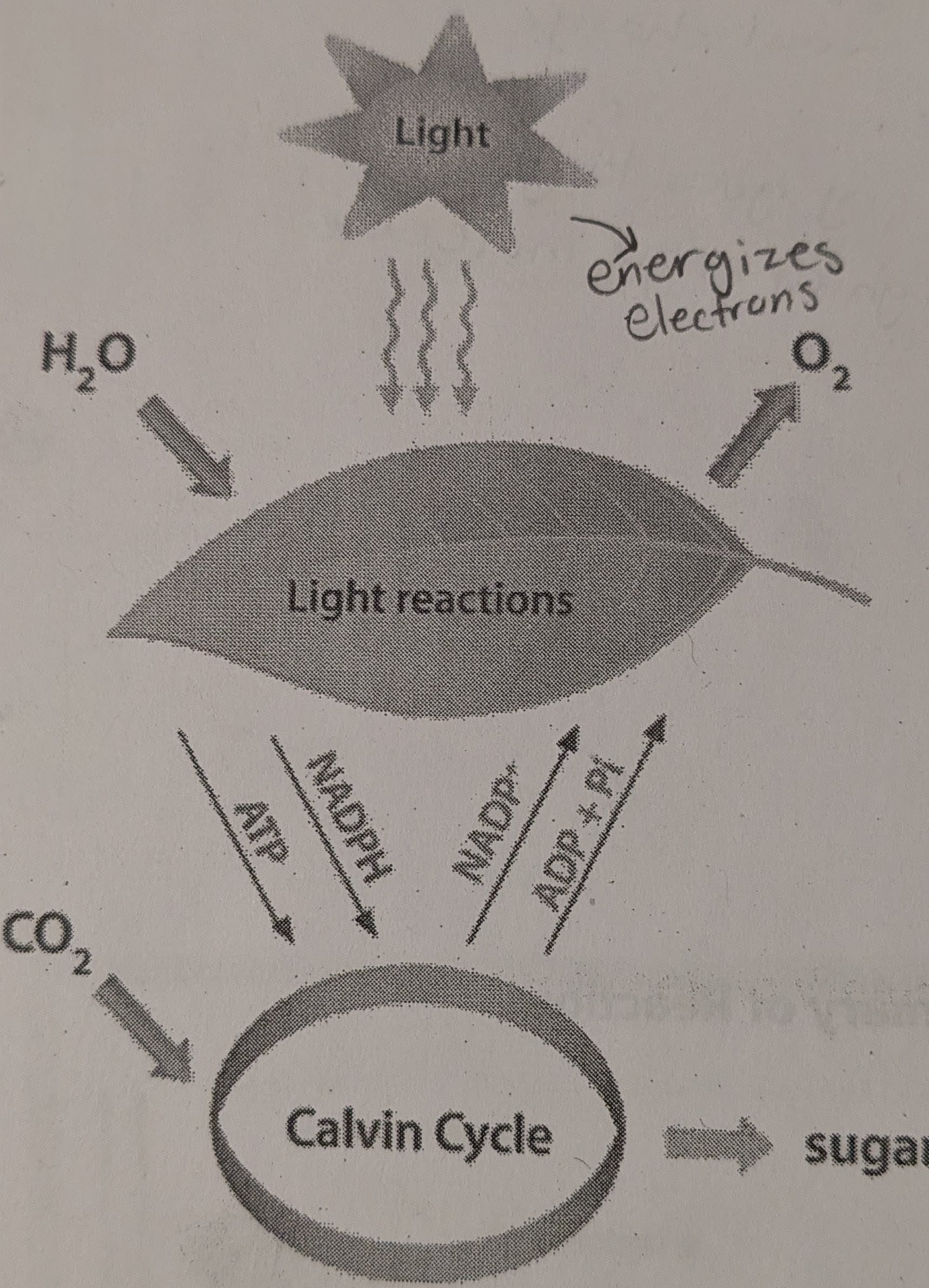
Light-dependent reactions (Inputs and outputs, location)
Inputs: H2O, Light, NADP+, and ADP+P
Outputs: ATP, NADPH, and O2
Location: Thylakoids
Calvin cycle [Light independent reactions] (inputs and outputs, location)
Inputs: ATP, NADPH, and CO2
Outputs: G3P (a precursor to glucose) NADP+ and ADP + P
Location: Stroma of the chloroplast
Role of chlorophyll in photosynthesis
Chlorophyll molecules absorb light energy, and transfer it to the electrons, exciting them and are built into the thylakoid membranes.
Role of ATP in photosynthesis
ATP stores light energy, and acts as the universal energy currency, and powers (with NADPH) the Calvin cycle, by providing the energy for the chemical reactions that build sugar molecules (G3P) NEEDS 2 G3Ps for glucose.
Role of NADPH in photosynthesis
A mobile electron carrier, or a full dump truck for electrons and hydrogen (H+) taking them to the calvin cycle. NADP+ is the empty dump truck that picks up the electrons and hydrogen. NADPH recycles, coming back as NADP+.
Oxidation (definition) and how it applies to photosynthesis
Oxidation is when a molecule loses electrons, and it applies to photosynthesis since water is oxidized, contributing to it becoming oxygen. You can tell since it looses hydrogen molecules.
Reduction (definition) and how it applies to photosynthesis
Reduction is when a molecule gains electrons, and it applies to photosynthesis since carbon dioxide is reduced, contributing to it becoming sugars/glucose. You can tell since it gains hydrogen molecules.
Chemical Equation for cellular respiration
C6H12O6 + 6O2→6CO2 + 6H2O + ATP + HEAT
1 glucose and 6 oxygen react to produce 6 carbon dioxide and 6 water and ATP and heat.
Which reactant is oxidized, which is reduced?
Glucose is oxidized and Oxygen is reduced.
Why is cellular respiration an exergonic process?
It releases energy as a product, which comes from the breakdown of glucose releasing stored energy.
What happens to the energy stored in glucose that is not converted into ATP?
It is released as heat.
Structure of the mitochondria
Has a double membrane, that is smooth. Inner membrane is folded into cristae, which is important because it increases surface area. The presence of the inner membrane creates two different compartments, inter membrane space and matrix.
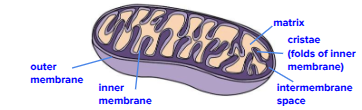
How do the folds of the inner membrane and the resulting membrane-bound spaces facilitate cellular respiration?
The fold increases the surface area of the inner membrane significantly. All three areas contribute to the four stages of cellular respiration, especially with the Electron Transport Chain.
What are the four stages of cellular respiration? Add diagram
Glycolysis, [Pyruvate Oxidation into Acetyl CoA and the Citric Acid (Krebs) Cycle], Oxidative Phosphorylation (Electron transport and chemiosmosis).
![<p>Glycolysis, [Pyruvate Oxidation into Acetyl CoA and the Citric Acid (Krebs) Cycle], Oxidative Phosphorylation (Electron transport and chemiosmosis).</p>](https://knowt-user-attachments.s3.amazonaws.com/b746b104-d27f-49d5-86a5-d95322765a26.png)
Glycolysis (inputs, outputs, where)
Oxidation of glucose
Glucose and NAD+ and ADP + P
Pyruvate and NADH and ATP
Cytososl/Cytoplasm
Pyruvate Oxidation
Mitochondria (Matrix)
Pyruvate and NAD+
Acetyl coA, CO2 and NADH NO ATP
The citric acid (Krebs) cycle (inputs, outputs, where)
Mitochondria (Matrix)
Acetyl coA, NAD+ and FAD
CO2, NADH and FADH2 and 2 ATP
Oxidative phosphorylation (inputs, outputs, where)
Inner membrane of the mitochondria, but also the Matrix.
NADH, FADH2 and O2
NAD+, FAD, and H2O and 28-32 ATP
Role of NADH in aerobic cellular respiration
NAD+ is an electron accepter, and turns into NADH, an electron carrier. It brings electrons from the first two cycles to the electron transport chain, where they then reduce oxygen (oxidizing NADH and FADH2) to form water.
Role of FADH2 in aerobic cellular respiration
FAD is an electron accepter, and turns into FADH2, an electron carrier. It brings electrons from the first two cycles to the electron transport chain, where they then reduce oxygen (oxidizing NADH and FADH2) to form water.
Role of oxygen in aerobic cellular respiration
It is the final electron accepter in the electron transport chain, pulling electrons through the chain, driving ATP production.
Why is oxygen the driving force behind aerobic cellular respiration.
Because it pulls the electrons through the transport chain, which causes them to lose energy, where that energy powers protein pumps pumping hydrogen into the intermembrane space, allowing it to interact with ATP synthase, power ATP production. Without oxygen the process would not be able to occur.
Compare and contrast the conditions and efficiency of aerobic cellular respiration with fermentation
Conditions:
ACR requires oxygen, fermentation does not (uses enzymes bacteria and yeast)
ACR is much more efficient producing 28-32 ATP, while fermentation produces only 2 ATP.