Structural Systems Quiz 2
 Call Kai
 Learn
Learn Practice Test
 Spaced Repetition
 Match
Match Flashcards
 Knowt Play
1/30

There's no tags or description
Looks like no tags are added yet.
Name | Mastery | Learn | Test | Matching | Spaced | Call with Kai |
|---|
No analytics yet
Send a link to your students to track their progress
31 Terms
d. Restrained beam
What is the type of beam wherein no rotation or vertical movement can occur at either ends?
b. Toughness
The property of materials that enable it to absorb energy before rupturing, represented by the area under stress strain curve derived from a tensile test of the material.
d. Rigidity
The property of a material to resist a change in its physical shape.
a. Ductility
The property of a material to undergo plastic deformation after being stressed beyond the elastic limit before rupturing.
c. Brittleness
The property of a material to fracture at low stress without appreciable deformation.
a. Axial Load
A force that acts perpendicular to the cross section of a structural member and at its centroid.
c. Torsion
The twisting of a structural member about its longitudinal axis by two equal and opposite torques.
d. Propped beam
A type of beam with fixed support and a roller support at the other end.
a. Proportional Limit
The stress beyond which the ratio of stress and strain for a material no longer remains constant.
a. Strain
The change in length caused usually by a force applied to a piece, the change being expressed as a ratio, the increase or decreased divided by the original length
a. 10 Mpa
A spherical pressure vessel with an internal diameter of 540 mm is to be generated using a 3mm thick steel. The yield stress of the material is 450 Mpa and the maximum allowable shear stress is 240 Mpa. Determine the maximum allowable internal pressure in Mpa.
c. Poisson’s Ratio
The Ratio of the transverse strain to longitudinal strain.
b. 200 Gpa
The modulus of elasticity of steel is
a. Modulus of Toughness
This represents the ability of the material to absorb energy without any permanent damage to the material.
a. Bitumen
What class of black or dark colored cementitious substances is composed principally of high molecular weight hydrocarbons?
a. L/AE
Give the flexibility of a truss member with length L, cross sectional area A, modulus of elasticity E and moment of inertia I.
b. Purlin
What terms refer to roof beams spanning between trusses?
a. Girt
What do you call the horizontal wall beams serving principally to resist bending due to wind on the side of an industrial building.
d. 88419 Mpa
A metal specimen with 36mm diameter and has a length L=360 mm and a force of 300 Kn, elongates the length by 1.2mm. What is the elastic of modulus?
d. Chromium
This element is added to the steel to make the steel corrosion resistant, when this element is more than 16%, the material is called stainless steel.
c. Quenching
A heat treatment of steel which is done through shock cooling by immersing it to liquid or molten material into a cooling medium.
c. Ultimate Strength
It is the largest stress based on the original cross-sectional area which a material can stand. Thus, it is the maximum ordinate of the stress-strain curve.
c. 0.04 Mpa
What is the stress developed in a bar 1m Length with rectangular cross section 50mm x 50mm subjected to an axial tensile force of 100 N.
b. Elastic Curve
When a beam is loaded the new position of its longitudinal centroid axis is called.
c. 14.11 Mpa
A 2m solid shaft having a radius of 35mm in subjected to a torque of 950N-m. Using G=80000 Mpa.
Calculate the maximum torsional shearing stress developed.
a. 0.01 radians
Calculate the maximum angle of twist
b. 190.59 mm
A cantilever beam 6m long carries a uniform load of 400kn/m throughout the span I=1.7 x 10^9 mm and e=200000mpa. What is the deflection at the free end?
b. Point of Inflection
The point in the moment diagram at which the curvature reverses as it changes from concave to convex is called
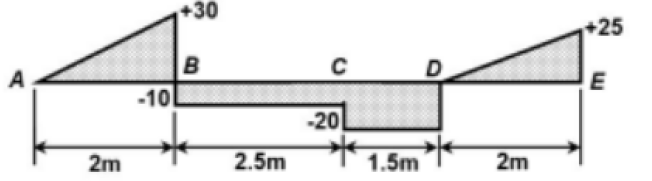
d. 30 KN-m
From the given shear diagram shown. Determine the maximum moment in the beam.
d. 817.27 kN
From the simply supported beam shown,
Calculate the reaction at A
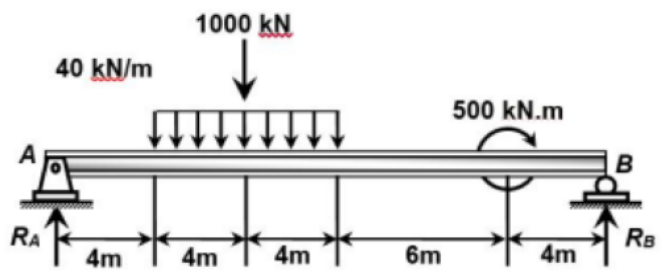
b. 502.73 kN
Calculate the reaction at B