Essay 12- Basic surgical procedures- -tomy and -stomy
 Call Kai
 Learn
Learn Practice Test
 Spaced Repetition
 Match
Match Flashcards
 Knowt Play
1/11

There's no tags or description
Looks like no tags are added yet.
Name | Mastery | Learn | Test | Matching | Spaced | Call with Kai |
|---|
No analytics yet
Send a link to your students to track their progress
12 Terms
What is a surgical procedure?
A procedure that involves cutting or incising structures in order to facilitate a certain operation
Examples of surgical procedures
-tomia
Stomia
Incisio
Excisio
Trepanatio- drilling into bones (skull)
By-pass (CABG)
Resectio (stomach, liver, pancreas, parotid gland)
Ectomia (removal)
Amputatio
Breast reduction
Breast augmentation
-tomy
comes from the Greek word tomos, meaning "cutting"
refers to any surgical incision made into the body or a structure
to facilitate a procedure or operation.
Incision size and location depend on the extent of exposure needed.
Use of scalpel and other cutting instruments is essential.
Langer’s Lines are natural lines in the skin, oriented along the collagen fibers.
Best incisions should run parallel to these lines
to reduce scarring
promote better healing.
Incision Types and Uses:
Wilde’s incision
thoracotomy
laparotomy
laparoscopic port sites
medial sternotomy
Wilde’s Incision:
Used for drainage of mastoiditis, made behind the ear.
Thoracotomy:
Surgical opening of the chest,
usually performed for procedures involving the lungs or heart
(e.g., lung resection, heart surgery).
Laparotomy
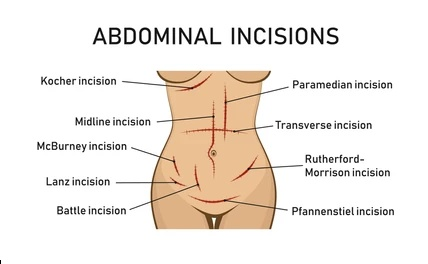
A midline incision along the linea alba
used in abdominal surgeries,
like exploratory surgeries or removing organs
Pfannenstiel Incision: Transverse incision below the umbilicus (commonly used for C-sections).
McBurney Incision: Oblique incision in the lower right quadrant (used in appendectomy).
Kocher Incision: Subcostal incision, used for gall bladder surgery or biliary tree pathologies.
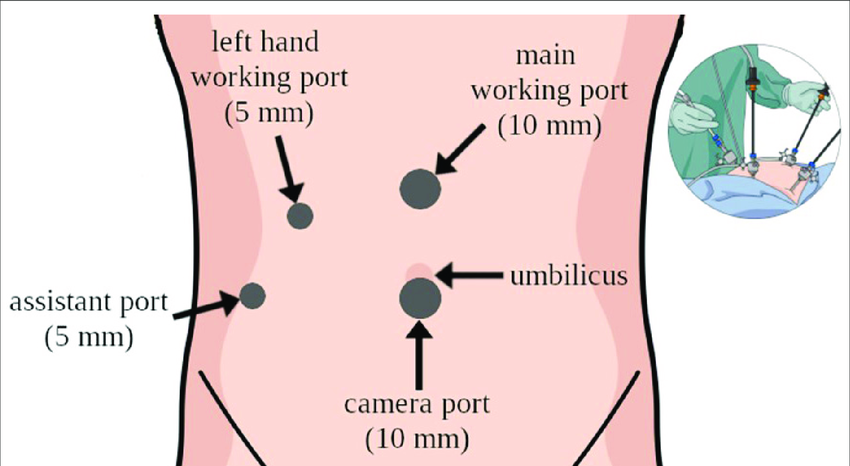
Laparoscopic Port Sites:
Small incisions made for laparoscopy,
where instruments are passed into the abdominal cavity.
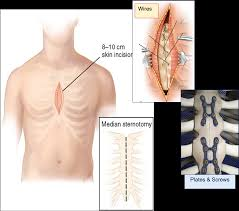
Medial sternotomy
for cardiac procedures
Incision used in cardiac surgery, extending from the sternal notch to the xiphoid process.
Managing Bleeding Post-Incision:
Fine surgery: Blood may be drained, especially in extremity surgery.
Local anesthesia: Weak adrenaline solutions can constrict vessels.
Pressure: Applied directly to the cut edge to control small vessel bleeding.
Hemostatic Forceps: Used to clamp and seal bleeding vessels.
stomy
from greek word stomia which means mouth
the creation of a surgical opening
in a body part or between two body parts
to allow for the diversion of fluids
or the insertion of medical devices.
Common Types of -Stomy Procedures:
Tracheostomy- opening on cricothyroid membrane for a direct airway through an incision for tracheal tube
Gastrostomy- opening made in stomach to insert a feeding tube
Gastrostomy can be done if the opening between the stomach and small intestine is eliminated
Colostomy- opening in healthy part of LI and suturing it to abdominal wall and attaching stoma appliance
Nephrostomy- opening created in skin and kidney which allows urine diversion from renal pelvis
Laparostomy- surgical opening of the abdomen which is left open for a few days
Also called open abdomen
Ileostomy- surgically created opening between the ileum and anterior abdominal wall
Gastroileostomy- surgical connection between stomach and small intestine’
Gastroduodenostomy- surgical connection between the stomach and duodenum
Required in the event of serious peptic ulcer disease