Muscular System A+P OAT Prep

0.0(0)
Studied by 0 people
call kaiCall Kai
learnLearn
examPractice Test
spaced repetitionSpaced Repetition
heart puzzleMatch
flashcardsFlashcards
GameKnowt Play
Card Sorting

1/44

encourage image

There's no tags or description

Looks like no tags are added yet.

Last updated 4:13 AM on 6/18/26
Name
Mastery
Learn
Test
Matching
Spaced
Call with Kai

No analytics yet

Send a link to your students to track their progress

45 Terms

1
New cards

What does a muscle do?

  • Transfer of what into what

It converts chemical energy into mechanical energy

  • This of course happens through muscle contraction

2
New cards

What is a contraction

Pulling

3
New cards

Skeletal Muscle

  • Function

Moves the body, maintains the body posture, and the body temperature
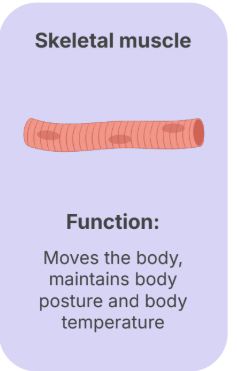
<p><strong>Moves </strong>the body, maintains the body <strong>posture</strong>, and the <strong>body temperature</strong></p>
4
New cards

Cardiac Muscle

  • Main function

Contracts the heart to pump blood throughout the body.
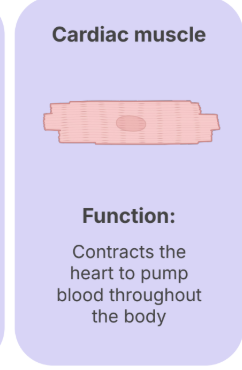
<p><strong>Contracts </strong>the <strong>heart </strong>to pump <strong>blood </strong>throughout the body.</p>
5
New cards

Smooth Muscle

  • Main function

Aids the organ systems like the gastrointestinal, digestive, and circulatory system
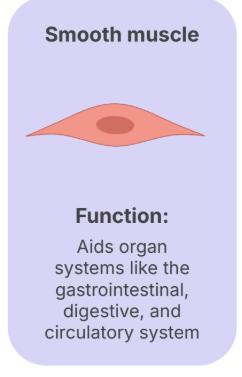
<p>Aids the organ systems like the <strong>gastrointestinal, digestive, and circulatory system</strong></p>
6
New cards

Striated muscles meaning

  • Also striated vs nonstriated muscles

Appearance

  • Striated or nonstriated

A muscle with dark and light band differences. (they have sarcomeres)

Striated: Cardiac, Skeletal

Nonstriated: Smooth

7
New cards

Involuntary vs Voluntary muscles

  • Control type

    • Involuntary or voluntary

Concious or non concious use.

Cardiac and Smooth are involuntary.

Skeletal are voluntary.

8
New cards

Multinucleated vs mononucleated muscles

  • Nuclei

    • Single (one) or multinucleated

Mononucleated: Cardiac and smooth

Multinucleated: Skeletal muscles

9
New cards

Skeletal Muscle

  • Function (again)

  • Locations

  • Characteristics (striated/nonstriated, voluntary/involuntary, nucleated/multinucleated)

Function: Moves our bodies and maintains posture and body temperature. Also stabilizes joints

Locations:

Bones

● Tongue and esophagus

● Diaphragm

● Eye socket

Characteristics:

● Nuclei: multinucleated

● Appearance: striated (sarcomeres)

● Control: voluntary
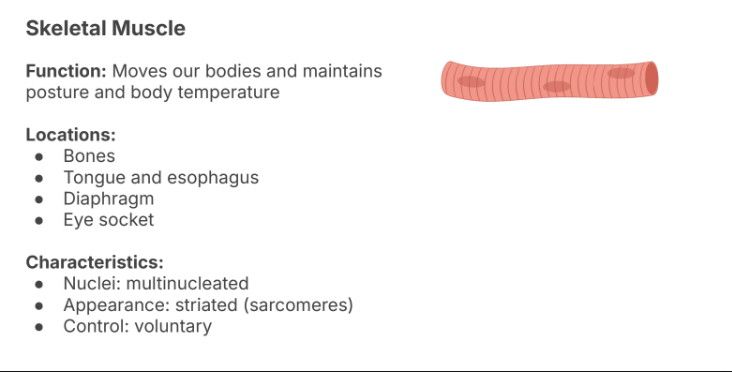
<p><strong>Function</strong>: Moves our bodies and maintains posture and body temperature. Also stabilizes joints</p><p></p><p>Locations:</p><p>●<strong> Bones</strong></p><p><strong>● Tongue and esophagus</strong></p><p><strong>● Diaphragm</strong></p><p><strong>● Eye socket</strong></p><p></p><p>Characteristics:</p><p>● Nuclei: multinucleated</p><p>● Appearance: striated (sarcomeres)</p><p>● Control: voluntary</p>
10
New cards

Cardiac Muscle

  • Function

  • Locations

  • Characteristics (striated/nonstriated, voluntary/involuntary, nucleated/multinucleated)

  • What do they contain that makes them special

Function: Contracts the heart to pump blood

throughout the body

Locations:

● Walls of the heart

Characteristics:

● Nuclei: one

● Appearance: striated (sarcomeres)

● Control: involuntary

They have intercalated discs

  • These guys have coordinated electrical impulse propagation.

  • They consist of desmosomes (which hole cells together) and gap junctions (which connect cytoplasms for ion exchange)
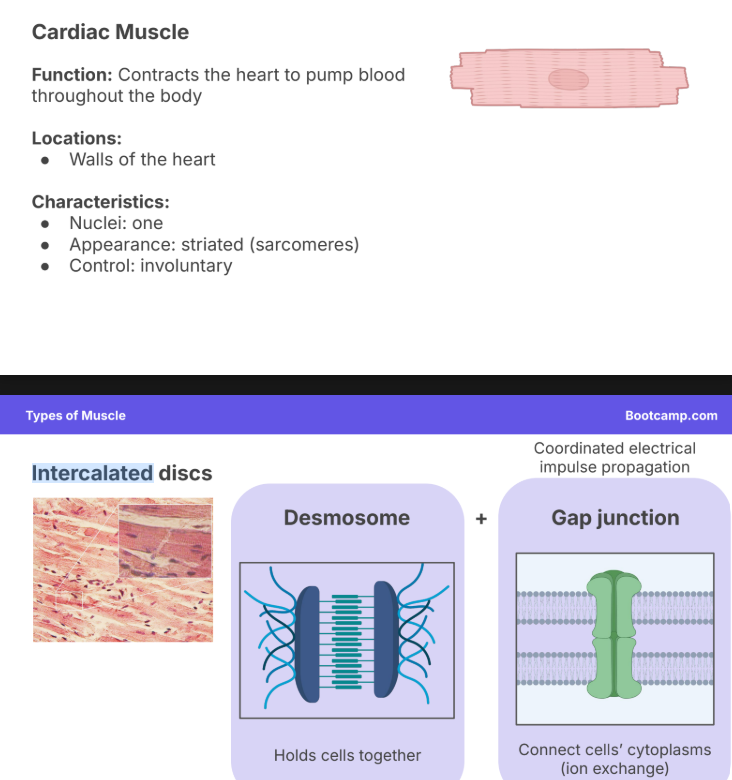
<p>Function: Contracts the heart to pump blood</p><p>throughout the body</p><p></p><p><strong>Locations</strong>:</p><p><strong>● Walls of the heart</strong></p><p></p><p>Characteristics:</p><p>● Nuclei: one</p><p>● Appearance: striated (sarcomeres)</p><p>● Control: involuntary</p><p></p><p>They have <strong>intercalated discs</strong></p><ul><li><p>These guys have coordinated electrical impulse propagation.</p></li><li><p> They consist of <strong>desmosomes </strong>(which hole cells together) and <strong>gap junctions </strong>(which connect cytoplasms for ion exchange)</p></li></ul><p></p><p></p>
11
New cards

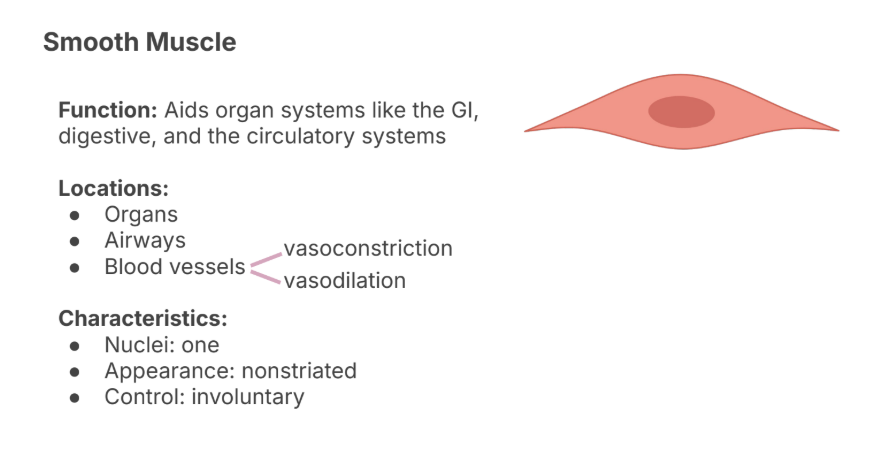
Smooth Muscle

  • Function

  • Locations

  • Characteristics (striated/nonstriated, voluntary/involuntary, nucleated/multinucleated)

Function: Aids organ systems like the GI, digestive, and the circulatory systems

Locations:

  • Organs

  • Airways

  • Blood vessels

    • Can undergo vasoconstriction and vasodilation

Characteristics:

  • Nuclei: one

  • Appearance: nonstriated

  • Control: involuntary

<p><strong>Function</strong>: Aids organ systems like the GI, digestive, and the circulatory systems</p><p></p><p><strong>Locations</strong>:</p><ul><li><p>Organs</p></li><li><p>Airways</p></li><li><p>Blood vessels</p><ul><li><p>Can undergo vasoconstriction and vasodilation</p></li></ul></li></ul><p></p><p><strong>Characteristics:</strong></p><ul><li><p>Nuclei: one</p></li><li><p>Appearance: nonstriated</p></li><li><p>Control: involuntary</p></li></ul><p></p>
12
New cards

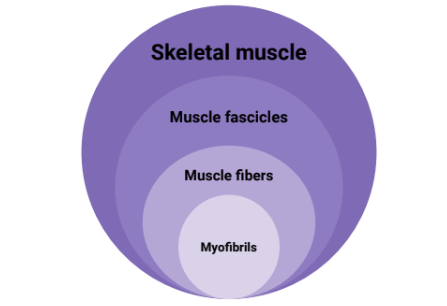
Label the order from largest to smallest skeletal muscle anatomy parts starting with the skeletal muscle.

  • Skeletal Muscle

  • Muscle Fascicles

  • Muscle Fibers

  • Myofibrils

<ul><li><p><strong>Skeletal Muscle</strong></p></li><li><p><strong>Muscle Fascicles</strong></p></li><li><p><strong>Muscle Fibers</strong></p></li><li><p><strong>Myofibrils</strong></p></li></ul><p></p>
13
New cards

Skeletal Muscle

  • What is it surrounded by

  • What is it made of

  • Largest bundle

○ Surrounded by: protective sheath, epimysium

○ Composed of: fascicles
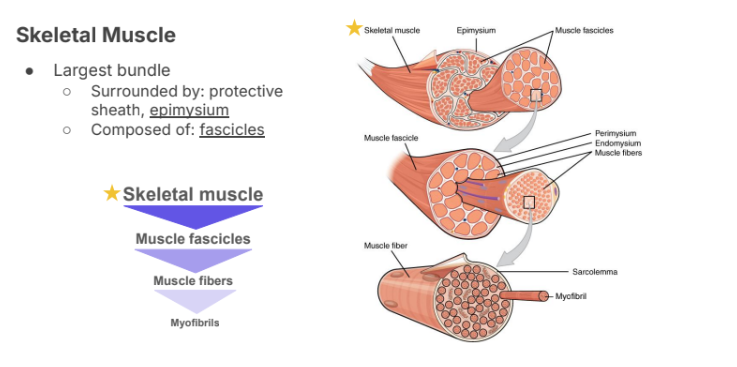
<ul><li><p>Largest bundle</p></li></ul><p>○ Surrounded by: protective sheath, <strong>epimysium</strong></p><p>○ Composed of: <strong>fascicles</strong></p>
14
New cards

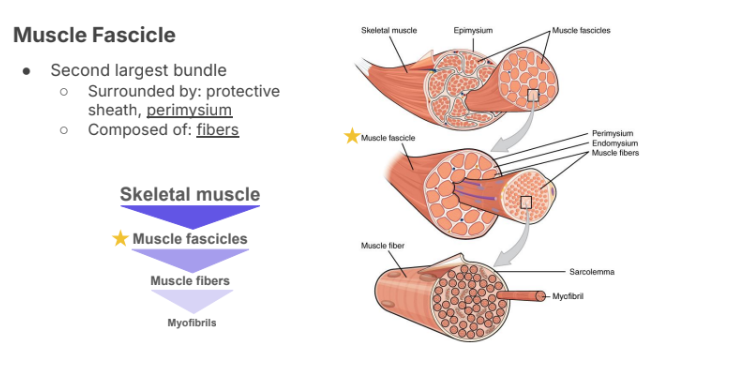
Muscle Fascicle

  • What is it surrounded by

  • What is it made of

  • Second largest bundle

    • Surrounded by: protective sheath, perimysium

    • Composed of: fibers

<ul><li><p>Second largest bundle</p><ul><li><p>Surrounded by: protective sheath, <strong>perimysium</strong></p></li><li><p>Composed of: <strong>fibers</strong></p></li></ul></li></ul><p></p>
15
New cards

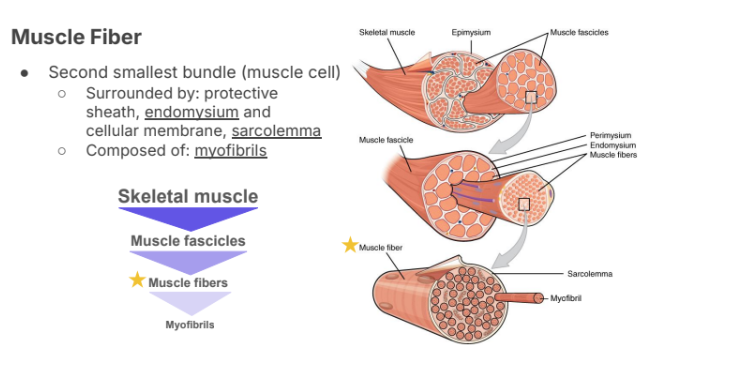
Muscle Fibers

  • What is it surrounded by

  • What is it made of

  • Second smallest bundle (muscle cell)

    • Surrounded by: protective sheath, endomysium and cellular membrane, sarcolemma

    • Composed of: myofibrils

<ul><li><p>Second smallest bundle (muscle cell)</p><ul><li><p>Surrounded by: protective sheath, <strong>endomysium </strong>and cellular membrane, <strong>sarcolemma</strong></p></li><li><p>Composed of: <strong>myofibrils</strong></p></li></ul></li></ul><p></p>
16
New cards

Myofibrils

  • What is it surrounded by

  • What is it made of

Smallest bundle

○ Surrounded by: sarcoplasm

(cytoplasm, not protective sheath)

○ Composed of: contractile proteins
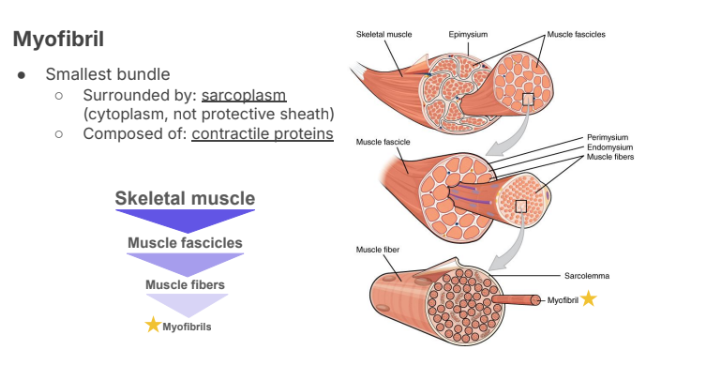
<p>Smallest bundle</p><p>○ Surrounded by: <strong>sarcoplasm</strong></p><p>(cytoplasm, not protective sheath)</p><p>○ Composed of: <strong>contractile proteins</strong></p>
17
New cards

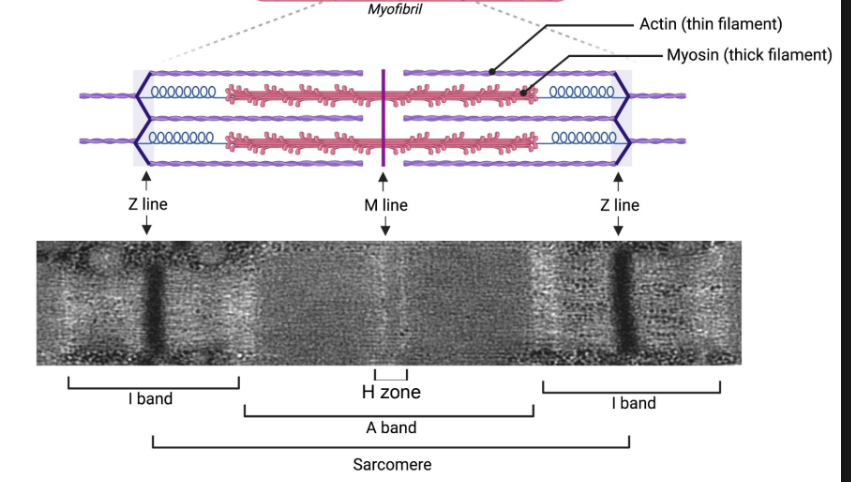
What are sarcomeres?

  • What do they consist of?

  • Sarcomeres are the functional unit of skeletal muscle cells (muscle fibers)

    • Located in the myofibrils

  • Sarcomeres contain myofilaments which have:

    • Actin

    • Myosin

sliding filament model of muscle contraction

18
New cards

Actin Def

  • Actin (thin filaments)

19
New cards

Myosin Def

  • Myosin (thick filaments)

20
New cards

Sarcolemma def

Cell membrane

21
New cards

Sarcoplasmic reticulum

Regulates calcium

22
New cards

Sarcoplasm

cytoplasm of skeletal and cardiac muscle

23
New cards

Actin and Myosin’s role in sliding filament theory

They are the contractile filaments

24
New cards

Troponin

Regulatory protein (the lined one)

25
New cards

Troponin

Regulatory Protein

26
New cards

What is the neuromuscular junction?

  • How does contraction occur here?

  • PT 1 of contraction

  • NMJ is a connection between a motor neuron and a muscle cell

  • Muscle contraction:

  1. Action potential reaches the end of motor neuronʼs axon

  2. Acetylcholine (ACh) is released

  3. ACh binds to ligand-gated sodium channels; channels open (graded potentials), causing EPSP

  4. If threshold is reached, voltage-gated sodium channels open → action potential
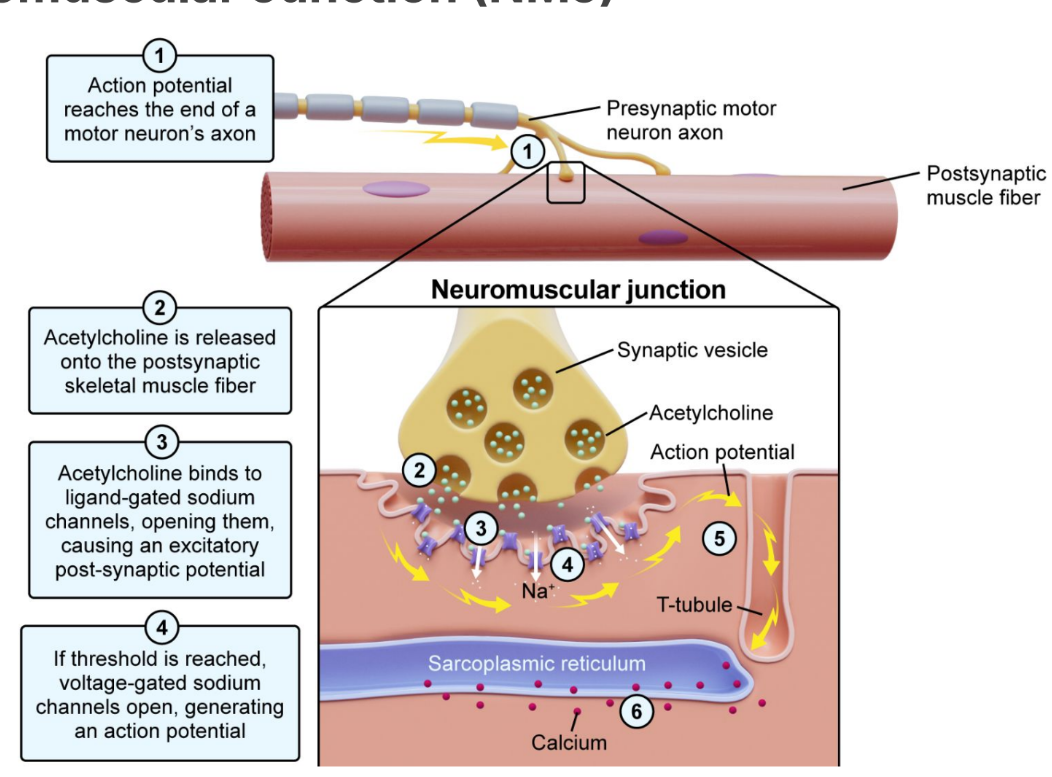
<ul><li><p>NMJ is a connection between a motor neuron and a muscle cell</p></li><li><p>Muscle contraction:</p></li></ul><ol><li><p>Action potential reaches the end of motor neuronʼs axon</p></li><li><p>Acetylcholine (ACh) is released</p></li><li><p>ACh binds to ligand-gated sodium channels; channels open (graded potentials), causing EPSP</p></li><li><p>If threshold is reached, voltage-gated sodium channels open → action potential</p></li></ol><p></p>
27
New cards

Sliding Filament theory part of contraction

  1. Action potential goes down the T-tubles

  2. Action potential triggers the sarcoplasmic reticulum to release calcium

  3. Calcium binds to troponin, which stimulates a power stroke

  4. Muscle fiber shortens and the muscle contracts.
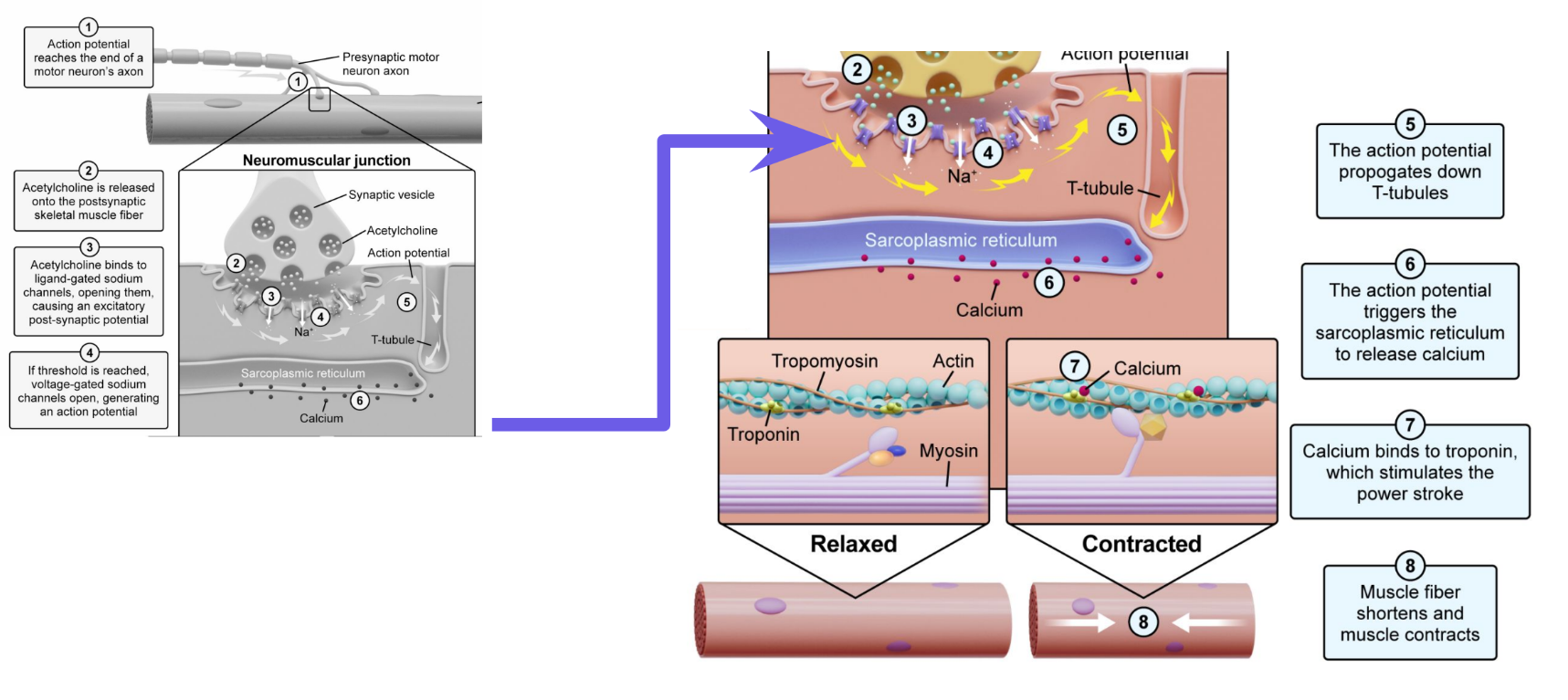
<ol start="5"><li><p>Action potential goes down the <strong>T-tubles</strong></p></li><li><p>Action potential triggers the <strong>sarcoplasmic reticulum </strong>to release <strong>calcium</strong></p></li><li><p>Calcium binds to <strong>troponin, </strong>which stimulates a <strong>power stroke</strong></p></li><li><p>Muscle fiber shortens and the muscle contracts. </p></li></ol><p></p>
28
New cards

Cross Bridge cycle (sliding filament theory in depth.

  1. ADP-bound myosin head is cocked and ready to bind to actin (high energy state).

  2. In the presence of Ca2+, Ca2+ binds to troponin, which exposes a binding site for myosin.

  3. The bound myosin rotates its head, producing a “power stroke”

  4. Then ADP is released and an ATP molecule binds to the myosin head

  5. The actin and myosin detach

ATP is then hydrolyzed to ADP, which cocks back the myosin head.
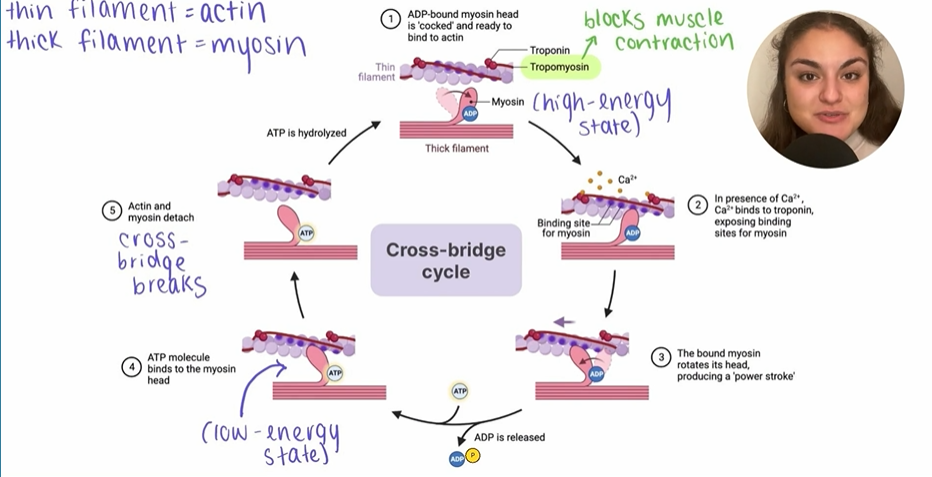
<ol><li><p>ADP-bound myosin head is cocked and ready to bind to actin (high energy state).</p></li><li><p>In the presence of <strong>Ca<sup>2+</sup>, </strong>Ca2+ binds to troponin, which exposes a binding site for myosin.</p></li><li><p>The bound myosin rotates its head, producing a “power stroke”</p></li><li><p>Then ADP is released and an ATP molecule binds to the <strong>myosin head</strong></p></li><li><p>The actin and myosin detach</p></li></ol><p></p><p>ATP is then hydrolyzed to ADP, which cocks back the myosin head.</p><p></p>
29
New cards

Rigor Mortis

Muscles stiffen after death

This is since it requires ATP to relax the muscle

30
New cards

Contractile Unit of the muscle

  • What is it?

Sarcomere

31
New cards

Z lines

Ends of sarcomeres

○ Thin actin filaments
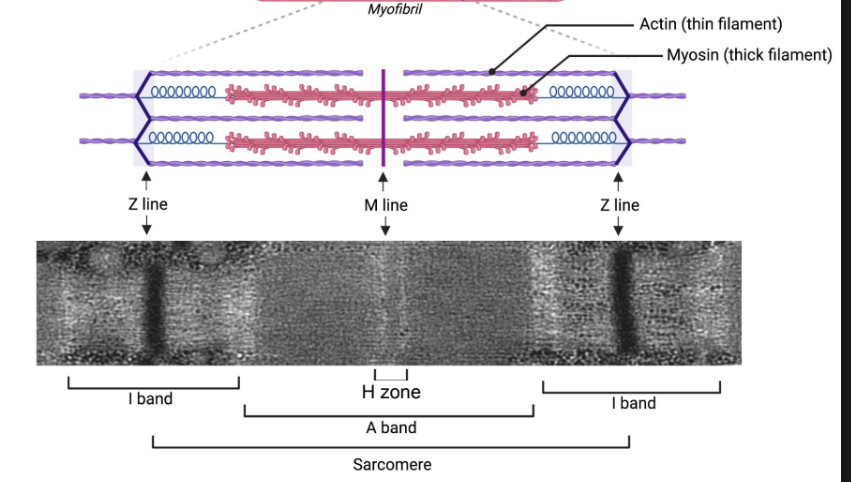
<p><strong>Ends </strong>of sarcomeres</p><p>○ Thin <strong>actin </strong>filaments</p>
32
New cards

M lines

Middle of the sarcomere

  • Thick myosin filaments

<p>Middle of the sarcomere</p><ul><li><p>Thick <strong>myosin </strong>filaments</p></li></ul><p></p>
33
New cards

I band

Only has actin present (I is thin just like actin)

Vowels = band
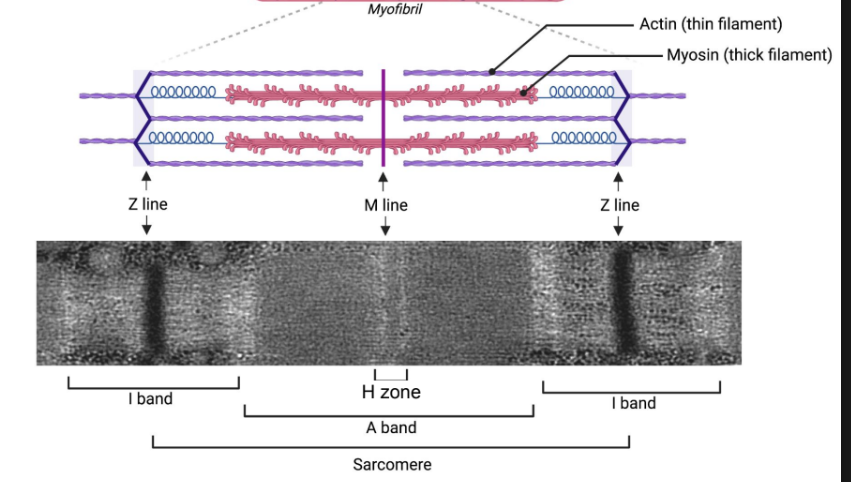
<p>Only has actin present (I is thin just like actin)</p><p></p><p>Vowels = band</p>
34
New cards

H zone

only has myosin present

(H is thick like myosin)

constanants are a zone
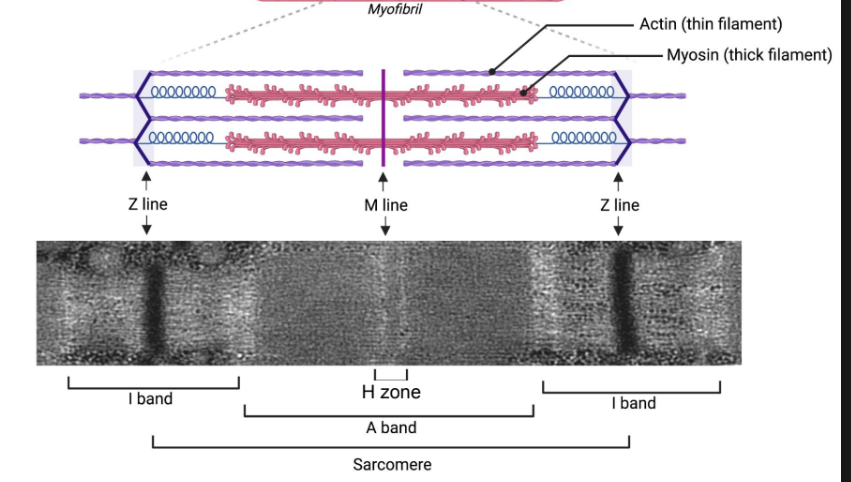
<p>only has <strong>myosin </strong>present</p><p>(H is <strong>thick </strong>like myosin)</p><p></p><p>constanants are a zone</p>
35
New cards

A band

Spans the length of myosin, while also having actin and myosin overlap.

Vowels = band
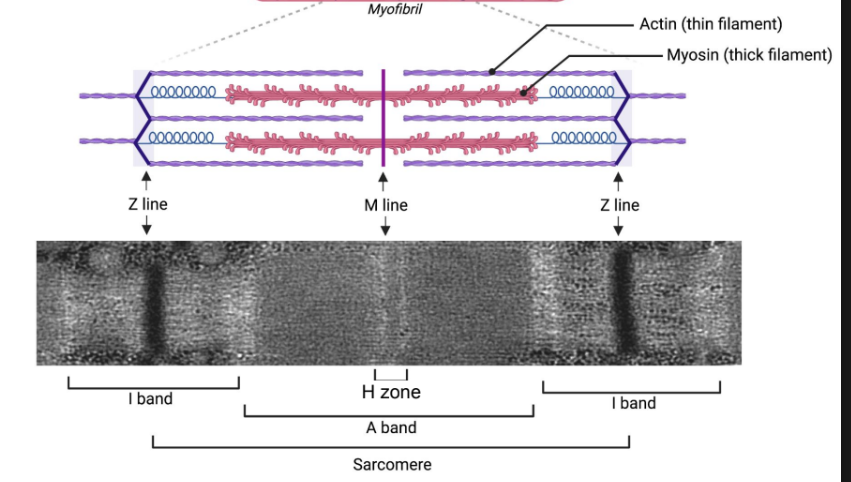
<p>Spans the length of <strong>myosin, </strong>while also having <strong>actin </strong>and <strong>myosin </strong>overlap.</p><p></p><p>Vowels = band</p>
36
New cards

Which bands shrink when the muscle contracts

Which band stays the same

I and H shrink

A band stays the same
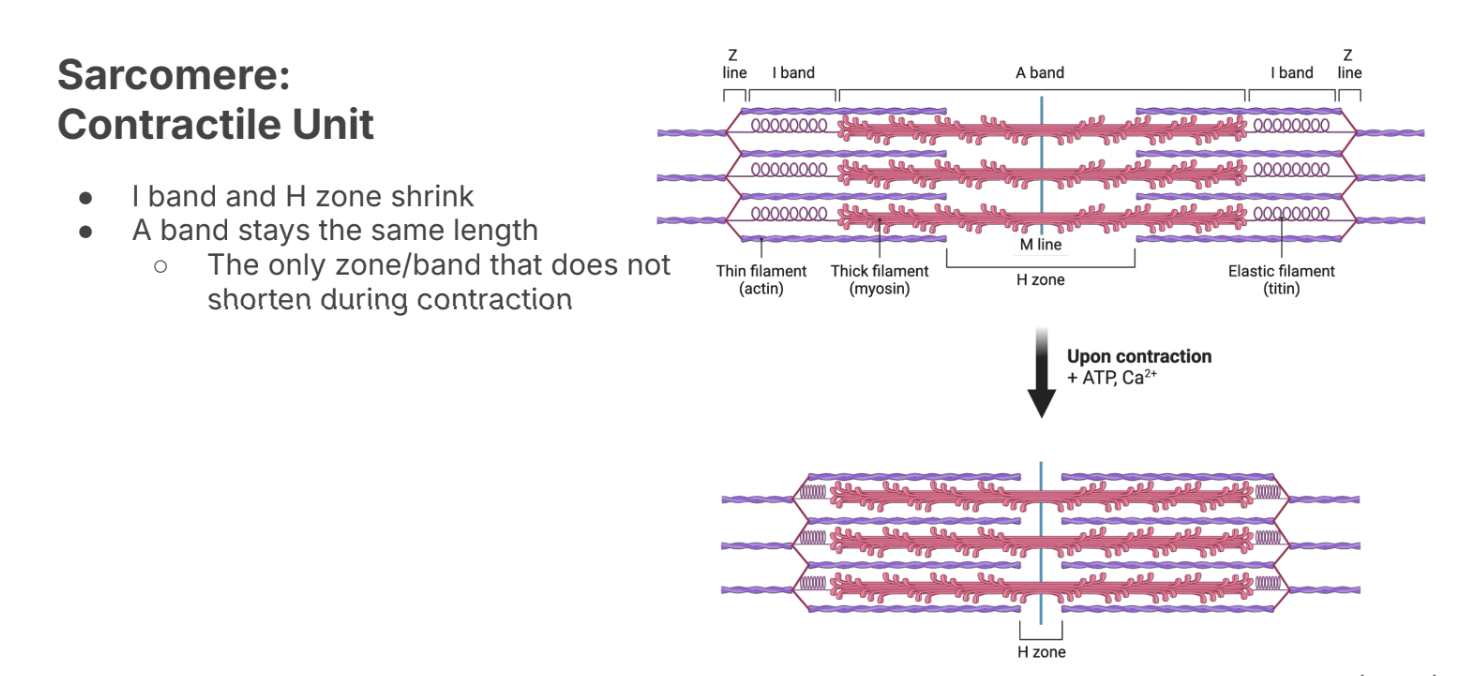
<p><strong>I and H shrink</strong></p><p><strong>A band stays the same</strong></p>
37
New cards

What is a motor unit

Muscle fibers innervated by a single neuron

  • i.e. variable number of muscle cells to one motor neuron

38
New cards

Small motor units

  • What are they used for

  • example

  • Only a few muscle fibers innervated by a motor neuron

  • Used for precise movements (i.e. fine motor control)

Example: extraocular eye muscles
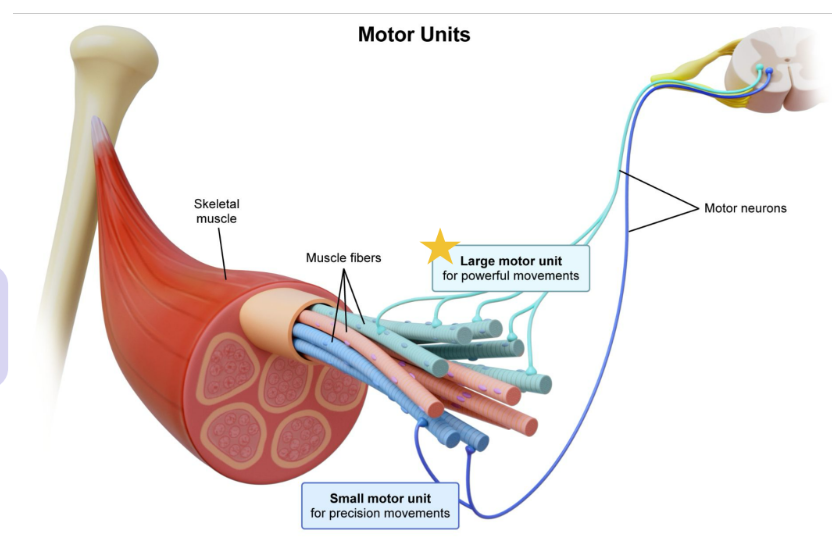
<ul><li><p>Only a few muscle fibers innervated by a motor neuron</p></li><li><p>Used for precise movements (i.e.<strong> fine motor control</strong>)</p></li></ul><p></p><p>Example: <strong>extraocular eye muscles</strong></p>
39
New cards

Large Motor Units

  • Many muscle fibers innervated by a motor neuron

  • Used for powerful movements

EX: Thigh muscles
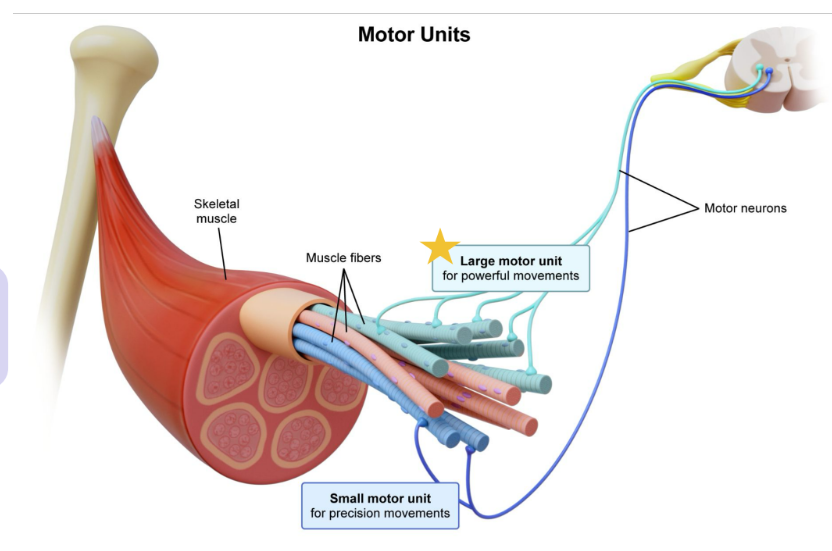
<ul><li><p>Many muscle fibers innervated by a motor neuron</p></li><li><p>Used for powerful movements</p></li></ul><p></p><p><strong>EX: </strong>Thigh muscles</p>
40
New cards

Twitch Contraction

  • Neuron stimulates contraction of ALL muscle fibers belonging to its motor unit

  • Each twitch has the same size and duration
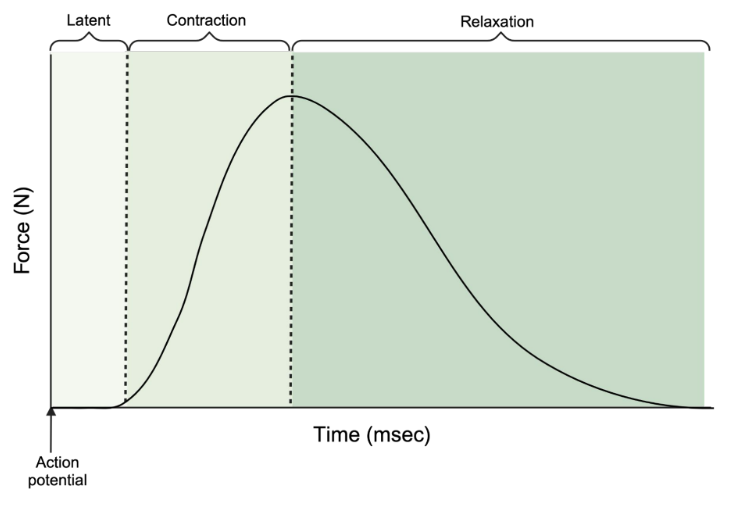
<ul><li><p>Neuron stimulates contraction of ALL muscle fibers belonging to its motor unit</p></li></ul><ul><li><p><strong>Each twitch has the same size and duration</strong></p></li></ul><p></p>
41
New cards

Acetylcholinosterase use

It is used to stop acetylcholine from passing the NMJ. It is hydrolyzes Acetycholine.

42
New cards
43
New cards
44
New cards
45
New cards