Artificial Limbs 1
 Call Kai
 Learn
Learn Practice Test
 Spaced Repetition
 Match
Match Flashcards
 Knowt Play
1/47

There's no tags or description
Looks like no tags are added yet.
Name | Mastery | Learn | Test | Matching | Spaced | Call with Kai |
|---|
No analytics yet
Send a link to your students to track their progress
48 Terms
Why do arms and legs enable someone to do
enable movement, fine motor skills, provide support & maintaining balance, moving, engaging with the surrounding environment
what are the 3 distinct features of a limb
bones, muscles and joints
What is bone
bone is a composite tissue consisting of mineral, matrix (collagen and non-collagenous proteins), cells and water
what are the 5 main functions of the bones
support of the body
protection of soft organs
storage of minerals and fats
blood cell formation (hematopoiesis)
movement thanks to the attached skeletal muscles
what are joints
joints are the areas where two or more bones meet. Most joints are mobile, allowing the bones to move, creates the flexibility of the human body, types of joints according to the movement they allow
what are the 3 types of muscles
smooth muscle- found in the internal organs and blood vessels → involuntary
cardiac muscle- found only in the heart
skeletal muscle- attached to the skeleton → voluntary
what is the result of a muscle contraction
is always tension; a muscle can only exert a pull, muscles cannot exert a push
movement of the human body segments is achieved as
a result of forces generated by skeletal muscles
antagonistic muscle pairs
the muscle is contracting is called the agonist and the muscle that is relaxing or lengthening is called the antagonist
what happens during a bicep curl
the biceps will be the agonist
the triceps will eb the antagonist
what are ligaments
connect bones to bones directly
limit joint movement and stabilize joints
in physiological conditions, experience low loads which increase with range of motion
what are tendons
attach muscle to bones
loaded in series with the muscles
experience high loads
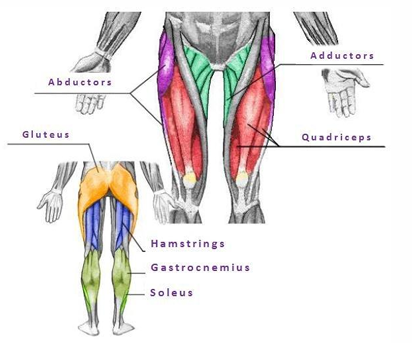
lower limbs anatomy
quadriceps femoris group
hamstring group
gluteal muscles
adductors
abductors
calf muscles
tibialis anterior
isometric contractions
generate force without changing the length of the muscle
Isotonic contractions
generate force by changing the length of the muscle and can be concentric or eccentric contractions
Isotonic concentric contraction
causes muscles to shorten, thereby generating force
Isotonic eccentric contractions
allow a controlled elongation in response to a greater opposing force
what are the two phases of a normal step
stance and swing
stance phase
Stance phase occupies 60% of the gait cycle, during which one leg and foot are bearing most or all of the body weight
swing phase
Swing phase occupies only 40% of it, during which the foot is not touching the walking surface
double-support phase
both feet are in contact with the floor at the same time for about 20% of the time. This part of the cycle is called the double-support phase
orthosis
medical apparatus designed to support, align, or enhance the function of a person's musculoskeletal system.
address various orthopaedic issues
correct deformities
provide stability to an affected body part.
prostheses
artificial device that replaces a missing body part, such as a limb, joint, or even a tooth. restore functionality and improve the quality of life for individuals who have lost a part of their body due to injury, disease, or congenital conditions.
what are the two type of limb prostheses
artificial limbs and joint prostheses
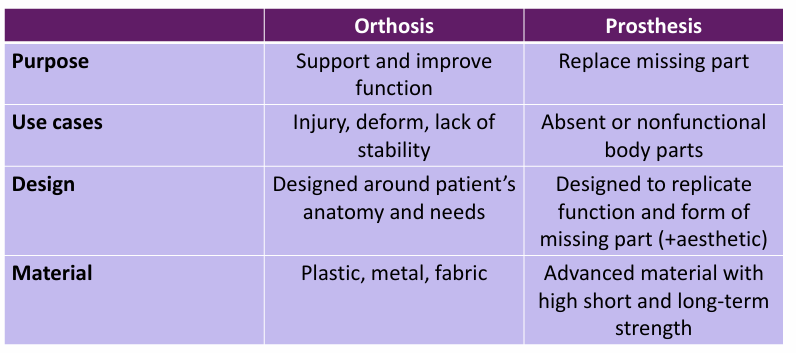
what are the differences between orthosis and prosthesis
orthosis: support and improve function
prosthesis: replace missing part
what medical conditions can prostheses help
amputations, replacements, birth abnormalities
what may create a situation of incapable of exercising their physiological action
in a pathological situation, however one or more tissues may be weakened or damaged and therefore incapable of exercising their physiological action
how can normal functionality be re-established through the use of orthoses
the use of orthoses that modify the system of forces and moments acting on one or more joints of the body, compensating for the inadequacy of the compromised tissues
what is the function of orthotic design
function, comfort, cosmesis, fabrication, cost
what is the function of orthotic design (FUNCTION)
meets the individuals mobility needs and goals
maximises stance phase stability
minimizes abnormal alignment
minimally compromises swing clearance
effectively prepositions the limb for initial contact
is energy efficient
what is the function of orthotic design (COMFORT)
can be worn for long periods without damaging skin or causing pain
can be easily donned and doffed
what is the function of orthotic design (COSMESIS)
meets the individuals need to fit in with peers
what is the function of orthotic design (FABRICATION)
Can be made in the shortest period of time
Uses a minimally complex design
Has some degree of adjustability to enhance initial fitting
For children, responds to growth or change over time
Is durable: stands up to stresses/strains of daily activity
what is the function of orthotic design (COST)
can be made with minimal initial cost, and minimal cost for maintenance
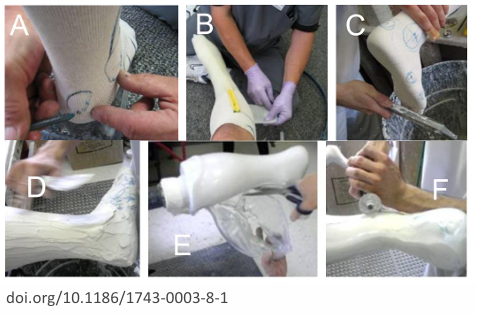
How is orthosis manufactured
Once the orthotist has determined the configuration and orientation of the subject's anatomy for corrective measures, the limb shape is captured by wrapping a sock and casting the leg (Figure A,B)
Once the cast has set it is cut away along the anterior contour (Figure C).
Plaster is poured into the leg cavity. Key surfaces are built outwards with plaster by embedding staples corresponding to surface markers (Figure D).
Pre-heated thermoplastic is vacuum formed around the plaster (Figure E). Once cool, the unwanted plastic is cut away, and edges on the AFO are ground down & smoothed (Figure F).
Due to warehousing considerations, most leg busts in clinics are not kept for more than typically 2 months, so for each patient refitting (typically occurring every other year), the whole process must start from the beginning
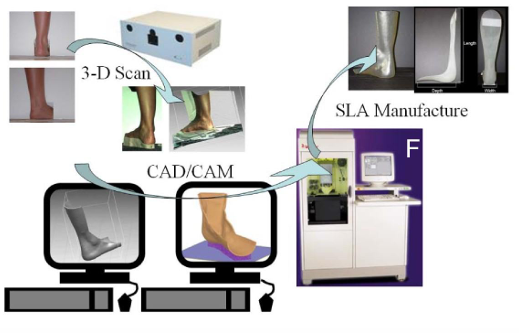
Manufacturing of orthosis using CAD
a. The patient is positioned; a 3D scanner capable of creating a full 3D point cloud of the ankle-foot complex is used to record the anatomical surface
b. the point cloud is processed and manipulated to create the computer model of the desired orthosis according to the clinical needs
c. RP is used to fabricate the orthosis
ankle foot orthosis (rigid or solid)
characterized by stiff shells preventing ankle movement in the three anatomical planes
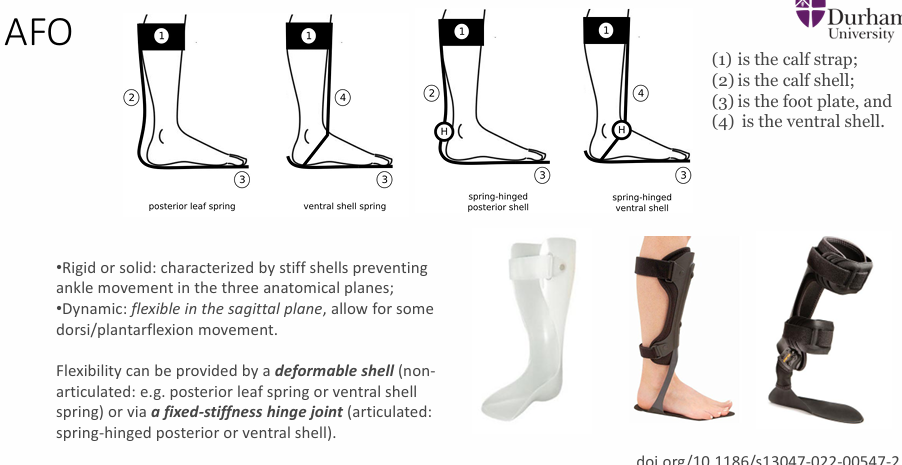
ankle foot orthosis (dynamic)
flexible in the sagittal plane, allow for some dorsi/plantarflexion movement
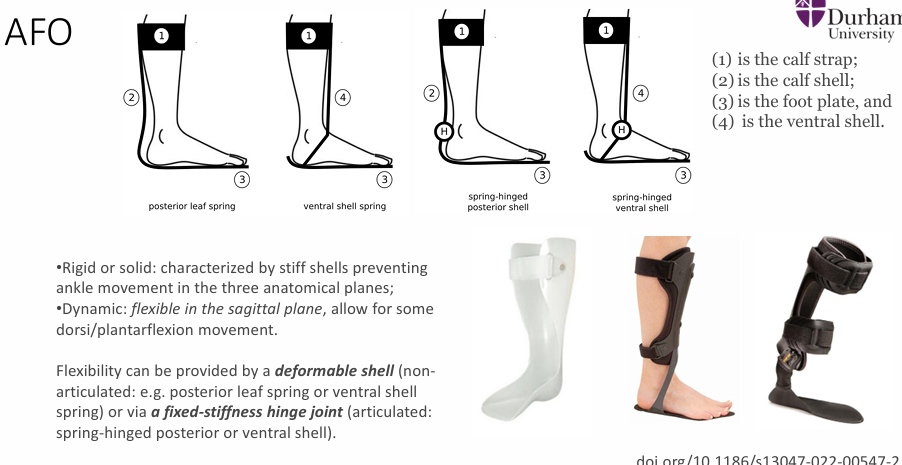
how can flexibility be provided for AFO
Flexibility can be provided by a deformable shell (non articulated: e.g. posterior leaf spring or ventral shell spring) or via a fixed-stiffness hinge joint (articulated: spring-hinged posterior or ventral shell).Flexibility can be provided by a deformable shell (non articulated: e.g. posterior leaf spring or ventral shell spring) or via a fixed-stiffness hinge joint (articulated: spring-hinged posterior or ventral shell).
What is the purpose of AFO- Fixed
provide a rigid structure around the foot and ankle, promoting healing
stop the foot from dropping during walking
What is the design considerations of AFO- Fixed
standardised sizing
level of affixation (neurological or orthopaedic)
comfort
length of wear
cost
What is the human factors of AFO- Fixed
will the user be able to don and off themselves
can it be put on wrong
will overuse cause damage
how much walking will they be doing
What is the design considerations of AFO- Hinged/Spring
Semi Custom
User comfort
Cost low/high
What is the purpose of AFO- Hinged/Spring
lift the foot during walking (neurological conditions)
maintain energy through gait
What is the human factors of AFO- Hinged/Spring
more active users
complex conditions
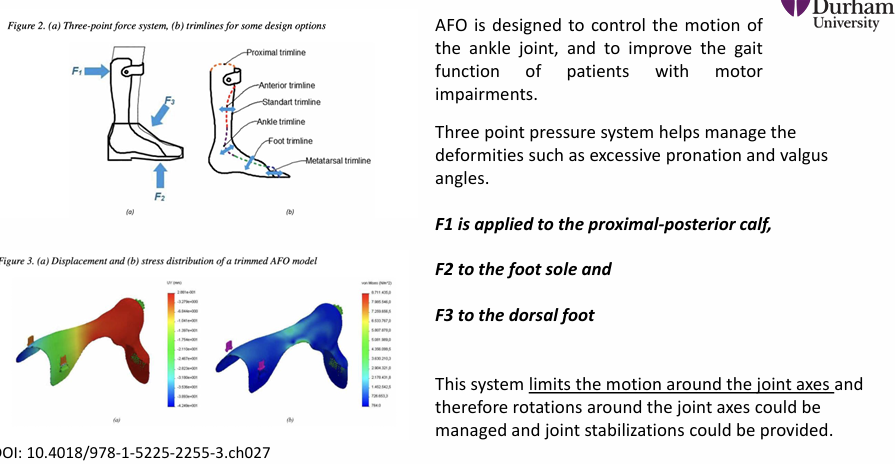
What is AFO designed to control and improve
AFO is designed to control the motion of the ankle joint, and to improve the gait function of patients with motor impairments
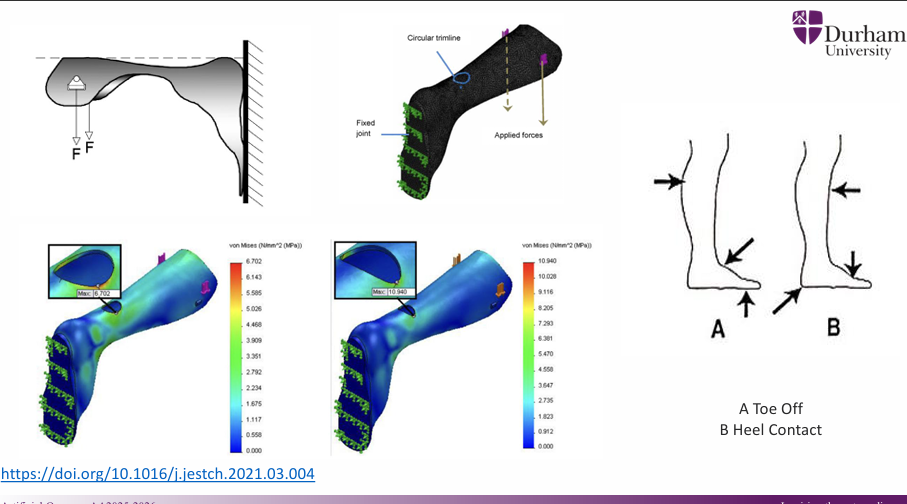
what is the three point pressure system
Three point pressure system helps manage the deformities such as excessive pronation and valgus angles
F1 is applied to the proximal-posterior calf
F2 to the foot sole
F3 to the dorsal foot
This system limits the motion around the joint axes and therefore rotations around the joint axes could be managed and joint stabilizations could be provided