9. Sociolinguistics
 Call Kai
 Learn
Learn Practice Test
 Spaced Repetition
 Match
Match Flashcards
 Knowt Play
1/32

There's no tags or description
Looks like no tags are added yet.
Name | Mastery | Learn | Test | Matching | Spaced | Call with Kai | Chat |
|---|
No analytics yet
Send a link to your students to track their progress
33 Terms
Sociolinguistics
_____________: the study of the relationship between society and language, including details of word choice, syntax, and pronunciation
Speech community
_____________: a group of people who share social conventions, or “sociolinguistic norms”, about language use
Sociolinguistic markers
_____________: salient (noticeable) features that are recognizable within the community and mark our speech; sociolinguistic indicators are less noticeable (‘below the radar’)
Phonological (pronunciation), lexical (words we choose), syntactic/discourse (way we put sentences together), etc.
Markers generally linguistics notice, others may not
Canadian raising, upspeak
Bunny hug or hoodie? Toque or beanie?
Mutual intelligibility
_____________: used to determine whether people are speaking different dialects of the same language, or two different languages; social/political considerations complicate this concept
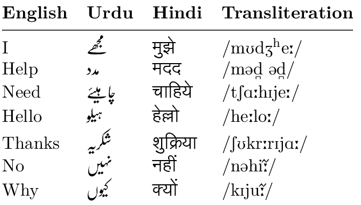
Urdu (Pakistan) and Hindi (India) are mutually intelligible, but are considered separate languages because they are spoken in different countries and have different writing systems (Nasta'liq and Devanagari)
Swedish and Norwegian are mutually intelligible, but are considered two different languages because they’re spoken in different countries.
“A language is a dialect with an army and a navy.” –Max Weinreich
Standard variety
_____________: the variety of a language taught in school, used in formal writing, the news, authority sources
Non-standard varieties
_____________: dialects spoken by less powerful groups
Variety
_____________: preferred term by linguists for any subset of a language; a dialect
Prefer to talk of them as equal, but must acknowledge one is taught in school, used in writing, etc.
Slang
_____________: used by non-linguists for non-standard varieties; linguistically, this refers to words only—new words, or words with new meanings (can become standard, or can disappear)
Accent
_____________: only refers to pronunciation (phonetics, phonology), and does not include vocabulary choices or other differences
Time
_____________: All spoken languages change.
Change over time results in variation in each time period, usually across generations (people’s basic grammar doesn’t change much during their lifetime). We don’t adopt changes from the new generations
We dont look at a single person (generational linguistics)
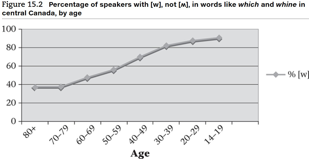
E.g. the loss of /ʍ/, percentage of /w/ goes up as getting younger
Happening right now: Canadian Vowel Shift “sorry,” “milk”
Place
_____________: Geographical location is probably the most-studied social factor affecting variation.
Dialectology
Dialect Levelling
Dialectology
_____________: the study of regional differences in language
Dialects (varieties)
_____________: subsets of the same language
Dialect levelling
_____________: the process of the wearing down of uncommon or distinct features of a dialect over time; a more homogenous dialect emerges. If we all move to an island and share space, by the end of a few generations we’d all be speaking the same dialect. Most frequent features start to dominate, creating a homogenous dialect
Original settler generations keep their (multiple) home dialects
The next generation chose somewhat randomly from all the linguistic options available
The third generation levels out the diversity in favour of the most frequent variant
Canadian Lexical Features
constable, Crown prosecutor, riding, win by acclamation, double-double, smorg (?)
serviette vs. napkin (?), blinds vs. shades, in hospital vs. in the hospital, washroom vs restroom
(?), zed vs. zee, shone rhymes with gone, not bone, bag and beg, caught and cot
Slew, dugout, moccasin, toboggan
Canadian Pronunciation
Canadian raising
Morphology and syntax
The use of be rather than have with the perfect form of a few verbs: I’m finished my homework (ungrammatical in USA) vs. I’ve finished my homework.
Isolation
_____________: Speech communities that are isolated in some way seem to preserve older ways of speaking
physical, isolated from other communities: E.g. Newfoundland English
linguistic, isolated from speakers of the same or a similar language: E.g. Québec French
social, isolated by conventions or attitudes: E.g. African Nova Scotia English
Physical Isolation
physically isolated from other communities. Newfoundland, which I believe is mutually intelligible.
Linguistic Isolation
isolated from speakers of the same or a similar language. French and Quebec French. To me the speaker from France has words pronounced more smoothly and at the back of the mouth/throat, and the Quebec one sounds more strong and exaggerated.
Social isolation
isolated by conventions or attitudes: E.g. African Nova Scotia English
Contact
Code Switching
Situational code-switching
Pidgin
Creole
Code-switching
_____________: a common phenomenon when bilinguals get together and use two (or more) languages (or ‘codes’) to communicate. the use of words or phrases from two languages in one sentence or stretch of discourse, or the use of two different dialects by one individual depending on the social situation
Situational code-switching
_____________: switching between languages for clearly identifiable reasons (e.g. one language in the workplace and another in the home)
Pidgin
_____________: a language stripped down to its essentials for cross-linguistic purposes; consists of a small set of content words and very little grammatical complexity; no L1 speakers. a heavily simplified language that emerges when speakers of different languages require intergroup communication
Creole
_____________: a pidgin that is learned as a first language, became the native (first) language of a community. with expanded lexicon and grammatical rules., favor unmarked features
Creole universals
_____________: fixed word order, minimal inflection, derivational affixes with a consistent and transparent meaning, and an absence of tone
Gender
Do women lead language change?
_____________: tend to adopt more innovative forms than men, perhaps because of linguistic insecurity, trying to sound more elevated in speech because of social conventions
often do more of the jobs that require standard speech (teacher, reception)
primary caregivers
Shifts towards inclusive language: chair instead of chairman, nurse instead of male nurse
Influencer Dialect
Is there a “Tik Talk”
_____________: Upspeak, macroprosody (more intonation, variety in timing and pausing), over-articulation, tighter body language (making movements possible to see on a small screen)Keep audience engaged advised to “never sound like you’re finishing a sentence”, Sound more personal and persuasive. More female than male
Uptalk → rising intonation at end of sentences (sometimes seen as uncertainty)
Vocal fry → creaky voice
Lengthened vowels
Clear consonants
Varied pacing
The Canadian Vowel Shift
A major change in how Canadians pronounce vowels first identified in 1995. as they’ve merged, getting articulated further back in the mouth and higher other vowels moving. Likely started in Urban Ontario.
New pronunciations get social meaning, being associated with younger urban speech, subconsciously speak the way they do. There is more diversity and tolerance of accents, and some influence from what happening in California “Valley Girl Speech” Originally led by young women
More noticeable in words with sounds like “th” and “sh”
Milk —> melk
God → gawd
Bagel → bahgel
pillow → pellow
Sorry → less like sore-y
Caught = cot
Kiwi Accent
The evolution of the New Zealand English Accent. A comedian made a character “Lynn of Tawa” with exaggerated vowels. Some actual politicians have been criticized for the way they talk. It was colonized later than Australia, so there are more records of what they sounded like, broadcasters recorded Kiwis, with the mixing of all accents something emerged. Great Britain wasn’t happy about these changes
New Zealand —> Nu Zuland
Rising front vowels
Pat → pet
Pet → pit
Pit → peet
Fish → feesh
Chips → chups
Rule we follow
Thee → apple
Thuh → chair, one place is started to prefer this whereever
Class
Some ways of speaking are seen as more prestigious (higher status).
Example: “these things” (prestige) vs “dem tings” (non-prestige)
Higher-class speakers:
Use more prestige forms
Sometimes copy outside standards (e.g., British English)
Hypercorrection:
Happens when people overuse prestige forms
Most common in the second-highest class
Caused by:
Linguistic insecurity
Trying to move up socially
Glaswegian Accent
Considered less attractive in the UK
has: Become more distinct over time, not less
Changes in pronunciation:
Older speech → more “ah” sounds
Modern speech → more “ih” sounds
Strong community networks (“largest village in the world”)
Language tied closely to identity and solidarity
Accent can be a way to: Show pride, Resist negative stereotypes
Uses a uvular “r” (similar to French pronunciation)
Important point:
The same sound (like French “r”) is not judged negatively in other contexts
→ Shows that judgment is social, not linguistic and related to CLASS