Inheretance, Variation, Evolution
 Call Kai
 Learn
Learn Practice Test
 Spaced Repetition
 Match
Match Flashcards
 Knowt Play
1/67

There's no tags or description
Looks like no tags are added yet.
Name | Mastery | Learn | Test | Matching | Spaced | Call with Kai |
|---|
No analytics yet
Send a link to your students to track their progress
68 Terms
DNA
Contains all genetic information.
Carries coded instructions for building and operating an organism.
Found in the nucleus, organized in long structures called chromosomes.
Chromosomes come in pairs.
Made of two polymer strands of nucleotides twisted into a double helix shape.
Gene and proteins overview
A gene is a small section of DNA.
Each gene codes for a specific sequence of amino acids.
Amino acids are put together to make a specific protein.
There are only 20 amino acids, but different combinations make thousands of proteins.
DNA determines which proteins a cell produces, which in turn determines the type of cell.
Genome
The genome is the entire set of genetic material in an organism.
Allows scientists to identify genes linked to different diseases.
Knowing which genes are linked to inherited diseases helps us understand them better and develop effective treatments.
Scientists can study the genome to trace human migration.
All modern humans descended from a common ancestor in Africa.
Humans are now found all over the world.
The human genome is almost identical in all individuals, but small differences developed as humans migrated.
Studying these differences helps scientists see when populations split, which directions they moved, and their migration routes.
Structure of DNA
DNA strands are polymers made of repeating units called nucleotides.
Each nucleotide consists of:
Sugar
Phosphate group
One base
The sugar and phosphate groups form the backbone of the DNA strand, alternating along the strand.
One of the four bases (A, T, C, G) is attached to each sugar.
Bases pair with a base on the opposite strand of the double helix:
A pairs with T
C pairs with G
This is called complementary base pairing.
Genes and Proteins - detail DNA
The order of bases in a gene determines the order of amino acids in a protein.
Each amino acid is coded by a sequence of three bases in the gene (a codon).
Amino acids are joined together to make various proteins, depending on the order of bases in the gene.
Some parts of DNA do not code for proteins; these non-coding parts can switch genes on and off, controlling whether a gene is expressed and used to make a protein.
mRNA - Protein Synthesis
Proteins are made in the cell cytoplasm in tiny structures called ribosomes.
Ribosomes use the code in DNA to assemble proteins.
DNA cannot leave the nucleus because it is too large.
The cell uses a molecule called mRNA to carry the code from DNA to the ribosome.
mRNA is made by copying the DNA code.
It acts as a messenger between the DNA and the ribosome.
Carrier molecules (tRNA) bring the correct amino acids to the ribosome in the right order to make the protein.
Function of Proteins
Enzymes – act as biological catalysts to speed up chemical and biological reactions in the body.
Hormones – carry messages around the body.
Structural proteins – physically strong, provide support and structure.
Example: Collagen strengthens connective tissues such as ligaments and cartilage.
Mutations
Definition: Mutations are random changes in an organism’s DNA.
Inheritance: Mutations can be inherited.
Occurrence:
Can occur spontaneously, e.g., when a chromosome is not replicated properly.
The chance of mutation increases with exposure to radiation or certain chemicals.
Effects of mutations on Genes and Proteins:
Effect on genes:
Mutations change the sequence of DNA bases in a gene, creating a genetic variant (a different form of the gene).
DNA bases code for amino acids, so a mutation can change the protein the gene codes for.
Most mutations have little or no effect on the protein; its function and appearance remain unaffected.
Some mutations can alter a protein, changing its shape and inhibiting its function.
Example: If an enzyme’s active site changes, the substrate can no longer bind.
Example: Structural proteins like collagen may lose strength if their shape changes, affecting support and structure in tissues.
Mutations in non-coding regions can affect how genes are expressed, switching them on or off.
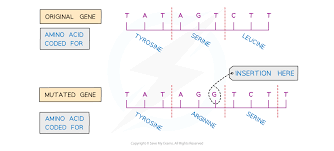
Insertions
An insertion is when a new base is added into the DNA sequence where it shouldn’t be.
DNA is read in groups of three bases (codons), each coding for one amino acid.
An insertion shifts the reading frame, changing how the codons are read.
This can alter multiple amino acids after the insertion, having a knock-on effect on the protein.
Deletions
When a random base is deleted from a DNA base sequence.
Like deletions, this changes the way the base sequence is read and can have knock-on effects further down the sequence.
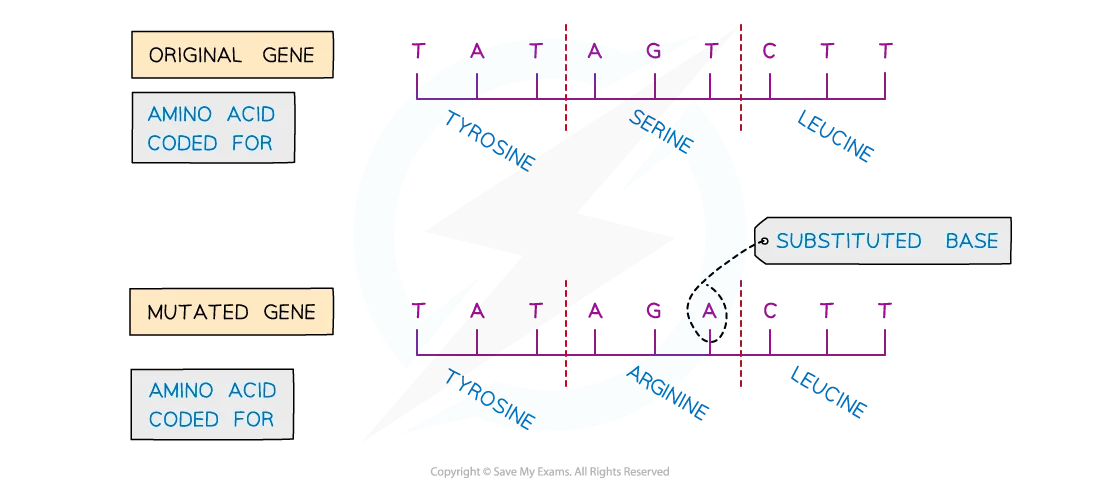
Substitutions
A substitution mutation is when a random base in the DNA sequence is changed to a different base
Sexual reproduction
Involves the fusion of male and female gametes.
Offspring contain a mixture of their parents’ genes, making them genetically different from either parent.
Gametes (egg and sperm) are produced by meiosis.
In humans, each gamete contains 23 chromosomes (half the normal number).
Each gamete has one of each chromosome instead of a pair.
During fertilisation, the egg and sperm fuse to form a cell with the full number of chromosomes (half from mother, half from father).
This is why offspring inherit features from both parents.
The mixture of genetic information produces variation in the offspring.
Flowering plants reproduce sexually too:
Female gametes = egg cells
Male gametes = pollen
Asexual reproduction
One parent → offspring are genetically identical to the parent (clones).
Mitosis: a cell divides to make a new cell with the same genetic information as the original.
No fusion of gametes → no mixing of chromosomes, no genetic variation.
Examples: bacteria and some animals reproduce asexually.
Gametes - Meiosis
Produces cells/gametes with half the number of original chromosomes (haploid).
Involves two cell divisions.
In humans, meiosis only happens in reproductive organs.
Meiosis
DNA duplicates, forming two-armed chromosomes (each arm is an exact copy of the other).
Chromosomes arrange into pairs after replication.
First division:
Chromosome pairs line up at the cell centre.
Pairs are pulled apart, so each new cell gets one copy of each chromosome.
Some chromosomes go into one cell, some into the other.
Second division:
Chromosomes line up at the centre again.
Chromosome arms are pulled apart.
Result: 4 gametes, each with a single set of chromosomes.
Each gamete is genetically different due to shuffling of chromosomes and the fact that each gamete gets half of the chromosomes at random.
Mitosis after Fertilisation
After two gametes fuse during fertilisation, the resulting new cell divides by mitosis to make copies of itself.
Mitosis repeats many times, producing lots of new cells in the embryo.
As the embryo develops, these cells differentiate into specialised cells, forming the tissues and organs of the organism.
Advantages of sexual reproduction
Offspring have a mixture of two sets of chromosomes → inherit genes and features from both parents → variation.
Variation increases the chance of survival in a changing environment.
Some individuals may survive better in new conditions → they have a survival advantage.
Natural selection:
Individuals with helpful characteristics are more likely to survive and reproduce.
These characteristics are passed on to offspring over generations.
Selective Breeding
Humans can speed up natural selection by breeding organisms with desirable traits.
Example:
Animals that produce more meat can be selectively bred to increase food production.
Plants or animals with favourable traits are bred to pass these traits to the next generation. - breeding animals that produce lots of meat.
Asexual reproduction advantages
Only one parent needed.
Uses less energy – no need to find a mate.
Faster than sexual reproduction.
Many genetically identical offspring can be produced in favourable conditions.
Examples of Sexual and Asexual Reproduction
Malaria
Caused by a parasite spread by mosquitoes.
Parasite reproduces sexually in the mosquito and asexually in the human host.
Transferred to humans through mosquito bites.
Fungi
Can reproduce sexually or asexually.
Release spores that can grow in a suitable place.
Asexual spores → genetically identical to parent fungus.
Sexual spores → introduce variation, often in response to unfavourable conditions, increasing survival chances.
Plants
Most plants produce seeds sexually, but can also reproduce asexually.
Examples of asexual reproduction in plants:
Runners: stems that grow horizontally; new plants form along the runner and are identical to parent (e.g., strawberries).
Bulbs: new bulbs form from the main bulb and divide off; each new bulb grows into a new identical plant (e.g., daffodils).
XY chromosomes
Humans have 23 pairs of chromosomes in every cell.
22 pairs control characteristics; the 23rd pair (XX or XY) determines sex.
Males: XY chromosomes
Females: XX chromosomes → allows female characteristics to develop
Sperm cells: 50% chance of carrying X, 50% chance of carrying Y
Egg cells: always carry one X chromosome (egg is xx while male is xy)
Genes, Characteristics and Alleles
Explain how inheritance affects characteristics in organisms.”
Genes you inherit control the characteristics you develop
Some characteristics are controlled by a single gene(mouse fur colour and red-green colour blindness); most are controlled by several genes interacting
Genes exist in different forms called alleles
You have two alleles for each gene (one on each chromosome in a pair)
Types of Alleles and Expression
Homozygous: two identical alleles
Heterozygous: two different alleles
Dominant alleles (capital letters) are expressed if present
Recessive alleles (lowercase) are only expressed if both alleles are recessive
Genotype = combination of alleles
Phenotype = characteristics shown
Cystic fibrosis
Genetic disorder of the cell membranes.
Causes thick, sticky mucus in lungs and pancreas and air passages
Caused by a recessive allele so people with only one copy are carriers.
Carriers (1 in 25) have one allele, no disorder
Child needs two alleles (both parents carriers/affected)
Polydactyl
Genetic disorder where a person is born with extra fingers or toes (not life-threatening)
Caused by a dominant allele
Can be inherited if only one parent has the allele
The parent will also show the condition since it is dominant
How can embryos be screened for genetic disorders?
Embryo Screening and Genetic Testing
Embryos can be fertilised in a lab (IVF) and implanted into the mother’s womb
A cell can be removed from an embryo before implantation to analyse its genes
Embryos with bad alleles destroyed.
Genetic disorders (e.g. cystic fibrosis) can be detected this way
DNA can also be tested from embryos in the womb
This could lead to terminating the pregnancy.
Ethical, Social, and Economic Considerations For:
Embryos with harmful alleles may be destroyed
Screening in the womb could lead to abortion
Can reduce suffering and save government/taxpayer money on treatment
Against:
Could be misused (e.g. selecting non-medical traits like sex)
Suggests people with genetic disorders are undesirable → may increase prejudice
Parents might choose “desirable” traits
Process is expensive
Mendel
Austrian monk trained in mathematics and natural history
Conducted experiments on pea plants in his monastery garden in the mid-19th century
Observed how characteristics were inherited; published research in 1866
Became the foundation of modern genetics
Key Findings
Height in pea plants is determined by separately inherited hereditary units (alleles) from each parent
The ratio of tall and dwarf plants in offspring showed:
The gene for tall plants is dominant
The gene for dwarf plants is recessive
First cross: tall × dwarf → all tall offspring
Second cross: offspring from first cross × each other → 3 tall : 1 dwarf ratio in next generation
Mendel conclusions
Characteristics are determined by hereditary units (genes)
Hereditary units are passed to offspring unchanged from each parent (one unit from each parent)
Hereditary units-alleles can be dominant or recessive
If an individual has both dominant and recessive units, the dominant characteristic is expressed
Why was Mendel’s work ignored/not understood?
Background Knowledge on Genes
Before Mendel, no knowledge of genes, DNA, or chromosomes
Mendel’s work on pea plants (mid-19th century) provided the starting point for understanding inheritance
Late 1800s: scientists familiar with chromosomes observed how they behaved during cell division
Early 20th century: scientists noticed similarities between chromosomes and Mendel’s hereditary units, leading to the discovery that hereditary units are carried on chromosomes → now called genes
1953: structure of DNA determined, allowing scientists to understand how genes work
genetic variation
Species show differences due to genetic or environmental variation
All plants and animals have characteristics similar to their parents because genes inherited from parents control development
Genes are codes inside cells that control how an organism is made
Genes are passed on in sex cells when offspring develop
Most animals inherit one gene from each parent
The combination of genes causes genetic variation; some offspring are not identical
Some characteristics are determined only by genes, e.g.:
Flower colour in plants
Eye colour or blood group in animals
Inherited disorders
Environmental variation
The conditions an organism lives and grows in affect its characteristics
Example: a plant growing in plenty of sunlight will be green
The same plant in darkness will have tall, yellow leaves
How are characteristics due to genetic and environmental variation?
Example only here.
The maximum height a plant or animal can grow is determined by its genes
Whether it reaches that height depends on environmental factors, such as the amount of food it receives
How do mutations introduce variation?
Phenotype
Mutations are changes in the sequence of DNA bases
They can change the protein a gene codes for
Some mutations have no effect, while others slightly alter characteristics
Rarely, mutations can result in a new phenotype in a species
If the environment changes and the new phenotype provides a survival advantage, it can become more common through natural selection
Evolution
All species have evolved from simple life forms that started around 3 billion years ago
Darwin used observations, fossils, and geology to develop his theory of evolution by natural selection
He observed that species show variation in characteristics (phenotypic variation)
Organisms compete for limited resources in an ecosystem
Organisms with the most suitable characteristics for their environment are more successful competitors and more likely to survive (survival of the fittest)
Successful organisms are more likely to reproduce, passing on the genes for their advantageous characteristics to their offspring
Less successful organisms are less likely to survive and reproduce, so their genes are less likely to be passed on
Over time, beneficial characteristics become more common in the population, and the species evolves
What discoveries developed Darwin’’s theory?
At Darwin’s time, scientific knowledge was limited; he could not explain why new characteristics appeared
We now know that phenotype is controlled by genes
New phenotypic variation arises because of gene variants produced by mutations
Beneficial adaptations are passed on to future generations if the genes contribute to survival and reproduction
Speciation
Over a long period, phenotypes of organisms change so much through natural selection that a completely new species can form
Speciation occurs when populations of the same species change enough to become reproductively isolated
Reproductively isolated populations cannot interbreed to produce fertile offspring
Development of a new species
How does extinction occur?
Environment changes too quickly, e.g., destruction of habitat
New predators kill them, e.g., human hunting
New disease spreads and kills the population
Competition with another species for food
Catastrophic events kill all, e.g., volcanic eruption
Why did some disagree with Darwin? - Origin of Species 1850
Went against religious beliefs about how life on Earth developed
First plausible explanation for species evolving without a creator
Darwin could not explain how new useful characteristics appeared or how they were passed on
He did not know about genes or mutations (discovered ~50 years later)
Not enough scientific evidence at the time because few studies had been done on how organisms change over time
Lamarck’s Theory of Inheritance of Acquired Characteristics
Acquired this characteristic in their lifetime and pass on this characteristic to their offspring.
Lamarck argued that changes an organism acquires during its lifetime can be passed on to offspring
He suggested that if a characteristic is used a lot, it becomes more developed during the organism’s life
Offspring would inherit the acquired characteristic
Example: a rabbit that used its legs a lot would develop longer legs, and its offspring would be born with longer legs
Why scientists have different hypothesis?
Disproving Lamarck …
Proving Darwin …
Different religious beliefs influenced how people thought about life
The only way to determine which view is correct is by finding evidence to support or disprove each one
Lamarck’s theory was rejected because experiments showed acquired characteristics are not inherited
Example: dyeing a hamster’s fur bright color does not change the fur of its offspring
Darwin’s theory is supported by genetics, which explains how beneficial characteristics can be passed on via genes
Additional evidence comes from fossils, showing how organisms change over time
Fossil records allow scientists to see gradual changes, e.g., how organisms developed resistance to antibiotics, supporting evolution by natural selection
Selective Breeding
Humans artificially select plants or animals that are useful
The genes for particular characteristics remain in the population
Organisms are selected to develop features that are:
Useful or attractive
Animals that produce more meat, eggs, or milk
Crops that are disease resistant
Dogs with good temperament
How selective breeding works?
The process …
Select the stock with the characteristics you want
Breed them together
Select the best offspring and breed them together
Repeat over several generations
The desirable trait becomes stronger and all offspring show it
Examples:
Improving meat yield in cows: breed the best cows together to eventually get cows with high meat yield
Domestication of animals like cows and dogs through selective breeding over generations
Problems with selective breeding
Reduces the gene pool → fewer different alleles in a population
Happens because farmers keep breeding closely related animals or plants (inbreeding)
Inbreeding can cause health problems
Increases chance of harmful genetic defects
Some dog breeds are particularly susceptible to diseases because of inbreeding
New disease risk: if there is little variation, all stock are closely related, so one disease can affect them all
Summary: selective breeding → reduction in allele variety → less chance of resistance alleles being present in the population
Genetic engineering
Genetic Engineering
Genetic engineering: transferring a gene responsible for a desired characteristic from one organism into another
Process:
Useful gene is isolated from one organism’s genome using enzymes
Inserted into a vector (usually a virus or bacterial plasmid, circular DNA found in bacterial cells)
Vector is introduced into the target organism, and the useful gene is inserted into its cells
Uses of Genetic Engineering
Applications:
Genetically modifying bacteria to produce human insulin to treat diabetes
Genetically modifying crops to improve yield, quality, or resistance to disease, insects, or herbicides
Genetically modifying animals (e.g., sheep) to produce substances like drugs in their milk
Gene therapy: inserting working genes into humans to treat inherited diseases caused by faulty genes
Why is genetic engineering controversial?
Can treat diseases
More efficient food production
Worries about long-term effects of changing an organism’s genes
Unplanned problems could arise
Changes could be passed on to future generations
Pros and cons of GM crops
Pros:
Can increase yield, producing more food
Can be engineered to add missing nutrients (e.g., Golden Rice with beta-carotene to prevent blindness)
Already grown in some places without reported problems
Cons:
Can affect wildflowers and insect populations, reducing biodiversity
Some people are concerned about human health effects
Genes may escape into the environment
Example: herbicide-resistance genes could create superweeds
Cloning - tissue cultures
Plants are placed in a growth medium with hormones and develop into new plants (clones) of the parent plant
Plants grow quickly in very little space and require little equipment
Used by scientists to produce rare plants that are hard to reproduce naturally
Allows production of large numbers of plants quickly
Cloning - Cuttings
Cuttings are taken from good parent plants
Placed in suitable conditions to produce genetically identical plants (clones of the parent)
Cuttings grow quickly
Can be kept in controlled/moist conditions until ready to plant
Embryo transplants
Farmers can produce cloned offspring from their best bull and cow using embryo transplants
Process:
Sperm cell taken from the bull, egg cell taken from the cow
Egg is artificially fertilised
The embryo is split many times to form clones before any cell becomes specialized
Cloned embryos are implanted into lots of other cows, producing calves that are genetically identical
Hundreds of identical offspring can be produced every year
Adult cell cloning
Process:
Remove the nucleus from an unfertilised egg cell
Remove the nucleus from an adult body cell and insert it into the empty egg
Stimulate the egg artificially to start dividing like a normal embryo
When the embryo is a ball of cells, implant it into the womb of an adult female
The offspring is a genetically identical clone of the adult body cell donor
This technique was used to create Dolly the cloned sheep
Advantages and disadvantages of cloning
Advantages:
Can reduce gene pool issues in endangered species by preserving individuals
Studying animal clones could improve understanding of development, aging, and age-related disorders
Could help preserve endangered species
Disadvantages / Concerns:
Cloned animals may have health problems (e.g., Dolly the sheep had arthritis)
If human cloning were allowed, it could lead to unethical outcomes, such as children being born with severe disabilities
Reduces genetic variation → if a new disease appears, all individuals may be susceptible because there are no alternative alleles for resistance
Fossils
How do fossils form in rocks - Preservation
Fossils and Preservation
Fossils: remains of organisms from thousands of years ago, found in rocks
Can show how much or how little organisms have changed over time
Preservation where decay is prevented
Examples:
Amber: tree resin preserves organisms
Tar pits: oxygen-poor → prevents decay
Glaciers: too cold for microbes to survive
Peat bogs: acidic, low oxygen → slows microbial decay
How do fossils form in rocks -- Gradual replacement by minerals
Hard parts (teeth, shells, bones) don’t decay quickly
Buried remains are replaced by minerals, forming a rock-like substance shaped like the original
Surrounding sediment also turns to rock
How do fossils form in rocks - Casts and impressions
Organism buried in soft material (e.g., clay)
Clay hardens around it; the organism decays
Leaves a cast of its shape
Hard parts like bones or shells can also leave impressions
How life begun?
Scientists know how life evolved, but not exactly how it began
Various hypotheses:
Life may have first formed in a primordial swamp or under the sea
Simple organic molecules may have formed in early Earth conditions → gradually became more complex molecules → eventually formed simple life forms
Difficult to prove due to lack of concrete evidence
Early life forms were soft-bodied → remains often decayed → fossil record is incomplete
Fossils that did form millions of years ago may have been destroyed by geological activity (tectonic movement, erosion)
Some fossils may still be preserved in rock, but many are lost
Species
Group of similar organism that can reproduce to give fertile offspring.
Isolation
When populations of a species are separated by a physical barrier (e.g., floods, mountains, geographical isolation)
Isolated populations may experience different environments or climates → different characteristics become more common due to natural selection
Each population shows genetic variation because of differences in alleles
Individuals with advantageous characteristics are more likely to survive and reproduce
Beneficial alleles are passed on to the next generation
Over time, populations change so much that individuals from the two populations can no longer interbreed to produce fertile offspring → become two different species
Summary:
Geographic barrier → populations separated → different environments → natural selection → new species evolve
Wallace
Scientists at the same time as Darwin studied speciation and developed further evidence
Darwin combined his observations with Wallace who came up with natural selection
Published On the Origin of Species in 1859
Observations and evidence from around the world support evolution by natural selection
Example: Warning colours in some species protect them from predators
Such beneficial characteristics evolve through natural selection
Antibiotic Resistance in Bacteria
Random mutations in bacteria can lead to new characteristics, e.g., resistance to a particular antibiotic
Bacteria with antibiotic resistance genes become more common in the population over time
Bacteria reproduce rapidly, so they evolve quickly
Antibiotic resistance is a big advantage:
Resistant bacteria survive in hosts treated with antibiotics
They reproduce, increasing the population of resistant strains
These strains are problematic because:
They are immune to current antibiotics
Infections caused by them can spread between people
New antibiotics are needed as bacteria evolve, but resistant strains can become common
Example: MRSA
A common superbug
Hard to treat in hospitals
Can be fatal if it enters the bloodstream
Why is antibiotic resistance becoming more common?
Antibiotic Resistance and Misuse
Bacterial infections were first treated with antibiotics from naturally occurring sources
Antibiotic resistance has increased due to:
Overuse of antibiotics
Inappropriate use for viral infections or minor conditions
The more often antibiotics are used, the greater the problem of resistant bacteria
Resistant bacteria have a survival advantage → their numbers increase, making disease more common
To reduce resistance:
Patients should complete the full course of antibiotics
This ensures all bacteria are destroyed → prevents development of antibiotic-resistant strains
1. Antibiotic Use in Farming
Antibiotics are given to farm animals to prevent disease and improve growth
This can lead to antibiotic-resistant bacteria in animals
Resistant bacteria may transfer to humans through meat consumption
Some countries restrict antibiotic use to reduce this risk
2. Developing New Antibiotics
Increase in antibiotic resistance has encouraged drug companies to develop new antibiotics
Development is slow and expensive
Resistant strains continue to evolve, making it difficult to keep up with new bacterial threats
Classification
Organisms are sorted into a system according to their characteristics and structures
This system is called the Linnaean system
Living things are first grouped into kingdoms (e.g., Plant Kingdom)
Kingdoms are then subdivided into smaller groups:
Phylum → Class → Order → Family → Genus → Species
“King Philip Came Over For Great Spaghetti”
How Classifcation system changed?
Ss knowledge of biochemical processes improved and microscopes advanced, scientists could study the internal structures of organisms in more detail
This led to new models of classification
In the 1990s, scientists proposed the Three-Domain System based on evidence from chemical analysis and techniques such as RNA sequencing
Organisms are placed into large groups called domains:
The Three Domains of Life - Woese 1990
Archaea
Initially thought to be primitive bacteria
Actually a different type of prokaryotic cell
Found in extreme environments (e.g., hot springs, salt lakes)
Bacteria
Includes typical bacteria like E. coli and Staphylococci
Cells may look similar to Archaea, but there are many chemical differences
Eukaryota
Includes a broad range of organisms: fungi, plants, animals, and protists
Domains are further subdivided into:
Kingdom → Phylum → Class → Order → Family → Genus → Species
Binomial system
Every organism is given its own two-part Latin name
The first part is the genus → gives information about the organism’s ancestry
The second part is the species → identifies the specific organism
Example: Humans → Homo sapiens
Homo = genus
sapiens = species
The binomial system is used worldwide
Avoids confusion when scientists in different countries speak different languages
Ensures each species has the same name globally
Evolutionary Trees
Scientists show how different species are related by studying common ancestors and relationships between species
More recent common ancestors → species are more closely related
Species that share more characteristics are likely to be closely related
Scientists use different types of data to determine evolutionary relationships:
Living organisms: current classification, DNA analysis, structural similarities
Extinct species: information from the fossil record
Explain how our understanding of evolution has developed due to:
• fossil evidence
• increased understanding of the mechanisms of genetics.
Fossils
Show past life, evolution over time, and extinction
Show relationships to modern species
Fossil record shows development of species
Has gaps, but new discoveries are filling them
Used to create evolutionary trees
Formed by preservation in rock over time
Genetics
Gregor Mendel → genes (units of inheritance) from plant experiments
Dominant & recessive alleles
Chromosome behaviour matches Mendel’s units
DNA structure discovered → controls protein synthesis
Genetic variation within species
Variation caused by mutations (gene changes)
Advantageous traits → survive & reproduce more
Pass on beneficial alleles/genes
Leads to evolution (e.g. antibiotic resistance in bacteria)
New species form when reproduction is no longer possible
Why take cuttings rather than seeds?
Taking Cuttings (Cloning Plants)
Quicker → no need to wait for flowers, fruits, or seeds
Offspring identical (same appearance, e.g. large/bright flowers)
Same alleles/genes/DNA
Asexual reproduction (cloning)
No gamete fusion
No mixing of genes from two parents
Involves mitosis → copies genetic material
Does not involve meiosis → no variation
No variation in flowers
Prevents effects of pollination/cross-pollination
Increased profitability
Fewer resources needed
Faster production
Consistent quality plants