Transcription and Control of Gene Expression
 Call Kai
 Learn
Learn Practice Test
 Spaced Repetition
 Match
Match Flashcards
 Knowt Play
1/79

There's no tags or description
Looks like no tags are added yet.
Name | Mastery | Learn | Test | Matching | Spaced | Call with Kai |
|---|
No analytics yet
Send a link to your students to track their progress
80 Terms
What are the different parts of a gene in prokaryotes vs eukaryotes?
Prokaryotes:
-Open reading frame (ORF)-part of gene that is made into protein
-Promoter-control element
-Terminator
Eukaryotes:
-Have ORF with introns and exons
-Promoter-control element
-Poly A site
Transcription
-What direction is it?
Transcription is 5′ to 3′ on a template that is 3′ to 5′
Coding Strand
The DNA strand that has the same sequence
as the mRNA and is related by the genetic code to the protein sequence that it represents
RNA Polymerase
An enzyme that synthesizes RNA using a DNA template (formally described as a DNA-dependent RNA polymerase)
-Has high processivity
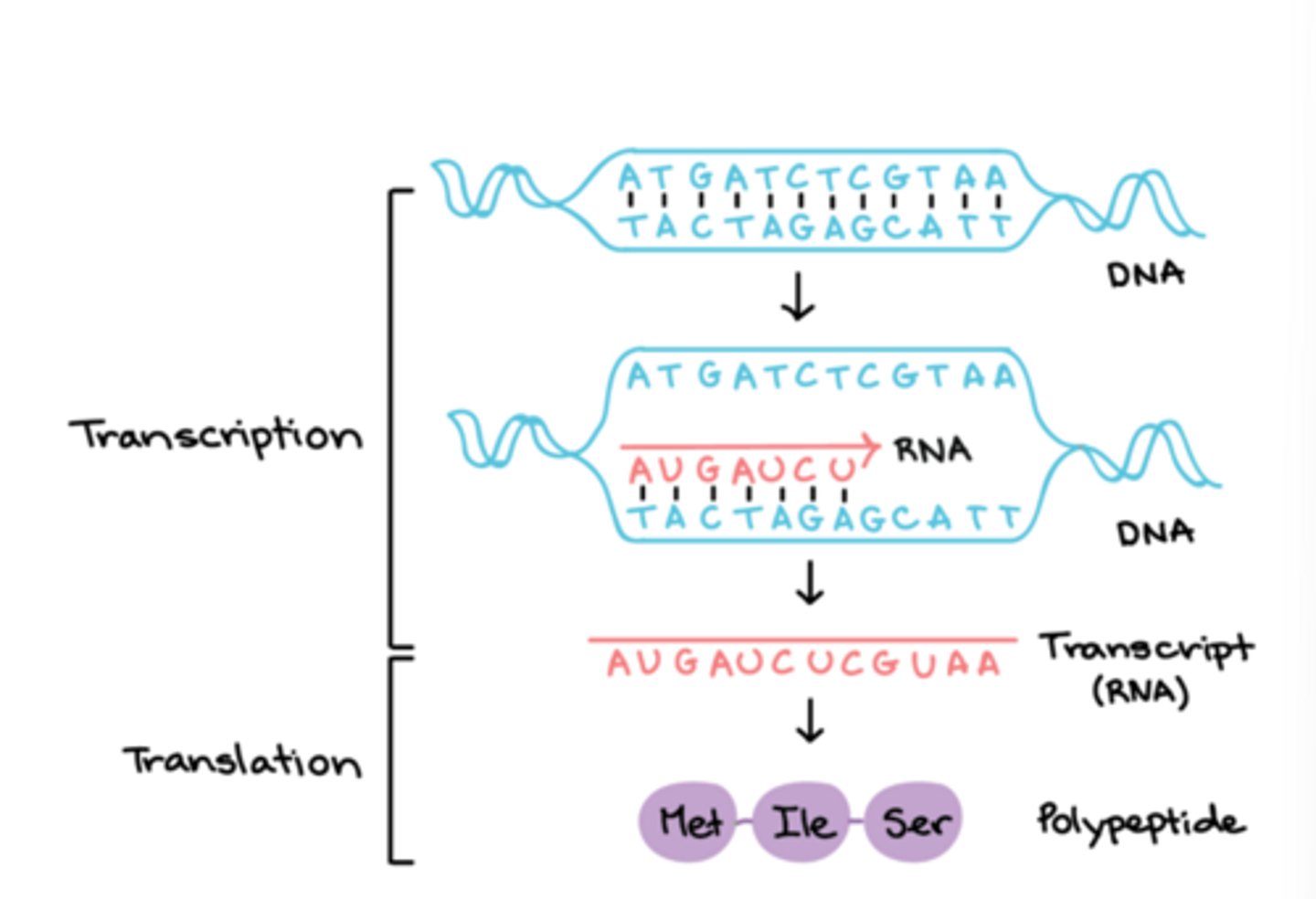
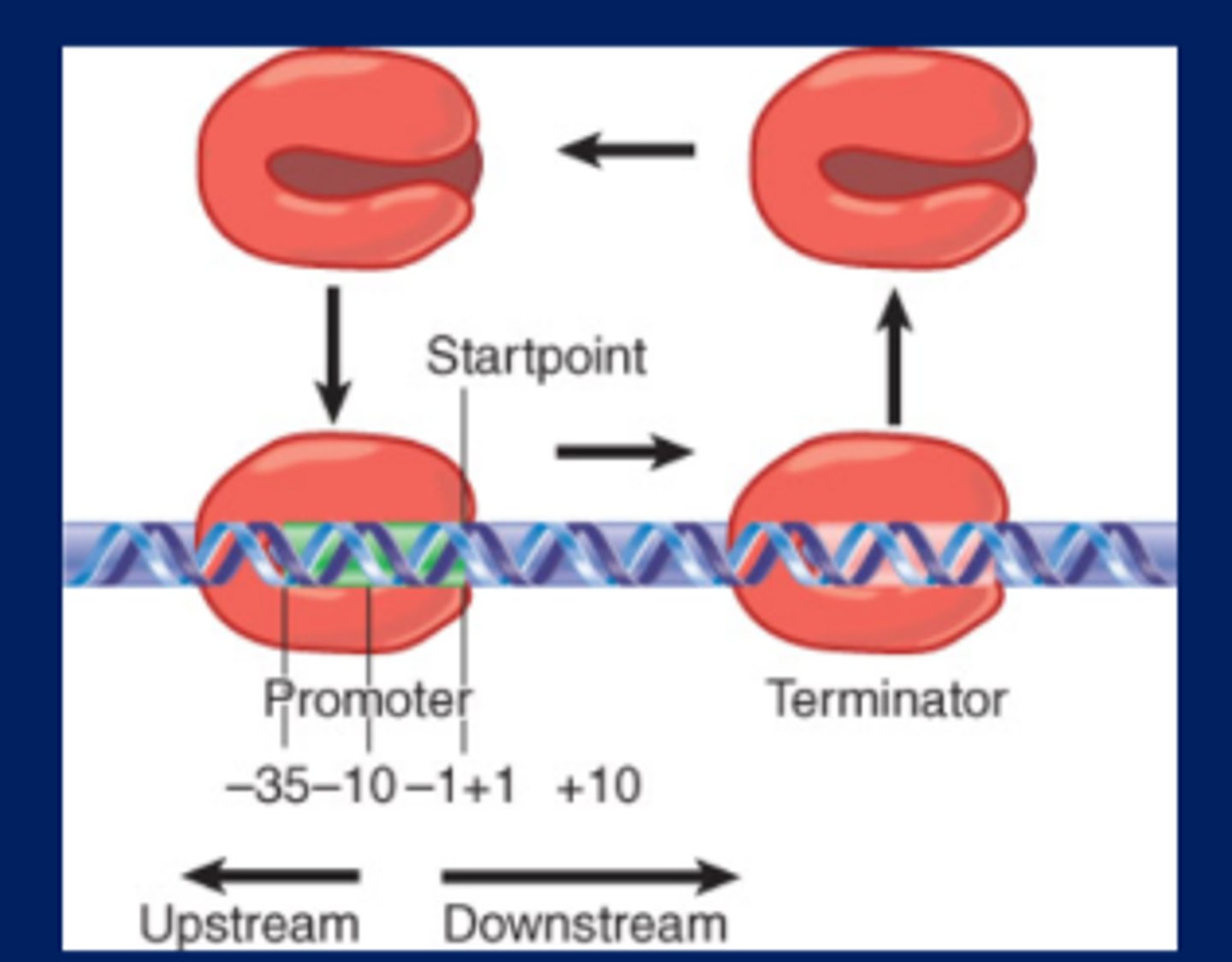
Promoter
A region of DNA where RNA polymerase binds to initiate transcription
-Proteins bind to promoters
Terminator
A sequence of DNA that causes RNA polymerase to terminate transcription
Transcription Unit
The sequence between sites of initiation and termination by RNA polymerase; it may include more than one gene
-A transcription unit is a sequence of DNA transcribed into a single RNA, starting at the promoter and ending at the terminator
- -1=upstream of gene
- +1 is where transcription starts
-Downstream=3' end
-Upstream=5' end
Startpoint
The position on DNA corresponding to the first base incorporated into RNA
How does RNA synthesis occur?
-What is a transcription bubble?
-What separates the 2 strands of DNA?
DNA strands separate to form a transcription bubble (once RNA polymerase binds). RNA is synthesized by complementary base pairing with one of the DNA strands.
-Transcription bubble forms and RNA polymerase makes RNA in the bubble, the bubble follows RNA polymerase as it transcribes
-Energy to open up transcription bubble comes from closing DNA behind the RNA polymerase
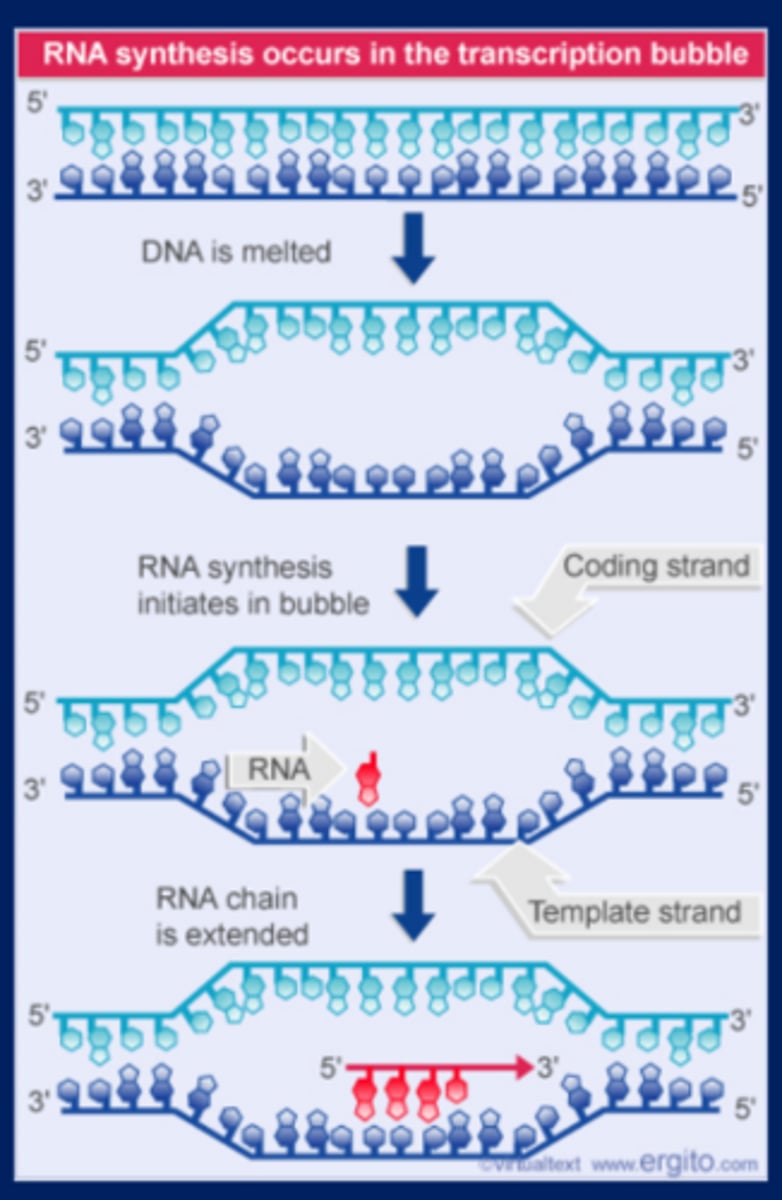
Transcription Bubble
-What separates the 2 strands of DNA?
-What direction is the RNA synthesized?
-What is the length of the bubble? What is the length of the RNA-DNA hybrid in the bubble?
Transcription occurs by base pairing in a "bubble" of unpaired DNA
-RNA polymerase separates the two strands of DNA in a transient bubble and uses one strand that runs 3′ to 5′ as a template to direct synthesis of a complementary sequence of RNA running 5′ to 3′
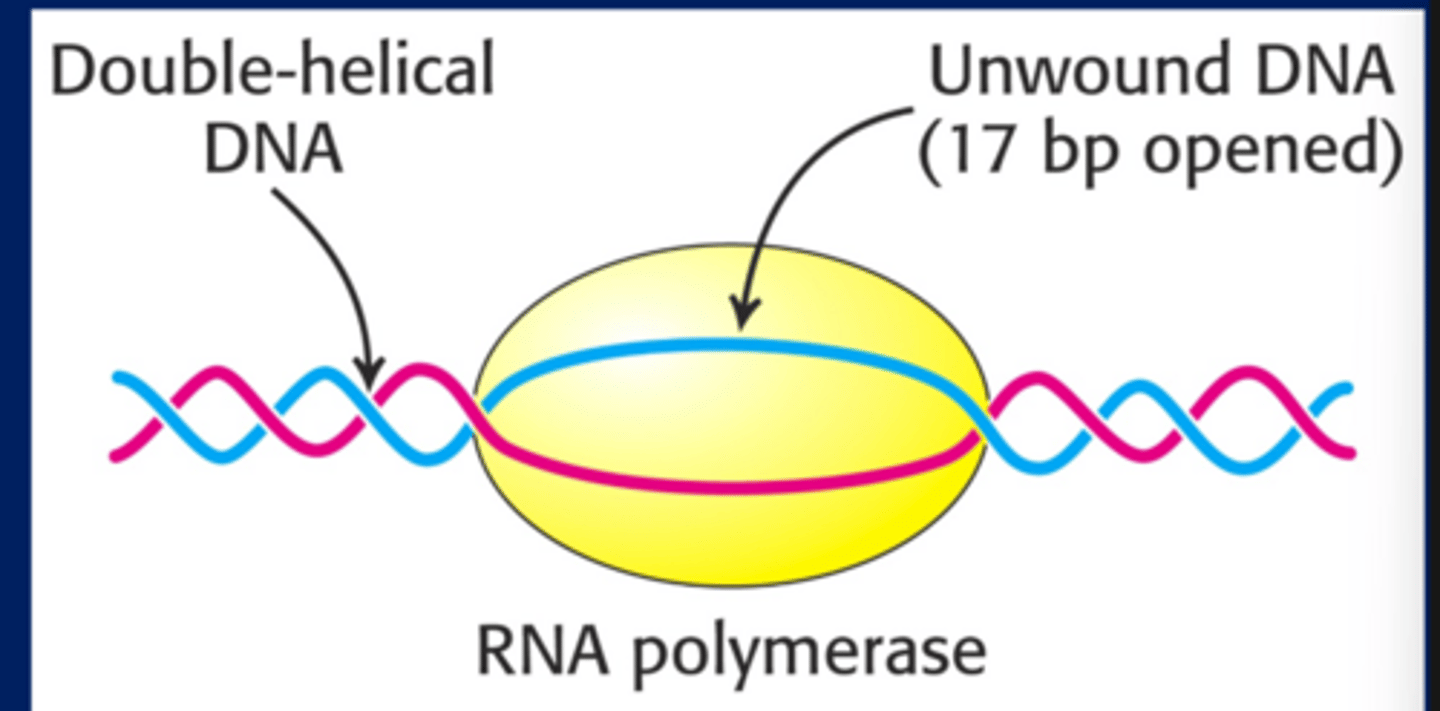
-The length of the bubble is ~12 to 14 bp, and the length of RNA-DNA hybrid within it is ~8 to 9 bp
-DNA strands separate to form a transcription bubble. RNA is synthesized by complementary base pairing with one of the DNA strands
-During transcription, the bubble is maintained within bacterial RNA polymerase, which unwinds and rewinds DNA and synthesizes RNA
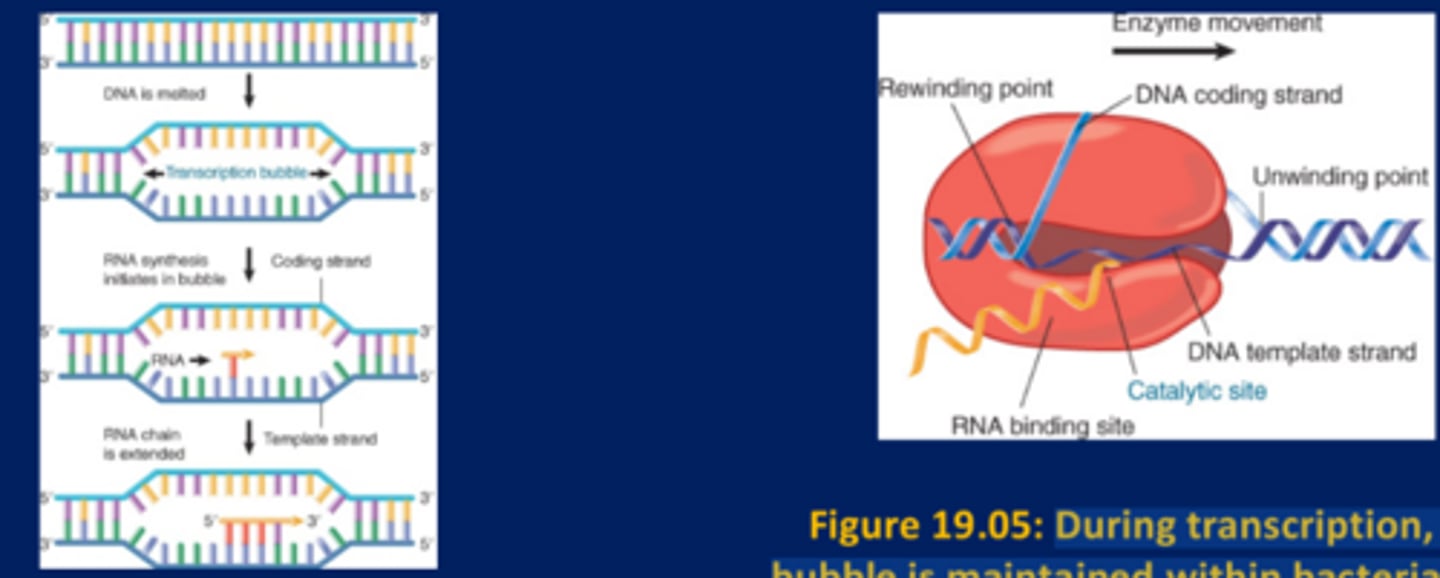
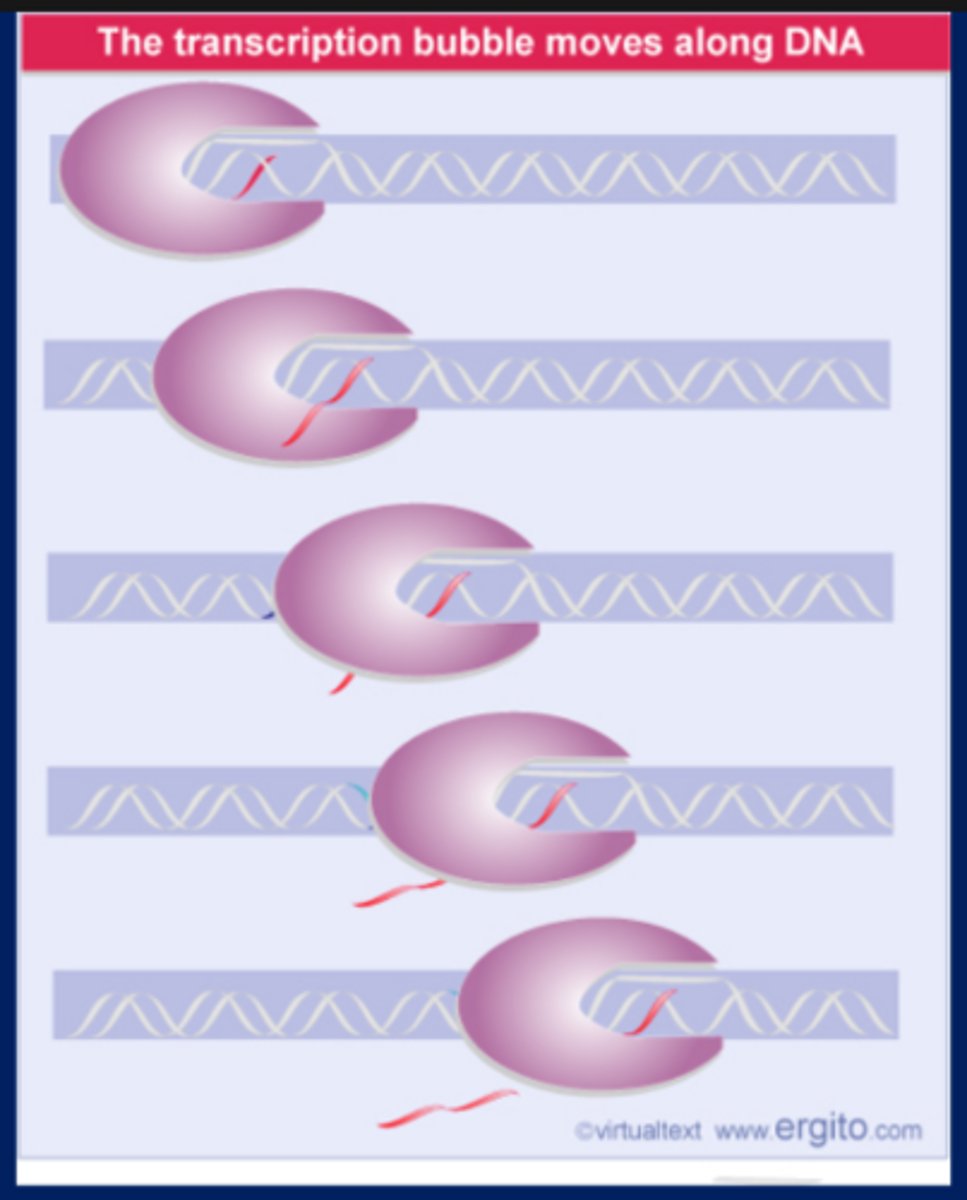
What happens to the DNA-RNA hybrid as transcription progresses?
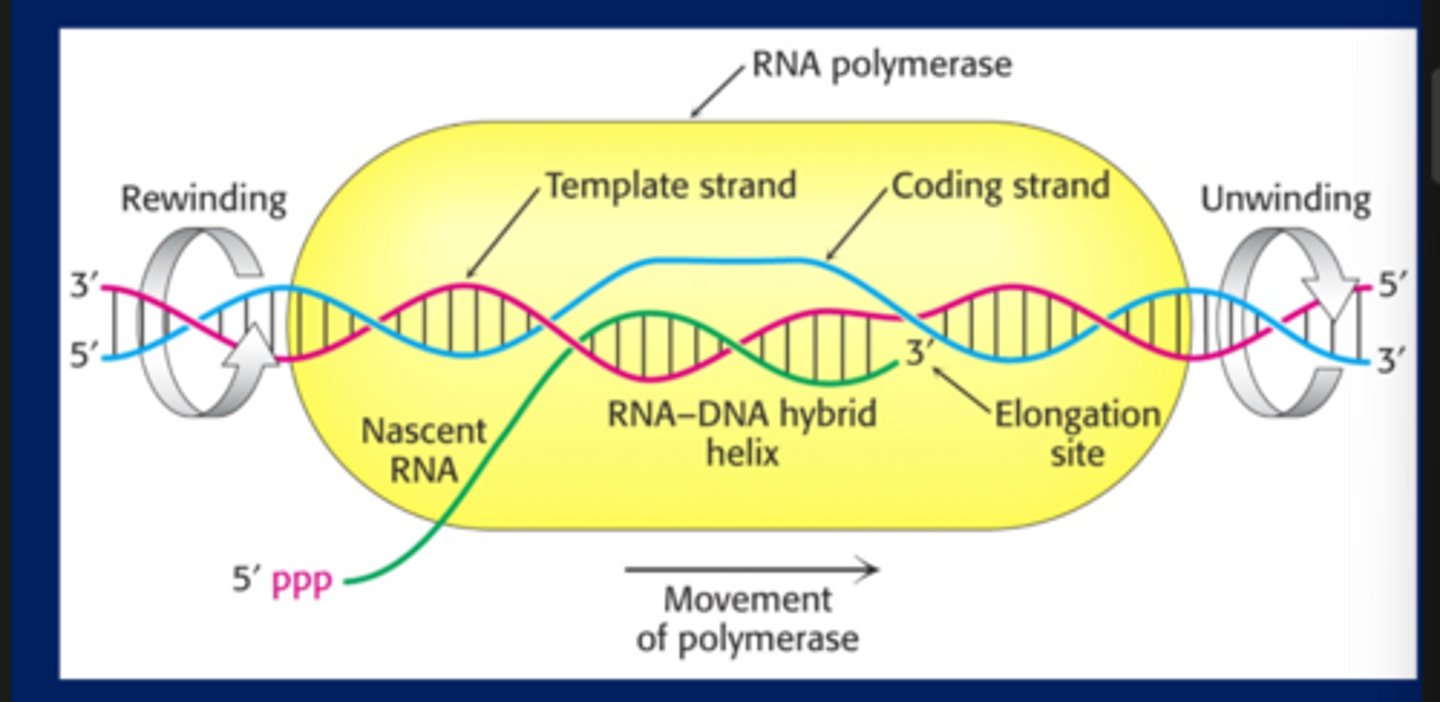
As the transcription bubble progresses, the DNA duplex reforms behind it, displacing the RNA in the form of a single polynucleotide chain
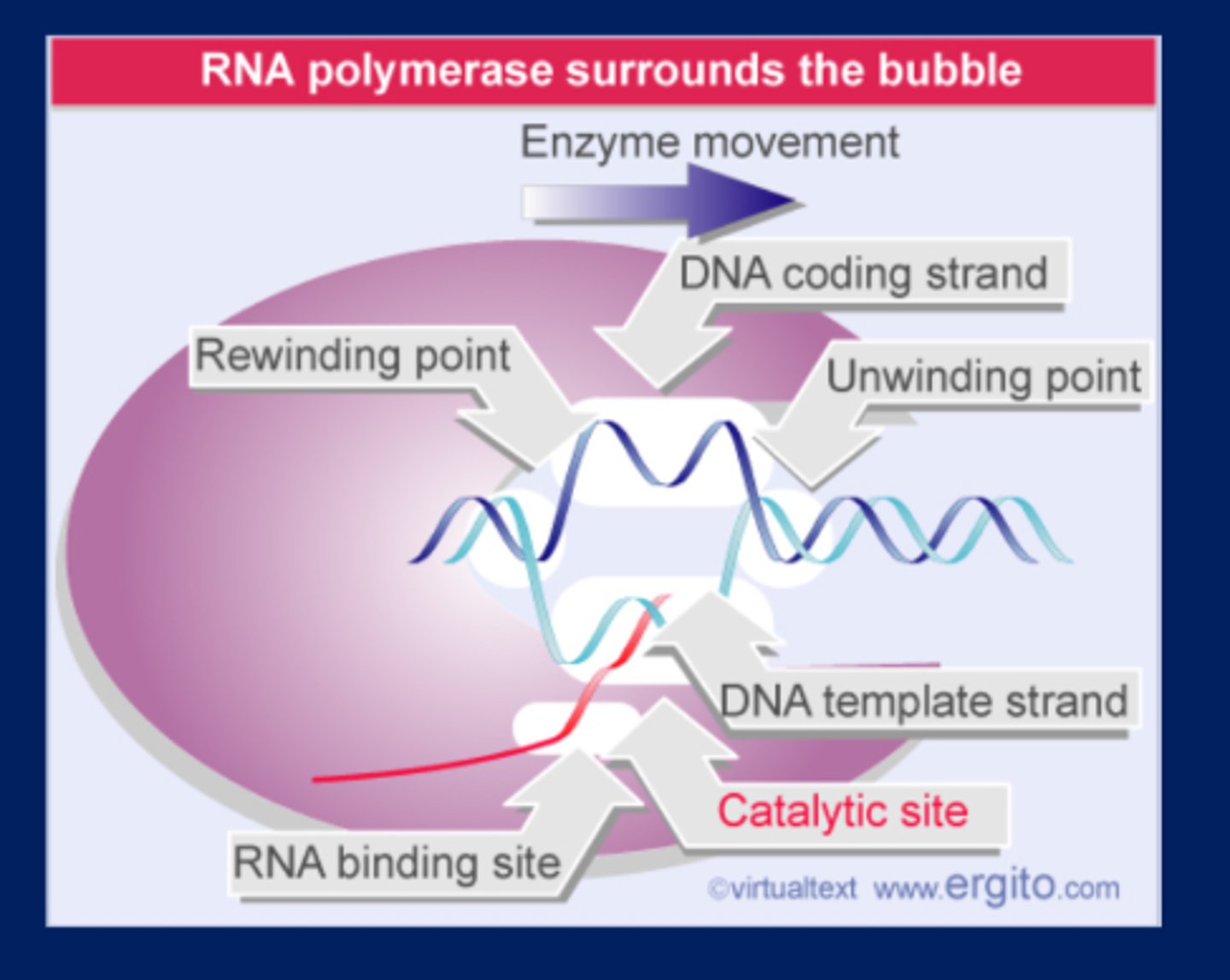
What 3 things does RNA polymerase do to maintain the transcription bubble?
During transcription, the bubble is maintained within/held together by bacterial RNA polymerase, which unwinds and rewinds DNA, maintains the conditions of the partner and template DNA strands, and synthesizes RNA
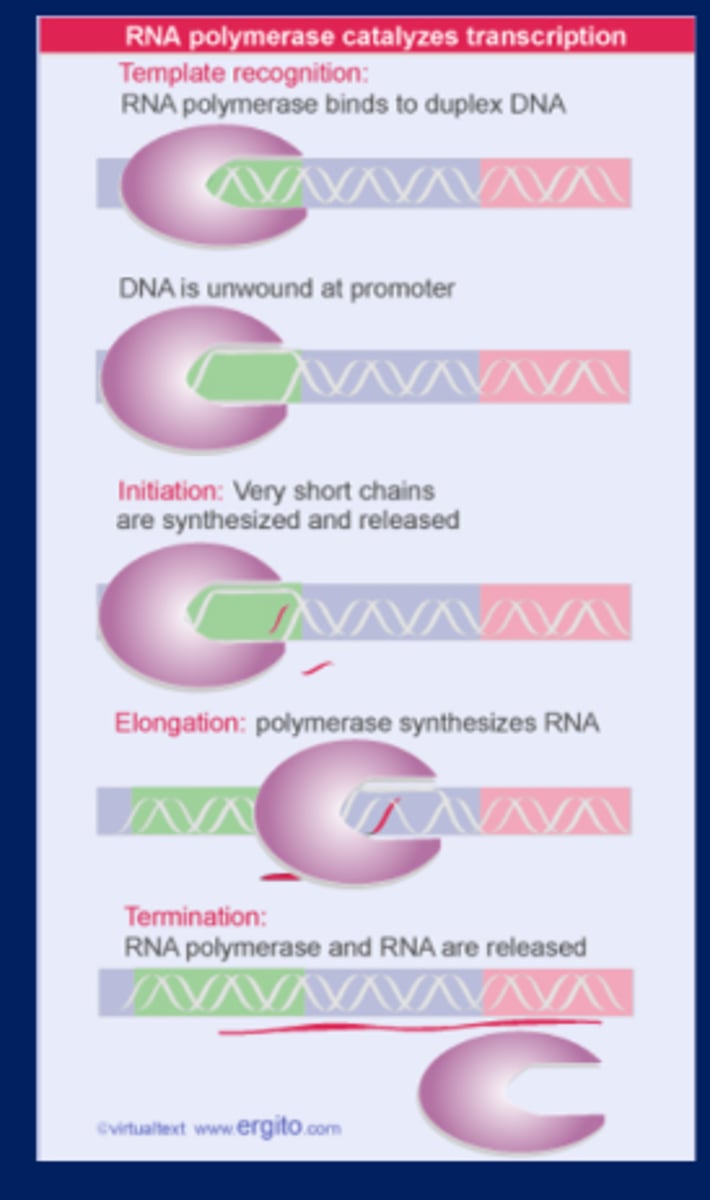
What are the 4 stages of transcription? How do they work?
Transcription has four stages, which involve different types of interaction between RNA polymerase and DNA. The enzyme binds to the promoter and melts DNA, remains stationary during initiation, moves along the template during elongation, and dissociates at termination
1. Template recognition-RNA polymerase binds DNA and looks for a start site with transcription factors
2. Initiation-RNA polymerase interacts with transcription factors and knows that's where transcription should start
-RNA polymerase separates the 2 DNA strands
3. Elongation
4. Termination
What are the 2 subunits of RNA polyemerase that have a channel for DNA/are the active site?
The β (cyan) and β' subunit (pink) of RNA polymerase have a channel for the DNA template/are the active site. Synthesis of an RNA transcript (copper) has just begun; the DNA template (red) and coding (yellow) strands are separated in a transcription bubble.
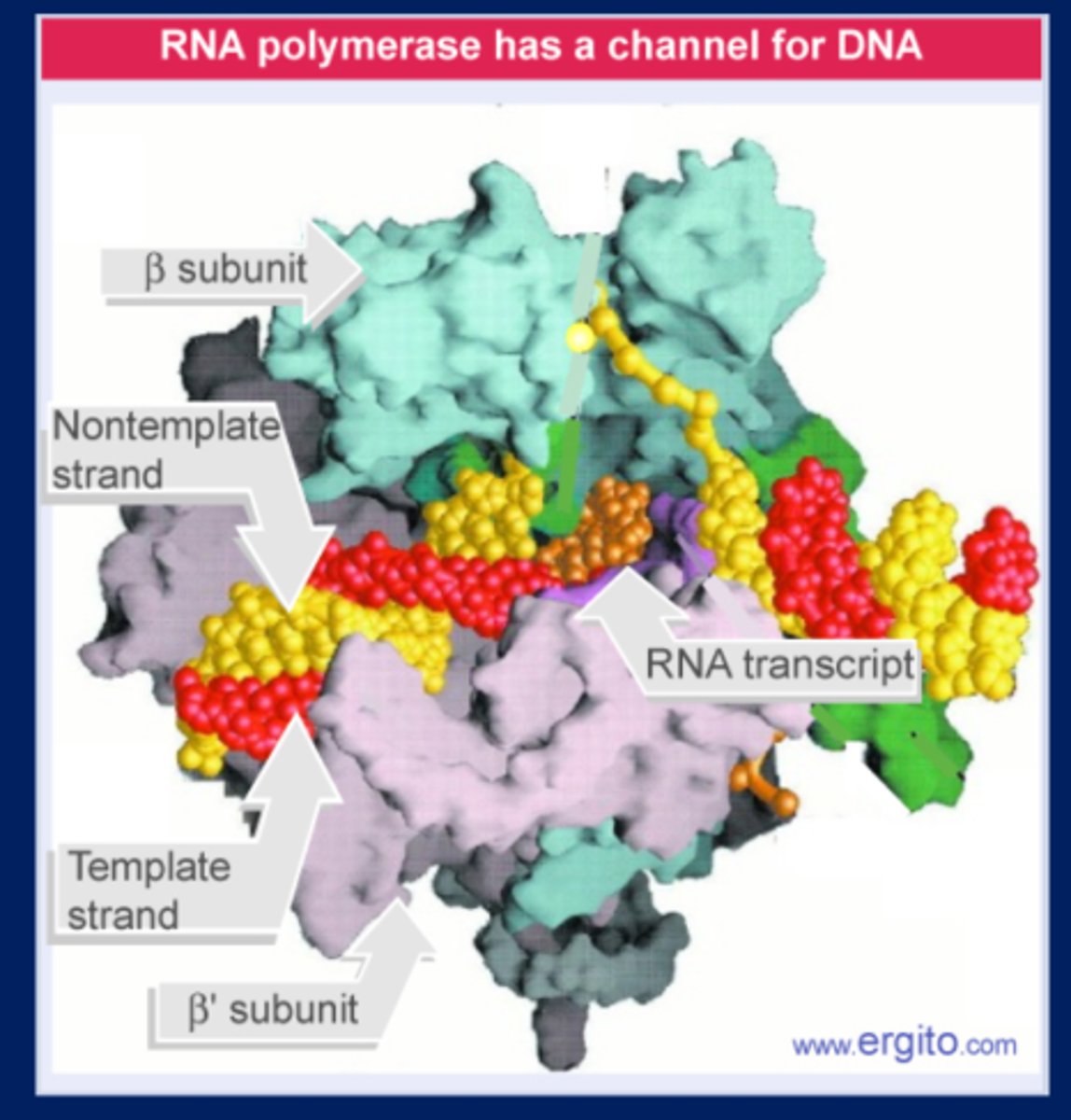
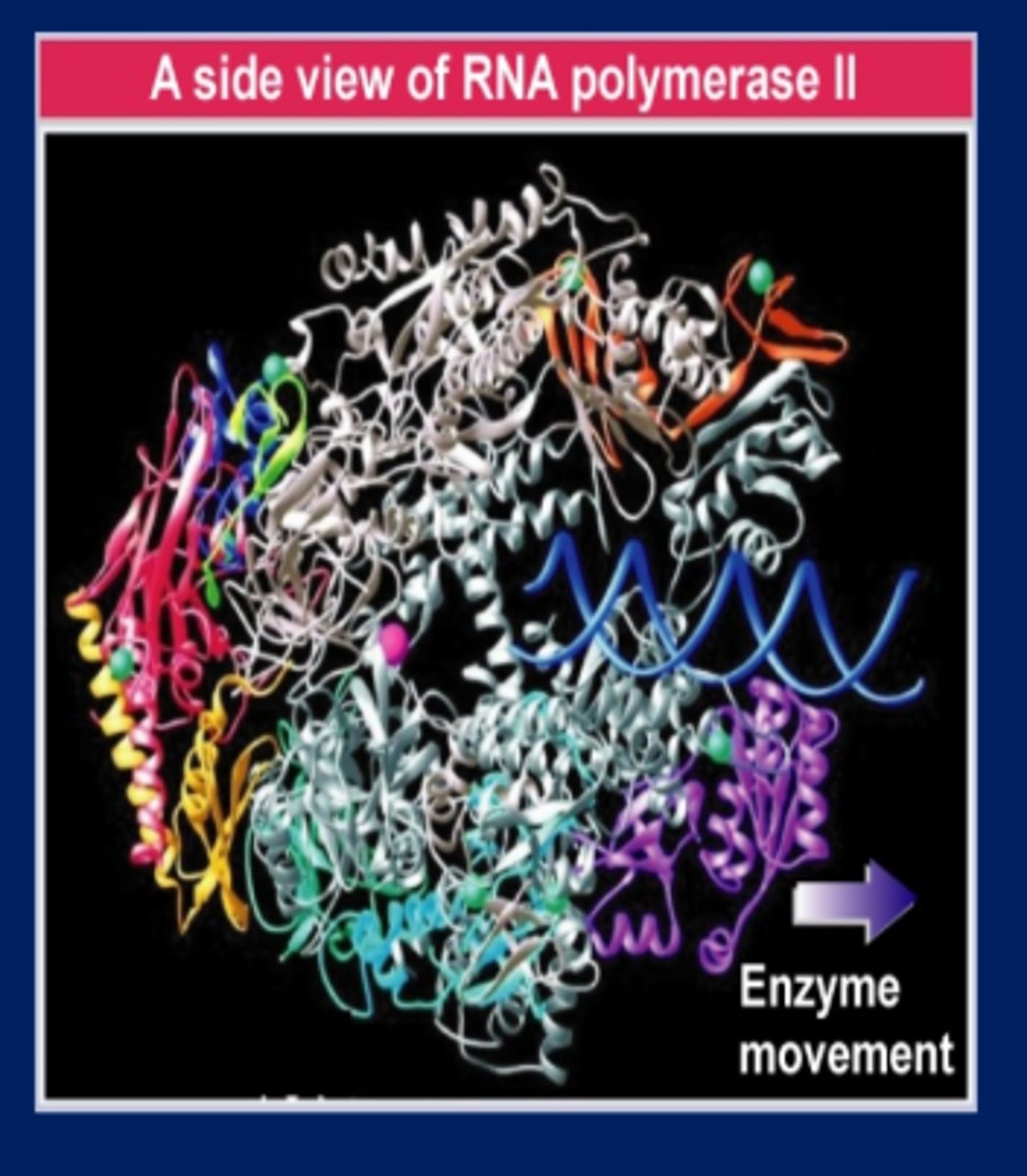
Side View of RNA Polymerase II
-How is DNA held?
The side view of the crystal structure of RNA
polymerase II from yeast shows that DNA is held
downstream by a pair of jaws
-All RNA polymerases have pac-man like structure like in the pic
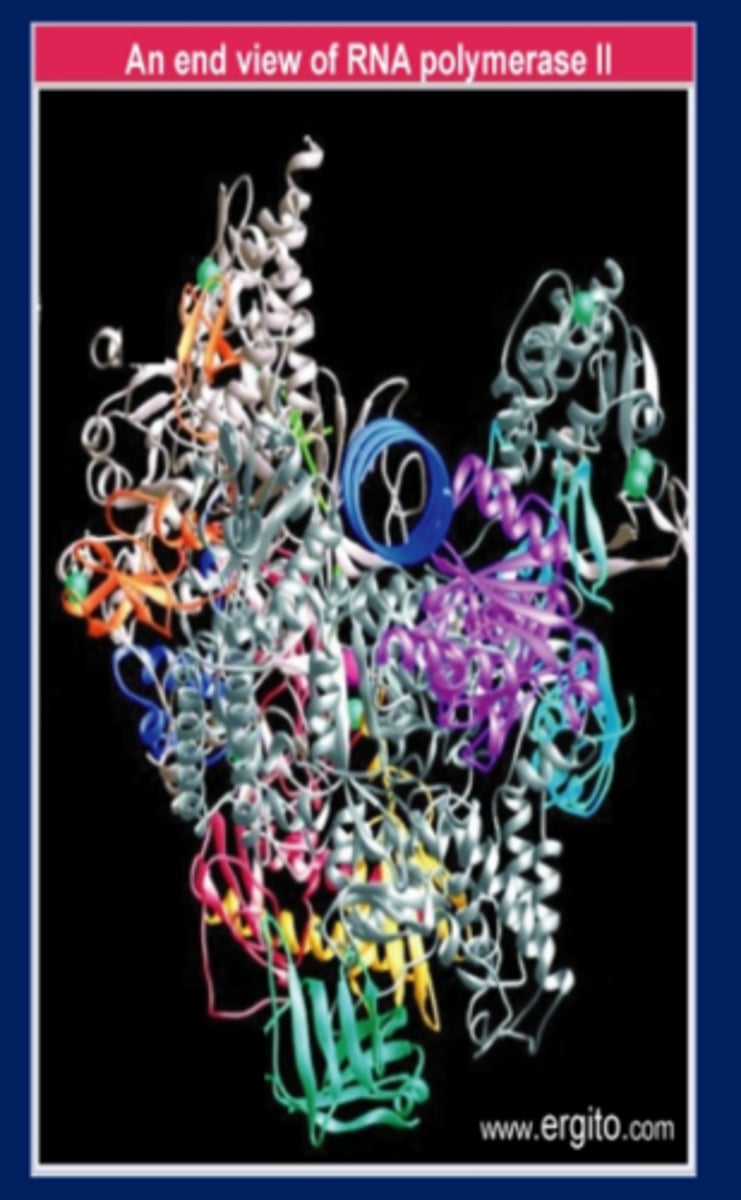
End View of RNA Polymerase II
-How much protein is DNA surrounded by?
The end view of the crystal structure of RNA polymerase II from yeast shows that DNA is surrounded by ~270° of protein
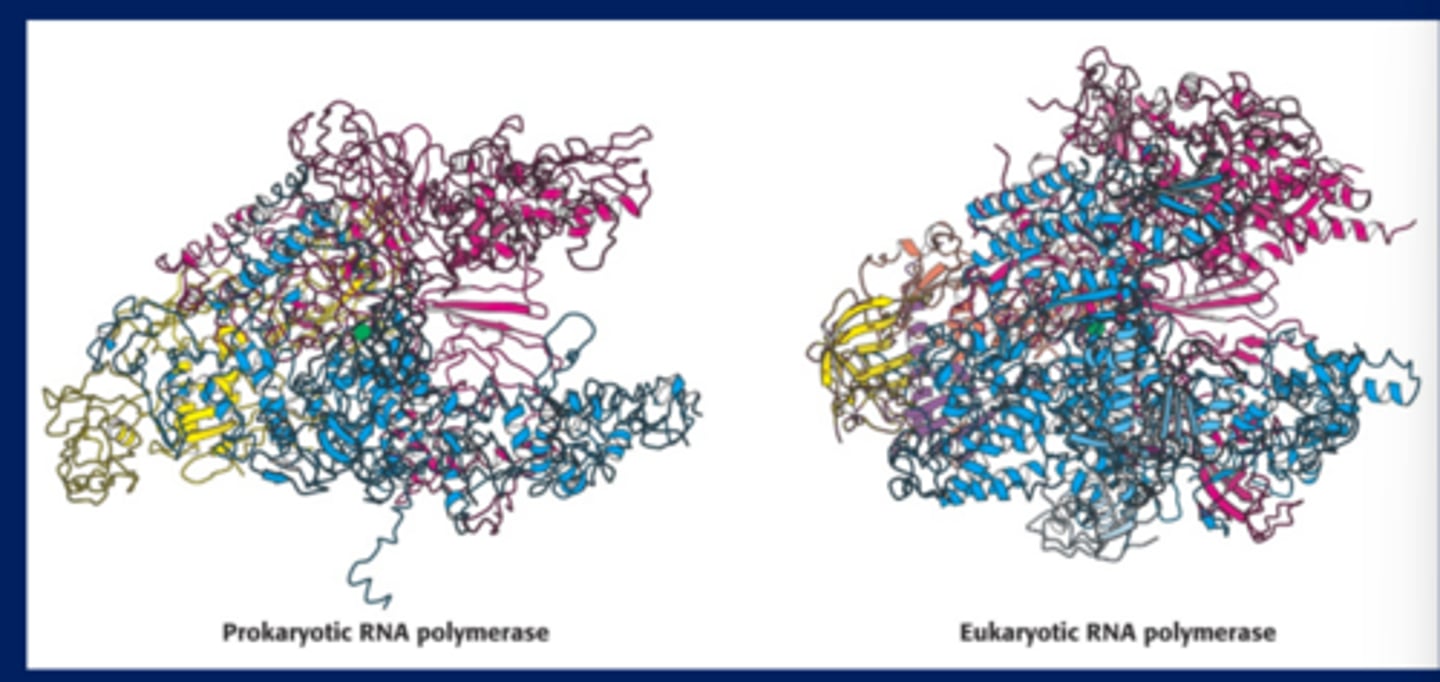
Similarities Between Prokaryotic and Eukaryotic RNA Polymerases
Structures are very similar
What are the different subunits of bacterial RNA polymerase? What do they each do?
Bacterial RNA polymerase holoenzyme can be divided into an α2ββ′ω core enzyme that catalyzes
transcription and a sigma (σ) subunit that is required only for initiation
-Sigma factor when it binds to RNA polymerase, it changes the DNA-binding properties of RNA polymerase so that its affinity for general DNA is reduced and its affinity for promoters is increased-tells it where to bind and then it transcribes
-Core enzyme binds indiscriminately/nonspecifically to any DNA (can't figure out where on the DNA RNA polymerase should bind)
-α2ββ′ω core enzyme + sigma subunit=holoenzyme (functional RNA polymerase that binds to a specific DNA sequence)
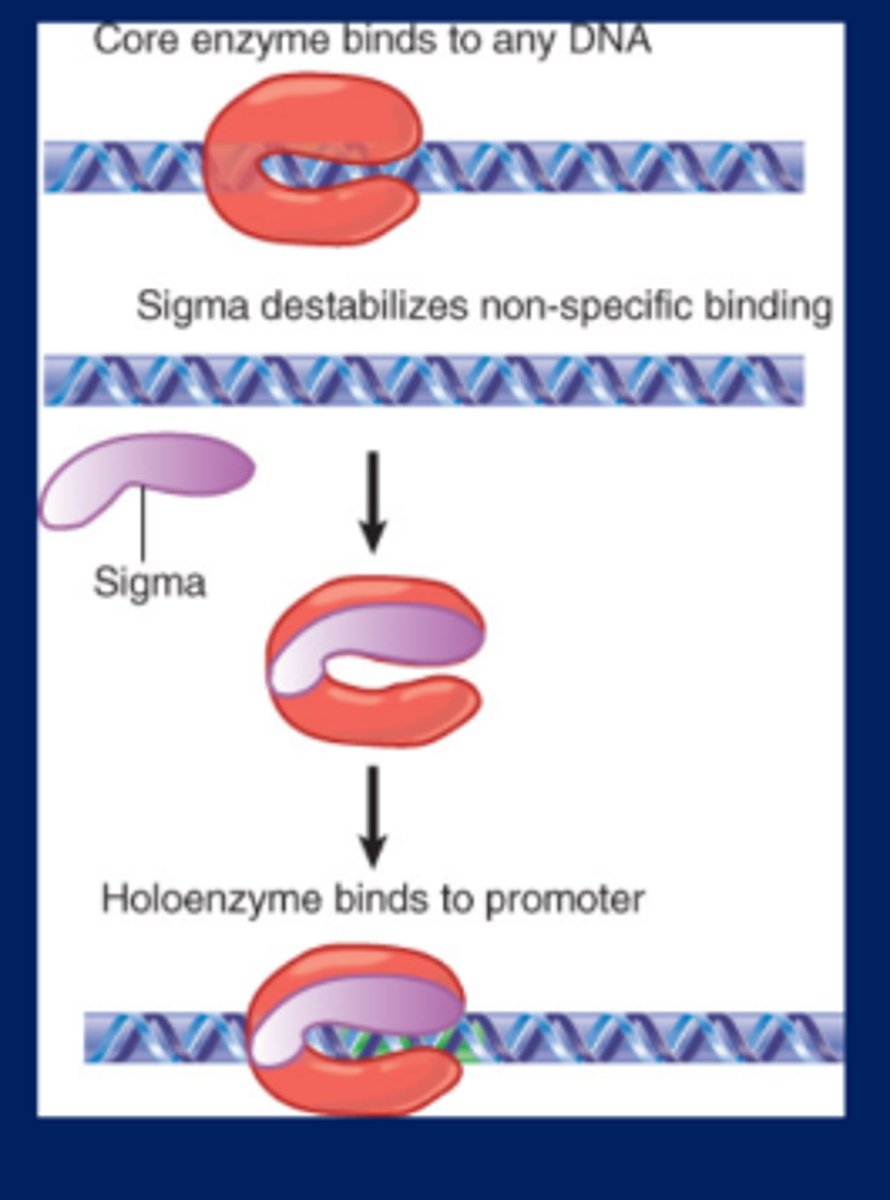
What are the functions of the 5 subunits of RNA polymerase core enzyme?
E. coli RNA polymerase (α2ββ′σ ω) has 5 types of subunit
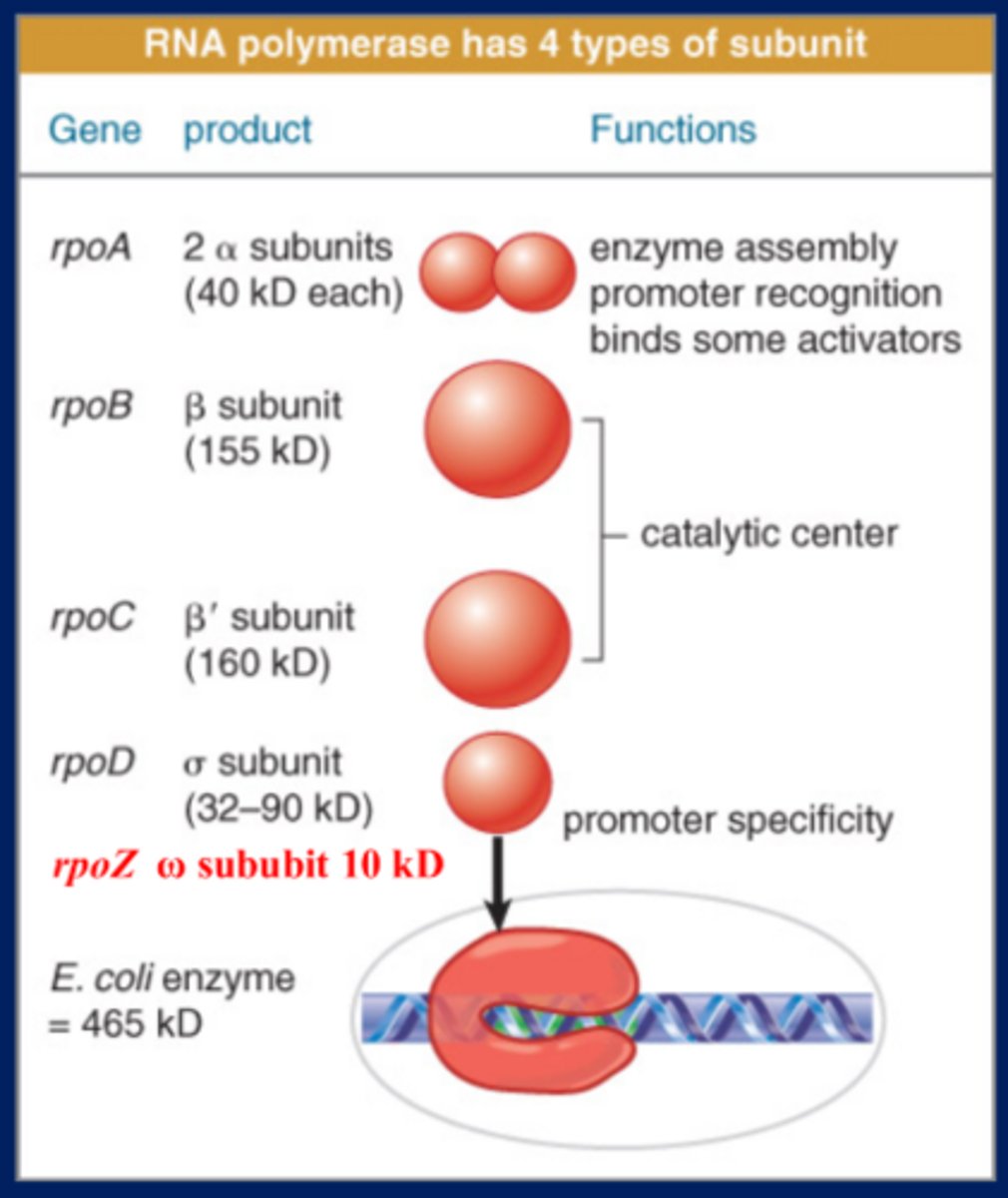
Specificity Factor
-What subunit of RNA polymerase is this? What does it do?
Sigma factor makes RNA polymerase core enzyme go off of DNA and find a promoter
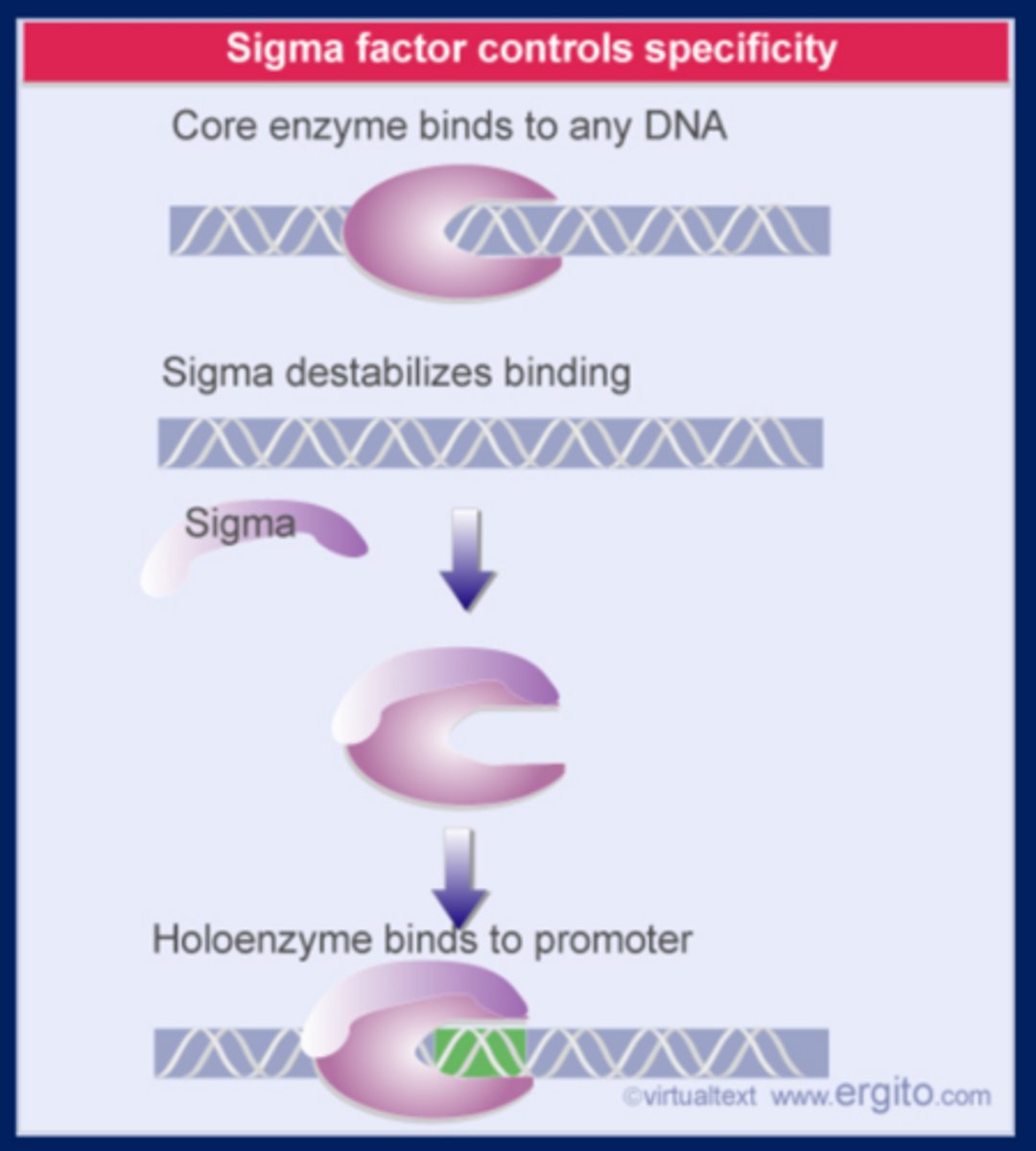
Recycling of Core and Sigma Factor
-What are the steps?
-Core enzyme moves around DNA
-When sigma binds to core enzyme, the polymerase goes very fast and binds to the promoter
-When the sigma is bound to the polymerase bound to the promoter and RNA is not made because the binding to the promoter is so tight
-Sigma falls off and transcription happens
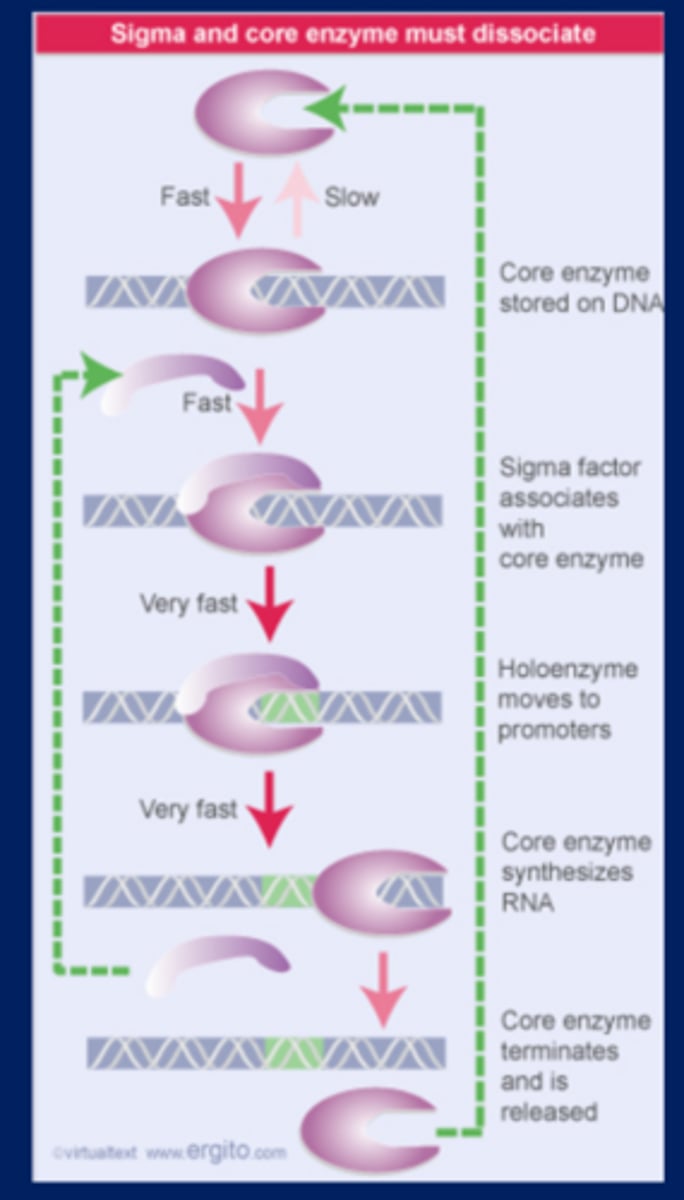
Promoter Recognition by Sigma Factor
-What are the steps? How does it work?
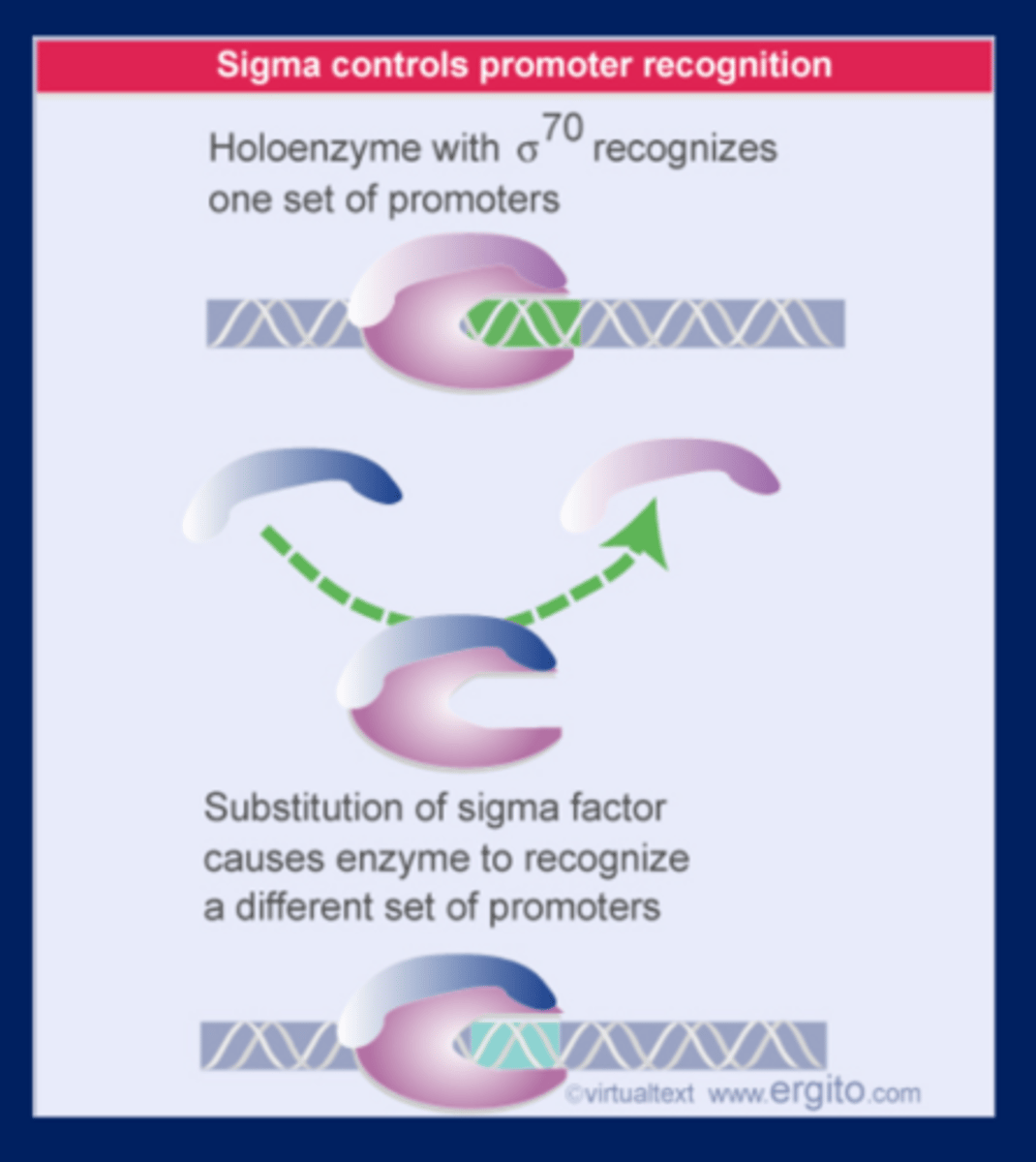
Subsitution of Sigma Factors May Control Initiation
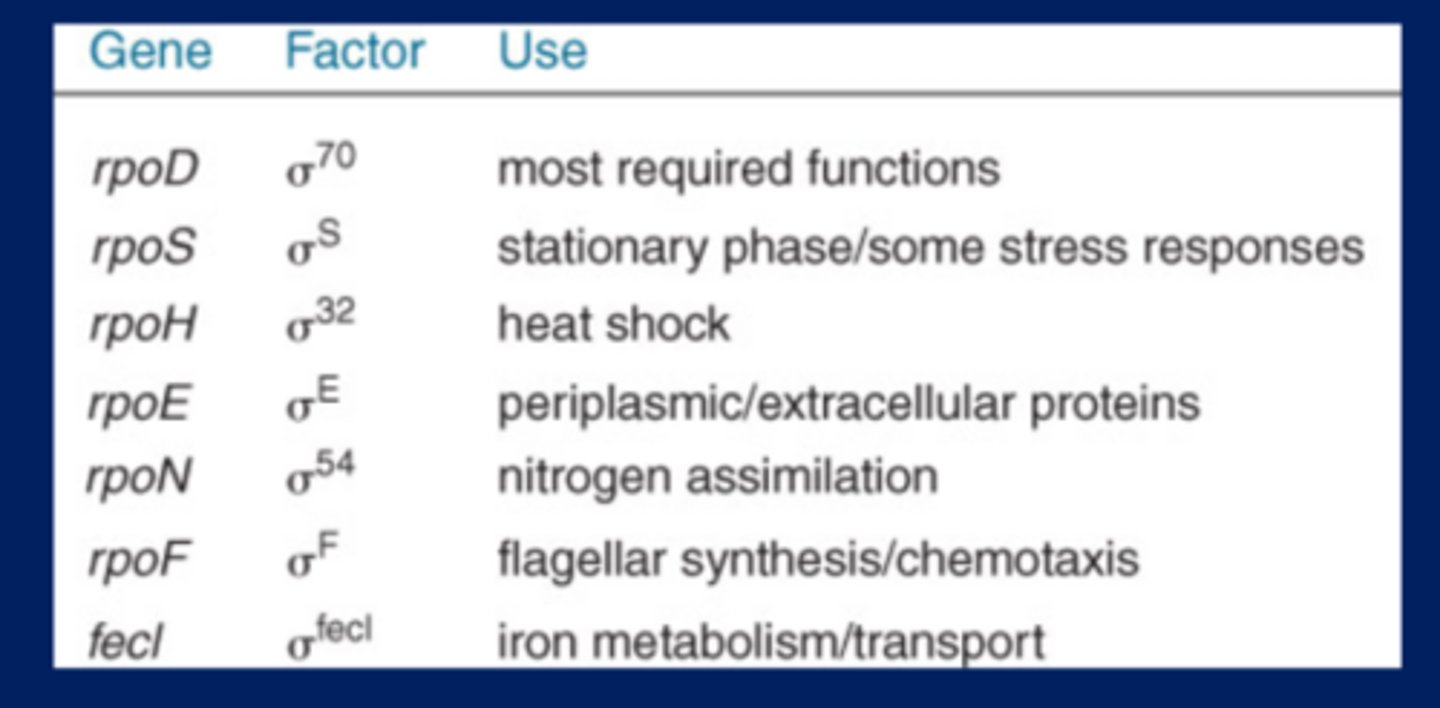
-How many sigma factors do E. coli have? What do they each do? Where?
E. coli has seven sigma factors, each of which causes RNA polymerase to initiate at a set of promoters defined by specific -35 and -10 sequences
-In addition to σ70, E. coli has several sigma factors that are induced by particular environmental conditions. (A number in the name of a factor indicates its mass.)
-Each sigma factor binds to different RNA polymerases to make the RNA polymerases transcribe different genes when needed
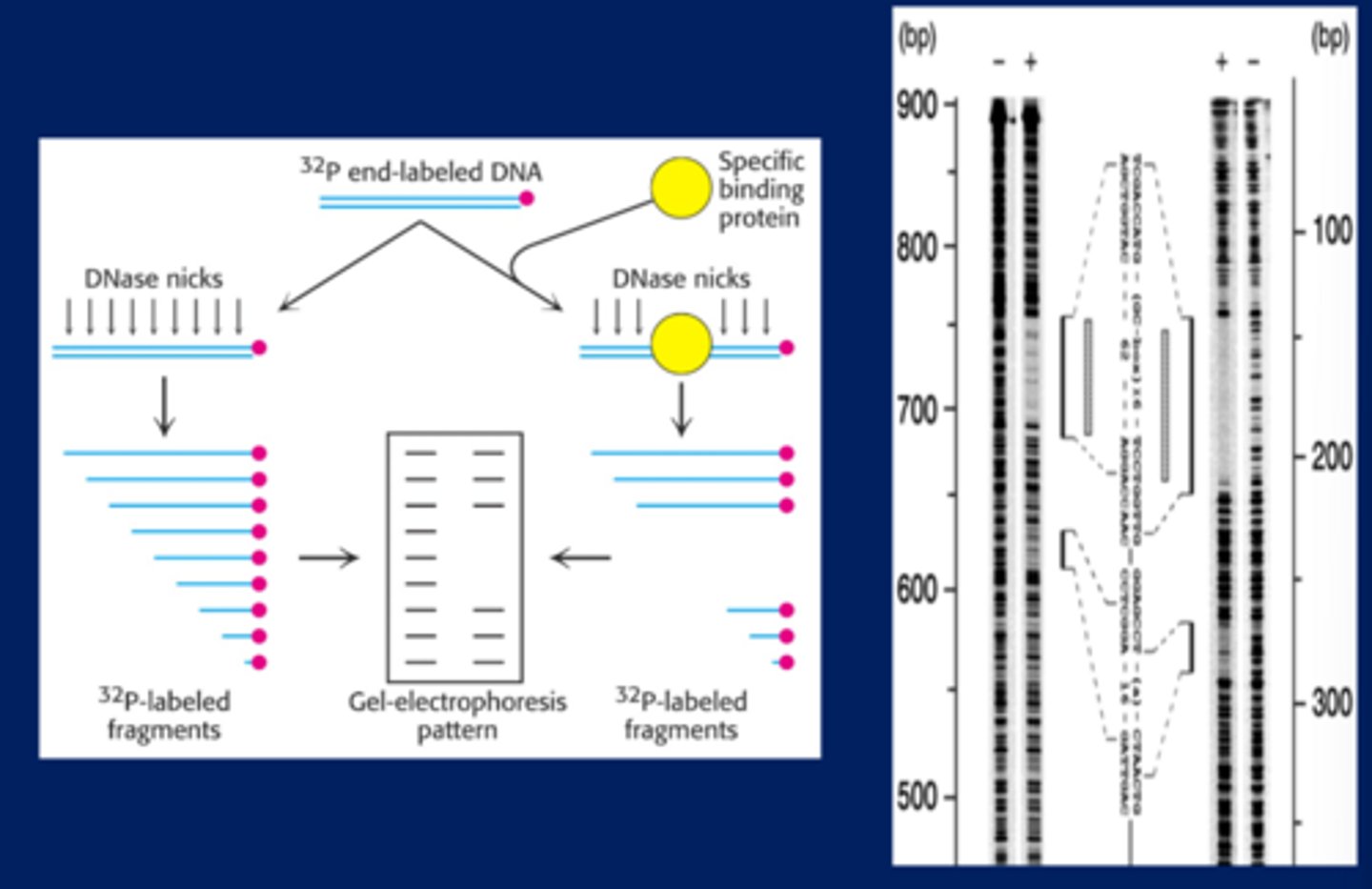
DNA Footprinting
-How does it work?
-What are the steps?
Footprinting is a technique that is used to determine the DNA binding sequence of a protein
-Cut the labelled DNA with DNase which cuts it up into fragments that are labelled
-Run the cut DNA on a gel and it will make a ladder
-Add the protein that binds to the DNA and then add DNase to cut and then run this on a gel
-The part on the gel that is empty is where the protein bound to the DNA (protected DNA from being cut by DNase)
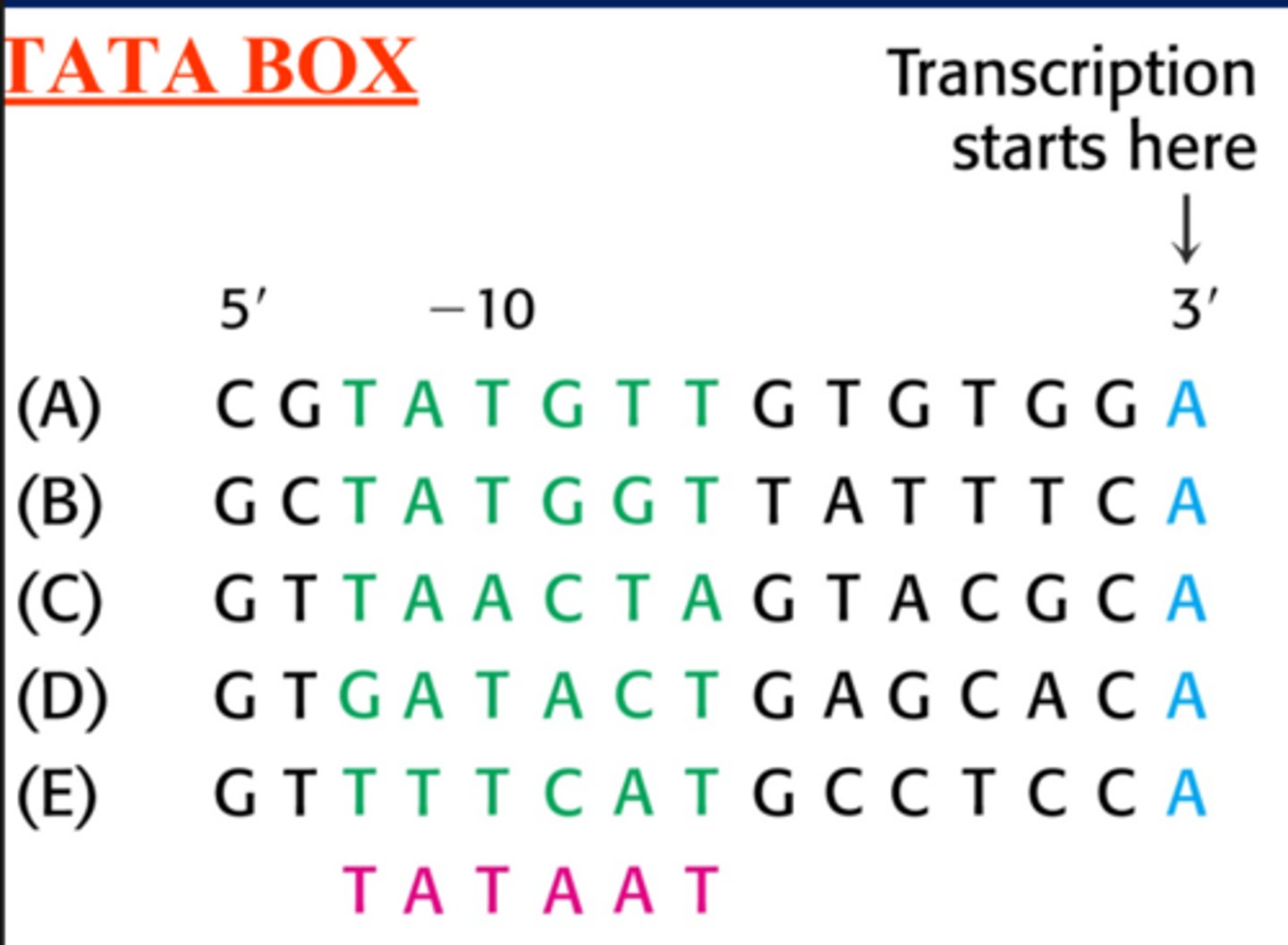
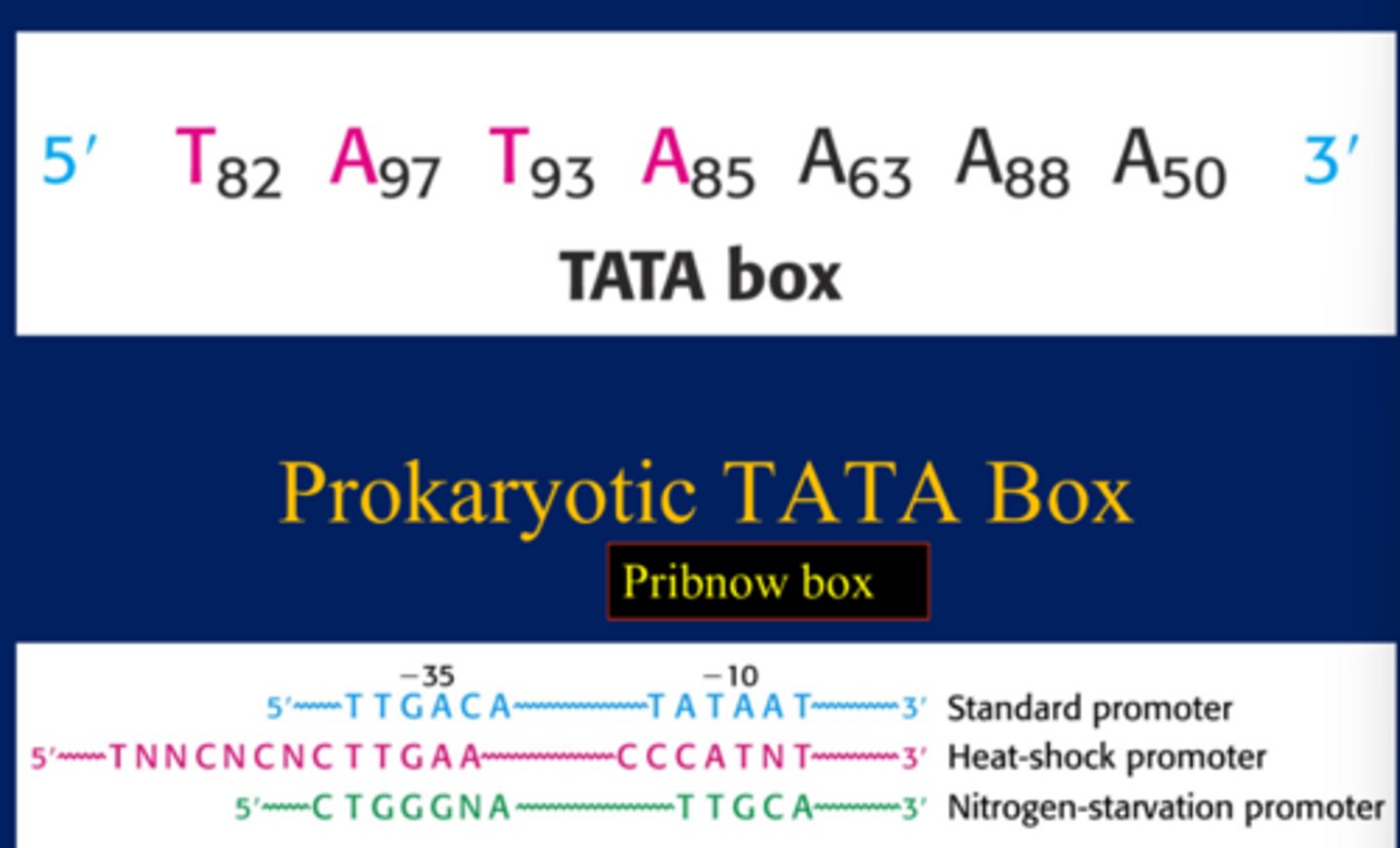
TATA Box
-Where does transcription start?
-What are the important sequences?
-What binds to it?
-Transcription starts at +1 at 3' end
-The consensus sequence (most common sequence at -10) is TATAAT-TATA box (pink on picture)
-Sigma binds to the TATA box
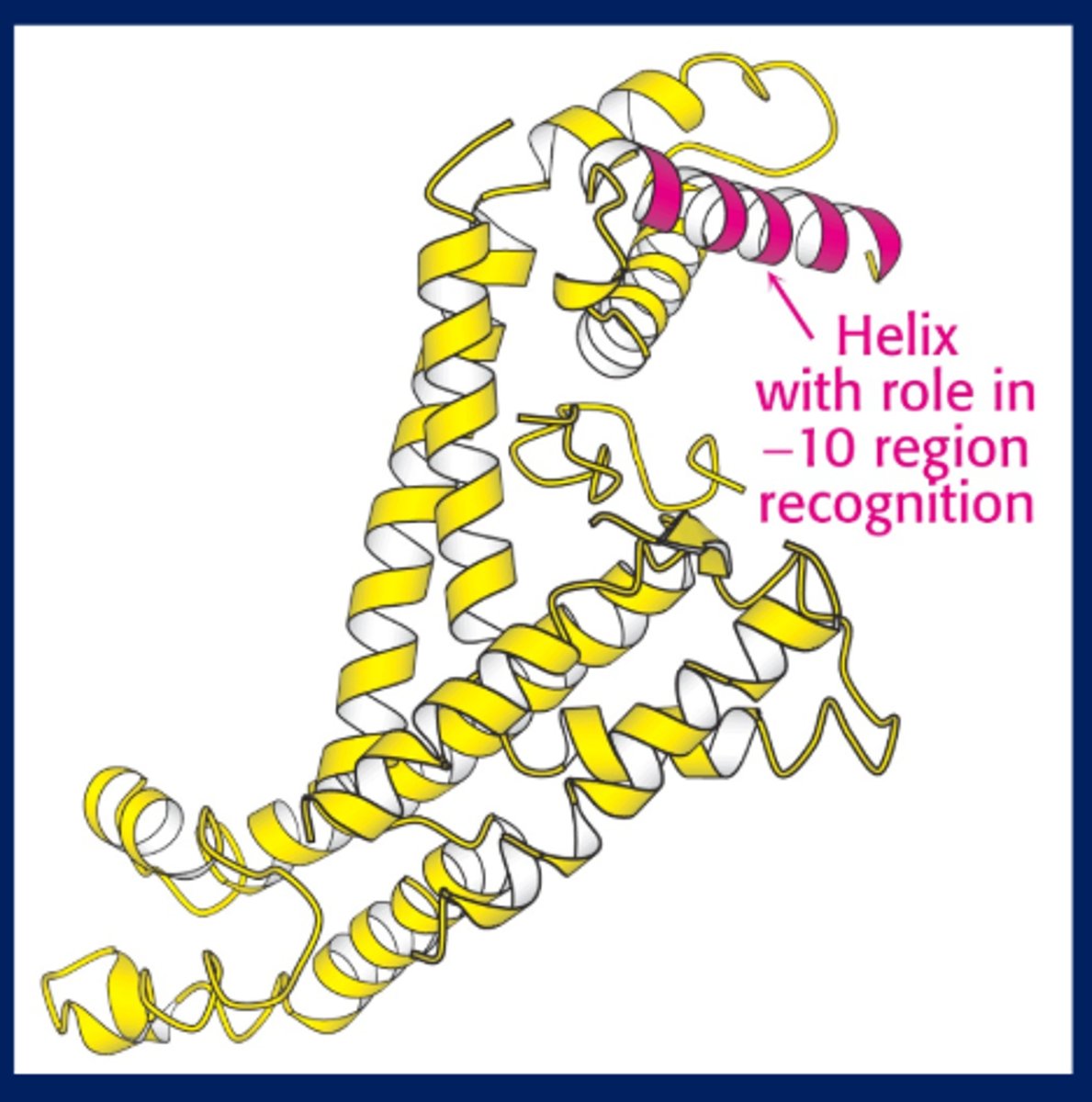
Helix of the Sigma Subunit
-What is its function?
-What does it recognize?
-Sigma subunit binds to the TATA box so RNA polymerase can start transcription
-Sigma subunit has an a helix that recognizes the -10 TATA box
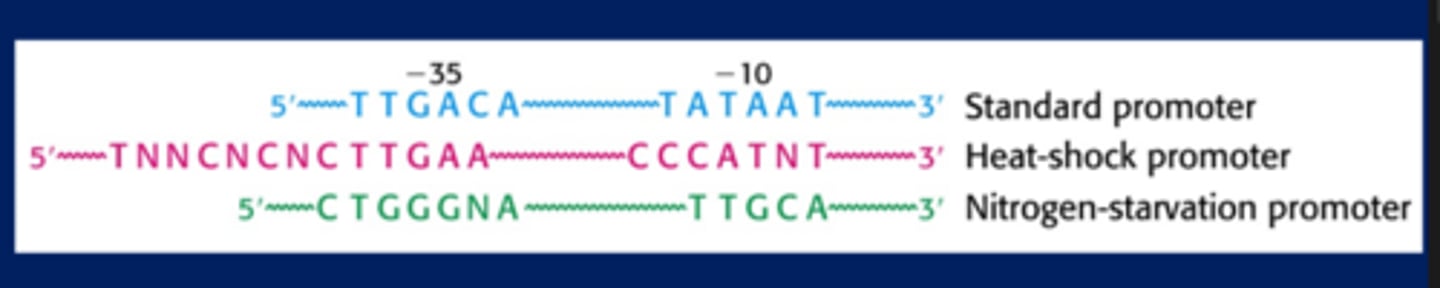
Prokaryotic (E. Coli) Promoters
-What are the -35 and -10 sequences?
-What are the standard, heat shock, and nitrogen starvation promoters?
-Have -10 TATA box and a -35 sequence
DNA Unwinding in Transcription
-What protein performs unwinding?
-How many base pairs are unwound at one time?
DNA Unwinding in Transcription
-What protein performs unwinding?
-What happens to the DNA-RNA hybrid?
-RNA-DNA hybrid is very small, rest of RNA is unbound from DNA
What are the 2 types of transcription termination?
1. Rho dependent
2. Rho independent
Intrinsic (Rho Independent) Termination
-What 2 things does it require? Why?
-How does it work?
-What are the steps?
-What bases are found there?
Intrinsic Termination Requires a Hairpin and U-Rich
Region
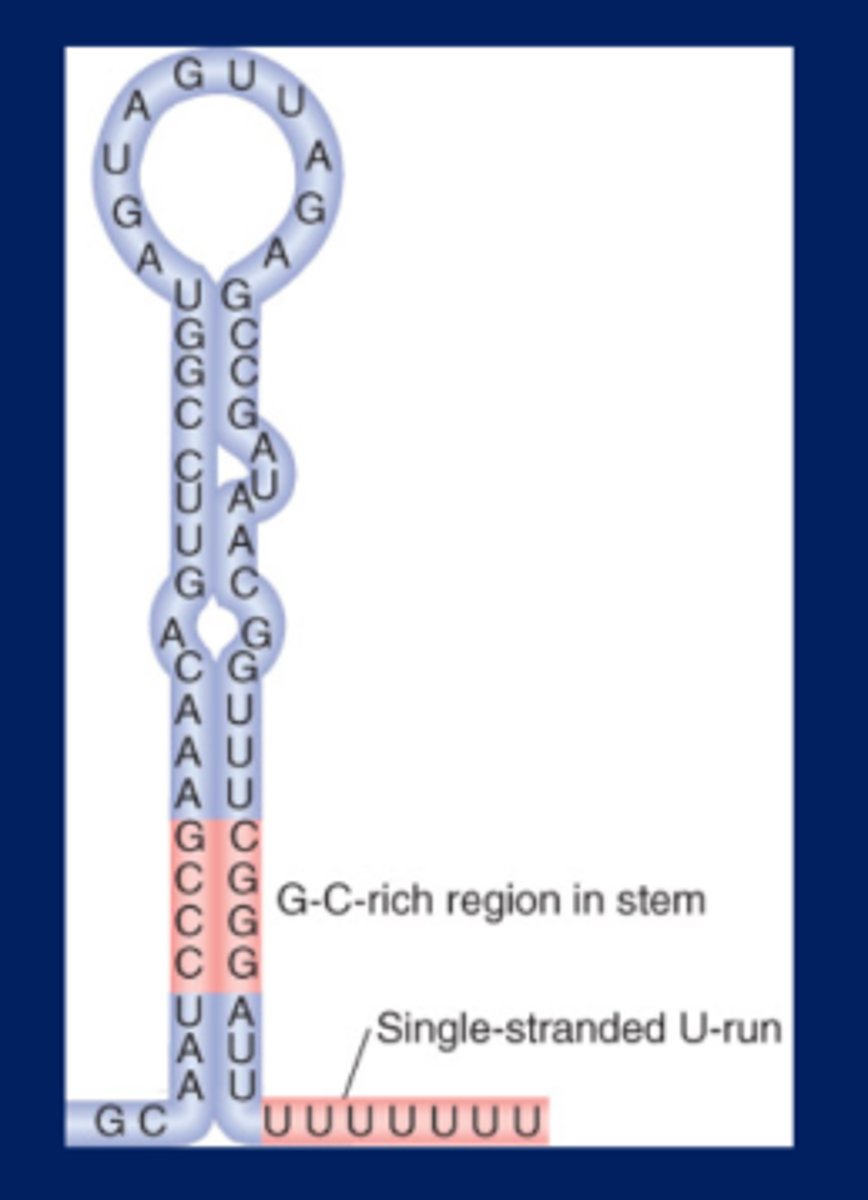
-Intrinsic terminators consist of a G-C-rich hairpin in the RNA product followed by a U-rich region in which
termination occurs
-Intrinsic terminators include palindromic regions that can form hairpins varying in length from 7 to 20
bp
-If there are 2 complimentary sequences in the RNA syntehsized, they will bind and form a loop structure (picture)
-This loop structure pulls the RNA out of the RNA polymerase which terminates transcription
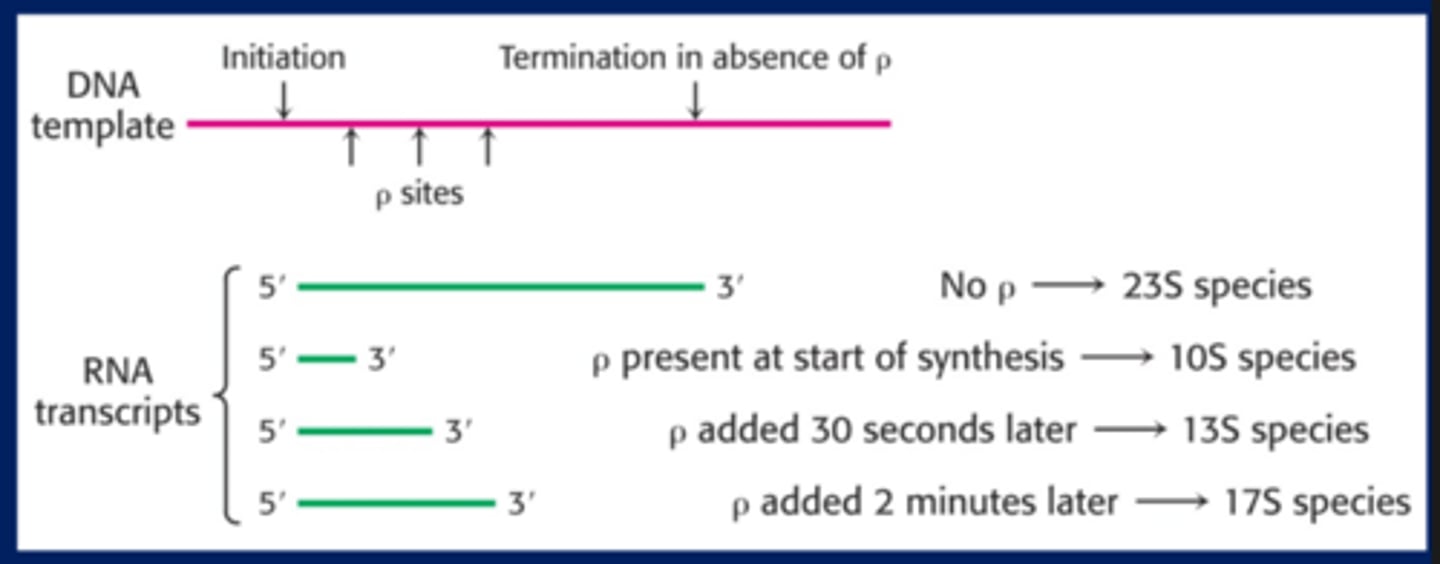
Effect of Rho Protein
-What base do Rho sites contain?
-What are p sites? How does when they are present affect the species made?
Rho sites are cytosine rich
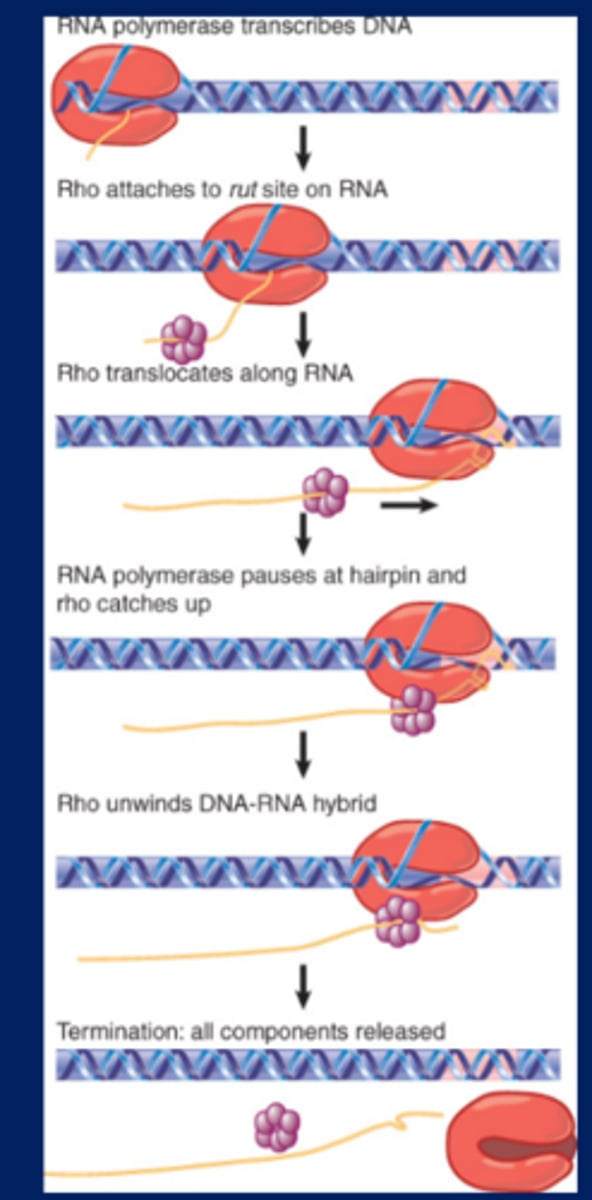
Rho Factor in Rho Dependent Termination
-What is it? Where does it bind?
-What is its function?
-Rho factor is a terminator protein that binds to a rut site on a nascent RNA and tracks along the RNA to release it from the RNA-DNA hybrid structure at the RNA polymerase
-rut - An acronym for rho utilization site, the sequence of RNA that is recognized by the rho termination factor
-Rho factor binds to RNA at a rut site and translocates along RNA until it reaches the RNA-DNA hybrid in RNA polymerase, where it releases the RNA from the DNA
-Rho twists the DNA? causing the RNA to come off, terminating transcription
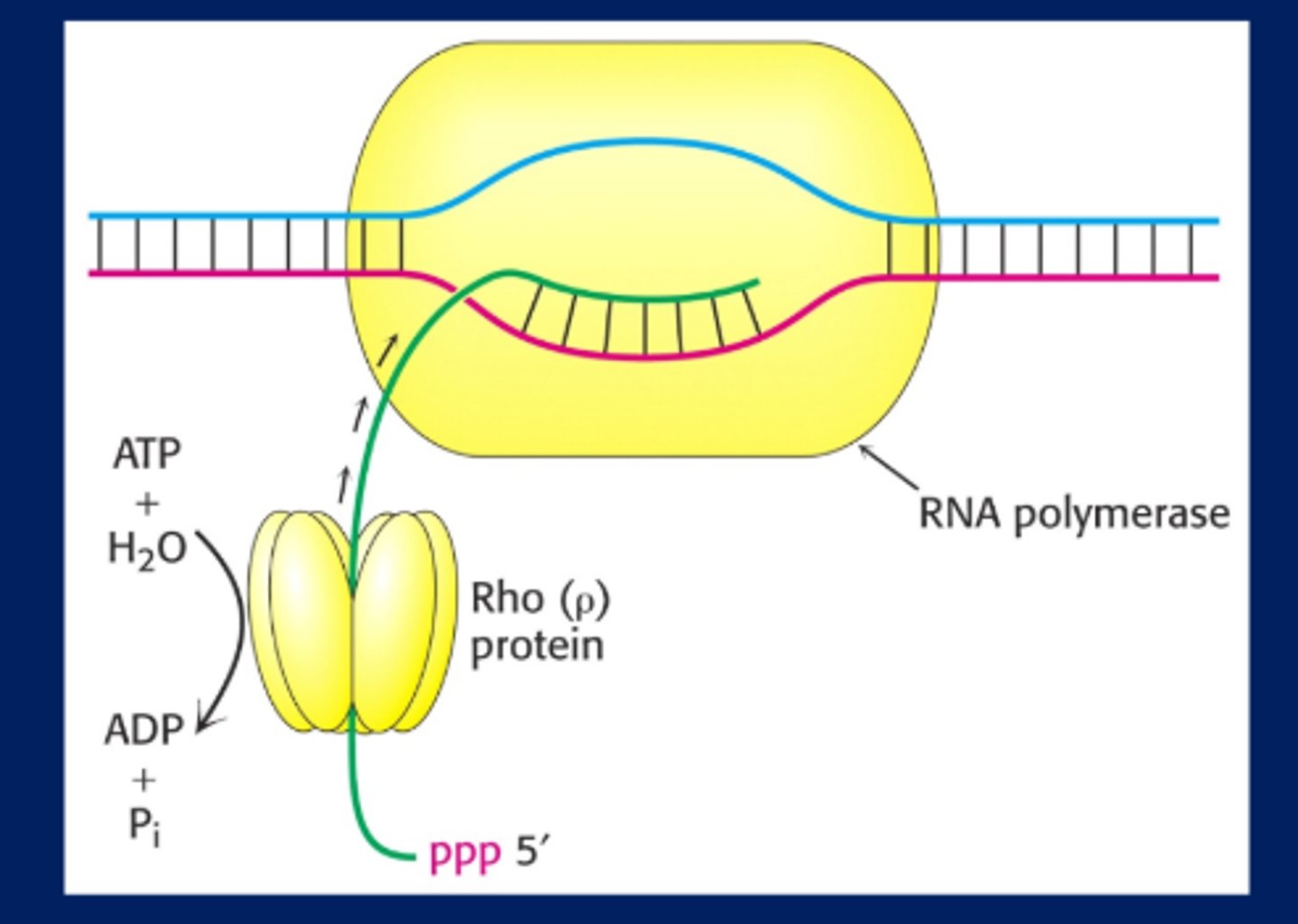
Rho
-What 2 types of enzymes is it? How does it work?
-Rho is a RNA-DNA helicase
-Rho is an RNA-dependent ATPase
Rho Factor
-What does it do with termination?
-What bases is the rut site rich and poor in? What end of the RNA?
-Rho factor is a site-specific terminator protein
-A rut site has a sequence rich in C and poor in G
preceding the actual site(s) of termination. The sequence corresponds to the 3′ end of the RNA.
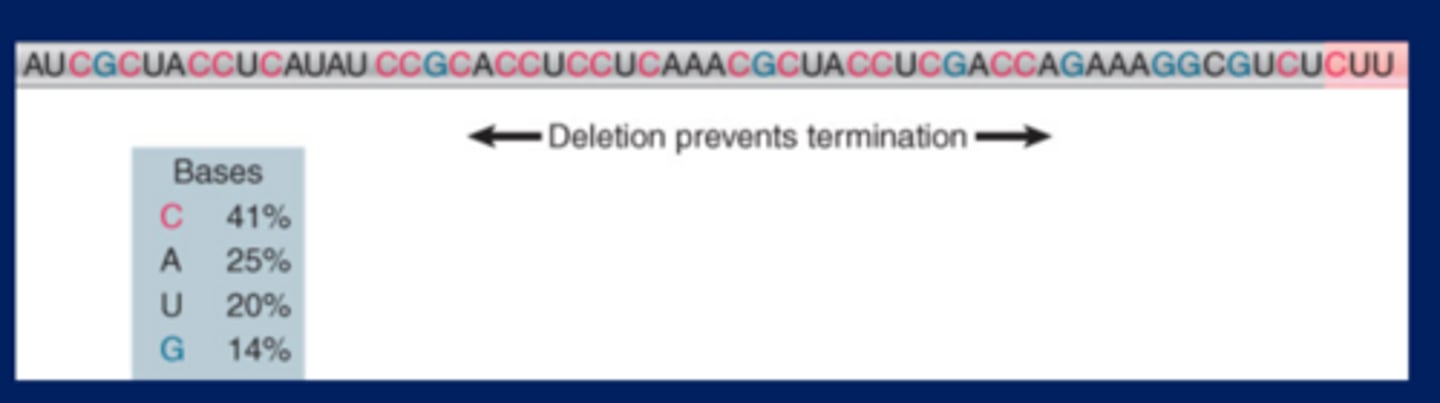
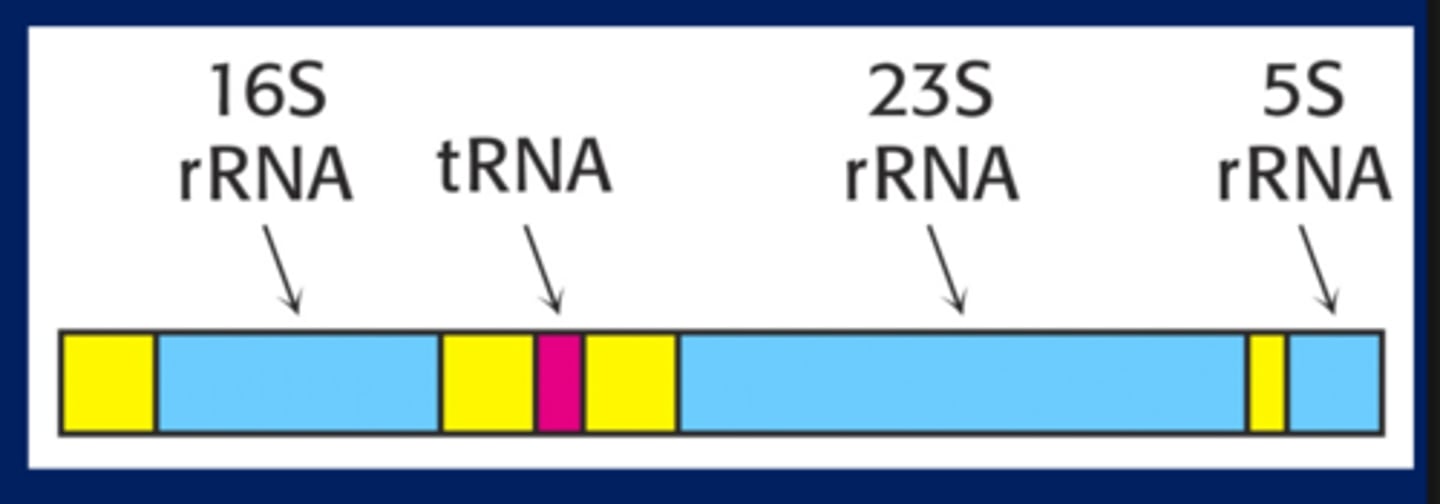
Primary Transcript of tRNA and rRNA
-Are multiple tRNAs and rRNAs made from the same or different primary transcripts?
Structure of a primary transcript of ribosomal and transfer RNAs
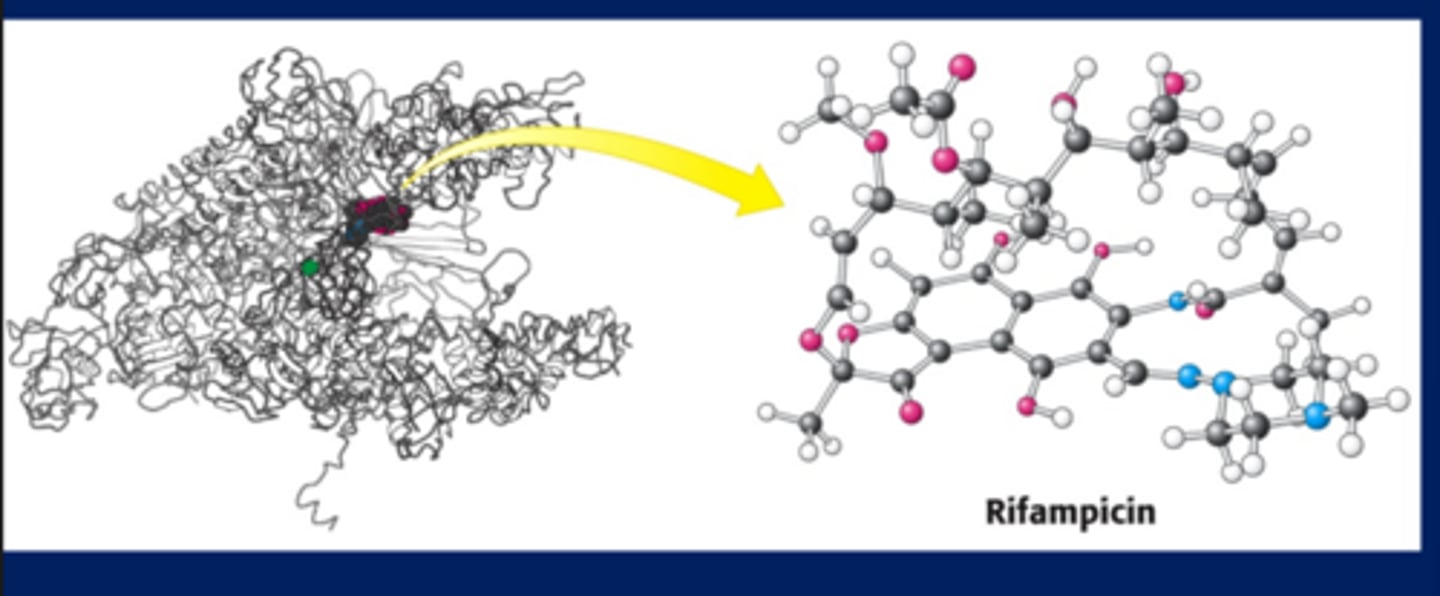
Rifampicin as an Inhibitor
-How does it work?
Rifampicin goes into active site of RNA polymerase and blocks transcription
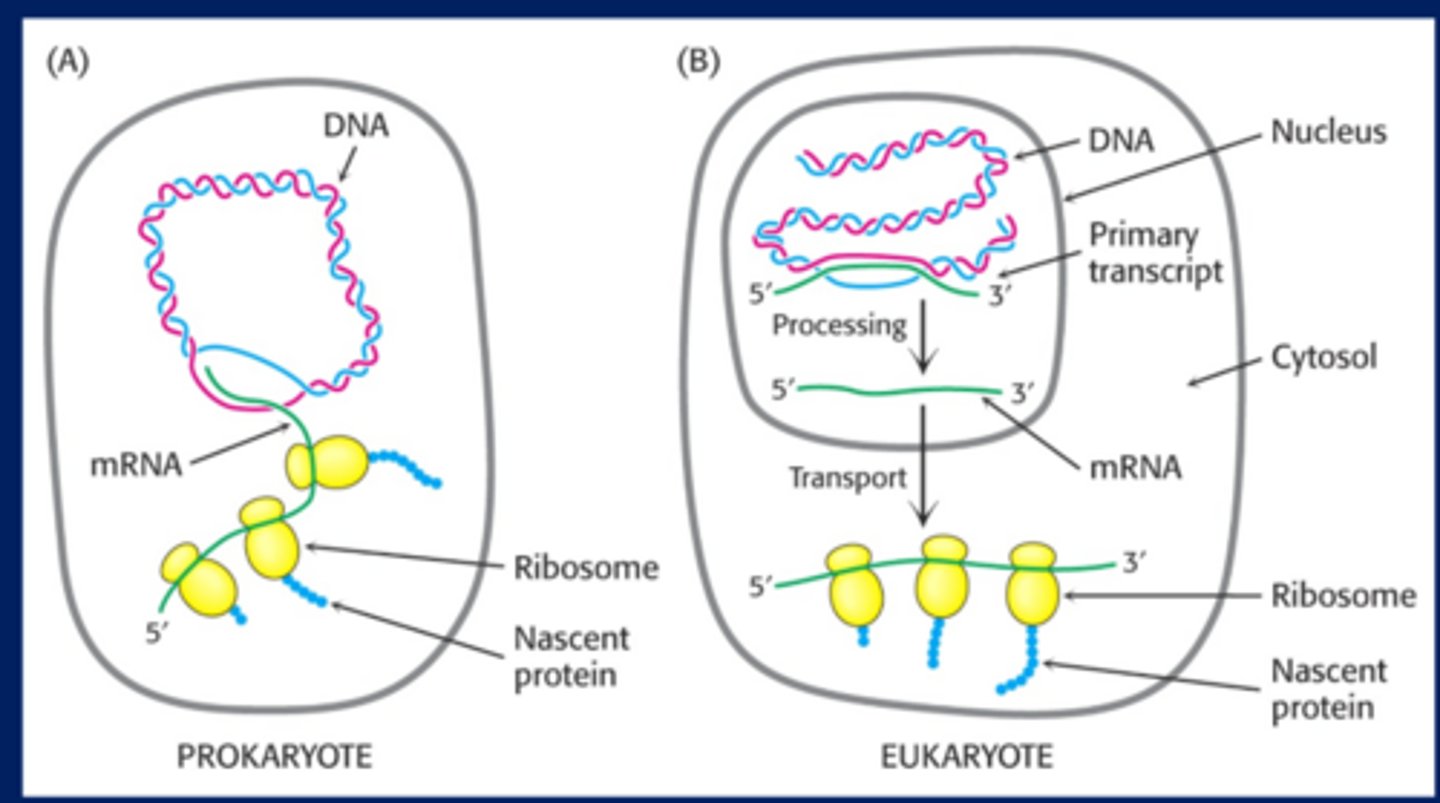
Where do transcription, splicing, and translation occur?
-Transcription and splicing take place in the nucleus
-Translation takes place in the cytoplasm
Eukaryotes vs Prokaryotes
-Where do transcription and translation take place? How?
-Prokaryotes have no nucleus, so as transcription of RNA is happening translation occurs on the RNA coming out of the RNA polymerase
-Eukaryotes-have nucleus, transcription and translation occur separately. There is a chance that the RNA could be degraded when being transported from the nucleus to the ribosome.
What are the 3 eukaryotic RNA polymerases?
-Where are they found?
-What are they used to make?
-What is the effect of a-amanitin on them?
-RNA polymerase II makes mRNA for all genes
-When RNA polymerases were run on an ion exchange chromatography column with increasing salt concentration
-RNA polymerase that came out first was I, then II came out, then III came out last
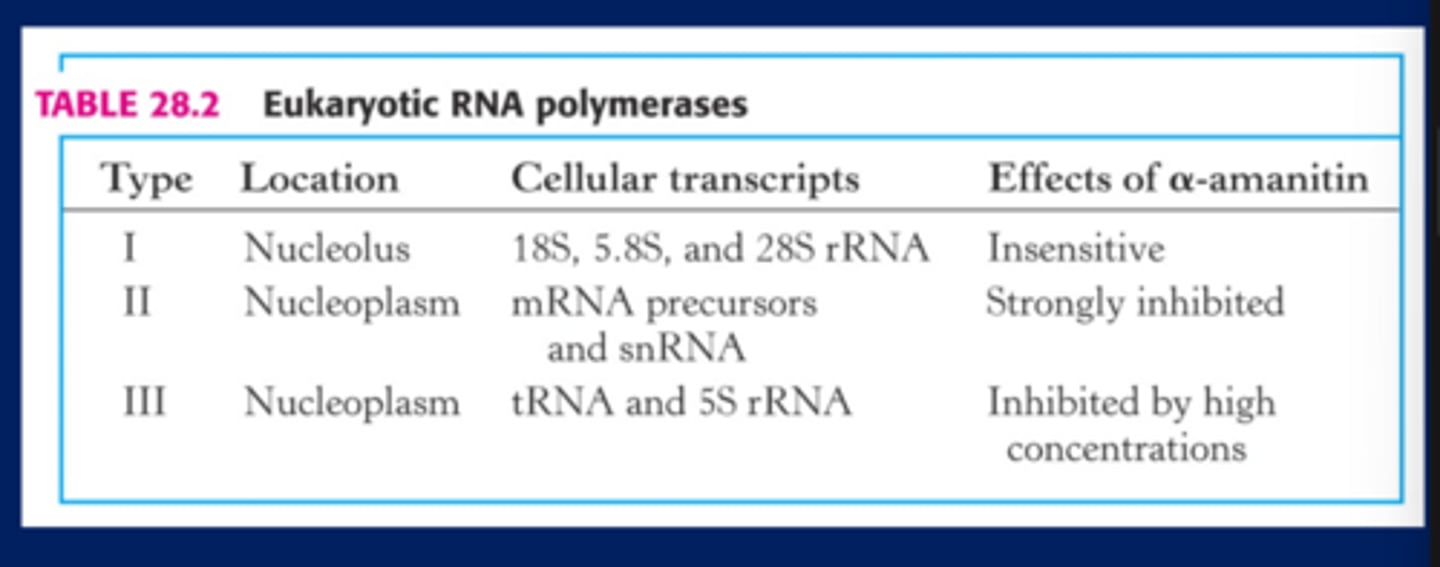
Eukaryotic RNA Polymerases
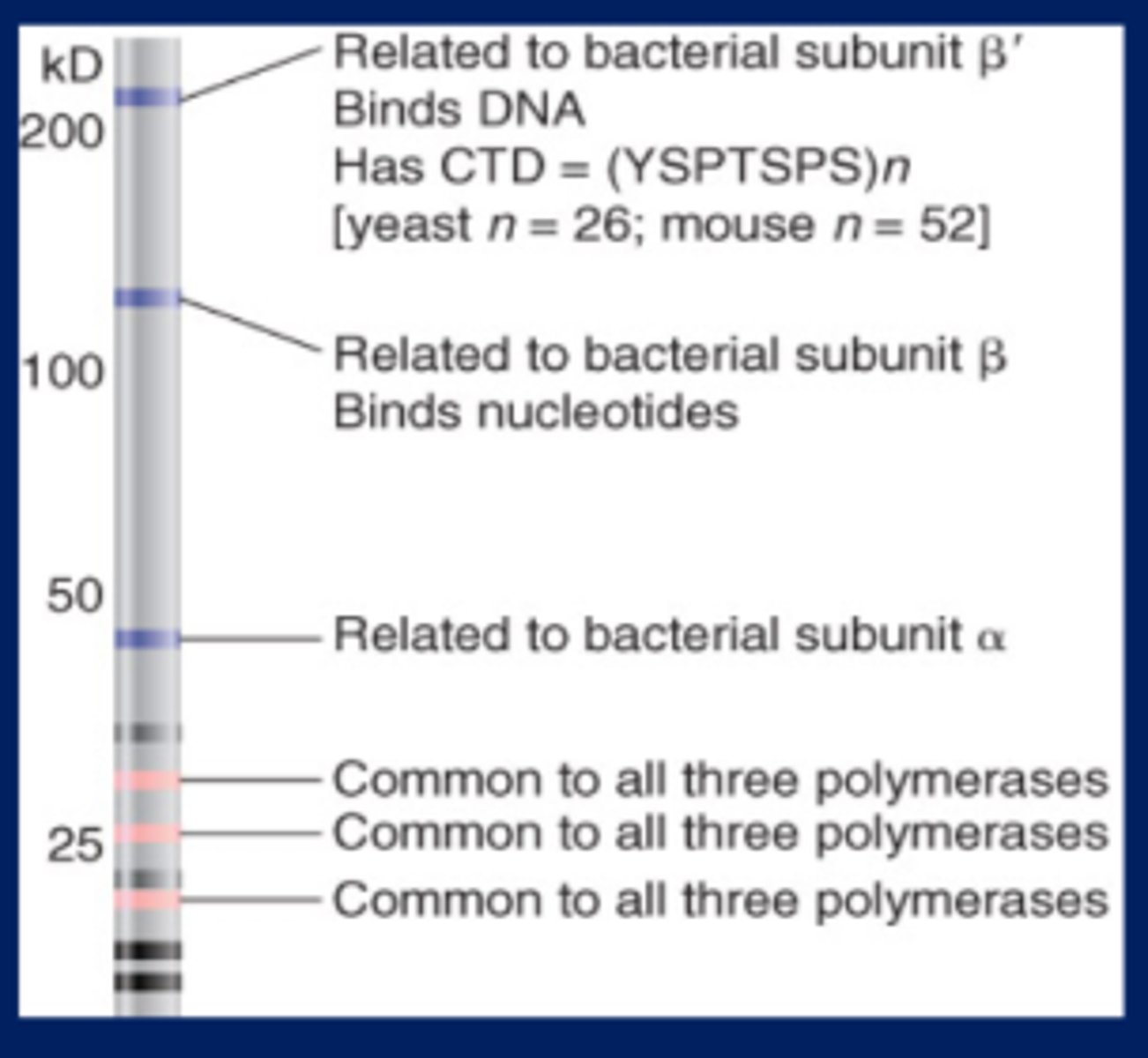
-How many subunits do they have?
-Are some subunits common to all the eukaryotic RNA polymerases?
-What is the largest subunit and what does it consist of? What RNA polymerase is it part of?
All eukaryotic RNA polymerases have ~12 subunits and are aggregates of ~500 kD
-Some subunits are common to all three RNA polymerases
-The largest subunit in RNA polymerase II has a CTD (carboxy-terminal domain) consisting of multiple repeats of a heptamer
-This drawing is a simulation of purified yeast RNA polymerase II run on an SDS gel to separate the subunits by size
Do eukaryotes have a sigma subunit for their RNA polymerase?
No, eukaryotes don't have a sigma subunit in their RNA polymerases, but they do have transcription factors
-Each element in the promoter have different transcription factors that bind to them
What transcription factor in eukaryotes is similar to/is the equivalent of sigma factor?
TFIID which has a TATA binding protein subunit which is similar to the sigma factor
Core Promoter in Eukaryotes
-What is it?
-What 4 elements does it include in mammals?
-How long is it?
-Core promoter - The shortest sequence at which an RNA polymerase can initiate transcription (typically at a much lower level than that displayed by a promoter containing additional elements)
-For mammalian RNA polymerase II it is the minimal sequence at which the basal transcription apparatus can assemble, and it often includes one or more of three sequence elements: TATA box, the Inr (Initiator element ) like the TATA box, and the DPE
-It is typically ~40 bp long
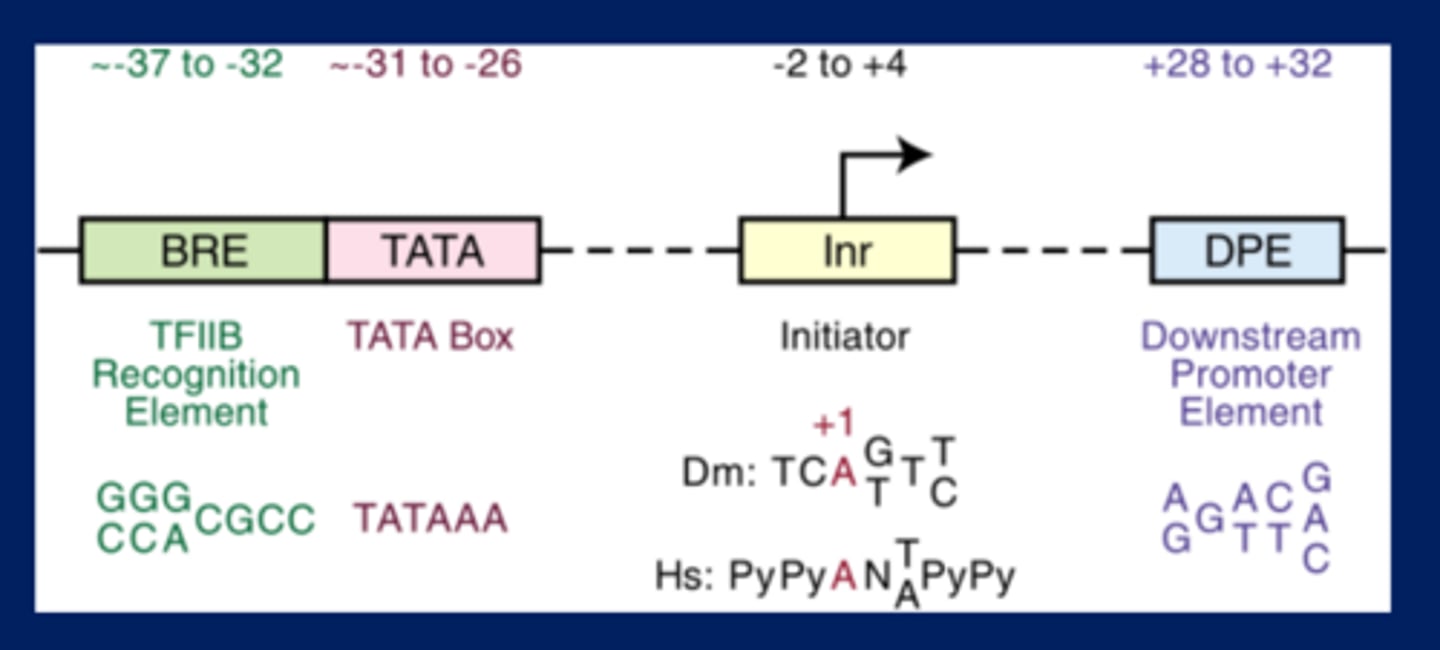
Eukaryotic vs Prokaryotic TATA Box
-What is the prokaryotic TATA box called?
What are the CAAT box and GC boxes?
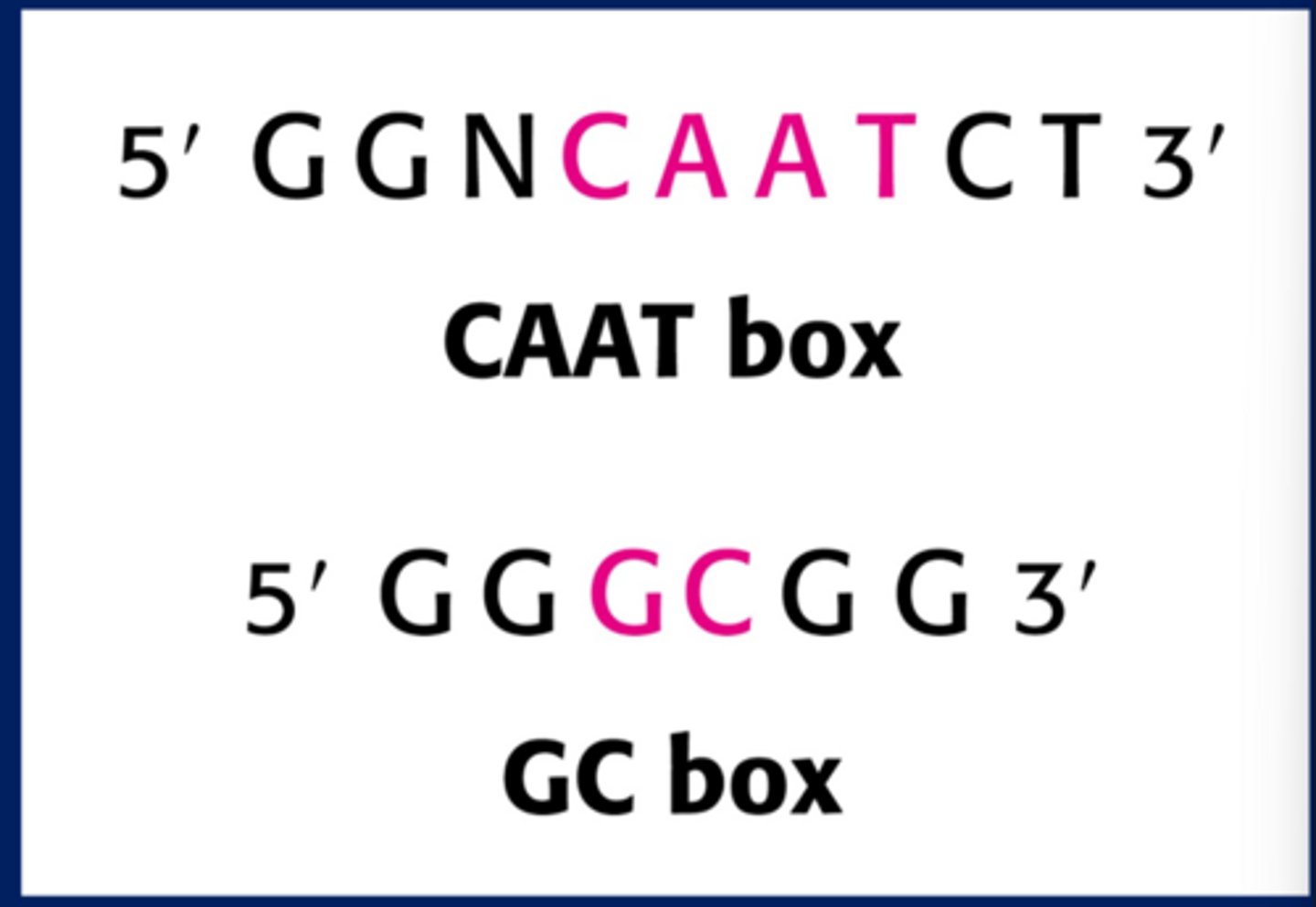
Differences in Transcription in Eukaryotes and Prokaryotes
-How big is the promoter? Where is it located?
Prokaryotes:
-Small promoter that is always 5' upstream from the gene
Eukaryotes:
-Large, complex promoter
-Promoters can be 5' upstream or 3' downstream
Where does the basal apparatus assemble?
-What increases the frequency of transcription?
-What is the first step in initiation of transcription? (What binds to what?)
-The basal apparatus assembles at the promoter
-The upstream elements and the factors that bind to them increase the frequency of initiation
-Binding of TFIID to the TATA box or Inr is the first step in initiation
-An initiation complex assembles at promoters for RNA polymerase II by an ordered sequence of association of transcription factors
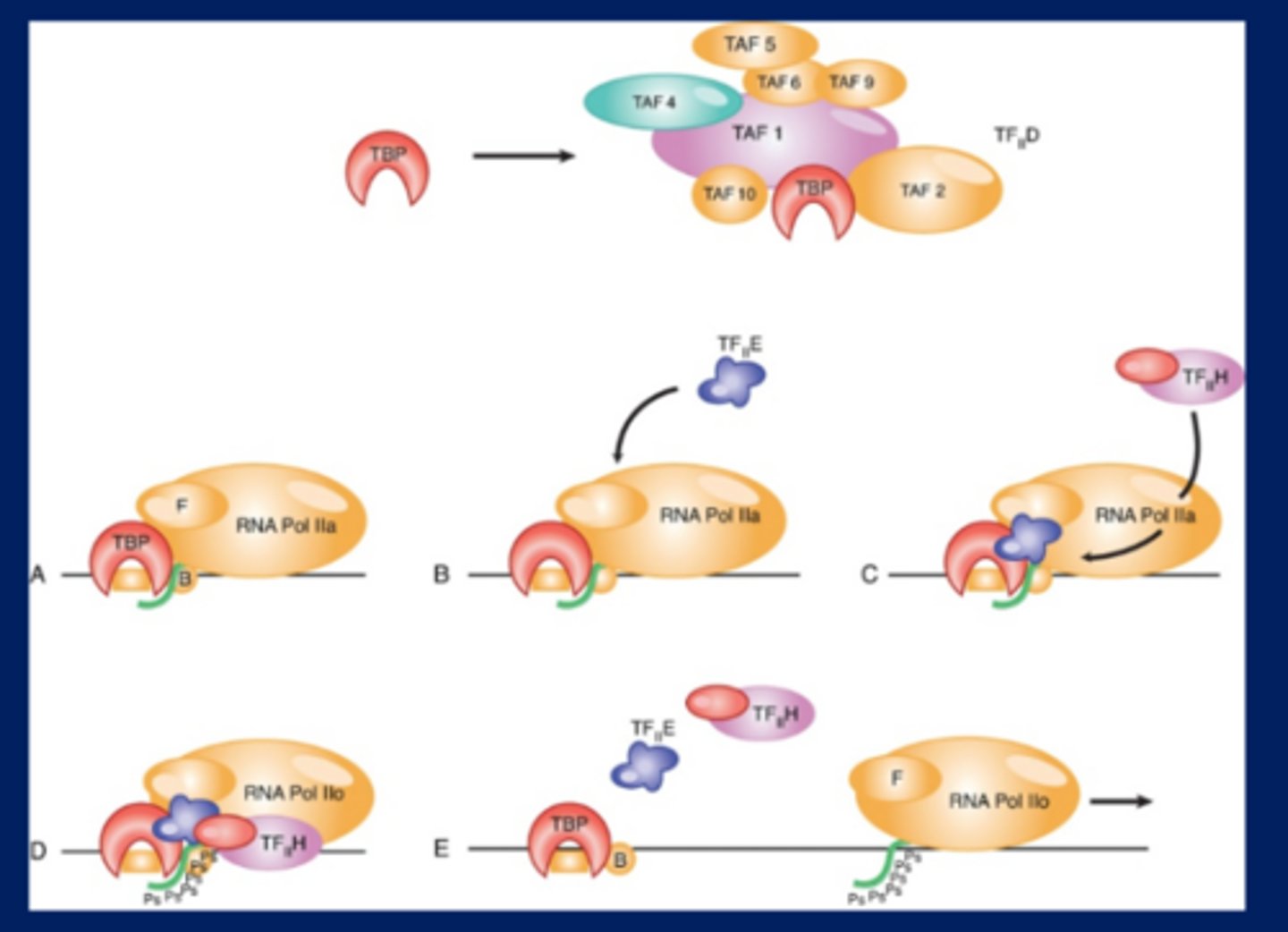
Transcription Initiation
-What are the steps?
-How many subunits?
1. TFIID binds to the TATA box
-TFIID is like the sigma factor of prokaryotic transcription
-TFIID=transcription factor, RNA polymerase II
-TFIID has 2 subunits including TBP which is part of sigma factor
-TBP is bound to a bunch of TAFs
-TBP binds to TATA box
-This attracts RNA polymerase II
2. Other transcription factors bind (TFII A, B, F, and E)
3. RNA polymerase II binds and it becomes a transcription complex and transcription begins
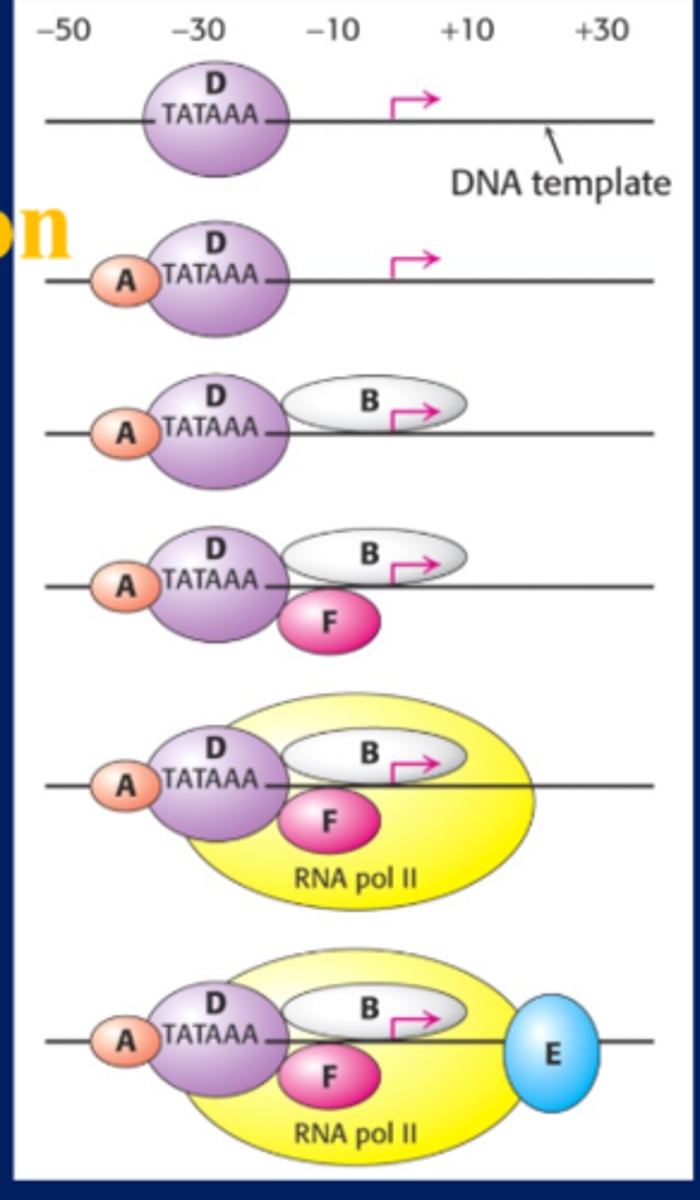
Eukaryotic Transcription Factors
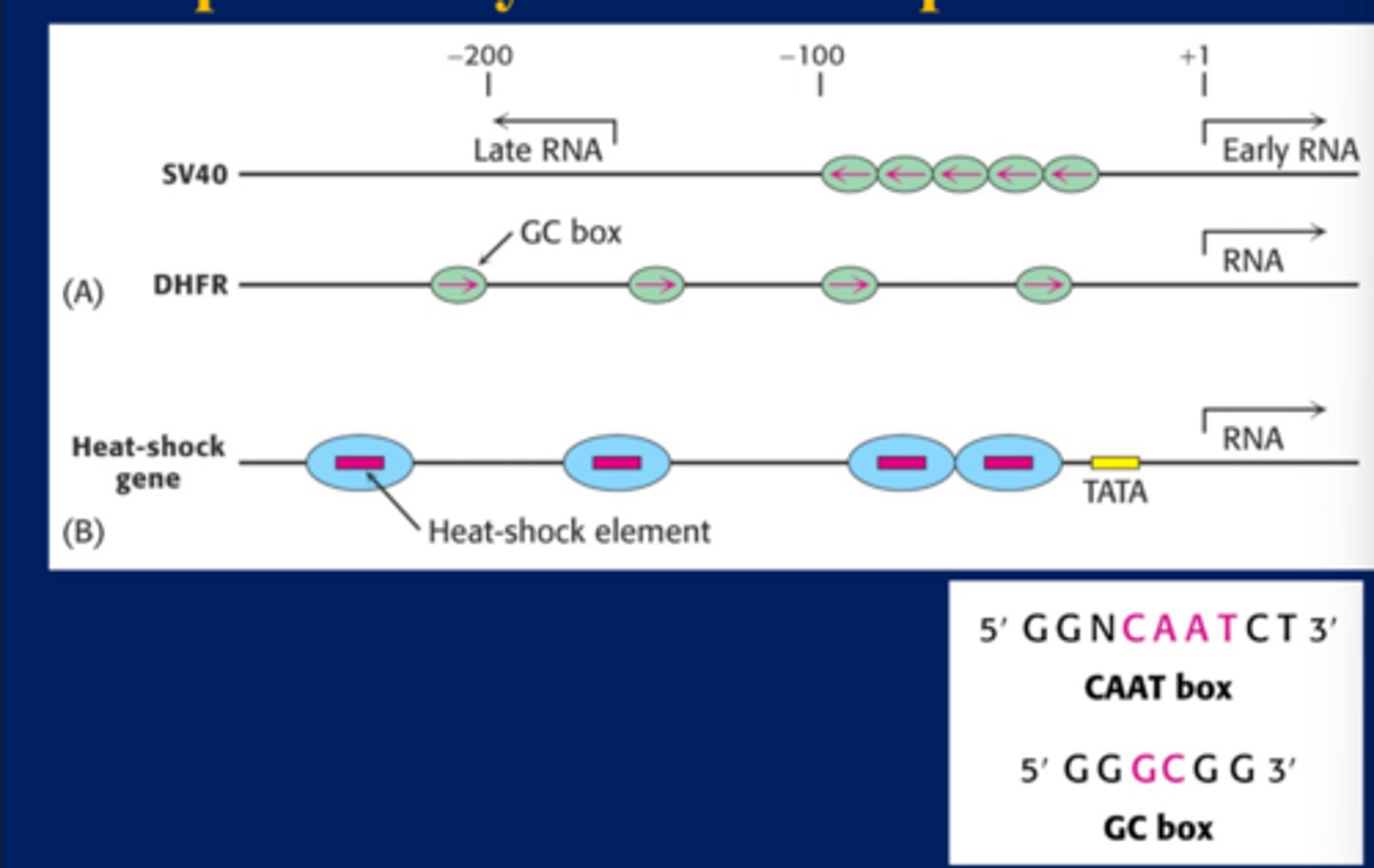
-What is the heat shock element?
-What is early and late RNA?
-What are the CAAT and GC boxes?
-DHFR-cancer gene, GC and CAT boxes
-GC boxes are oriented different ways
Start Point for RNA Polymerase II
-What are general transcription factors AKA? What is their function?
-What sequence is usually at the start point?
-What does a TATA box consist of? Where is it?
-RNA polymerase II requires general transcription factors (called TFIIX) to initiate transcription
-RNA polymerase II promoters frequently have a short-conserved sequence Py2CAPy5 (the initiator, Inr) at the start point
-The TATA box is a common component of RNA polymerase II promoters and consists of an A-T-rich octamer located ~25 bp upstream of the start point
-A minimal pol II promoter may have a TATA box ~25 bp upstream of the Inr
-TATA box is present in 60% of genes, when TATA isn't present there is Inr
-TFIID binds to TATA box or Inr depending on which is present
-Either TATA or Inr is present
-Inr is located at the start point
Transcripton start site: YYANWYY
-Y=pyrimidine
-W=A or T
-N=any base
TBP
-What is its function?
-What is it part of in eukaryotes?
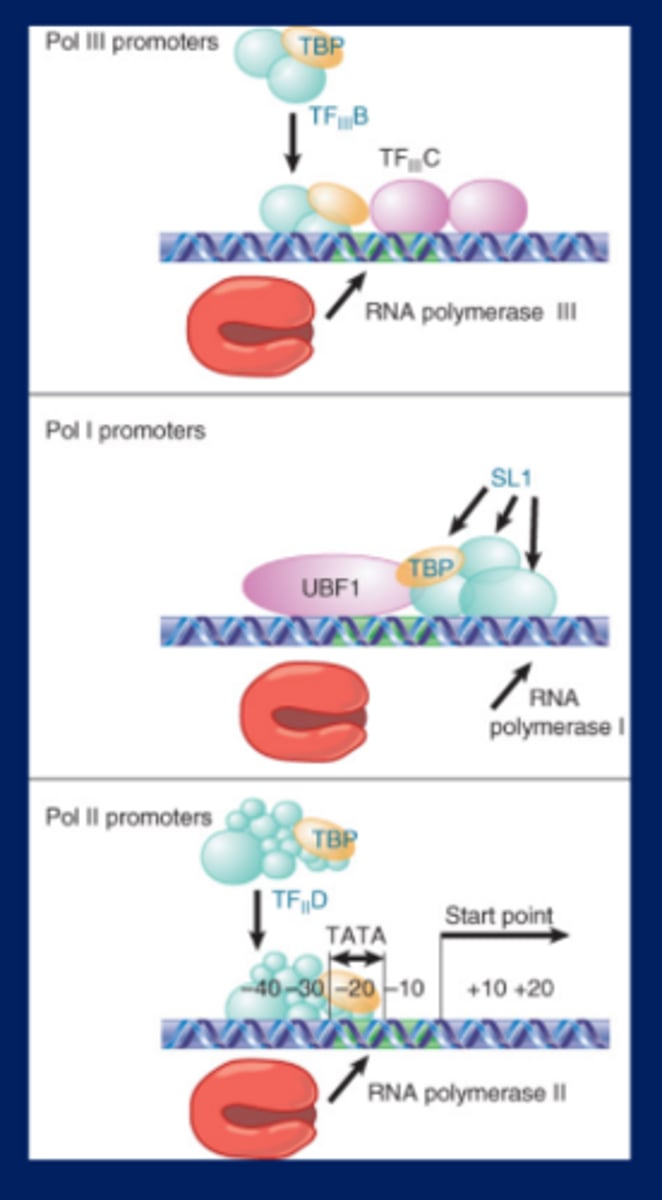
-TBP is a component of the positioning factor (positions RNA polymerase on the TATA box or Inr) that is required for each type of RNA polymerase to bind its promoter
-The factor for RNA polymerase II is TFIID, which consists of TBP and ~11 TAFs, with a total mass ~800 kD
-RNA polymerases are positioned at all promoters by a factor that contains TBP
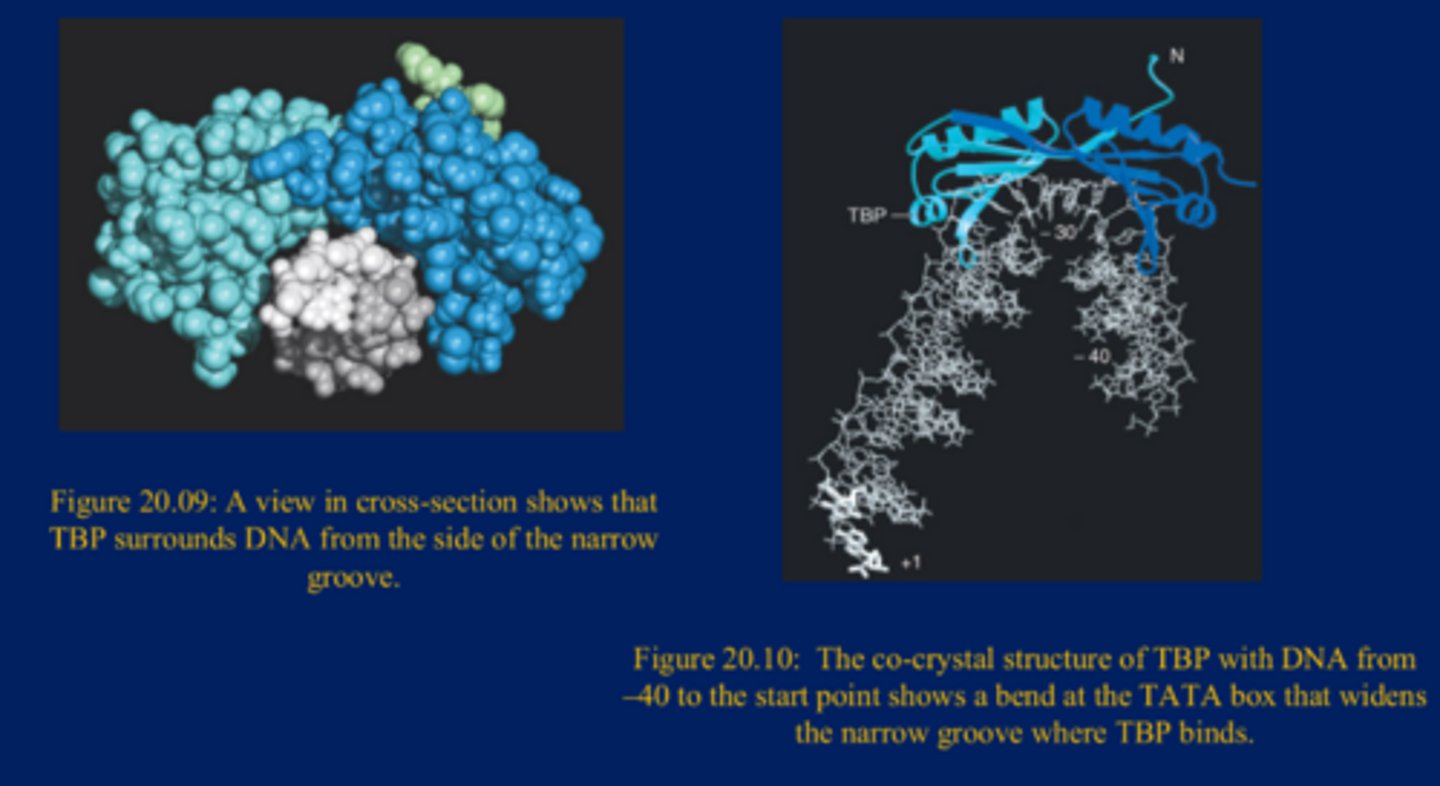
TBP
-Where does it bind? What groove of DNA is this (major or minor)?
-What does it form?
-TBP binds to the TATA box in the minor groove of DNA
-It forms a saddle around the DNA and bends it by ~80°
Downstream Promoter Element (DPE)
-What is it? What does it not contain?
-What 2 things does a core promoter for RNA polymerase II include?
-The downstream promoter element (DPE) is a common component of RNA polymerase II promoters that do not contain a TATA box (TATA-less promoters)
-A core promoter for RNA polymerase II includes the Inr and commonly either a TATA box or a DPE
-Location: 28-32 bp downstream from the start site inside the gene
-Context: mostly in TATA-less promoters
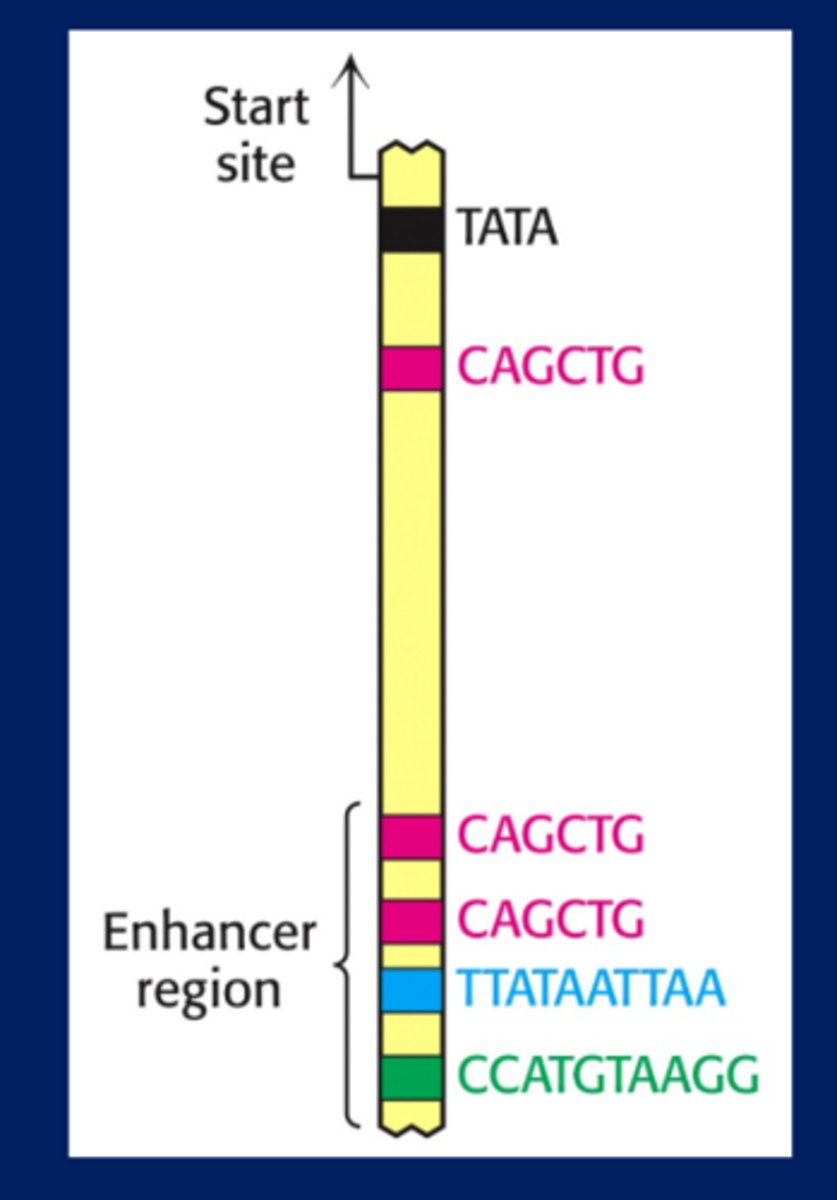
Enhancer
-What is its function?
-Is it cis or trans acting?
-Where is it?
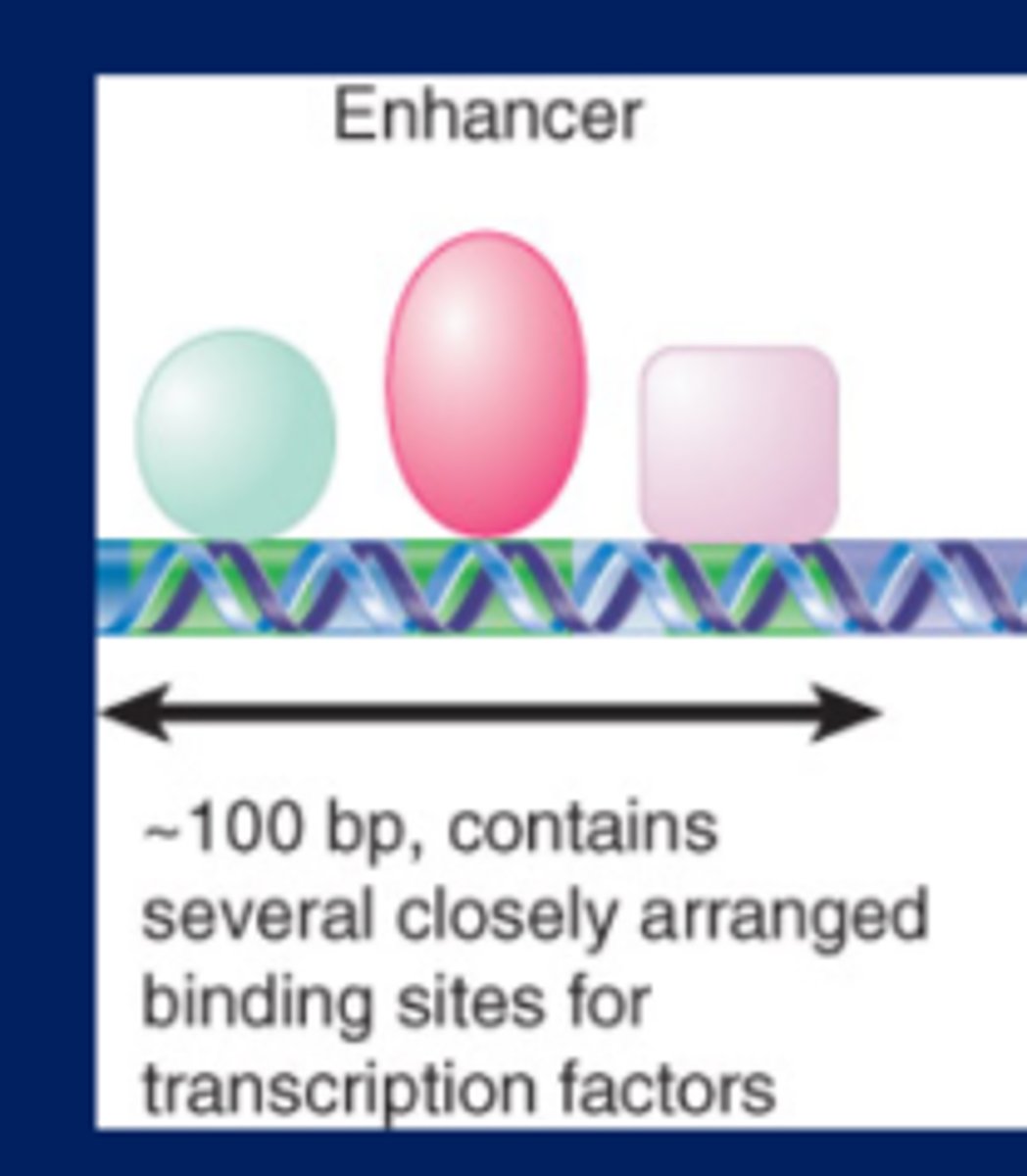
-A cis-acting sequence that increases the utilization of (most) eukaryotic promoters and can function in either orientation and in any location (upstream or downstream) relative to the promoter
-TFIID binding to TATA box=TATA box is cis acting element, TFIID is the trans acting factor
-If there is a cis acting element, a trans acting factor binds to it
Silencer
-What is it?
-What is its function?
-Where are enhancers and silencers located in relation to each other?
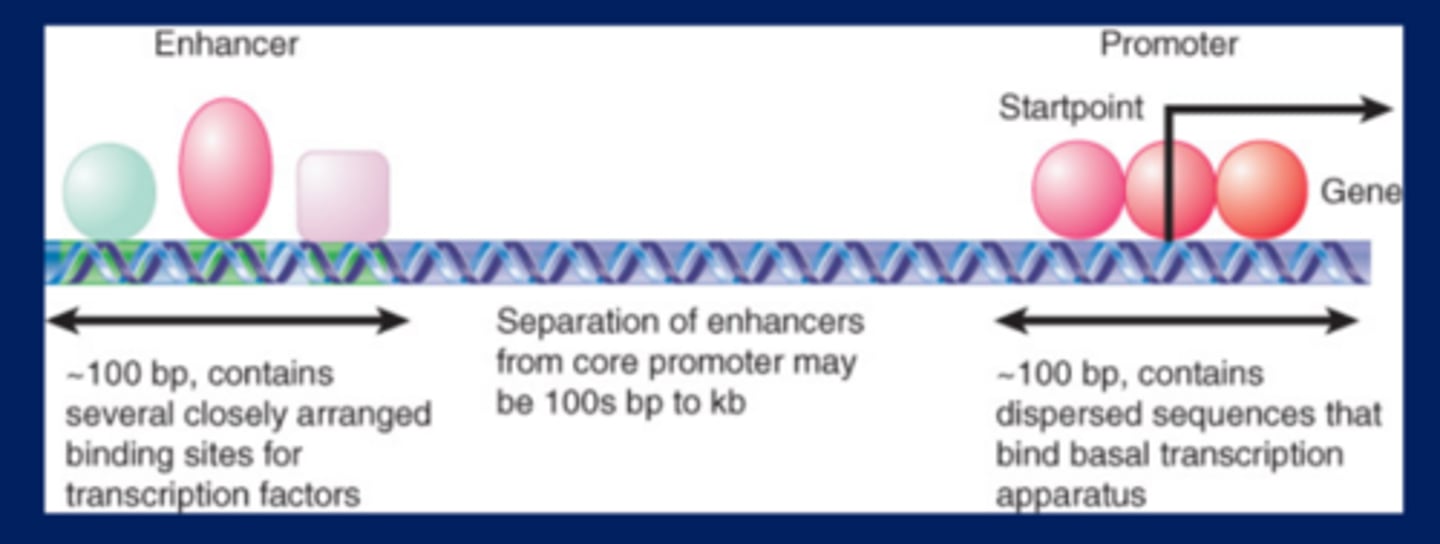
-A short sequence of DNA that can inactivate expression of a gene in its vicinity
-A typical gene transcribed by RNA polymerase II has a promoter that extends upstream from the site where transcription is initiated
Enhancers
-What sequences are present?
-Do long range activation
-Has cis acting elements
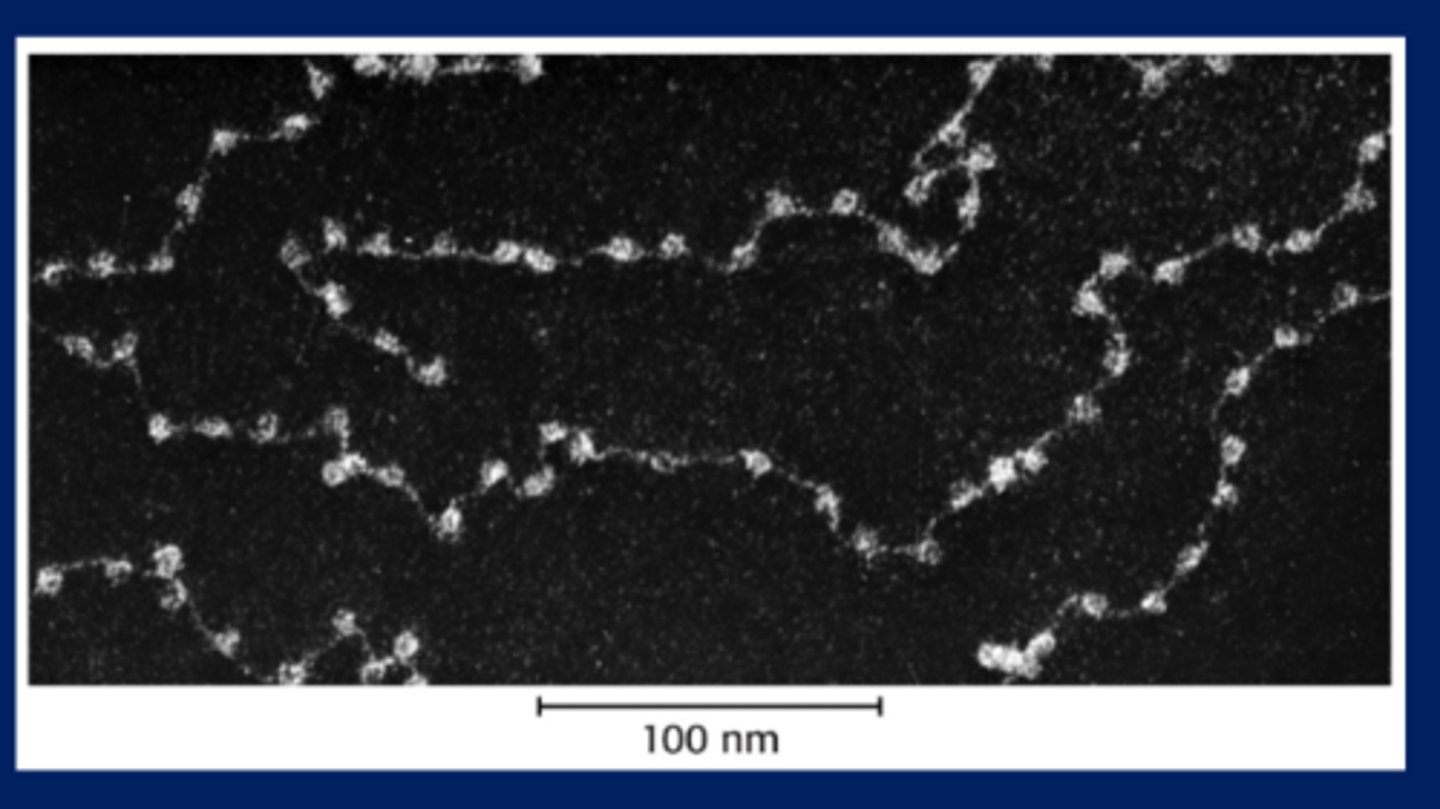
Structure of Eukaryotic Chromosome: Nucleosomes
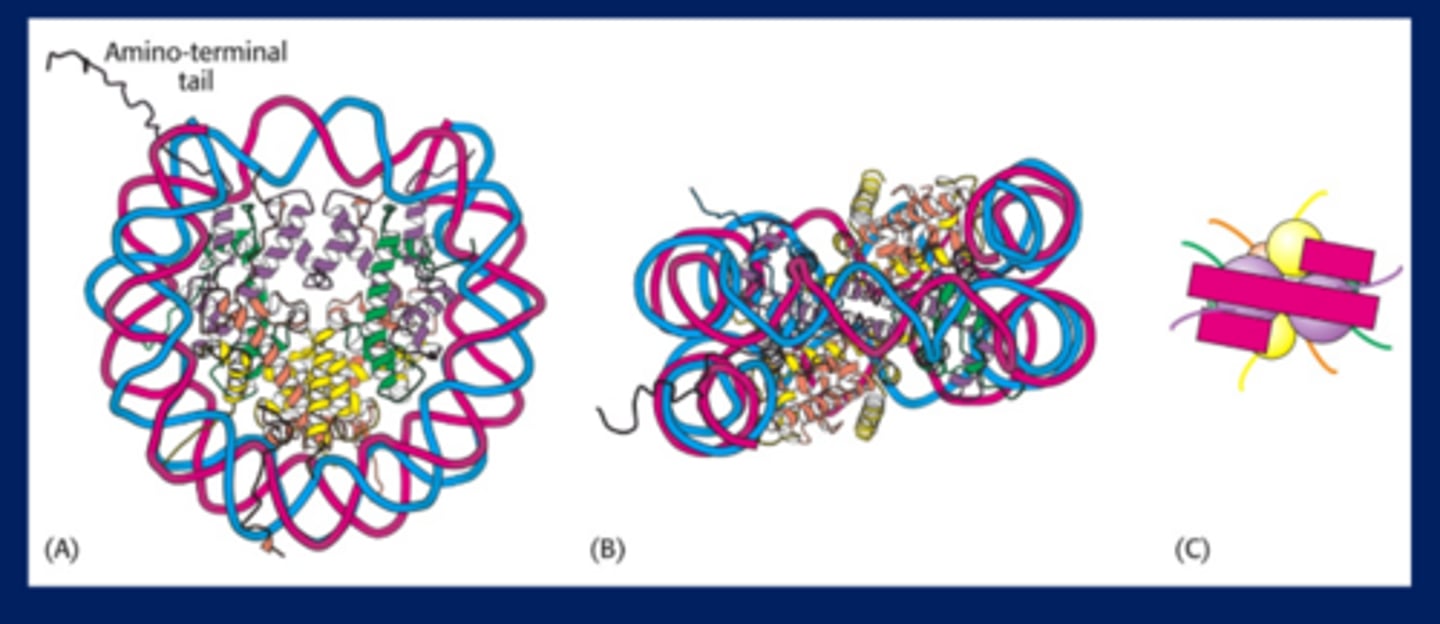
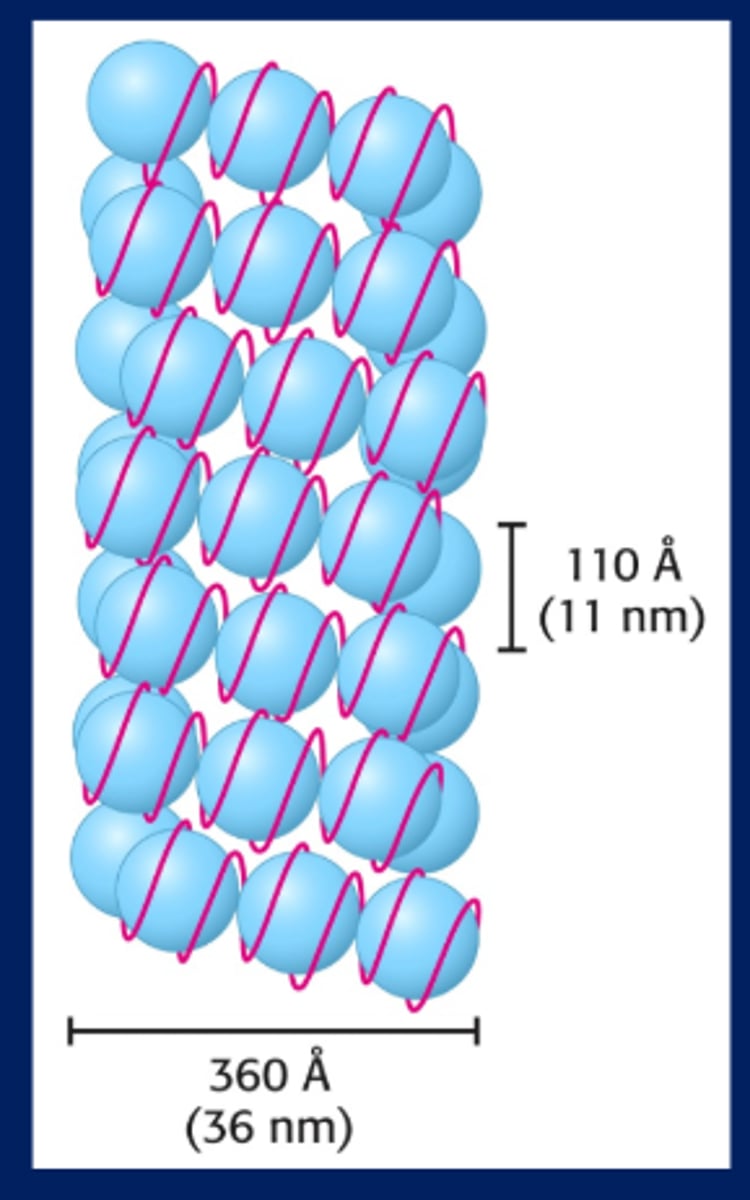
Single Nucleosome Particle
-How many base pairs is a nucleosome?
-What is it made of? What subunits? How many copies?
-What is its length in angstroms?
-One Nucleosome = 200 bp of DNA + Histone octamer (two copies each of H2A, H2B, H3, H4 histones)
-An amino terminal tail comes out
-110 angstrom
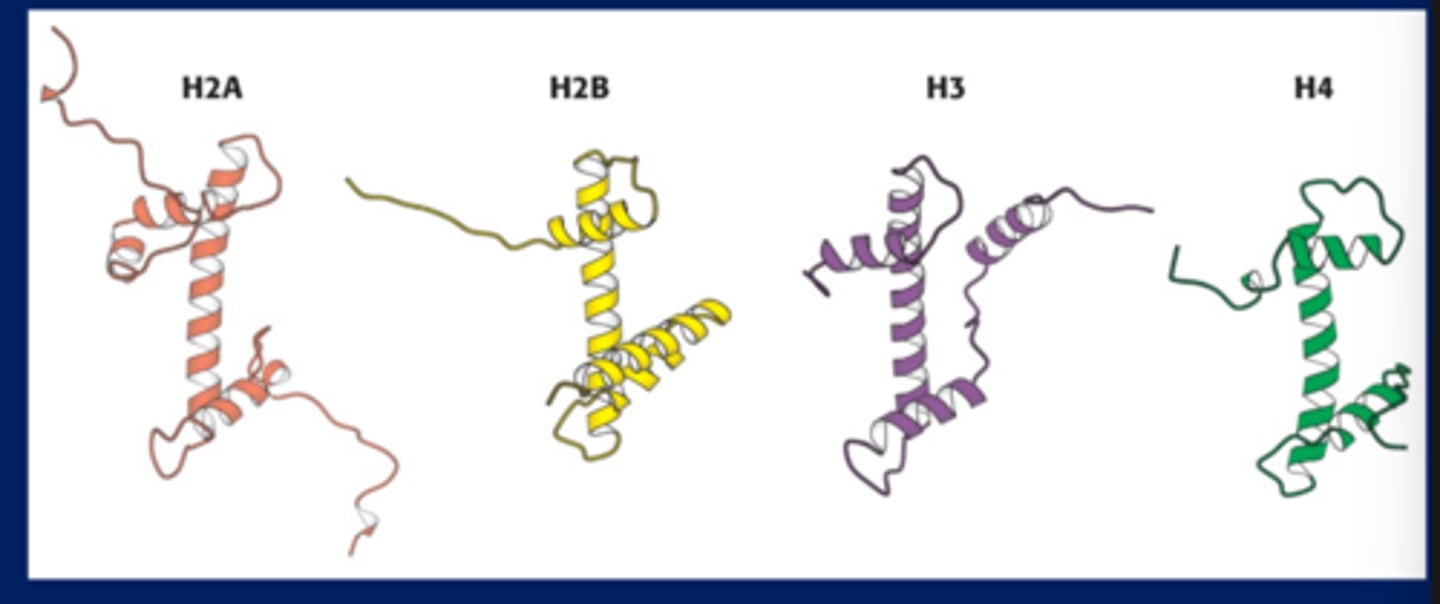
H2A, H2B, H3, and H4 Structures
-What are their charges?
Histones are highly basic/positively charged, this helps them pack DNA because DNA is negatively charged
-H2A and H2B have tails that stick out
Compacted Chromatin
-RNA polymerase, DNA polymerase, and transcription factors can't get to the DNA
-When necessary, chromatin remodeling engine comes in and opens up the DNA so they can bind
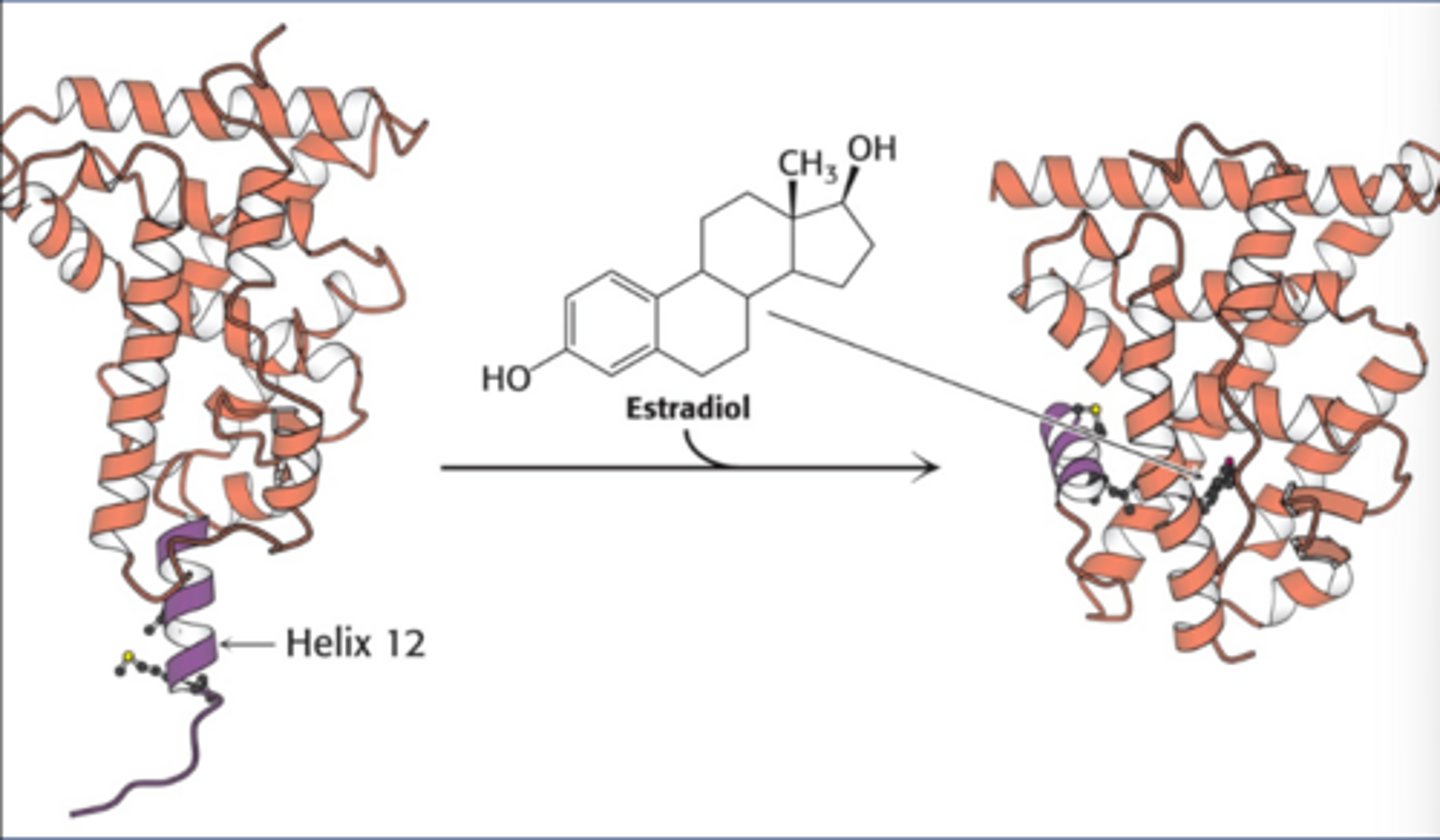
Estrogen Receptor
-What binds to it?
-What are the structural conformations?
-Estrogen is a transcription factor that binds to the estrogen receptor and brings it to the nucleus
-The estrogen receptor is a soluble protein in the cytoplasm not in the membrane
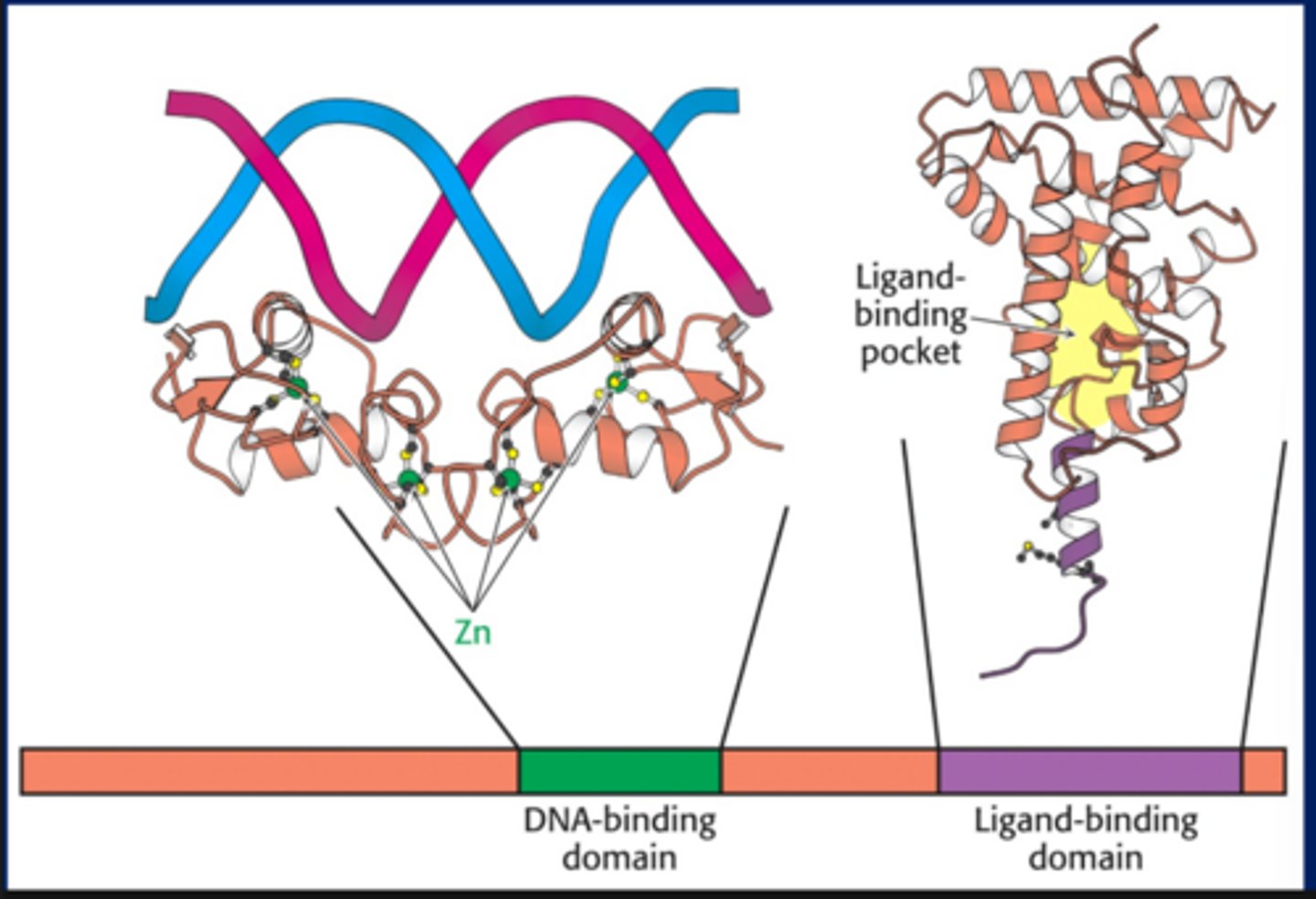
Steroid Hormone Receptors as Transcription Factors
-What are the 2 domains and what do they bind to?
Estrogen binds to receptor and becomes a transcription factor
-Receptors have a ligand binding domain (where hormone binds) and a DNA binding domain (hormone recognizes and activates a specific DNA sequence)
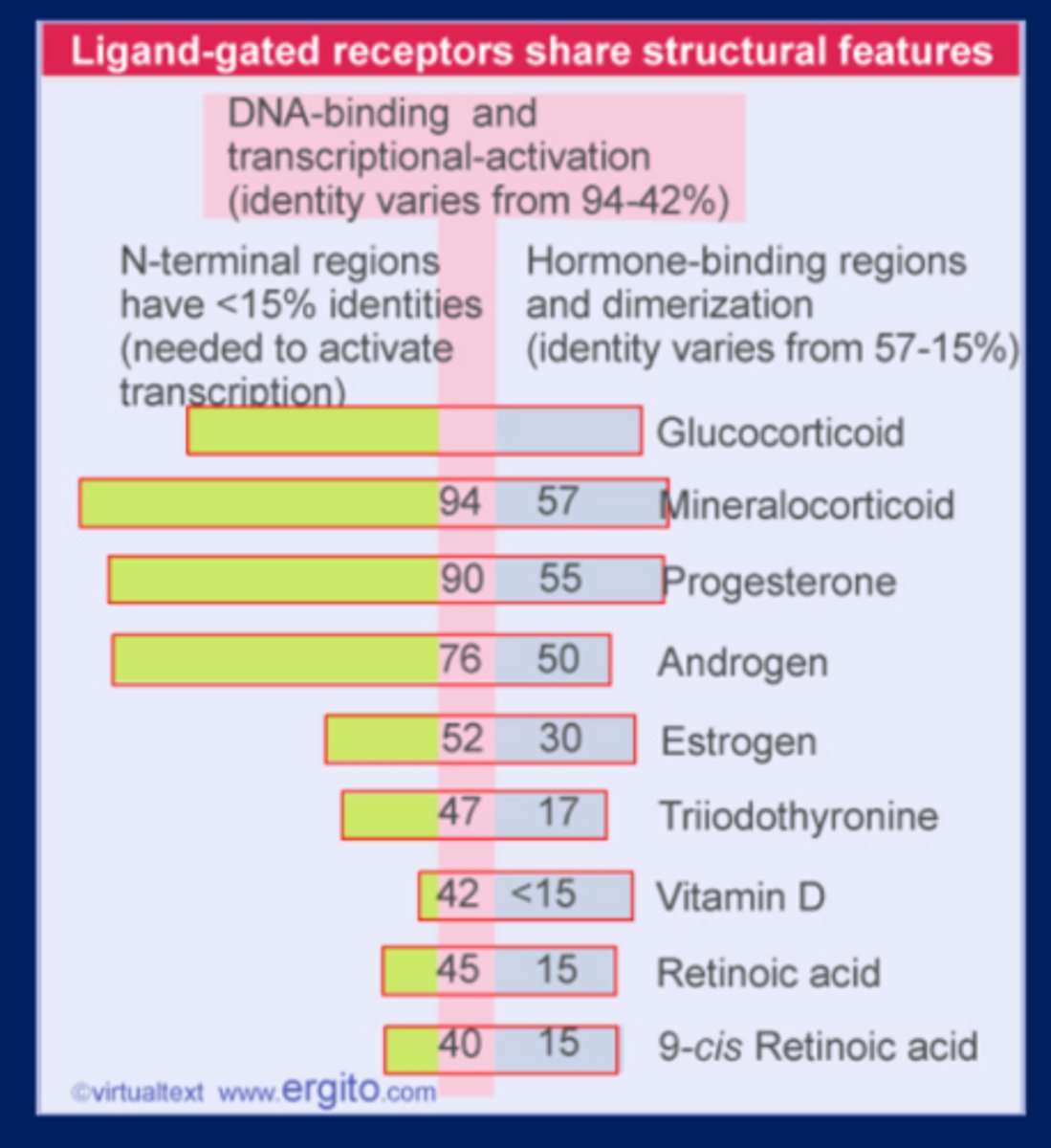
Steroid Hormone Receptors as Transcription Factors
-What structural features are shared?
-Each hormone is specific for a certain site on the DNA
Zinc Finger
-What 2 things do amino acids control?
-What binds?
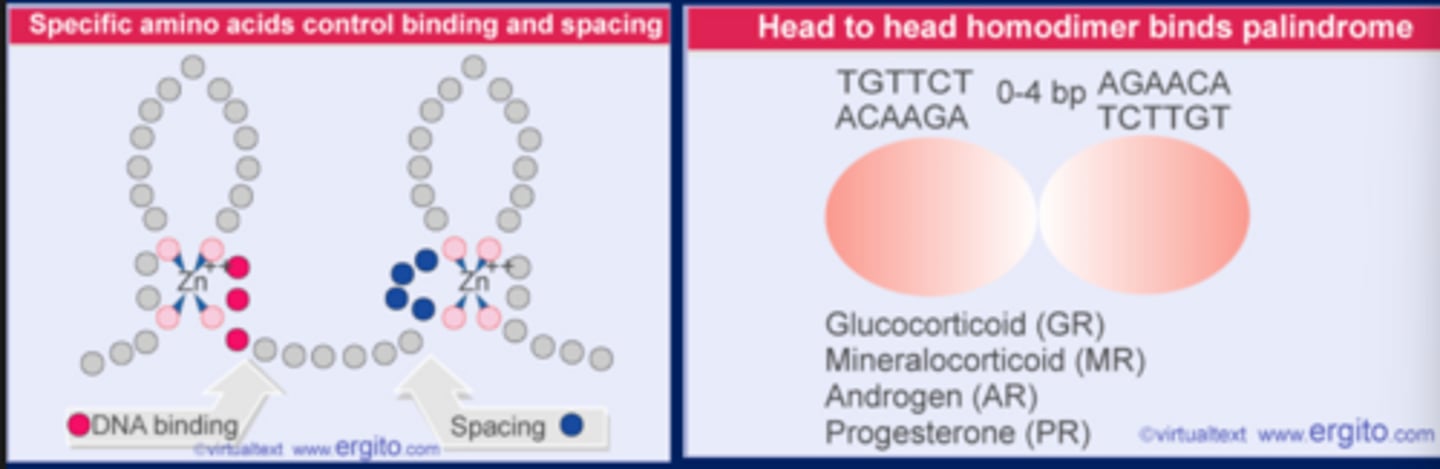
-The hormone receptors have zinc fingers that bind to the DNA elements
-Steroid hormone binds to and activates receptor, takes it to nucleus, and receptor turns into a transcription factor for RNA polymerase II
-Hormones turn on genes that contain certain cis acting elements
-Have zinc finger for binding
Coactivators and Corepressors
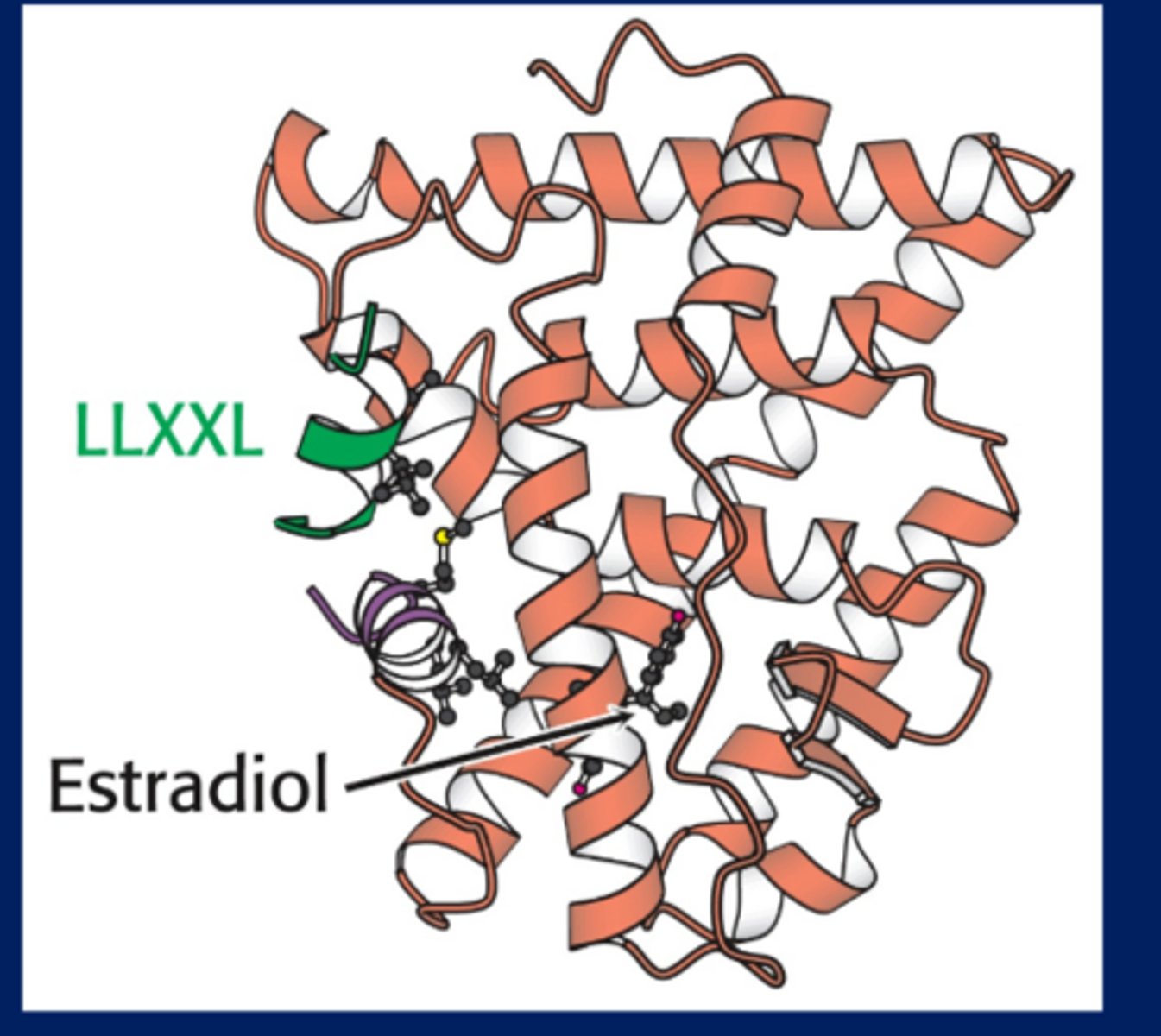
-What do they bind to?
Interactions Between Coactivator and Estrogen Receptor?
Interactions Between Coactivator and Estrogen Receptor?
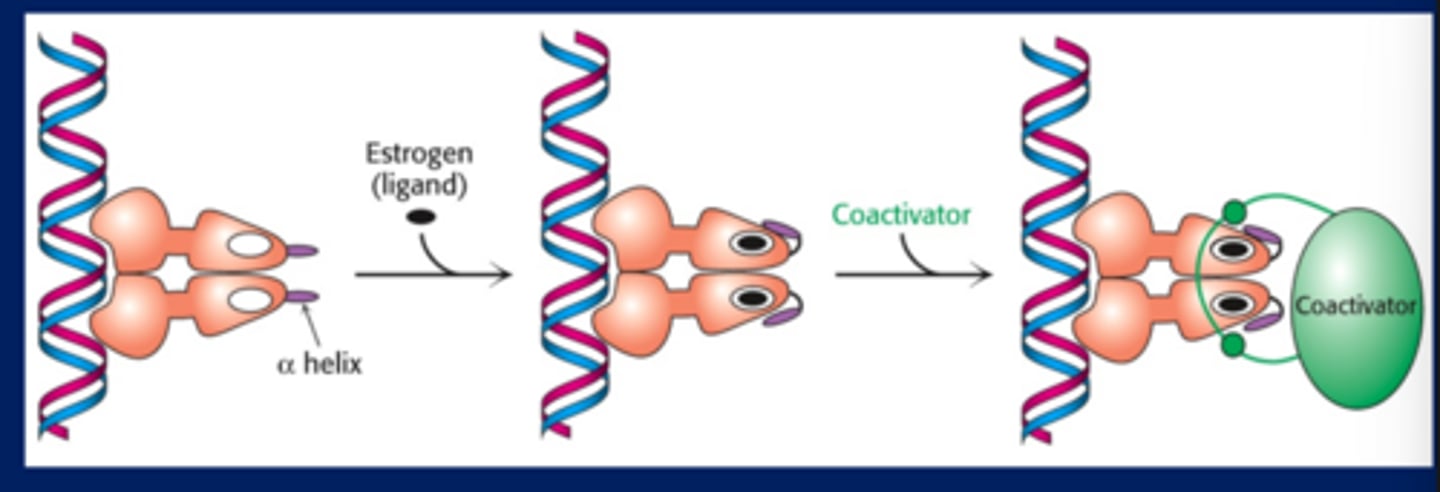
-What are the steps? What binds?
-Receptor binds to DNA and then estrogen binds
-Coactivator must bind to estrogen receptor for expression to be turned on (without coactivator the receptor does not cause transcription)
Addition of what group causes activation of transcription?
-What reaction causes this? What enzyme catalyzes it?
-Histone acetylation activates transcription
-Acetylation of histone: HistoneH3-Lysine + Acetyl CoA ---histone acetyl transferase--->acetylated-histone H3, opens up chromatin for transcription
-Condensed chromatin=deacetylated
-Add acetyl group to lysine, chromatin opens up so transcription can occur
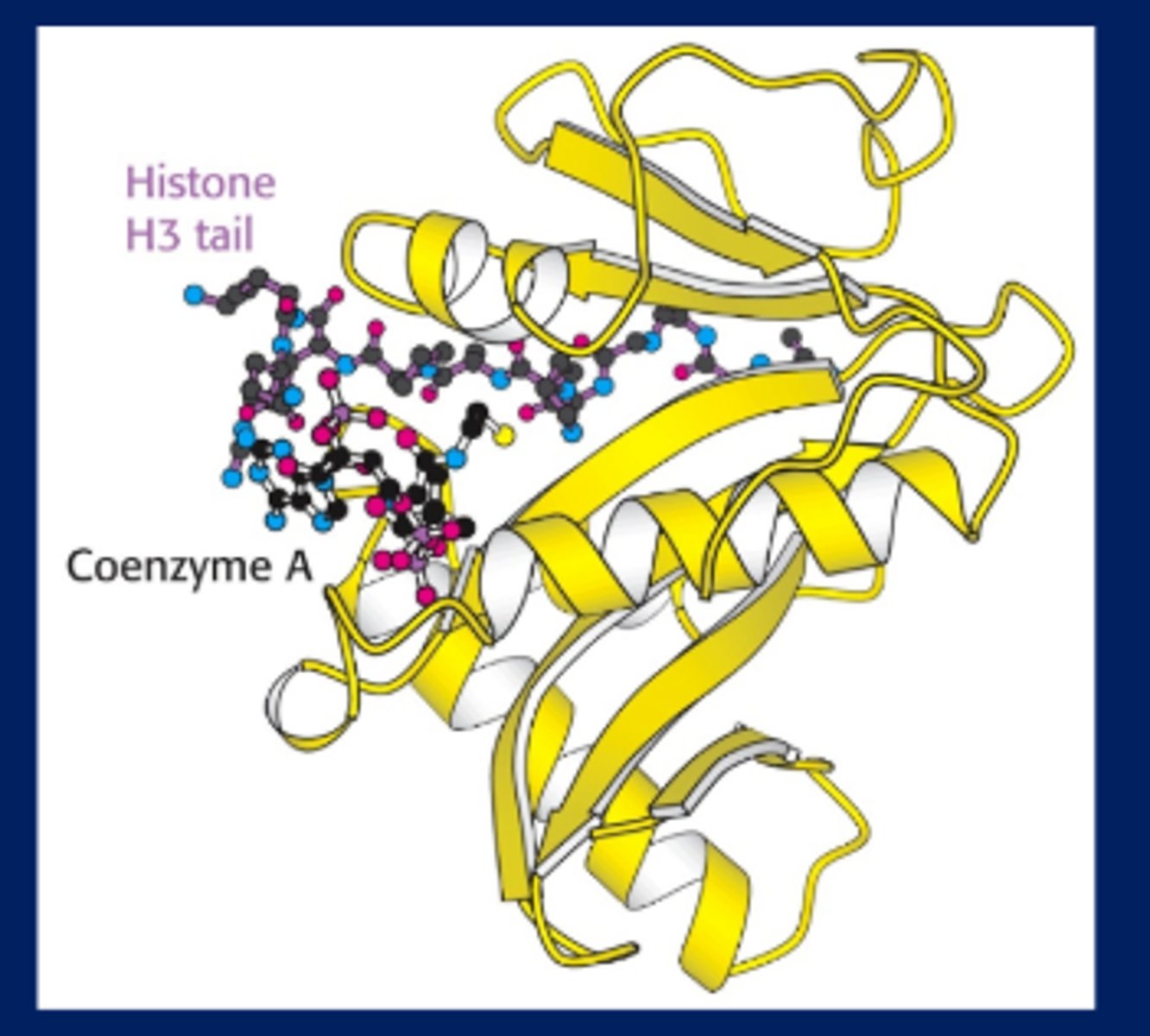
Acetyl-Lysine Specific Binding
-What is the domain called?
-What do acetylation and deacetylation lead to?
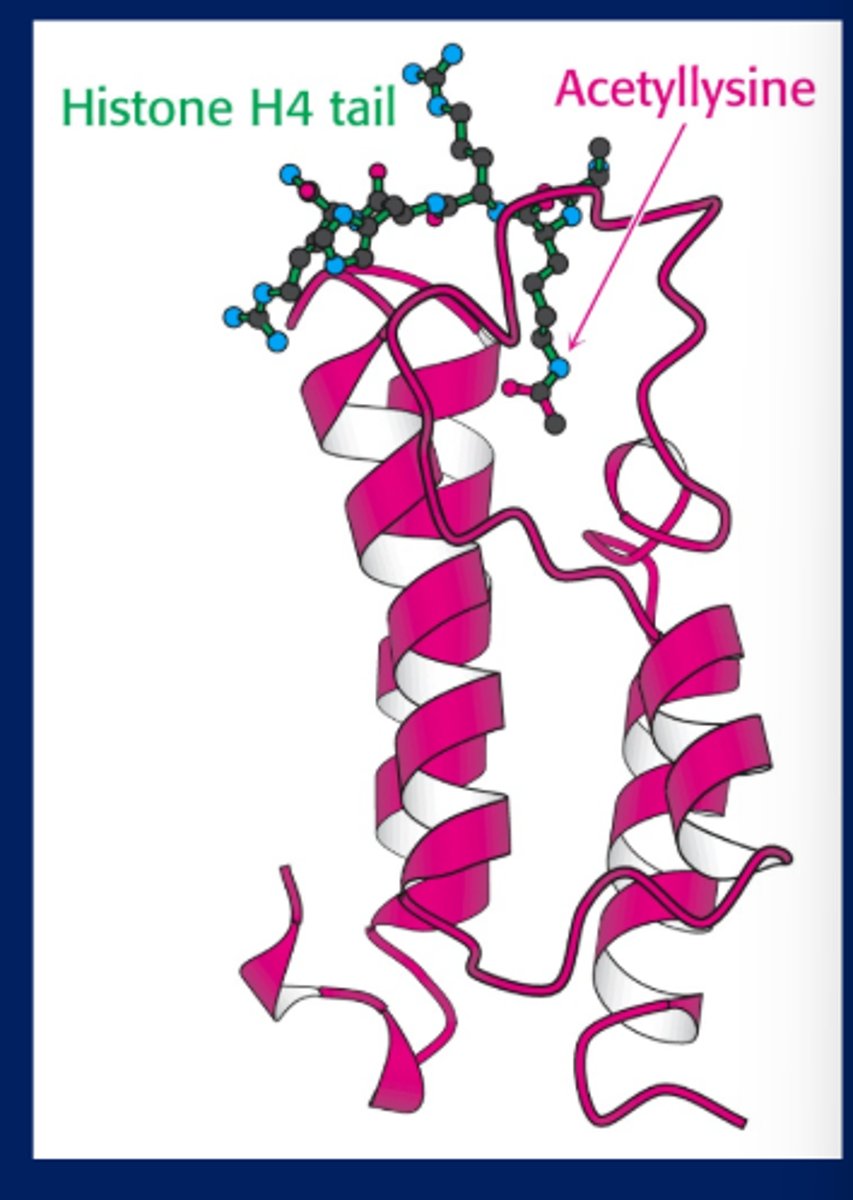
-Bromo-domain of transcription factors binds to acetyl-lysine and leads to transcription
-Acetylation leads to Transcription activation. Transcription activators may contain acetylation activity.
-Deacetylation leads to transcription repression. Transcription repressors may contain deacetylase activity.
-When transcription is over, deacetylation occurs
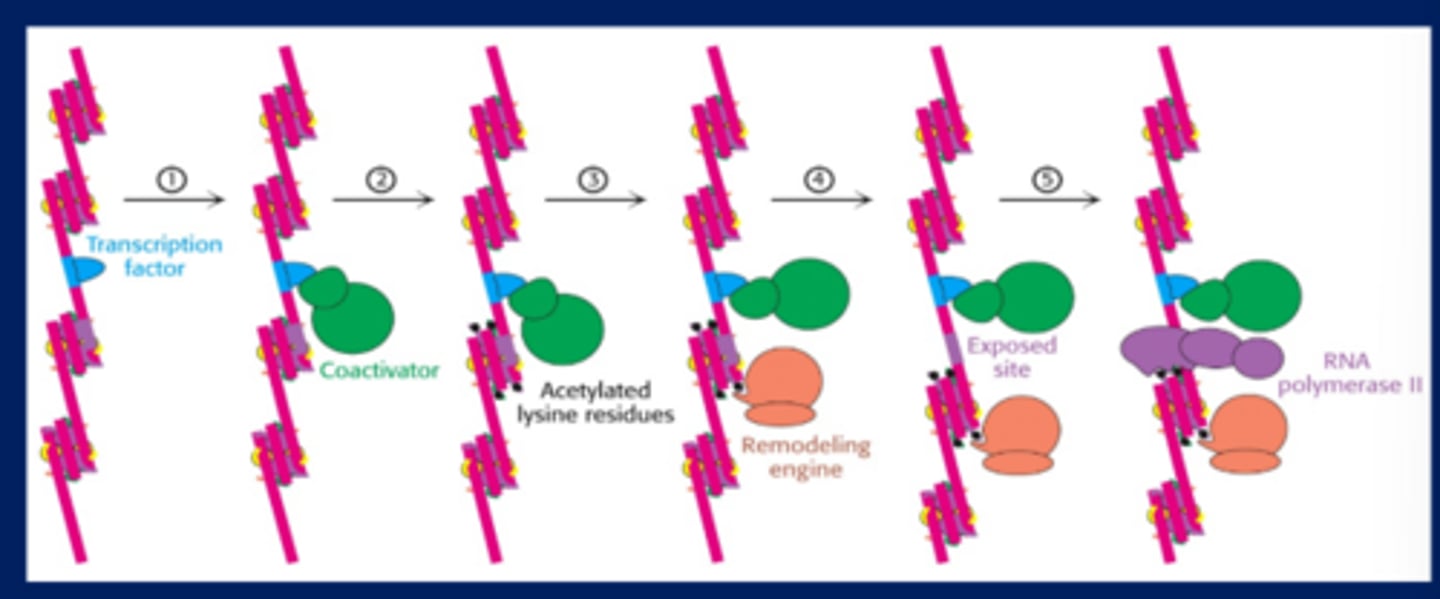
Chromatin Remodeling Preceding Transcription
-What are the steps?
-What group is added or removed from what and by what enzymes? Does this activate or inhibit transcription?
-Acetylation of Histone H3 tail lysine by histone acetyl transferase alter histone binding to DNA
-Histone deacetylases REPRESS transcription
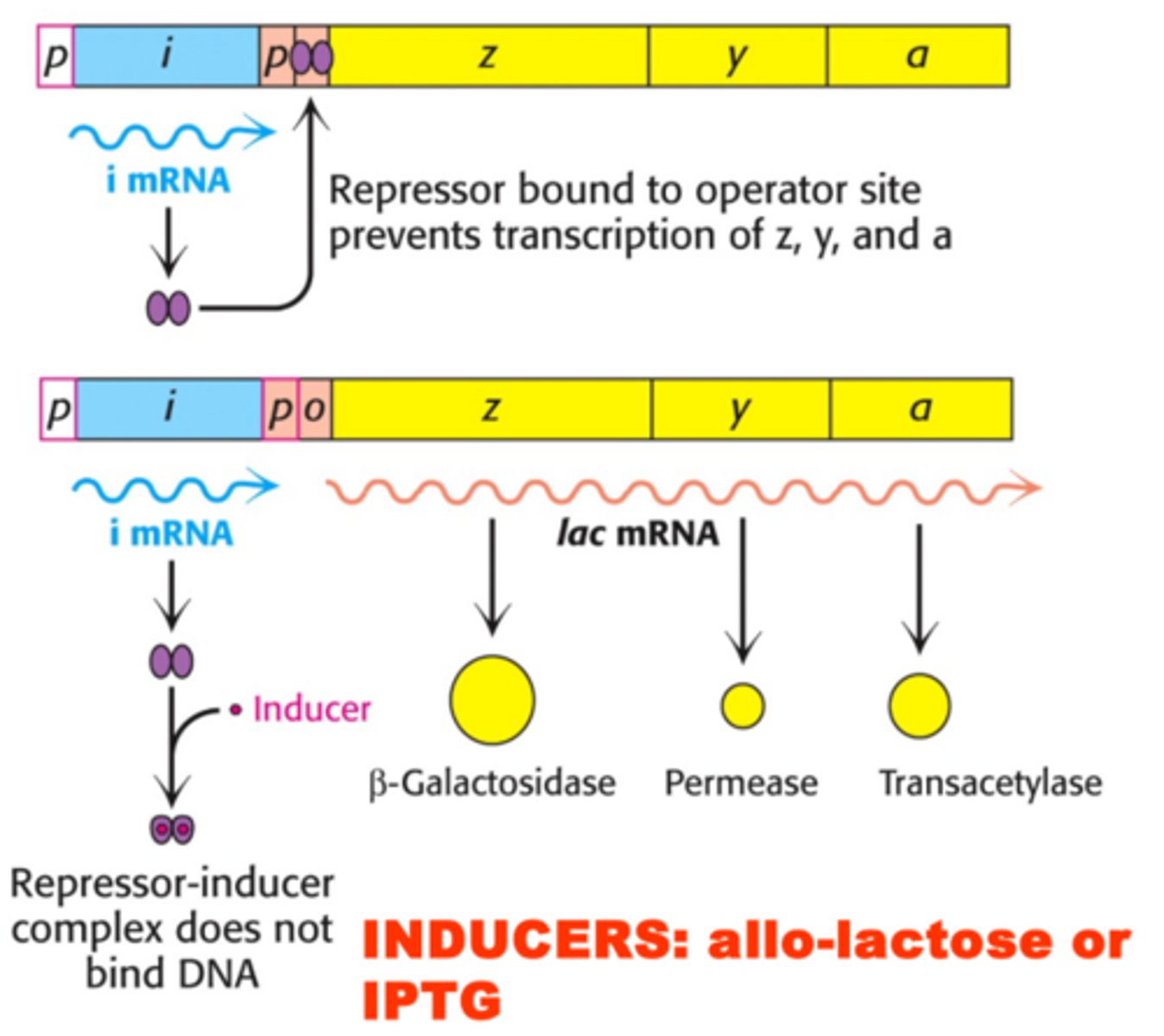
Lac Operon of E. Coli
-What is lactose broken down into? By what enzyme?
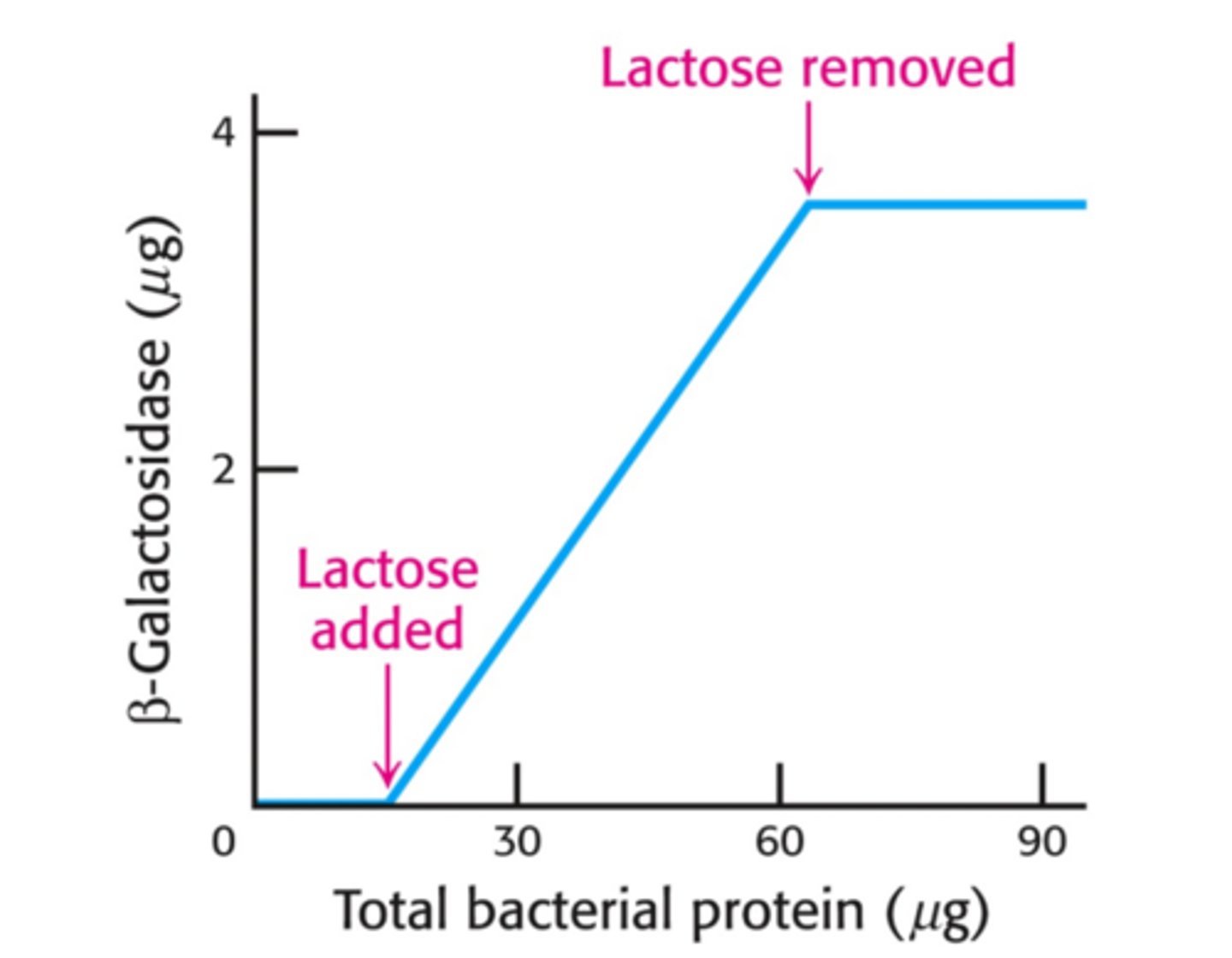
Conversion of lactose to galactose and glucose
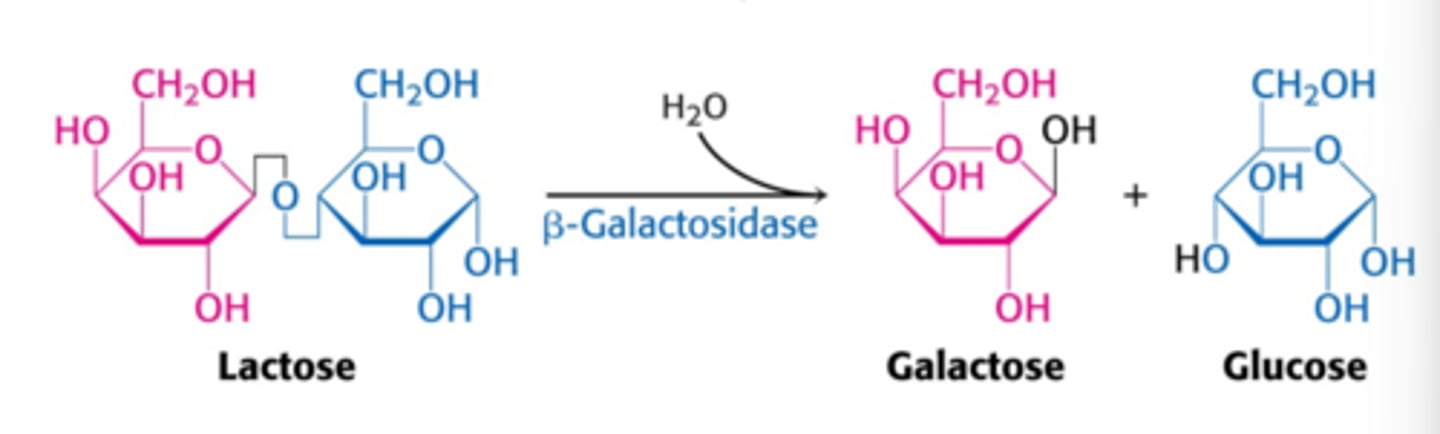
B-Galactosidase
-Does lactose inhibit or activate B-galactosidase?
-Lactose activates B-galactosidase
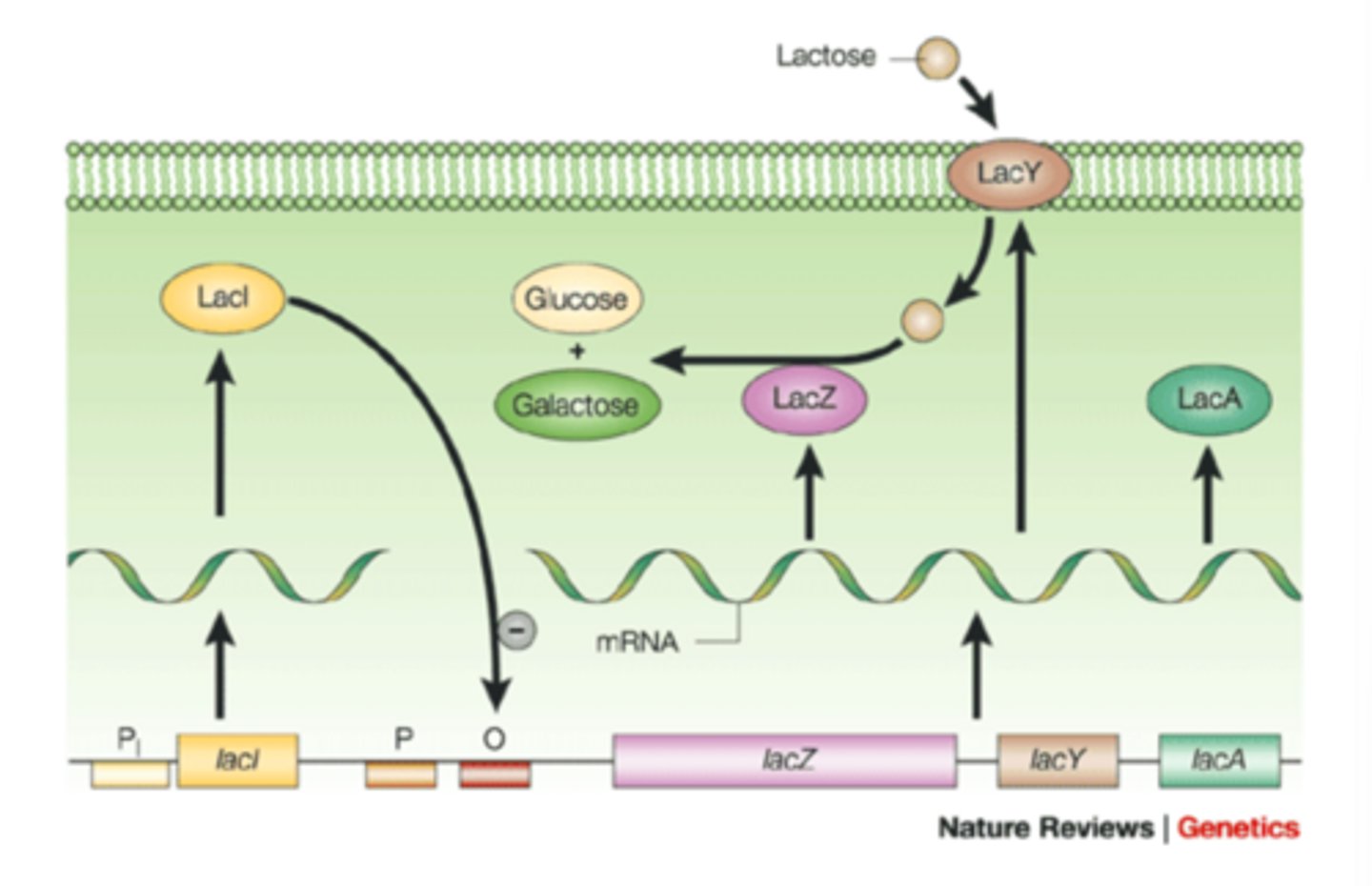
The Lac Operon
-How does it work?
1. Lactose-->lac Y which brings lactose inside the cell
2. Lac Z hydrolyzes lactose-->glucose and galactose
3. Lac operon has lac I, and lac Z, lacY, and lac A (these 3 help with breakdown of lactose)
-lac Z, lacY, lac A, and lac I genes make mRNA that are made into proteins that make lac z, y, a, and I respectively
-When lactose is present the genes are turned on
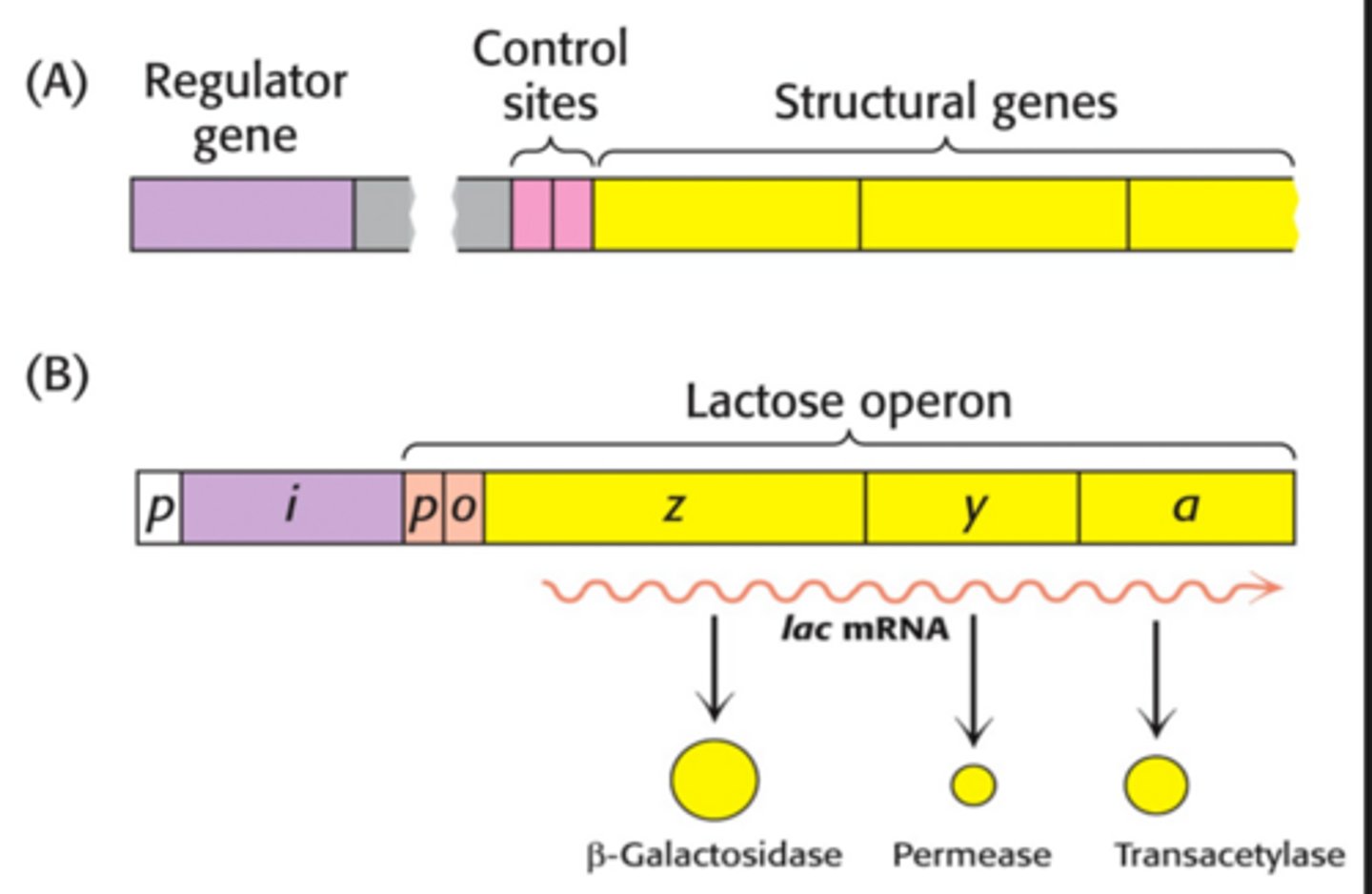
Organization of the Lac Operon
-What 3 genes are in the lac operon? What products do they make?
-What are the 2 control sites? What is the regulator gene?
-Which genes make lac mRNA?
-p and o are promoter and operator
-Lacz-->b galactosidase, lac y-->permease, lac a-->transacetylase
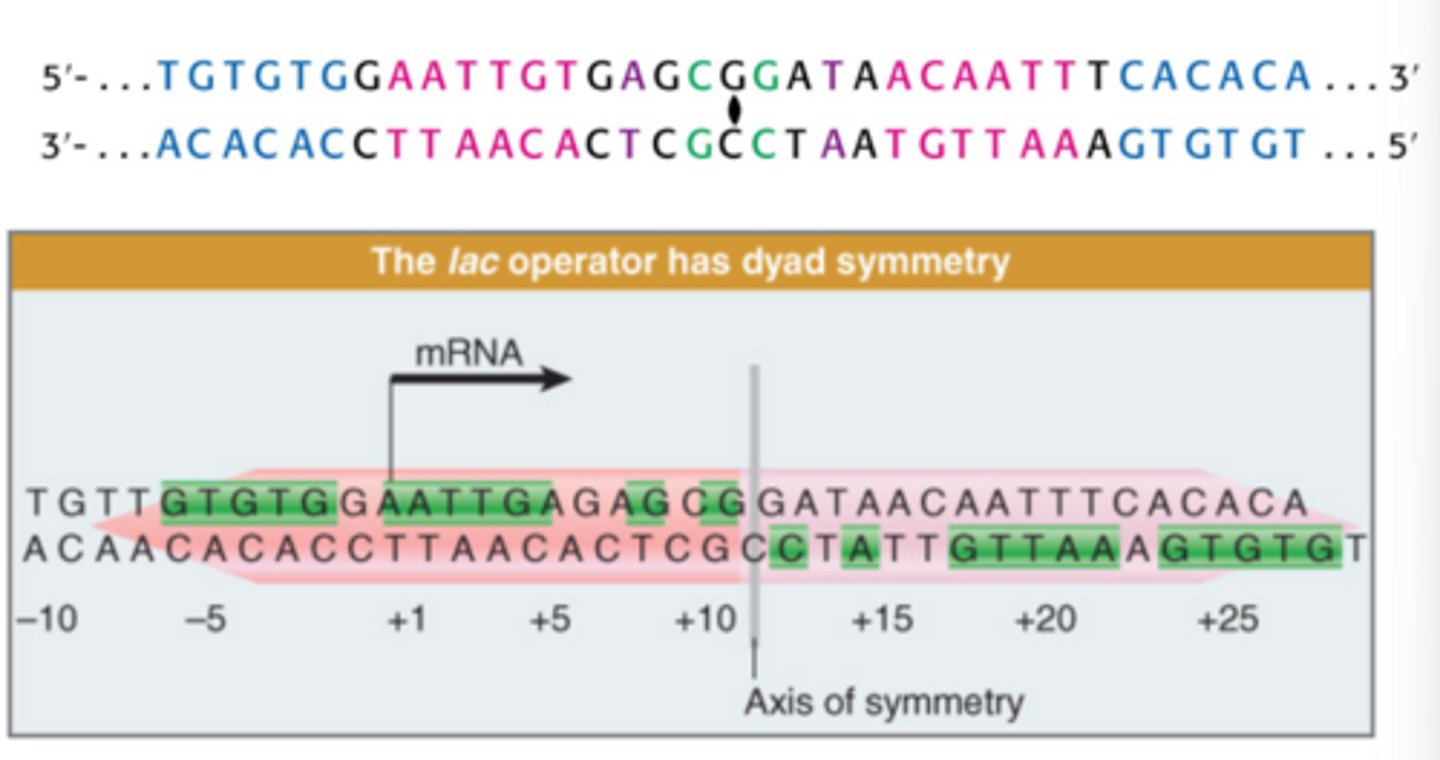
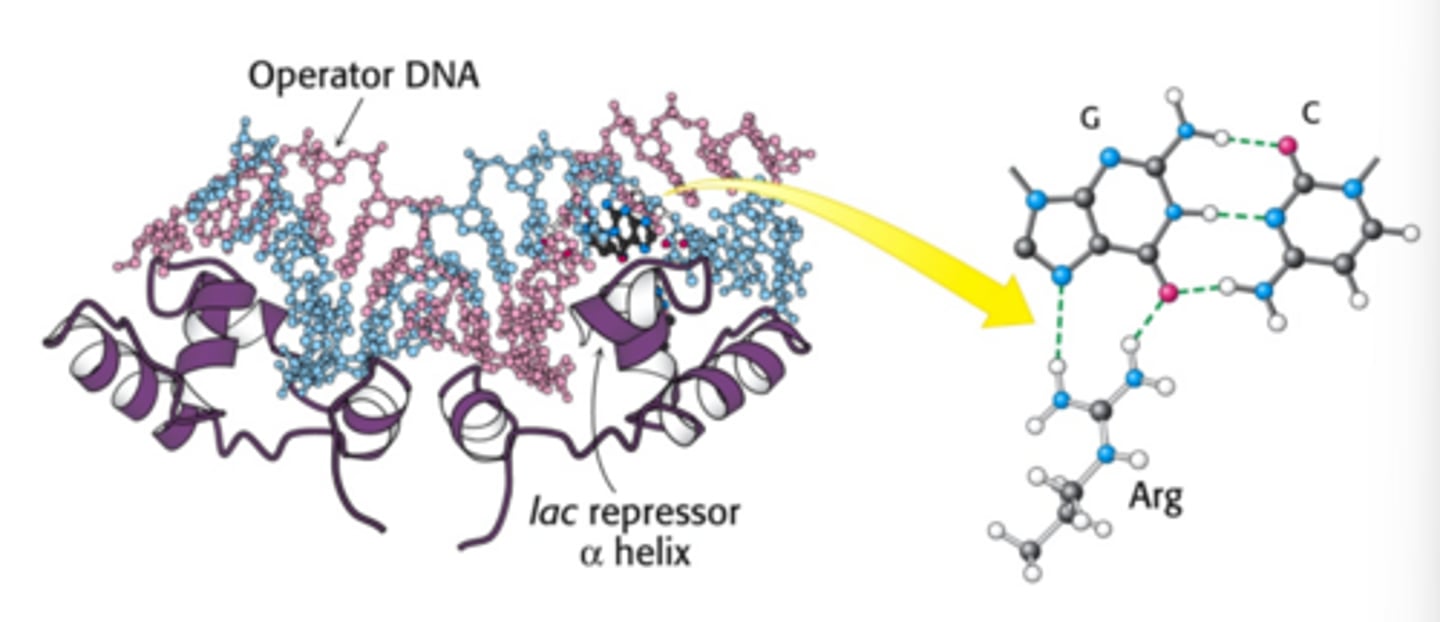
The Lac Operator
-What is the sequence?
-Wha type of symmetry does it have?
-What binds to it?
-Has hexameric sequences where lac I repressor binds
The Lac Repressor
-What is its structure?
-Is dimeric and binds to the lac operator
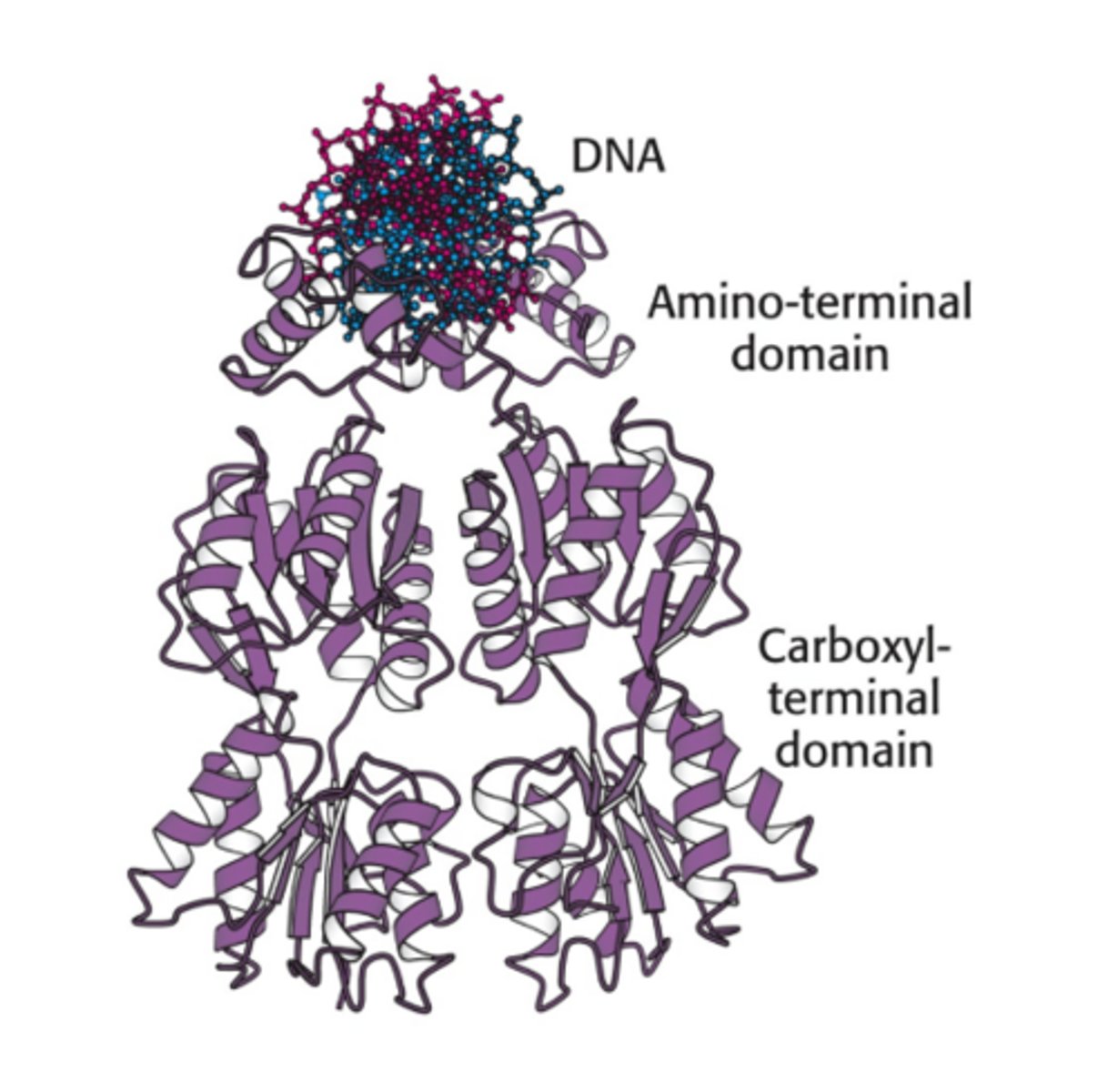
Lac Repressor
-What is its structure?
-What oligomeric state is it? (monomer, dimer, trimer, etc)
-Is it symmetrical or assymetrical?
-When lac I binds to lac operator it blocks the transcription by RNA polymerase
-Promoter is located upstream, then the operator in the middle, then the gene, so when lac I is bound, the RNA polymerase is blocked from transcribing the gene
IPTG Modulation
-What does IPTG do to the lac operon?
IPTG induces gene expression at lac operon
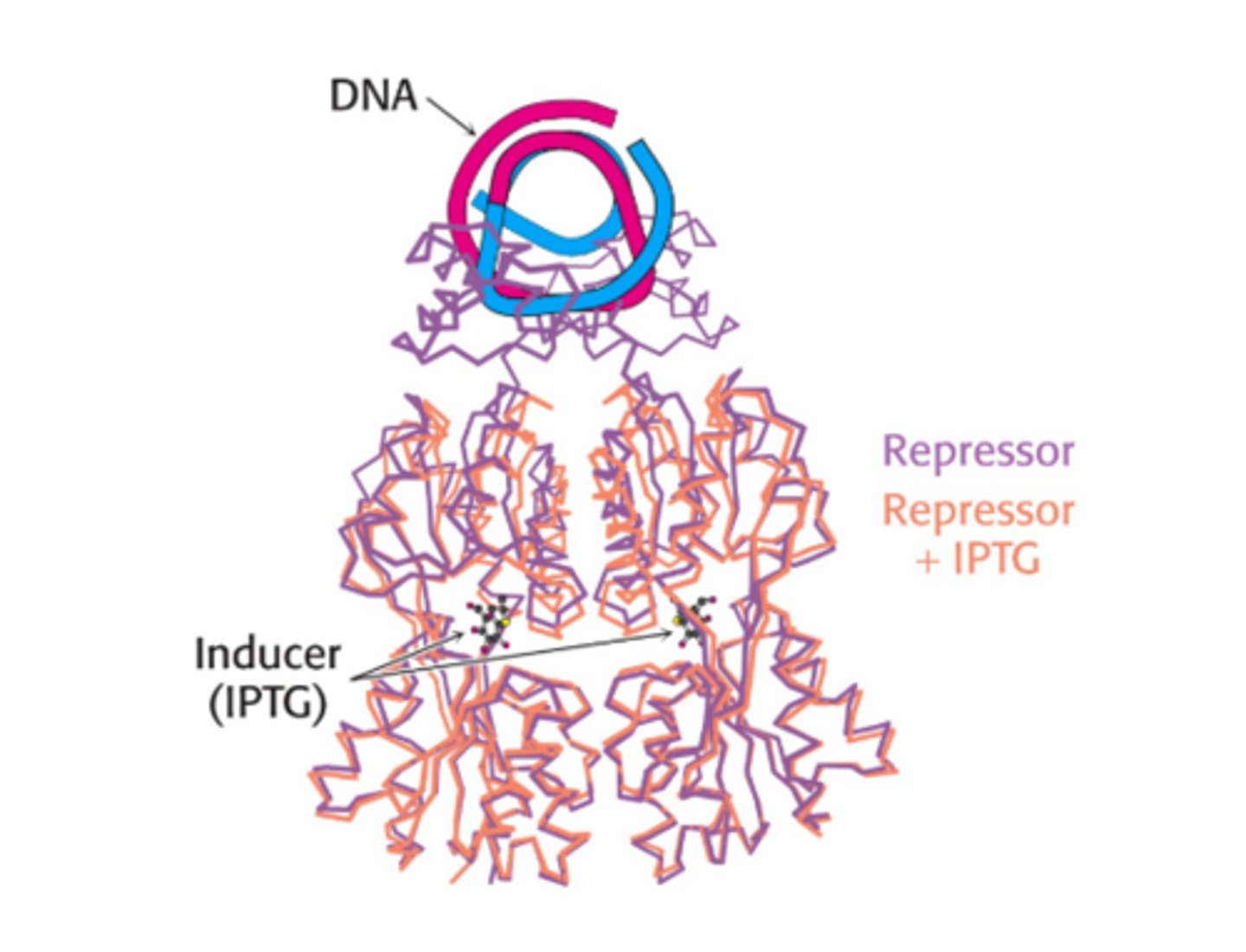
What happens when inducers and repressors bind to the lac operon?
-What are the 2 inducers of the lac operon? What do they do?
-Inducers-allo-lactose or IPTG
-Lactose binds to the lac I repressor which causes lac I to release from the DNA so transcription can occur
-IPTG acts in the same way lactose does but is more powerful