C. Human Resource Development & Management: Career, Training, and Employee Relations
 Call Kai
 Learn
Learn Practice Test
 Spaced Repetition
 Match
Match Flashcards
 Knowt Play
1/166

There's no tags or description
Looks like no tags are added yet.
Name | Mastery | Learn | Test | Matching | Spaced | Call with Kai |
|---|
No analytics yet
Send a link to your students to track their progress
167 Terms
What are the two main types of career development?
Formal and Informal
What does formal career development include?
Short-term training, education, certifications, workshops
What does informal career development include?
Mentorship opportunities, networking events, online courses, internships
What is Human Resource Development (HRD)?
The cultivation of an organization's employees through skills and knowledge enhancement.
What is the goal of Human Resource Development?
To empower employees to become major assets of the company.
What is the role of an HRD Manager?
To develop the organization's human capital and provide training and opportunities for career growth.
What is career planning?
A deliberate process where individuals become aware of their skills, interests, and establish career-related goals.
What are the components of Human Resource Management (HRM)?
Recruitment & Selection, Compensation & Benefits, Performance Appraisals, Employee Relations.
What is the focus of Training & Development in HRD?
Long-term growth and development of employees.
What is lifelong learning in the context of HRD?
Providing employees with continuous learning experiences throughout their tenure.
What is the purpose of performance development?
To enhance employee performance and align it with organizational goals.
What is organizational development?
A systematic approach to improving the effectiveness of an organization through planned change.
What is the significance of training in HRD?
To ensure employees learn necessary job skills and expand their professional capabilities.
What is the relationship between HRD and employee empowerment?
HRD aims to equip employees with skills and knowledge that empower them to contribute effectively to the organization.
What is the outcome of effective career planning?
Identification of career-related goals and establishment of action plans to achieve them.
How does HRD contribute to organizational success?
By developing employee skills that align with the organization's future needs.
What are the benefits of mentorship in informal career development?
Guidance, support, and networking opportunities for career advancement.
What is the importance of performance appraisals in HRM?
To assess employee performance and provide feedback for improvement.
What is the primary purpose of literacy training?
To increase the competency of employees who are less educated.
What is training in the context of employee development?
A process of acquiring skills, rules, concepts, or attitudes that result in improved performance.
What is orientation in employee training?
The process of providing new employees with basic information to help them function effectively.
What is another term for career management?
Onboarding.
What are the objectives of employee orientations?
To help employees feel welcomed, understand the organization, know work expectations, and begin the socialization process.
What does career development involve?
Setting long-term goals, exploring professional development opportunities, and gaining new work experience.
What is apprenticeship training?
A method of training that combines practical training on the job with theoretical classroom instruction.
What is the ADDIE model in training?
A five-step training process that stands for Analysis, Design, Develop, Implement, and Evaluate.
What is job instruction training?
Step-by-step training on the use of machines or specific job tasks.
What is informal learning?
Unstructured and self-directed learning that occurs naturally and spontaneously.
What is the purpose of needs analysis in training?
To determine the training needs of an organization.
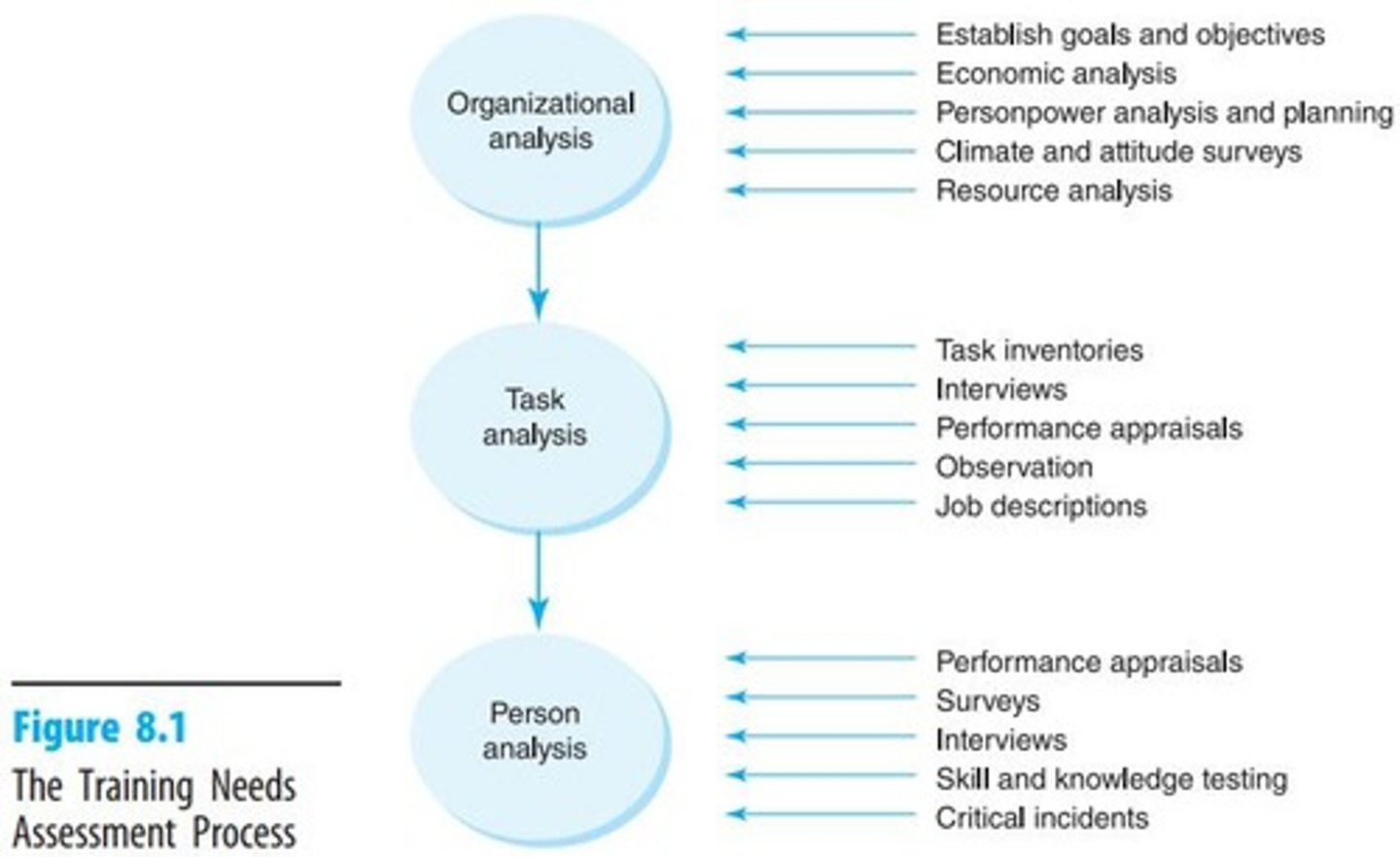
What is the role of performance appraisal scores in training needs analysis?
To ensure employees have the necessary knowledge and skills for their jobs.
What is the purpose of task analysis?
To identify the specific skills required for a job and how those skills are learned.
What is the vestibule training method?
Training technical staff near the production plant using simulated tools and machinery.
What is on-the-job training?
A hands-on, practical way of learning the skills required to do a job.
What is the significance of organizational analysis in training?
To determine factors that will facilitate or inhibit training effectiveness.
What are common methods for identifying training needs?
Surveys, interviews, performance appraisals, and task inventories.
What is the purpose of exit interviews in offboarding?
To manage employee exits respectfully and constructively.
What is the difference between skill tests and knowledge tests?
Skill tests measure job-related skills, while knowledge tests measure understanding of job-related topics.
What is the goal of employee training?
To teach new employees the basic skills they need to perform their jobs effectively.
What does job rotation involve?
Moving employees between different tasks to promote skill development.
What is the purpose of critical incidents in training needs analysis?
To identify areas of poor performance that indicate a need for additional training.
What is the significance of employee readiness for training?
To ensure that employees are willing and able to engage in the training process.
What are the advantages of on-the-job training?
It is inexpensive, hands-on, and provides immediate feedback.
What does the implementation step in the ADDIE model involve?
Carrying out the training program as designed.
What is the evaluation step in the ADDIE model?
Assessing the effectiveness of the training course after implementation.
What is the importance of aligning training with organizational goals?
To ensure that training programs contribute to the overall strategic objectives of the organization.
What is the purpose of employee training?
To provide knowledge and skills needed for the job.
What does succession planning aim to achieve?
To prepare future leaders by identifying and developing talent.
What is the Employee Value Proposition (EVP)?
It communicates what makes the organization attractive to employees.
What is the 9-Box Grid used for?
To map talent based on performance and potential.
What are the key components of talent management?
Attracting, selecting, and retaining employees.
What is the focus of management development?
To improve managerial performance by imparting knowledge and skills.
What is the goal of job rotation in management development?
To broaden experience and identify strengths and weaknesses.
What is the purpose of performance management?
To monitor and improve employee performance.
What does continuous feedback in performance development entail?
Real-time, constructive, and two-way communication encouraging learning.
What are SMART goals?
Goals that are Specific, Measurable, Achievable, Relevant, and Time-bound.
What is the role of HR in organizational development?
To act as an internal consultant and facilitate interventions.
What is the focus of organizational development?
To improve overall effectiveness and health of an organization.
What does the action research model include?
Diagnosis, Planning, Action, Evaluation, and Feedback loop.
What is the difference between HRD and OD?
HRD focuses on training and development, while OD focuses on planned organizational change.
What is the significance of talent acquisition?
To recruit and select the best-fit candidates for the organization.
What is the goal of employee retention and engagement?
To keep top talent motivated and loyal to the organization.
What is the purpose of performance check-ins?
To provide frequent feedback and support for employee development.
What is the main focus of career planning?
To plan for long-term growth and movement within the organization.
What is the aim of high-potential programs?
To accelerate the development of promising employees.
What does the term 'organizational effectiveness' refer to?
The ability of an organization to achieve its goals efficiently.
What is the function of performance appraisals?
To evaluate employee performance and provide feedback.
What is the significance of employee value proposition in talent management?
It helps in attracting and retaining the right talent.
What is the purpose of coaching and mentoring in management development?
To help employees solve problems and reflect on their performance.
What is the role of behavior modeling in training?
To model effective behaviors and encourage transfer of training to the job.
What is the goal of action learning in management training?
To allow trainees to analyze and solve problems in real-time.
What is the importance of aligning talent strategies with organizational goals?
To ensure that talent management supports the overall mission of the organization.
What is the main focus of HRD (Human Resource Development)?
HRD is highly future-oriented and involves finding out training needs of individuals.
What is the difference between training and development in HRM?
Training addresses present needs, while development focuses on future needs.
What is the primary goal of HRM (Human Resource Management)?
HRM is highly present-oriented and refers to the policies in processing human relations.
What are key aspects of maintaining union/labor relations?
Important for enhancing peace and productivity, involving maintenance, equilibrium, stability, and compliance.
What is job analysis?
The process of describing a position, including job duties, compensation, and working environment.
What is the Peter Principle?
The idea that organizations promote good employees until they reach their highest level of incompetence.
What are the activities involved in the staffing function of HRM?
Hiring, training, evaluating, and compensating employees.
What is workforce planning?
The process of deciding which positions are to be filled and how to fill them.
What is succession planning?
The process of identifying and developing internal talent to fill critical roles.
What does trend analysis in HRM provide?
An initial rough estimate of future staffing needs by analyzing employment trends.
What is a Personnel Replacement Chart used for?
To identify and prepare potential candidates for key positions within an organization.
What is Markov Analysis in HRM?
A method used to forecast the availability of internal job candidates.
What is the goal of workforce planning?
To identify and eliminate gaps between employer's workforce needs and current employees.
What are performance standards in job analysis?
Job's performance standards in terms of quantity or quality levels for each job duty.
What is the purpose of the supply of internal candidates?
To determine which existing employees are qualified or trainable for projected job openings.
What is the significance of job context in job analysis?
Describes physical working conditions, work schedule, and incentives related to a job.
What are the human requirements in a job analysis?
Knowledge or skills and required personal attributes for the job.
What is the role of HR staff in union/labor relations?
To facilitate a healthy relationship between the administration and union labor.
What does the term 'compensation and benefits' refer to?
The area of wages and salary administration where wages and compensations are fixed.
What is organizational development in HRM?
Generating healthy interpersonal and inter-group relationships within the organization.
What is the first step before recruiting and hiring employees?
Workforce planning.
What is the significance of continuous research in HRM?
To improve the exchange of information through effective communication systems.
What is the purpose of forecasting in workforce planning?
To understand future positions that need to be filled and identify promotable current employees.
What is a Workforce Strategic Plan?
A plan that prioritizes key workforce gaps and identifies specific strategies for filling them.
What are the two main types of recruitment?
Internal Recruitment (promoting from within) and External Recruitment (hiring from outside).
Why is internal recruitment beneficial?
It enhances employee morale and motivation by giving current employees an advantage in obtaining new positions.
What are some media used for recruitment advertisements?
Newspaper ads, electronic media (television and radio), and situation-wanted ads.
What is the difference between short-term and long-term demand in workforce planning?
Short-term demand involves daily, weekly, and seasonal forecasts, while long-term demand is estimated based on broader trends.
What are campus recruiters?
Recruiters who focus on hiring students and recent graduates from educational institutions.