HUMB C12
 Call Kai
 Learn
Learn Practice Test
 Spaced Repetition
 Match
Match Flashcards
 Knowt Play
1/45

There's no tags or description
Looks like no tags are added yet.
Name | Mastery | Learn | Test | Matching | Spaced | Call with Kai |
|---|
No analytics yet
Send a link to your students to track their progress
46 Terms
Nucleic acids
In all cells and viruses
Organic macromolecules (C,H,O,N,P)
Made of polynucleotides (chain of repeating nucleotide monomers)
Sequence of nitrogenous bases carries information
Two major classes: Deoxyribonucleic Acid (DNA), Ribonucleic Acid (RNA)
nucleotide
each contain:
A pentose sugar – deoxyribose, ribose
A phosphate group
A nitrogenous base – adenine, guanine, cytosine, thymine, uracil
Nucleoside
pentose sugar + nitrogenous base
Deoxyribonucleic Acid (DNA)
Mainly in nucleus, but also in mitochondria
codes protein synthesis
carries information for hereditary characteristics
1.5% of DNA encodes the 20,000 – 25, 000 genes in human genome
98.5% of DNA is non-coding (regulatory sequences, introns, repeat elements)
DNA structure
Double helix model - two antiparallel polynucleotide chains with an alternating deoxyribose-phosphate backbone
Complementary nitrogenous bases held together by weak hydrogen bonds form rungs of the ladder, adenine pairs with thymine and guanine pairs with cytosine
Organisation of DNA
DNA wrapped around proteins called histones to form chromatin
Chromatin twists and condenses to form chromosomes, each with hundreds to thousands of genes
Quantity of DNA
Each somatic (not sperm or egg) human cell nucleus has two copies of each chromosome (diploid) – one inherited from mother, other from father (homologous pair)
Each somatic cell has 46 chromosomes (23 pairs), 22 pairs are autosomal and 1 pair of sex chromosomes (women = XX, men = XY)
gametes (sperm or eggs) only have 1 chromosome of each homologous pair, so 23 haploid chromosomes
karyotype
image that arranges chromosones next to their pair during metaphase
Ribonucleic acid (RNA)
Single stranded polymer wuth an alternating ribose-phosphate backbone
Self complementary sequences forms folds, bulges, and helices
Supports DNA during protein synthesis
Found in nucleus and cytoplasm
Nitrogenous bases: adenine pairs with uracil, guanine pairs with cytosine
Types: mRNA, tRNA, rRNA
Different types have different sizes, shapes and functions
mRNA
m = messenger
transcription: carries information from DNA to ribosomes
tRNA
t = transfer
translation: brings amino acids to ribosomes
rRNA
r = ribosomal
integral part of ribosomes for protein synthesis
Genes and alleles
segment of DNA that codes for a protein
homologus chromosomes have genes in same locations but the allele (alternative form of a gene) can be different
Dominant and recessive alleles
Dominant alleles express themself even if only one copy is present, capital
Recessive alleles can only express themself if both copies are present, lowercase
eg is A = blue, Aa = blue
Genotype and Phenotype
Genotype – the actual gene (AA, Aa, aa)
Phenotype - person’s appearance (blue eyes, brown hair)
Sex-linked traits
affected by genes on sex chromosomes
if on X chromosome they appear in males and females
if on Y chromosome they only appear in males
Proteins
Organic macromolecule containing mainly C, H, O, and N
Long chain of amino acids linked by peptide bonds
Dipeptide (2 aa), oligopeptide (3-10 aa), polypeptide (10+ aa), protein (50+ aa)
Each amino acid has an amine group, acarboxyl group, a hydrogen atom, and a distinguishing side chain
Humans have 20 amino acids - 9 essential, 5 non-essential, 6 conditional (not essential but needed during illness/stress)
Protein Functions
function depends on protein’s ability to bond with other molecules
enzymes regulate metabolic processes, hormones regulate physiological processes
hemoglobin transports gases in blood, plasma proteins transport many substances in blood, protein channels in cell membrane control movement of substances in and out of cells
antibodies protect against foreign substances
allow muscle contraction
collagen fibres for structural frameworks, keratin strengthens skin, hair, and nails
can be broken down for energy
form cilia to move substances across cell surface and flagella to move sperm
Recommended intake of proteins
10-35% of total calories
Protein structure
Primary - Sequence of amino acids linked by peptide bonds
Secondary - folding into alpha helices or beta pleated sheets
Tertiary - 3D shape formed by alpha helices and beta pleated sheets folding
Quaternary - combined 3D structure of 2 or more polypeptide chains
Protein Types
Fibrous: elongated polypeptide chains arranged in parallel along one axis, insoluble, chemically stable, structural (support and strength), less sensitive to changes in temperature, pH
Globular: polypeptide chain compactly folded into rounded shape, water soluble, chemically active, functional (aid biological processes), sensitive to changes in temperature, pH
proteome
Proteome of a cell is all the proteins that a cell makes
Different cells make different proteins for exportation or cell functions
Cell’s DNA contains instructions for protein synthesis
Genetic code
specific arrangement of nucleotides in DNA and RNA that determine a protein’s amino acid sequence
Gene expression
production of proteins from the information stored in DNA
2 steps: transcription and translation
Central dogma
directional flow of information from DNA to RNA to Protein
Transcription
one polynucleotide chain named ‘coding strand’ and the other ‘template strand’
Initated by transcription factors that recruit RNA polymerase
Starts at promoter region, ends at terminator sequence
DNA uncoils and unzips, RNA polymerase attaches to template strand and copies genetic information to form mRNA with complimentary base pairing, mRNA exits nucleus through nuclear pores
Codons & amino acids
codon: sequence of 3 nitrogenous bases on mRNA, read by a ribosome
64 possible codons, but only 20 amino acids
an amino acid is specified by 1-6 codons
degenerate code - some codons have the same meaning
AUG is start codon
UAG, UAA, UGA are stop codons
tRNA
contains three nitrogeous bases (anticodon) and an amino acid specified by the correlating codon on the mRNA
Translation
mRNA goes to ribosomes
Ribosome reads one codon (3 nitrogenous bases) at a time
A tRNA with the amino acid specified by the codon and with a matching anticodon binds to codon
Amino acids linked by peptide bonds
empty tRNA detatches from ribosome and returns to cytoplasm to be reloaded with a new amino acids
Post-translational modification
After translation
Other functional groups can be attached, aa can be cleaved off the end, polypeptide can be cut in half, protein can be activated
Changes or extends protein’s function
Locus
location of a gene on a chromosome
Cell Types
Somatic - form body of multicellular organism, most cells, 46 chromosomes (diploid number), mitosis
Germ - give rise to gametes, located in gonads (ovaries + testes), meiosis
Gamete - fuse during sexual reproduction, sperm or egg, 23 chromosomes (haploid number)
Centromere
pernament DNA region that joins two sister chromatids after replication and site of spindle fibres
Centrioles & Spindle Fibers
2 centrioles located in centrosome
Before cell division, centrioles divide, move to ends of cell, and organize spindle fibers
Cell Life Cycle
Interphase: phase between cell division, divided into G1 phase, S phase, and G2 phase
Mitosis: 1 mother cell divides into 2 genetically identical somatic daughter cells, divided into prophase, metaphase, anaphase, and telophase
Cytokinesis
Interphase
DNA is unwound chromatin
G1 phase - routine metabolism
S phase - DNA replicated, each chromosome becomes two sister chromatids joined at a centromere
G2 phase - mitosis preparation, organelles replicated
Mitosis
Prophase: chromatin condenses making chromsomes visible, centrioles migrate to ends of each cell, spindle fibres attach to centromeres, nuclear envelope disintegrates
Metaphase: chromosomes align at the nuclear equator
Anaphase: spindle fibres separate the chromatids (each chromatid now referred to as a chromosome), 2 identical sets of chromosomes are moved to separate ends of the cell, cytokinesis begins
Telophase: nuclear envelope reforms around each set of chromosomes, chromosomes decondense into chromatin, cytokinesis continues
Cytokinesis
mother cell’s cytoplasm divides into 2 genetically identical somatic daughter cells
Mitosis examples
Areas of high abrasion (oral cavity, female reproductive tract)
Skin - Constant mitosis in basal layer, cells grow up superficially to replace top layer of cells
brain, heart, skeletal muscle has slow mitosis
Meiosis
Less common - Specialized for sexual reproduction
1 round of DNA replication followed by 2 cell divisions
In the gonads (testes/ovaries), 1 germ cell divides to produce 4 genetically different, haploid (23 chromosomes) gametes (sperm/egg)
Gametes unite, forming a zygote (new, genetically unique human being)
Meiosis 1 - Prophase 1
DNA replication already occured - nucleus has 46 chromosomes (23 pairs) each with two sister chromatids joined by a centromere
Prophase 1 - homologous crossing over: homologous chromosomes synapse (pair up - 1 paternal and 1 maternal chromosome) to form a tetrad (4 chromatids), non-sister chromatids of the homologous pair exchange matching segments of DNA so that sister chromatids are no longer identical, allowing new gene combinations from
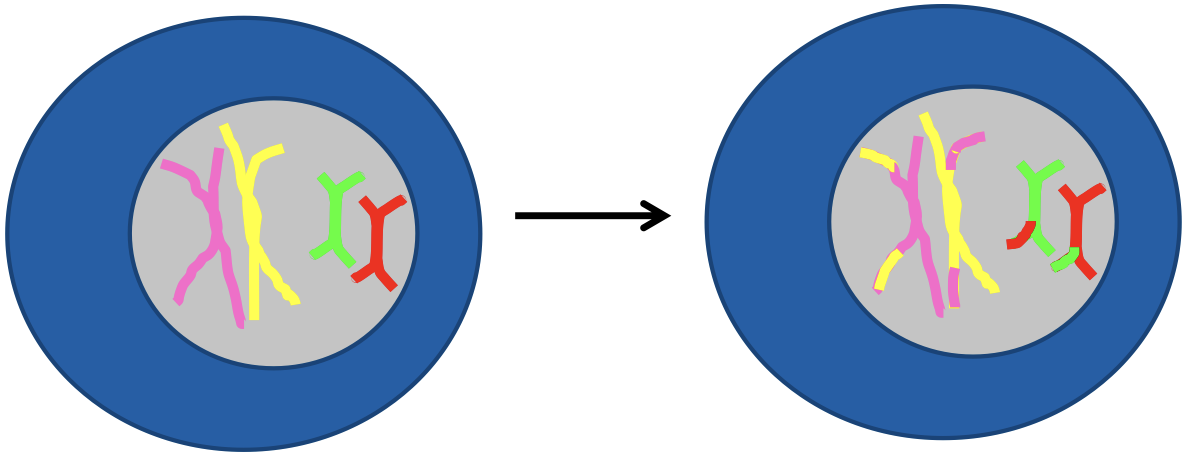
Meiosis 1 - Metaphase 1
Homologus chromosome pairs line up at cell’s centre with random maternal/paternal orientation (increasing possible gene combinations)
Meiosis 1 - Anaphase 1
Whole chromosomes (with 2 sister chromatids still joined by centromere) move to opposite sides of cell
Meiosis 1 - Telophase 1
2 new non-identical cells form, each with 23 chromosomes with replicated DNA (each chromosome made of 2 sister chromatids joined at a centromere)
Meiosis 2
There is no DNA replication
Both cells from meiosis 1 undergo Prophase, Metaphase, Anaphase, and Telophase the same as mitosis
Results in 4 genetically unique haploid cells, each with 23 chromosomes made of a single chromatid
Spermatogenesis vs Oogenesis
Oogensis:
1 functional oocyte and 3 nonfunctional polar bodies per meiotic cycle
At birth, ovaries contain all the oocytes they will ever have, they are stalled in prophase 1
Menstrual cycyle selects one primarty oocyte to complete meiosis 1 each month
Spermatogenesis:
4 functional sperm cells per meiotic cycle
lifelong process