Biology Module 4 Flashcards
 Call Kai
 Learn
Learn Practice Test
 Spaced Repetition
 Match
Match Flashcards
 Knowt Play
1/52

There's no tags or description
Looks like no tags are added yet.
Name | Mastery | Learn | Test | Matching | Spaced | Call with Kai |
|---|
No analytics yet
Send a link to your students to track their progress
53 Terms
Only one ___ allele is needed to express the phenotype.
Dominant
Two ___ alleles are needed to express the phenotype.
Recessive
Inheritance in which the phenotype of the heterozygous genotype is a mix of both traits.
Incomplete Dominance
The expression of both alleles in a genotype heterozygous for two alleles.
Codominance
Complexes of proteins in the cell membrane where a cell makes contact with another cell or the extracellular matrix.
Cell Junctions
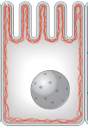
-Cytoskeleton Element
-Made up of Actin
-Resist Tension
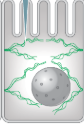
-Cytoskeleton Element
-Made up of Protein Subunits
-Holds Organelles in Place
Intermediate Filaments
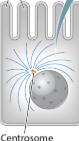
-Cytoskeleton Element
-Made up of alpha/beta tubulin dimers
-Maintains Cell Shape, Grows and Shrinks in Cell
Microtubules
Polymerization (Growth) and Depolymerization (Shrinkage) in microtubules is referred to as ___ instability.
Dynamic
Microtubules have a minus (-) end at the ___ and a plus (+) end away from it.
Centrosome
-Motor Protein
-Carries Cargo Towards Plus End of Microtubules
Kinesin
-Motor Protein
-Carries Cargo Towards Minus End of Microtubules
Dynein
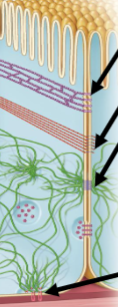
-Cell Junction
-Connects to Actin Filaments
-Stops Outside Substances From Passing Layers
Tight
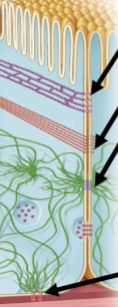
-Cell Junction
-Connects to Actin Microfilaments
-Sticks Cells Together
Adherens
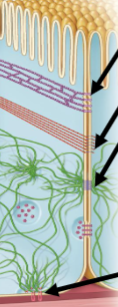
-Cell Junction
-Connects to Intermediate Filaments
-Sticks Cells Together
Desmosomes
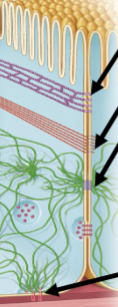
-Cell Junction
-Connects to Actin
-Allows for transferring of molecules from one cell to the next
Plasmodesmata
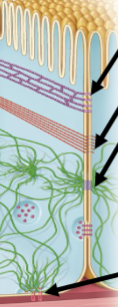
-Cell Junction
-Anchors Cells to the Basal Lamina
Hemidesmosomes
The four ___ types of animals are:
-Epithelial
-Connective
-Muscle
and
-Nerve
*Are Made Up of Cells
Tissue
-Bone
-Cartlidge
-Blood
-Tissue Type
-Provides Structural Support to Body
Connective Tissue
-Layered Tissue
-Protects Body
-Skin
Epithelial
-Located in Epidermis
-Cell Type
-Produces Protein that helps protect Skin
Keratinocytes
-Located in Epidermis
-Cell Type
-Produces Protein that provides skin color
Melanocytes
-Located in Dermis
-Cell Type
-Produces Protein that helps protect Skin and repairs wounds
Fibroblasts
-Tissue Type
-Skeletal
-Muscle
-Smooth
-Allows for Facilitated Movement of Body
Muscle Tissue
-Tissue Type
-Allows for Body Communication
Nerve Tissue
Name of the process that involves all the chemical reactions in a cell.
Metabolism
Chemical reaction that involves breaking substances down.
Catabolism
Chemical reaction that involves building up substances.
Anabolism
Breaking a bond will ___ energy.
Require
Forming a bond will ___ energy.
Release
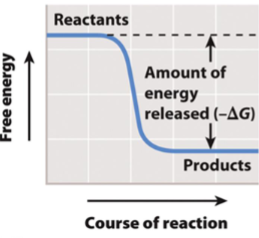
The ____ in energy (Delta G) is equal to Final State-Initial State.
Change
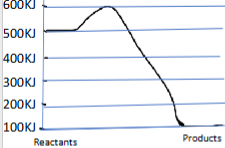
What is the Change in energy here?
-400 KJ
Energy cannot be created or destroyed describes the ___ law of thermodynamics.
First
All things go towards chaos or a simpler state over time describes the ___ law of thermodynamics. (Entropy)
Second
-Delta G is Negative
-A reaction releases Energy
These traits describe an ___ reaction.
Exergonic
-Delta G is Positive
-A reaction consumes Energy
These traits describe an ___ reaction.
Endergonic
*First Step of Cellular Respiration
Inputs: 1 Glucose, 2 NAD+, 2 ADP, 2 Inorganic Phosphate
Outputs: 2 Pyruvate, 2 ATP, 2 NADH
Glycolysis
Where does Glycolysis occur?
Cytoplasm
*Second Step of Cellular Respiration
Inputs: 2 Pyruvate, 2 Coenzyme A, 2 NAD+
Outputs: 2 Acetyl-CoA, 2 CO2, 2 NADH
Pyruvate Oxidation
Where does Pyruvate Oxidation occur?
Where does the Citric Acid Cycle occur?
Mitochondrial Matrix
*Third Step of Cellular Respiration
Inputs: 2 Acetyl-CoA, 6 NAD+, 2 FAD, 2 ADP, 2 Inorganic Phosphate
Outputs: 4 CO2, 6 NADH, 2 FADH2, 2 ATP
Citric Acid Cycle
*Final Step of Cellular Respiration
Inputs: All the NADH and FADH2
Outputs: Lots of ATP (28-32)
Electron Transport Chain
Where does the electron transport chain occur?
Inner Mitochondrial Membrane
What is the final electron acceptor?
Oxygen
Cellular Respiration that takes place in the absence of Oxygen is referred to as ____ respiration.
(Fermentation)
Anerobic
Signaling molecule is referred to as a ___.
Ligand
-Protein
-Binds to Ligand
Receptor

-Signaling Type
-Lond Distance
-Ligand Travels Through The Blood
Endocrine
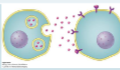
-Signaling Type
-Short Range
Paracrine
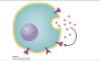
-Signaling Type
-Cell Signals to Itself
Autocrine
-Signaling Type
-Cells Must Touch to Communicate/Signal
Contact Dependent
Enzyme that removes phosphate group from a molecule.
(Dephosphorylation)
Phosphatase
Enzyme that adds phosphate group from a molecule.
(Phosphorylation)
Kinase