3.1 Measuring the Level of Economic Activity
 Call Kai
 Learn
Learn Practice Test
 Spaced Repetition
 Match
Match Flashcards
 Knowt Play
1/21

There's no tags or description
Looks like no tags are added yet.
Name | Mastery | Learn | Test | Matching | Spaced | Call with Kai |
|---|
No analytics yet
Send a link to your students to track their progress
22 Terms
Gross domestic product (GDP)
The total value of all final goods and services produced in an economy in a given time period (usually one year)
Gross national income (GNI)
GDP + net property income = GNI
The total monetary value of all income earned by a country's residents and businesses, regardless of whether those earnings are generated domestically or abroad
What’s not included in GDP
GDP is used to calculate the final goods produced
The value of intermediate goods (raw materials) and components are not included
GNI per capita
GNI per head of population
GNI / population = GNI per capita
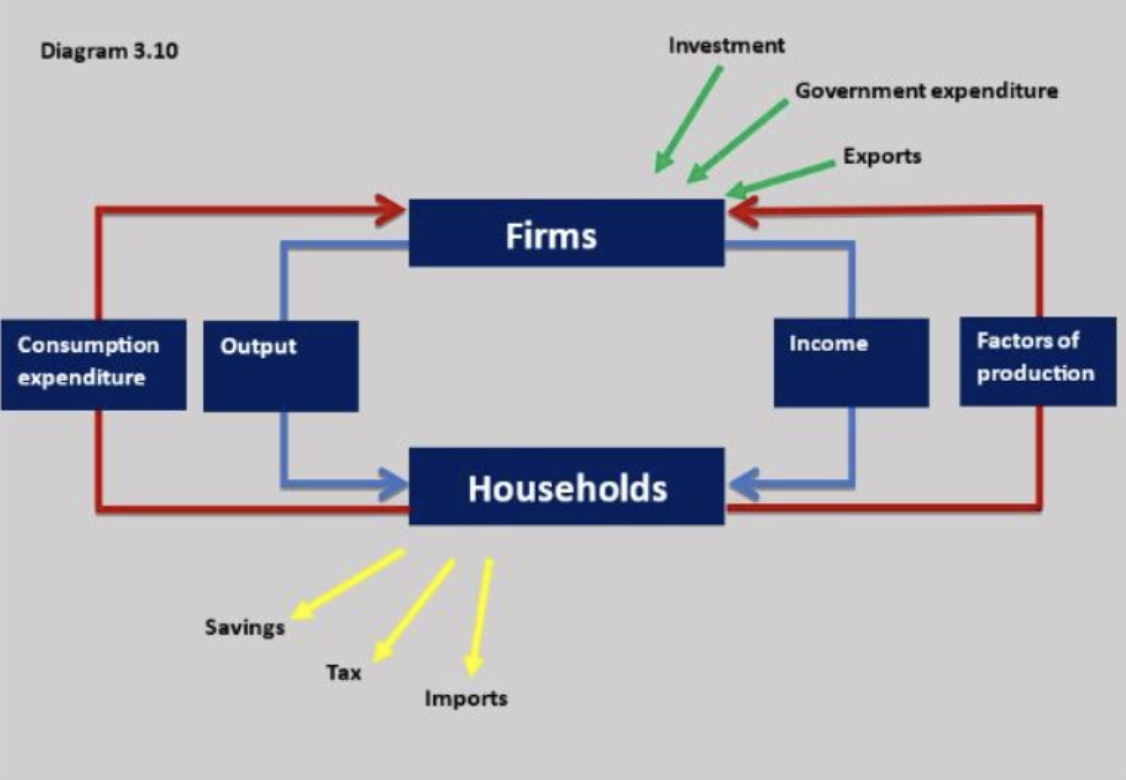
Circular flow of income
Economic model that illustrates the flow of money between firms and households
Income method
Value of income earned by households in one year
Wages paid to labor
Interest paid to capital
Rent paid to land
Profits and dividends paid to entrepreneurs
Output method
Value of firms in different sectors of the economy
Primary: Commodities: Agricultural goods
Secondary: Manufacturing: Cars
Tertiary: Services: Education
Expenditure method
Value of total expenditure of different sectors of the economy
C + I + G (X-M) = Total expenditure
Consumption (C): Spending done by households
Investments (I): Business spending on capital (like machinery)
Government expenditure (G): Spending on public services
Net exports (X-M): Exports - imports
Real GDP
GDP adjusted for inflation
(Nominal GDP/ GDP deflator) x 100
Inflation
General increase in prices over time
Nominal GDP
GDP measured in current market prices
Economic growth
Increase in a country’s real GDP over time
(Current year GDP - Previous year GDP)/ Previous year GDP x 100
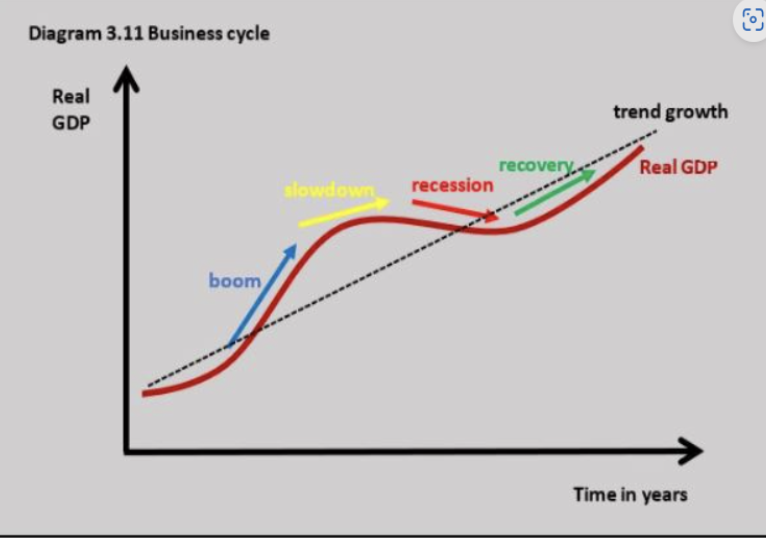
Business cycle
The way the economic growth rate rises and falls over time
Boom: Above trend rates of e.g.: Rise in income, inflation, fall in unemployment
Slowdown: Growth rate falls: Fall in rise of income, unemployment potentially start to rise, less pressure to raise inflation
Recession: Real GDP falls (period of two consecutive quarters of negative real GDP growth), household income falls, unemployment increases, inflation falls
Recovery: Real GDP starts to increase, household income rise, unemployment falls, rise in inflation
Economic development
Improvement of the well-being of a country’s citizens over time
Increase in household income
Decrease in poverty
Increase in provision of public services
Measuring e.g.: Human development index (HDI)
United Nations uses this to measure the country’s e.g.
Life expectancy
Education
Real GDP per capita
Given a numerical value from 0-1, the closer to 1, the more developed a country is
Measuring e.g.: Real GNI per capita
Higher the real GNI per capita of a country, the more developed it is
Higher average incomes
Lower levels of poverty
Better healthcare and education provision: Gov has more tax revenue to spend on public services
Purchase power parity (PPP)
Long term exchange rate calculated by considering the ratio of prices in one country compared to another
Basket of goods in Country A/ Basket of goods in Country B = PPP exchange rate
Measuring e.g.: Real GNI per capita CONS
Income distribution: GNI per capita is an average and does not account for the disparity between the richest and poorest people in society
Nature of produced goods: Some goods produced add more welfare than others
Money spent on welfare (education) → produces more welfare than money spent on luxury goods (yachts)
Non-monetary factors:
Crime rates
Political freedom
Leisure time
Climate
Mental health
Gender and racial equality
GDP deflator
Measure of inflation that compares the value of goods and services produced in an economy at current prices versus constant (base-year) prices
Shows the change in GDP rather than the change in actual production
World happiness report
Ranks national happiness via a survey
Resident’s happiness scale from 1 to 10
Citizen engagement/ communications/ technology/ education/ health/ emotion/ diversity
Happy planet index
Measures the sustainable well-being of a nation’s population
Life expectancy/ inequality of outcomes/ econological footprint
OECD Better life index
11 objectively measured criteria in a country to form an index number
Housing/ income/ safety and security/ world-life balance/ employment/ community life/ education/ environmental factors…etc.