Marine Bio Exam 4
 Call Kai
 Learn
Learn Practice Test
 Spaced Repetition
 Match
Match Flashcards
 Knowt Play
1/19

There's no tags or description
Looks like no tags are added yet.
Name | Mastery | Learn | Test | Matching | Spaced | Call with Kai |
|---|
No analytics yet
Send a link to your students to track their progress
20 Terms
Community
A group of interacting populations of different species living in the same place at the same time
Intra - interactions within SAME species
Inter - interactions between DIFFERENT species
Competitive Exclusion Principle
Two species that use a limited resource in the same way cannot co-exist indefinitely
Resource Partitioning: species use the same limited resources in different ways to reduce competition to allow coexistence
Adaptations to Avoid Predation
Armor
Toxins
Crypsis
Mimicry
Predation on Communities Structure
Species can be organized spatially due to predation pressures
Green algae easy to eat → upper intertidal, where herbivores can’t eat as easily
Brown and red algae harder to eat (chemicals) → middle/ lower intertidal, can withstand herbivores
Crustose coralline algae → subtidal, not eaten
Facilitation
One species benefits another species by improving environmental conditions or provide a habitat
Rockweed decreases heat and desiccation when tide low → allow species to hunt in intertidal
Mussels stabilize sediment in Salt marshes
Can aid in restoration efforts!
Clams increase seed germination due to increasing sediment stability and fertilizing with waste
Ecosystem
A community of living organisms interacting with each other and with their physical environment
Succession
Sequential changes in species composition through time often after a disturbance
Pioneer species - 1st organism to colonize a new or disturbed area
Tolerate harsh conditions, usually small and fast-grow
Intermediate species - Organism replaces pioneer species as conditions improve
Benefits from changes made by pioneers
Climax community - final stable community in succession
Most complex and diverse
Relatively stable
Succession in Marine Ecosystems
Scavenger stage: carcass eaten by mobile scavengers (sharks, fish, crabs)
Enriched sediment stage: sediment, rich in nutrients, supports invertebrates
Sulfide stage: sediment becomes anoxic, emits hydrogen sulfide, supports chemoautotrophic bacteria
Reef stage: bones provide hard substrate for epibenthic organisms
Succession in Rocky Intertidal
Disturbance caused by wave action makes an open patch on rock
Bare rock
Bacteria film
Seaweeds
Barnacles
Mussels
Succession can vary based on species present
Intermediate Disturbance Hypothesis
Most biodiversity and can coexist
At low levels: competitive dominants exclude other species
At high levels: only the most resistant survive
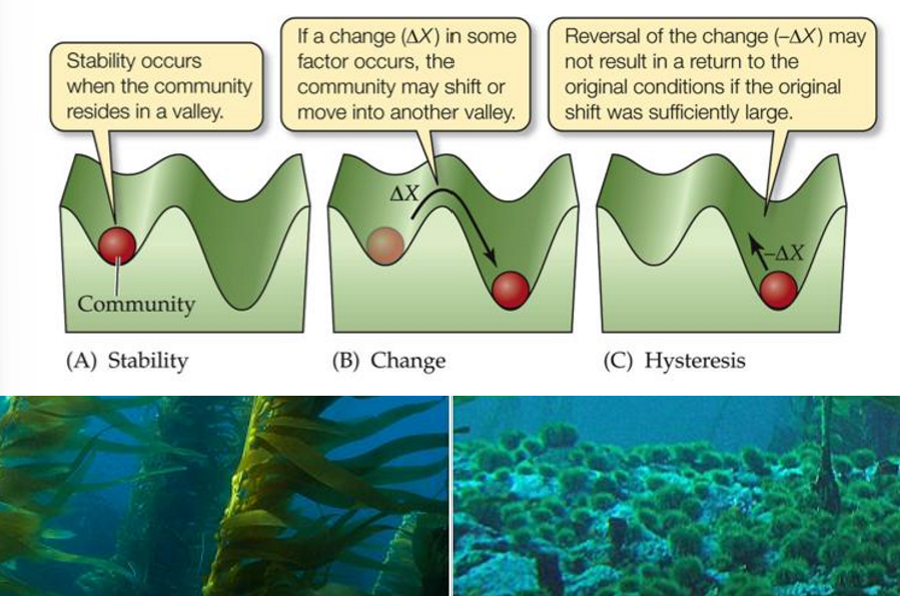
Alternative Stable State
Thresholds of change: borders between alternative stable states
if disturbance pushes past tipping point, ecosystem will switch to another state rapidly
Regime shifts: transition from one alt stable state to another through passing threshold
Hysteresis: path of ecosystem recovery is different of its decline, not easy to return to its original state
ecosystem shifts to barren ground, remove overgrazers will not automatically return
Ecosystem services
Natural processes and resources provided by ecosystems that support human life/ well-being
1) Provisioning: Provides food, water, and other resources
2) Regulating: Maintenance of stable ecosystem process
CO2 sequester
3) Cultural: Fostering creativity, culture, recreation, spiritual
4) Supporting: Basal services that support provision of other services
Coral Reefs provide costal protection, food/ fishing, tourism
Fisheries Terminology
Catch: # or weight of fish caught
Directed catch: intended or “target” catch species
Bycatch: unintentional catch species
Discards: # or weight of fish returned to the sea
Landings: # or weight of fish delivered (bycatch & discards removed)
Types of Fisheries
Finfish Fisheries: “fish” vertebrates with fins
increasing regulation and slowly leading to more sustainable exploitation
Invertebrates Fisheries: invertebrates with no backbone
rapid increase in demand
Longline
Gillnets
Pots and Traps
Purse seine
Pelagic Trawl
Bottom trawl